
New
67% Off

6G Quantum Communication Simulator

Original price was: ₹750.00.₹250.00Current price is: ₹250.00.
In Stock6G Quantum Communication Simulator with Python is a Python-based simulation platform for modeling and analyzing quantum-enabled communication concepts for next-generation 6G networks. It can be used to study quantum communication channels, quantum key distribution, qubits, quantum states, quantum noise, secure communication, transmission performance, and the integration of quantum technologies with future wireless communication systems.
Description
6G Quantum Communication Simulator
The 6G Quantum Communication Simulator with Python is an advanced simulation platform designed to explore the integration of quantum communication technologies with next-generation 6G wireless networks. The project provides a flexible virtual environment for researchers, students, developers, and telecommunications professionals to model quantum communication concepts, analyze quantum channels, study secure communication mechanisms, and investigate potential applications of quantum technologies in future communication networks.
As communication systems evolve toward 6G, security, computational efficiency, intelligent networking, and highly reliable communication are becoming increasingly important research areas. Quantum communication introduces new approaches to secure information exchange by exploiting fundamental properties of quantum systems. A Python-based 6G Quantum Communication Simulator provides an accessible environment for experimenting with these concepts without requiring specialized quantum communication hardware.
The simulator can model fundamental quantum communication elements such as qubits, quantum states, quantum channels, measurement operations, quantum noise, and communication links. Researchers can configure different simulation parameters and observe how quantum states behave during communication. These simulations can provide a foundation for understanding how quantum principles may be incorporated into future communication architectures.
One of the important applications of the project is the simulation of Quantum Key Distribution (QKD). QKD is a technique for establishing cryptographic keys using quantum communication principles. A simulator can represent the transmission and measurement of quantum states between communicating parties and analyze the resulting key generation process. Different channel conditions and noise levels can be introduced to study their effects on communication performance.
The Python Quantum Communication Simulator can also be used to explore well-known QKD concepts such as the BB84 protocol and other quantum communication approaches. Simulation models can represent sender and receiver operations, basis selection, quantum state transmission, measurement, error detection, and key reconciliation. These components can help researchers understand the fundamental workflow of quantum-based secure communication.

Another important area is quantum channel modeling. Quantum communication systems can be affected by noise, loss, decoherence, and other channel characteristics. The simulator can incorporate different channel models to investigate how quantum states are affected during transmission. Performance metrics such as quantum bit error rate, transmission fidelity, key generation rate, and communication reliability can be analyzed under different conditions.
The project can also investigate the relationship between quantum communication and 6G networks. Future communication architectures may involve a combination of conventional wireless networks, optical communication, satellite systems, edge computing, and quantum technologies. A simulation environment can provide a framework for studying how quantum communication components could interact with next-generation network infrastructure.
Python is well suited to this type of research because it provides extensive capabilities for numerical computation, scientific programming, data analysis, visualization, and quantum computing experimentation. Quantum programming and simulation frameworks can be incorporated into the project to implement quantum circuits, quantum states, measurement operations, and communication protocols.
The simulator can also be extended to study quantum-secure communication for 6G networks. As future networks connect billions of devices and support sensitive applications, security will remain an important consideration. Researchers can use the simulation platform to investigate how quantum communication concepts and quantum cryptographic techniques could contribute to secure information exchange.
Another potential research area is quantum communication over wireless and optical links. The simulator can represent different communication scenarios and analyze how channel conditions influence quantum information transmission. This can provide a foundation for exploring hybrid communication architectures that combine classical and quantum communication technologies.

The platform can also be used to study quantum network performance. Researchers can evaluate parameters such as transmission fidelity, quantum bit error rate, communication distance, channel loss, noise, key generation rate, and resource requirements. These measurements can be visualized using Python-based data analysis and plotting tools.
For academic projects, the 6G Quantum Communication Simulator using Python can be useful for research involving quantum communications, quantum computing, wireless networks, cybersecurity, cryptography, 6G technology, information theory, and network simulation. It provides a practical environment for students and researchers to experiment with quantum communication concepts and evaluate their potential applications in future network architectures.
The simulator can further be expanded with advanced features such as quantum repeaters, entanglement distribution, quantum network nodes, satellite-based quantum communication, quantum error correction, hybrid classical-quantum communication, and quantum-safe security mechanisms. These extensions can help create more comprehensive models of future quantum-enabled communication networks.
Visualization is another useful component of the project. The simulator can display quantum states, communication channels, error rates, key generation results, channel characteristics, and performance metrics. Graphical analysis can make complex quantum communication concepts easier to understand and can help researchers compare different protocols and network configurations.
Overall, the 6G Quantum Communication Simulator with Python provides a flexible research platform for exploring the intersection of quantum technologies and next-generation wireless communication. By combining quantum communication, Python programming, quantum key distribution, network simulation, cybersecurity, and 6G concepts, the project can support experimentation with secure and advanced communication architectures for future networks.

Related products
-
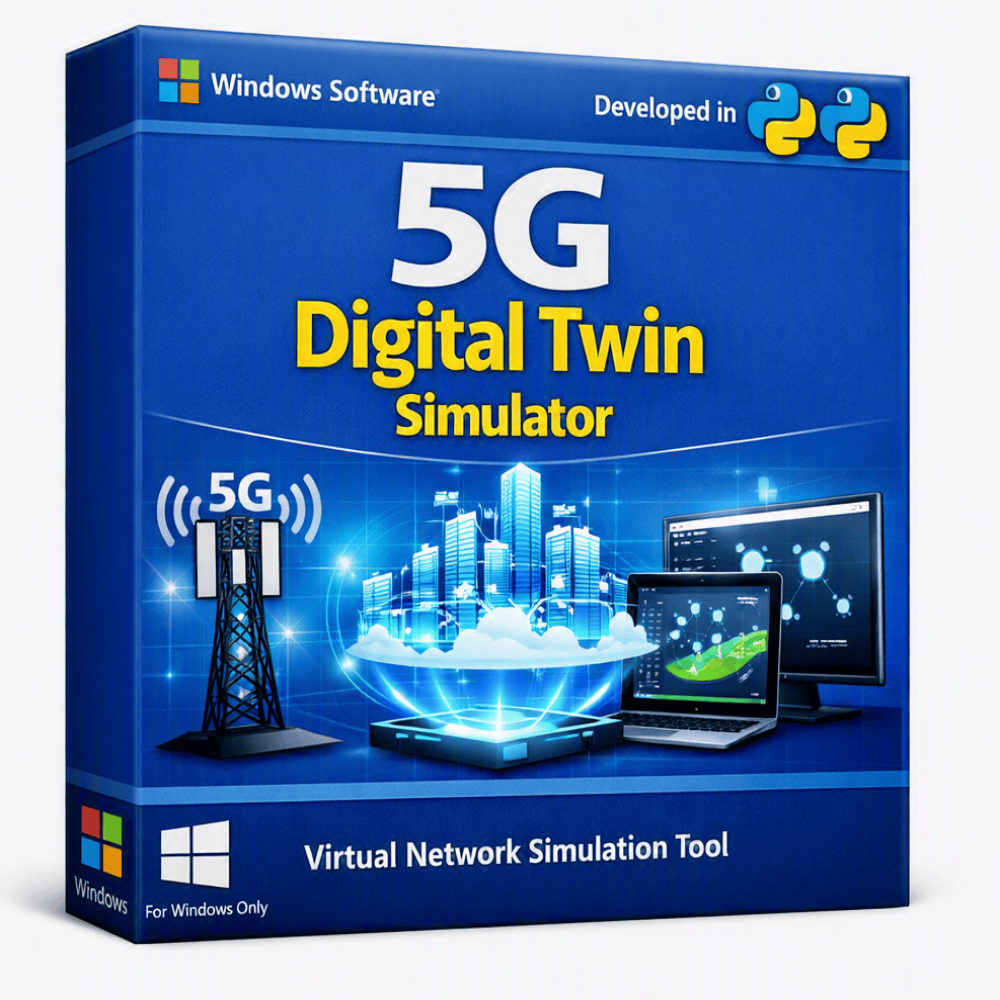
A Python-based 5G Digital Twin solution for creating a virtual representation of 5G network environments, components, and operational behavior. Designed for 5G research, network analysis, simulation, optimization, and academic projects, it enables users to model network scenarios, monitor virtualized network behavior, and experiment with different configurations in a controlled software environment.
Ideal for telecom engineers, researchers, developers, students, and academic institutions working on 5G network planning, performance analysis, intelligent network management, and digital twin research.
Original price was: ₹750.00.₹250.00Current price is: ₹250.00. -
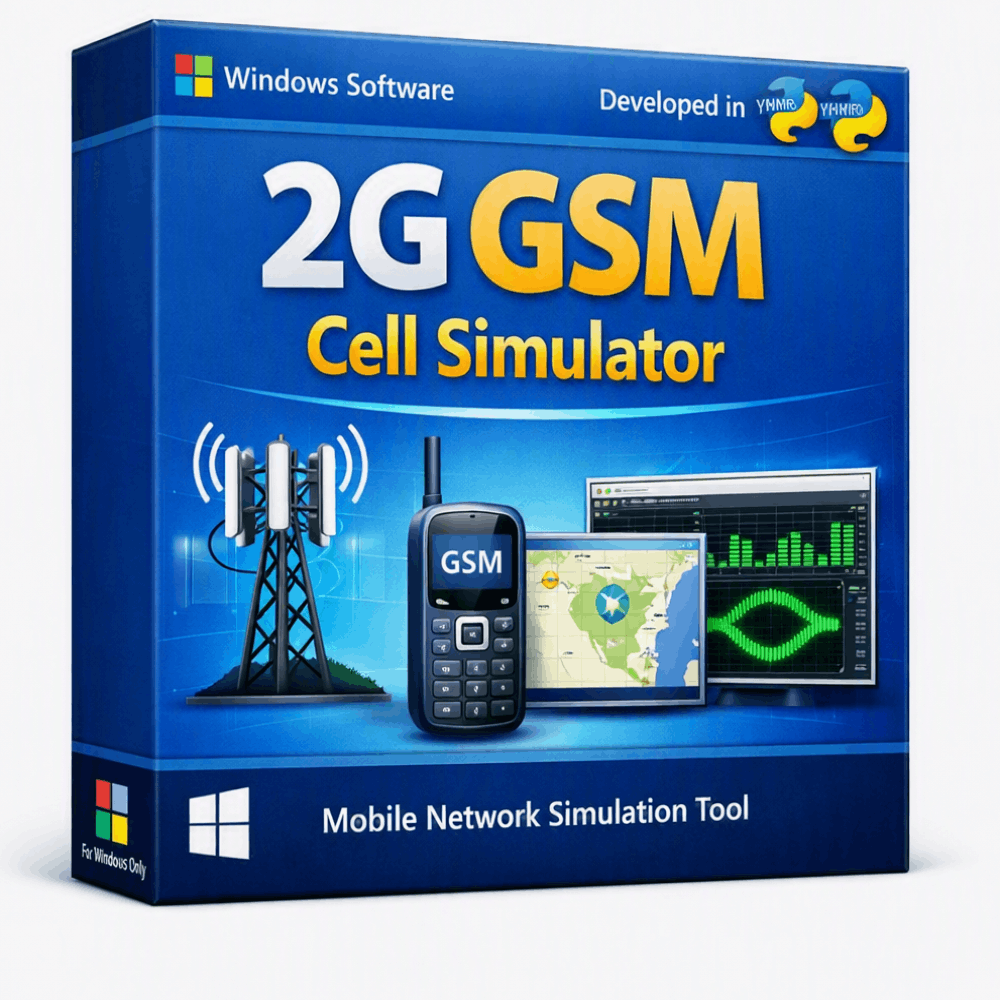
The 2G GSM Cell Simulator is a Python-based software project designed to simulate fundamental GSM cellular-network concepts. It provides a practical environment for understanding mobile stations, GSM cells, base stations, cellular coverage, mobility, communication channels, and basic network behavior. The project includes Python source code that can be studied, customized, and extended for academic projects, demonstrations, research, and learning. It is ideal for Electronics & Communication Engineering, Telecommunications, Computer Science, and related students looking to explore 2G GSM technology and cellular network simulation through a software-based implementation.
Original price was: ₹750.00.₹250.00Current price is: ₹250.00. -
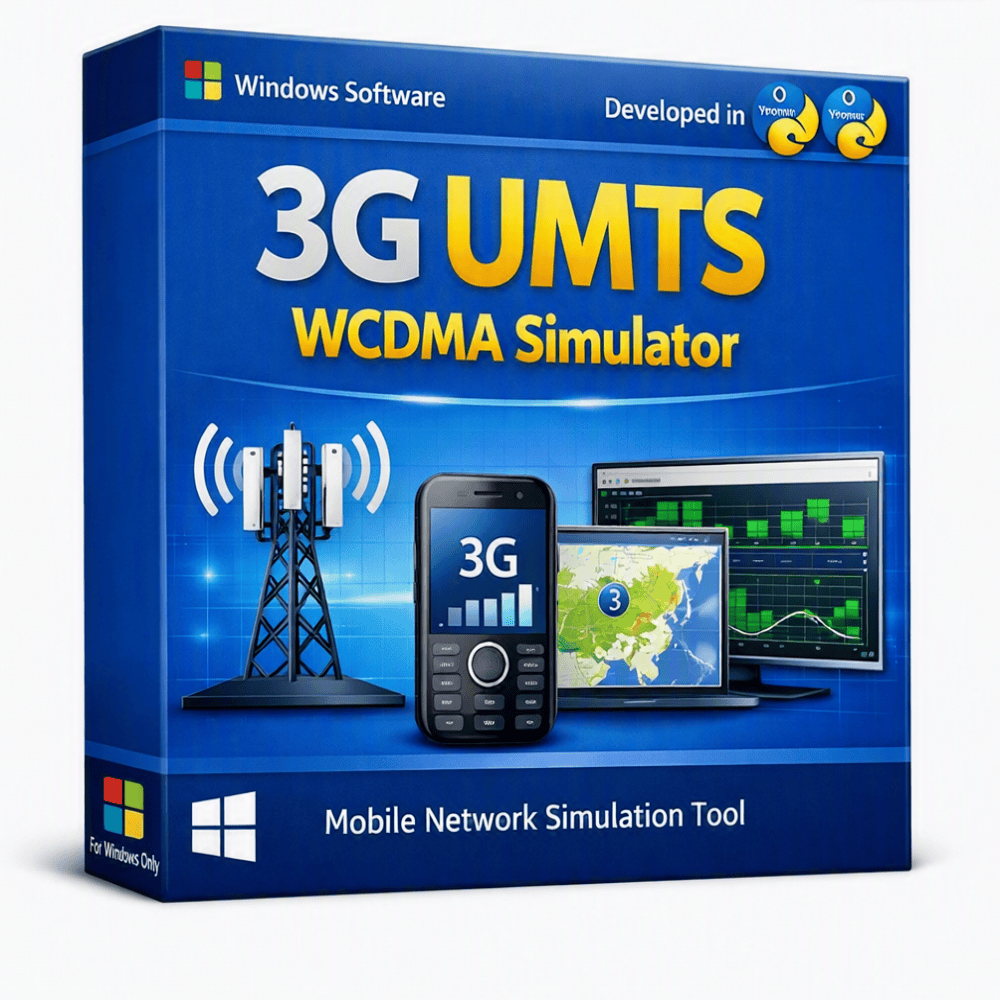
The 3G UMTS – WCDMA Simulator is a software-based simulation project designed to demonstrate the fundamental concepts of 3G Universal Mobile Telecommunications System (UMTS) and Wideband Code Division Multiple Access (WCDMA) technology. It provides a practical environment for studying cellular communication, spreading codes, signal transmission, mobile users, network connectivity, and WCDMA-based communication principles. The simulator is suitable for students, researchers, and developers working on telecommunications and wireless communication projects. It can be used for academic demonstrations, engineering projects, research, experimentation, and learning about 3G mobile communication and WCDMA network technologies.
Original price was: ₹750.00.₹250.00Current price is: ₹250.00. -
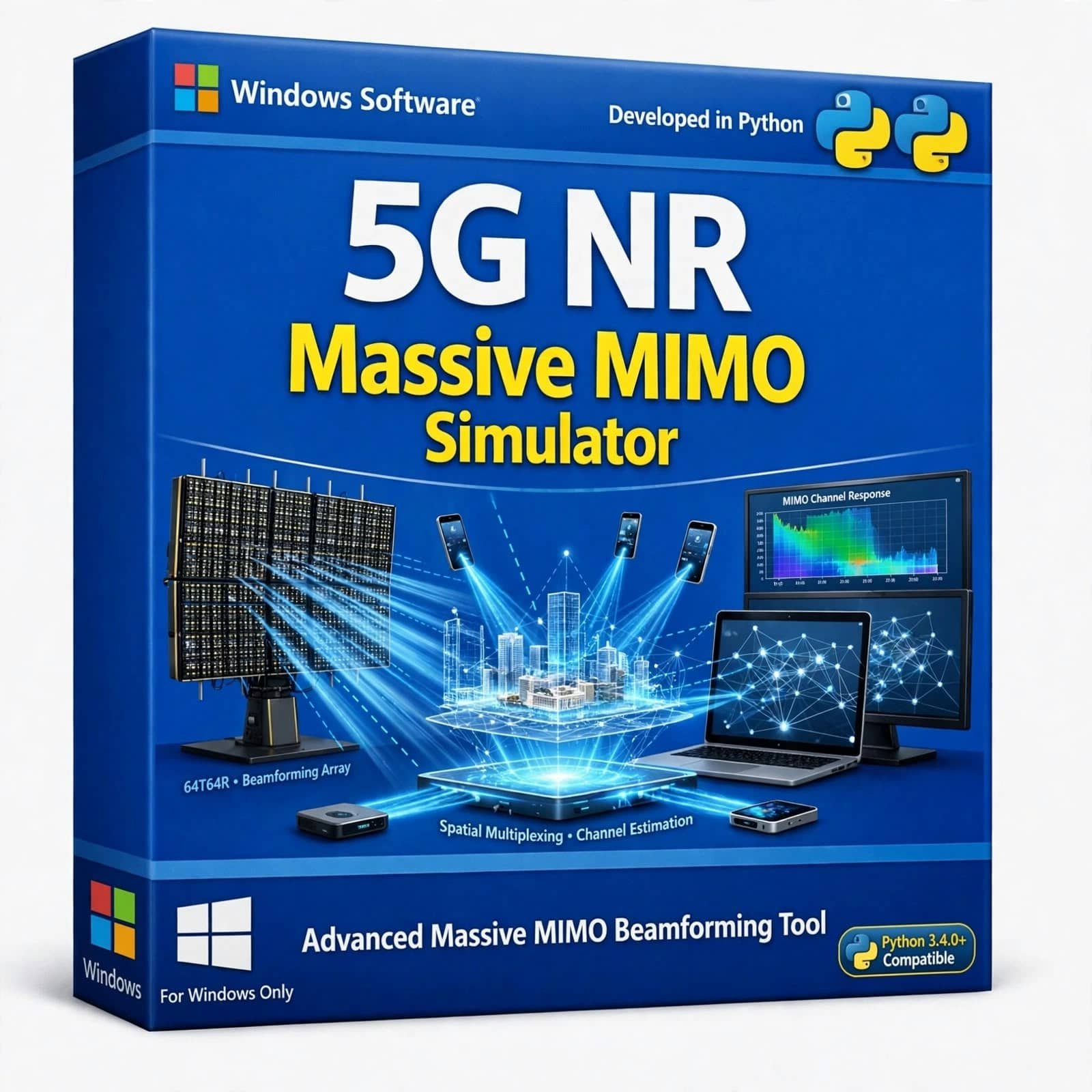
5G NR Massive MIMO Simulator is an advanced simulation solution for modeling and analyzing Massive Multiple-Input Multiple-Output (MIMO) technologies in 5G New Radio networks. It enables users to study large-scale antenna arrays, beamforming, precoding, spatial multiplexing, multi-user MIMO, channel estimation, and interference under configurable channel conditions. The simulator supports analysis of throughput, spectral efficiency, SINR, BER, BLER, MIMO capacity, beamforming gain, and multi-user performance, making it ideal for 5G NR research, algorithm development, academic projects, and 5G/6G wireless system optimization.
Original price was: ₹750.00.₹250.00Current price is: ₹250.00. -
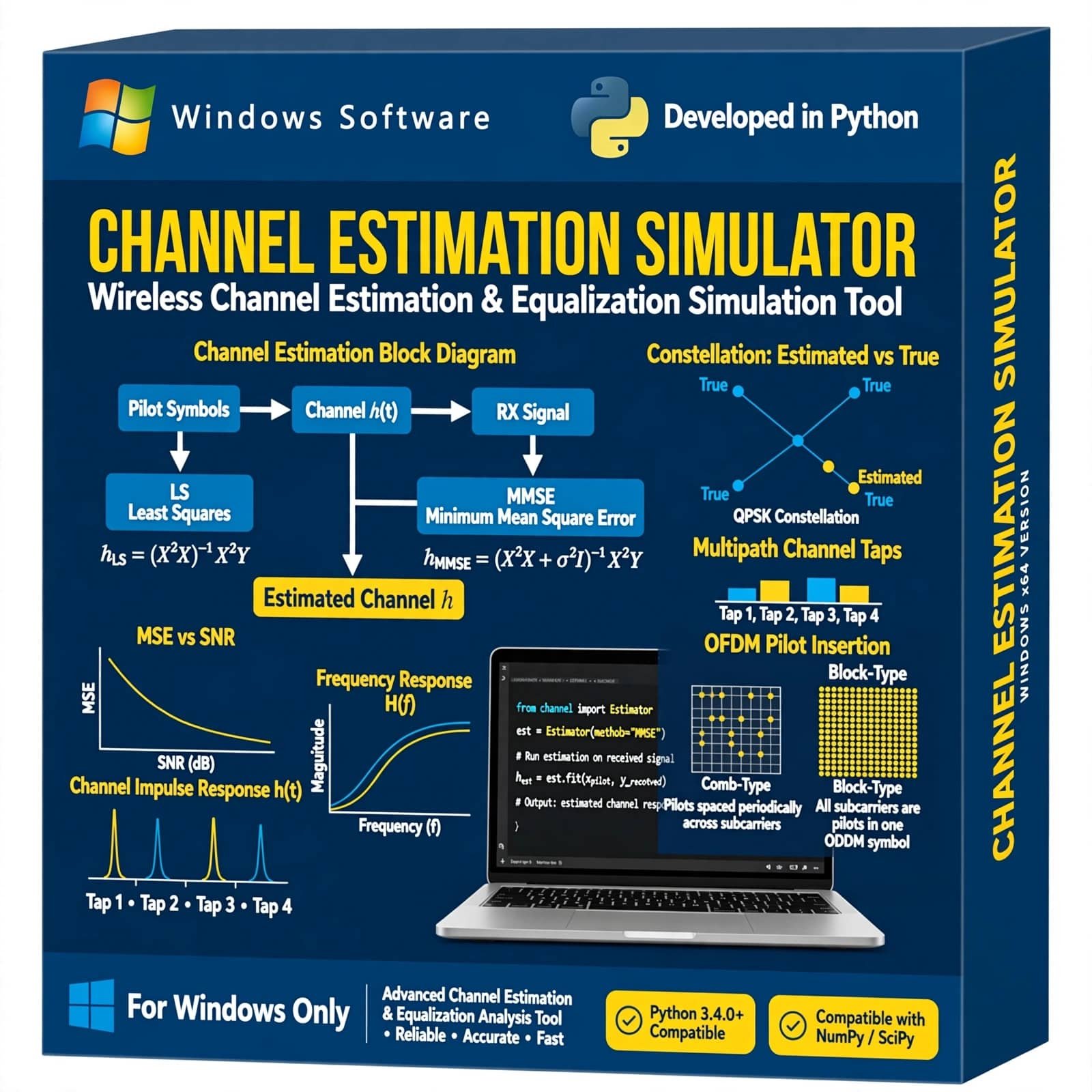
Channel Estimation Simulator is a wireless communication simulation tool designed to demonstrate and analyze channel estimation techniques in digital communication systems. It helps students, researchers, and communication engineers study channel effects, pilot-based estimation, signal distortion, and estimation performance through practical simulation.
Original price was: ₹750.00.₹250.00Current price is: ₹250.00. -
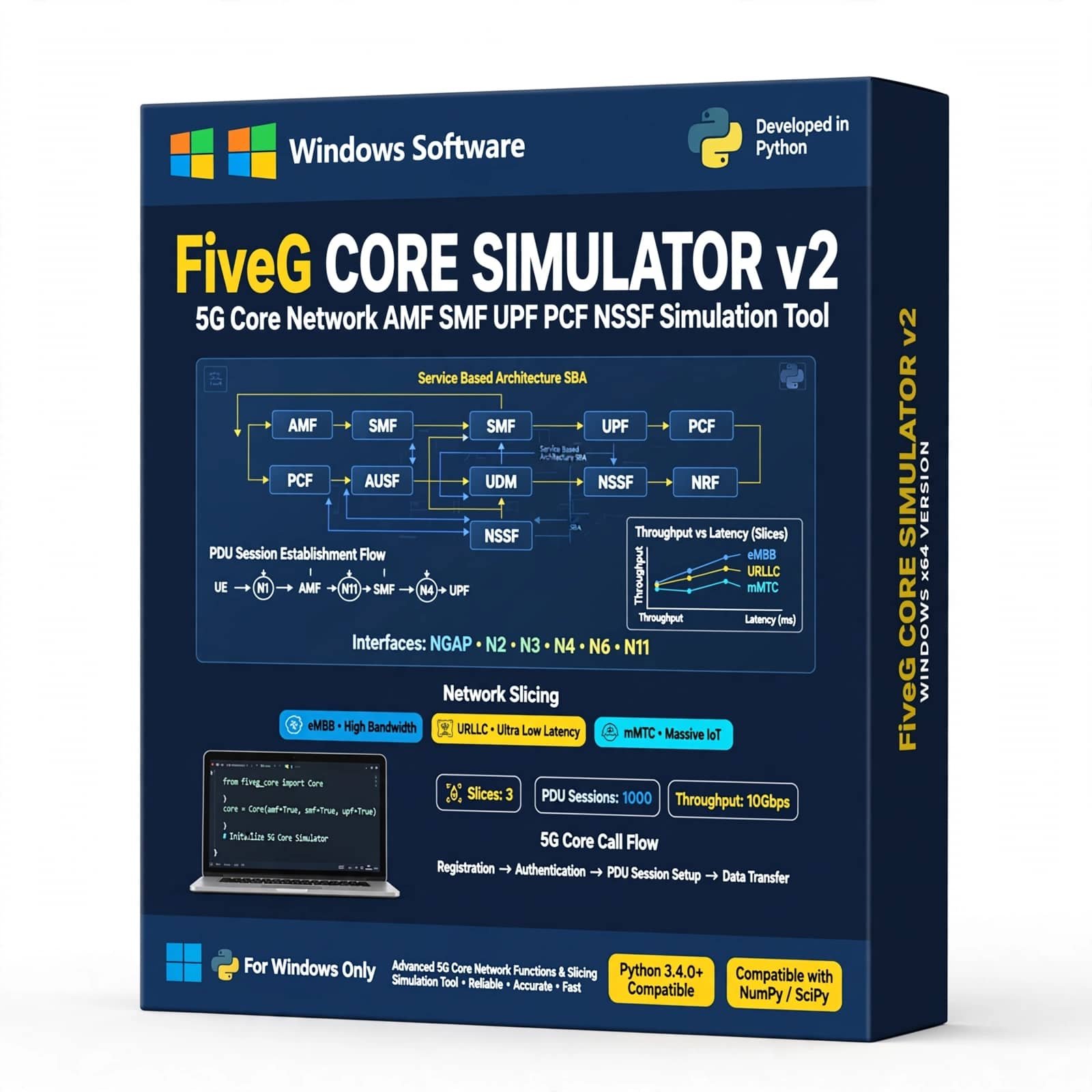
FiveG Core Simulator v2 is an educational 5G Core Network simulation tool designed to help students, educators, researchers, and telecom professionals understand 5G core architecture, network functions, signaling procedures, latency, and protocol interactions through an interactive topology and signaling animation environment.
Original price was: ₹750.00.₹250.00Current price is: ₹250.00.


Reviews
There are no reviews yet.