
-
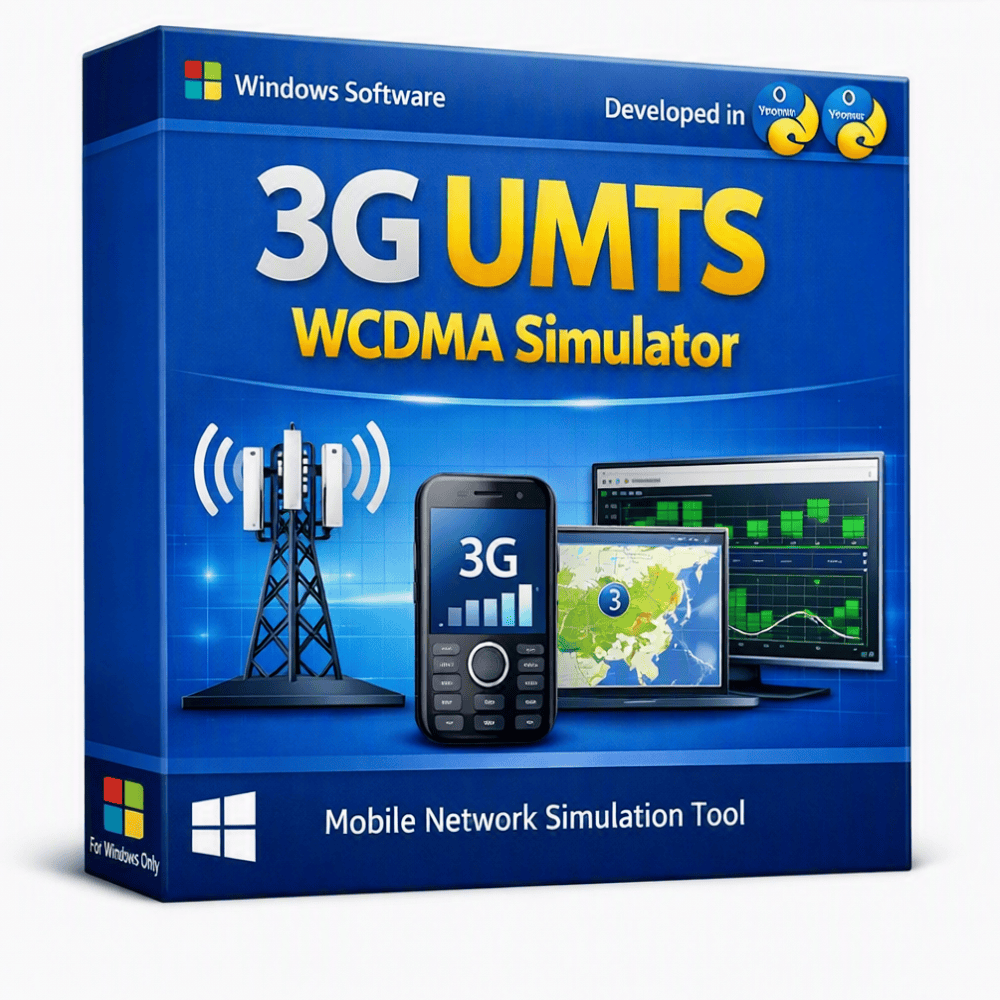
The 3G UMTS – WCDMA Simulator is a software-based simulation project designed to demonstrate the fundamental concepts of 3G Universal Mobile Telecommunications System (UMTS) and Wideband Code Division Multiple Access (WCDMA) technology. It provides a practical environment for studying cellular communication, spreading codes, signal transmission, mobile users, network connectivity, and WCDMA-based communication principles. The simulator is suitable for students, researchers, and developers working on telecommunications and wireless communication projects. It can be used for academic demonstrations, engineering projects, research, experimentation, and learning about 3G mobile communication and WCDMA network technologies.
₹3,999.00 -
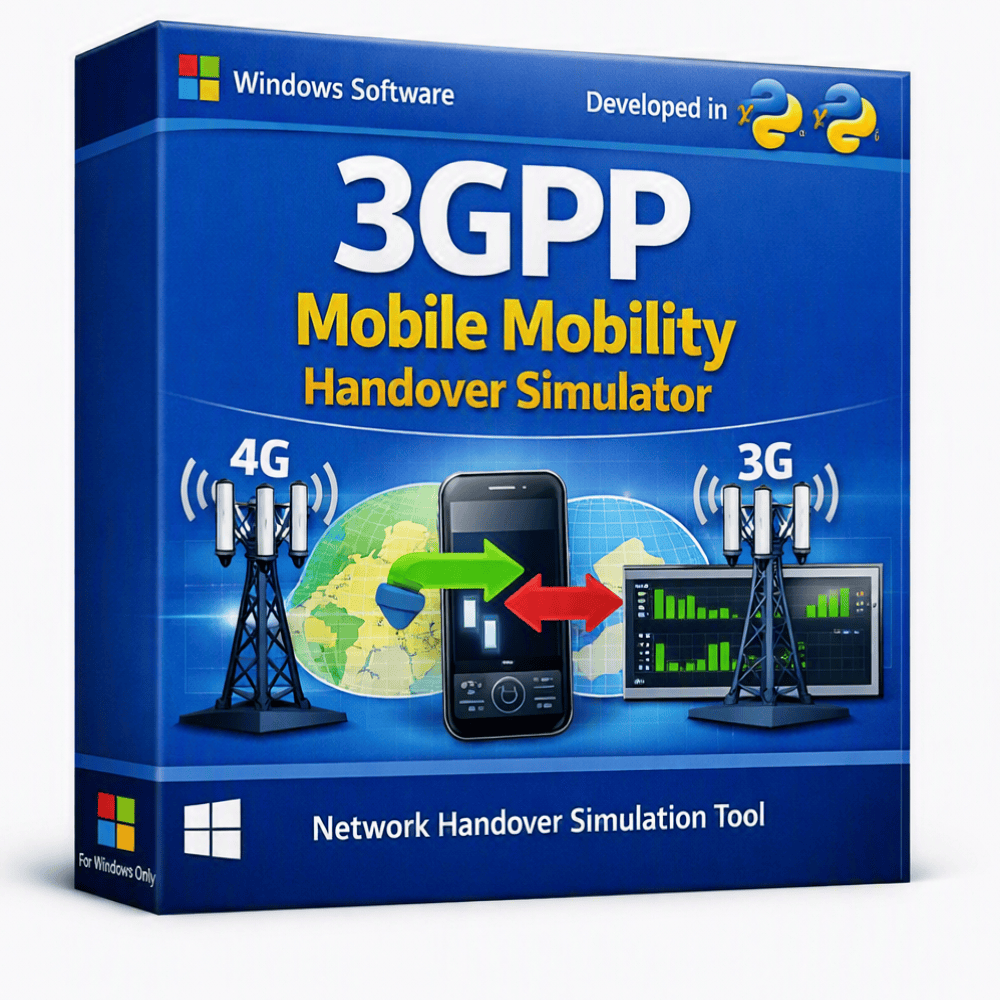
A powerful simulation tool for analyzing and validating 3GPP mobile mobility and handover procedures. The simulator enables users to model mobile network scenarios, study handover behavior, and evaluate mobility performance under different network conditions.
Key Features:
- 3GPP-compliant mobility and handover simulation
- Configurable network and mobility scenarios
- Analysis of handover performance and behavior
- Supports research, testing, and network optimization
- Useful for telecom engineers, researchers, and academic projects
Ideal for 5G/4G/3G mobility research, protocol testing, network planning, and academic simulation studies.
₹3,999.00 -
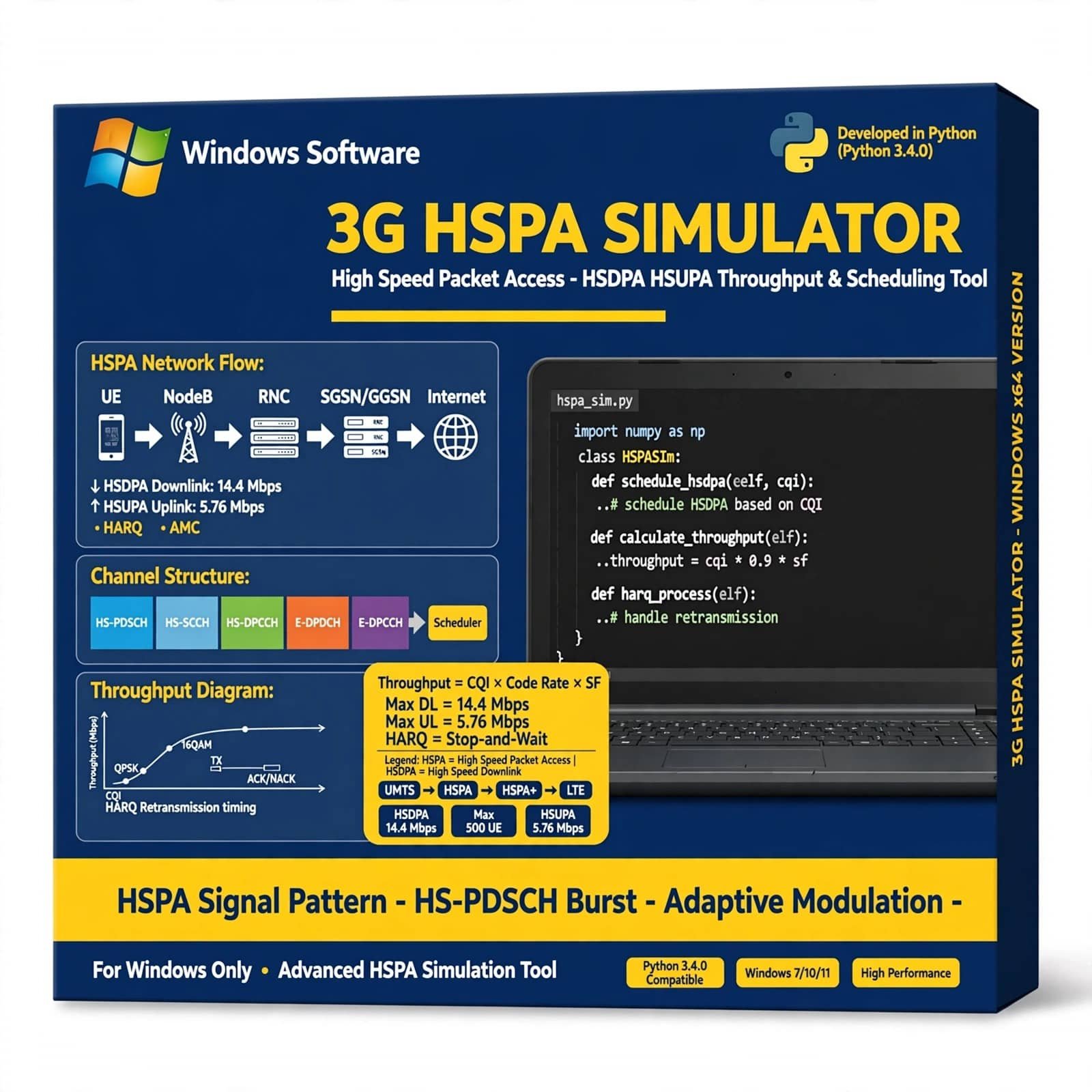
3G HSPA Simulator with Python is a wireless communication simulation tool designed for studying High-Speed Packet Access (HSPA), 3G mobile broadband, WCDMA networks, packet data transmission, scheduling, throughput, and radio resource management. Developed using Python, it is suitable for telecom students, researchers, engineers, universities, and laboratories for practical HSPA simulation and academic projects.
₹3,999.00 -
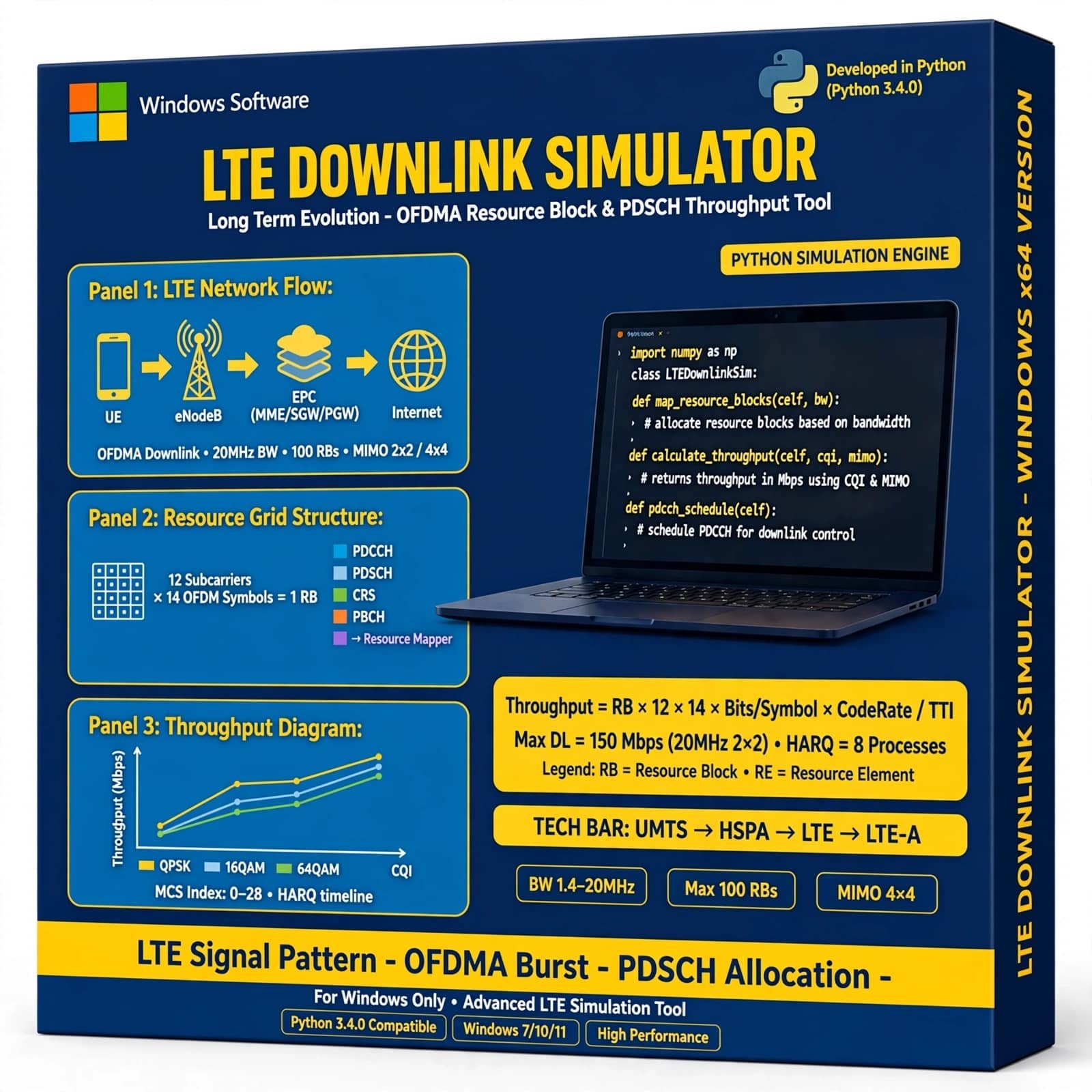
The LTE Downlink Simulator with Python is a practical wireless communication simulation tool for studying and analyzing LTE downlink transmission using Python. It helps students, researchers, and communication engineers explore LTE concepts such as OFDM, modulation, channel modeling, signal transmission, noise, BER, SNR, and downlink performance. Ideal for academic projects, research, laboratory experiments, and wireless communication system analysis.
₹6,999.00 -

LTE EPC Simulator developed with Python is a powerful software simulation solution for modeling and testing key components of the 4G LTE Evolved Packet Core (EPC) network. Designed for telecom research, academic projects, network development, protocol testing, and learning, this Python-based LTE EPC Simulator provides a flexible environment to understand EPC architecture, signaling procedures, user equipment connectivity, and packet-core network operations without requiring a complete physical LTE infrastructure.
₹6,999.00 -

LTE Handover Simulator developed with Python is a software-based simulation solution designed to study, analyze, and demonstrate handover procedures in 4G LTE wireless communication networks. It provides a practical environment for understanding LTE mobility management, cell-to-cell transitions, handover decision-making, signaling procedures, and network performance. Ideal for telecom research, academic projects, engineering students, protocol analysis, and LTE network experimentation.
₹6,999.00 -

LTE HARQ Simulator developed with Python is a software-based simulation solution for studying Hybrid Automatic Repeat Request (HARQ) mechanisms used in 4G LTE wireless communication systems. It provides a practical environment for understanding data transmission, error detection, retransmission, ACK/NACK procedures, packet recovery, and communication reliability. The simulator is suitable for LTE research, academic projects, engineering demonstrations, wireless communication studies, and Python-based telecom simulations.
₹6,999.00 -

LTE MIMO Simulator developed with Python is a software-based simulation solution designed to study and analyze Multiple-Input Multiple-Output (MIMO) communication techniques used in 4G LTE wireless networks. It provides a practical environment for exploring multiple antenna transmission, spatial multiplexing, diversity techniques, signal processing, channel behavior, and LTE MIMO performance. Ideal for wireless communication research, academic projects, engineering students, telecom development, and Python-based LTE simulation.
₹6,999.00 -

LTE Resource Grid Simulator developed with C++ is a software-based simulation solution designed to visualize, study, and analyze the LTE physical-layer resource grid used in 4G wireless communication systems. It provides a practical environment for understanding LTE resource elements, resource blocks, subcarriers, OFDM symbols, time-frequency mapping, and physical-channel resource allocation. Ideal for LTE research, academic projects, telecom engineering studies, signal-processing experiments, and C++-based wireless communication simulation.
₹6,999.00 -

LTE Scheduler Simulator developed with Python is a software-based simulation solution designed to study and analyze radio resource scheduling mechanisms in 4G LTE wireless communication networks. It provides a practical environment for understanding resource allocation, user scheduling, bandwidth management, throughput, fairness, Quality of Service (QoS), and scheduling algorithms. Ideal for LTE research, academic projects, telecom engineering studies, network performance analysis, and Python-based wireless communication simulation.
₹6,999.00 -

LTE Uplink SC-FDMA Simulator developed with Python is a software-based simulation solution designed to study and analyze the SC-FDMA transmission technique used in the LTE uplink. It provides a practical environment for understanding DFT-spread OFDM, subcarrier mapping, signal generation, modulation, transmission, and receiver processing. Ideal for 4G LTE physical-layer research, wireless communication studies, academic projects, signal-processing experiments, and Python-based telecom simulation.
₹6,999.00 -

LTE VoLTE Simulator developed with Python is a software-based simulation solution designed to study and demonstrate Voice over LTE (VoLTE) communication concepts over 4G LTE networks. It provides a practical environment for exploring LTE voice communication, call setup and release procedures, IP-based voice services, signaling, QoS, and VoLTE service workflows. Ideal for telecom research, academic projects, engineering studies, IMS and VoLTE learning, network simulation, and Python-based communication projects.
₹6,999.00