
New
67% Off

6G Edge Intelligence and Federated Learning Simulator

Original price was: ₹750.00.₹250.00Current price is: ₹250.00.
In Stock6G Edge Intelligence and Federated Learning Simulator with Python is a Python-based simulation platform for modeling intelligent edge computing and distributed machine learning in next-generation 6G networks. It can simulate edge devices, users, edge servers, communication networks, local model training, federated aggregation, communication costs, latency, resource allocation, and AI performance for research into privacy-aware and decentralized 6G intelligence.
Description
6G Edge Intelligence and Federated Learning Simulator
The 6G Edge Intelligence and Federated Learning Simulator with Python is an advanced simulation platform designed to model, analyze, and evaluate intelligent edge computing and distributed machine learning techniques for next-generation 6G wireless networks. The project combines Edge Intelligence, Federated Learning, Artificial Intelligence, Machine Learning, and wireless network simulation to provide a flexible environment for studying how intelligent services can operate closer to users and network endpoints.
As 6G networks evolve, artificial intelligence is expected to become an important component of communication, computing, resource management, and network optimization. Instead of sending all data to centralized cloud servers, Edge Intelligence enables computation and AI processing closer to the source of data. This approach can reduce communication latency, improve responsiveness, and support applications that require real-time decision-making. A Python-based 6G Edge Intelligence simulator provides a practical environment for studying these concepts under different network and computing conditions.
The simulator can model an environment containing mobile users, IoT devices, edge devices, edge servers, communication links, and centralized or distributed computing resources. Different network parameters can be configured to represent realistic 6G edge computing scenarios. Researchers can investigate how device capabilities, network conditions, computational resources, and machine learning workloads affect system performance.
One of the central technologies supported by the project is Federated Learning (FL). Federated Learning allows multiple distributed devices or edge nodes to train a shared machine learning model without directly transferring their local training data to a centralized server. Instead, devices can perform local model training and send model updates to an aggregation server or other coordinating nodes. This provides a useful framework for studying distributed AI while reducing the need to transfer raw data.

The 6G Federated Learning Simulator using Python can model important federated learning parameters such as the number of participating devices, local datasets, local training rounds, communication rounds, model updates, aggregation strategies, training time, bandwidth, and network latency. Researchers can use these parameters to evaluate different Federated Learning configurations and investigate their impact on model accuracy and communication efficiency.
Communication overhead is a significant consideration in distributed machine learning. Federated Learning requires devices to exchange model updates with aggregation servers or other network nodes. The simulator can be used to analyze the relationship between model size, network bandwidth, communication latency, number of participating devices, and overall training performance.
The project can also support edge resource management and optimization. Edge devices and servers often have limited computational, memory, battery, and communication resources. Simulation models can evaluate how computing workloads are distributed among edge nodes and how resources can be allocated to different users and AI tasks.
Another important application is latency-aware Edge Intelligence. Many 6G applications may require rapid processing and decision-making. By moving AI workloads closer to users, edge computing can potentially reduce the time required to send data to distant cloud infrastructure. The simulator can model processing delays, communication delays, queuing delays, and model training time to analyze end-to-end performance.

The Python environment also makes it possible to integrate machine learning and deep learning algorithms into the simulation framework. Researchers can experiment with different models, datasets, optimization methods, and federated aggregation techniques. Simulation results can be used to compare training accuracy, convergence behavior, communication efficiency, computational requirements, and resource consumption.
The simulator can further be extended to investigate privacy-aware and decentralized AI for 6G networks. Since Federated Learning is based on distributed model training, it provides a framework for exploring methods that reduce the need to transfer raw user data. Researchers can investigate privacy-preserving approaches, secure aggregation, differential privacy, and other techniques within a controlled simulation environment.
Non-IID data distribution can also be incorporated into the simulation. In practical Federated Learning environments, different devices may generate data with different characteristics and distributions. For example, mobile devices in different locations may collect different types or quantities of data. Simulating heterogeneous datasets can help researchers study the effect of data imbalance and device diversity on model convergence and accuracy.
The platform can also model heterogeneous edge devices, where devices have different processing capabilities, battery levels, network connectivity, memory capacity, and computational resources. Such scenarios are useful for investigating client selection, workload distribution, asynchronous Federated Learning, and resource-aware training strategies.

Visualization and analytics can be incorporated to display important simulation results, including training accuracy, loss, convergence rate, communication overhead, latency, resource utilization, energy consumption, and device participation. These visualizations can make it easier to compare different Federated Learning and Edge Intelligence strategies.
For students and academic researchers, the 6G Edge Intelligence and Federated Learning Simulator with Python can be useful for projects involving 6G communication, edge computing, distributed AI, Federated Learning, IoT, machine learning, privacy-aware computing, and network optimization. The simulator provides a practical environment for implementing algorithms and evaluating their behavior under different network and computing scenarios.
The project can also serve as a foundation for advanced research into AI-native 6G networks. Additional capabilities such as intelligent resource allocation, edge-assisted inference, reinforcement learning, digital twins, network slicing, intelligent task offloading, device selection, and AI-driven network optimization can be incorporated into the simulation framework.
Overall, the 6G Edge Intelligence and Federated Learning Simulator with Python provides a flexible platform for exploring how distributed artificial intelligence can be integrated with future wireless networks. By combining Edge Intelligence, Federated Learning, Python programming, machine learning, edge computing, wireless communication, and resource optimization, the project supports experimentation with intelligent, distributed, and privacy-aware AI systems for next-generation 6G applications.

Related products
-
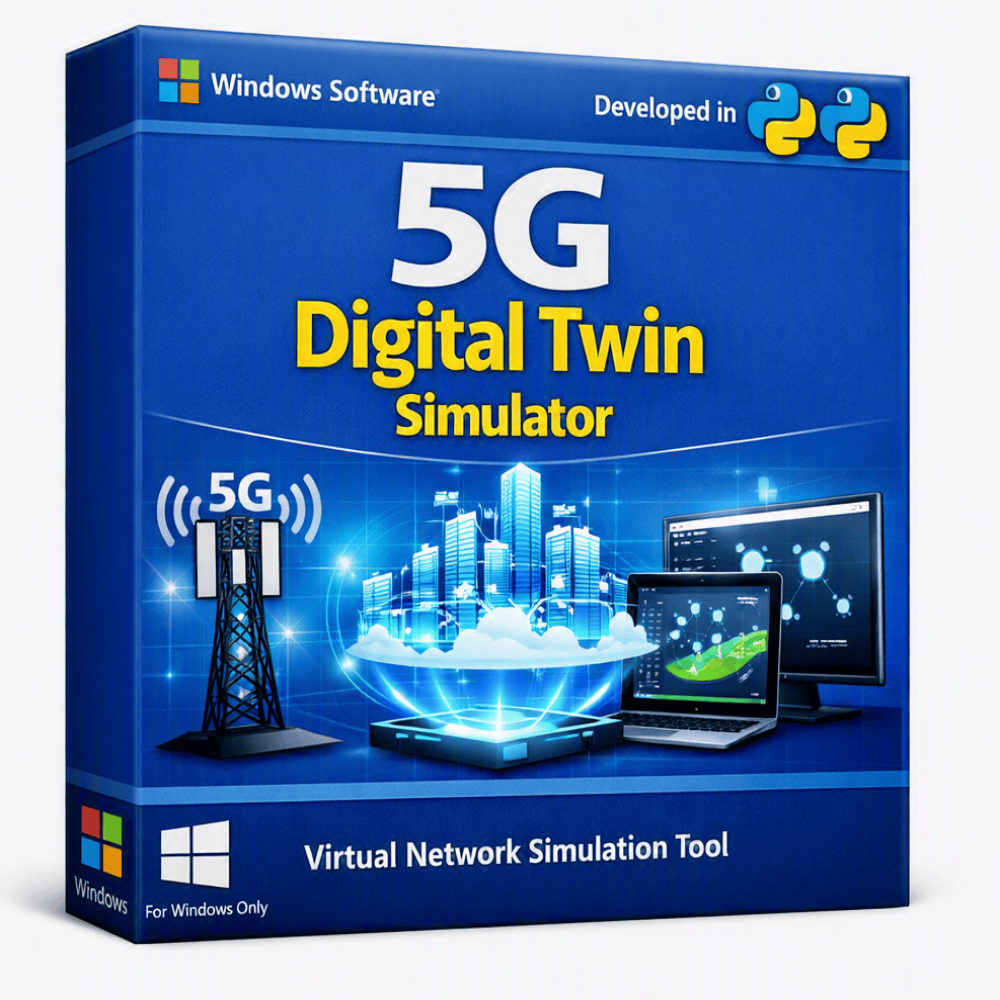
A Python-based 5G Digital Twin solution for creating a virtual representation of 5G network environments, components, and operational behavior. Designed for 5G research, network analysis, simulation, optimization, and academic projects, it enables users to model network scenarios, monitor virtualized network behavior, and experiment with different configurations in a controlled software environment.
Ideal for telecom engineers, researchers, developers, students, and academic institutions working on 5G network planning, performance analysis, intelligent network management, and digital twin research.
Original price was: ₹750.00.₹250.00Current price is: ₹250.00. -
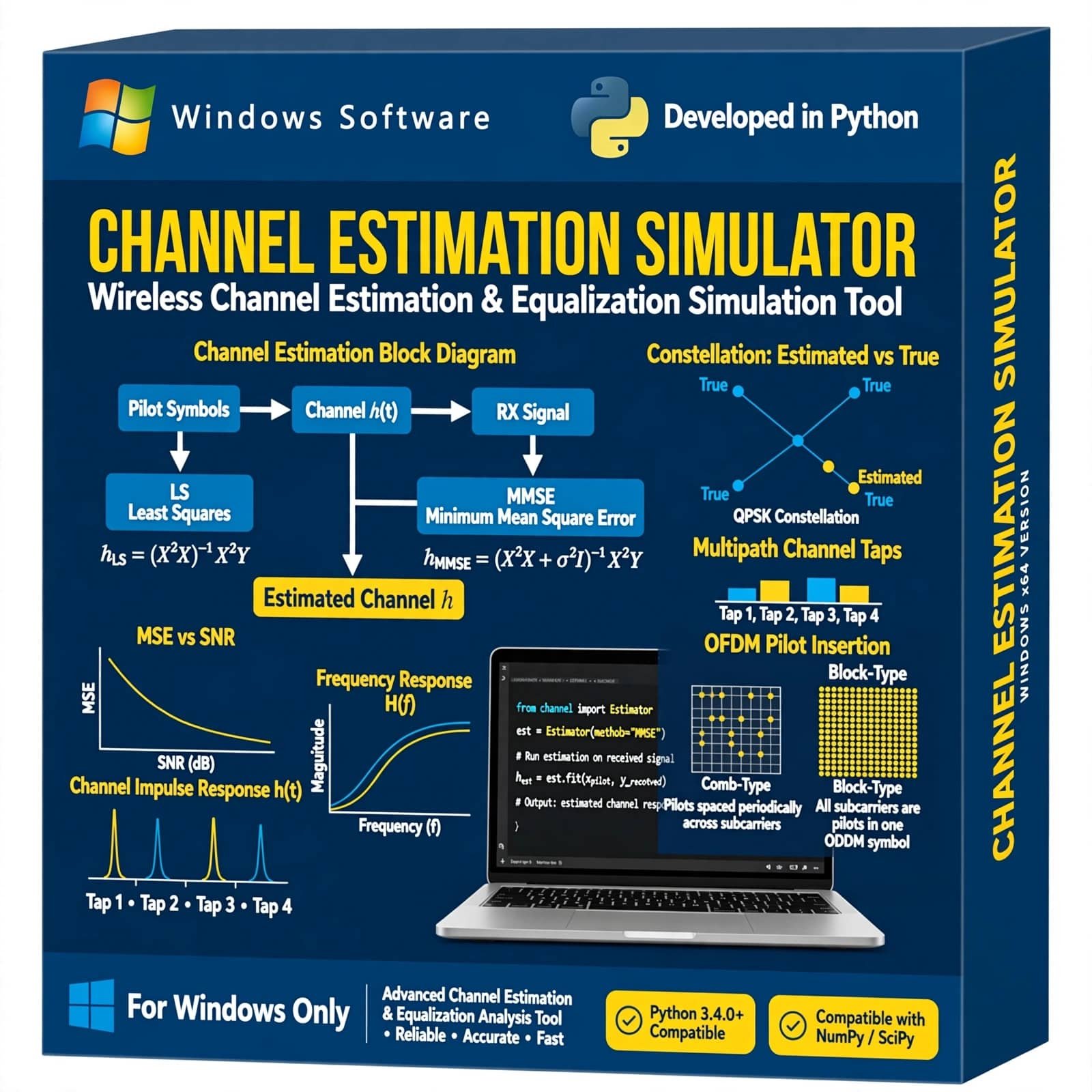
Channel Estimation Simulator is a wireless communication simulation tool designed to demonstrate and analyze channel estimation techniques in digital communication systems. It helps students, researchers, and communication engineers study channel effects, pilot-based estimation, signal distortion, and estimation performance through practical simulation.
Original price was: ₹750.00.₹250.00Current price is: ₹250.00. -
EDGE Simulator Using Python is a practical mobile communication simulation tool designed to demonstrate and analyze Enhanced Data rates for GSM Evolution (EDGE) technology. It helps students, researchers, and communication engineers study GSM/EDGE data transmission, modulation, channel conditions, bit error rate, data rates, and wireless communication performance using Python-based simulation.
Original price was: ₹750.00.₹250.00Current price is: ₹250.00. -
The 2G GSM Cell Simulator is a Python-based software project designed to simulate fundamental GSM cellular-network concepts. It provides a practical environment for understanding mobile stations, GSM cells, base stations, cellular coverage, mobility, communication channels, and basic network behavior. The project includes Python source code that can be studied, customized, and extended for academic projects, demonstrations, research, and learning. It is ideal for Electronics & Communication Engineering, Telecommunications, Computer Science, and related students looking to explore 2G GSM technology and cellular network simulation through a software-based implementation.
Original price was: ₹750.00.₹250.00Current price is: ₹250.00. -
5G NR Massive MIMO Simulator is an advanced simulation solution for modeling and analyzing Massive Multiple-Input Multiple-Output (MIMO) technologies in 5G New Radio networks. It enables users to study large-scale antenna arrays, beamforming, precoding, spatial multiplexing, multi-user MIMO, channel estimation, and interference under configurable channel conditions. The simulator supports analysis of throughput, spectral efficiency, SINR, BER, BLER, MIMO capacity, beamforming gain, and multi-user performance, making it ideal for 5G NR research, algorithm development, academic projects, and 5G/6G wireless system optimization.
Original price was: ₹750.00.₹250.00Current price is: ₹250.00. -
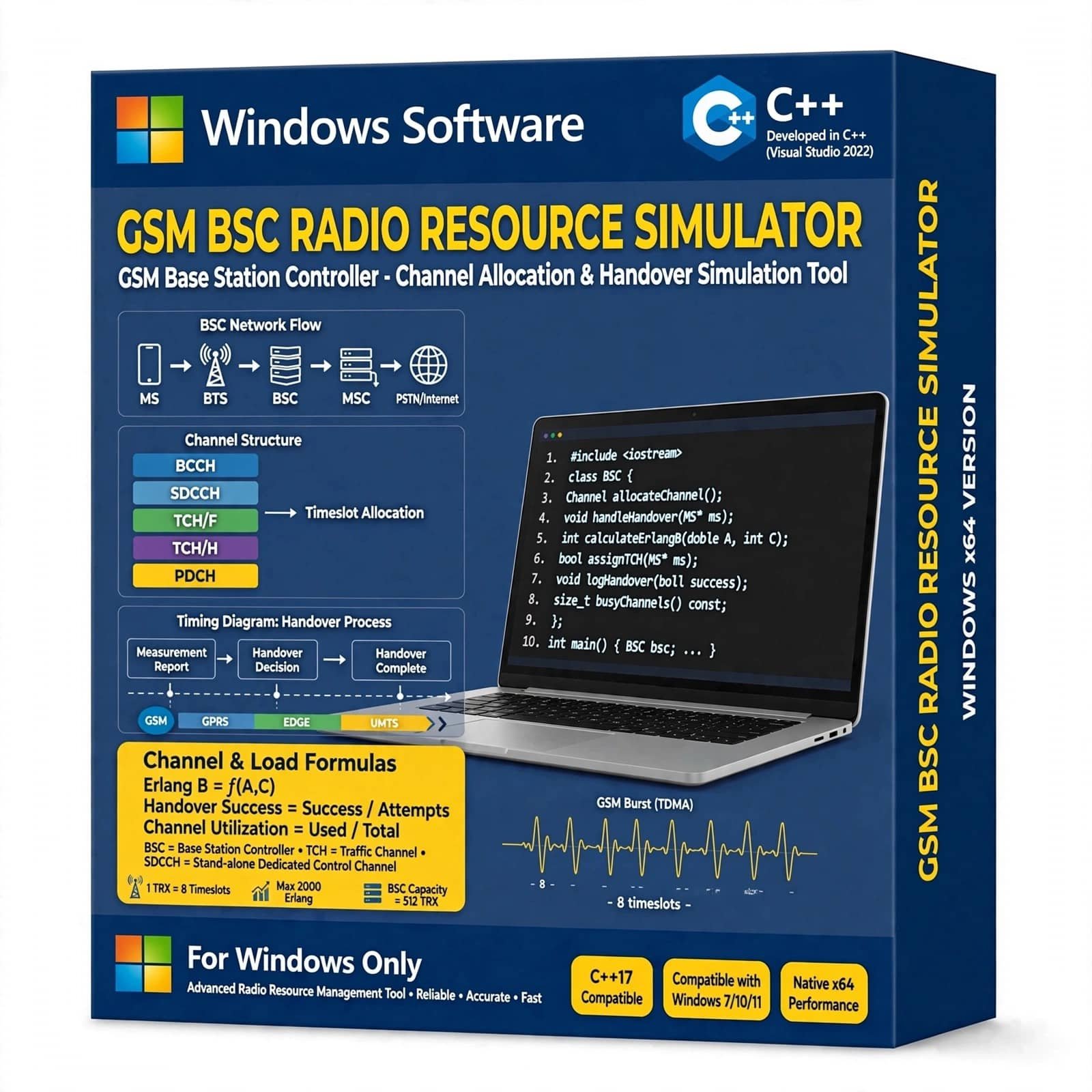
GSM BSC Radio Resource Simulator is a professional telecom training and development solution designed to simulate GSM Base Station Controller (BSC) radio resource management functions. It helps students, telecom engineers, researchers, and network professionals understand GSM radio resource allocation, channel management, call handling, handover concepts, and BSC-related network procedures in a controlled simulation environment.
Original price was: ₹750.00.₹100.00Current price is: ₹100.00.





Reviews
There are no reviews yet.