
New
67% Off

DVB-S2-S2X Performance Analyzer


Original price was: ₹750.00.₹250.00Current price is: ₹250.00.
In StockDVB-S2-S2X Performance Analyzer with Python is a Python-based tool for analyzing and visualizing satellite communication performance. It can be used to study BER, SNR, modulation performance, throughput, spectral efficiency, constellation behavior, and other key parameters of DVB-S2 and DVB-S2X systems through simulation and signal-processing techniques.
Description
DVB-S2-S2X Performance Analyzer
The DVB-S2-S2X Performance Analyzer with Python is a powerful software-based solution designed to analyze, evaluate, and visualize the performance of modern satellite communication systems. Built using Python, this analyzer can help engineers, researchers, students, and communication professionals study key performance parameters associated with DVB-S2 and DVB-S2X digital satellite communication standards. By combining signal-processing techniques with Python-based data analysis and visualization, the tool provides an efficient environment for understanding satellite communication performance under different operating conditions.
DVB-S2, or Digital Video Broadcasting – Satellite – Second Generation, is widely used for satellite television, broadband satellite services, professional broadcasting, and other high-throughput communication applications. DVB-S2X extends the capabilities of DVB-S2 by introducing additional modulation, coding, and efficiency improvements for specialized and high-performance applications. A DVB-S2-S2X Performance Analyzer can therefore be valuable for examining how different modulation and coding configurations affect communication quality, bandwidth utilization, and system performance.
This Python-based project can be used to analyze important parameters such as Bit Error Rate (BER), Signal-to-Noise Ratio (SNR), modulation performance, throughput, spectral efficiency, and received signal quality. Depending on the implementation, users can generate simulated DVB-S2-S2X signals, introduce controlled noise or channel impairments, process the received data, and evaluate system performance through numerical results and graphical plots.

One of the major advantages of developing a DVB-S2 performance analyzer in Python is flexibility. Python provides a large ecosystem of libraries for numerical computing, signal processing, visualization, and scientific analysis. Libraries such as NumPy, SciPy, and Matplotlib can be integrated into the project to perform mathematical calculations, process communication signals, and generate informative performance graphs. This makes Python an accessible and extensible platform for satellite communication research and experimentation.
The analyzer can also be designed to compare different DVB-S2 and DVB-S2X modulation schemes, allowing users to investigate how modulation choices influence system behavior. Performance measurements can be presented using BER-versus-SNR curves, throughput comparisons, constellation diagrams, spectral analysis, and other relevant visualization methods. Such graphical representations make it easier to identify performance trends and understand the relationship between channel conditions and communication reliability.
For academic and research applications, this project can serve as a practical demonstration of concepts from digital communications, satellite communications, wireless communication, error-control coding, modulation techniques, and software-defined radio. Students can use the analyzer to experiment with different parameters and observe their effects without requiring access to expensive satellite communication hardware.

For engineering applications, a DVB-S2-S2X performance analysis tool can assist with early-stage system evaluation and algorithm development. Engineers can modify simulation parameters, test communication scenarios, compare configurations, and analyze the resulting data. Python’s scripting capabilities also make it possible to automate repeated experiments and create customized performance reports.
The project can be extended with features such as configurable channel models, automated BER testing, modulation and coding selection, constellation visualization, SNR sweeps, performance comparison dashboards, CSV data export, and automated plotting. Additional support for software-defined radio interfaces can further expand the analyzer from a simulation-focused application into a more practical signal-analysis environment.
Another important benefit is reproducibility. Python scripts can document the complete analysis workflow, allowing researchers and developers to repeat experiments with consistent parameters. Results can be stored, compared, and visualized to support technical reports, research papers, engineering studies, and educational demonstrations.

The DVB-S2-S2X Performance Analyzer with Python is therefore a useful project for anyone interested in analyzing next-generation satellite communication systems. It combines digital communication theory, satellite signal processing, Python programming, and performance visualization into a single analytical workflow. Whether used for academic learning, simulation, algorithm testing, or communication-system research, the project provides a practical foundation for exploring the performance characteristics of DVB-S2 and DVB-S2X technologies.
With its customizable architecture and Python-based implementation, the analyzer can be adapted to different experimental requirements. Users can introduce new performance metrics, communication scenarios, channel conditions, visualization methods, and analysis algorithms as their project evolves. This makes it suitable for students, researchers, telecommunications engineers, satellite communication professionals, and Python developers working with digital communication systems.
Overall, the DVB-S2-S2X Performance Analyzer using Python offers a practical way to study satellite communication performance through simulation, signal analysis, numerical evaluation, and visualization. It can help users understand how modulation, noise, coding, signal quality, and transmission parameters interact in a satellite communication environment while providing a flexible Python platform for further development and experimentation.

Related products
-
5G NR Massive MIMO Simulator is an advanced simulation solution for modeling and analyzing Massive Multiple-Input Multiple-Output (MIMO) technologies in 5G New Radio networks. It enables users to study large-scale antenna arrays, beamforming, precoding, spatial multiplexing, multi-user MIMO, channel estimation, and interference under configurable channel conditions. The simulator supports analysis of throughput, spectral efficiency, SINR, BER, BLER, MIMO capacity, beamforming gain, and multi-user performance, making it ideal for 5G NR research, algorithm development, academic projects, and 5G/6G wireless system optimization.
Original price was: ₹750.00.₹250.00Current price is: ₹250.00. -
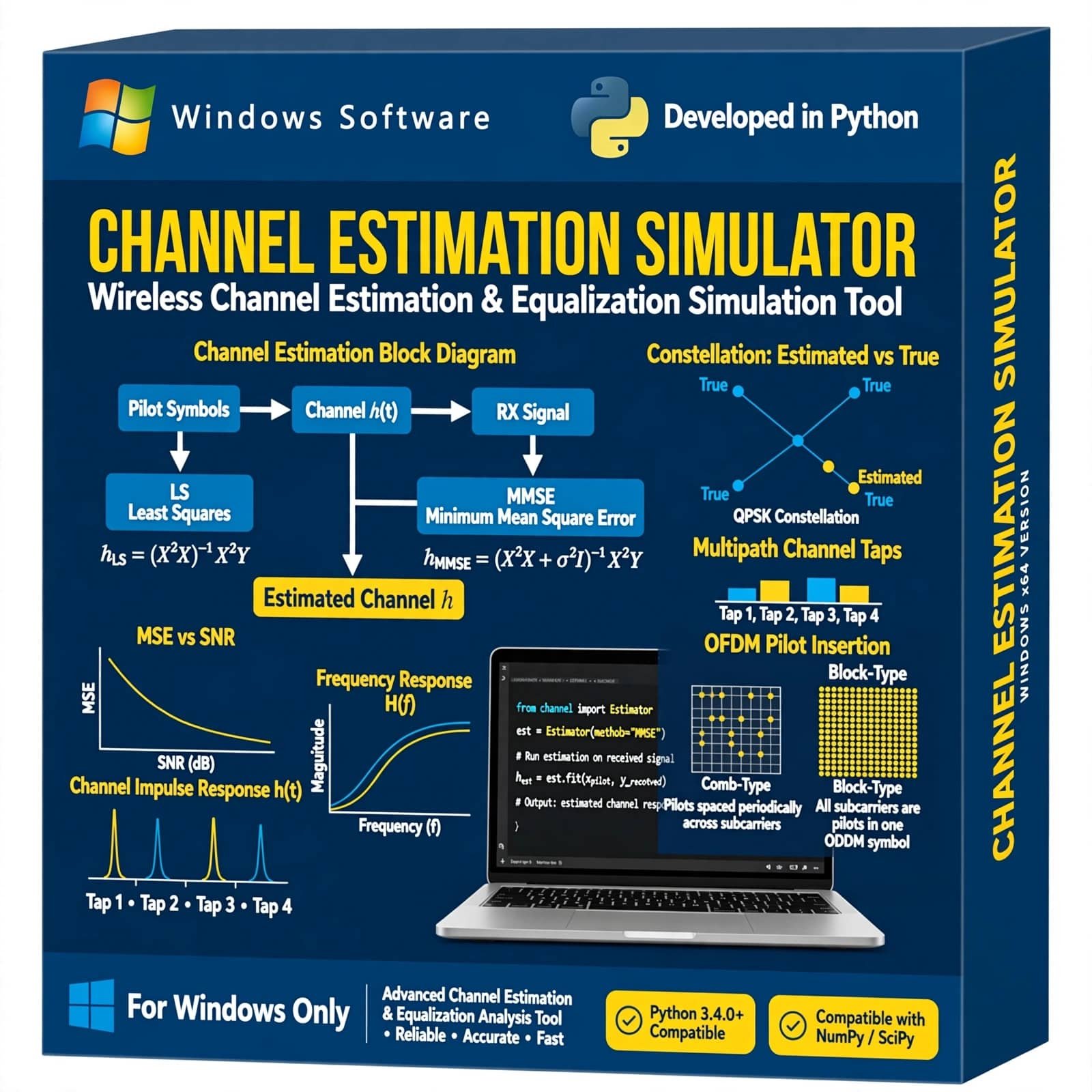
Channel Estimation Simulator is a wireless communication simulation tool designed to demonstrate and analyze channel estimation techniques in digital communication systems. It helps students, researchers, and communication engineers study channel effects, pilot-based estimation, signal distortion, and estimation performance through practical simulation.
Original price was: ₹750.00.₹250.00Current price is: ₹250.00. -
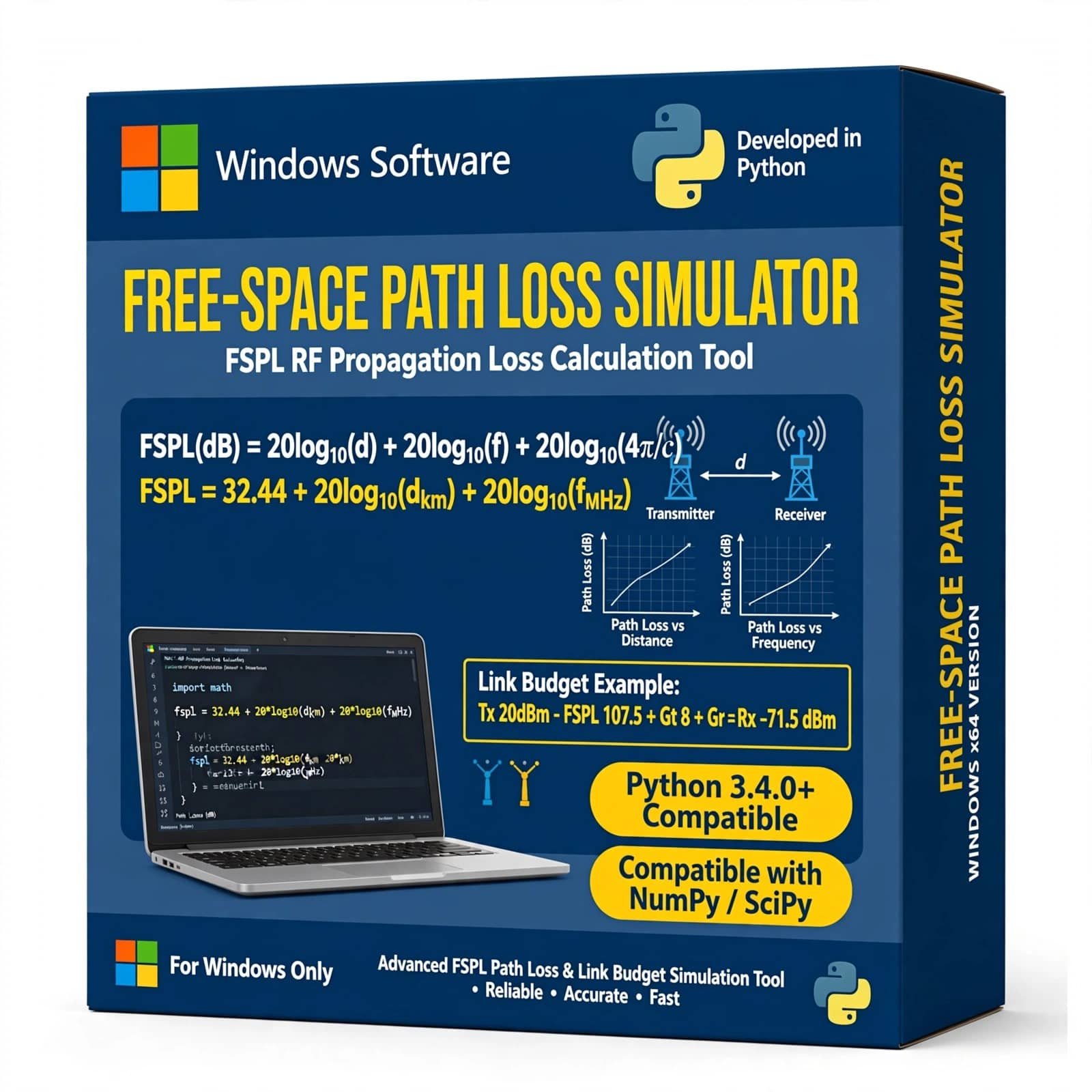
Free Space Path Loss Simulator Using Python is a practical wireless communication simulation project designed to calculate and visualize signal power loss as a radio wave travels through free space. Developed using Python, this simulator helps students, researchers, and communication engineers understand Free Space Path Loss (FSPL), transmission distance, frequency, received signal power, and wireless link performance.
The project provides an easy-to-understand simulation environment for analyzing how distance and operating frequency affect signal propagation. It is suitable for B.Tech, M.Tech, engineering students, academic projects, wireless communication studies, RF analysis, and Python-based simulation projects.
Original price was: ₹750.00.₹250.00Current price is: ₹250.00. -
A Python-based 5G Network Slicing and Resource Isolation Simulator designed to model and analyze how multiple logical network slices can share physical 5G infrastructure while maintaining resource isolation. The simulator enables users to study CPU, memory, bandwidth, network capacity, traffic allocation, and resource management across different 5G network slices.
Ideal for 5G research, telecom engineering, academic projects, network optimization, resource allocation studies, and university laboratories.
Original price was: ₹750.00.₹250.00Current price is: ₹250.00. -
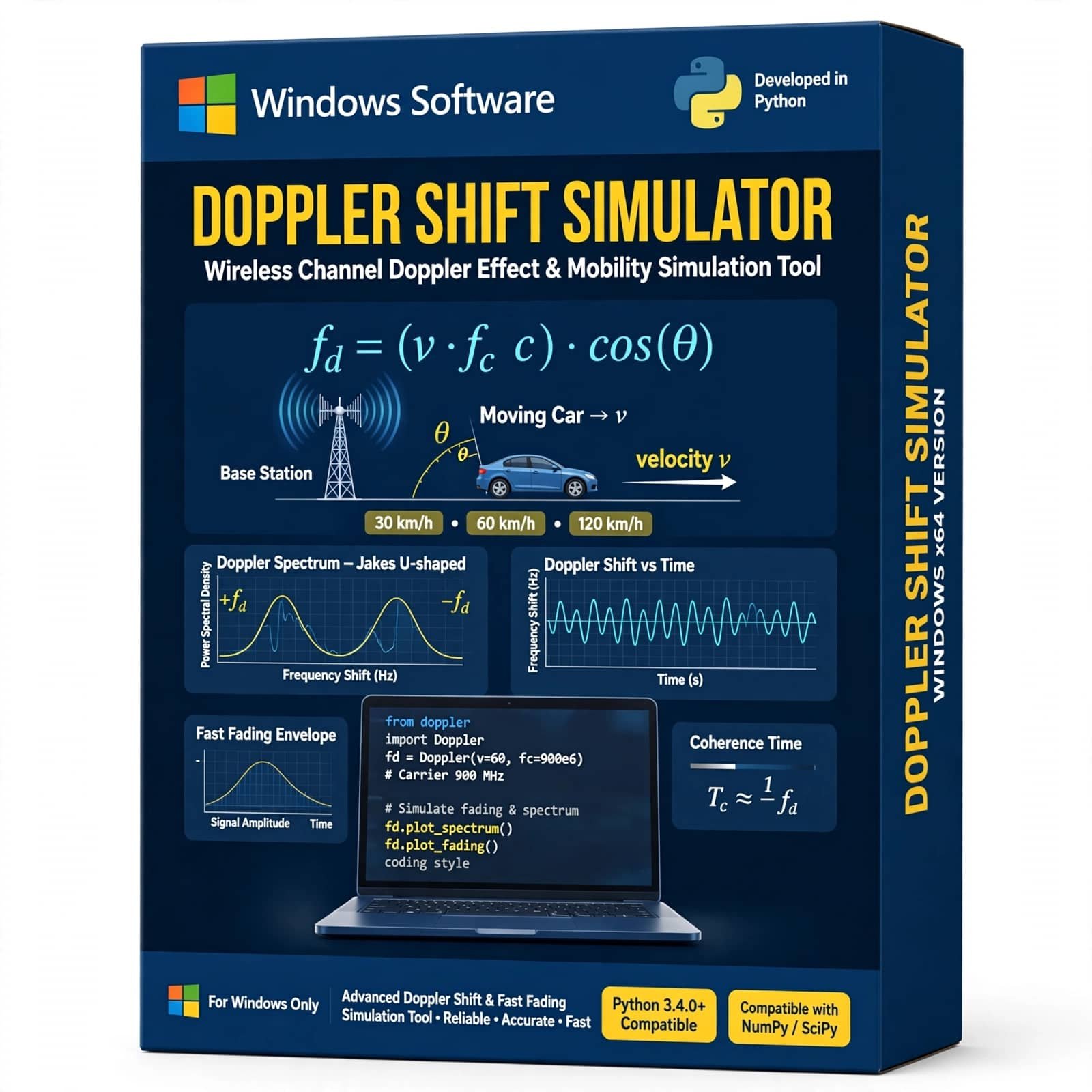
Doppler Shift Simulator Using Python is a practical wireless communication simulation tool for studying the Doppler effect and frequency shift caused by relative motion between a transmitter and receiver. It helps students, researchers, and communication engineers analyze Doppler frequency, carrier frequency, velocity, and mobile channel effects through Python-based simulation.
Original price was: ₹750.00.₹250.00Current price is: ₹250.00. -
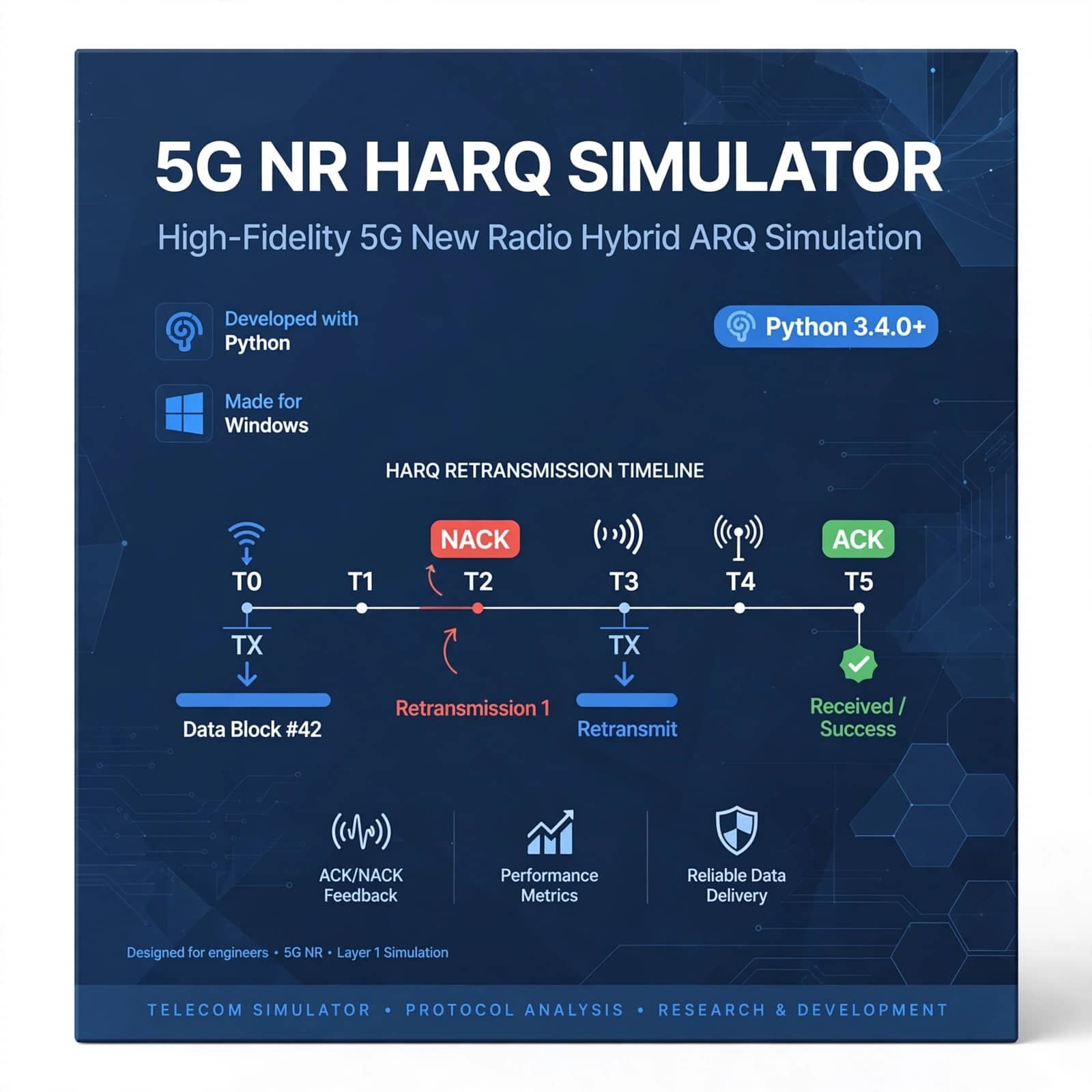
5G NR HARQ Simulator is an advanced simulation solution for modeling and analyzing Hybrid Automatic Repeat Request (HARQ) mechanisms in 5G New Radio networks. It enables users to study HARQ processes, ACK/NACK feedback, retransmissions, link adaptation, channel errors, and communication reliability under configurable network conditions. The simulator supports analysis of throughput, BLER, latency, retransmission rate, packet errors, spectral efficiency, and other key performance metrics, making it suitable for 5G NR research, algorithm development, academic projects, and wireless communication system optimization.
Original price was: ₹750.00.₹250.00Current price is: ₹250.00.




Reviews
There are no reviews yet.