
New
87% Off

VSAT Bandwidth Scheduler Simulator

Original price was: ₹750.00.₹100.00Current price is: ₹100.00.
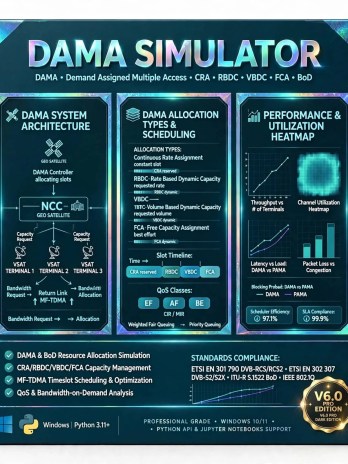
In StockVSAT Bandwidth Scheduler Simulator with Python is a Python-based simulation tool for modeling bandwidth allocation among multiple VSAT terminals. It can evaluate scheduling algorithms such as Round Robin, Weighted Round Robin, priority-based, and demand-based allocation while analyzing throughput, latency, bandwidth utilization, fairness, queue length, and resource distribution.
Description
VSAT Bandwidth Scheduler Simulator
The VSAT Bandwidth Scheduler Simulator with Python is a software-based simulation tool designed to model, analyze, and optimize bandwidth allocation in Very Small Aperture Terminal (VSAT) satellite communication networks. Developed using Python, the simulator provides a flexible environment for studying how available satellite bandwidth can be dynamically distributed among multiple VSAT terminals, users, services, or communication sessions according to traffic demand and scheduling policies.
VSAT networks are widely used for providing reliable connectivity to geographically distributed locations where terrestrial communication infrastructure may be limited or unavailable. These networks can support applications such as enterprise connectivity, remote-site communications, broadband services, banking networks, maritime communication, disaster recovery, and other satellite-based data services. Since satellite bandwidth is a shared and valuable resource, efficient VSAT bandwidth scheduling is an important aspect of network performance and resource management.
The VSAT Bandwidth Scheduler Simulator using Python can simulate a centralized or distributed scheduling environment in which multiple terminals compete for a limited amount of available bandwidth. The simulator can generate different traffic demands and apply scheduling algorithms to determine how bandwidth should be assigned to individual VSAT terminals. By comparing different scheduling strategies, users can investigate their effects on throughput, latency, fairness, utilization, and overall network efficiency.

A typical simulation can include multiple VSAT terminals with different bandwidth requirements and traffic priorities. Each terminal may generate data according to a predefined traffic pattern, while the scheduler monitors the available capacity and assigns bandwidth according to configured rules. The simulation can then calculate performance metrics and visualize how bandwidth is distributed over time.
Python is an excellent platform for developing a VSAT bandwidth scheduling simulator because it provides extensive capabilities for numerical computation, data processing, algorithm development, and visualization. Libraries such as NumPy, Pandas, and Matplotlib can be used to manage simulation data, implement scheduling logic, calculate performance metrics, and generate informative graphs.
The simulator can support several scheduling approaches depending on the project requirements. Examples may include Round Robin scheduling, Weighted Round Robin, Priority-Based scheduling, Fair Queuing, demand-based allocation, and custom bandwidth allocation algorithms. Users can compare these approaches using the same simulated traffic conditions and observe how each strategy distributes the available satellite capacity.

One of the key objectives of a VSAT bandwidth scheduler is efficient utilization of available capacity. If bandwidth is allocated inefficiently, some terminals may experience unnecessary delays while other capacity remains unused. A simulation environment allows users to experiment with different allocation policies and observe how changes in scheduling parameters influence resource utilization.
The simulator can analyze important network performance metrics such as bandwidth utilization, throughput, packet delay, queue length, packet loss, fairness, resource allocation, and service response time. These metrics can be calculated during the simulation and presented through tables and graphical charts.
Traffic prioritization can also be incorporated into the simulator. Different VSAT users or applications may have different service requirements. For example, real-time or mission-critical traffic may require lower latency, while bulk data transfers may prioritize throughput. A priority-aware scheduler can assign available bandwidth according to configured service classes. The simulator can demonstrate how priority rules affect the allocation of shared satellite resources.

Another useful feature is dynamic bandwidth allocation. Instead of assigning a fixed amount of capacity to every VSAT terminal, the scheduler can adjust allocations based on current traffic demand. When one terminal has higher demand, the algorithm can allocate additional capacity while ensuring that other terminals continue to receive appropriate service. This provides a practical way to study adaptive resource allocation in satellite networks.
The VSAT Bandwidth Scheduler Simulator with Python can also model changing traffic conditions. Users can introduce burst traffic, periodic traffic, varying terminal demands, or different numbers of active VSAT terminals. The scheduler can then respond to these changes, allowing users to evaluate how efficiently the system handles changing network loads.

Visualization is an important part of the project. The simulator can generate bandwidth allocation graphs, throughput charts, queue-length plots, latency graphs, utilization reports, and terminal-wise resource distribution charts. These visualizations make it easier to understand scheduler behavior and identify potential performance bottlenecks.
For students, the project provides a practical way to understand concepts related to VSAT networks, satellite communication, bandwidth management, traffic scheduling, queue management, and network resource allocation. Instead of studying scheduling algorithms only from theoretical examples, students can create simulations and observe how different algorithms behave under realistic traffic scenarios.
For researchers and engineers, the simulator can provide a foundation for evaluating new scheduling algorithms and resource-allocation techniques. Python makes it possible to automate large numbers of experiments, change simulation parameters, collect results, and compare algorithm performance. New scheduling strategies can be implemented and tested without requiring access to a physical VSAT network.

The simulator can be extended with additional features such as configurable satellite capacity, multiple service classes, traffic generators, priority queues, time-slot allocation, demand-assignment mechanisms, graphical dashboards, CSV data export, and automated performance reports. It can also be adapted to study bandwidth allocation in different satellite network architectures and communication scenarios.
An interactive graphical user interface can further improve usability by allowing users to configure the number of VSAT terminals, available bandwidth, traffic demand, scheduling algorithm, simulation duration, and priority settings. After the simulation is completed, the application can display performance metrics and allocation charts for easy analysis.

Overall, the VSAT Bandwidth Scheduler Simulator with Python provides a flexible and practical environment for studying bandwidth management in satellite communication networks. By combining VSAT network modeling, bandwidth allocation, traffic scheduling, Python programming, algorithm development, and performance visualization, the simulator helps users understand how shared satellite resources can be managed under different traffic and scheduling conditions.
Whether used for VSAT network research, satellite communication education, Python projects, bandwidth scheduling studies, algorithm development, or academic simulation, this project provides a useful foundation for analyzing and improving bandwidth allocation strategies in VSAT communication systems.

Related products
-
CDMA Power Control Simulator is an advanced communication engineering simulation tool designed to help students, researchers, and professionals understand and analyze power control techniques in Code Division Multiple Access (CDMA) wireless communication systems. It enables practical study of uplink and downlink power control, signal interference, power levels, and system performance.
Original price was: ₹750.00.₹250.00Current price is: ₹250.00. -
The Beamforming Simulator is a practical wireless communication simulation project designed to demonstrate how antenna arrays can control and direct radio-frequency signals toward desired users or directions. The simulator helps visualize beam patterns, signal direction, antenna-array behavior, and beam steering under different parameters. It is suitable for studying beamforming, antenna arrays, MIMO, 5G communication, wireless networks, and signal processing. This project is ideal for engineering students, researchers, and learners working on wireless communication and advanced antenna technologies.
Original price was: ₹750.00.₹250.00Current price is: ₹250.00. -
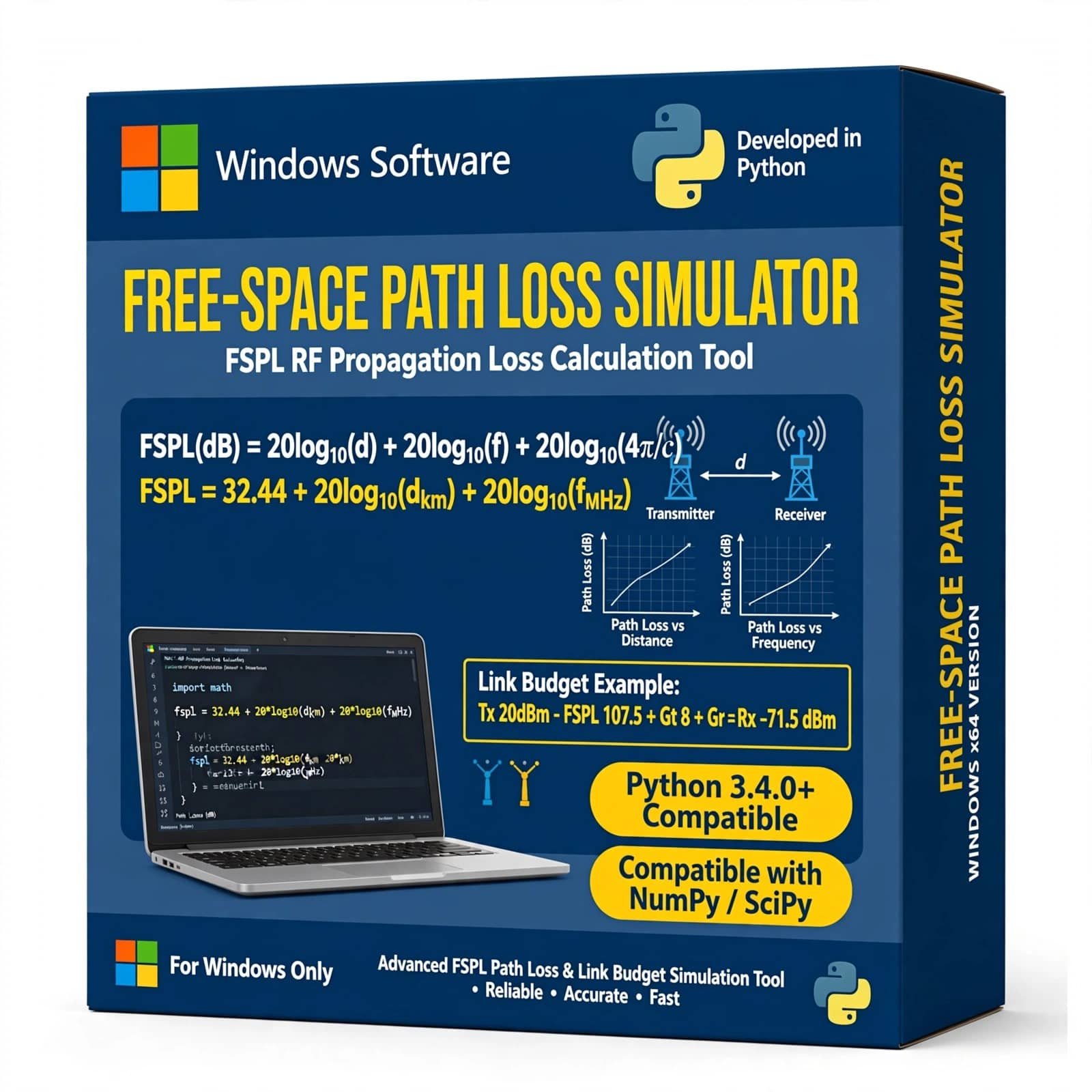
Free Space Path Loss Simulator Using Python is a practical wireless communication simulation project designed to calculate and visualize signal power loss as a radio wave travels through free space. Developed using Python, this simulator helps students, researchers, and communication engineers understand Free Space Path Loss (FSPL), transmission distance, frequency, received signal power, and wireless link performance.
The project provides an easy-to-understand simulation environment for analyzing how distance and operating frequency affect signal propagation. It is suitable for B.Tech, M.Tech, engineering students, academic projects, wireless communication studies, RF analysis, and Python-based simulation projects.
Original price was: ₹750.00.₹250.00Current price is: ₹250.00. -
FiveG Core Simulator v2 is an educational 5G Core Network simulation tool designed to help students, educators, researchers, and telecom professionals understand 5G core architecture, network functions, signaling procedures, latency, and protocol interactions through an interactive topology and signaling animation environment.
Original price was: ₹750.00.₹250.00Current price is: ₹250.00. -
A Python-based 5G Digital Twin solution for creating a virtual representation of 5G network environments, components, and operational behavior. Designed for 5G research, network analysis, simulation, optimization, and academic projects, it enables users to model network scenarios, monitor virtualized network behavior, and experiment with different configurations in a controlled software environment.
Ideal for telecom engineers, researchers, developers, students, and academic institutions working on 5G network planning, performance analysis, intelligent network management, and digital twin research.
Original price was: ₹750.00.₹250.00Current price is: ₹250.00. -
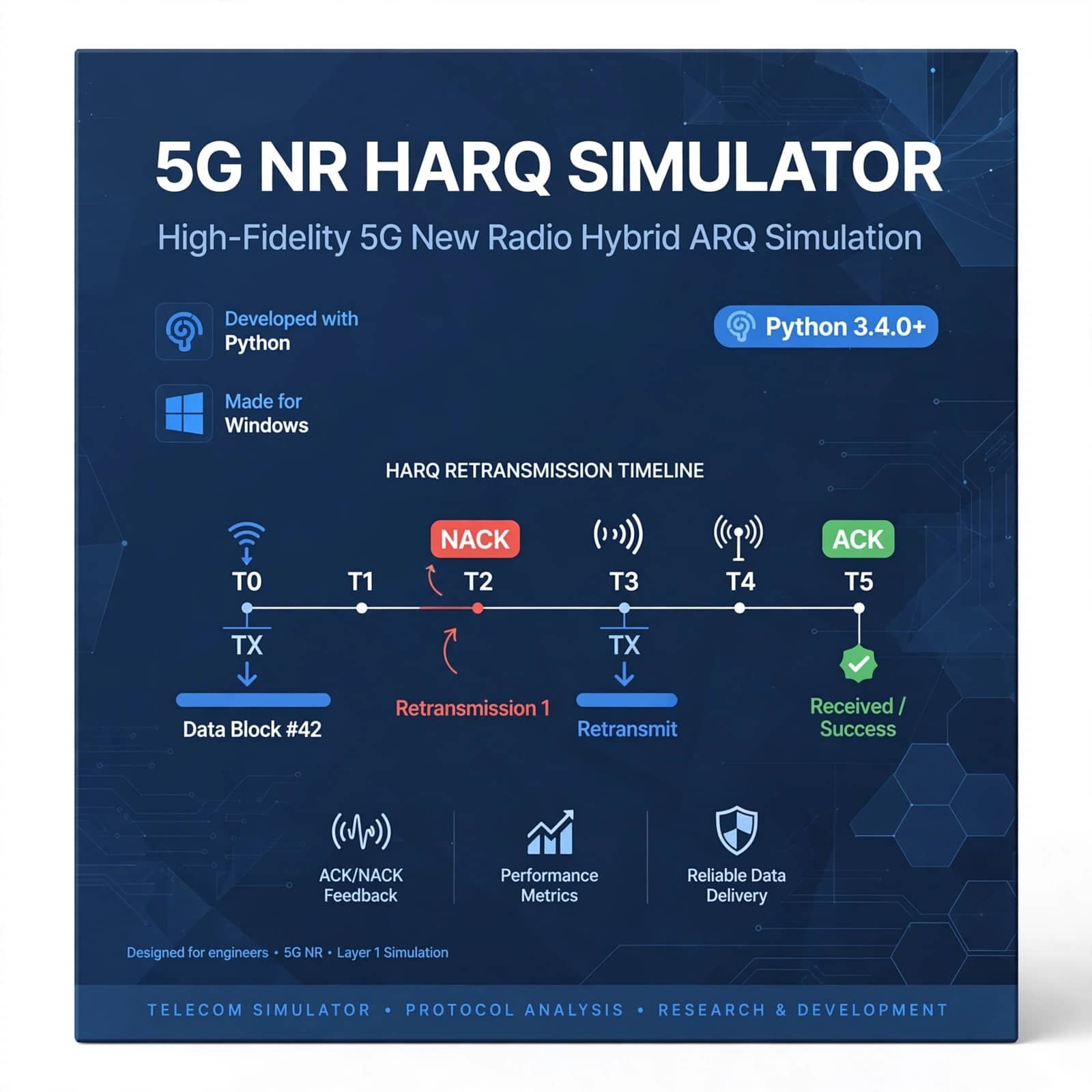
5G NR HARQ Simulator is an advanced simulation solution for modeling and analyzing Hybrid Automatic Repeat Request (HARQ) mechanisms in 5G New Radio networks. It enables users to study HARQ processes, ACK/NACK feedback, retransmissions, link adaptation, channel errors, and communication reliability under configurable network conditions. The simulator supports analysis of throughput, BLER, latency, retransmission rate, packet errors, spectral efficiency, and other key performance metrics, making it suitable for 5G NR research, algorithm development, academic projects, and wireless communication system optimization.
Original price was: ₹750.00.₹250.00Current price is: ₹250.00.






Reviews
There are no reviews yet.