
New
67% Off

DVB-S2 ACM Link Budget Simulator
Original price was: ₹750.00.₹250.00Current price is: ₹250.00.
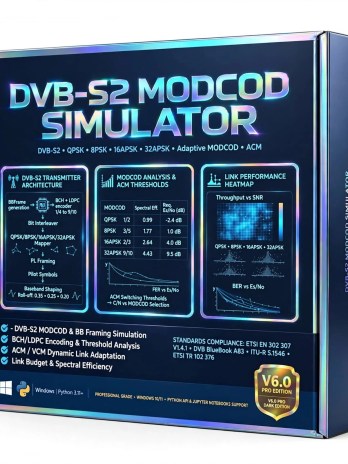
In StockDVB-S2 ACM Link Budget Simulator with Python is a Python-based tool for analyzing satellite communication link budgets with Adaptive Coding and Modulation. It can calculate EIRP, path loss, received power, C/N, Eb/N0, link margin, and evaluate DVB-S2 MODCOD configurations under different channel and propagation conditions.
Description
DVB-S2 ACM Link Budget Simulator
The DVB-S2 ACM Link Budget Simulator with Python is a software-based simulation and analysis tool designed to evaluate satellite communication links using Adaptive Coding and Modulation (ACM). Developed with Python, the simulator provides a practical environment for analyzing satellite link budgets, estimating received signal quality, evaluating link margins, and understanding how different DVB-S2 ACM configurations can be selected according to changing channel conditions.
DVB-S2 (Digital Video Broadcasting – Satellite – Second Generation) is widely used in satellite broadcasting, broadband connectivity, professional communication, and high-throughput satellite systems. One of its important capabilities is support for Adaptive Coding and Modulation, which allows the transmission configuration to be adjusted based on the quality of the communication channel. A DVB-S2 ACM link budget simulator helps users understand this adaptive behavior by combining traditional satellite link-budget calculations with MODCOD and channel-performance analysis.
A satellite link budget is an essential part of communication-system design. It considers the gains and losses that occur between the transmitting earth station, satellite, and receiving station. Important parameters can include transmit power, antenna gain, operating frequency, free-space path loss, atmospheric losses, pointing losses, receiver gain, system noise temperature, and received signal power. By calculating these parameters in Python, the simulator can estimate the overall link performance and available margin.
The DVB-S2 ACM Link Budget Simulator using Python can be designed to calculate important metrics such as EIRP, received power, carrier-to-noise ratio (C/N), energy per bit to noise density ratio (Eb/N0), link margin, free-space path loss, and required signal quality. These calculations allow users to investigate whether a satellite communication link can support a particular DVB-S2 MODCOD configuration under specified operating conditions.
The ACM functionality adds another important dimension to the simulator. Instead of relying on a single fixed modulation and coding configuration, an ACM-enabled system can select among multiple configurations based on channel conditions. For example, a more robust configuration can be considered when the received signal quality decreases, while a higher-efficiency configuration can be selected when the link has sufficient margin. The simulator can model this relationship and demonstrate how ACM can balance communication reliability and transmission efficiency.

Python is particularly suitable for developing this type of satellite communication simulator because it provides powerful numerical, scientific, and visualization libraries. NumPy can be used for mathematical calculations and parameter processing, while SciPy can support scientific computations. Matplotlib can generate link-budget charts, performance curves, and visual comparisons between different ACM configurations.
A typical simulation workflow can begin with user-defined satellite and earth-station parameters. The user can enter values such as transmit power, antenna diameter or gain, frequency, satellite distance, receiver characteristics, atmospheric losses, and other link parameters. The simulator can then calculate the individual gains and losses and produce an overall link-budget result.
The simulator can also analyze the relationship between link margin and DVB-S2 MODCOD selection. By comparing the calculated Eb/N0 or C/N against the required performance threshold for different configurations, the software can identify which configurations are compatible with the simulated channel conditions. This makes the project useful for demonstrating the basic principles behind ACM-based satellite communication.
Another valuable feature is parameter variation and sensitivity analysis. Users can change parameters such as transmit power, antenna gain, frequency, path distance, atmospheric attenuation, or receiver noise characteristics and observe how these changes influence the final link margin. Such analysis can help students and researchers understand which parameters have a significant effect on satellite link performance.
The simulator can provide graphical outputs including link-budget charts, received-power plots, Eb/N0 versus distance graphs, link-margin curves, ACM operating regions, and MODCOD comparison charts. These visualizations can make complex satellite communication calculations easier to understand and can be useful for technical reports, research projects, academic demonstrations, and engineering studies.
For students, the DVB-S2 ACM Link Budget Simulator with Python offers a practical way to connect satellite communication theory with numerical simulation. Concepts such as EIRP, antenna gain, propagation loss, noise temperature, C/N, Eb/N0, link margin, modulation, coding, and adaptive transmission can be explored through configurable simulations rather than theoretical calculations alone.

For researchers and engineers, the simulator can serve as a foundation for evaluating different satellite-link scenarios and ACM strategies. It can be extended to include additional propagation impairments, rain attenuation models, atmospheric losses, satellite coverage scenarios, configurable MODCOD tables, and automated parameter sweeps. Results can also be exported for further analysis or inclusion in technical documentation.
The project can further be enhanced with an interactive graphical user interface. Such an interface could allow users to enter link parameters, select satellite and earth-station configurations, choose ACM settings, run simulations, and view calculated results and plots from a single application. Automated reporting and CSV data export can also make the tool more useful for repeated simulations.
The modular Python architecture allows developers to customize the simulator according to their specific requirements. Additional channel models, satellite parameters, antenna models, ACM algorithms, performance metrics, and visualization features can be incorporated without redesigning the complete application.
Overall, the DVB-S2 ACM Link Budget Simulator with Python provides a flexible platform for studying satellite communication link performance and adaptive transmission. By combining link-budget analysis, DVB-S2 MODCOD evaluation, ACM concepts, Python programming, numerical calculations, and data visualization, the simulator helps users understand how satellite links behave under different operating conditions.
Whether used for satellite communication research, DVB-S2 education, Python engineering projects, link-budget analysis, ACM simulation, or communication-system design studies, this project provides a practical foundation for modeling and analyzing adaptive DVB-S2 satellite links.
Related products
-
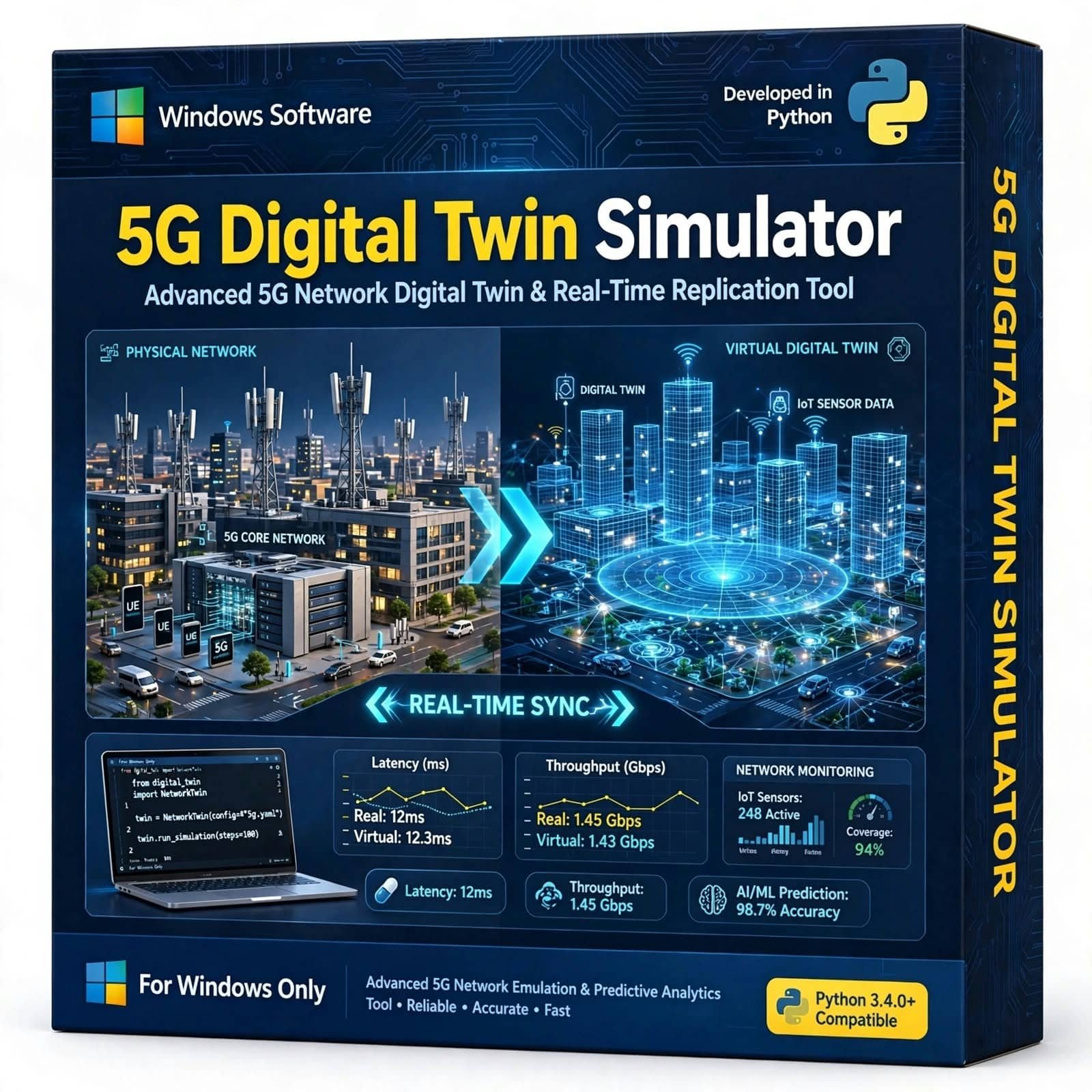
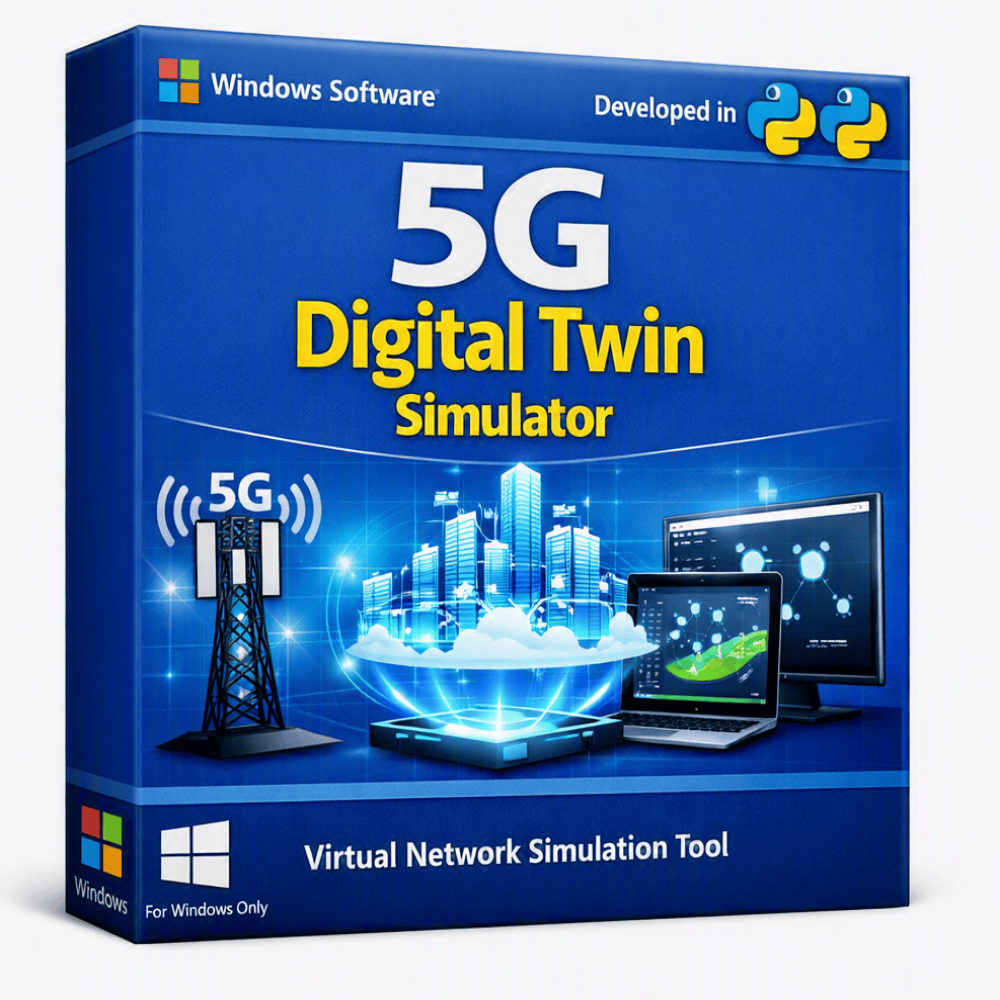
The 5G Digital Twin is a Python-based software solution designed for researchers, engineers, developers, students, and telecommunications professionals interested in modeling, simulating, and analyzing 5G communication networks and their real-world behavior in a virtual environment.
A digital twin provides a virtual representation of a physical or network system, enabling users to study system behavior, evaluate scenarios, analyze performance, and experiment with different configurations. Developed using Python, this 5G Digital Twin can support research, education, network analysis, experimentation, and proof-of-concept development.
Available for sale as a software product. Contact us for pricing, licensing, technical specifications, customization, and purchase information.
Original price was: ₹750.00.₹250.00Current price is: ₹250.00. -
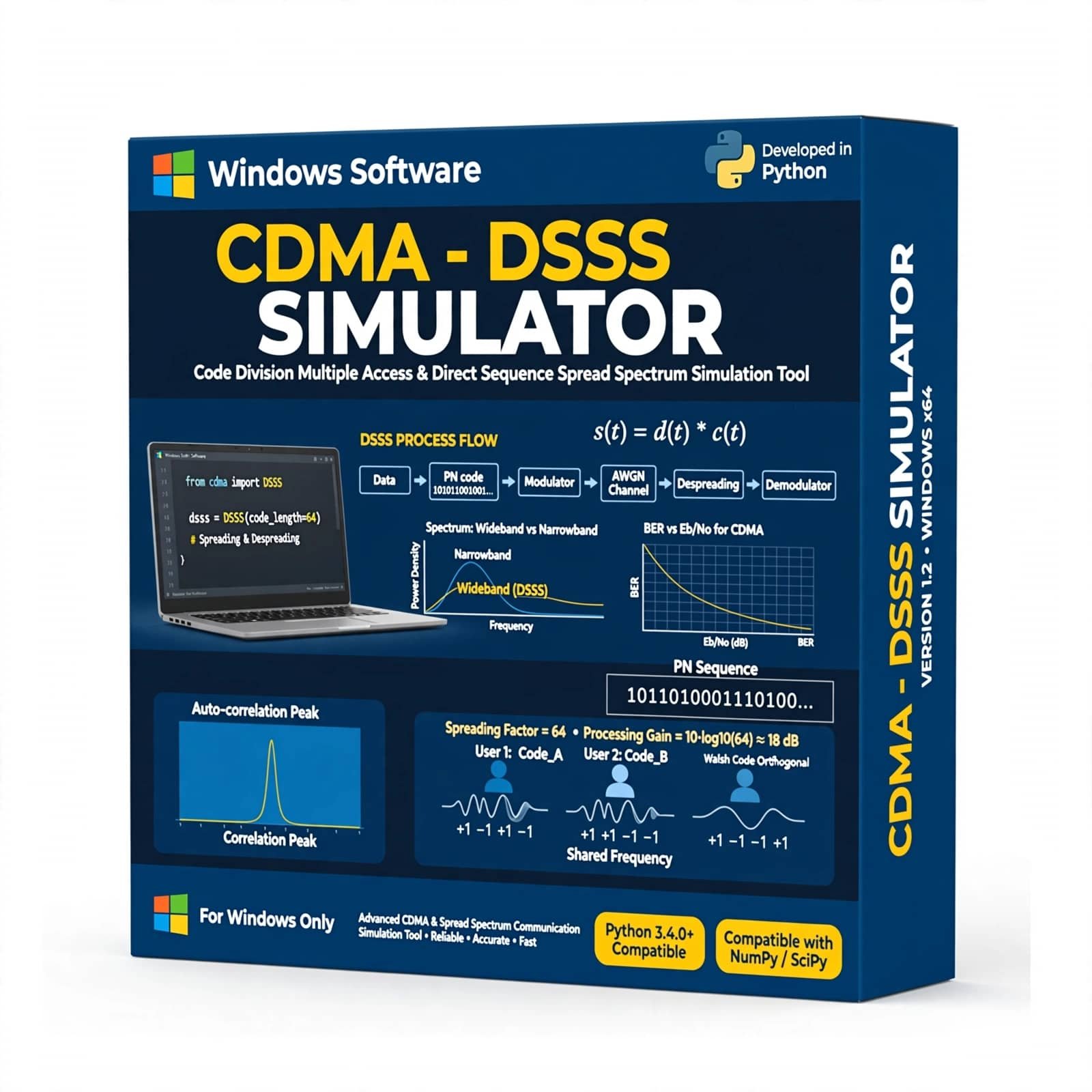
The CDMA – DSSS Simulator with Python is a software-based communication simulation tool designed to demonstrate and analyze Code Division Multiple Access (CDMA) and Direct Sequence Spread Spectrum (DSSS) techniques. Developed using Python, the simulator provides a practical environment for studying spreading codes, signal spreading and despreading, data transmission, multiple-access communication, interference, and signal recovery. It is ideal for digital communication and wireless communication laboratories, engineering education, student projects, technical training, and communication-system research.
Original price was: ₹750.00.₹250.00Current price is: ₹250.00. -
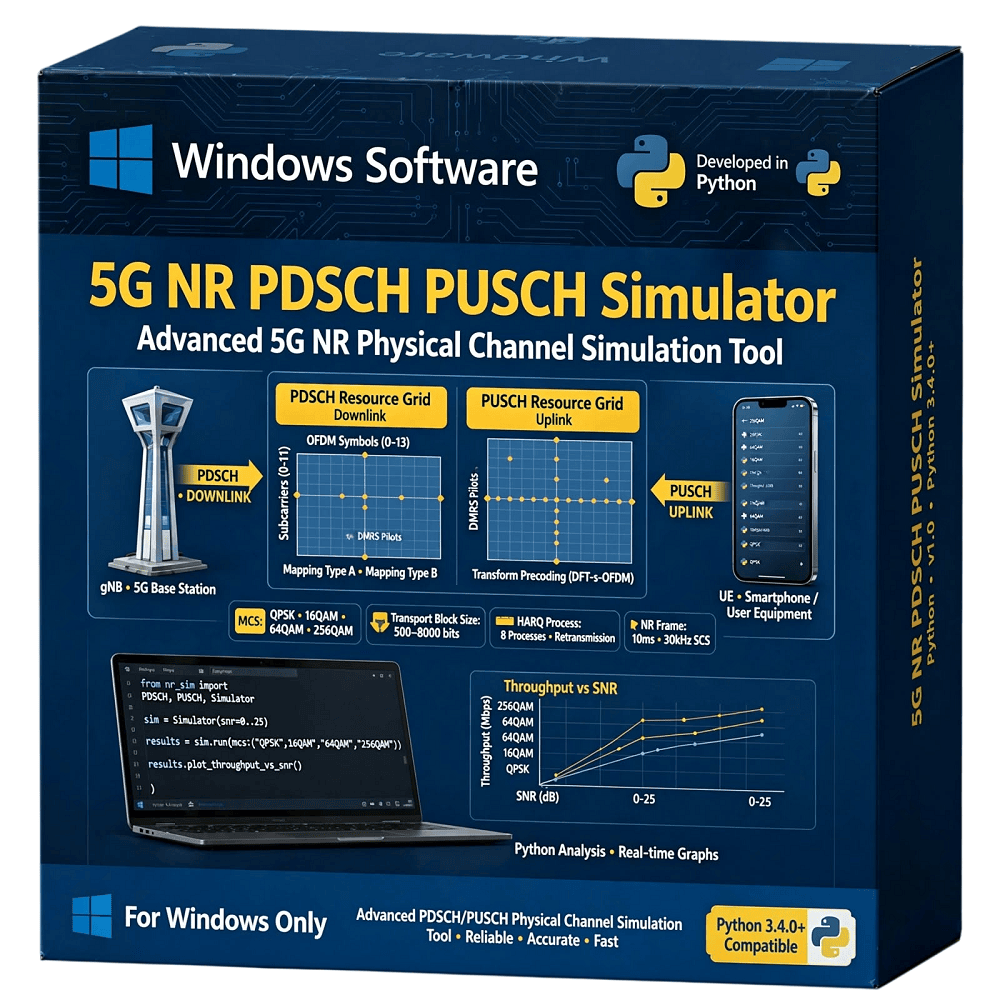
The 5G NR PDSCH PUSCH Simulator is a Python-based simulation software solution designed for researchers, engineers, students, and telecommunications professionals working with 5G New Radio (NR) physical-layer technologies. The simulator provides a practical environment for studying and experimenting with PDSCH (Physical Downlink Shared Channel) and PUSCH (Physical Uplink Shared Channel) transmission concepts.
Developed using Python, the simulator is suitable for academic research, algorithm development, demonstrations, testing, and educational applications related to 5G NR communication systems.
Available for sale as a software product. Contact us for product details, licensing, and purchase information.
Original price was: ₹750.00.₹250.00Current price is: ₹250.00. -
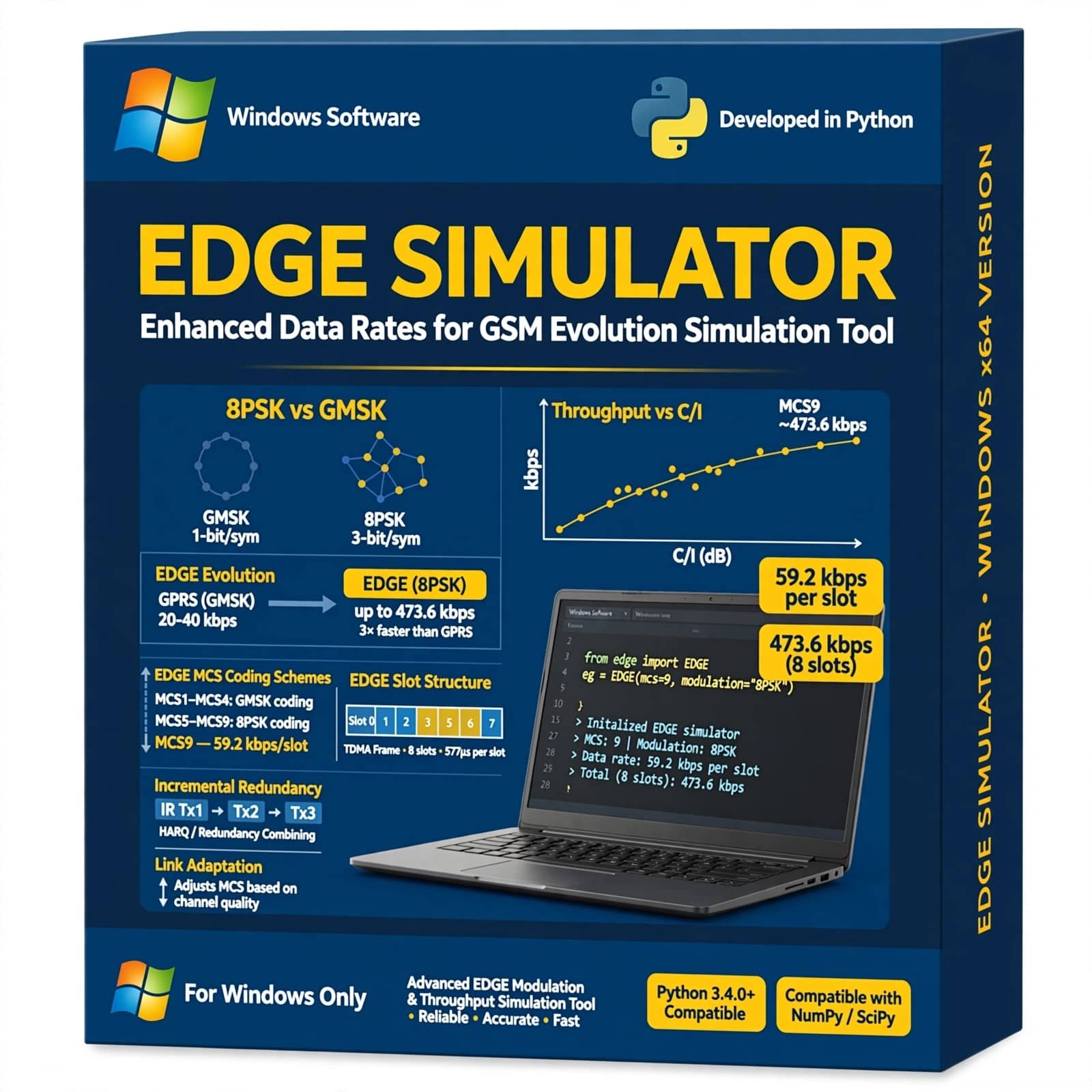
EDGE Simulator Using Python is a practical mobile communication simulation tool designed to demonstrate and analyze Enhanced Data rates for GSM Evolution (EDGE) technology. It helps students, researchers, and communication engineers study GSM/EDGE data transmission, modulation, channel conditions, bit error rate, data rates, and wireless communication performance using Python-based simulation.
Original price was: ₹750.00.₹250.00Current price is: ₹250.00. -
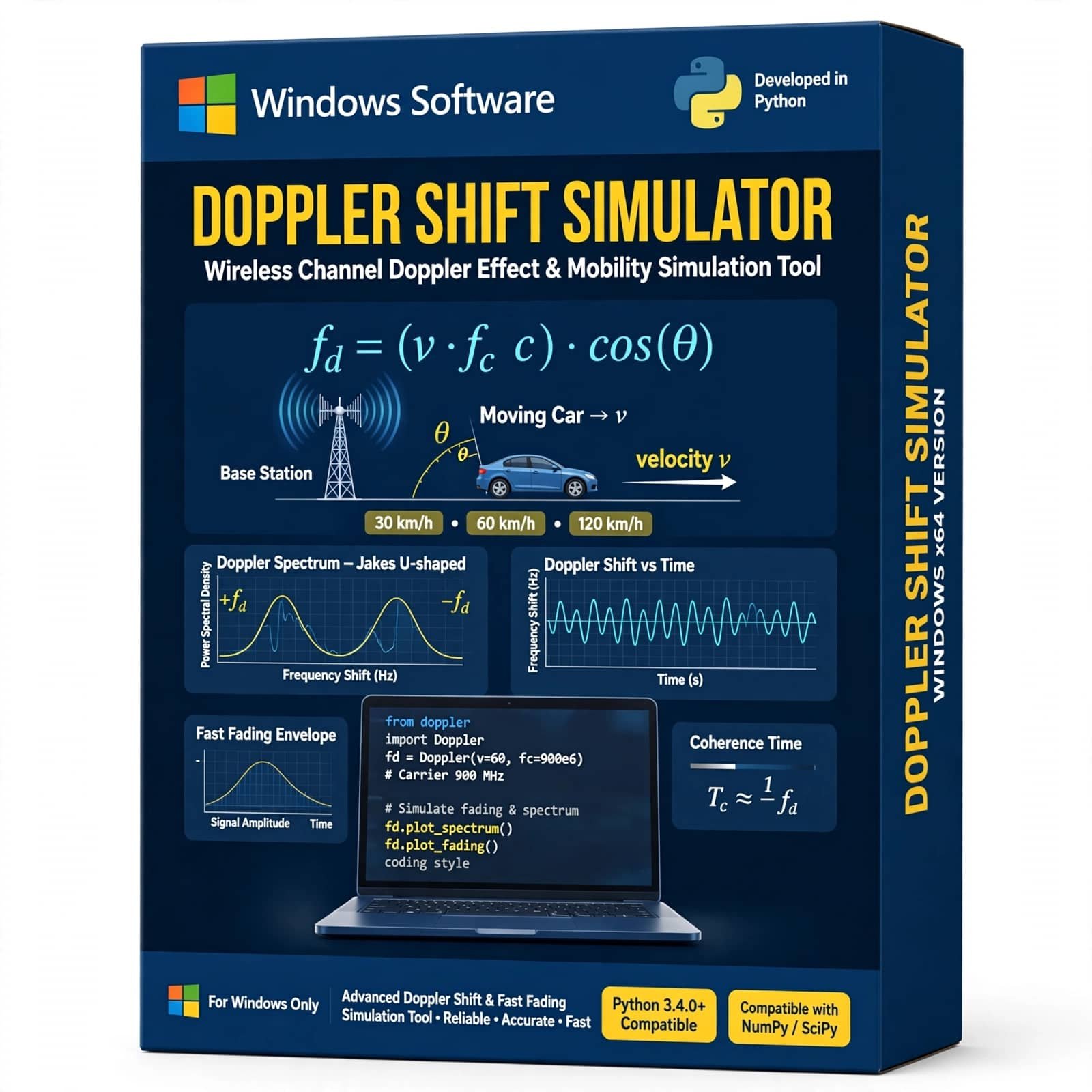
Doppler Shift Simulator Using Python is a practical wireless communication simulation tool for studying the Doppler effect and frequency shift caused by relative motion between a transmitter and receiver. It helps students, researchers, and communication engineers analyze Doppler frequency, carrier frequency, velocity, and mobile channel effects through Python-based simulation.
Original price was: ₹750.00.₹250.00Current price is: ₹250.00. -
A Python-based 5G Digital Twin solution for creating a virtual representation of 5G network environments, components, and operational behavior. Designed for 5G research, network analysis, simulation, optimization, and academic projects, it enables users to model network scenarios, monitor virtualized network behavior, and experiment with different configurations in a controlled software environment.
Ideal for telecom engineers, researchers, developers, students, and academic institutions working on 5G network planning, performance analysis, intelligent network management, and digital twin research.
Original price was: ₹750.00.₹250.00Current price is: ₹250.00.


Reviews
There are no reviews yet.