
New
87% Off

DAMA Simulator
Original price was: ₹750.00.₹100.00Current price is: ₹100.00.
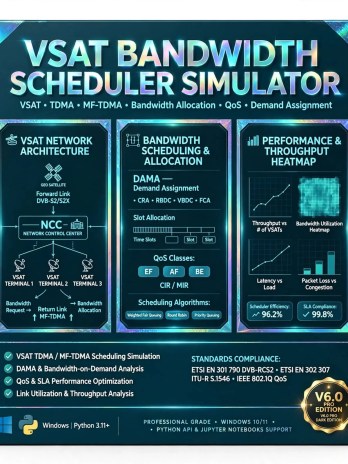
In StockDAMA Simulator with Python is a practical simulation project designed to help students, researchers, and Python developers understand and implement DAMA (Demand Assigned Multiple Access) concepts through programming. The project demonstrates how DAMA-based resource allocation can be simulated using Python, making it useful for academic projects, communication-system studies, networking simulations, and Python-based research work.
Description
DAMA Simulator
The DAMA Simulator with Python is a practical simulation project developed to demonstrate the concepts and working principles of Demand Assigned Multiple Access (DAMA) using the Python programming language. It is suitable for students, researchers, engineering learners, and developers who want to explore communication networks, channel access mechanisms, resource allocation, and simulation techniques through a hands-on Python project.
DAMA, or Demand Assigned Multiple Access, is a resource allocation technique in which communication resources are assigned to users according to their requirements. Instead of permanently allocating resources to every user, the system dynamically assigns available resources based on demand. This approach makes DAMA an important concept for understanding efficient bandwidth utilization and shared communication systems.
With this Python DAMA simulation project, users can study the fundamental behavior of demand-based resource allocation in a simulated environment. The project provides an opportunity to understand how users request communication resources, how resources can be allocated according to demand, and how a system can manage shared resources efficiently.

Learn DAMA Simulation Using Python
Python is widely used for academic simulations because of its readable syntax, extensive libraries, and flexibility. Using Python to implement a DAMA simulator makes it easier to understand the underlying concepts while also gaining practical programming experience.
This project can be useful for students working on Python simulation projects, networking projects, communication engineering assignments, computer science projects, and academic demonstrations. Instead of studying DAMA only from theoretical material, users can explore the concept through a programmable simulation model.
The project can also serve as a foundation for further experimentation. Depending on your requirements, the simulation can be studied or extended to investigate different users, traffic demands, resource availability, allocation strategies, and performance-related parameters.

Key Features of DAMA Simulator with Python
The DAMA Simulator with Python is designed as a practical learning resource for understanding demand-based multiple access and resource allocation. Key areas covered by the project include:
- DAMA-based communication simulation
- Demand-driven resource allocation concepts
- Python-based simulation implementation
- Multiple-user communication scenarios
- Dynamic resource assignment
- Shared communication resource management
- Simulation-oriented programming
- Academic and research project applications
- Scope for customization and experimentation
- Easy-to-understand Python implementation
These features make the project suitable for learners who want to connect theoretical networking and communication concepts with practical programming.

Why Use a DAMA Simulation Project?
Understanding how shared communication resources are managed is important in networking and communication systems. A DAMA approach can be used as an example for studying how resources may be assigned dynamically rather than being permanently dedicated to individual users.
A simulator provides a controlled environment where these concepts can be explored without requiring a physical communication network. Students can use the DAMA simulator project to understand system behavior, experiment with different scenarios, and analyze the effects of changing simulation parameters.
For academic purposes, the project can also be useful as a starting point for a final-year project, mini project, laboratory demonstration, research prototype, or Python programming assignment.

Python-Based Communication Simulation
One of the main advantages of this project is its use of Python for implementing the simulation. Python provides a convenient environment for developing and modifying simulation logic, making it appropriate for learners who are beginning to explore programming-based engineering simulations.
The DAMA Simulator in Python can help users develop practical skills in areas such as programming logic, simulation modeling, parameter handling, resource allocation, and result interpretation.
Students can use the project as a learning reference and potentially modify the implementation according to their academic requirements. Researchers and developers can also use the basic simulation concept as a foundation for developing more advanced communication-system experiments.

Applications
The DAMA Simulator with Python can be relevant to several academic and technical areas, including:
- Communication engineering
- Computer networking
- Wireless communication studies
- Satellite communication concepts
- Resource allocation research
- Network simulation
- Python programming projects
- Engineering final-year projects
- Academic demonstrations
- Research and experimentation
The project is particularly useful when the goal is to demonstrate how multiple users can share limited communication resources through a demand-based allocation mechanism.

Who Can Use This Project?
This DAMA Python project can be useful for:
- Engineering students
- Computer science students
- Electronics and communication students
- Networking students
- Python learners
- Academic researchers
- Project developers
- Students working on simulation projects
Whether you are learning the fundamentals of DAMA or looking for a practical Python-based simulation project, this resource can provide a useful starting point for understanding the relationship between communication theory and software-based simulation.
Build Your Understanding of DAMA with Python
The DAMA Simulator with Python combines communication-system concepts with practical programming. By working with a simulation rather than relying exclusively on theoretical explanations, learners can gain a clearer understanding of how demand-based resource allocation can be represented programmatically.

It can also provide opportunities for customization and further development. Users may explore different traffic conditions, user requirements, allocation parameters, and simulation scenarios depending on their project objectives.
If you are looking for a DAMA simulation project in Python, this project is a practical resource for studying demand assigned multiple access, resource allocation, communication networks, and simulation programming.
Get the DAMA Simulator with Python and use it as a foundation for learning, experimentation, academic projects, and further development in communication and networking simulations.
Related products
-
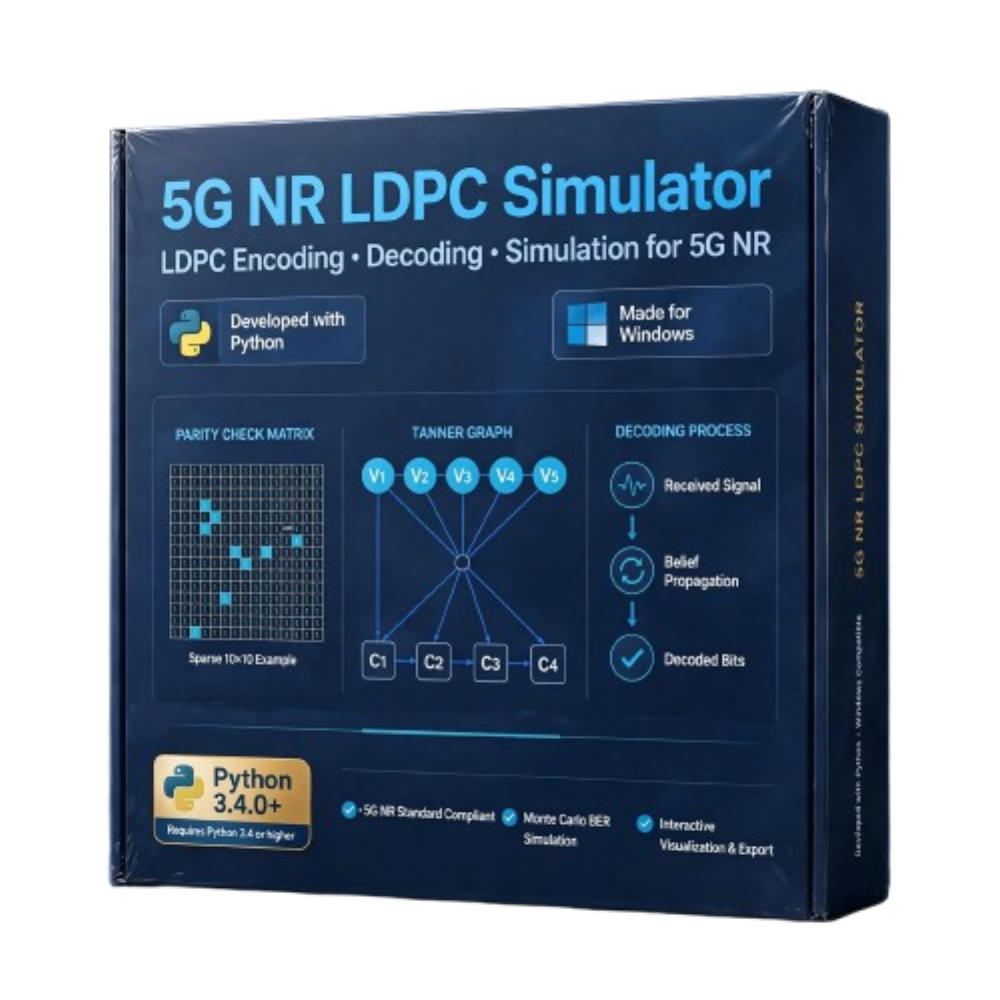
5G NR LDPC Simulator is an advanced simulation solution for modeling and analyzing Low-Density Parity-Check (LDPC) channel coding used in 5G New Radio systems. It enables users to simulate LDPC encoding and decoding, evaluate error correction performance, and analyze BER, BLER, SNR, coding rate, decoding iterations, throughput, and convergence under configurable channel conditions. The simulator is ideal for 5G NR channel coding research, algorithm development, academic projects, decoder performance analysis, and next-generation wireless communication system optimization.
Original price was: ₹750.00.₹250.00Current price is: ₹250.00. -
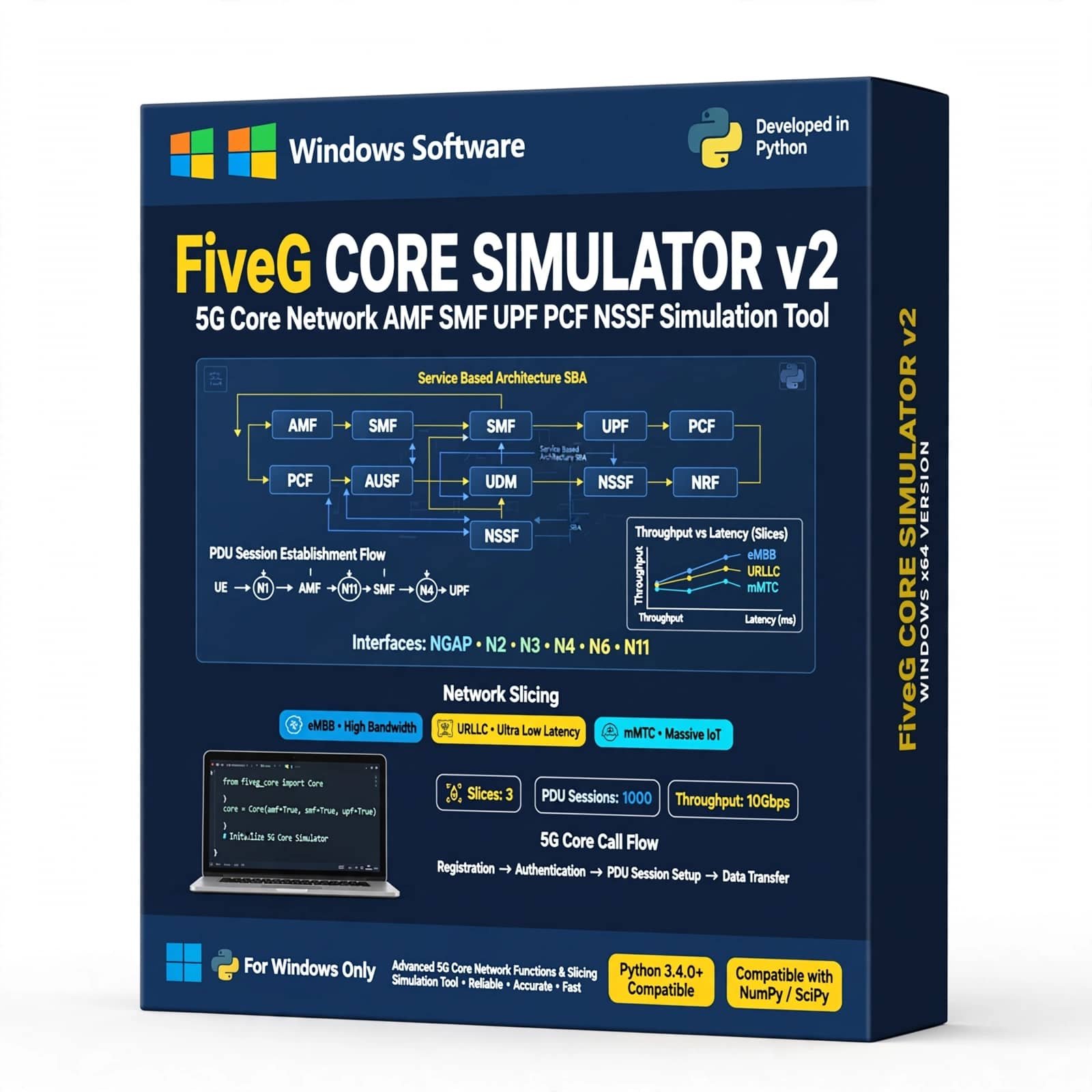
FiveG Core Simulator v2 is an educational 5G Core Network simulation tool designed to help students, educators, researchers, and telecom professionals understand 5G core architecture, network functions, signaling procedures, latency, and protocol interactions through an interactive topology and signaling animation environment.
Original price was: ₹750.00.₹250.00Current price is: ₹250.00. -
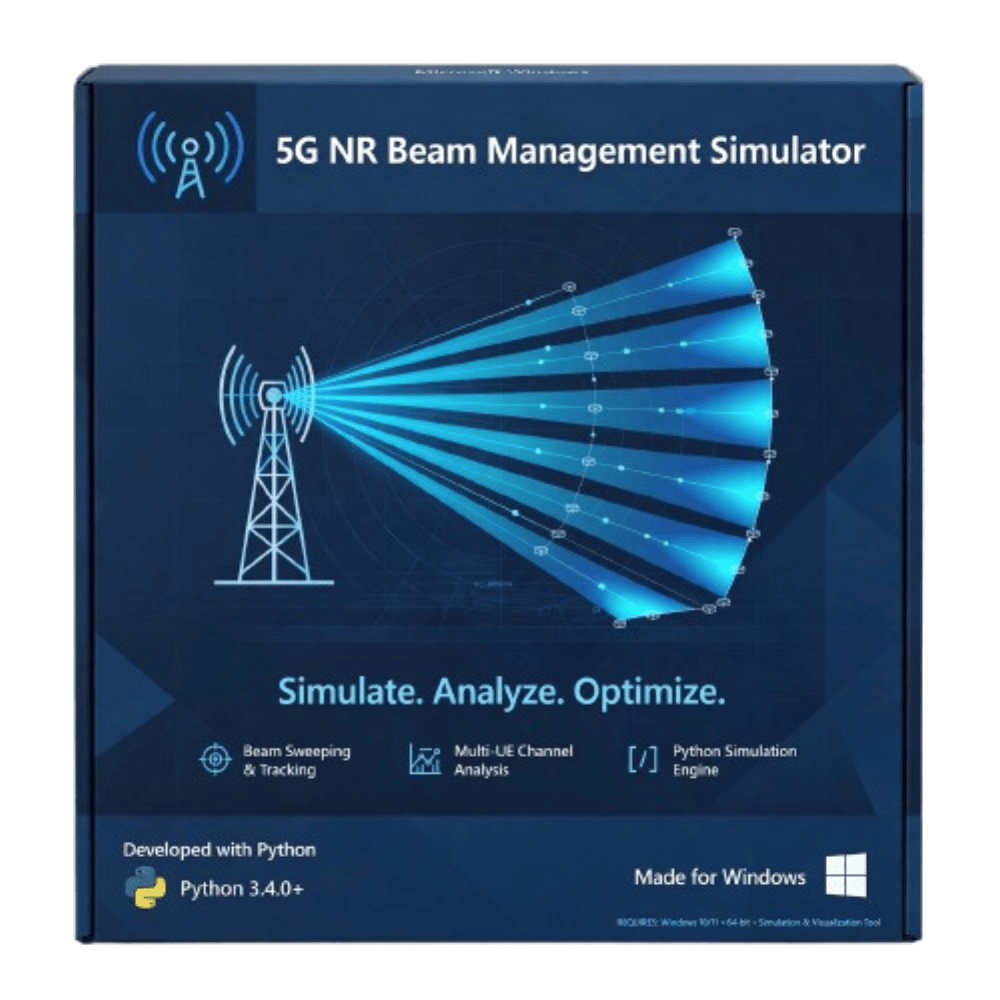
5G NR Beam Management Simulator is an advanced simulation solution designed to model, analyze, and optimize beam management procedures in 5G New Radio (NR) networks. It enables engineers and researchers to evaluate beam sweeping, beam measurement, beam selection, beam reporting, and beam recovery under diverse network and channel conditions. The simulator supports performance analysis of directional communication, helping users assess beamforming strategies, mobility scenarios, link reliability, and system-level performance before real-world deployment.
Original price was: ₹750.00.₹250.00Current price is: ₹250.00. -
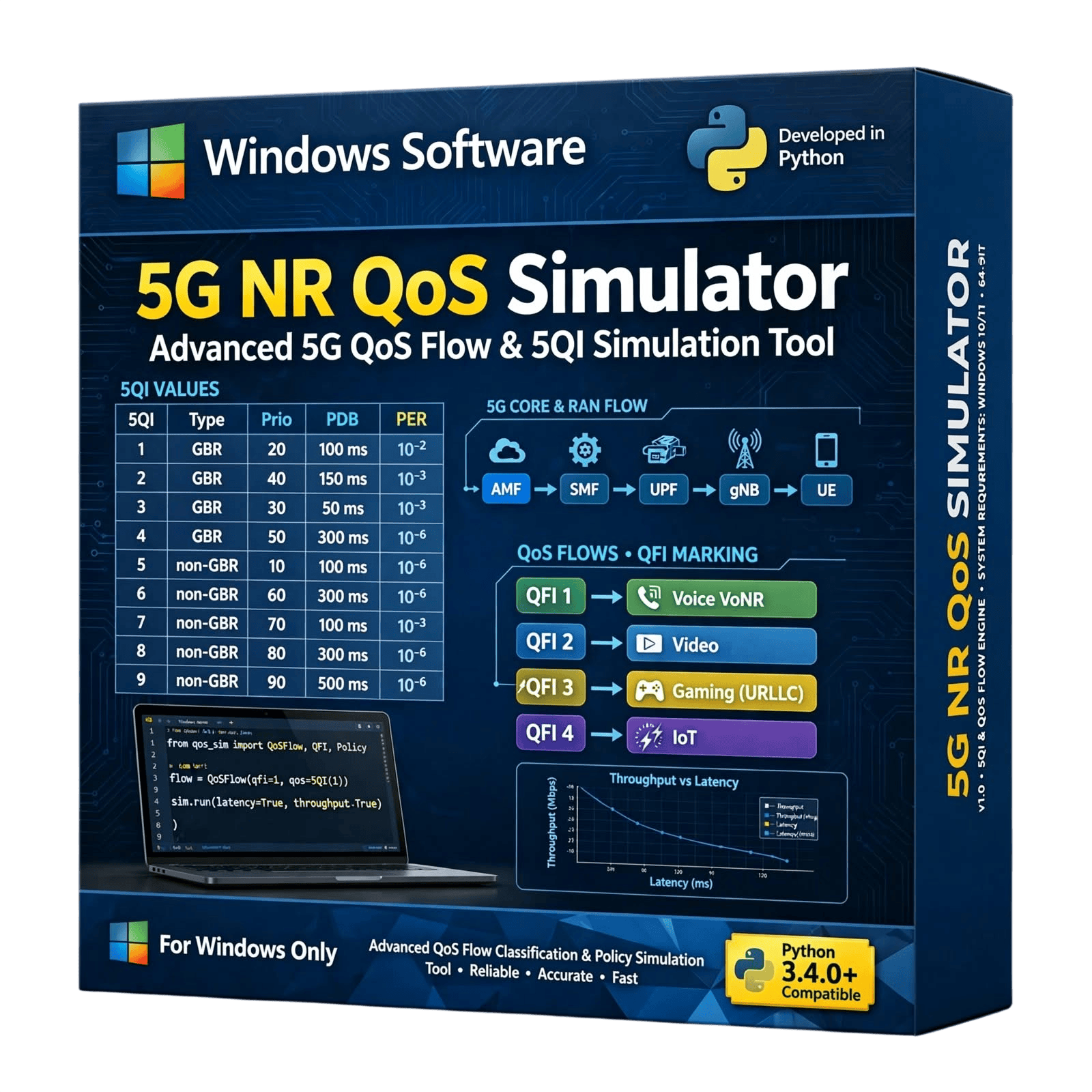
The 5G QoS Simulator is a Python-based software solution designed for researchers, engineers, students, developers, and telecommunications professionals working with 5G Quality of Service (QoS) concepts. The simulator provides a software-based environment for studying and analyzing QoS-related aspects of 5G communication networks, including service performance, traffic behavior, resource management, and network performance evaluation.
Developed using Python, the simulator is suitable for academic research, telecommunications projects, demonstrations, experimentation, algorithm development, and educational applications.
Available for sale as a software product. Contact us for pricing, licensing, features, customization, and purchase information.
Original price was: ₹750.00.₹250.00Current price is: ₹250.00. -
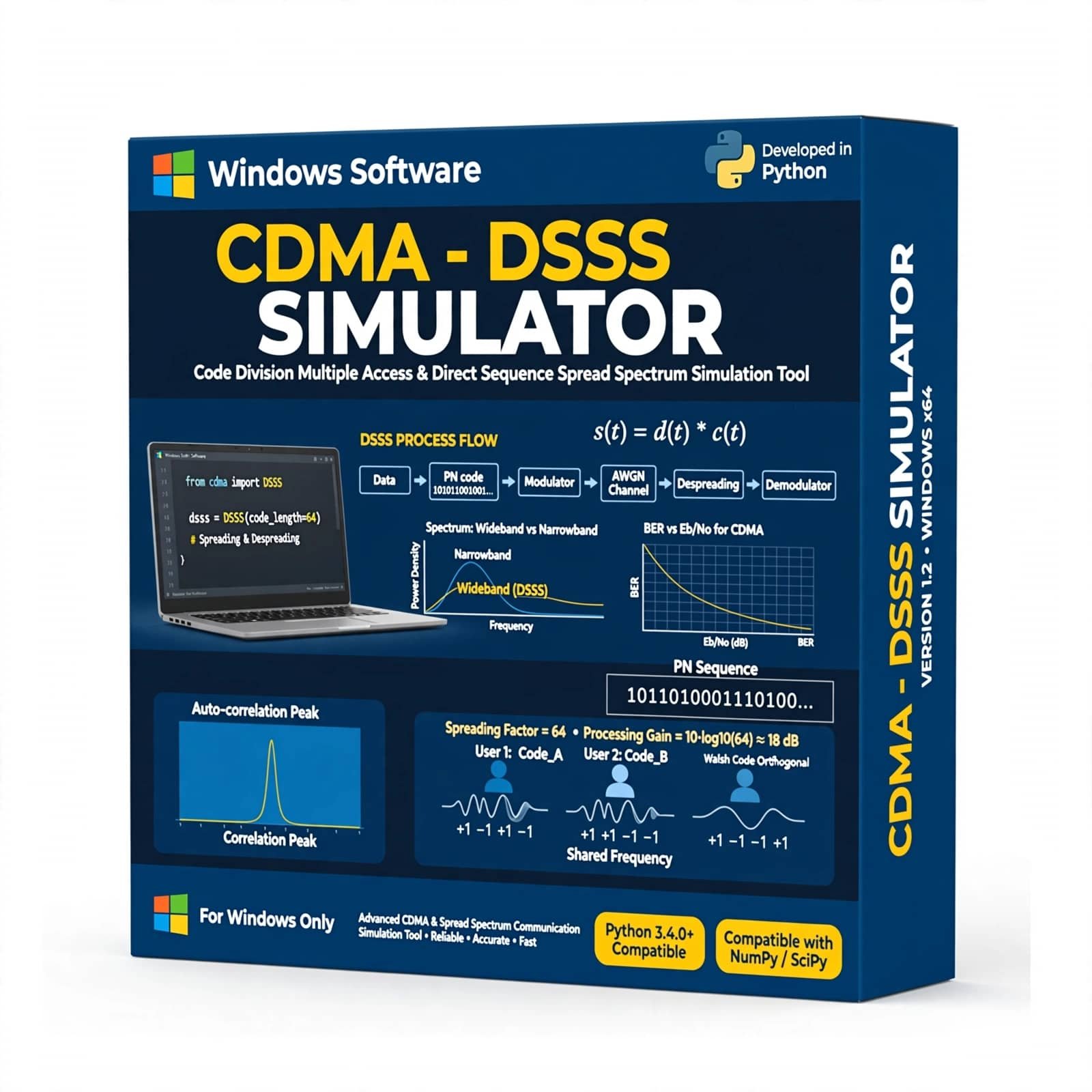
The CDMA – DSSS Simulator with Python is a software-based communication simulation tool designed to demonstrate and analyze Code Division Multiple Access (CDMA) and Direct Sequence Spread Spectrum (DSSS) techniques. Developed using Python, the simulator provides a practical environment for studying spreading codes, signal spreading and despreading, data transmission, multiple-access communication, interference, and signal recovery. It is ideal for digital communication and wireless communication laboratories, engineering education, student projects, technical training, and communication-system research.
Original price was: ₹750.00.₹250.00Current price is: ₹250.00. -
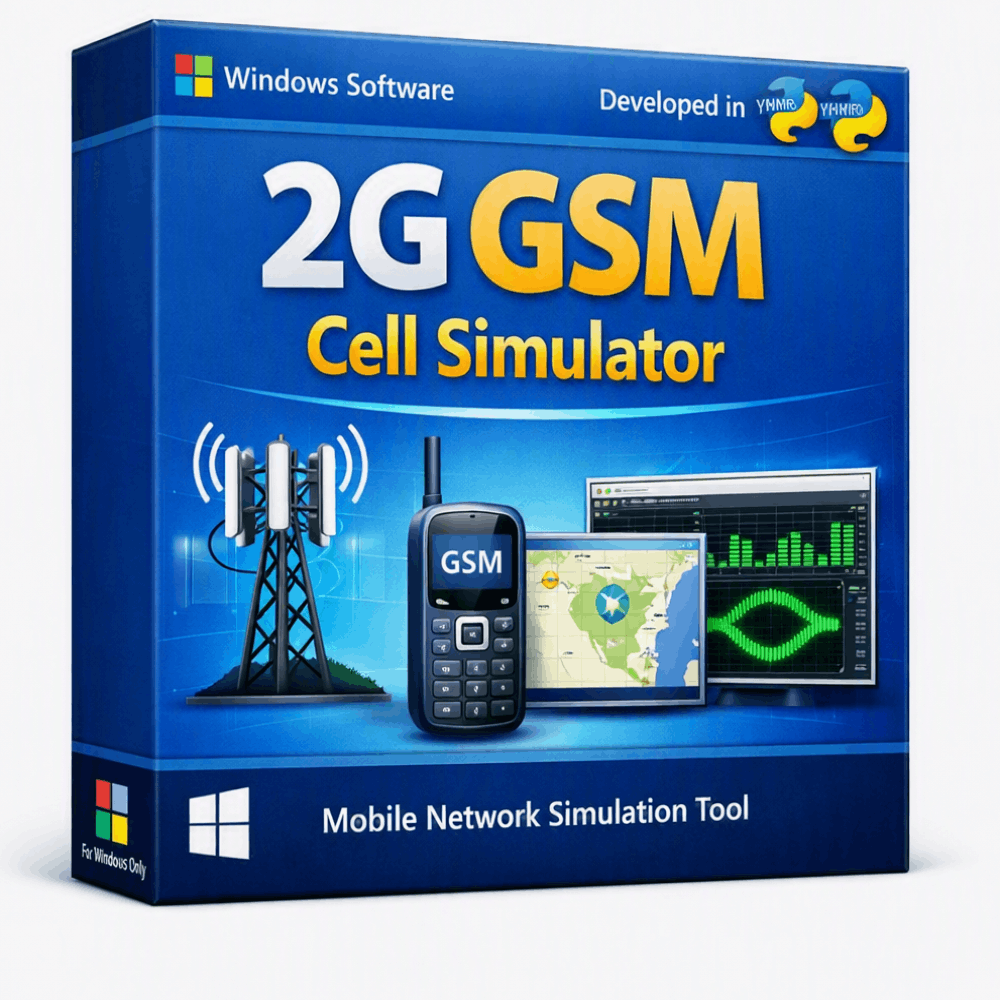
The 2G GSM Cell Simulator is a Python-based software project designed to simulate fundamental GSM cellular-network concepts. It provides a practical environment for understanding mobile stations, GSM cells, base stations, cellular coverage, mobility, communication channels, and basic network behavior. The project includes Python source code that can be studied, customized, and extended for academic projects, demonstrations, research, and learning. It is ideal for Electronics & Communication Engineering, Telecommunications, Computer Science, and related students looking to explore 2G GSM technology and cellular network simulation through a software-based implementation.
Original price was: ₹750.00.₹250.00Current price is: ₹250.00.


Reviews
There are no reviews yet.