
New
67% Off

DVB-S2 MODCOD Simulator

Original price was: ₹750.00.₹250.00Current price is: ₹250.00.
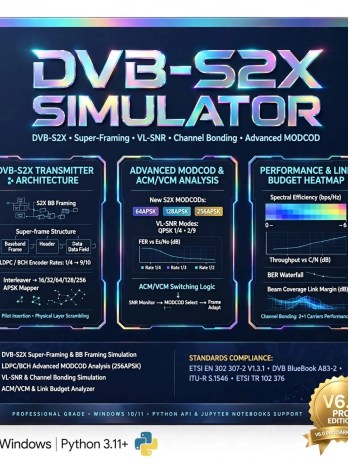
In StockDVB-S2 MODCOD Simulator with Python is a Python-based simulation tool for analyzing DVB-S2 modulation and coding configurations. It enables users to study MODCOD performance through BER, SNR, throughput, spectral efficiency, constellation diagrams, and comparative performance analysis under different satellite communication channel conditions.
Description
DVB-S2 MODCOD Simulator
The DVB-S2 MODCOD Simulator with Python is a software-based simulation tool designed to model, evaluate, and analyze the performance of DVB-S2 Modulation and Coding (MODCOD) schemes in digital satellite communication systems. Developed using Python, the simulator provides a flexible environment for studying how different modulation and coding configurations affect satellite communication performance, including data throughput, spectral efficiency, signal quality, and bit error rate.
DVB-S2, or Digital Video Broadcasting – Satellite – Second Generation, is a widely used standard for satellite broadcasting, broadband communication, professional services, and other high-performance satellite applications. One of the important characteristics of DVB-S2 is its use of multiple MODCOD configurations, allowing communication systems to adapt transmission parameters according to channel conditions and required service performance. A Python-based DVB-S2 MODCOD simulator provides an effective way to understand and experiment with these configurations through software simulation.
The term MODCOD combines modulation and coding. Modulation determines how digital information is represented on a carrier signal, while channel coding adds redundancy to improve the ability of the receiver to recover information in the presence of noise and channel impairments. By simulating different MODCOD configurations, users can study the trade-offs between transmission efficiency, robustness, bandwidth utilization, and communication reliability.
The DVB-S2 MODCOD Simulator using Python can model important stages of a satellite communication system, including input data generation, encoding, modulation, channel transmission, demodulation, decoding, and performance measurement. The simulated communication link can be exposed to different levels of noise or signal degradation, allowing users to evaluate how individual MODCOD configurations perform under changing channel conditions.
One of the main applications of the simulator is BER performance analysis. By running simulations across a range of Signal-to-Noise Ratio (SNR) or energy-per-bit-to-noise-density values, users can generate performance curves and compare the error behavior of different MODCOD configurations. These results can help demonstrate the relationship between coding strength, modulation order, channel quality, and reliable data transmission.

Python provides an excellent development platform for this type of simulator because of its extensive scientific computing and visualization capabilities. Libraries such as NumPy, SciPy, and Matplotlib can be used for numerical operations, signal processing, simulation management, and graphical representation of results. The modular nature of Python also makes it possible to add new modulation schemes, coding configurations, channel models, and performance metrics as the project develops.
The simulator can be configured to analyze commonly used DVB-S2 modulation schemes and associated coding configurations. Depending on the implementation, users can experiment with different modulation orders and coding rates and observe how these parameters influence system performance. Comparative graphs can be generated to visualize differences in BER, throughput, spectral efficiency, and required signal quality.
Another useful feature of a DVB-S2 MODCOD simulator is adaptive performance analysis. Satellite communication systems can select different transmission configurations depending on channel conditions. A simulation environment can demonstrate this concept by evaluating multiple MODCOD options across different channel-quality levels. Users can investigate how selecting a more robust configuration can improve reliability under poor conditions, while higher-efficiency configurations can provide greater data throughput when channel conditions permit.
The simulator can also generate useful visualizations such as constellation diagrams, BER-versus-SNR curves, throughput comparisons, spectral-efficiency charts, and received signal plots. These graphical outputs make the project suitable for academic demonstrations and technical analysis, while helping users understand the practical impact of modulation and coding decisions.
For students and researchers, the DVB-S2 MODCOD Simulator with Python provides a practical platform for exploring important concepts in digital communication and satellite engineering. It can be used to demonstrate modulation, forward error correction, channel noise, signal detection, decoding, and performance evaluation. Students can modify simulation parameters and observe how changes affect the communication link.

For engineers and developers, the simulator can provide a foundation for testing communication algorithms and evaluating system configurations before moving to hardware-based implementations. Automated simulations can be used to test multiple MODCOD combinations, collect performance results, and generate comparative reports.
The project can be further enhanced with features such as configurable channel models, automated SNR sweeps, MODCOD selection menus, CSV result export, performance dashboards, interactive plots, and graphical user interfaces. Integration with software-defined radio platforms can also provide opportunities to extend the simulation environment toward practical signal-generation and signal-analysis applications.
A Python-based architecture also makes the project highly customizable. Developers can introduce additional modulation methods, coding algorithms, channel impairments, receiver processing techniques, and performance metrics according to their research requirements. This flexibility makes the simulator useful for academic projects, research experiments, communication-system studies, and prototype development.
Overall, the DVB-S2 MODCOD Simulator with Python provides a practical and extensible environment for studying the relationship between modulation, channel coding, signal quality, and transmission performance in satellite communication systems. By combining digital communication theory with Python programming, numerical simulation, and data visualization, the project helps users investigate DVB-S2 MODCOD behavior in a clear and measurable way.
Whether used for DVB-S2 research, satellite communication education, Python projects, digital communication simulation, or engineering experimentation, this simulator offers a useful foundation for understanding how different modulation and coding configurations influence the efficiency and reliability of a DVB-S2 communication link.

Related products
-
Cell Coverage Simulator is a wireless communication simulation tool designed to model and analyze cellular network coverage using Python. It helps students, researchers, and telecom professionals visualize cell coverage, signal propagation, coverage areas, and network planning concepts through practical simulation and analysis.
Original price was: ₹750.00.₹250.00Current price is: ₹250.00. -
A Python-based 5G Digital Twin solution for creating a virtual representation of 5G network environments, components, and operational behavior. Designed for 5G research, network analysis, simulation, optimization, and academic projects, it enables users to model network scenarios, monitor virtualized network behavior, and experiment with different configurations in a controlled software environment.
Ideal for telecom engineers, researchers, developers, students, and academic institutions working on 5G network planning, performance analysis, intelligent network management, and digital twin research.
Original price was: ₹750.00.₹250.00Current price is: ₹250.00. -
The Beamforming Simulator is a practical wireless communication simulation project designed to demonstrate how antenna arrays can control and direct radio-frequency signals toward desired users or directions. The simulator helps visualize beam patterns, signal direction, antenna-array behavior, and beam steering under different parameters. It is suitable for studying beamforming, antenna arrays, MIMO, 5G communication, wireless networks, and signal processing. This project is ideal for engineering students, researchers, and learners working on wireless communication and advanced antenna technologies.
Original price was: ₹750.00.₹250.00Current price is: ₹250.00. -
CDMA Power Control Simulator is an advanced communication engineering simulation tool designed to help students, researchers, and professionals understand and analyze power control techniques in Code Division Multiple Access (CDMA) wireless communication systems. It enables practical study of uplink and downlink power control, signal interference, power levels, and system performance.
Original price was: ₹750.00.₹250.00Current price is: ₹250.00. -
5G NR Massive MIMO Simulator is an advanced simulation solution for modeling and analyzing Massive Multiple-Input Multiple-Output (MIMO) technologies in 5G New Radio networks. It enables users to study large-scale antenna arrays, beamforming, precoding, spatial multiplexing, multi-user MIMO, channel estimation, and interference under configurable channel conditions. The simulator supports analysis of throughput, spectral efficiency, SINR, BER, BLER, MIMO capacity, beamforming gain, and multi-user performance, making it ideal for 5G NR research, algorithm development, academic projects, and 5G/6G wireless system optimization.
Original price was: ₹750.00.₹250.00Current price is: ₹250.00. -
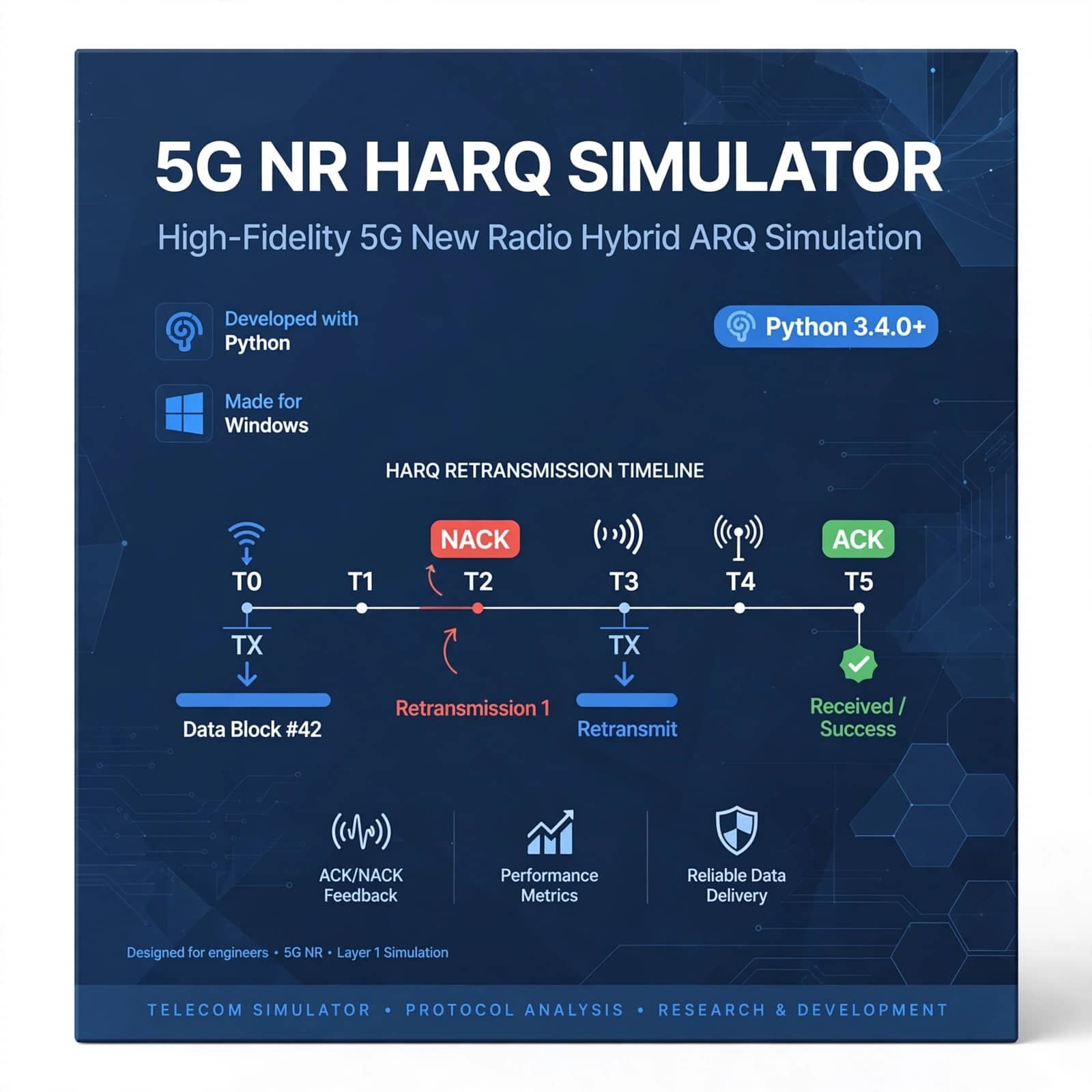
5G NR HARQ Simulator is an advanced simulation solution for modeling and analyzing Hybrid Automatic Repeat Request (HARQ) mechanisms in 5G New Radio networks. It enables users to study HARQ processes, ACK/NACK feedback, retransmissions, link adaptation, channel errors, and communication reliability under configurable network conditions. The simulator supports analysis of throughput, BLER, latency, retransmission rate, packet errors, spectral efficiency, and other key performance metrics, making it suitable for 5G NR research, algorithm development, academic projects, and wireless communication system optimization.
Original price was: ₹750.00.₹250.00Current price is: ₹250.00.






Reviews
There are no reviews yet.