
New
67% Off

Convolutional – Viterbi Simulator

Original price was: ₹750.00.₹250.00Current price is: ₹250.00.
In StockConvolutional – Viterbi Simulator with Python is a practical software tool for studying, simulating, and analyzing convolutional encoding and Viterbi decoding using Python. It is designed for students, researchers, communication engineers, and developers working with digital communications, error-control coding, wireless communication, and signal processing. Simulate convolutional codes, encode data, introduce transmission errors, and explore Viterbi decoding concepts in a convenient Python-based environment.
Description
Convolutional – Viterbi Simulator with Python
Understanding error-control coding is an important part of digital communication system design. Convolutional codes and the Viterbi algorithm are widely studied techniques for improving the reliability of data transmission over noisy communication channels. The Convolutional – Viterbi Simulator with Python provides a practical software environment for learning, experimenting with, and analyzing these concepts using Python.
Instead of working only with mathematical equations and theoretical examples, users can explore the complete process of convolutional encoding and Viterbi decoding through simulation. This makes the software useful for academic projects, communication-system research, algorithm development, laboratory exercises, and Python-based digital communication experiments.
Python-Based Convolutional Coding Simulation
Python provides a flexible environment for implementing communication algorithms and analyzing their behavior. With this simulator, users can work with convolutional coding concepts and investigate how encoded data can be recovered at the receiver using Viterbi decoding.
The software can be used to understand the relationship between input data, encoded sequences, channel errors, and decoded output. By changing simulation parameters and observing the resulting data, users can gain a clearer understanding of how error-control coding works in practical communication systems.
Explore the Viterbi Decoding Algorithm
The Viterbi algorithm is a well-known maximum-likelihood decoding technique commonly associated with convolutional codes. It uses a trellis-based approach to identify the most likely transmitted sequence from the received data.
For students and engineers learning digital communications, the algorithm can initially appear complex because it involves states, branches, path metrics, and sequence decisions. A simulation environment provides an opportunity to study these concepts step by step.
Using Python-based simulation, users can investigate how the decoder evaluates possible paths and selects an appropriate decoded sequence. This makes the simulator useful for educational demonstrations as well as algorithm development and experimentation.
Simulate Error-Control Coding
Communication channels can introduce errors into transmitted information. Error-control coding techniques add structured redundancy to transmitted data so that the receiver can detect or correct certain errors.
The Convolutional – Viterbi Simulator can be used to explore this process by creating input data, applying convolutional encoding, simulating transmission conditions, and analyzing the decoded output. This allows users to investigate how coding and decoding affect communication reliability.

Useful for Digital Communication Projects
The simulator is suitable for a wide range of digital communication and signal-processing applications. It can support experimentation with coding techniques without requiring specialized communication hardware.
Typical applications include:
- Digital communication system simulation
- Convolutional coding experiments
- Viterbi decoder development
- Error-control coding research
- Wireless communication studies
- Communication engineering projects
- Python-based signal processing
- Algorithm testing and prototyping
- Academic laboratory assignments
- Engineering demonstrations and training
Educational Tool for Students
Convolutional coding and Viterbi decoding are commonly encountered in communication engineering and digital signal processing courses. Students often need to understand not only the mathematical theory but also how the algorithms behave when processing actual data.
A Python-based simulator can bridge the gap between theory and implementation. Students can experiment with coding parameters, examine encoded sequences, introduce errors, and observe how decoding changes the recovered information.
This practical approach can make complex communication concepts easier to investigate and can also provide a foundation for developing larger communication-system simulations.
Research and Algorithm Development
Researchers and communication engineers can use simulation software to prototype algorithms and evaluate different scenarios before implementing them in hardware or a larger communication system.
Python makes it convenient to modify simulation logic, automate experiments, analyze results, and integrate the simulation with other scientific or engineering software. The simulator can therefore be useful as part of a broader research workflow involving digital communications, coding theory, signal processing, and wireless systems.
Understand Trellis-Based Decoding
One of the important concepts associated with convolutional codes and Viterbi decoding is the trellis representation. A trellis illustrates possible encoder states and transitions over time.
Studying the trellis through simulation can help users understand how a decoder evaluates different paths through the state diagram. By observing the decoding process, users can develop a more practical understanding of concepts such as state transitions, path metrics, survivor paths, and decoded sequences.

Key Benefits
- Python-based convolutional coding simulation
- Viterbi decoder simulation and experimentation
- Useful for digital communication education
- Helps demonstrate error-control coding concepts
- Suitable for communication engineering projects
- Useful for algorithm development and prototyping
- Supports experimentation with encoded and decoded data
- Helps visualize and understand Viterbi decoding concepts
- Suitable for research and academic projects
- Can be integrated into Python-based communication simulations
Who Can Use This Product?
Convolutional – Viterbi Simulator with Python is suitable for communication engineers, electronics engineers, Python developers, researchers, engineering students, educators, and anyone studying digital communication and error-control coding.
It can be particularly useful for students working on communication-system projects, researchers testing coding algorithms, and developers who want to understand or prototype convolutional encoding and Viterbi decoding in Python.
Product Summary
The Convolutional – Viterbi Simulator with Python provides a practical way to explore convolutional coding and Viterbi decoding through software simulation. It combines communication theory with Python-based experimentation, helping users investigate encoding, transmission errors, decoding, and error-control concepts in a controlled environment.
Whether you are studying digital communications, developing a college project, researching error-control coding, or prototyping a communication algorithm, this simulator provides a useful environment for experimentation and learning.
Explore convolutional coding and Viterbi decoding with Python and develop a deeper practical understanding of error-control techniques used in digital communication systems.
Related products
-
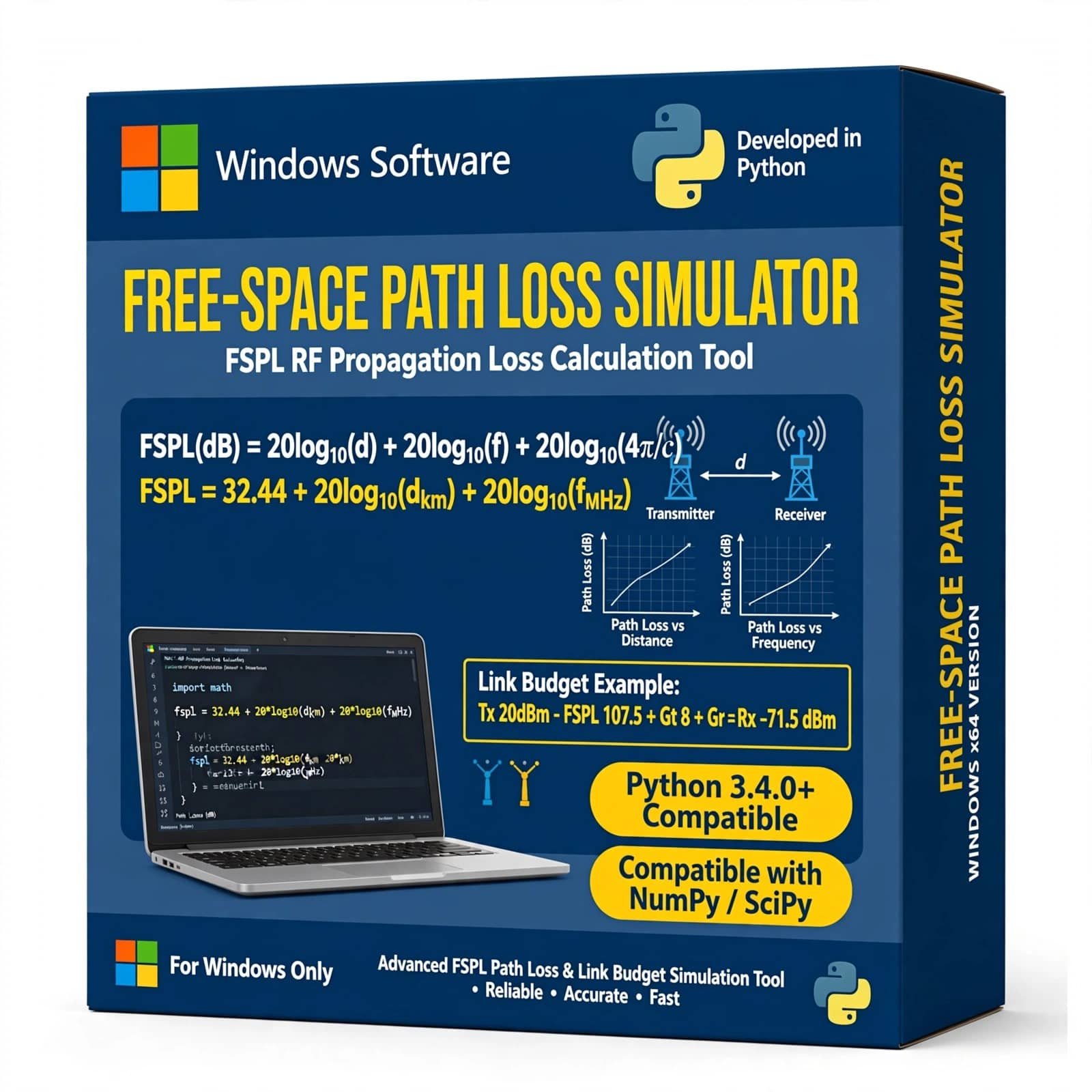
Free Space Path Loss Simulator Using Python is a practical wireless communication simulation project designed to calculate and visualize signal power loss as a radio wave travels through free space. Developed using Python, this simulator helps students, researchers, and communication engineers understand Free Space Path Loss (FSPL), transmission distance, frequency, received signal power, and wireless link performance.
The project provides an easy-to-understand simulation environment for analyzing how distance and operating frequency affect signal propagation. It is suitable for B.Tech, M.Tech, engineering students, academic projects, wireless communication studies, RF analysis, and Python-based simulation projects.
Original price was: ₹750.00.₹250.00Current price is: ₹250.00. -
dBm Calculator Using C++ is a practical software tool for calculating and converting radio frequency and electrical power values in dBm. It helps students, researchers, and communication engineers understand power measurements, signal strength, dBm-to-watt conversions, and RF calculations through a simple C++ implementation.
Original price was: ₹750.00.₹100.00Current price is: ₹100.00. -
GSM Mobile Station Simulator – C++ Educational Software is an interactive educational simulator designed to demonstrate key GSM mobile station concepts, including MS hardware and identity, SIM card status, battery level, authentication, network registration, cell connectivity, signal strength, mobility, and Call/SMS states. Developed in C++, this simulator provides a simple visual environment for learning and demonstrating GSM network and mobile-station behavior.
Original price was: ₹750.00.₹100.00Current price is: ₹100.00. -
An AWGN Simulator i.e. Additive White Gaussian Noise Simulator developed using Python is a software-based tool designed to demonstrate and analyze the effect of Gaussian noise on digital communication signals. The simulator generates a clean input signal, adds controlled amounts of AWGN, and displays both the original and noisy signals for comparison. Users can vary parameters such as noise power, signal-to-noise ratio (SNR), and signal characteristics to observe how communication quality changes under different noise conditions. Python libraries such as NumPy, SciPy, and Matplotlib can be used for signal generation, noise modeling, numerical processing, and graphical visualization but this is purely from tkinter only. The simulator is useful for understanding fundamental concepts of wireless and digital communication systems.
Original price was: ₹750.00.₹250.00Current price is: ₹250.00. -
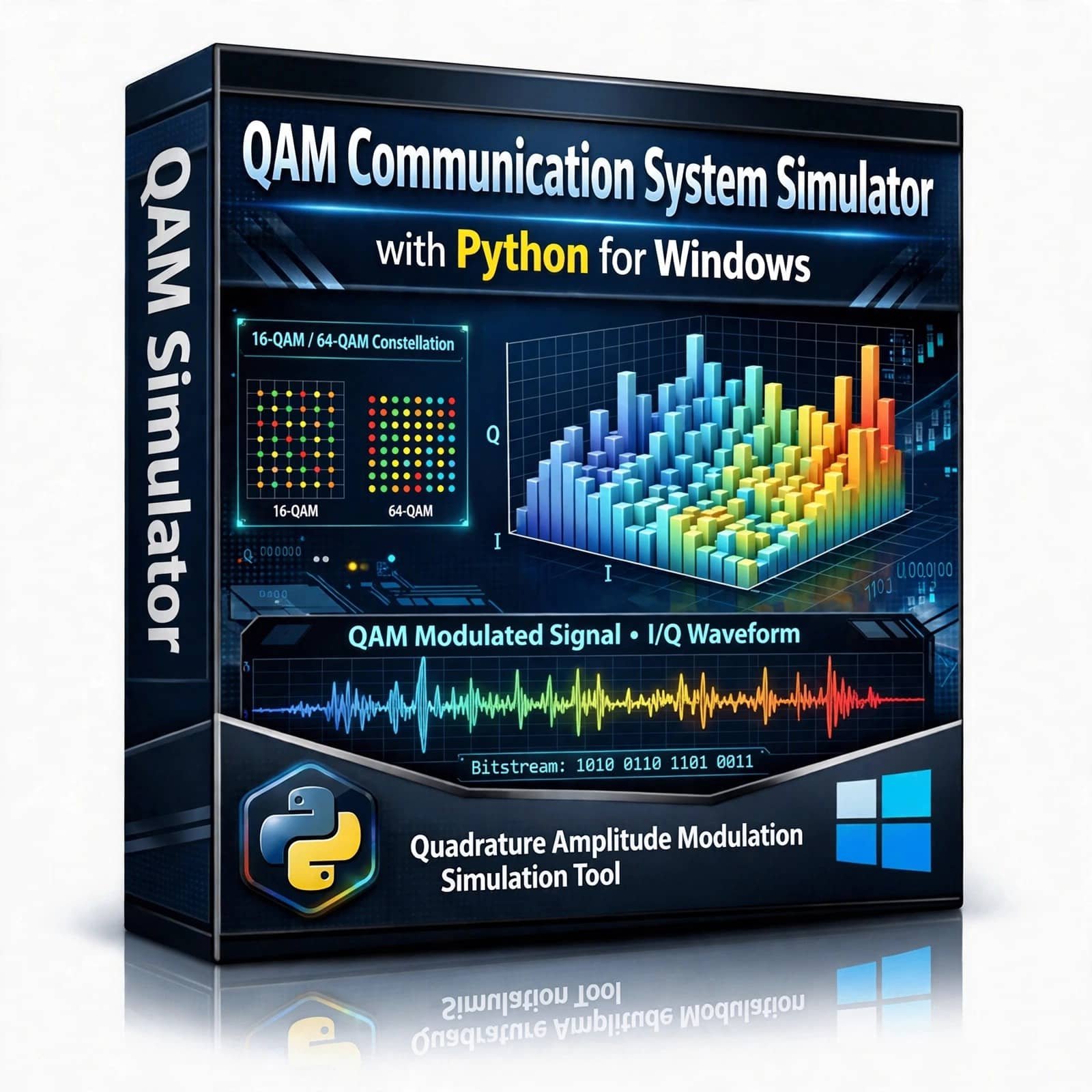
QAM Communication System Simulator – Explore and simulate Quadrature Amplitude Modulation (QAM) with this Python-based Communication System Simulator. Designed for students, researchers, and communication engineering enthusiasts, this project provides an interactive way to understand QAM modulation, signal transmission, noise effects, constellation diagrams, demodulation, and communication system performance using Python.
Original price was: ₹750.00.₹250.00Current price is: ₹250.00. -
OFDM Simulator – C++ Educational Software is an interactive learning and simulation tool for understanding Orthogonal Frequency Division Multiplexing (OFDM) and digital communication concepts. Developed using C++, it allows users to configure FFT/IFFT size, active subcarriers, cyclic prefix length, modulation, SNR, and number of OFDM symbols while visualizing the resulting time-domain waveform, spectrum, and constellation. The simulator also provides measurable results such as PAPR, BER, Eb/N0, simulated bits, and cyclic-prefix overhead.
Original price was: ₹750.00.₹250.00Current price is: ₹250.00.




Reviews
There are no reviews yet.