
New
67% Off

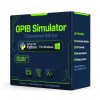
GPIB Simulator
Original price was: ₹750.00.₹250.00Current price is: ₹250.00.
In StockGPIB Simulator with Python is a practical software solution for simulating GPIB/IEEE-488 instrument communication using Python. Ideal for electronics engineers, test and measurement professionals, automation developers, researchers, students, and laboratories, it helps you develop and test GPIB-based applications without requiring physical instruments during every stage of development. Build, test, debug, and automate instrument communication using a flexible Python-based simulation environment.
Description
GPIB Simulator
Developing and testing automated test and measurement applications can be challenging when physical laboratory instruments are limited, expensive, or unavailable during software development. GPIB Simulator with Python provides a convenient way to simulate GPIB (General Purpose Interface Bus) communication and experiment with instrument-control workflows using Python.
Designed for engineers, developers, researchers, educators, and students, this simulator can help reproduce common GPIB communication scenarios in a controlled software environment. Instead of depending exclusively on physical GPIB instruments for application development, you can use simulated instruments to develop communication logic, test commands, troubleshoot application behavior, and refine automation workflows.
Python-Based GPIB Simulation
Python is widely used for test automation, laboratory control, data acquisition, engineering applications, and scientific programming. By combining Python with GPIB simulation, developers can create and test instrument-control applications using familiar programming techniques.
The GPIB Simulator with Python can be useful when developing applications that communicate with instruments through commands, responses, and automated measurement sequences. It provides a practical environment for understanding how software interacts with GPIB-enabled equipment and for testing application logic before connecting to real hardware.
Useful for Test Automation Development
Automated testing often requires reliable communication between a computer and one or more instruments. Physical hardware may not always be available to every developer or team member, particularly during early software development or when working remotely.
A GPIB simulator can provide a software-based environment for experimenting with communication workflows. Developers can work on Python applications, test command sequences, identify programming issues, and improve automation logic before deploying their software with actual test equipment.

This makes the simulator particularly useful for:
- Test and measurement software development
- Python-based instrument automation
- GPIB communication learning
- Laboratory automation projects
- Electronics engineering projects
- Automated testing research
- Educational demonstrations
- Software testing and debugging
- Instrument-control application development
- Prototyping measurement workflows
Learn GPIB and IEEE-488 Communication
GPIB, also known as IEEE-488, is a communication interface historically and widely used for connecting computers with electronic test and measurement instruments. Learning how instruments exchange commands and return measurement data can be an important part of developing automated laboratory systems.
The simulator provides an accessible way to explore these concepts without requiring a complete physical test setup. Students and engineers can gain practical experience with instrument communication concepts while using Python as the programming environment.
Reduce Dependence on Physical Instruments
Access to specialized laboratory equipment can sometimes be limited by availability, cost, location, or scheduling. A software simulator can complement physical equipment by providing an environment for development and testing when hardware access is not convenient.
For development teams, this can help separate software development from hardware availability. Python code and automation workflows can be prepared and tested in a simulated environment and subsequently adapted for use with compatible physical GPIB instruments.

Suitable for Engineers, Researchers, and Students
Whether you are developing a test automation application, studying GPIB communication, working on an electronics project, or teaching laboratory automation concepts, GPIB Simulator with Python can serve as a practical development and learning resource.
It is particularly valuable for users who want to combine Python programming with traditional instrument-control technologies. The simulator can also be incorporated into development workflows where repeatable communication scenarios are useful for testing and debugging.
Build and Test Automation Workflows
A structured simulation environment allows developers to focus on the software side of instrument automation. Python programs can be developed around simulated communication scenarios, making it easier to identify issues in command handling, application logic, sequencing, and response processing.
Once the application is ready, developers can move toward integration with compatible GPIB hardware where required.
Key Benefits
- Python-based GPIB simulation environment
- Useful for IEEE-488/GPIB communication development
- Helps reduce reliance on physical instruments during development
- Suitable for test and measurement automation
- Useful for education, research, and engineering projects
- Supports development and debugging of Python automation applications
- Helps users understand instrument communication workflows
- Suitable for prototyping automated test systems
- Convenient for software development before hardware integration

Who Can Use This Product?
GPIB Simulator with Python is suitable for electronics engineers, test engineers, Python developers, laboratory automation professionals, researchers, engineering students, educators, and hobbyists working with instrumentation and automated testing.
If your project involves Python, GPIB/IEEE-488 communication, test equipment, or automated measurement workflows, this simulator can provide a useful software-based environment for development, experimentation, and learning.
Product Summary
GPIB Simulator with Python brings together Python programming and GPIB instrument communication simulation in a practical software environment. It can help users develop automation applications, learn GPIB concepts, test communication workflows, and prepare software before connecting to physical laboratory equipment.
For engineers and developers working on test automation and instrumentation projects, it provides a convenient way to explore GPIB communication without making physical hardware the only option during the software development process.
Start developing your Python-based GPIB automation workflows with a practical simulation environment designed for learning, testing, prototyping, and instrument-control software development.

Related products
-
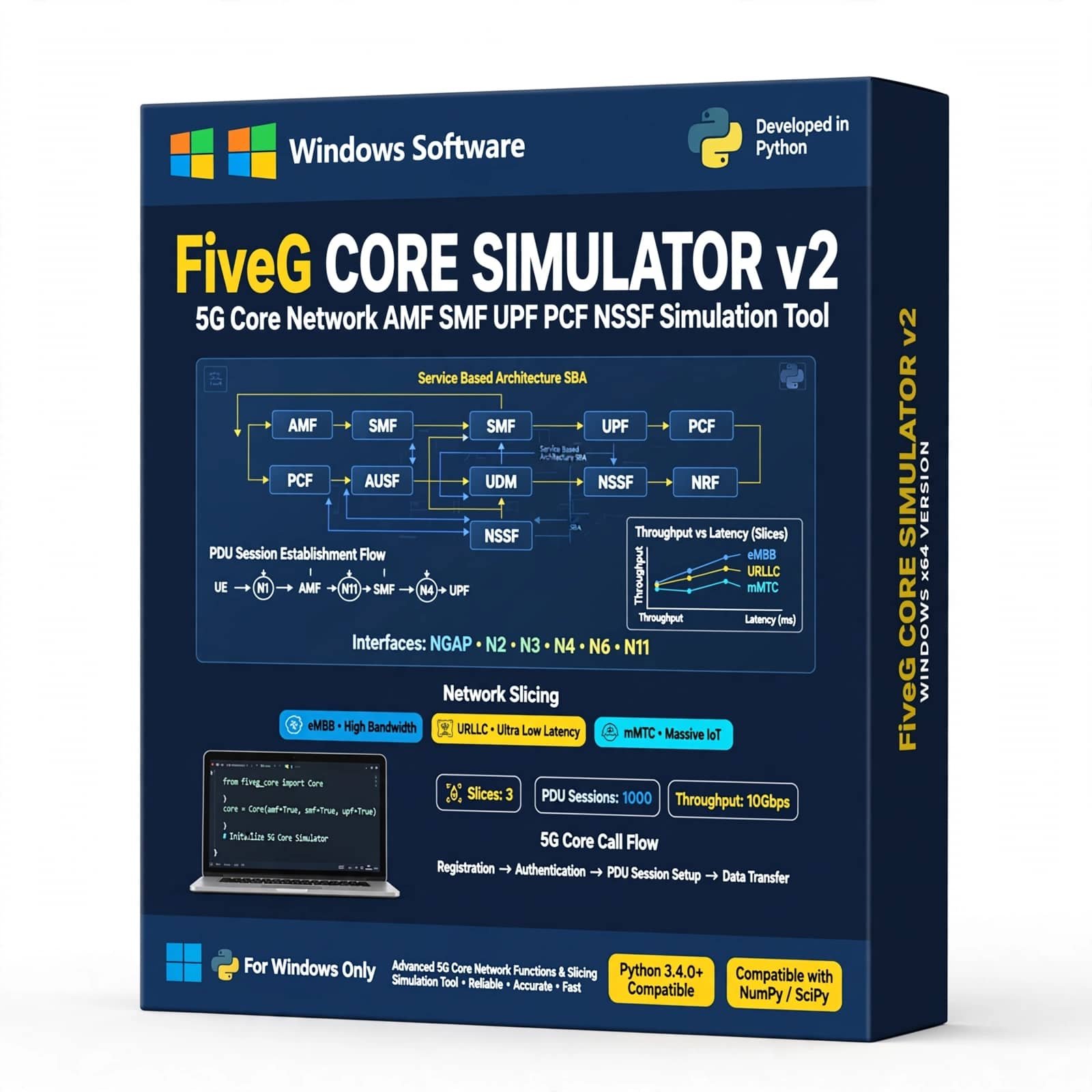
FiveG Core Simulator v2 is an educational 5G Core Network simulation tool designed to help students, educators, researchers, and telecom professionals understand 5G core architecture, network functions, signaling procedures, latency, and protocol interactions through an interactive topology and signaling animation environment.
Original price was: ₹750.00.₹250.00Current price is: ₹250.00. -
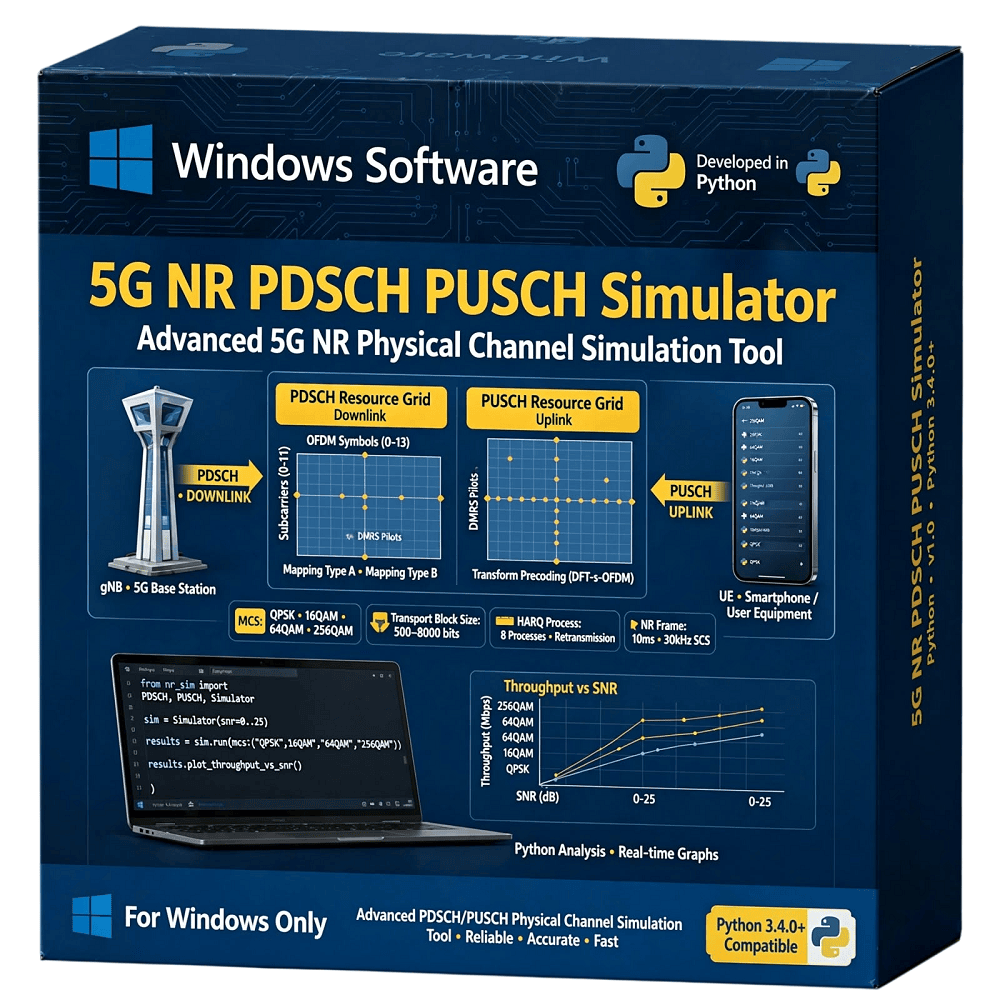
The 5G NR PDSCH PUSCH Simulator is a Python-based simulation software solution designed for researchers, engineers, students, and telecommunications professionals working with 5G New Radio (NR) physical-layer technologies. The simulator provides a practical environment for studying and experimenting with PDSCH (Physical Downlink Shared Channel) and PUSCH (Physical Uplink Shared Channel) transmission concepts.
Developed using Python, the simulator is suitable for academic research, algorithm development, demonstrations, testing, and educational applications related to 5G NR communication systems.
Available for sale as a software product. Contact us for product details, licensing, and purchase information.
Original price was: ₹750.00.₹250.00Current price is: ₹250.00. -
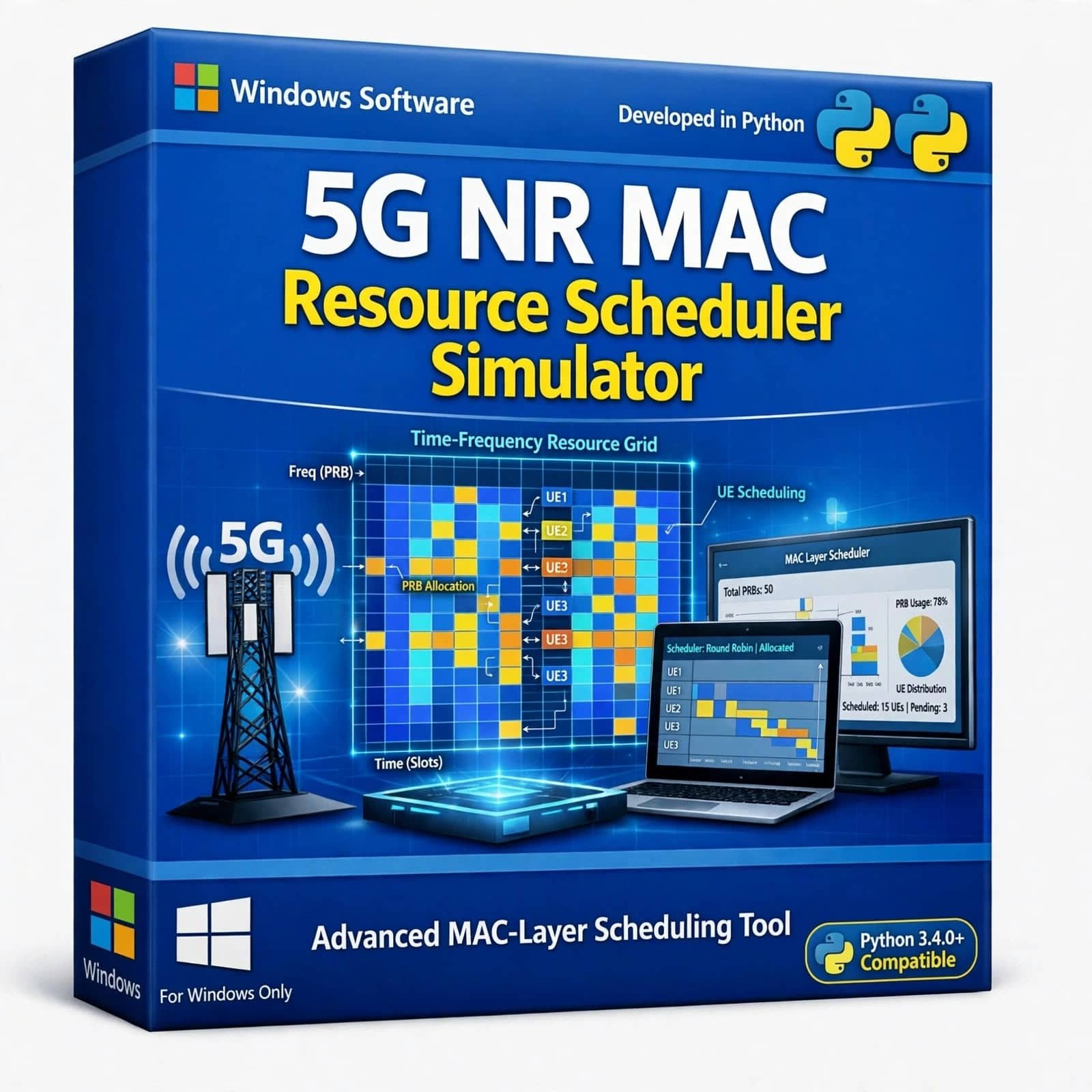
5G NR MAC Resource Scheduler Simulator is an advanced simulation solution for modeling and analyzing Medium Access Control (MAC) layer resource scheduling in 5G New Radio networks. It enables users to evaluate dynamic resource allocation, multi-UE scheduling, uplink and downlink resource management, QoS-aware scheduling, traffic conditions, and scheduling algorithms. The simulator supports analysis of throughput, latency, fairness, spectral efficiency, resource utilization, packet loss, and QoS performance, making it ideal for 5G NR research, scheduler algorithm development, academic projects, and wireless network optimization.
Original price was: ₹750.00.₹250.00Current price is: ₹250.00. -
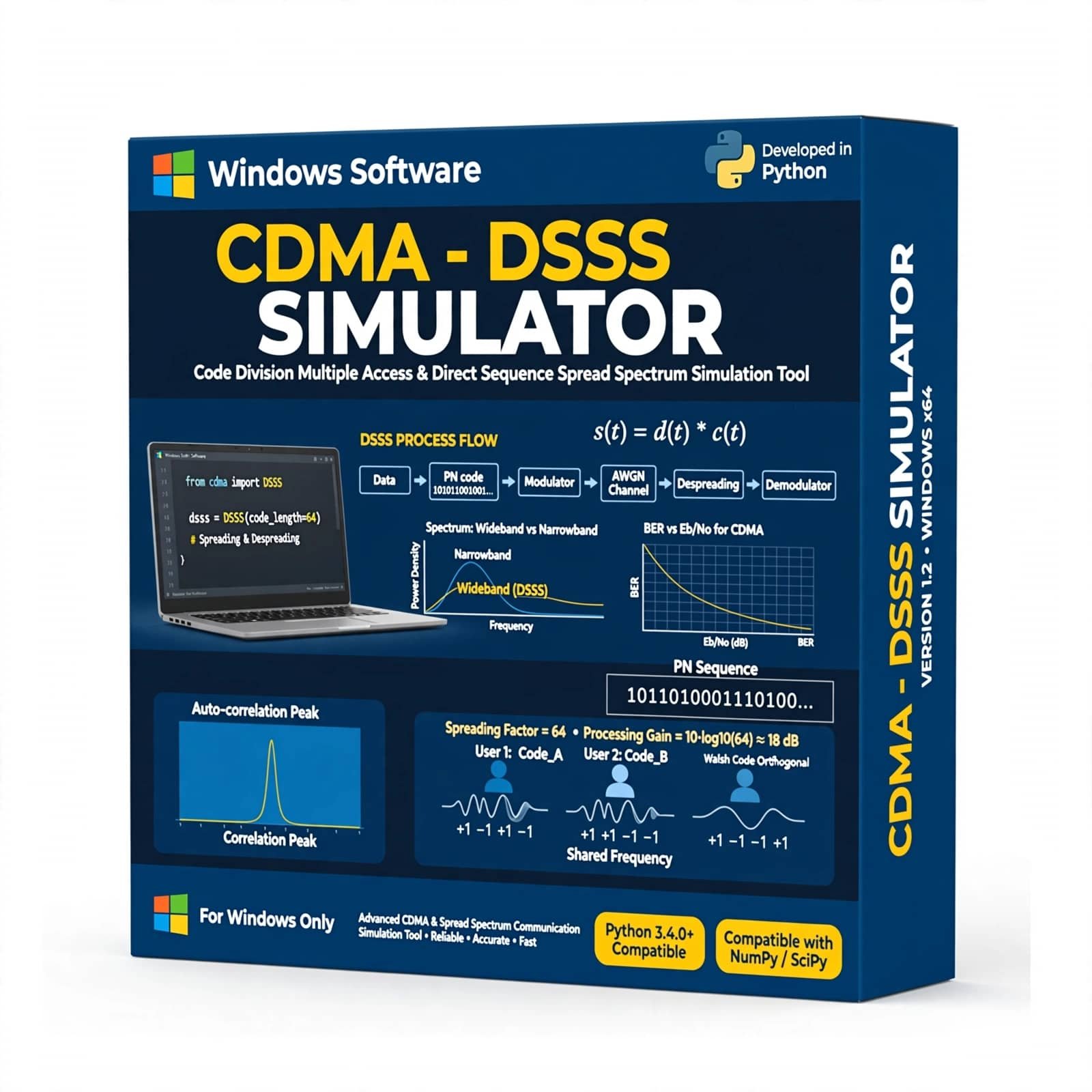
The CDMA – DSSS Simulator with Python is a software-based communication simulation tool designed to demonstrate and analyze Code Division Multiple Access (CDMA) and Direct Sequence Spread Spectrum (DSSS) techniques. Developed using Python, the simulator provides a practical environment for studying spreading codes, signal spreading and despreading, data transmission, multiple-access communication, interference, and signal recovery. It is ideal for digital communication and wireless communication laboratories, engineering education, student projects, technical training, and communication-system research.
Original price was: ₹750.00.₹250.00Current price is: ₹250.00. -
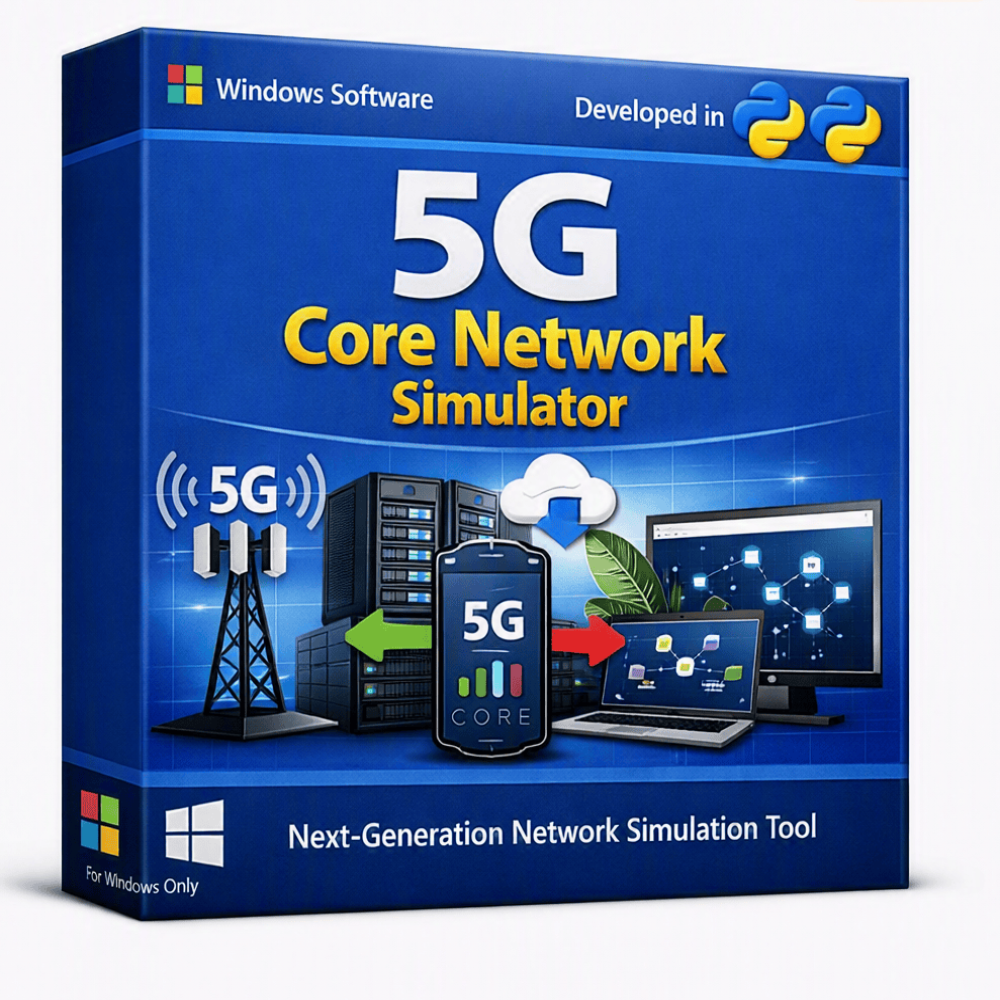
A Python-based 5G Core Network Simulator designed for studying, analyzing, and demonstrating 5G Core network architecture and procedures. Explore key 5G Network Functions such as AMF, SMF, UPF, AUSF, UDM, PCF, NRF, and NSSF, along with UE registration, authentication, session management, mobility, and signaling procedures.
Ideal for 5G research, telecom engineering, academic projects, university laboratories, protocol development, and network simulation. Provides a flexible software environment for experimenting with 5G Core concepts without requiring a complete commercial 5G network infrastructure.
Original price was: ₹750.00.₹250.00Current price is: ₹250.00. -
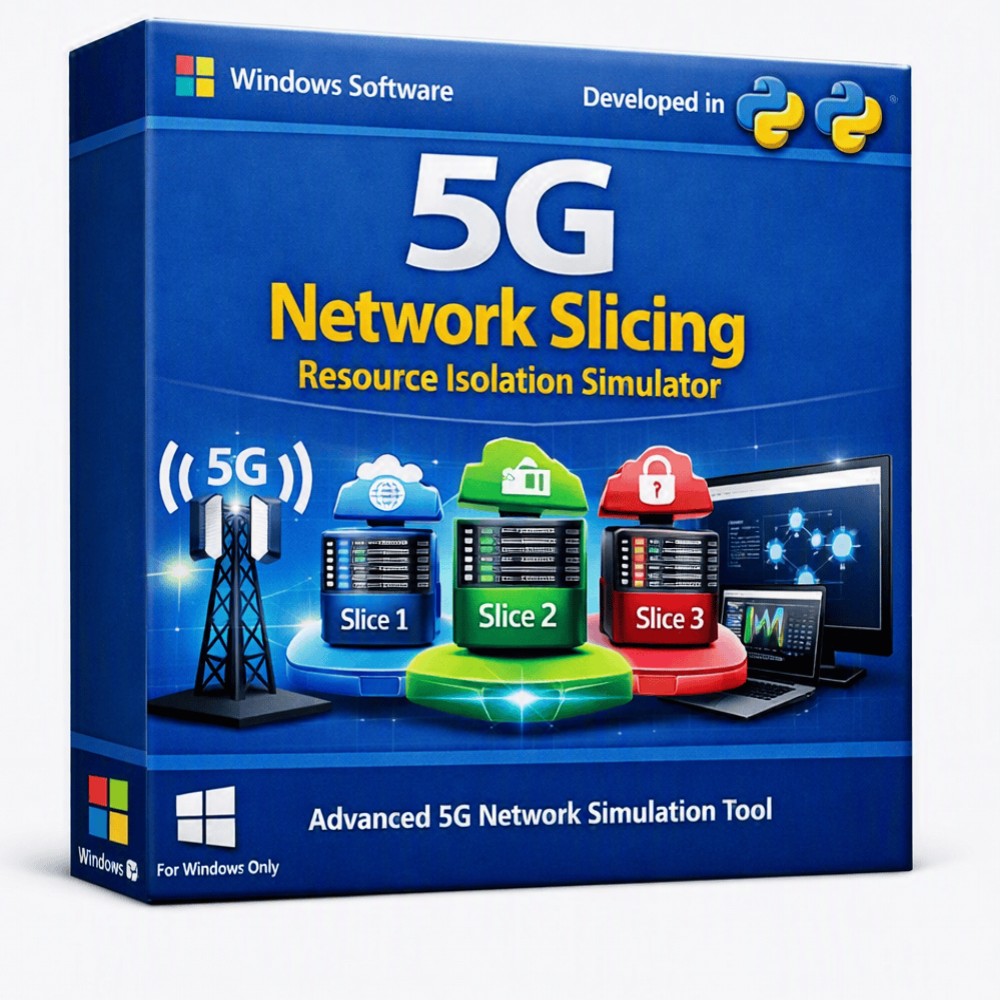
A Python-based 5G Network Slicing and Resource Isolation Simulator designed to model and analyze how multiple logical network slices can share physical 5G infrastructure while maintaining resource isolation. The simulator enables users to study CPU, memory, bandwidth, network capacity, traffic allocation, and resource management across different 5G network slices.
Ideal for 5G research, telecom engineering, academic projects, network optimization, resource allocation studies, and university laboratories.
Original price was: ₹750.00.₹250.00Current price is: ₹250.00.

Reviews
There are no reviews yet.