
New
67% Off

OFDM Simulator
Original price was: ₹750.00.₹250.00Current price is: ₹250.00.
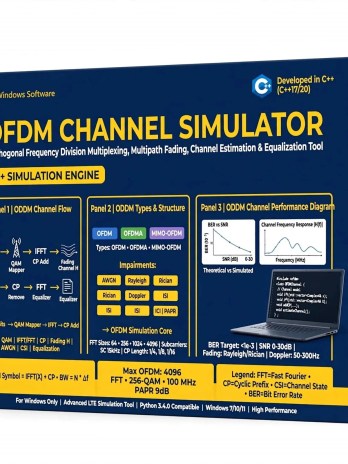
In StockOFDM Simulator – C++ Educational Software is an interactive learning and simulation tool for understanding Orthogonal Frequency Division Multiplexing (OFDM) and digital communication concepts. Developed using C++, it allows users to configure FFT/IFFT size, active subcarriers, cyclic prefix length, modulation, SNR, and number of OFDM symbols while visualizing the resulting time-domain waveform, spectrum, and constellation. The simulator also provides measurable results such as PAPR, BER, Eb/N0, simulated bits, and cyclic-prefix overhead.
Description
OFDM Simulator
Learn the fundamentals of Orthogonal Frequency Division Multiplexing (OFDM) through an interactive, visual, and practical simulation environment with the OFDM Simulator developed using C++.
OFDM is one of the most important technologies in modern digital and wireless communication systems. Understanding how information is mapped onto multiple subcarriers, converted between frequency and time domains, transmitted with a cyclic prefix, and affected by noise requires both theoretical knowledge and practical experimentation.
This C++ OFDM Simulator provides students, educators, researchers, and communication-engineering learners with an accessible environment for exploring these concepts. Instead of relying only on mathematical equations or static diagrams, users can adjust simulation parameters, generate OFDM waveforms, visualize signal characteristics, and examine important performance measurements.
The simulator is designed as an educational tool with a Beginner-to-Expert learning approach, making it suitable for introductory OFDM lessons as well as more advanced communication-system experiments.
Explore OFDM Parameters
The simulator provides a dedicated parameter panel where users can configure important OFDM system characteristics.
Available parameters include:
- FFT / IFFT Size (Nfft)
- Active Subcarriers (Nsc)
- Cyclic Prefix Length (Ncp)
- Modulation
- SNR (dB)
- Number of OFDM Symbols
For example, the displayed simulator configuration includes an FFT/IFFT size of 256, 52 active subcarriers, a cyclic prefix length of 16, QPSK modulation, 20 dB SNR, and 200 OFDM symbols.
Changing these parameters allows learners to investigate how different OFDM configurations affect waveform characteristics and system performance.
Visualize the Time-Domain OFDM Waveform
One of the main features of the software is its Time-Domain Waveform visualization.
The simulator displays the generated OFDM waveform and distinguishes between the real and imaginary components, helping learners understand the complex nature of digitally modulated OFDM signals.
The interface also visually identifies the Cyclic Prefix, making it easier for students to understand where the CP is positioned within the OFDM waveform.
This visualization provides a practical connection between OFDM theory and the actual signal generated by the simulation.
Analyze the OFDM Spectrum
The simulator includes a dedicated Spectrum view for examining the frequency-domain characteristics of the generated OFDM signal.
Students can use the spectrum visualization to understand the relationship between:
- OFDM subcarriers
- Frequency-domain signal representation
- Active subcarriers
- FFT/IFFT processing
- Overall signal bandwidth
This makes the simulator useful for classroom demonstrations and practical digital-communication experiments.
Study OFDM Constellations
The built-in Constellation view provides another important visualization for understanding digital modulation.
Users can investigate how modulation schemes such as QPSK represent information using constellation points. By changing simulation parameters such as modulation and SNR, learners can study the relationship between signal quality and constellation behavior.
This is particularly useful when introducing concepts related to digital modulation, symbol mapping, signal quality, noise, and receiver performance.
Measure PAPR and BER
The simulator provides quantitative results in addition to graphical visualizations.
The Results section can display important performance parameters such as:
PAPR
Peak-to-Average Power Ratio (PAPR) is an important characteristic of OFDM signals. The simulator provides a measured PAPR value so learners can understand the high peak-power characteristics commonly associated with multicarrier OFDM signals.
BER
The simulator calculates the Bit Error Rate (BER) based on the simulated transmission. This allows students to evaluate communication performance and investigate how simulation conditions influence bit errors.
Eb/N0
An approximate Eb/N0 value is also provided, helping learners connect SNR-based simulation settings with another important digital-communication performance metric.
Additional Results
The interface can also display:
- Bits simulated
- Bit errors
- Cyclic-prefix overhead
- Measured PAPR
- Measured BER
- Approximate Eb/N0
These measurements make the application useful for practical OFDM experiments rather than simply waveform visualization.

Understand Cyclic Prefix and OFDM Overhead
The simulator provides a configurable Cyclic Prefix Length (Ncp) and reports the associated CP overhead.
This allows learners to understand why a cyclic prefix is added to an OFDM symbol and how increasing the CP length can introduce additional transmission overhead.
The simulator therefore provides a practical environment for exploring the trade-off between OFDM signal robustness and spectral efficiency.
Beginner-to-Expert Learning
The application is designed as an educational tool for different learning levels.
Beginners can start with basic configurations and learn:
- What OFDM is
- How subcarriers work
- What FFT and IFFT do
- Why a cyclic prefix is used
- How QPSK modulation works
- How SNR affects communication
More advanced users can investigate:
- Active subcarrier configuration
- OFDM waveform characteristics
- PAPR
- BER
- Eb/N0
- Spectrum characteristics
- CP overhead
- Effects of changing FFT size and modulation parameters
The integrated Theory & Help section further supports learning by providing access to explanations and educational material directly within the simulator.
Developed Using C++
The OFDM Simulator is developed using C++, making it particularly relevant to students and developers interested in combining C++ programming with digital communication and signal-processing concepts.
It can serve as an educational demonstration of how communication-system algorithms and mathematical concepts can be implemented as an interactive software application.
Ideal for Engineering Students and Educational Use
The OFDM Simulator can be used for:
- Digital Communication courses
- Wireless Communication courses
- Signal Processing education
- Telecommunications training
- Communication-system laboratories
- Engineering college projects
- C++ programming projects
- DSP demonstrations
- OFDM practical experiments
- Academic presentations
- Classroom demonstrations
- Independent technical learning
It is especially useful for students studying Electronics and Communication Engineering, Electrical Engineering, Computer Engineering, Telecommunications, Signal Processing, and Digital Communications.
Key Features
- C++ developed OFDM simulator
- Beginner-to-Expert educational interface
- Configurable FFT/IFFT size
- Adjustable active subcarriers
- Configurable cyclic prefix length
- QPSK and modulation support
- Adjustable SNR in dB
- Configurable number of OFDM symbols
- Time-domain OFDM waveform visualization
- Real and imaginary waveform display
- Cyclic-prefix visualization
- Spectrum analysis
- Constellation visualization
- PAPR measurement
- BER calculation
- Approximate Eb/N0 calculation
- Bit simulation statistics
- Bit-error reporting
- Cyclic-prefix overhead measurement
- Integrated Theory & Help section
- Interactive waveform generation
- Suitable for academic and training purposes
A Practical Way to Learn OFDM
The OFDM Simulator turns complex OFDM concepts into an interactive learning experience. Users can modify parameters, generate a waveform, examine the spectrum and constellation, and evaluate important performance measurements from the same application.
Whether you are teaching OFDM in a classroom, preparing an engineering project, learning digital communication, or exploring C++ implementation of communication algorithms, this simulator provides a practical platform for experimentation.
Learn OFDM through simulation, visualization, and measurable results with this C++-based OFDM Educational Simulator.
Related products
-
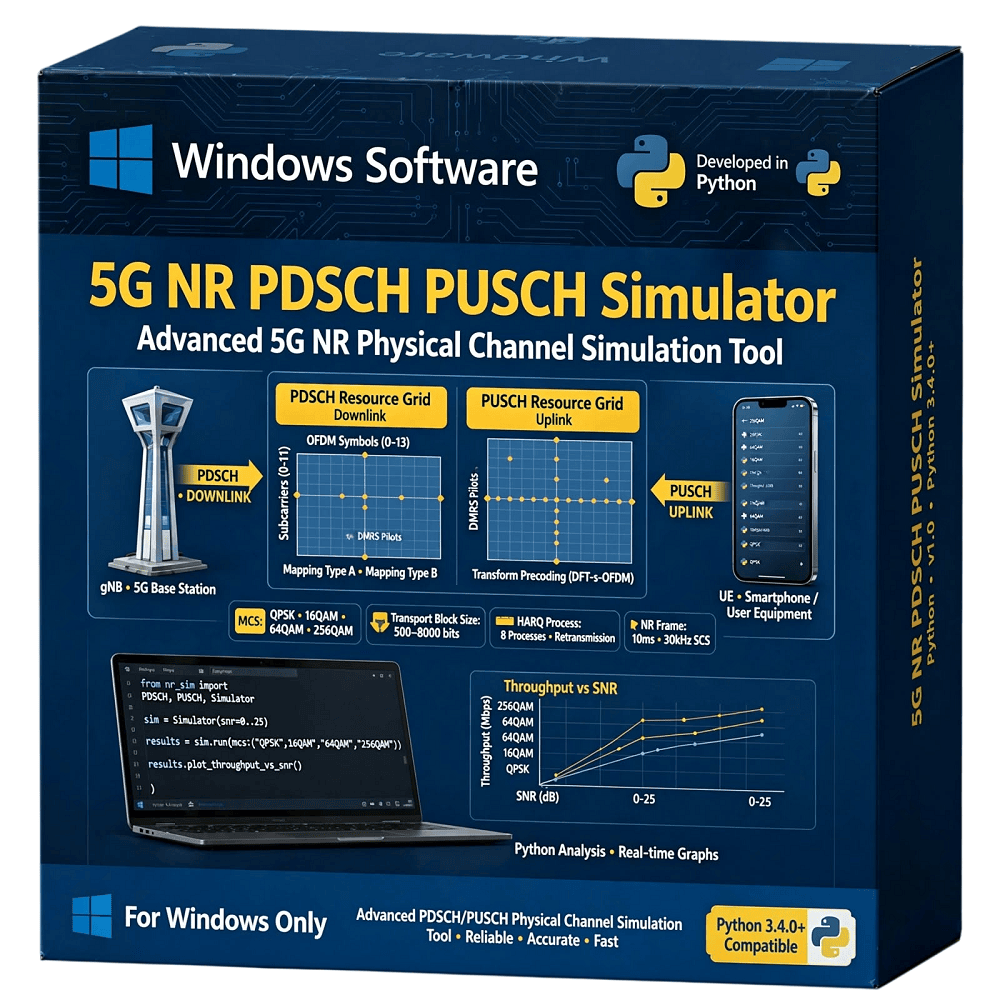
The 5G NR PDSCH PUSCH Simulator is a Python-based simulation software solution designed for researchers, engineers, students, and telecommunications professionals working with 5G New Radio (NR) physical-layer technologies. The simulator provides a practical environment for studying and experimenting with PDSCH (Physical Downlink Shared Channel) and PUSCH (Physical Uplink Shared Channel) transmission concepts.
Developed using Python, the simulator is suitable for academic research, algorithm development, demonstrations, testing, and educational applications related to 5G NR communication systems.
Available for sale as a software product. Contact us for product details, licensing, and purchase information.
Original price was: ₹750.00.₹250.00Current price is: ₹250.00. -
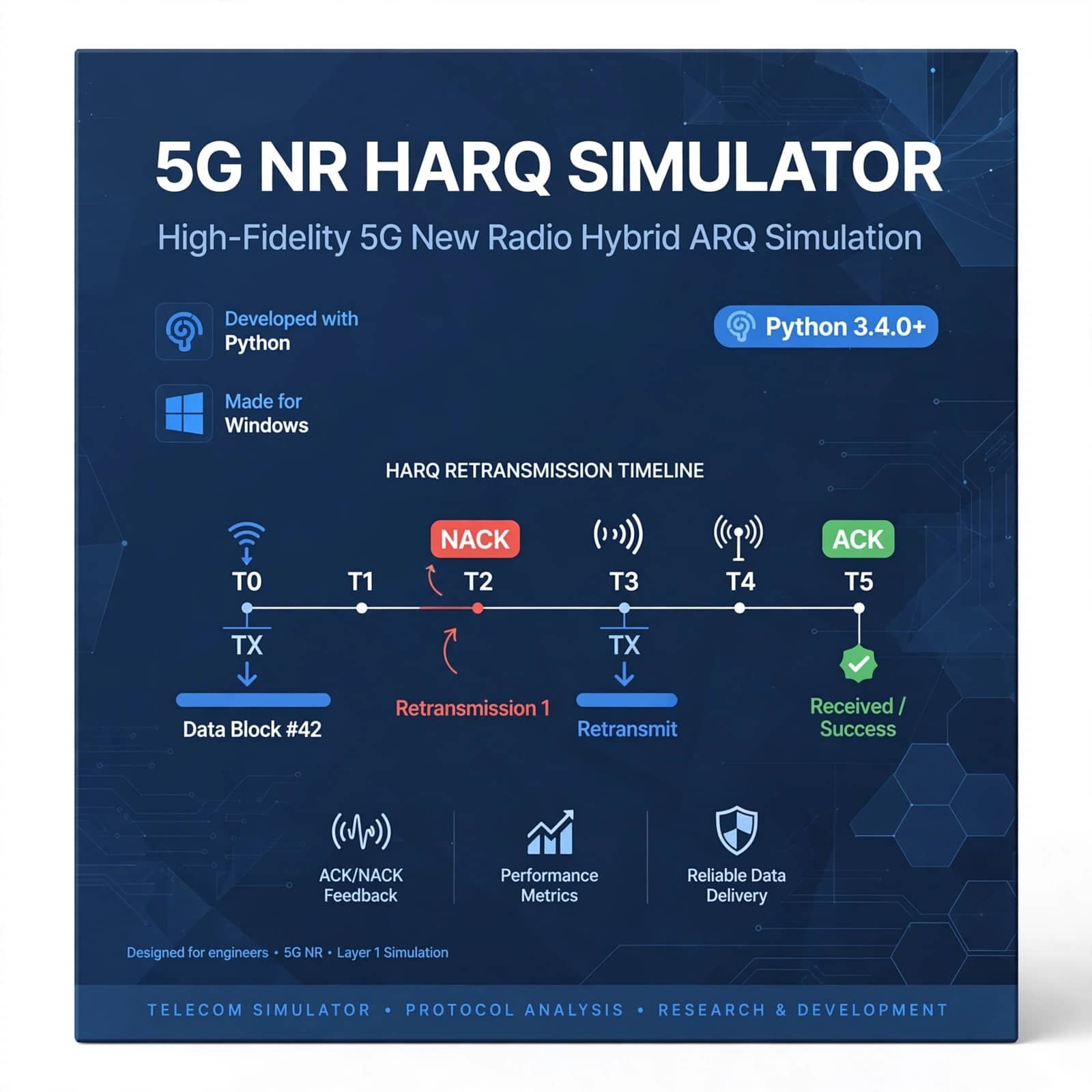
5G NR HARQ Simulator is an advanced simulation solution for modeling and analyzing Hybrid Automatic Repeat Request (HARQ) mechanisms in 5G New Radio networks. It enables users to study HARQ processes, ACK/NACK feedback, retransmissions, link adaptation, channel errors, and communication reliability under configurable network conditions. The simulator supports analysis of throughput, BLER, latency, retransmission rate, packet errors, spectral efficiency, and other key performance metrics, making it suitable for 5G NR research, algorithm development, academic projects, and wireless communication system optimization.
Original price was: ₹750.00.₹250.00Current price is: ₹250.00. -
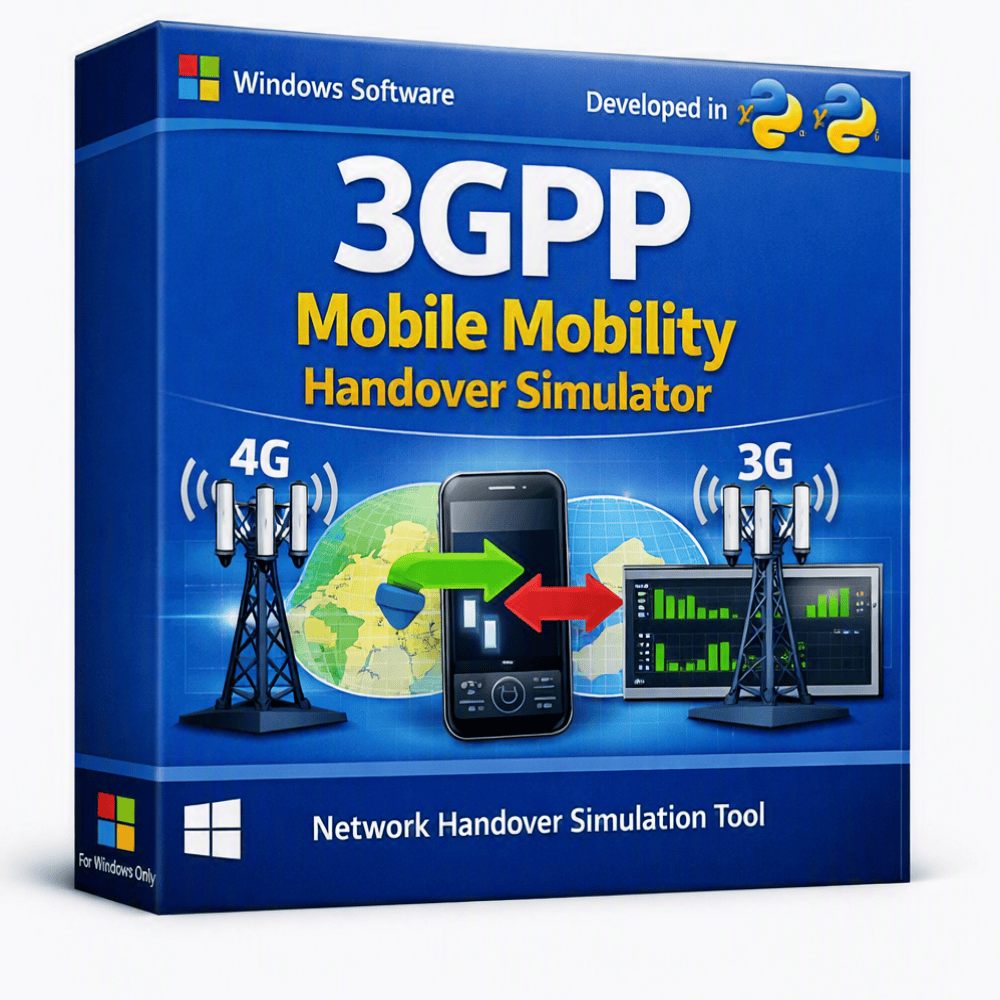
A powerful simulation tool for analyzing and validating 3GPP mobile mobility and handover procedures. The simulator enables users to model mobile network scenarios, study handover behavior, and evaluate mobility performance under different network conditions.
Key Features:
- 3GPP-compliant mobility and handover simulation
- Configurable network and mobility scenarios
- Analysis of handover performance and behavior
- Supports research, testing, and network optimization
- Useful for telecom engineers, researchers, and academic projects
Ideal for 5G/4G/3G mobility research, protocol testing, network planning, and academic simulation studies.
Original price was: ₹750.00.₹250.00Current price is: ₹250.00. -
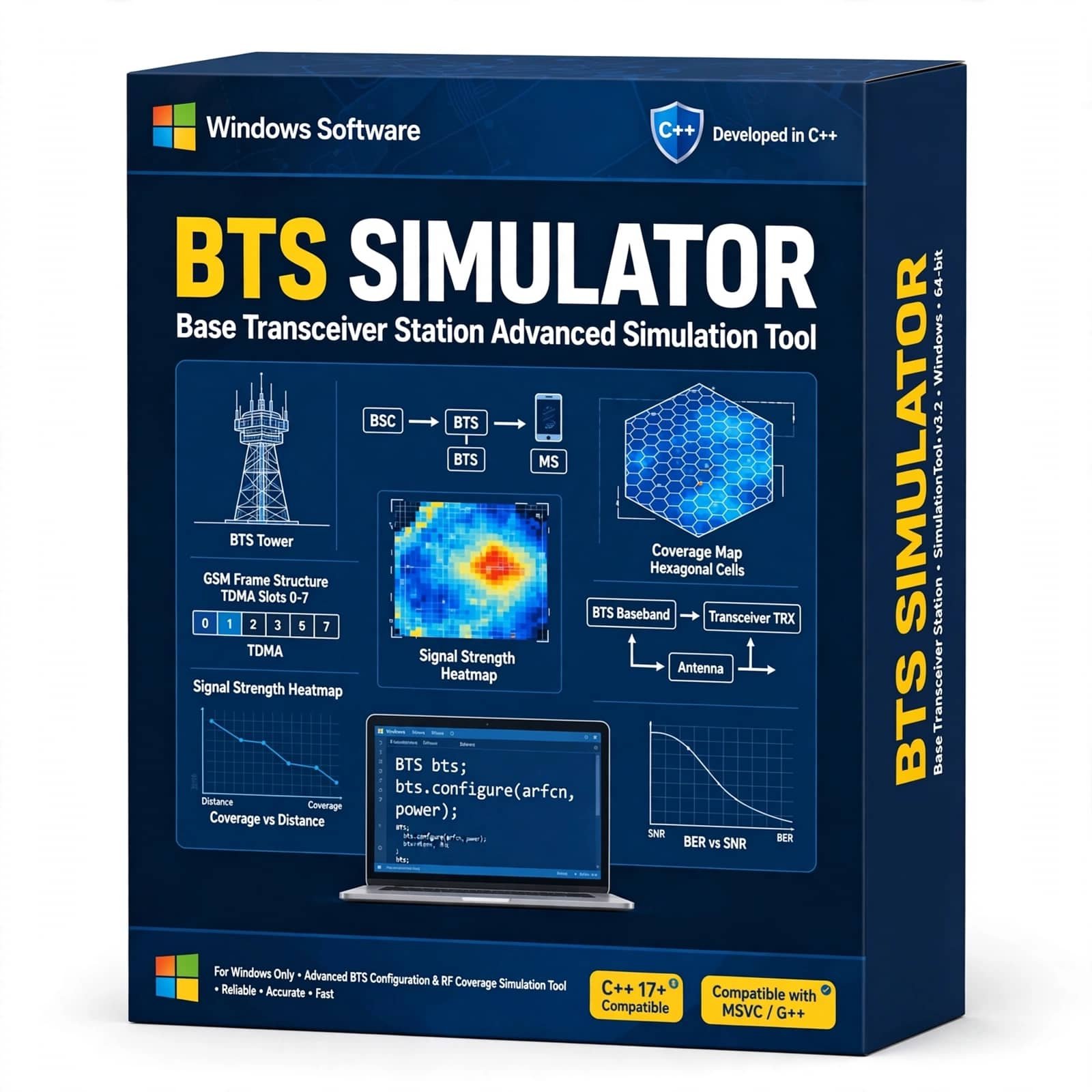
The BTS Simulator with C++ is a software-based Base Transceiver Station simulation tool designed for studying mobile communication, wireless networks, and telecommunications concepts. Developed using C++, it provides a practical environment for understanding BTS operation, communication processes, signal transmission and reception, and cellular network fundamentals. The simulator is ideal for telecommunication laboratories, engineering education, student projects, technical training, and communication-system research.
Original price was: ₹750.00.₹250.00Current price is: ₹250.00. -
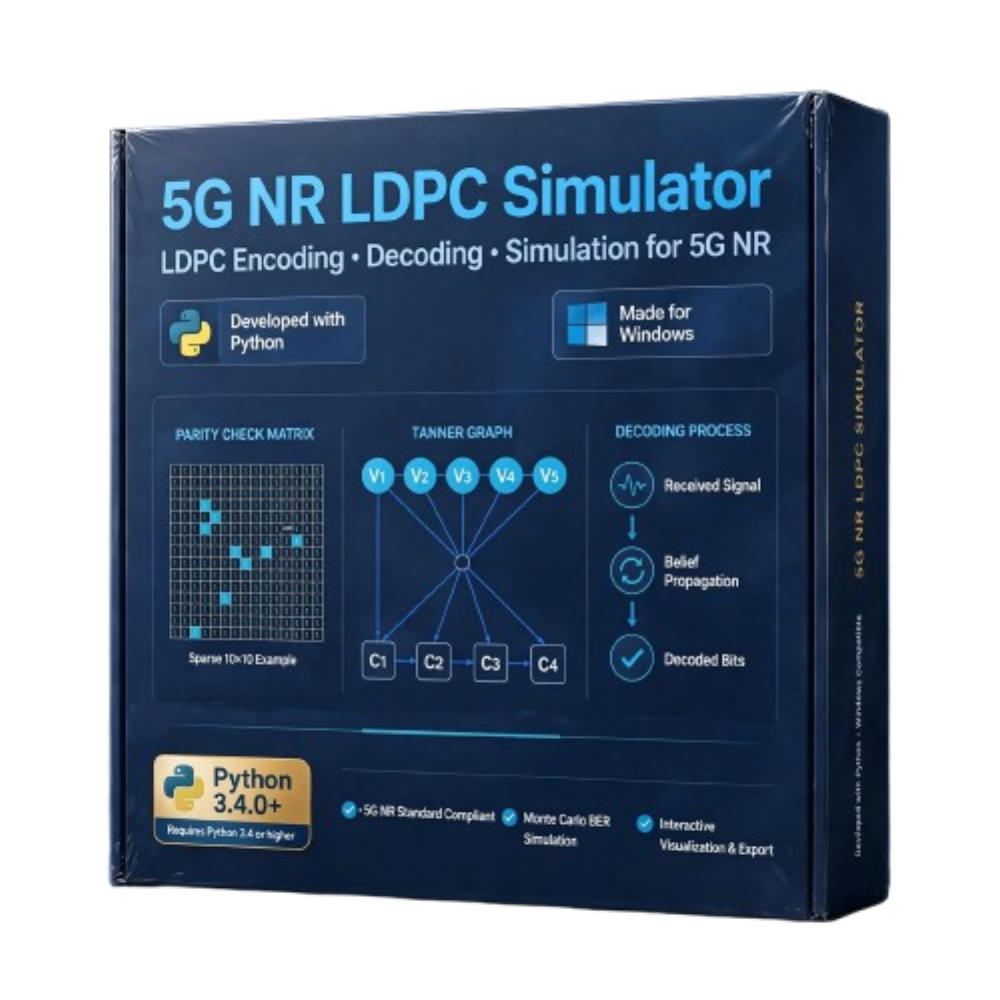
5G NR LDPC Simulator is an advanced simulation solution for modeling and analyzing Low-Density Parity-Check (LDPC) channel coding used in 5G New Radio systems. It enables users to simulate LDPC encoding and decoding, evaluate error correction performance, and analyze BER, BLER, SNR, coding rate, decoding iterations, throughput, and convergence under configurable channel conditions. The simulator is ideal for 5G NR channel coding research, algorithm development, academic projects, decoder performance analysis, and next-generation wireless communication system optimization.
Original price was: ₹750.00.₹250.00Current price is: ₹250.00. -
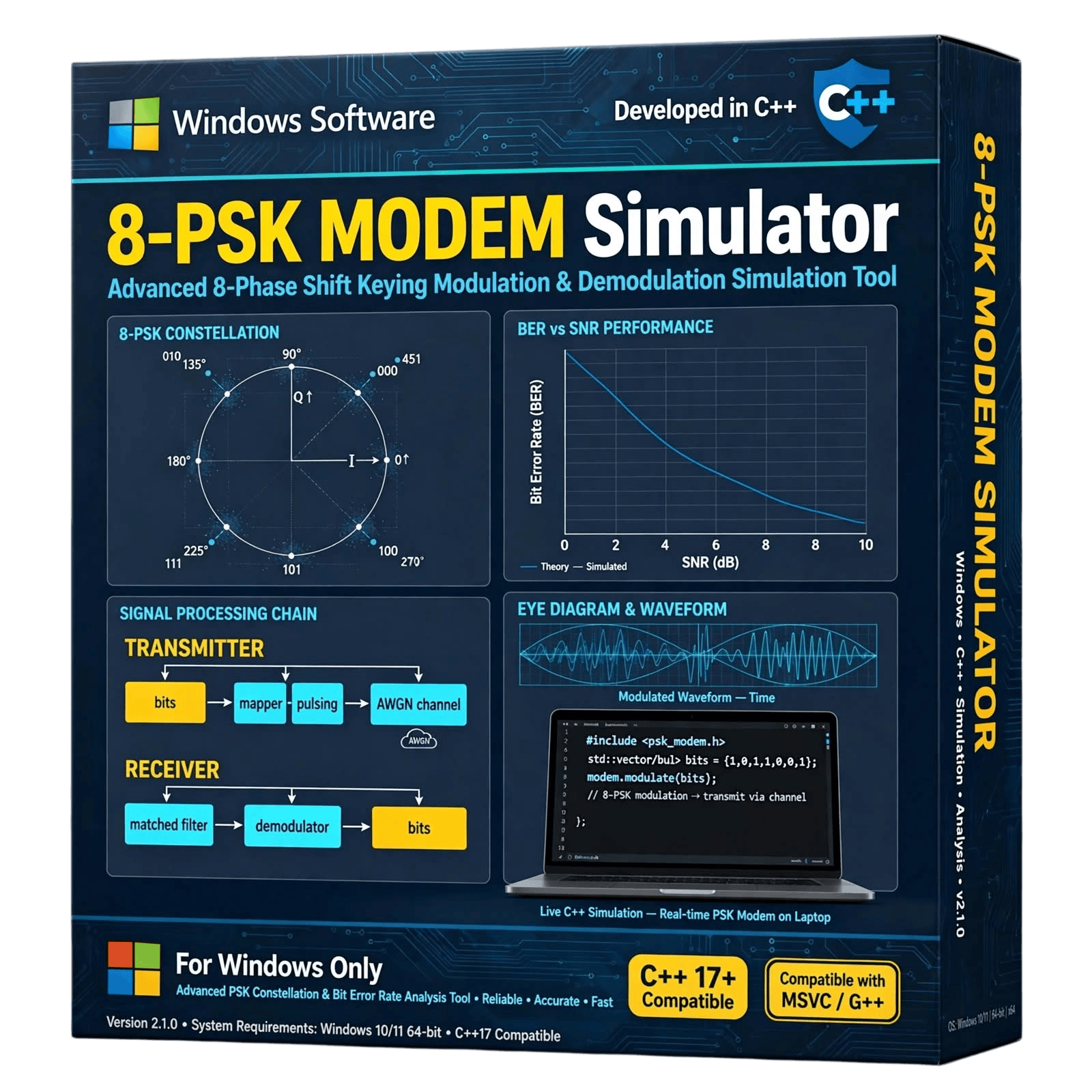
The 8-PSK Modem Simulator is a C++-based software solution designed for students, researchers, communication engineers, developers, and academic institutions working with digital communication and modulation techniques. The simulator provides a practical environment for studying 8-Phase Shift Keying (8-PSK) modulation and demodulation concepts.
Developed using C++, the simulator can be used for digital communication research, academic projects, laboratory demonstrations, signal-processing studies, experimentation, and educational purposes.
Available for sale as a software product. Contact us for pricing, licensing, technical specifications, customization, and purchase information.
Original price was: ₹750.00.₹250.00Current price is: ₹250.00.


Reviews
There are no reviews yet.