

Log-Distance Path Loss Simulator


₹6,999.00
In StockThe Log-Distance Path Loss Simulator is a powerful wireless communication simulation tool designed to analyze and visualize signal attenuation over distance. It helps students, researchers, engineers, and RF professionals understand path loss, received signal strength, wireless propagation, and network performance using the log-distance path loss model. Ideal for academic projects, RF research, wireless network analysis, and communication system simulations.
Description
Log-Distance Path Loss Simulator
Understanding how wireless signals weaken as they travel through space is essential for designing reliable and efficient communication systems. The Log-Distance Path Loss Simulator provides an easy and practical way to study wireless signal propagation, path loss, received power, and distance-dependent signal attenuation using the widely used log-distance path loss model.
Designed for students, researchers, teachers, RF engineers, communication engineers, and wireless network professionals, this simulator makes it easier to experiment with different propagation parameters and observe how they influence wireless communication performance.

What Is the Log-Distance Path Loss Model?
The log-distance path loss model is commonly used to estimate the loss of signal power as the distance between a transmitter and receiver increases. Unlike an ideal free-space model, the log-distance model can represent a wider range of real-world propagation environments by using a path loss exponent.
The model is generally expressed as:
PL(d) = PL(d₀) + 10n log₁₀(d/d₀) + Xσ
where PL(d) represents the path loss at distance d, PL(d₀) is the reference path loss at distance d₀, n is the path loss exponent, and Xσ represents shadowing or environmental variation.
With the Log-Distance Path Loss Simulator, users can modify relevant parameters and study how signal strength changes as the transmitter-receiver distance increases.
Explore Wireless Signal Attenuation
Signal attenuation is one of the most important factors affecting wireless communication. As distance increases, received signal power generally decreases, which can influence coverage, connectivity, data transmission quality, and network reliability.
This simulator allows users to visualize the relationship between distance and path loss, making complex wireless propagation concepts easier to understand. By experimenting with different path loss exponents and reference conditions, users can compare theoretical propagation behavior across different environments.
Useful for RF and Wireless Communication Research
The Log-Distance Path Loss Simulator can be used as a supporting tool for a variety of wireless communication studies and research activities. It is suitable for analyzing concepts related to:
- Wireless propagation
- Path loss modeling
- Received signal strength
- RF communication
- Wireless network planning
- Signal attenuation
- Radio-frequency engineering
- Communication system design
- Wireless coverage analysis
- Propagation environment modeling
Researchers can use simulation results to better understand the impact of distance and propagation characteristics on wireless links.

Ideal for Students and Academic Projects
Wireless communication concepts can sometimes be difficult to understand using equations alone. A simulation-based approach provides a more interactive learning experience.
The Log-Distance Path Loss Simulator can be particularly useful for engineering students working on wireless communication projects, RF simulation projects, networking assignments, academic demonstrations, laboratory exercises, and final-year projects.
By changing simulation parameters and observing the resulting path loss, students can connect theoretical formulas with practical wireless communication behavior.
Understand the Effect of the Path Loss Exponent
One of the key parameters in the log-distance path loss model is the path loss exponent. Different propagation environments can produce different levels of signal attenuation.
Using the simulator, users can investigate how changes in the path loss exponent affect signal propagation over distance. This provides valuable insight into why wireless signals may behave differently in open spaces, indoor environments, urban areas, and other propagation scenarios.
Visualize Simulation Results
A major benefit of a simulation tool is the ability to interpret results visually. The Log-Distance Path Loss Simulator can help users examine the relationship between transmission distance and signal loss, making it easier to identify trends and compare simulation scenarios.
Visual analysis can be useful when preparing research reports, academic presentations, laboratory records, technical documentation, and project demonstrations.
Applications of the Log-Distance Path Loss Simulator
The simulator can support a wide range of wireless communication applications, including:
Wireless Network Planning: Study how increasing distance can affect link quality and coverage.
RF Engineering: Analyze basic propagation characteristics and signal attenuation.
Academic Research: Use the log-distance model for wireless communication experiments and research studies.
Engineering Education: Demonstrate path loss and propagation concepts in classrooms and laboratories.
Final-Year Projects: Incorporate wireless propagation simulations into engineering and technology projects.
Communication System Analysis: Investigate how propagation parameters influence received signal performance.

Why Choose the Log-Distance Path Loss Simulator?
The Log-Distance Path Loss Simulator combines theoretical wireless propagation concepts with practical simulation. Instead of calculating individual values manually, users can experiment with parameters and observe how changes affect path loss.
It is a useful resource for anyone who wants to gain a better understanding of wireless signal propagation and distance-based path loss.
Whether you are an engineering student learning wireless communication, a researcher studying RF propagation, or a professional exploring communication system behavior, this simulator can provide a convenient environment for analyzing the log-distance path loss model.
Key Benefits
- Study the log-distance path loss model
- Understand the relationship between distance and signal attenuation.
- Analyze the effect of the path loss exponent.
- Explore wireless propagation concepts through simulation.
- Support RF and wireless communication research.
- Useful for academic projects and laboratory demonstrations.
- Visualize path loss behavior for easier interpretation.
- Improve understanding of wireless link performance.
- Suitable for students, researchers, educators, and RF professionals.
Get Started with Wireless Propagation Simulation
The Log-Distance Path Loss Simulator is a practical tool for exploring one of the fundamental concepts in wireless communication: how signal power changes with distance and propagation conditions.
Use it to experiment with propagation parameters, analyze path loss trends, and build a stronger understanding of RF signal behavior, wireless communication systems, and radio propagation. It can be a valuable addition to academic laboratories, engineering projects, wireless research, and RF simulation workflows.
Related products
-
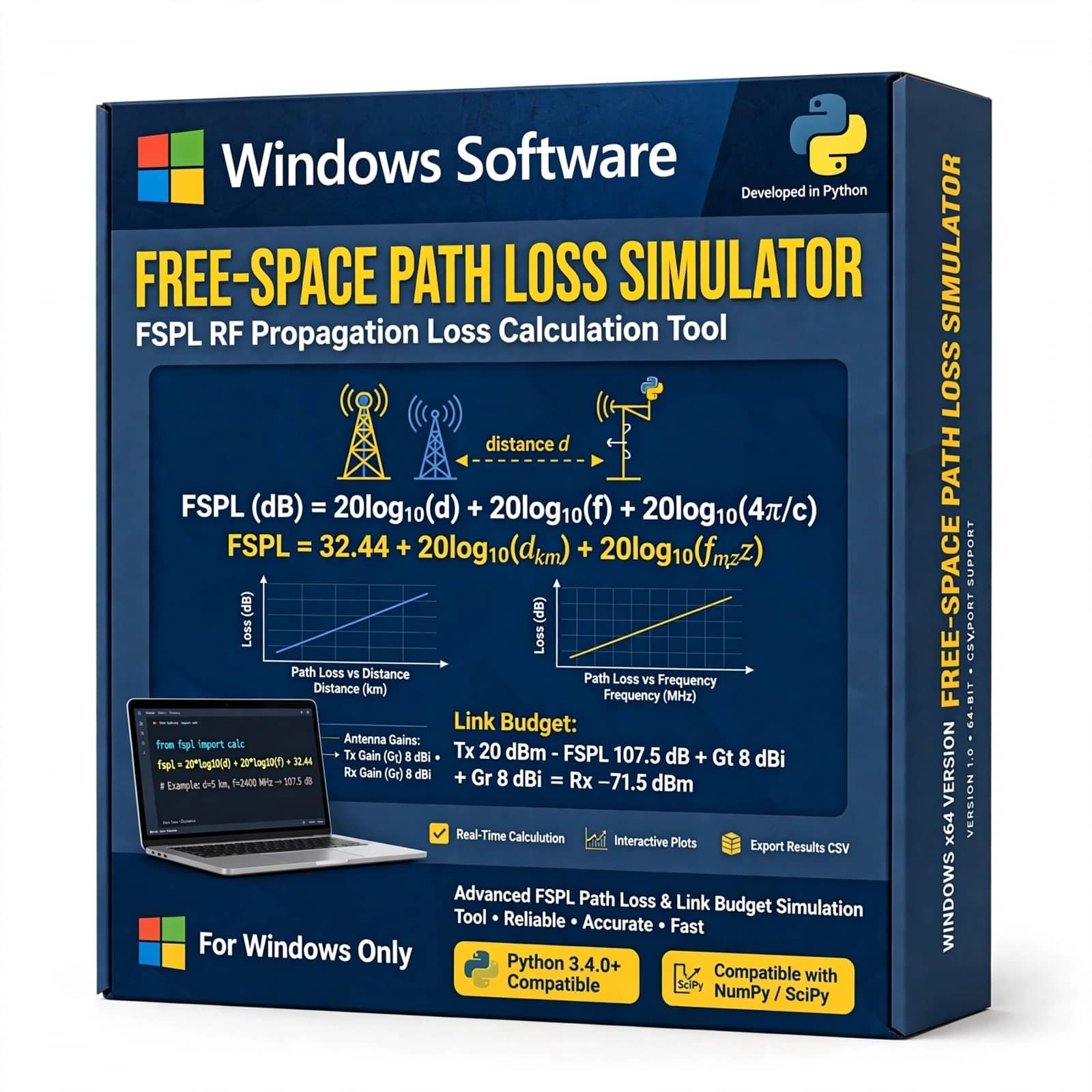
Free-Space Path Loss Simulator is an educational RF and wireless communication simulation tool designed to help students, engineers, researchers, and telecom professionals understand how radio signals lose power as they propagate through free space. It enables users to analyze the impact of frequency, distance, antenna characteristics, and transmission parameters on received signal strength and path loss.
Original price was: ₹1,999.00.₹749.00Current price is: ₹749.00. -
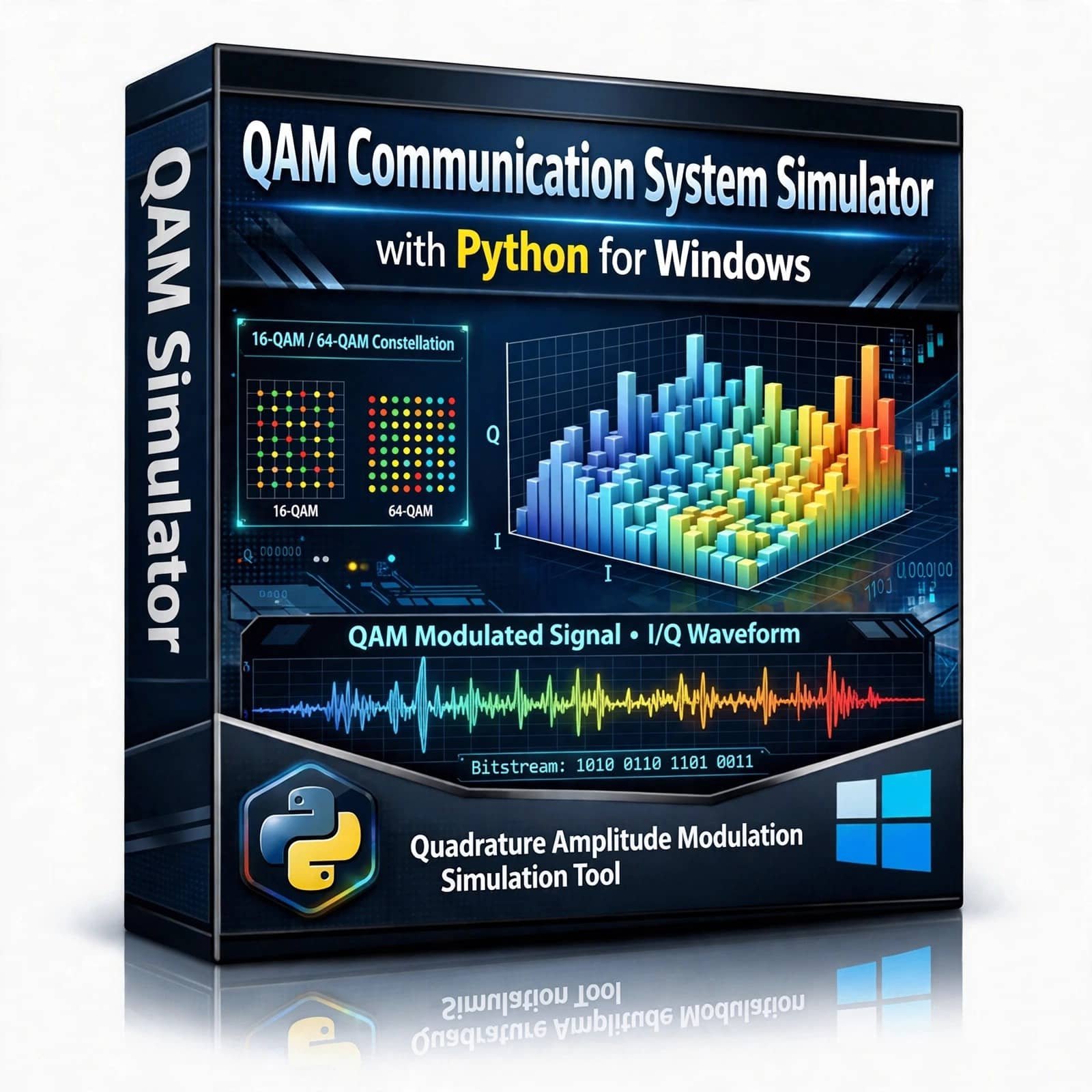
QAM Communication System Simulator – Explore and simulate Quadrature Amplitude Modulation (QAM) with this Python-based Communication System Simulator. Designed for students, researchers, and communication engineering enthusiasts, this project provides an interactive way to understand QAM modulation, signal transmission, noise effects, constellation diagrams, demodulation, and communication system performance using Python.
₹1,999.00 -
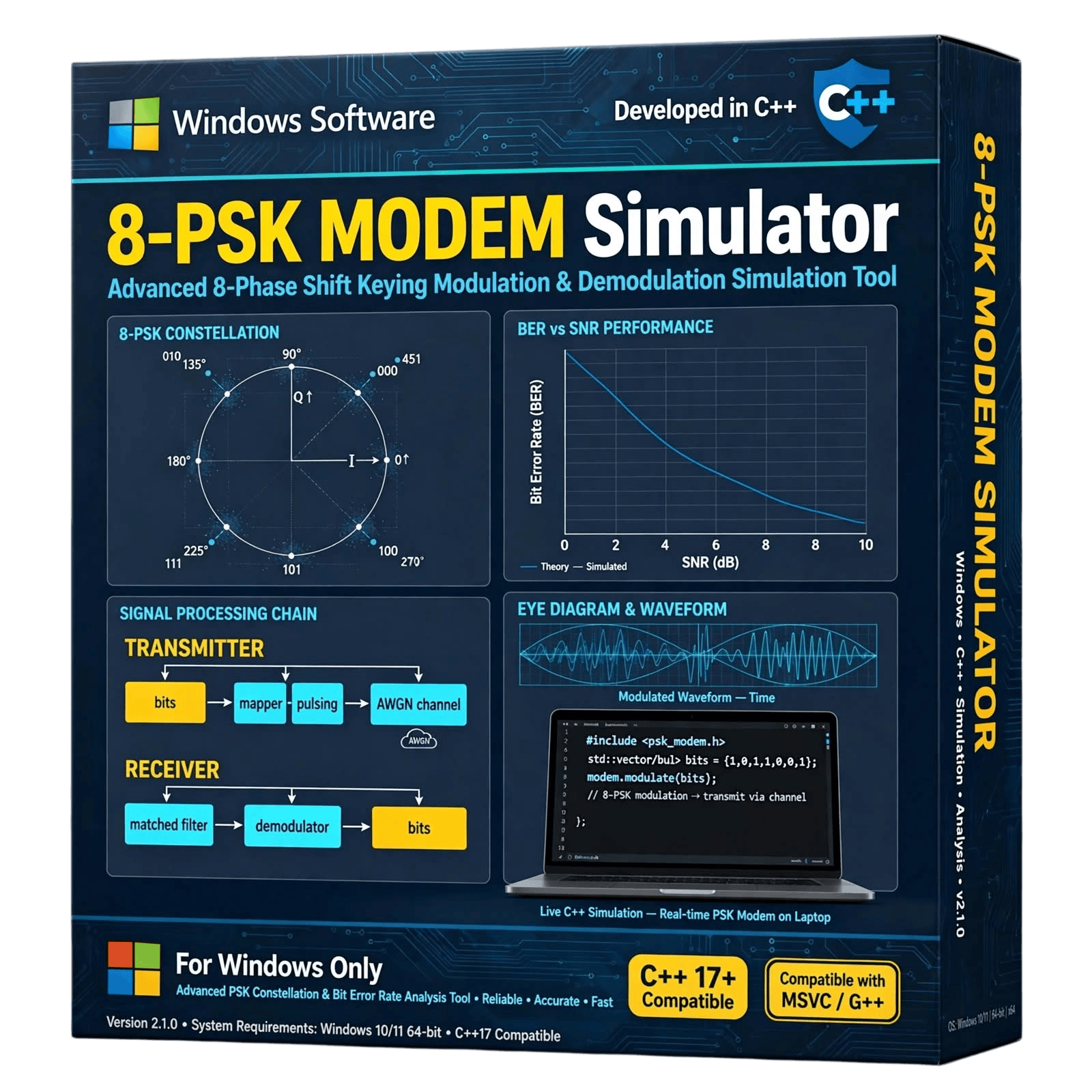
The 8-PSK Modem Simulator is a C++-based software solution designed for students, researchers, communication engineers, developers, and academic institutions working with digital communication and modulation techniques. The simulator provides a practical environment for studying 8-Phase Shift Keying (8-PSK) modulation and demodulation concepts.
Developed using C++, the simulator can be used for digital communication research, academic projects, laboratory demonstrations, signal-processing studies, experimentation, and educational purposes.
Available for sale as a software product. Contact us for pricing, licensing, technical specifications, customization, and purchase information.
₹1,999.00 -
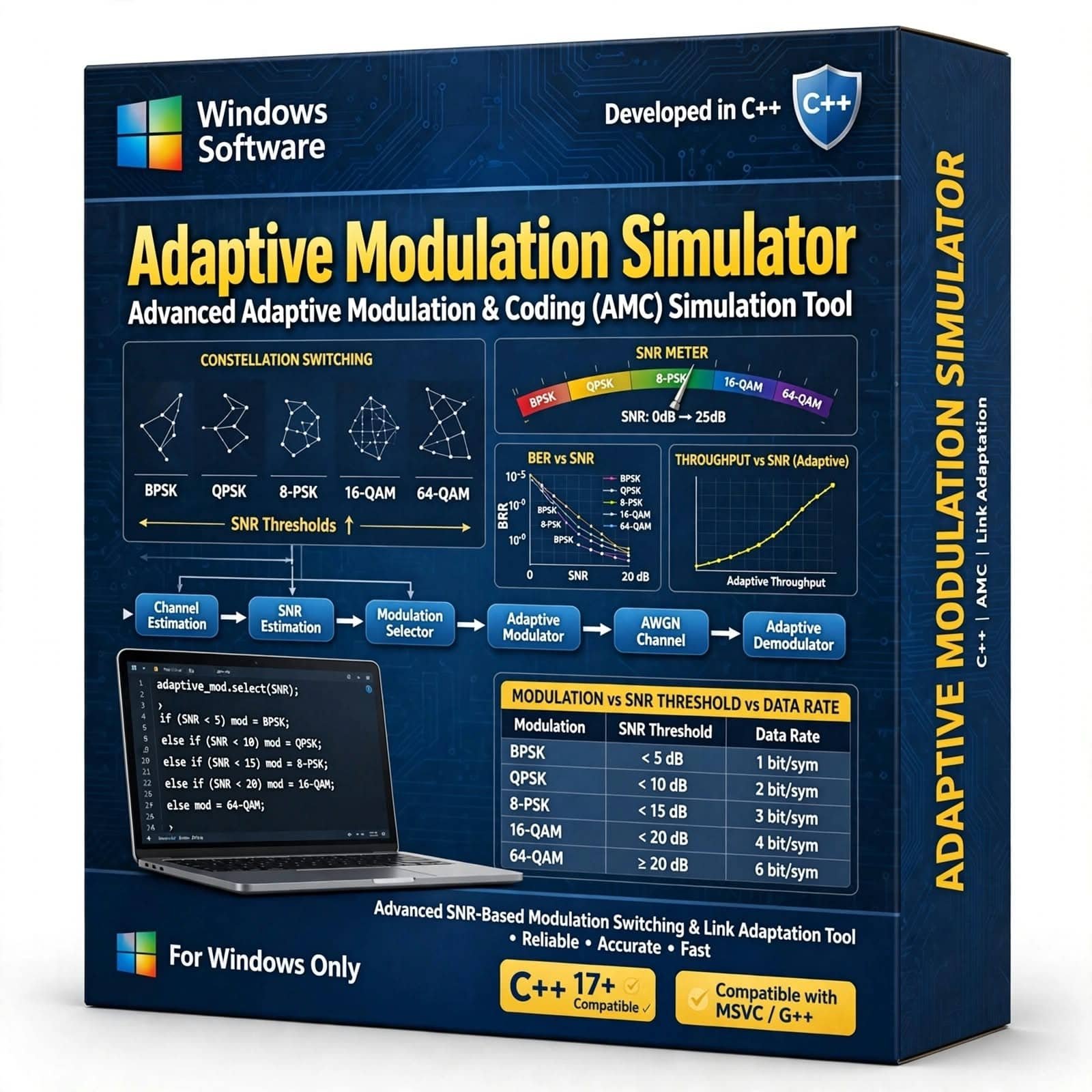
The Adaptive Modulation Simulator is a C++-based software solution designed for students, researchers, engineers, developers, and telecommunications professionals working with digital communication and adaptive modulation techniques. The simulator provides a practical environment for studying how modulation schemes can be selected or adapted according to communication-system conditions.
Developed using C++, the simulator is suitable for academic projects, digital communication research, laboratory demonstrations, signal-processing studies, algorithm development, and educational applications.
Available for sale as a software product. Contact us for pricing, licensing, technical specifications, customization, and purchase information.
₹1,999.00 -
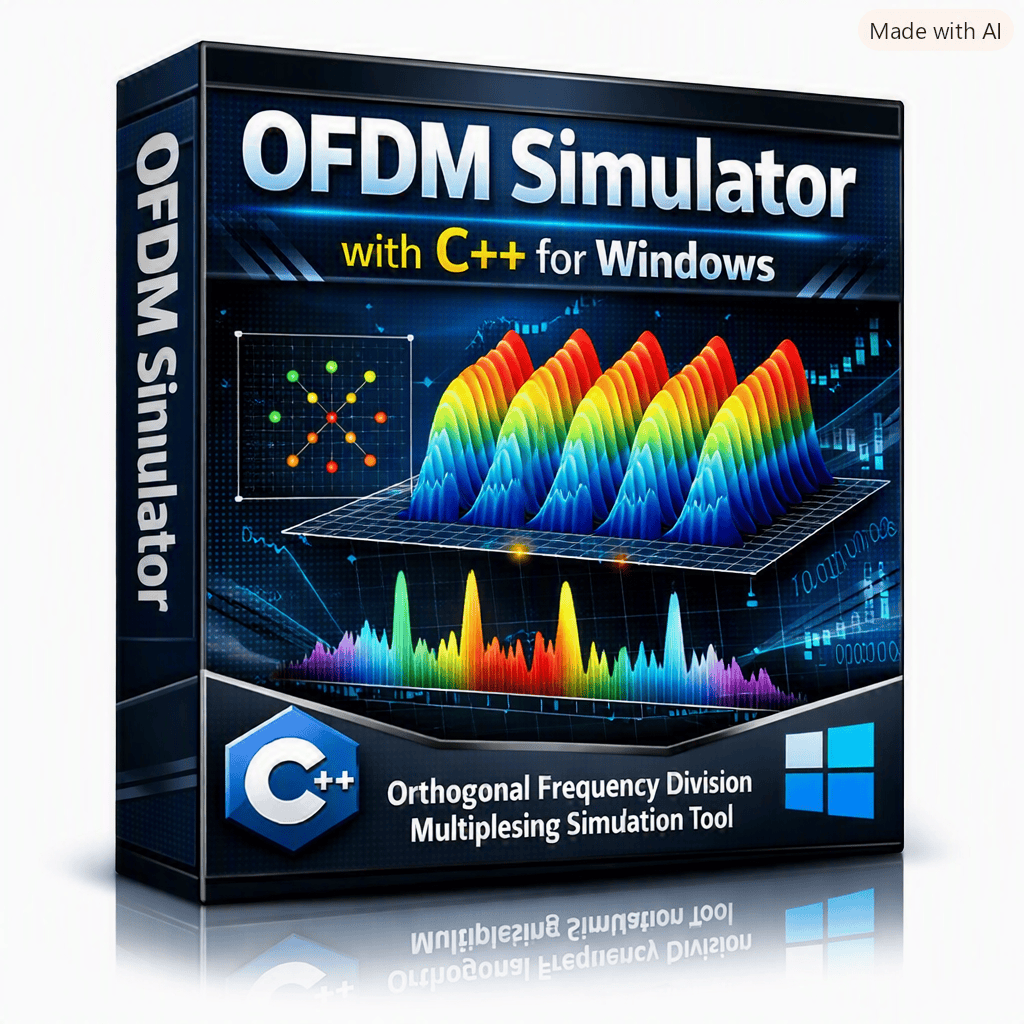
OFDM Simulator – C++ Educational Software is an interactive learning and simulation tool for understanding Orthogonal Frequency Division Multiplexing (OFDM) and digital communication concepts. Developed using C++, it allows users to configure FFT/IFFT size, active subcarriers, cyclic prefix length, modulation, SNR, and number of OFDM symbols while visualizing the resulting time-domain waveform, spectrum, and constellation. The simulator also provides measurable results such as PAPR, BER, Eb/N0, simulated bits, and cyclic-prefix overhead.
₹1,999.00 -
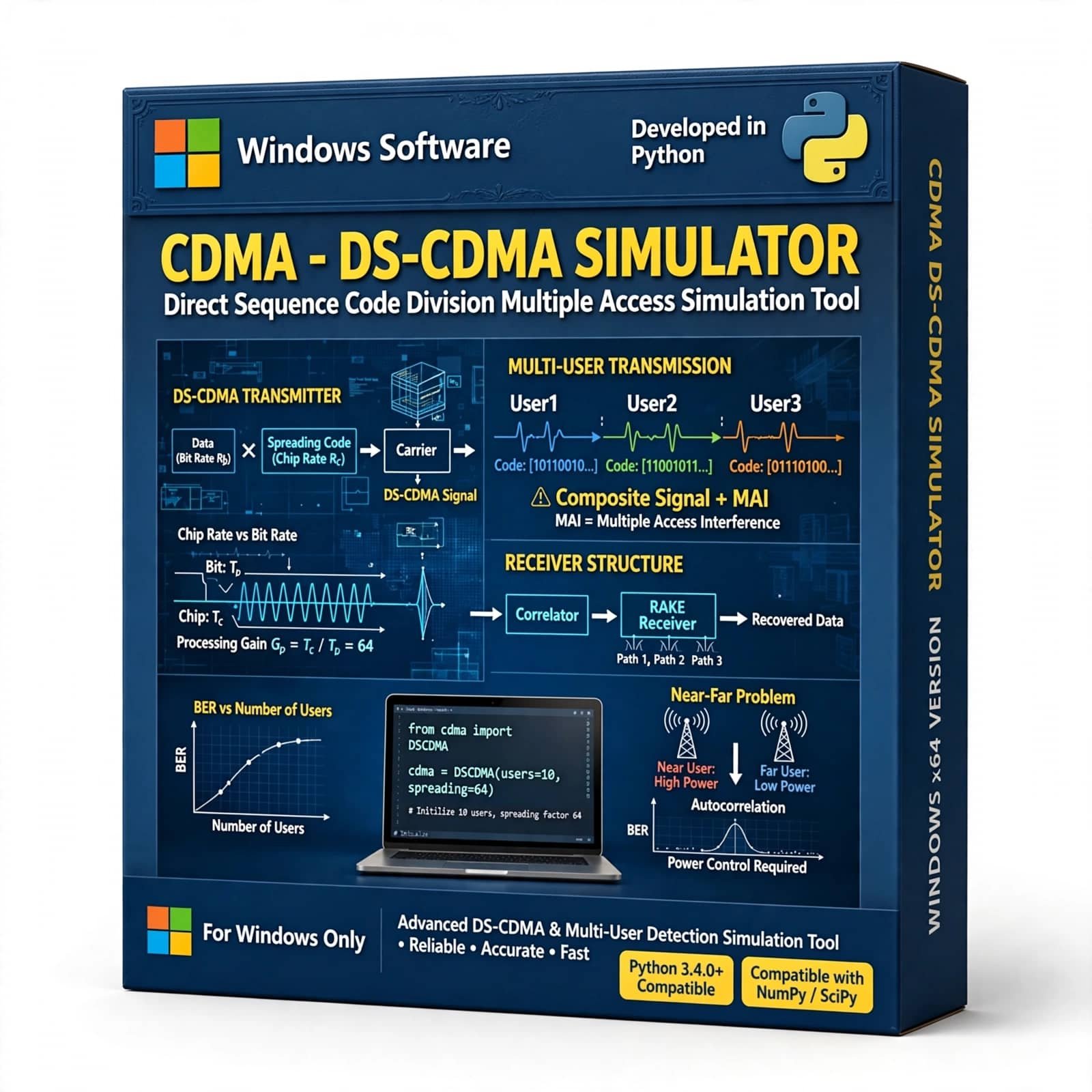
The CDMA DS-CDMA Simulator with Python is a software-based communication simulation tool designed to demonstrate and analyze Direct Sequence Code Division Multiple Access (DS-CDMA) technology. Developed using Python, the simulator provides a practical environment for studying spreading codes, chip sequences, multiple-user communication, signal spreading and despreading, interference, correlation, and transmitted-data recovery. It is suitable for digital communication laboratories, wireless communication education, telecommunications training, student projects, and communication-system research.
Original price was: ₹3,999.00.₹2,499.00Current price is: ₹2,499.00.


Reviews
There are no reviews yet.