

LTE Downlink Simulator

₹6,999.00
In StockThe LTE Downlink Simulator with Python is a practical wireless communication simulation tool for studying and analyzing LTE downlink transmission using Python. It helps students, researchers, and communication engineers explore LTE concepts such as OFDM, modulation, channel modeling, signal transmission, noise, BER, SNR, and downlink performance. Ideal for academic projects, research, laboratory experiments, and wireless communication system analysis.
Description
LTE Downlink Simulator
The LTE Downlink Simulator with Python is a simulation-based tool designed to help users understand, analyze, and experiment with the fundamental principles of LTE downlink communication systems. Developed around Python-based simulation concepts, it provides a practical environment for exploring how data is transmitted from an LTE base station to user equipment over a wireless channel.
LTE, or Long-Term Evolution, is a major technology in the development of modern mobile broadband communication systems. Understanding its downlink transmission process is important for students, researchers, wireless communication engineers, and anyone working on cellular network simulation.
This simulator provides a convenient way to study LTE downlink behavior without requiring access to a physical cellular network. Users can investigate transmission parameters, channel effects, signal quality, and system performance through simulation.

What Is LTE Downlink?
In an LTE network, the downlink refers to communication from the base station toward the user equipment. LTE uses technologies such as Orthogonal Frequency Division Multiplexing (OFDM) in the downlink to efficiently transmit data over multiple subcarriers.
The LTE Downlink Simulator with Python can be used to explore the different stages involved in a typical downlink communication chain, from generating and processing data to transmission through a simulated wireless channel and analyzing the received signal.
This makes the simulator particularly useful for understanding how theoretical LTE concepts translate into practical communication-system behavior.
Python-Based LTE Simulation
Python is widely used for engineering simulations, signal processing, data analysis, and wireless communication research. A Python-based LTE simulator provides users with an accessible environment for experimenting with communication algorithms and analyzing simulation results.
The LTE Downlink Simulator with Python can support learning and experimentation involving concepts such as:
- LTE downlink transmission
- OFDM signal generation
- Digital modulation
- Wireless channel modeling
- Additive noise
- Signal-to-noise ratio (SNR)
- Bit error rate (BER)
- Transmitter and receiver processing
- Signal analysis
- Communication system performance
By modifying simulation parameters, users can examine how different conditions affect the performance of an LTE downlink.

Study OFDM in LTE
OFDM is a key technology used in LTE downlink transmission. It divides the available bandwidth into multiple orthogonal subcarriers, allowing data to be transmitted efficiently across the wireless channel.
The simulator can help users understand important OFDM concepts, including subcarrier-based transmission, symbol generation, channel effects, and signal recovery. This makes it useful for students studying digital communications, wireless communications, signal processing, and mobile communication systems.
Analyze Wireless Channel Effects
Real wireless communication systems are affected by noise and channel conditions. These factors can influence the reliability of received data and overall system performance.
With the LTE Downlink Simulator, users can experiment with different channel and noise conditions and observe their impact on the transmitted and received signals. Such experiments can help demonstrate why signal quality and channel characteristics are important in cellular communication.

BER and SNR Performance Analysis
Performance evaluation is an important part of wireless communication research. Metrics such as Bit Error Rate (BER) and Signal-to-Noise Ratio (SNR) provide valuable information about the reliability of a communication link.
The simulator can be used to investigate the relationship between SNR and BER under different simulated conditions. By analyzing these results, users can develop a better understanding of how noise and channel conditions affect LTE downlink communication.
Simulation results can also be useful for preparing research reports, project documentation, academic presentations, laboratory exercises, and technical studies.
Ideal for Academic and Final-Year Projects
The LTE Downlink Simulator with Python is well suited for students working on projects related to:
- LTE and 4G communication
- Mobile communication systems
- Wireless communication
- OFDM
- Digital signal processing
- Communication system simulation
- Python-based engineering projects
- BER and SNR analysis
- Wireless channel modeling
- Cellular network research
It can serve as a practical foundation for demonstrating LTE downlink concepts and experimenting with communication-system parameters.
Useful for Researchers and Engineers
Researchers can use the simulator as a starting point for studying LTE-related communication techniques and evaluating different simulation scenarios. Python’s flexibility also makes it suitable for extending simulations, analyzing datasets, implementing algorithms, and generating performance plots.
For engineers and researchers, simulation provides a cost-effective way to test concepts before moving toward more complex implementations or physical test environments.

Key Benefits of LTE Downlink Simulator with Python
- Study LTE downlink communication through simulation.
- Explore OFDM-based wireless transmission.
- Understand transmitter and receiver processing.
- Experiment with modulation and signal generation.
- Analyze wireless channel and noise effects.
- Study SNR and BER performance.
- Use Python for communication-system simulation.
- Generate and analyze simulation results.
- Support wireless communication research.
- Suitable for academic and final-year engineering projects.
- Useful for laboratory demonstrations and classroom learning.
- Build practical knowledge of LTE and cellular communication.
Applications
The LTE Downlink Simulator with Python can be applied in several educational, research, and engineering scenarios.
Wireless Communication Education: Demonstrate LTE downlink and OFDM concepts in an interactive simulation environment.
Academic Projects: Support undergraduate and postgraduate projects involving LTE, Python, digital communications, and wireless systems.
Research and Development: Experiment with communication parameters, channel conditions, and performance metrics.
Signal Processing Studies: Analyze transmitted and received signals using Python-based processing techniques.
Communication System Analysis: Evaluate how noise, SNR, modulation, and channel conditions influence system performance.

Learn LTE Through Practical Simulation
The LTE Downlink Simulator with Python bridges the gap between theoretical LTE concepts and practical wireless communication experimentation. Instead of relying solely on mathematical equations, users can simulate transmission scenarios, modify parameters, observe signal behavior, and analyze system performance.
Whether you are a student learning mobile communication, a researcher investigating wireless transmission, or an engineer working with communication-system simulations, this tool provides a practical environment for exploring LTE downlink principles using Python.
Start experimenting with LTE downlink transmission, OFDM, wireless channels, BER, SNR, and signal processing and gain a deeper understanding of the technologies behind modern mobile communication systems.
Related products
-
A Python-based 5G Core Network Simulator designed for studying, analyzing, and demonstrating 5G Core network architecture and procedures. Explore key 5G Network Functions such as AMF, SMF, UPF, AUSF, UDM, PCF, NRF, and NSSF, along with UE registration, authentication, session management, mobility, and signaling procedures.
Ideal for 5G research, telecom engineering, academic projects, university laboratories, protocol development, and network simulation. Provides a flexible software environment for experimenting with 5G Core concepts without requiring a complete commercial 5G network infrastructure.
Original price was: ₹74,999.00.₹19,999.00Current price is: ₹19,999.00. -
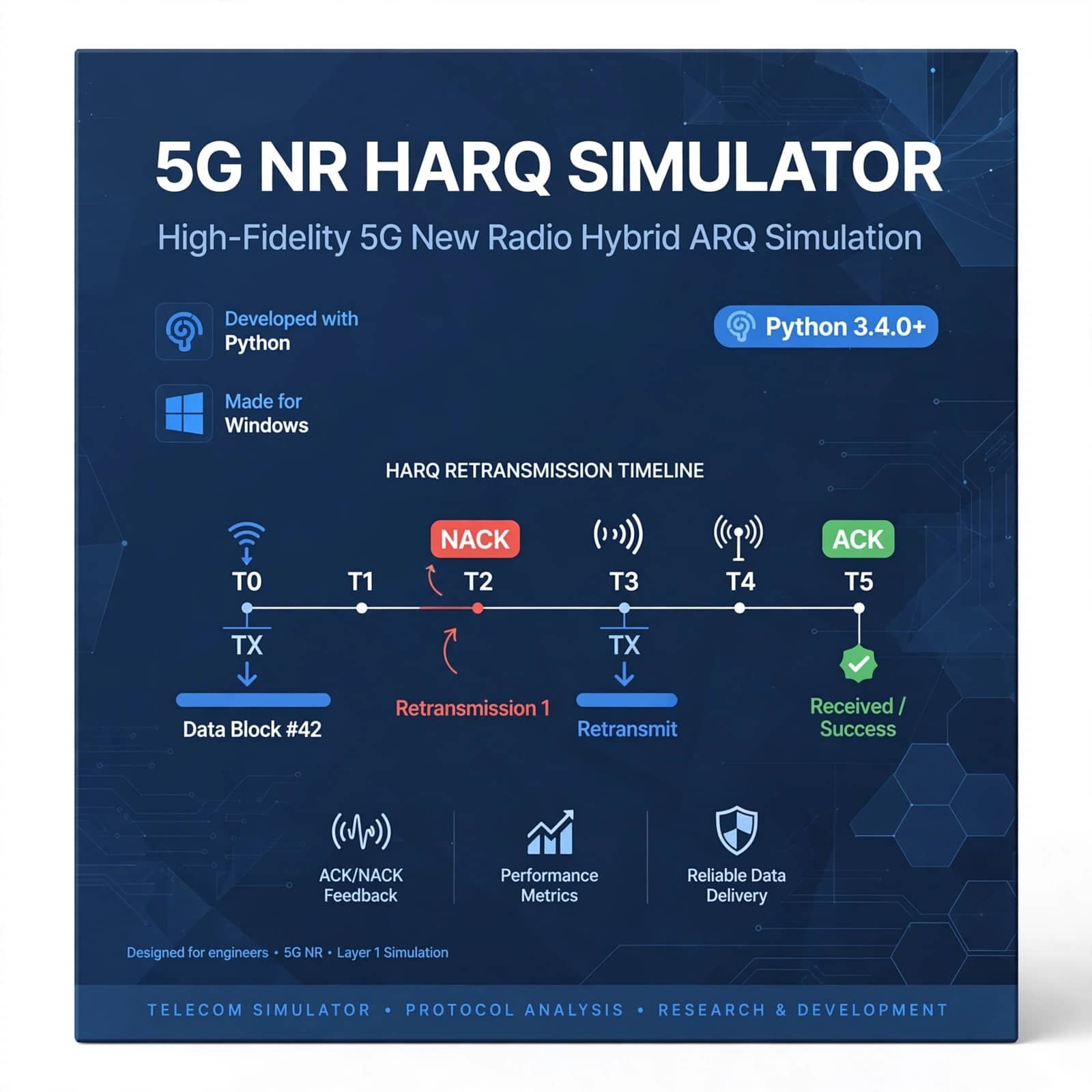
5G NR HARQ Simulator is an advanced simulation solution for modeling and analyzing Hybrid Automatic Repeat Request (HARQ) mechanisms in 5G New Radio networks. It enables users to study HARQ processes, ACK/NACK feedback, retransmissions, link adaptation, channel errors, and communication reliability under configurable network conditions. The simulator supports analysis of throughput, BLER, latency, retransmission rate, packet errors, spectral efficiency, and other key performance metrics, making it suitable for 5G NR research, algorithm development, academic projects, and wireless communication system optimization.
Original price was: ₹74,999.00.₹9,999.00Current price is: ₹9,999.00. -
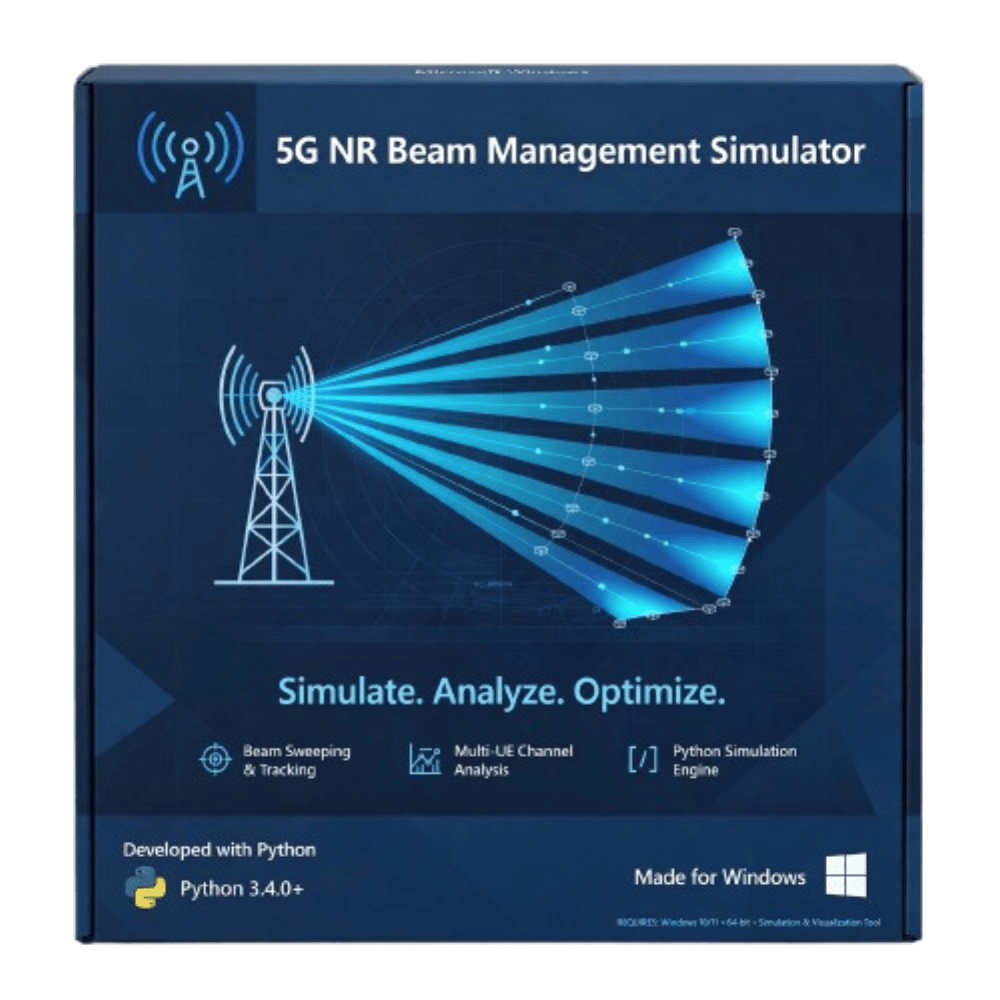
5G NR Beam Management Simulator is an advanced simulation solution designed to model, analyze, and optimize beam management procedures in 5G New Radio (NR) networks. It enables engineers and researchers to evaluate beam sweeping, beam measurement, beam selection, beam reporting, and beam recovery under diverse network and channel conditions. The simulator supports performance analysis of directional communication, helping users assess beamforming strategies, mobility scenarios, link reliability, and system-level performance before real-world deployment.
Original price was: ₹74,999.00.₹12,999.00Current price is: ₹12,999.00. -
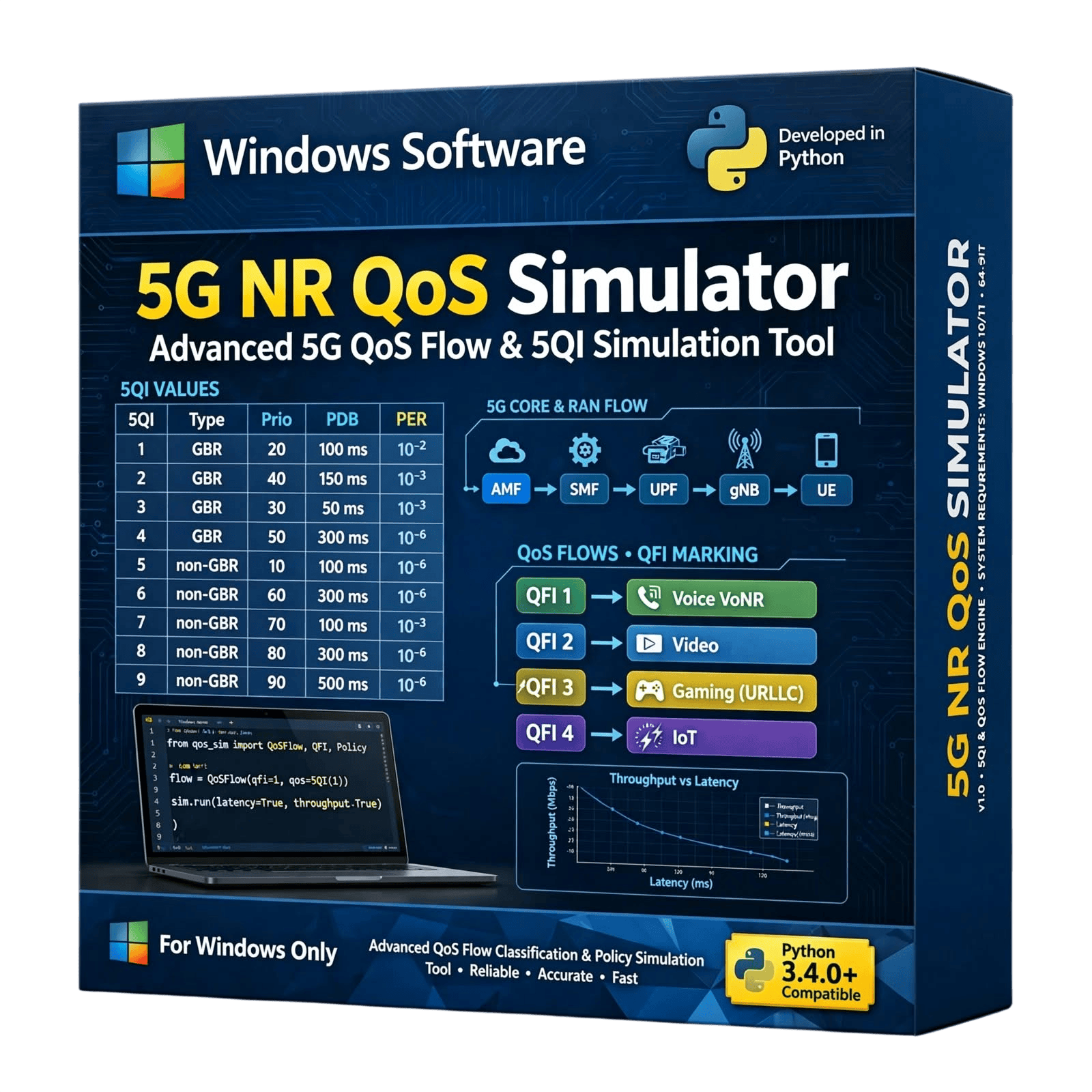
The 5G QoS Simulator is a Python-based software solution designed for researchers, engineers, students, developers, and telecommunications professionals working with 5G Quality of Service (QoS) concepts. The simulator provides a software-based environment for studying and analyzing QoS-related aspects of 5G communication networks, including service performance, traffic behavior, resource management, and network performance evaluation.
Developed using Python, the simulator is suitable for academic research, telecommunications projects, demonstrations, experimentation, algorithm development, and educational applications.
Available for sale as a software product. Contact us for pricing, licensing, features, customization, and purchase information.
Original price was: ₹74,999.00.₹9,999.00Current price is: ₹9,999.00. -
5G NR Massive MIMO Simulator is an advanced simulation solution for modeling and analyzing Massive Multiple-Input Multiple-Output (MIMO) technologies in 5G New Radio networks. It enables users to study large-scale antenna arrays, beamforming, precoding, spatial multiplexing, multi-user MIMO, channel estimation, and interference under configurable channel conditions. The simulator supports analysis of throughput, spectral efficiency, SINR, BER, BLER, MIMO capacity, beamforming gain, and multi-user performance, making it ideal for 5G NR research, algorithm development, academic projects, and 5G/6G wireless system optimization.
Original price was: ₹149,999.00.₹14,999.00Current price is: ₹14,999.00. -

FiveG Core Simulator v2 is an educational 5G Core Network simulation tool designed to help students, educators, researchers, and telecom professionals understand 5G core architecture, network functions, signaling procedures, latency, and protocol interactions through an interactive topology and signaling animation environment.
₹19,999.00




Reviews
There are no reviews yet.