

Adaptive Modulation Simulator


₹1,999.00
In StockThe Adaptive Modulation Simulator is a C++-based software solution designed for students, researchers, engineers, developers, and telecommunications professionals working with digital communication and adaptive modulation techniques. The simulator provides a practical environment for studying how modulation schemes can be selected or adapted according to communication-system conditions.
Developed using C++, the simulator is suitable for academic projects, digital communication research, laboratory demonstrations, signal-processing studies, algorithm development, and educational applications.
Available for sale as a software product. Contact us for pricing, licensing, technical specifications, customization, and purchase information.
Description
Adaptive Modulation Simulator
The Adaptive Modulation Simulator is a specialized software application developed in C++ for studying and demonstrating the principles of adaptive modulation in digital communication systems. It is designed for students, researchers, communication engineers, developers, and telecommunications professionals who want to understand how modulation techniques can be adapted according to changing communication conditions.
Adaptive modulation is an important concept in modern wireless communication systems. Unlike a fixed modulation approach, an adaptive system can select different modulation schemes according to factors such as channel conditions, signal quality, or other system requirements. The objective is generally to achieve an appropriate balance between data transmission performance, signal robustness, and available communication resources.
This simulator provides a software-based environment for exploring these concepts without requiring dedicated communication hardware.
C++ Based Simulation
A key characteristic of this product is that the Adaptive Modulation Simulator is written in C++. C++ is widely used in telecommunications, digital signal processing, embedded systems, simulation applications, and high-performance software development.
The C++ implementation makes the simulator particularly suitable for engineering and computer science students who are learning both programming and digital communication concepts. It can also provide researchers and developers with a foundation for experimentation and further development according to their project requirements.
Users can study adaptive modulation concepts while working within a powerful and widely adopted programming environment.
Understanding Adaptive Modulation
In a conventional digital communication system, a fixed modulation scheme may be used for transmitting information. However, wireless communication channels can experience changing conditions. Signal quality can vary because of factors such as interference, fading, distance, mobility, and environmental conditions.
Adaptive modulation addresses this challenge by allowing the communication system to select an appropriate modulation level based on the current or estimated communication conditions.
Depending on the system design, different modulation schemes can provide different trade-offs between robustness and data rate. Lower-order modulation can generally provide greater robustness under challenging channel conditions, while higher-order modulation can provide higher data throughput when channel conditions are favorable.
The simulator provides an environment in which these fundamental concepts can be explored and demonstrated.
Simulation of Adaptive Communication Concepts
The Adaptive Modulation Simulator can be used to investigate how modulation selection can affect communication-system behavior. By working with different scenarios and parameters, users can study the relationship between channel conditions, modulation selection, and system performance.
This makes the software useful for understanding the basic principles behind adaptive transmission strategies and for developing simulation-based communication-system projects.
The simulator can also serve as a foundation for users who want to investigate their own adaptive modulation algorithms or extend the software for specific research requirements.
Academic and Educational Applications
The simulator is particularly suitable for universities, engineering colleges, communication laboratories, students, and academic researchers.
Potential applications include:
- Digital communication laboratory projects
- Adaptive modulation studies
- Wireless communication projects
- C++ programming projects
- Signal-processing experiments
- Telecommunications assignments
- Final-year engineering projects
- Master’s and PhD research
- Communication-system demonstrations
- Algorithm development projects
- Classroom teaching and demonstrations
- Proof-of-concept implementations
By combining communication theory with C++ software implementation, the simulator can help students develop both theoretical understanding and practical programming skills.
Research and Development Applications
The Adaptive Modulation Simulator can be useful for research involving wireless communications, digital modulation, communication-system optimization, signal processing, and adaptive transmission techniques.
Researchers can use simulation environments to investigate different approaches before implementing them on physical communication hardware. Simulation makes it possible to repeat experiments, modify parameters, compare strategies, and analyze system behavior in a controlled environment.
The C++ source implementation can also be valuable for developers who want to experiment with communication algorithms or integrate additional functionality into their own research projects, subject to the applicable software license.
Advantages of Simulation-Based Learning
Simulation provides a practical way to understand complex communication concepts. Rather than relying exclusively on theoretical equations or physical laboratory equipment, users can explore communication behavior through software.
An adaptive modulation simulator can help users visualize the relationship between changing communication conditions and modulation selection. This can make concepts that are otherwise difficult to understand more accessible to students and researchers.
Simulation can also reduce the effort required to set up initial experiments and allows users to repeat scenarios consistently.

Suitable for Students, Researchers, and Engineers
The Adaptive Modulation Simulator is designed for a broad range of users, including electronics and communication engineering students, telecommunications professionals, researchers, software developers, signal-processing engineers, and academic institutions.
It can be used for learning, research, demonstrations, algorithm experimentation, project development, and communication-system studies.
Potential Applications
The software can be considered for projects involving:
- Adaptive modulation research
- Wireless communication simulation
- Digital communication studies
- Modulation technique analysis
- Signal-processing research
- Communication-system optimization
- C++ software development
- Academic demonstrations
- Research prototypes
- Telecommunications education
Key Highlights
- Adaptive Modulation Simulator
- Designed for studying adaptive modulation concepts
- Developed using C++
- Suitable for digital communication research
- Useful for wireless communication studies
- Suitable for modulation and signal-processing experiments
- Useful for engineering and academic projects
- Suitable for C++ programming and communication projects
- Useful for demonstrations and proof-of-concept development
- Suitable for students, researchers, engineers, and developers
- Can serve as a foundation for further experimentation
- Available for sale
- Licensing and customization options can be discussed with the seller
Software Product – Available for Sale
The Adaptive Modulation Simulator is available for sale as a software product for customers interested in digital communications, adaptive transmission techniques, modulation systems, and C++-based simulation.
Whether you are a student, researcher, telecommunications engineer, software developer, university, engineering college, or research laboratory, this simulator can provide a practical software environment for exploring adaptive modulation concepts.
Customers can contact the seller for information regarding pricing, licensing, installation, source-code availability, technical specifications, supported modulation schemes, customization, and purchase options.
Conclusion
The Adaptive Modulation Simulator provides a practical C++-based environment for studying the principles of adaptive modulation in digital communication systems. By allowing users to explore how modulation strategies can be associated with changing communication conditions, the simulator can support education, research, algorithm development, and communication-system experimentation.
With its C++ implementation and focus on adaptive modulation, this software can be a useful resource for students, researchers, engineers, developers, and institutions working on digital and wireless communication technologies.
The Adaptive Modulation Simulator is available for sale. Contact us today for product details, pricing, licensing, and purchase information.
Related products
-
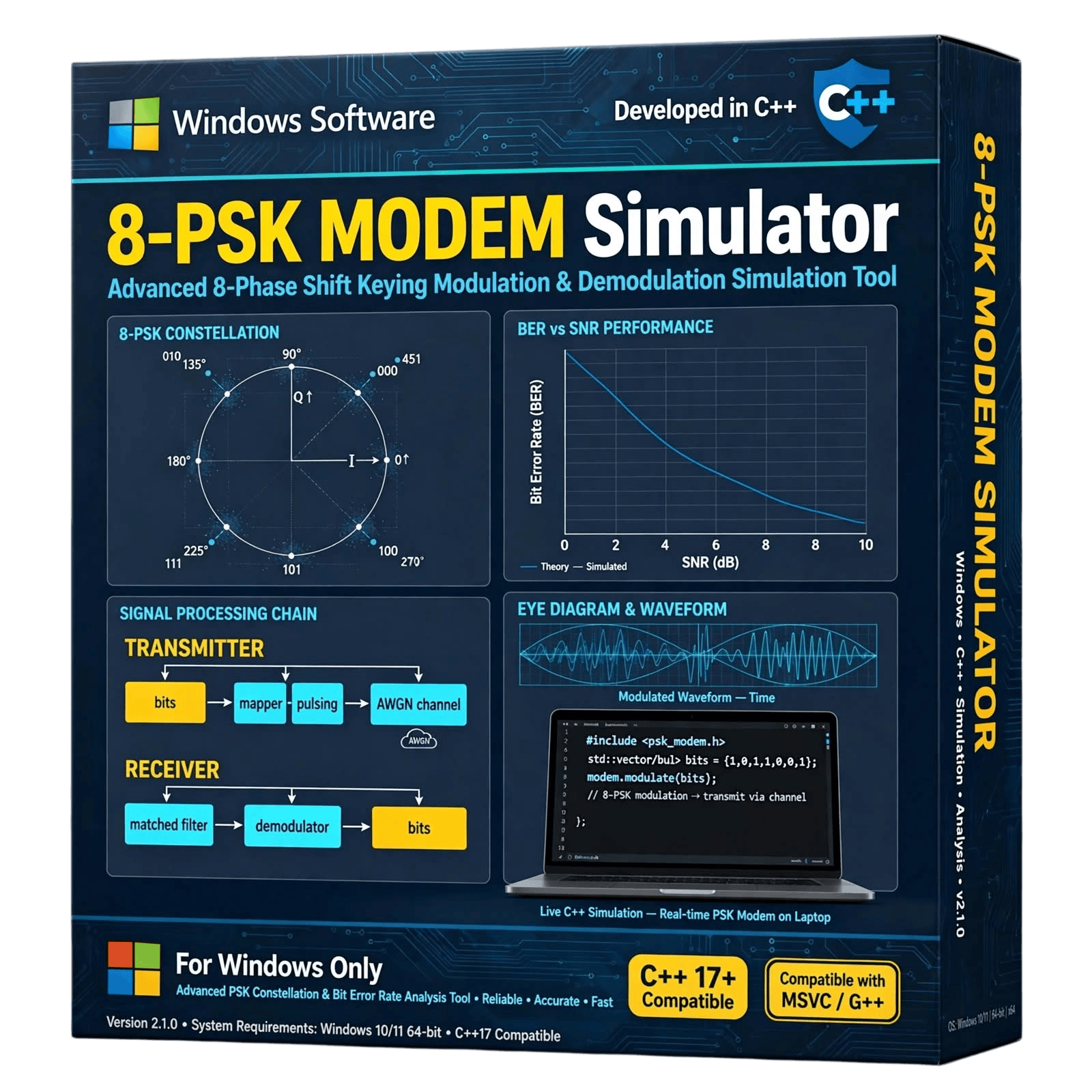
The 8-PSK Modem Simulator is a C++-based software solution designed for students, researchers, communication engineers, developers, and academic institutions working with digital communication and modulation techniques. The simulator provides a practical environment for studying 8-Phase Shift Keying (8-PSK) modulation and demodulation concepts.
Developed using C++, the simulator can be used for digital communication research, academic projects, laboratory demonstrations, signal-processing studies, experimentation, and educational purposes.
Available for sale as a software product. Contact us for pricing, licensing, technical specifications, customization, and purchase information.
₹1,999.00 -
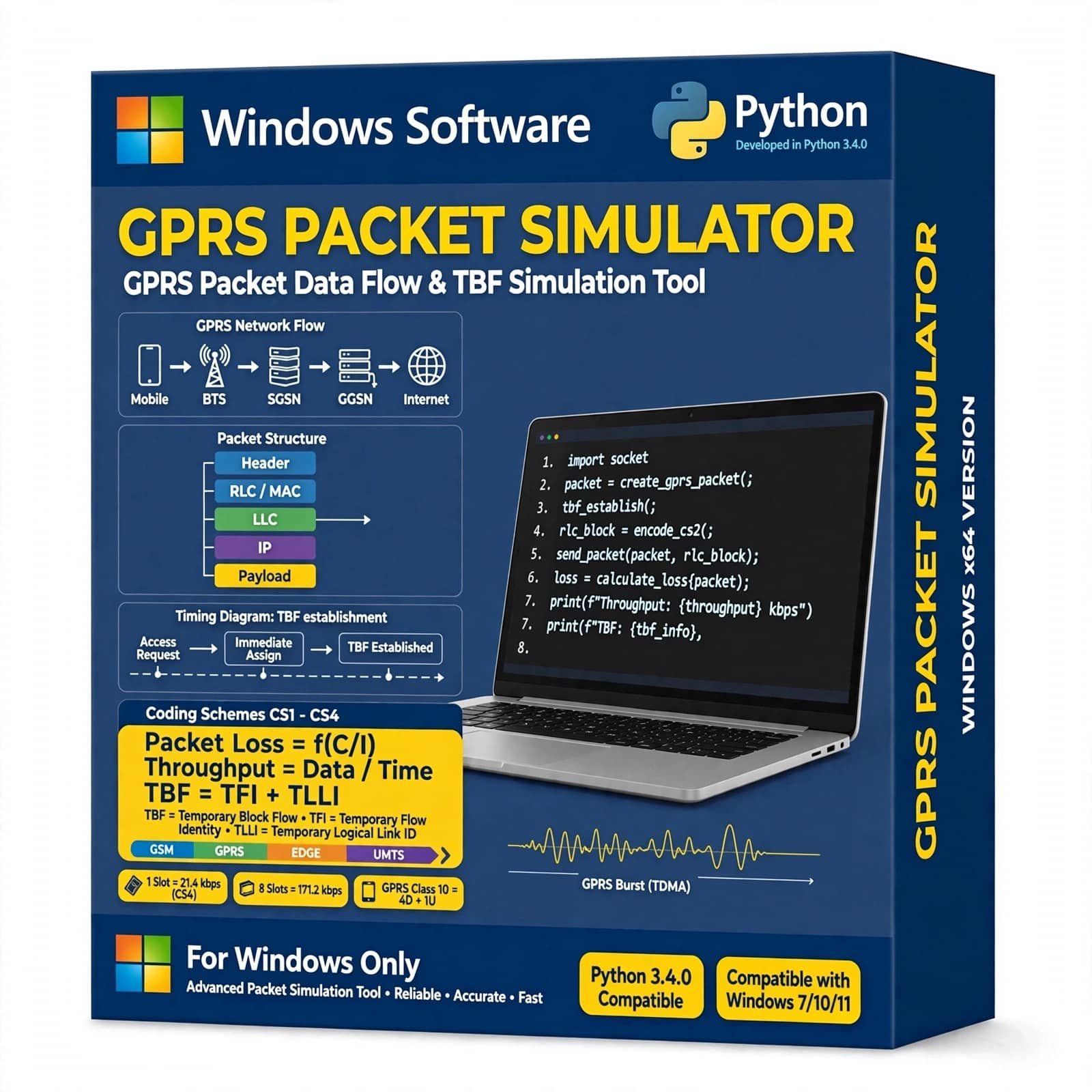
GPRS Packet Simulator is a powerful software solution for simulating GPRS data packets and testing GSM/GPRS communication systems. It helps developers, engineers, and testing teams generate, analyze, and validate packet-based communication in a controlled environment without requiring extensive physical network infrastructure. Ideal for GPRS testing, protocol development, IoT applications, and telecom system validation.
₹3,999.00 -
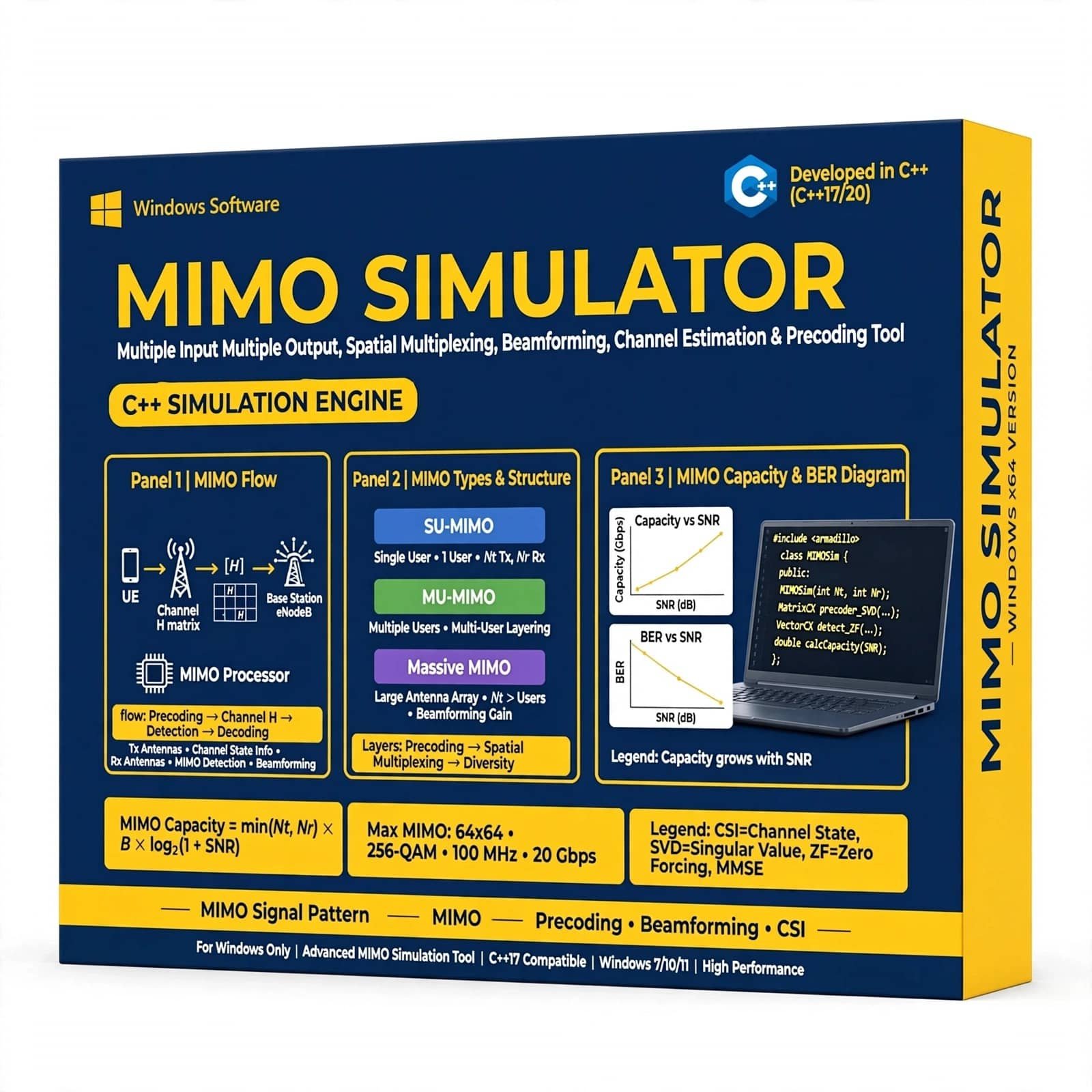
MIMO Simulator with C++ is a powerful wireless communication simulation solution designed for students, researchers, engineers, and communication professionals. Simulate Multiple-Input Multiple-Output (MIMO) systems, analyze channel performance, evaluate BER and SNR, and study different modulation, detection, and fading techniques using efficient C++ implementation.
₹3,999.00 -
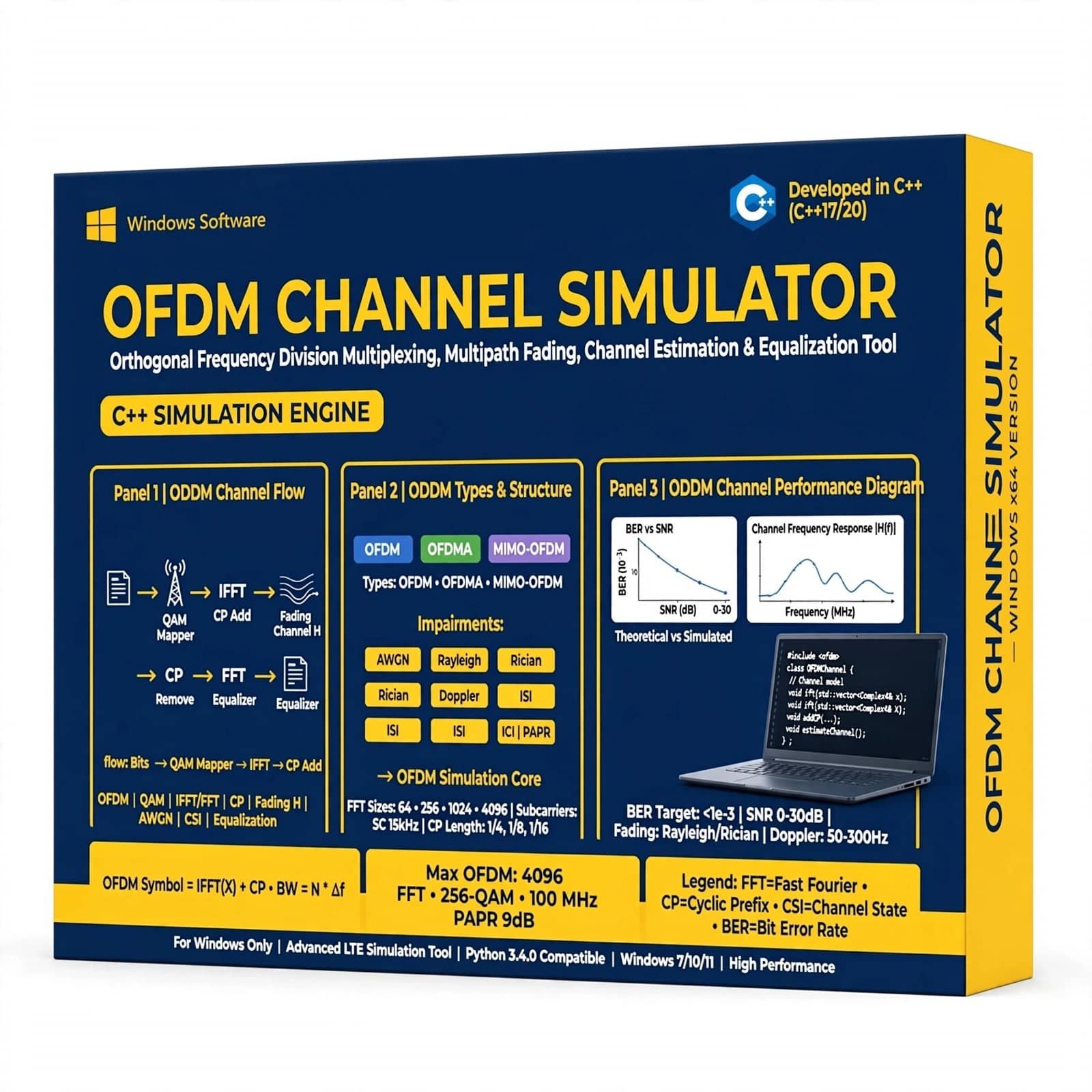
OFDM Channel Simulator – C++ Educational Software is an interactive simulation tool designed to help students, educators, researchers, and communication-engineering learners understand Orthogonal Frequency Division Multiplexing (OFDM) and wireless channel effects. Developed using C++, the simulator demonstrates FFT/IFFT processing, cyclic prefix, QPSK and QAM modulation, multipath channels, delay spread, channel frequency response, equalization, BER, EVM, and constellation diagrams through an intuitive graphical interface.
₹1,999.00 -
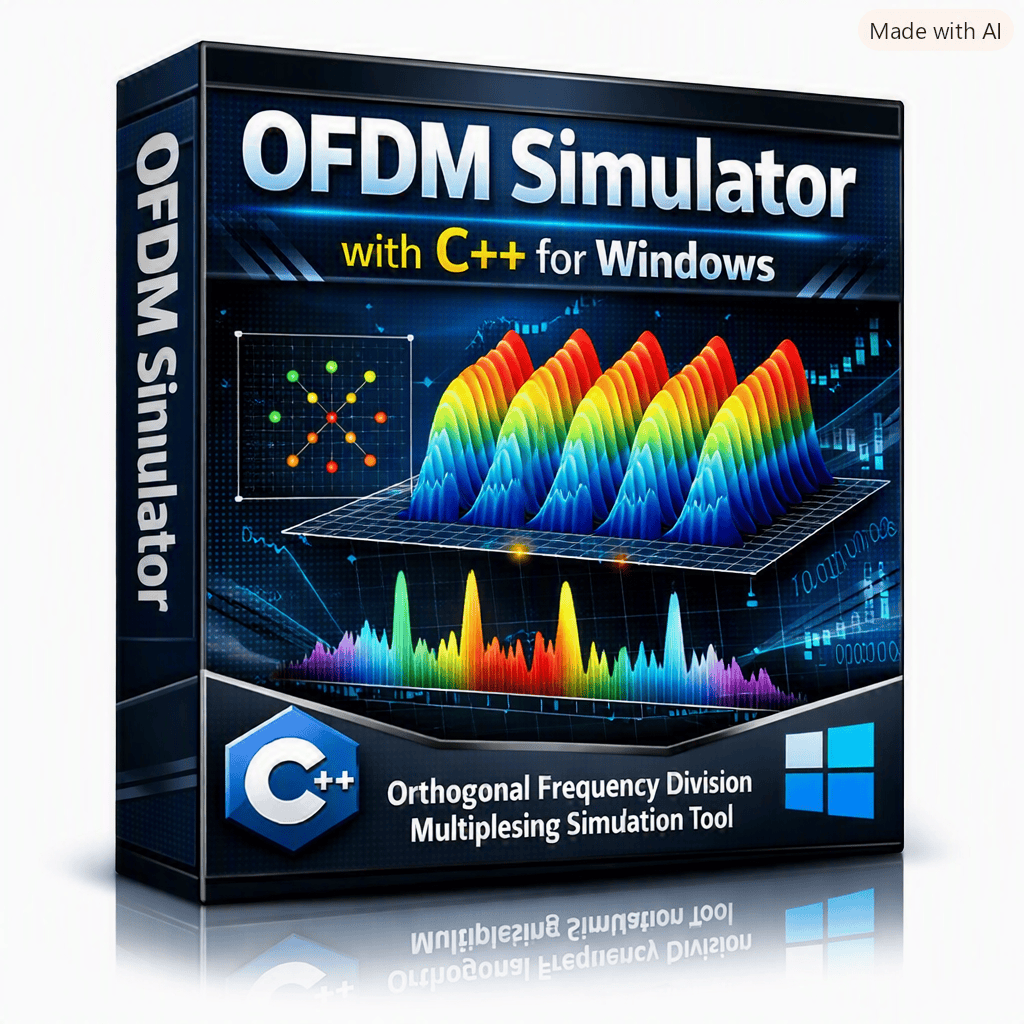
OFDM Simulator – C++ Educational Software is an interactive learning and simulation tool for understanding Orthogonal Frequency Division Multiplexing (OFDM) and digital communication concepts. Developed using C++, it allows users to configure FFT/IFFT size, active subcarriers, cyclic prefix length, modulation, SNR, and number of OFDM symbols while visualizing the resulting time-domain waveform, spectrum, and constellation. The simulator also provides measurable results such as PAPR, BER, Eb/N0, simulated bits, and cyclic-prefix overhead.
₹1,999.00 -
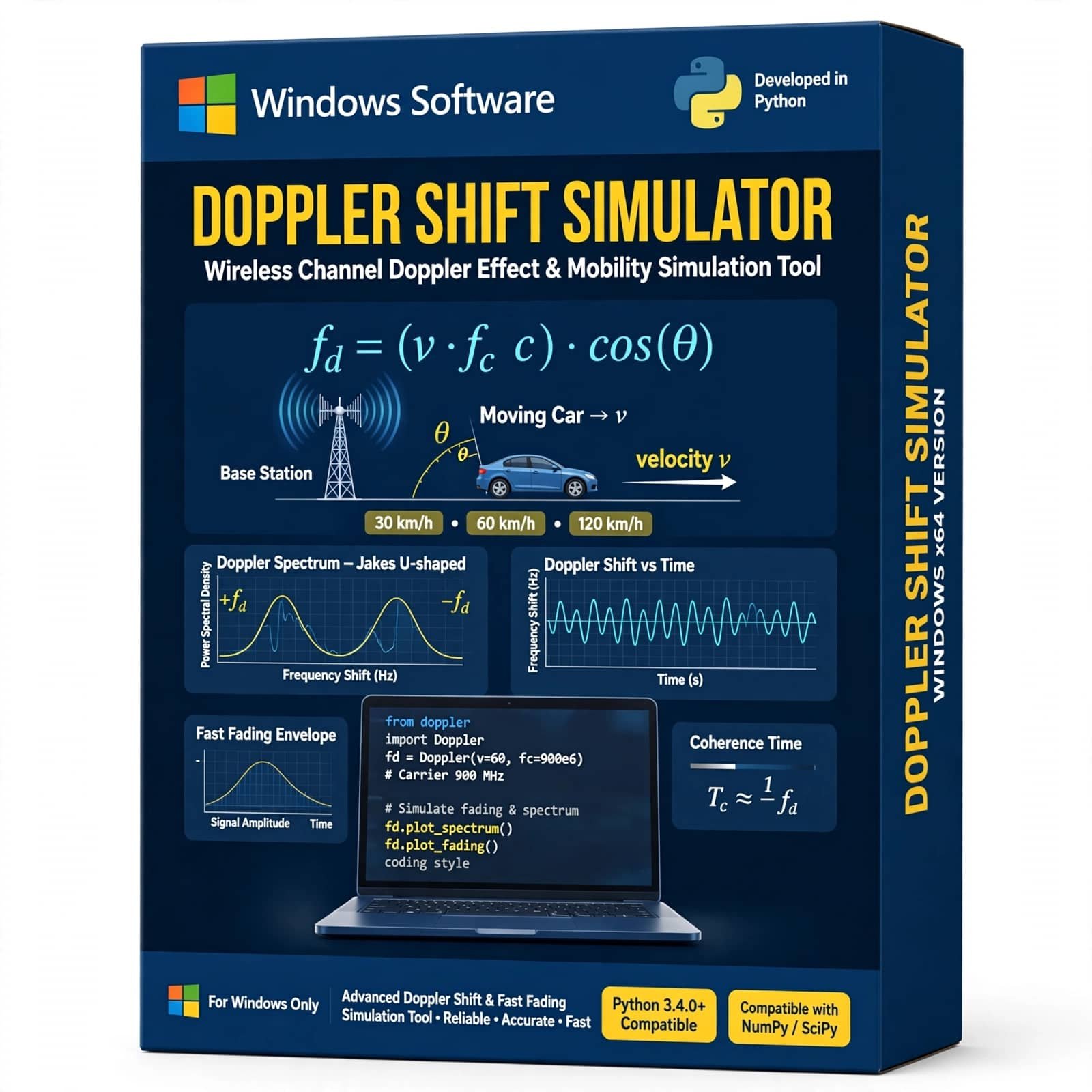
Doppler Shift Simulator Using Python is a practical wireless communication simulation tool for studying the Doppler effect and frequency shift caused by relative motion between a transmitter and receiver. It helps students, researchers, and communication engineers analyze Doppler frequency, carrier frequency, velocity, and mobile channel effects through Python-based simulation.
Original price was: ₹6,999.00.₹2,499.00Current price is: ₹2,499.00.

Reviews
There are no reviews yet.