
New
80% Off

PLD Family Timeline Simulator


Original price was: ₹750.00.₹150.00Current price is: ₹150.00.
In StockPLD Family Timeline Simulator with Python 3.4.0 is an educational and analytical software tool for exploring the historical evolution of Programmable Logic Devices (PLDs). Designed with Python 3.4.0, the simulator helps users study major PLD families, understand their technological progression, and visualize the transition from early programmable logic technologies to more advanced programmable devices.
Ideal for electronics students, digital design learners, researchers, educators, and hardware enthusiasts studying PLD architecture, programmable logic, FPGA history, CPLD technology, and digital electronics.
Description
PLD Family Timeline Simulator
Understanding the evolution of Programmable Logic Devices (PLDs) provides valuable insight into the development of modern digital electronics and programmable hardware. The PLD Family Timeline Simulator with Python 3.4.0 is an educational software tool designed to help users explore the progression of programmable logic device families through a structured timeline-based simulation environment.
From early programmable logic technologies to increasingly sophisticated programmable devices, the history of PLDs reflects major developments in digital circuit design, logic implementation, hardware flexibility, and semiconductor technology. This Python-based simulator provides a practical way to study these developments and understand how different PLD families relate to one another.
Designed using Python 3.4.0, the project is particularly suitable for students, educators, electronics enthusiasts, researchers, and developers interested in learning about PLD technology, digital logic design, FPGA development, CPLD architecture, and programmable hardware.

What Is a PLD Family Timeline Simulator?
A PLD Family Timeline Simulator is a software-based learning tool that organizes the evolution of programmable logic devices into a chronological and conceptual framework. Instead of studying individual PLD technologies in isolation, users can explore how programmable logic families developed over time and how newer technologies addressed limitations or requirements associated with earlier devices.
The simulator can be used to represent major stages in the development of programmable logic and provide an interactive or structured method for studying different device families.
This makes the project useful for understanding the broader relationship between PROM, PLA, PAL, GAL, CPLD, FPGA, and related programmable logic technologies, depending on the timeline and device data implemented in the simulator.

Explore the Evolution of Programmable Logic
Programmable logic has played an important role in digital system development. Early programmable devices provided designers with ways to implement custom logic without creating a completely custom integrated circuit for every application.
As technology progressed, programmable logic devices became more capable, flexible, and complex. Device families such as PLAs and PALs introduced programmable logic structures, while later technologies such as GALs, CPLDs, and FPGAs provided increasingly sophisticated approaches to configurable digital hardware.
The PLD Family Timeline Simulator with Python 3.4.0 provides a way to organize this evolution and examine the progression of programmable logic technologies in a single project.
Key Learning Areas

The simulator can support exploration of several important digital electronics concepts, including:
- Programmable Logic Devices
- PLD technology evolution
- Digital logic implementation
- PROM-based logic
- PLA architecture
- PAL architecture
- GAL technology
- CPLD development
- FPGA evolution
- Programmable hardware
- Digital circuit design
- Hardware configuration
- Semiconductor technology history
By presenting these concepts through a timeline-oriented approach, the project can make historical and technical relationships easier to understand.
Why Python 3.4.0?
Python provides a straightforward environment for developing educational simulations, data-driven applications, and technology demonstrations. Python 3.4.0 is particularly relevant for projects that need to maintain compatibility with older Python development environments or demonstrate software development using an earlier Python release.
Working with Python 3.4.0 can also provide students and developers with practical experience in maintaining and understanding software written for earlier versions of a programming language.
The project can serve as a starting point for further development, allowing users to expand the timeline, add additional PLD families, introduce more device characteristics, or modify the presentation and simulation logic according to their requirements.

Educational Applications
The PLD Family Timeline Simulator can be useful in academic and self-learning environments. Electronics and computer engineering students can use it as a supplementary project when studying digital electronics, programmable logic, computer architecture, or VLSI-related subjects.
Teachers and instructors can also use the concept as a demonstration tool for explaining how programmable logic technologies evolved and why different PLD architectures emerged.
For researchers and hardware enthusiasts, the project provides a foundation that can be extended into a more detailed historical or technical visualization of programmable logic technology.
Who Can Use This Project?
This Python-based PLD simulator is suitable for:
- Electronics engineering students
- Electrical engineering students
- Computer engineering students
- Digital electronics learners
- FPGA beginners
- CPLD learners
- Hardware design enthusiasts
- Electronics educators
- Researchers studying programmable hardware
- Python developers working on educational simulations
It can also be useful as a college project, academic demonstration, digital electronics project, Python simulation project, or programmable logic learning resource.

Understand PLD, CPLD, and FPGA Technology
One of the key benefits of studying PLD history is gaining a better understanding of the relationship between different programmable hardware technologies.
Early programmable logic devices addressed the need for configurable digital logic. Later generations increased logic capacity, flexibility, and architectural sophistication. CPLDs and FPGAs subsequently became important platforms for implementing increasingly complex digital systems.
Studying these technologies as part of a timeline can help learners understand that modern programmable hardware did not emerge as a single technology, but rather through a progression of architectures and design approaches.
The PLD Family Timeline Simulator with Python 3.4.0 provides a practical framework for exploring that progression.
Customizable Python Simulation Project
Because the simulator is implemented in Python, developers can potentially extend its functionality according to their project requirements. Additional PLD families, timeline events, device information, descriptions, or visualization features can be incorporated into an expanded version of the project.

This makes the simulator more than a static historical reference. It can serve as a Python-based foundation for programmable logic research, education, and digital hardware visualization.
Key Features
- Python 3.4.0-based PLD simulation project
- Timeline-oriented exploration of PLD technology
- Study of programmable logic device families
- Educational approach to PLD evolution
- Useful for digital electronics learning
- Suitable for FPGA and CPLD learners
- Customizable Python project structure
- Useful for academic and research projects
- Helps visualize programmable hardware development
- Suitable for students, educators, and electronics enthusiasts
Get the PLD Family Timeline Simulator
The PLD Family Timeline Simulator with Python 3.4.0 offers an accessible way to study the evolution of programmable logic devices while combining digital electronics concepts with Python programming.

Whether you are learning about PLD architecture, FPGA history, CPLD technology, programmable logic, or digital circuit design, this project provides a practical foundation for exploring how programmable hardware technologies developed over time.
Use it as an educational project, demonstration tool, research starting point, or customizable Python simulation for studying the fascinating evolution of programmable logic devices.
Related products
-
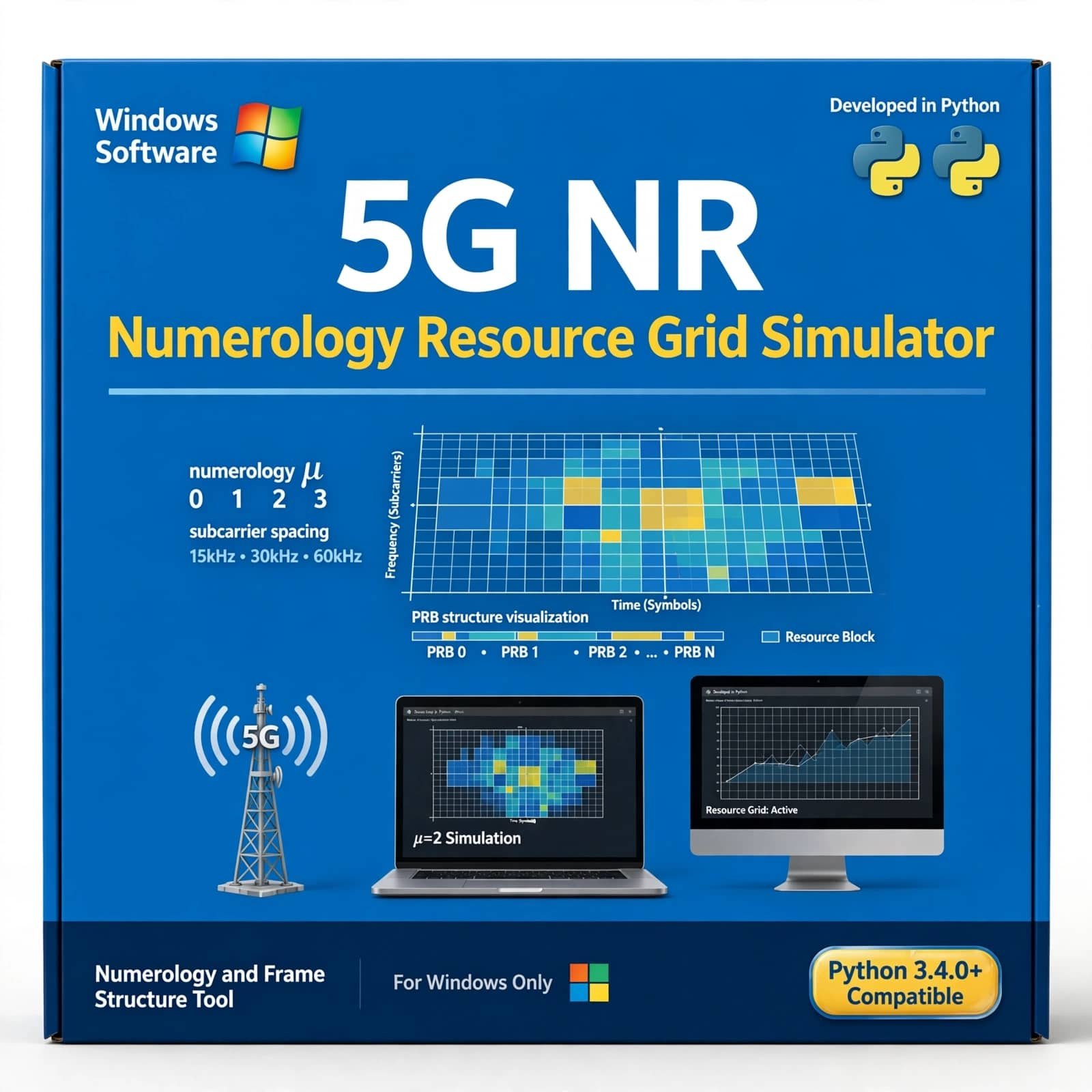
5G NR Numerology Resource Grid Simulator is an advanced simulation solution for modeling and analyzing 5G New Radio numerology and time-frequency resource grid structures. It enables users to study subcarrier spacing, OFDM symbols, slot structure, cyclic prefix, Physical Resource Blocks (PRBs), Resource Elements (REs), bandwidth configurations, and resource mapping. The simulator is ideal for 5G NR physical-layer research, numerology analysis, resource allocation studies, academic projects, waveform development, and 5G/6G wireless communication research.
Original price was: ₹750.00.₹250.00Current price is: ₹250.00. -
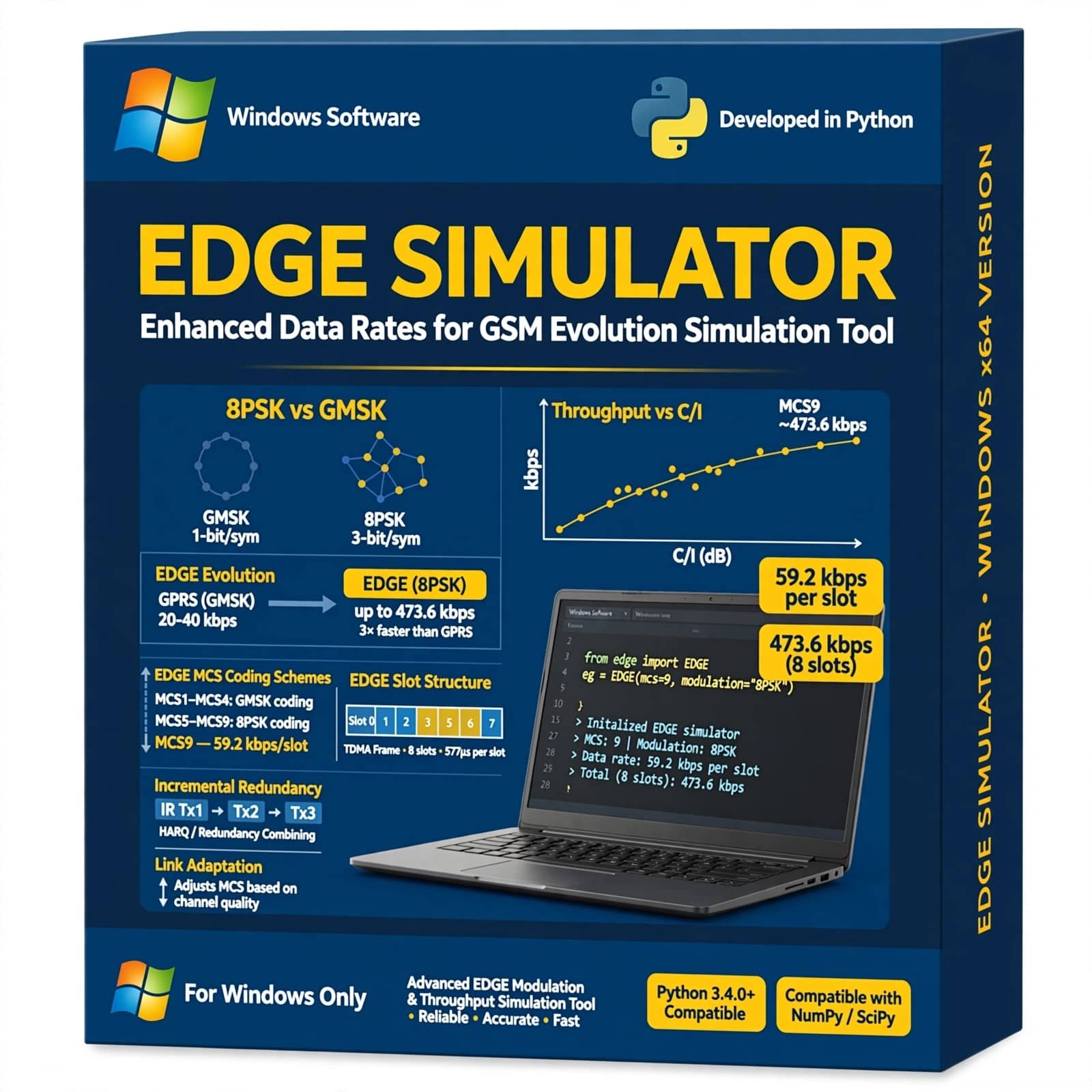
EDGE Simulator Using Python is a practical mobile communication simulation tool designed to demonstrate and analyze Enhanced Data rates for GSM Evolution (EDGE) technology. It helps students, researchers, and communication engineers study GSM/EDGE data transmission, modulation, channel conditions, bit error rate, data rates, and wireless communication performance using Python-based simulation.
Original price was: ₹750.00.₹250.00Current price is: ₹250.00. -
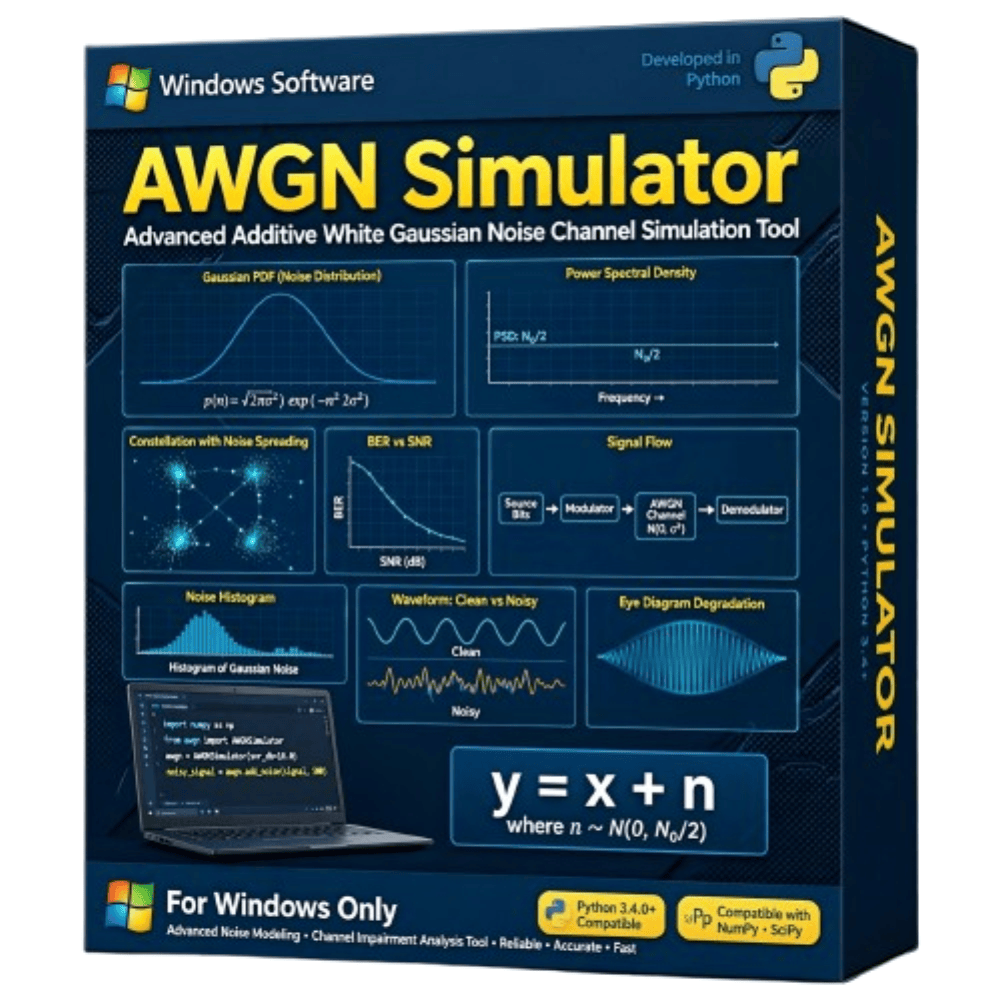
An AWGN Simulator i.e. Additive White Gaussian Noise Simulator developed using Python is a software-based tool designed to demonstrate and analyze the effect of Gaussian noise on digital communication signals. The simulator generates a clean input signal, adds controlled amounts of AWGN, and displays both the original and noisy signals for comparison. Users can vary parameters such as noise power, signal-to-noise ratio (SNR), and signal characteristics to observe how communication quality changes under different noise conditions. Python libraries such as NumPy, SciPy, and Matplotlib can be used for signal generation, noise modeling, numerical processing, and graphical visualization but this is purely from tkinter only. The simulator is useful for understanding fundamental concepts of wireless and digital communication systems.
Original price was: ₹750.00.₹250.00Current price is: ₹250.00. -
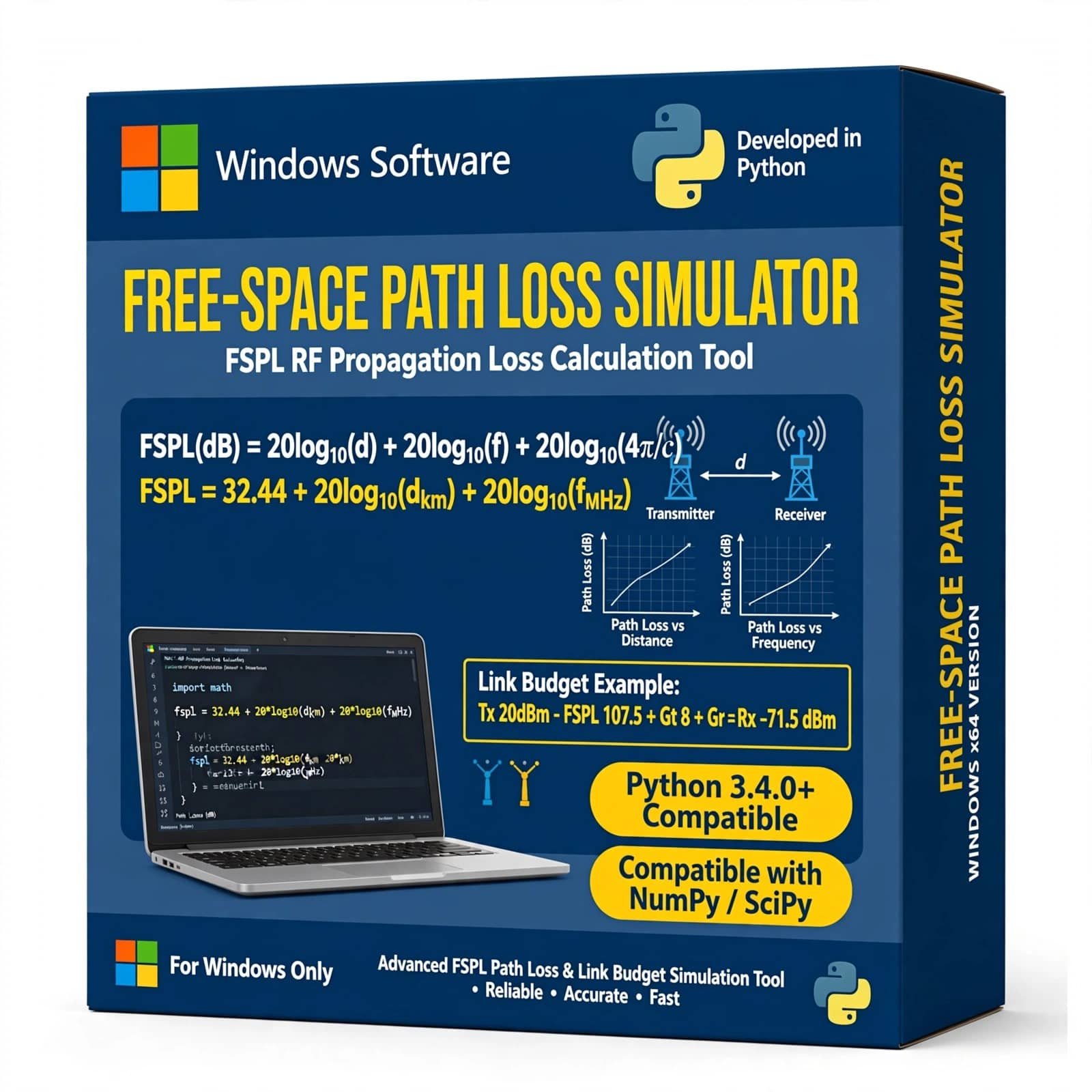
Free Space Path Loss Simulator Using Python is a practical wireless communication simulation project designed to calculate and visualize signal power loss as a radio wave travels through free space. Developed using Python, this simulator helps students, researchers, and communication engineers understand Free Space Path Loss (FSPL), transmission distance, frequency, received signal power, and wireless link performance.
The project provides an easy-to-understand simulation environment for analyzing how distance and operating frequency affect signal propagation. It is suitable for B.Tech, M.Tech, engineering students, academic projects, wireless communication studies, RF analysis, and Python-based simulation projects.
Original price was: ₹750.00.₹250.00Current price is: ₹250.00. -
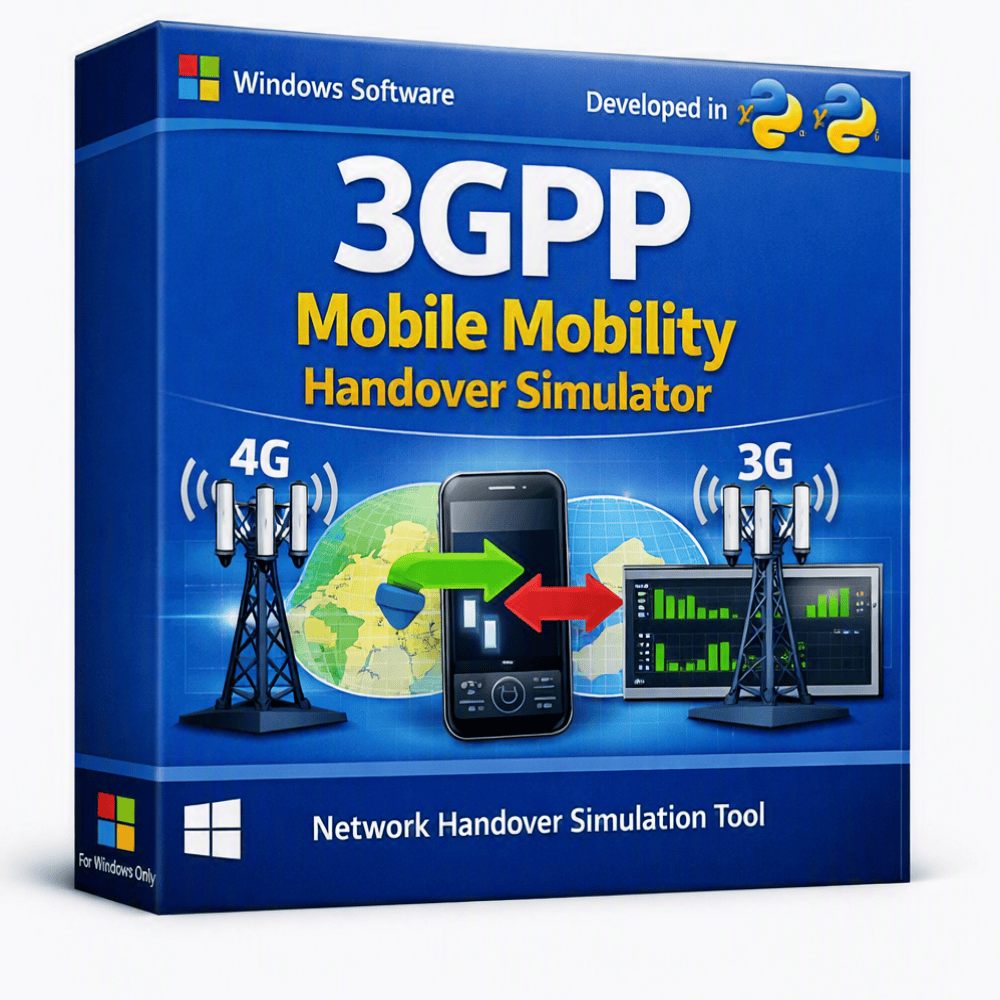
A powerful simulation tool for analyzing and validating 3GPP mobile mobility and handover procedures. The simulator enables users to model mobile network scenarios, study handover behavior, and evaluate mobility performance under different network conditions.
Key Features:
- 3GPP-compliant mobility and handover simulation
- Configurable network and mobility scenarios
- Analysis of handover performance and behavior
- Supports research, testing, and network optimization
- Useful for telecom engineers, researchers, and academic projects
Ideal for 5G/4G/3G mobility research, protocol testing, network planning, and academic simulation studies.
Original price was: ₹750.00.₹250.00Current price is: ₹250.00. -
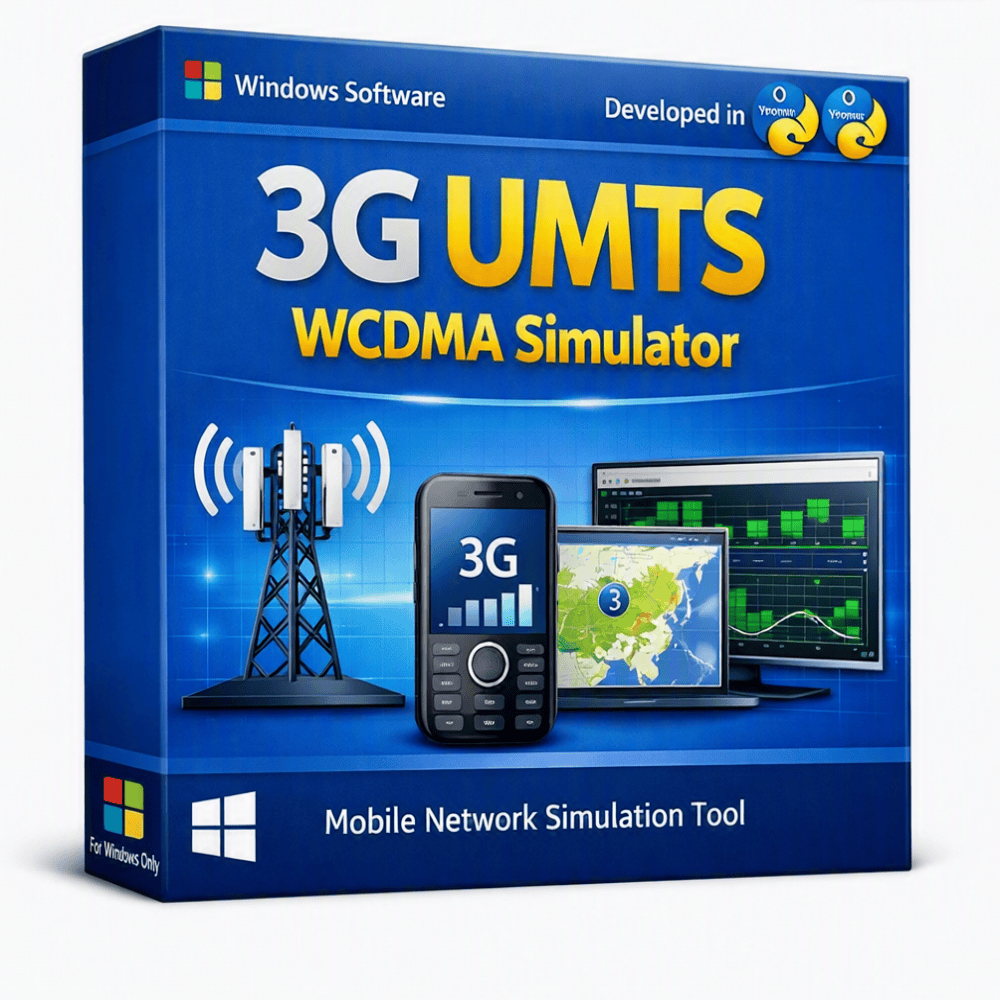
The 3G UMTS – WCDMA Simulator is a software-based simulation project designed to demonstrate the fundamental concepts of 3G Universal Mobile Telecommunications System (UMTS) and Wideband Code Division Multiple Access (WCDMA) technology. It provides a practical environment for studying cellular communication, spreading codes, signal transmission, mobile users, network connectivity, and WCDMA-based communication principles. The simulator is suitable for students, researchers, and developers working on telecommunications and wireless communication projects. It can be used for academic demonstrations, engineering projects, research, experimentation, and learning about 3G mobile communication and WCDMA network technologies.
Original price was: ₹750.00.₹250.00Current price is: ₹250.00.


Reviews
There are no reviews yet.