
New
80% Off

EPLD vs CPLD vs FPGA vs ASIC Simulator


Original price was: ₹750.00.₹150.00Current price is: ₹150.00.
In StockThe ultimate EPLD vs CPLD vs FPGA vs ASIC Simulator with Python 3.4+ and Windows 7+ support. This edition features a powerful Comparison Tool that simulates Architecture Structure, Cost Analysis, Speed & Performance, Flexibility & Reconfigurability, and Power & Density in one dashboard.
Visualize EPLD PAL/GAL arrays vs CPLD macrocell blocks vs FPGA LUT/CLB fabric vs ASIC standard-cell tapeout. Use the Side-by-side matrix to compare logic density, timing, power, NRE cost, and reprogrammability instantly. The built-in Decision Wizard recommends the best technology based on your volume, speed, power, and budget.
Includes dedicated tabs for Export Report, Timing Analysis, Utilization Heatmap, and Power Graphs. Topics simulated: Product-term vs LUT logic, interconnect modeling, synthesis estimation, place & route, bitstream vs tapeout flow, and break-even analysis.
Description
EPLD vs CPLD vs FPGA vs ASIC Simulator
One Simulator. Four Technologies. Clear Decision. Choosing between EPLD, CPLD, FPGA and ASIC is the most critical decision in digital design. The EPLD vs CPLD vs FPGA vs ASIC Simulator V6.0 Pro is a professional-grade Windows software with Python that finally gives you a scientific way to decide.
Built with the exact workflow you requested – Comparison Tool, Architecture Structure Viewer, Cost Analysis Engine, Speed and Performance Analyzer, Flexibility and Reconfigurability Lab, Power and Density Estimator, Side by Side Matrix, Decision Wizard, and Export Report Tabs – this is the only tool that simulates and analyses all topics in one place.
WHAT’S INSIDE – FEATURE WISE BREAKDOWN:

- Advanced Comparison Tool:
The core engine. Load any digital design (Adder, MUX, FSM, RISC processor) and the tool simultaneously maps it to all four architectures. Instantly see gate count, macrocell vs LUT usage, and estimated silicon area.

- Architecture Structure Visualizer:
Interactive block diagrams as seen on the box.
EPLD: AND-OR plane, product terms, PAL/GAL structure.
CPLD: Functional Blocks (FBs), macrocells, PIA interconnect, I/O blocks.
FPGA: LUTs, CLBs, Switch Matrix, Block RAM, DSP, Clock Tree, FPGA Fabric Grid.
ASIC: Standard cells, sea-of-gates, full-custom vs semi-custom flow, tapeout stages.

- Cost Analysis Tab:
The most demanded feature. The simulator calculates NRE (Non-Recurring Engineering) cost, per-unit cost, and generates a break-even volume graph. See why EPLD/CPLD is best for <1k units, FPGA for 1k-10k prototyping, and ASIC for >100k volume production. Includes mask cost and development time estimation.
- Speed and Performance Tab:
Real engineering metrics, not theory. Simulates pin-to-pin delay (CPLD – fast deterministic), LUT delay + routing delay (FPGA), and critical path timing (ASIC). Compare Fmax, propagation delay, setup/hold time, and clock skew across technologies. Includes Utilization vs Speed graph.
- Flexibility and Reconfigurability Lab:
Simulate in-system reprogrammability. Test EPLD UV-erase cycle, CPLD ISP, FPGA SRAM-based reconfiguration and partial reconfiguration, vs ASIC one-time fixed logic. Perfect for teaching why FPGA is used for prototyping and field updates.
- Power and Density Estimator:
Analyze static power, dynamic power (mW/MHz), logic density (gates/mm2), and thermal estimation. The LUT Utilization Heatmap shows power hotspots and interconnect congestion. Compare Power vs Density curves for low-power IoT selection.

- Side by Side Matrix:
A single, exportable matrix table that compares 25+ parameters: Logic Capacity, Architecture, Volatility, Reprogrammable, Power, Speed, Cost per unit, NRE, Time-to-market, Design Tools (Verilog/VHDL/SystemVerilog), and Best Use-Cases. Ideal for thesis, reports, and client presentations.

- Decision Wizard:
Answer 6 questions – Your target volume? Required speed? Power budget? Need reprogrammability? Budget? Timeline? – and the Wizard recommends EPLD, CPLD, FPGA, or ASIC with justification score and risk analysis.

- Export Report Tabs:
One-click export of all simulations to PDF report, CSV data, PNG graphs, and Matplotlib plots via Python API. Tabs include: Architecture Report, Timing Report, Power Report, Cost Report, and Comparison Summary.
TOPICS SIMULATED / ANALYSED:
Product-term Logic vs LUT Logic, Macrocell Timing, FPGA Synthesis, Place & Route Estimation, Bitstream Generation vs ASIC Tapeout, Interconnect Delay Modeling, Power Estimation (UPF compliant), Resource Utilization, IP-XACT packaging, HDL import (IEEE 1364 Verilog, IEEE 1076 VHDL, IEEE 1800 SystemVerilog).
Related products
-
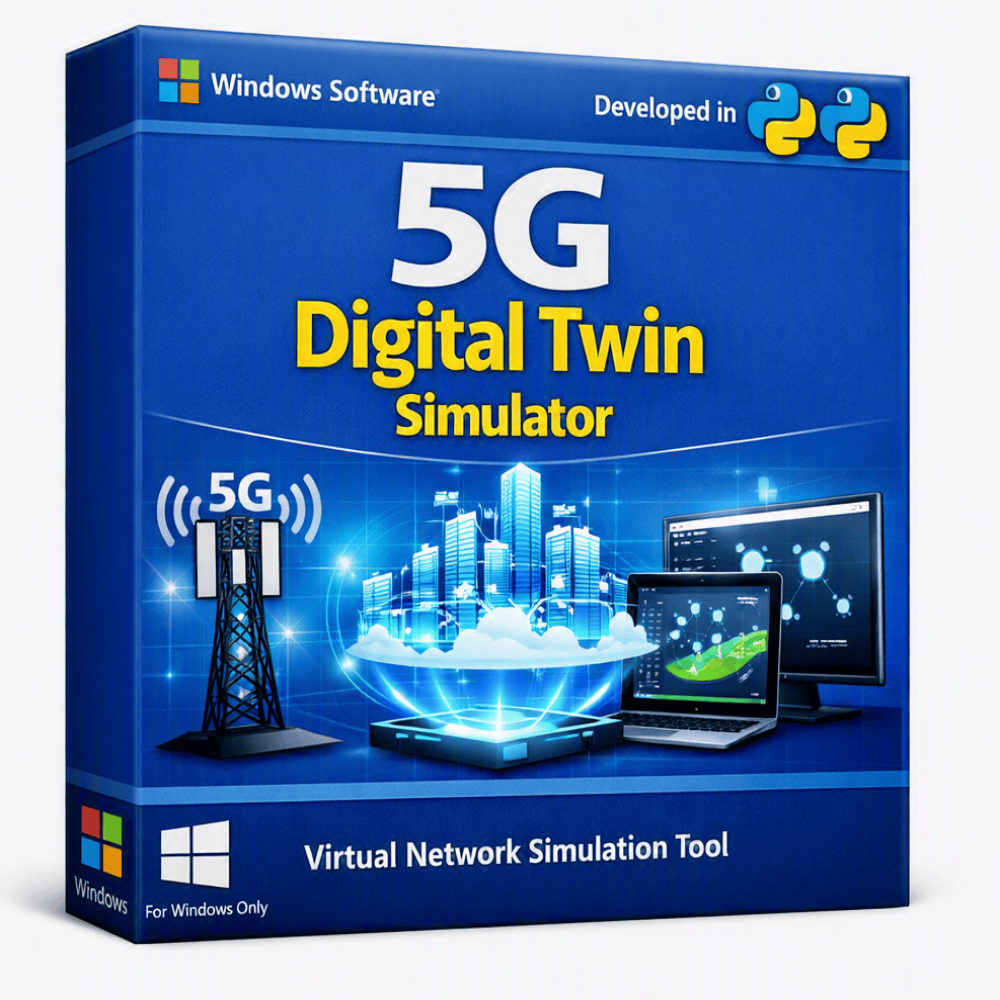
A Python-based 5G Digital Twin solution for creating a virtual representation of 5G network environments, components, and operational behavior. Designed for 5G research, network analysis, simulation, optimization, and academic projects, it enables users to model network scenarios, monitor virtualized network behavior, and experiment with different configurations in a controlled software environment.
Ideal for telecom engineers, researchers, developers, students, and academic institutions working on 5G network planning, performance analysis, intelligent network management, and digital twin research.
Original price was: ₹750.00.₹250.00Current price is: ₹250.00. -
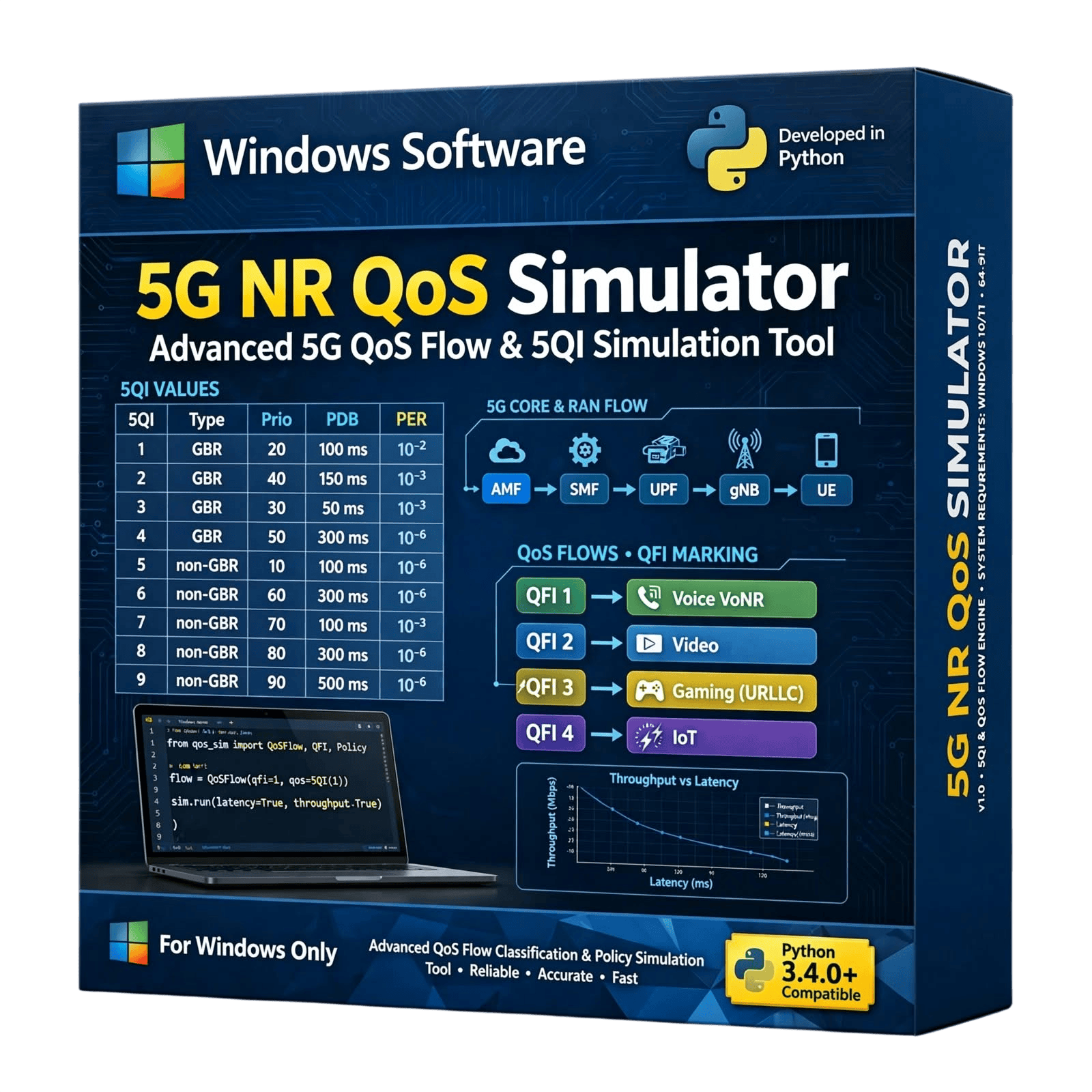
The 5G QoS Simulator is a Python-based software solution designed for researchers, engineers, students, developers, and telecommunications professionals working with 5G Quality of Service (QoS) concepts. The simulator provides a software-based environment for studying and analyzing QoS-related aspects of 5G communication networks, including service performance, traffic behavior, resource management, and network performance evaluation.
Developed using Python, the simulator is suitable for academic research, telecommunications projects, demonstrations, experimentation, algorithm development, and educational applications.
Available for sale as a software product. Contact us for pricing, licensing, features, customization, and purchase information.
Original price was: ₹750.00.₹250.00Current price is: ₹250.00. -
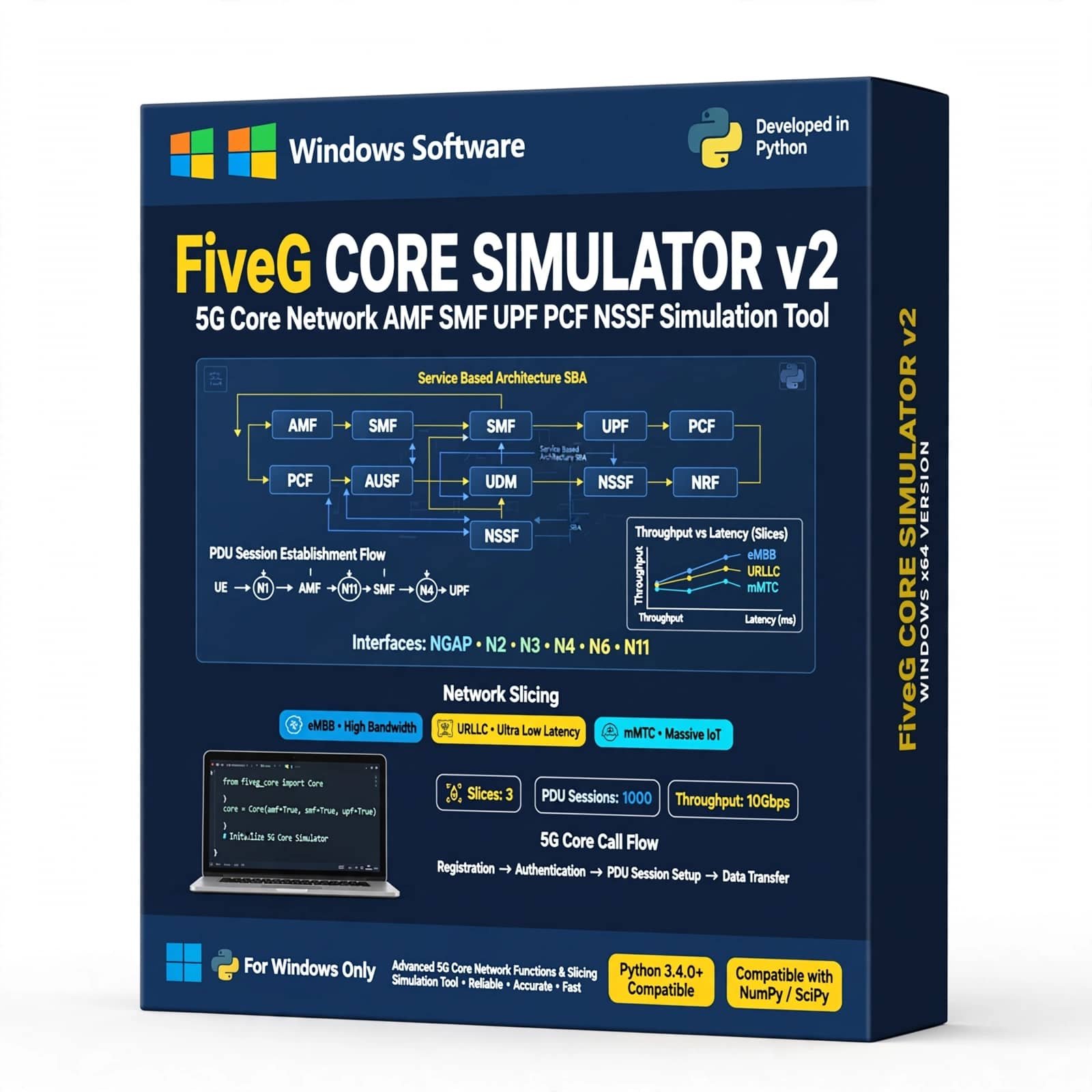
FiveG Core Simulator v2 is an educational 5G Core Network simulation tool designed to help students, educators, researchers, and telecom professionals understand 5G core architecture, network functions, signaling procedures, latency, and protocol interactions through an interactive topology and signaling animation environment.
Original price was: ₹750.00.₹250.00Current price is: ₹250.00. -
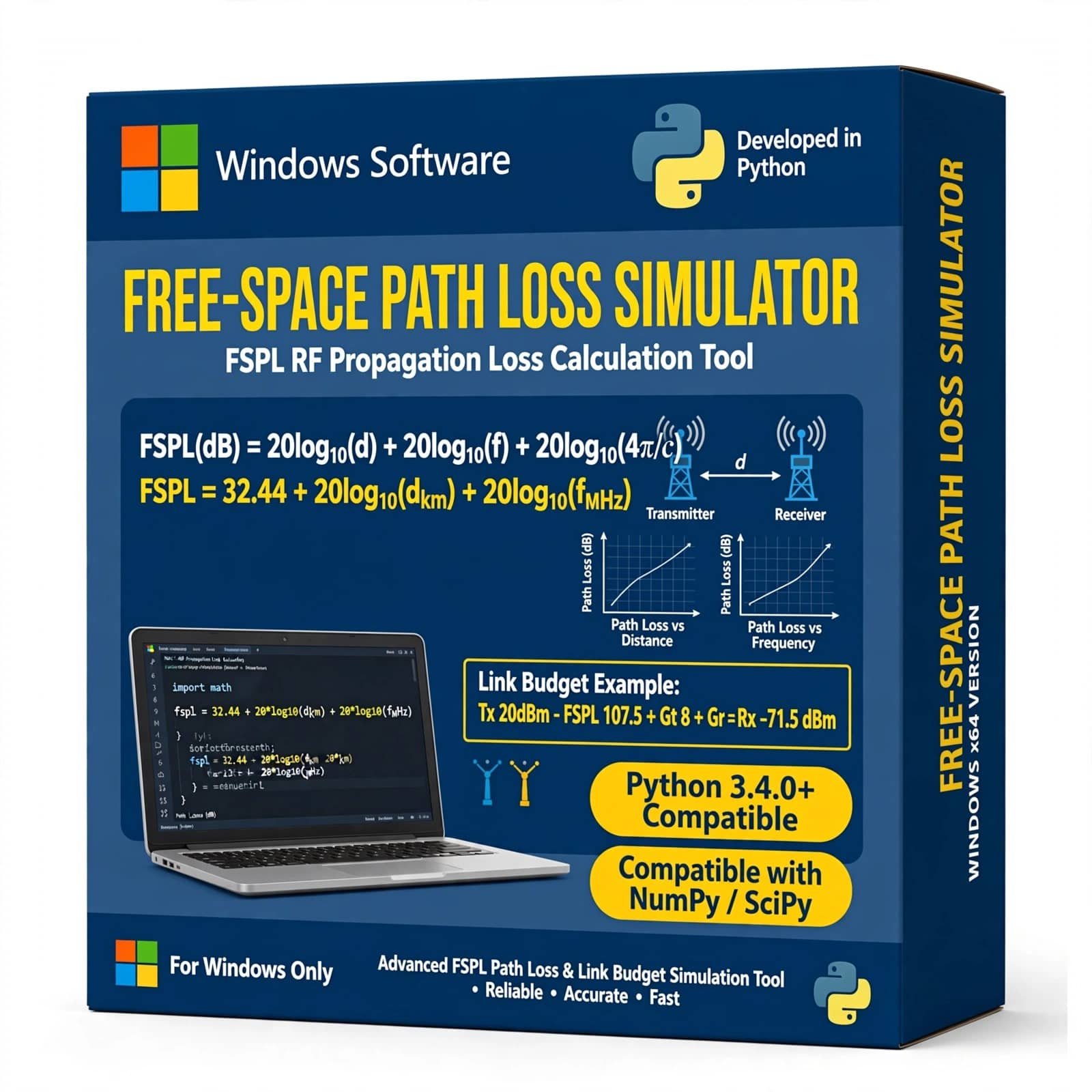
Free Space Path Loss Simulator Using Python is a practical wireless communication simulation project designed to calculate and visualize signal power loss as a radio wave travels through free space. Developed using Python, this simulator helps students, researchers, and communication engineers understand Free Space Path Loss (FSPL), transmission distance, frequency, received signal power, and wireless link performance.
The project provides an easy-to-understand simulation environment for analyzing how distance and operating frequency affect signal propagation. It is suitable for B.Tech, M.Tech, engineering students, academic projects, wireless communication studies, RF analysis, and Python-based simulation projects.
Original price was: ₹750.00.₹250.00Current price is: ₹250.00. -
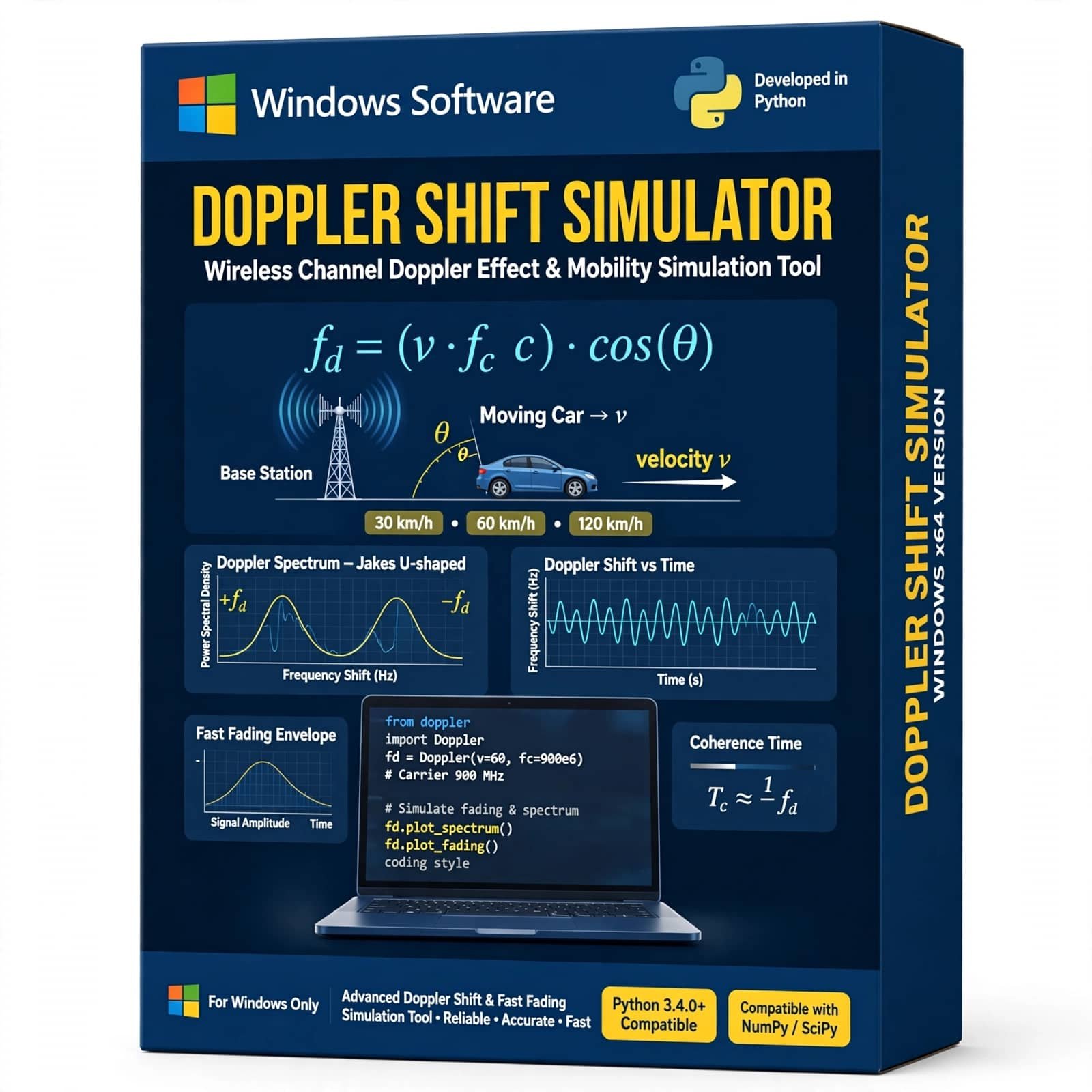
Doppler Shift Simulator Using Python is a practical wireless communication simulation tool for studying the Doppler effect and frequency shift caused by relative motion between a transmitter and receiver. It helps students, researchers, and communication engineers analyze Doppler frequency, carrier frequency, velocity, and mobile channel effects through Python-based simulation.
Original price was: ₹750.00.₹250.00Current price is: ₹250.00. -
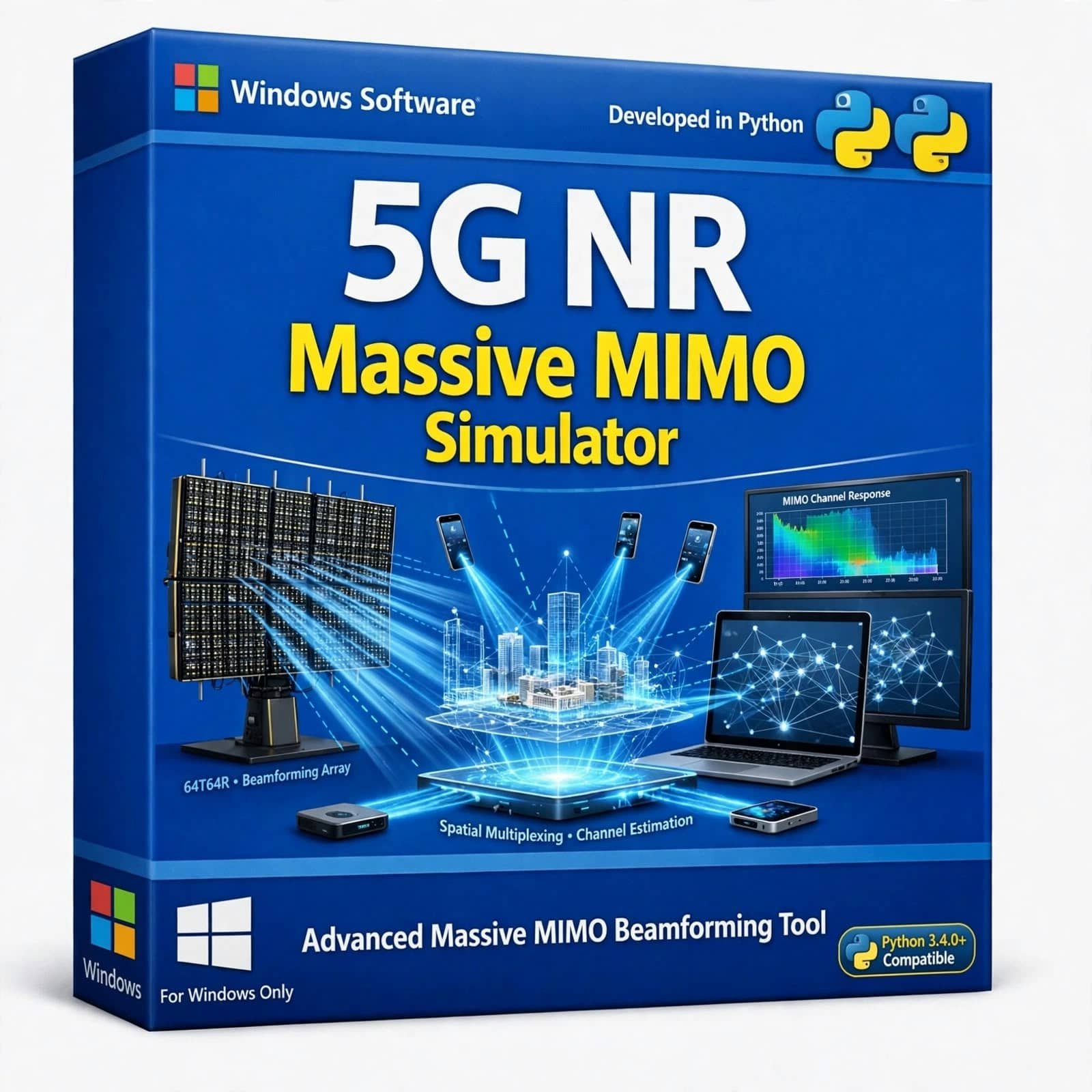
5G NR Massive MIMO Simulator is an advanced simulation solution for modeling and analyzing Massive Multiple-Input Multiple-Output (MIMO) technologies in 5G New Radio networks. It enables users to study large-scale antenna arrays, beamforming, precoding, spatial multiplexing, multi-user MIMO, channel estimation, and interference under configurable channel conditions. The simulator supports analysis of throughput, spectral efficiency, SINR, BER, BLER, MIMO capacity, beamforming gain, and multi-user performance, making it ideal for 5G NR research, algorithm development, academic projects, and 5G/6G wireless system optimization.
Original price was: ₹750.00.₹250.00Current price is: ₹250.00.


Reviews
There are no reviews yet.