
New
90% Off

RF Power Simulator
Original price was: ₹750.00.₹75.00Current price is: ₹75.00.
In StockRF Power Simulator – Learn and analyze fundamental RF power and wireless communication calculations with this C++-based RF Power Simulator. Convert RF power between Watts, milliwatts, dBm, dBW, and other commonly used units, while exploring concepts such as EIRP, antenna gain, cable loss, free-space path loss, received power, and RF link budget. Ideal for students, electronics engineers, RF engineers, communication engineering projects, and practical learning.
Description
RF Power Simulator
The RF Power Simulator is a C++-based educational and engineering simulation tool designed to help users understand the fundamentals of radio frequency power calculations, RF power units, antenna gain, transmission losses, EIRP, and wireless communication link budgets.
In RF and wireless communication engineering, power is frequently represented using logarithmic units such as dBm and dBW instead of only using Watts or milliwatts. Understanding how these units relate to one another is essential when working with transmitters, receivers, antennas, cables, wireless links, satellite communication systems, and RF measurement equipment.
This RF Power Simulator in C++ provides a practical way to perform these calculations and understand the mathematical relationships behind them.
Rather than generating RF power physically, the simulator focuses on RF power calculation, conversion, analysis, and link-budget concepts. It can help users understand how an RF signal’s power level is represented and how gains and losses affect the overall power available at different points in a communication system.
Convert RF Power Between Watts, dBm, dBW and More
One of the most important features of an RF power analysis tool is the ability to convert between different power units.
The simulator can be used to understand conversions involving commonly used RF units such as:
- Watts (W)
- Milliwatts (mW)
- dBm
- dBW
For example, RF engineers often express transmitter output power in Watts or dBm depending on the application. Being able to move between linear and logarithmic representations makes it easier to analyze complete RF systems.
The simulator provides a practical environment for learning these conversions and understanding why logarithmic units are so widely used in RF engineering.
Understand dBm and dBW
dBm expresses power relative to 1 milliwatt, while dBW expresses power relative to 1 Watt.
These units are commonly encountered in wireless communication specifications, RF test equipment, receiver sensitivity measurements, transmitter specifications, antenna systems, and link-budget calculations.
The RF Power Simulator helps users understand the relationship between:
Power in Watts → Power in mW → dBm → dBW
This makes it particularly useful for students who are learning RF engineering and may initially find logarithmic power calculations difficult to visualize.
Learn EIRP Calculations
Another important concept covered by the RF Power Simulator is EIRP – Effective Isotropic Radiated Power.
EIRP is an important parameter used to describe the effective radiated power of a transmitter and antenna system relative to an isotropic radiator.
EIRP calculations involve understanding the relationship between transmitter power, transmission losses, and antenna gain.
A simplified RF power analysis may involve:
Transmitter Power + Antenna Gain − System Losses = EIRP
By experimenting with these parameters, users can better understand how an antenna’s gain and other system losses influence the effective radiated power of a wireless communication system.
Understand RF Link Budget
A major application of RF power calculations is link-budget analysis.
An RF link budget estimates the received power of a wireless communication link by accounting for transmitter power, antenna gains, propagation losses, cable losses, and other system parameters.
The RF Power Simulator provides an educational environment for understanding how these parameters interact.
A typical link-budget concept can be represented as:
Received Power = Transmit Power + Gains − Losses
Users can experiment with different values to understand how changing transmitter power, antenna gain, distance, or propagation loss can influence the expected received signal level.
This makes the simulator useful for learning the fundamentals of RF link-budget calculations.
Explore Free-Space Path Loss
Wireless signals experience propagation losses as they travel through space. One commonly studied model is Free-Space Path Loss (FSPL).
The RF Power Simulator can help users understand how distance and frequency influence free-space propagation loss and how that loss affects the overall RF link budget.
By changing parameters such as frequency and distance, users can study how propagation conditions influence the received power.

This is particularly useful for understanding wireless communication scenarios involving:
- RF transmitters and receivers
- Point-to-point wireless links
- Microwave communication
- Satellite communication concepts
- Antenna systems
- Wireless networks
- Telecommunication systems
Antenna Gain and System Losses
RF system performance depends on more than transmitter output power.
Antenna gain can increase the effective power in a particular direction, while cables, connectors, filters, and other components can introduce losses.
The simulator helps users understand how these values can be incorporated into RF calculations.
Users can study the effect of:
- Transmitter power
- Antenna gain
- Receiver antenna gain
- Cable loss
- Connector loss
- Propagation loss
- Other system losses
Understanding these parameters is essential for developing a complete RF link budget.
C++ Based RF Engineering Project
The RF Power Simulator is developed using C++, making it suitable for students and developers interested in combining programming with RF and communication engineering.
The project demonstrates how RF engineering formulas and calculations can be implemented in software. Users with C++ programming knowledge can study the source code, understand the mathematical implementation, modify calculations, and potentially add additional RF analysis features.
This makes the project useful not only as an RF calculator but also as a C++ engineering project for academic learning and experimentation.
Ideal for Electronics and Communication Engineering Projects
The RF Power Simulator can be used for a wide range of academic and technical applications, including:
- RF Engineering Projects
- Electronics Engineering Projects
- Communication Engineering Projects
- Telecommunication Projects
- Wireless Communication Projects
- C++ Projects
- RF Power Calculation Projects
- Link Budget Projects
- Antenna Engineering Studies
- Microwave Communication Projects
- Satellite Communication Studies
- Final-Year Engineering Projects
- Mini Projects
- Communication Laboratory Demonstrations
- RF Engineering Training
The simulator can help students convert theoretical RF equations into practical calculations and understand how different parameters affect a communication link.
Practical RF Power Analysis
Instead of treating dBm, dBW, EIRP, and link-budget calculations as isolated formulas, the simulator brings these concepts together into a practical RF analysis environment.
Users can start with a transmitter power level, convert it into logarithmic units, add antenna gain, subtract cable and system losses, account for propagation loss, and determine the resulting received power.
This provides a more complete understanding of how an RF communication link can be analyzed from the transmitter to the receiver.
Key Features
- C++ based RF Power Simulator
- RF power conversion and calculation
- Watts to milliwatts conversion
- Watts to dBm conversion
- Watts to dBW conversion
- dBm to Watts conversion
- dBW to Watts conversion
- dBm and dBW relationship analysis
- EIRP calculation concepts
- Antenna gain analysis
- C++ source code for learning and customization
Ideal for Students and RF Engineers
The RF Power Simulator is designed for users who want to develop a stronger practical understanding of RF power calculations and wireless communication systems.
Students can use the project to learn how RF power is expressed in different units and how those values are incorporated into EIRP and link-budget calculations.
Engineers and researchers can also use the simulator as an educational reference or as a foundation for developing more advanced RF analysis applications.
Expandable C++ RF Calculation Project
Because the project is implemented in C++, it can potentially be extended with additional RF engineering calculations and analysis features.
Advanced versions could incorporate receiver sensitivity, noise figure, thermal noise, SNR, fade margin, antenna efficiency, Fresnel-zone calculations, atmospheric losses, cable attenuation, polarization losses, or additional propagation models.
These extensions can transform the project into a more comprehensive RF link-budget and wireless communication analysis platform.
Why Choose the RF Power Simulator?
If you are looking for a C++ RF Power Simulator, dBm calculator, dBW calculator, EIRP calculator, or RF link-budget project, this software provides a practical way to understand the calculations used in RF and wireless communication engineering.
The project does not generate physical RF power. Instead, it focuses on the calculation and analysis of RF power levels and related wireless communication parameters.
From simple power-unit conversions to EIRP and complete link-budget concepts, the simulator provides a practical learning environment for understanding how RF power changes throughout a communication system.
It is especially useful for students who want to combine C++ programming, RF engineering, antenna concepts, and wireless communication theory in one practical project.
Product Highlights
- C++ RF Power Calculation Simulator
- RF power conversion between linear and logarithmic units
- Watts, mW, dBm and dBW calculations
- C++ source code for customization and further development
Get the RF Power Simulator in C++ and develop a practical understanding of RF power units, dBm, dBW, EIRP, antenna gains, propagation losses, and wireless communication link-budget calculations.
Related products
-
Cell Coverage Simulator is a wireless communication simulation tool designed to model and analyze cellular network coverage using Python. It helps students, researchers, and telecom professionals visualize cell coverage, signal propagation, coverage areas, and network planning concepts through practical simulation and analysis.
Original price was: ₹750.00.₹250.00Current price is: ₹250.00. -
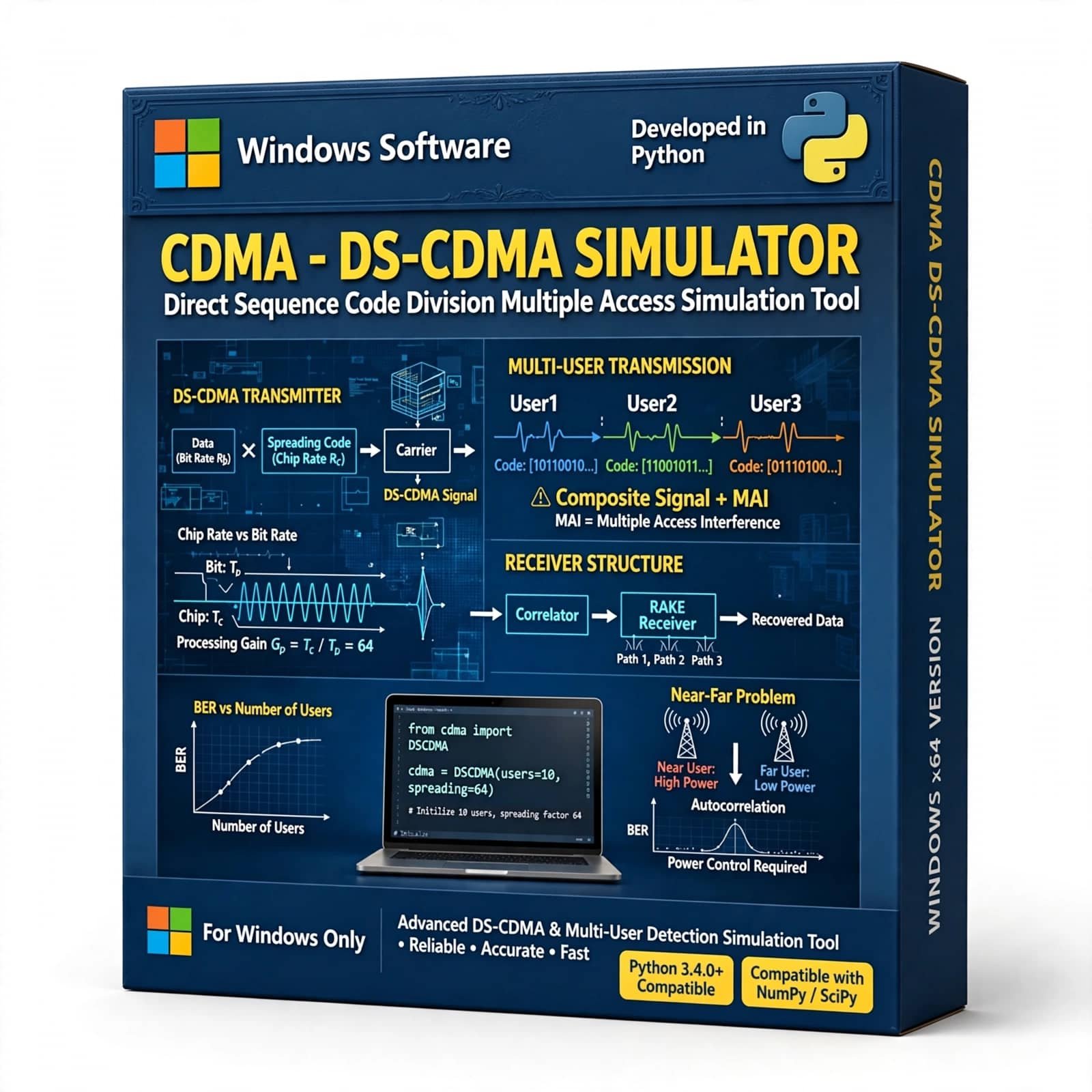
The CDMA DS-CDMA Simulator with Python is a software-based communication simulation tool designed to demonstrate and analyze Direct Sequence Code Division Multiple Access (DS-CDMA) technology. Developed using Python, the simulator provides a practical environment for studying spreading codes, chip sequences, multiple-user communication, signal spreading and despreading, interference, correlation, and transmitted-data recovery. It is suitable for digital communication laboratories, wireless communication education, telecommunications training, student projects, and communication-system research.
Original price was: ₹750.00.₹250.00Current price is: ₹250.00. -
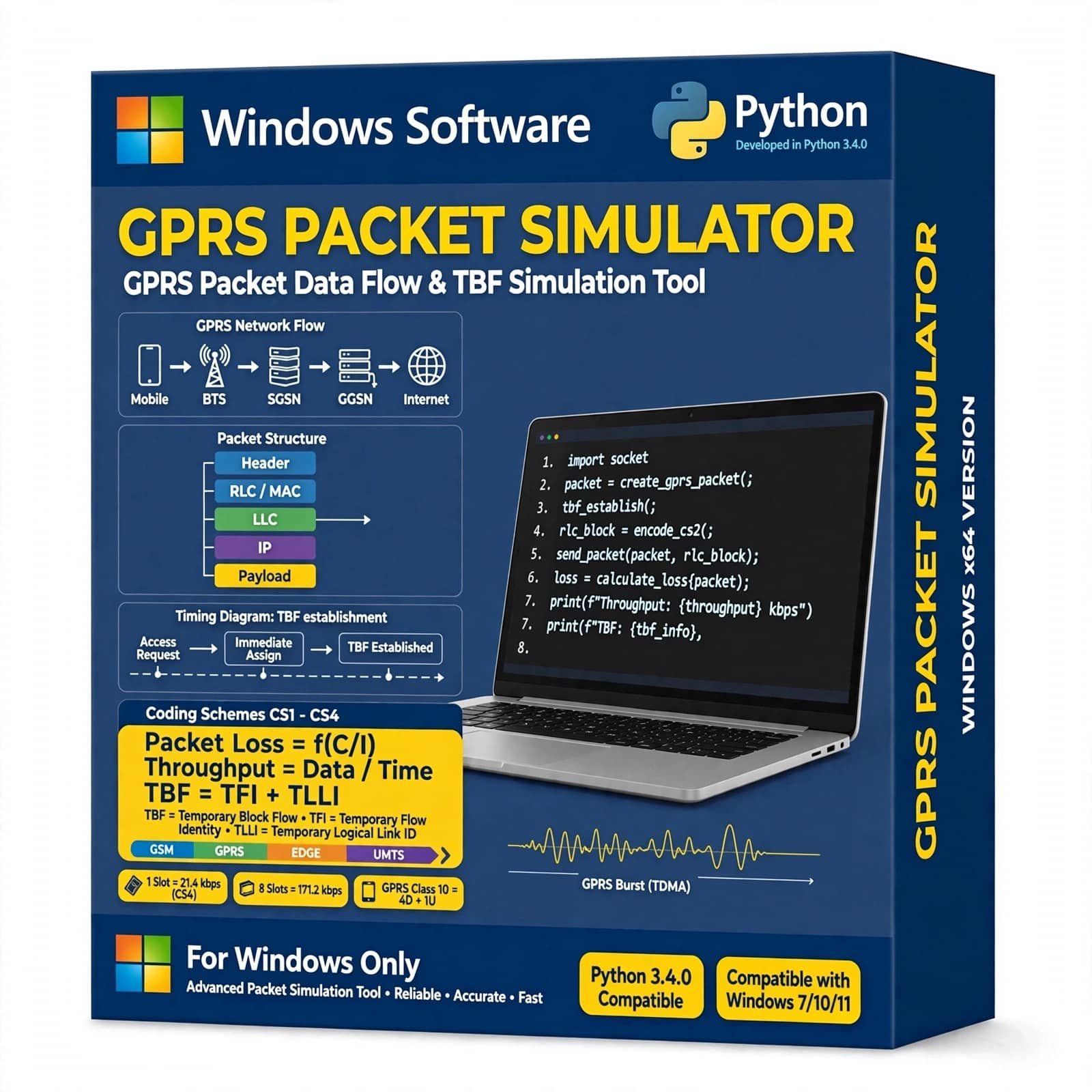
GPRS Packet Simulator is a powerful software solution for simulating GPRS data packets and testing GSM/GPRS communication systems. It helps developers, engineers, and testing teams generate, analyze, and validate packet-based communication in a controlled environment without requiring extensive physical network infrastructure. Ideal for GPRS testing, protocol development, IoT applications, and telecom system validation.
Original price was: ₹750.00.₹250.00Current price is: ₹250.00. -
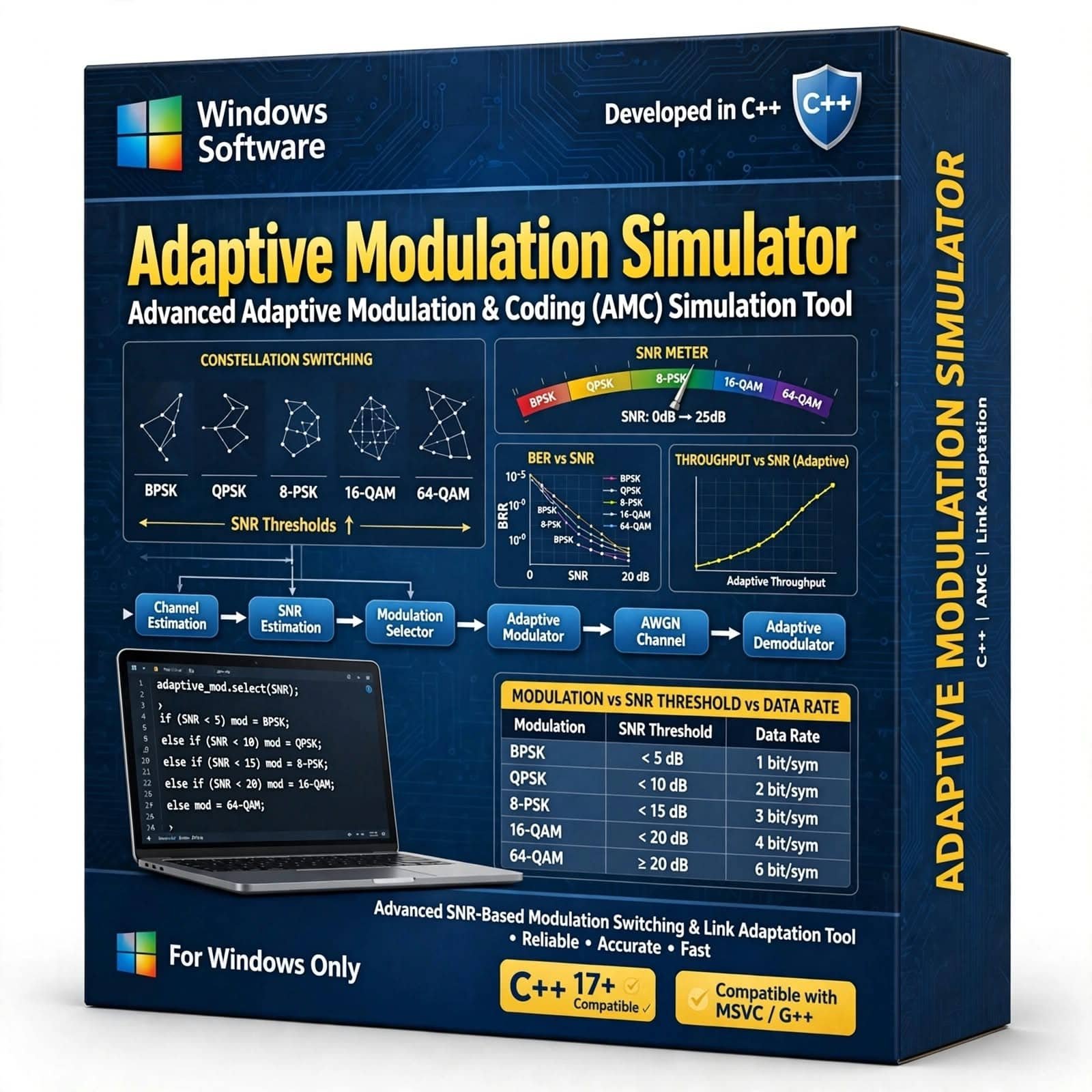
The Adaptive Modulation Simulator is a C++-based software solution designed for students, researchers, engineers, developers, and telecommunications professionals working with digital communication and adaptive modulation techniques. The simulator provides a practical environment for studying how modulation schemes can be selected or adapted according to communication-system conditions.
Developed using C++, the simulator is suitable for academic projects, digital communication research, laboratory demonstrations, signal-processing studies, algorithm development, and educational applications.
Available for sale as a software product. Contact us for pricing, licensing, technical specifications, customization, and purchase information.
Original price was: ₹750.00.₹250.00Current price is: ₹250.00. -
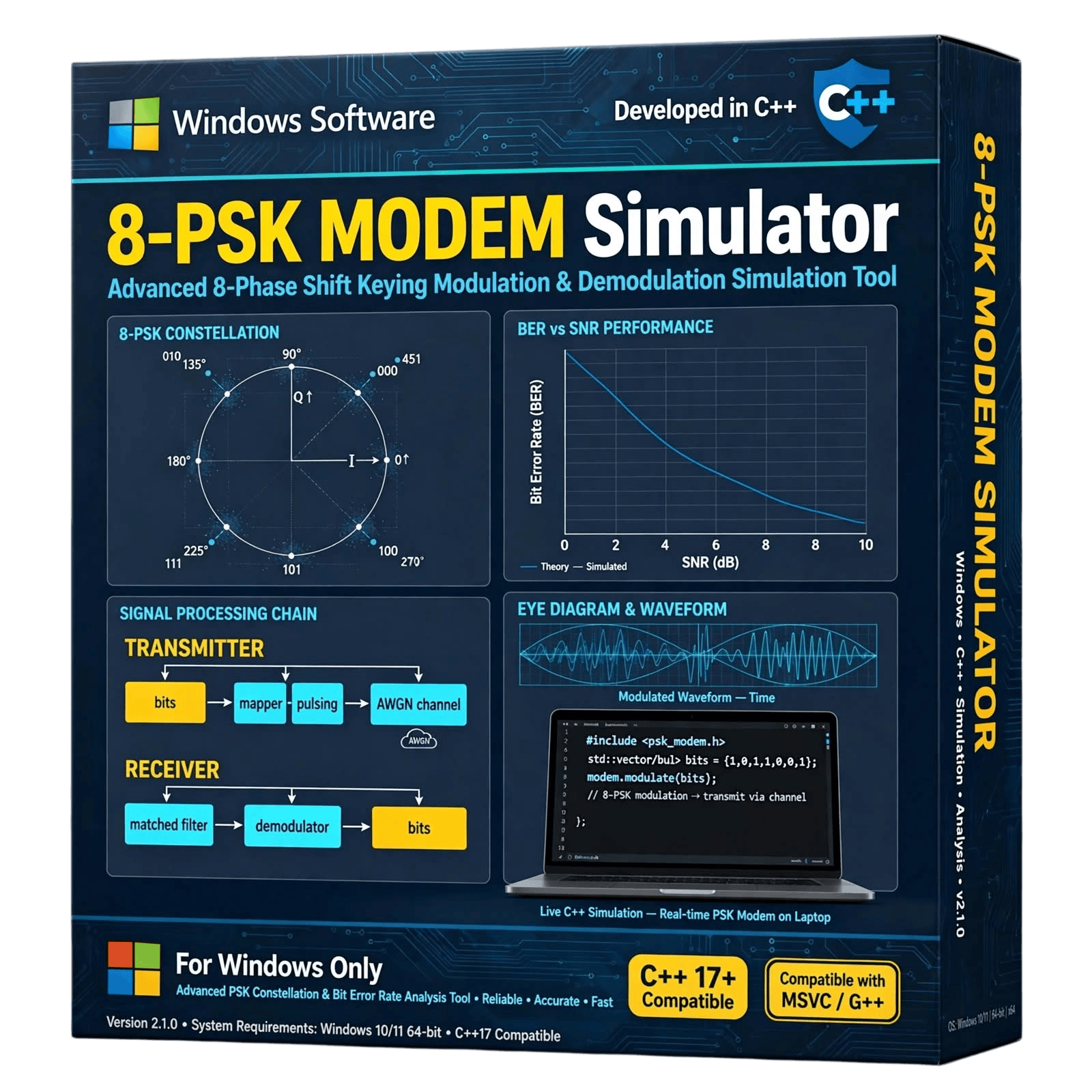
The 8-PSK Modem Simulator is a C++-based software solution designed for students, researchers, communication engineers, developers, and academic institutions working with digital communication and modulation techniques. The simulator provides a practical environment for studying 8-Phase Shift Keying (8-PSK) modulation and demodulation concepts.
Developed using C++, the simulator can be used for digital communication research, academic projects, laboratory demonstrations, signal-processing studies, experimentation, and educational purposes.
Available for sale as a software product. Contact us for pricing, licensing, technical specifications, customization, and purchase information.
Original price was: ₹750.00.₹250.00Current price is: ₹250.00.


Reviews
There are no reviews yet.