
New
67% Off

6G Non-Terrestrial Networks Simulator


Original price was: ₹750.00.₹250.00Current price is: ₹250.00.
In Stock6G Non-Terrestrial Networks Simulator i.e NTN Simulator with Python is a Python-based simulation platform for modeling next-generation wireless communication systems involving satellites, high-altitude platforms, unmanned aerial vehicles, and other non-terrestrial communication infrastructure. The simulator can be used to study 6G network architecture, satellite communication, coverage, mobility, latency, connectivity, resource allocation, and network performance in integrated terrestrial and non-terrestrial environments.
Description
6G Non-Terrestrial Networks Simulator
The 6G Non-Terrestrial Networks Simulator with Python is an advanced simulation platform designed to model, analyze, and evaluate next-generation wireless communication systems based on 6G Non-Terrestrial Networks (NTN). The project provides a virtual environment for studying communication scenarios involving satellites, High-Altitude Platforms (HAPs), Unmanned Aerial Vehicles (UAVs), aerial platforms, and terrestrial network infrastructure.
As wireless communication technology moves toward 6G, Non-Terrestrial Networks are expected to play an important role in extending connectivity beyond traditional terrestrial cellular infrastructure. NTN technologies can provide communication coverage across remote areas, oceans, rural regions, disaster zones, transportation networks, and other locations where conventional terrestrial networks may have limited availability. A Python-based 6G NTN simulator provides researchers and developers with a flexible environment for exploring these communication scenarios without requiring expensive physical infrastructure.
The simulator can model different types of non-terrestrial communication nodes and their interactions with terrestrial networks and user equipment. Depending on the implementation, the simulation environment can represent Low Earth Orbit (LEO) satellites, Medium Earth Orbit (MEO) satellites, Geostationary Earth Orbit (GEO) satellites, High-Altitude Platforms, UAVs, ground stations, base stations, and mobile users.
Using Python, researchers can create configurable network scenarios and evaluate important performance parameters such as latency, throughput, coverage, propagation delay, connectivity, signal quality, bandwidth utilization, handover behavior, packet delivery, and resource allocation. These measurements can help researchers understand how different NTN configurations affect overall 6G network performance.
One of the key applications of a 6G Non-Terrestrial Network Simulator is satellite communication research. Satellite-based communication can provide wide-area coverage and support connectivity in locations where terrestrial infrastructure is unavailable or difficult to deploy. The simulator can be used to investigate satellite-user communication, satellite movement, link characteristics, coverage areas, and communication performance under different network conditions.
The project can also support LEO satellite network simulation, which is particularly relevant to modern broadband satellite communication research. Since LEO satellites move relative to users on the ground, network topology and connectivity can change continuously. A simulation environment can model satellite mobility, user mobility, link availability, and satellite handovers to help analyze these dynamic communication scenarios.

Another important area is 6G integrated terrestrial and non-terrestrial networks. Future wireless systems are expected to combine terrestrial cellular networks with satellite and aerial communication infrastructure. A Digital simulation environment can represent interactions between these different network segments and provide a framework for studying seamless connectivity, traffic distribution, network selection, and resource management.
The Python 6G NTN Simulator can also be extended to investigate intelligent network management using Artificial Intelligence (AI) and Machine Learning (ML). Simulation data can be generated from different network scenarios and used to develop machine learning models for traffic prediction, resource allocation, network optimization, anomaly detection, intelligent handover, link prediction, and adaptive communication strategies.
Mobility is another important component of NTN research. Satellites, UAVs, aerial platforms, and mobile users may all exhibit different mobility patterns. A Python simulator can model these movements and evaluate how changes in network topology affect communication links. This can be particularly useful for studying handover management in 6G satellite networks, where users may need to switch between satellites or between terrestrial and non-terrestrial network nodes.
The simulator can also be used for coverage analysis. Researchers can define geographic areas, communication nodes, user locations, and network parameters to evaluate potential coverage and connectivity. Such simulations can help investigate how satellite constellations, aerial platforms, and terrestrial infrastructure can work together to provide broader wireless coverage.
Another potential application is 6G IoT and massive machine-type communication. Future IoT deployments may require connectivity for devices located in remote or difficult-to-reach environments. NTN technologies can help connect sensors, vehicles, industrial equipment, agricultural devices, maritime systems, and other distributed IoT devices. The simulator can provide an environment for evaluating communication requirements, traffic patterns, latency, and network scalability.
The Python implementation also makes the project suitable for academic research and experimentation. Python provides extensive libraries for numerical computing, data analysis, visualization, optimization, artificial intelligence, and scientific simulation. These capabilities allow additional algorithms and models to be incorporated into the 6G NTN simulation framework.
For students and researchers, the 6G Non-Terrestrial Networks Simulator using Python can be useful for projects related to wireless communication, satellite networks, 6G technology, aerospace communication, IoT, network optimization, artificial intelligence, and next-generation telecommunications. It can provide a practical platform for testing theoretical concepts and comparing different network configurations in a controlled virtual environment.
The simulator can further be enhanced with visualization features for displaying satellite positions, user locations, communication links, coverage areas, network topology, mobility patterns, and performance metrics. Graphical representations can make complex NTN behavior easier to analyze and can help researchers identify network performance trends.
Overall, the 6G Non-Terrestrial Networks Simulator with Python provides a flexible foundation for investigating the future of integrated terrestrial and non-terrestrial wireless communication. By combining 6G concepts, satellite communication, aerial networks, Python programming, network simulation, data analytics, and AI-based optimization, the project can support experimentation and research into scalable, intelligent, and widely accessible next-generation communication networks.
Related products
-
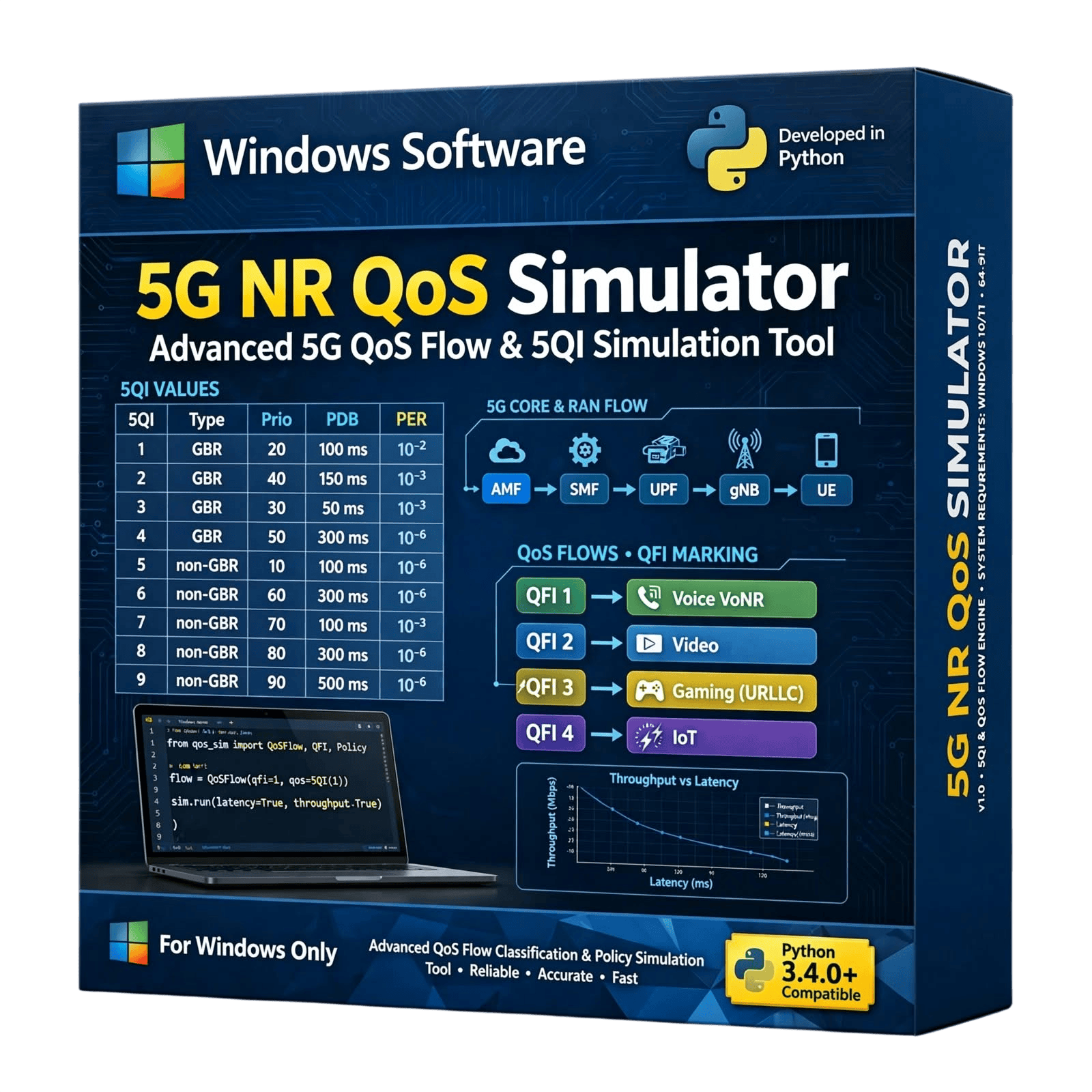
The 5G QoS Simulator is a Python-based software solution designed for researchers, engineers, students, developers, and telecommunications professionals working with 5G Quality of Service (QoS) concepts. The simulator provides a software-based environment for studying and analyzing QoS-related aspects of 5G communication networks, including service performance, traffic behavior, resource management, and network performance evaluation.
Developed using Python, the simulator is suitable for academic research, telecommunications projects, demonstrations, experimentation, algorithm development, and educational applications.
Available for sale as a software product. Contact us for pricing, licensing, features, customization, and purchase information.
Original price was: ₹750.00.₹250.00Current price is: ₹250.00. -
A Python-based 5G Core Network Simulator designed for studying, analyzing, and demonstrating 5G Core network architecture and procedures. Explore key 5G Network Functions such as AMF, SMF, UPF, AUSF, UDM, PCF, NRF, and NSSF, along with UE registration, authentication, session management, mobility, and signaling procedures.
Ideal for 5G research, telecom engineering, academic projects, university laboratories, protocol development, and network simulation. Provides a flexible software environment for experimenting with 5G Core concepts without requiring a complete commercial 5G network infrastructure.
Original price was: ₹750.00.₹250.00Current price is: ₹250.00. -
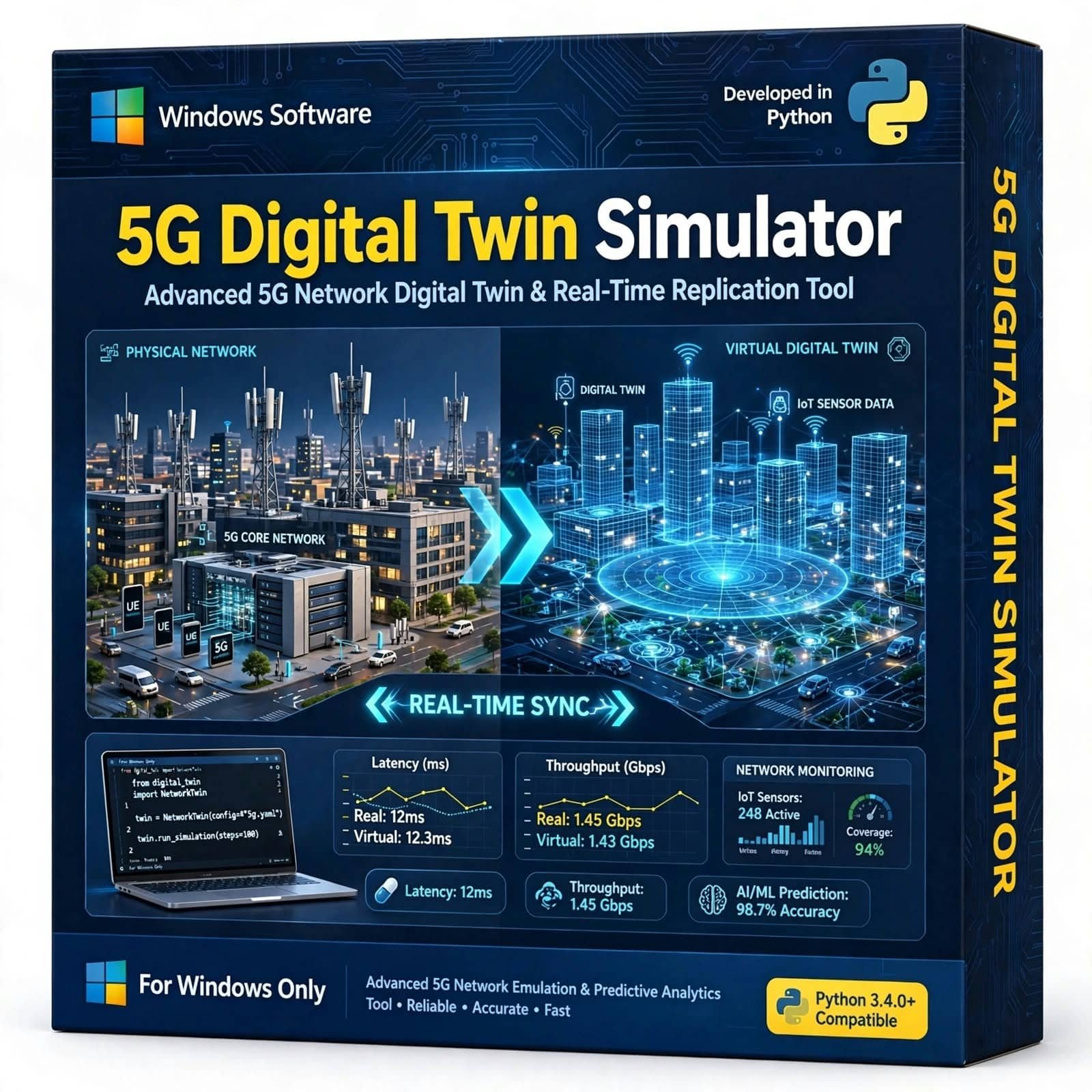
The 5G Digital Twin is a Python-based software solution designed for researchers, engineers, developers, students, and telecommunications professionals interested in modeling, simulating, and analyzing 5G communication networks and their real-world behavior in a virtual environment.
A digital twin provides a virtual representation of a physical or network system, enabling users to study system behavior, evaluate scenarios, analyze performance, and experiment with different configurations. Developed using Python, this 5G Digital Twin can support research, education, network analysis, experimentation, and proof-of-concept development.
Available for sale as a software product. Contact us for pricing, licensing, technical specifications, customization, and purchase information.
Original price was: ₹750.00.₹250.00Current price is: ₹250.00. -
The 3G UMTS – WCDMA Simulator is a software-based simulation project designed to demonstrate the fundamental concepts of 3G Universal Mobile Telecommunications System (UMTS) and Wideband Code Division Multiple Access (WCDMA) technology. It provides a practical environment for studying cellular communication, spreading codes, signal transmission, mobile users, network connectivity, and WCDMA-based communication principles. The simulator is suitable for students, researchers, and developers working on telecommunications and wireless communication projects. It can be used for academic demonstrations, engineering projects, research, experimentation, and learning about 3G mobile communication and WCDMA network technologies.
Original price was: ₹750.00.₹250.00Current price is: ₹250.00. -
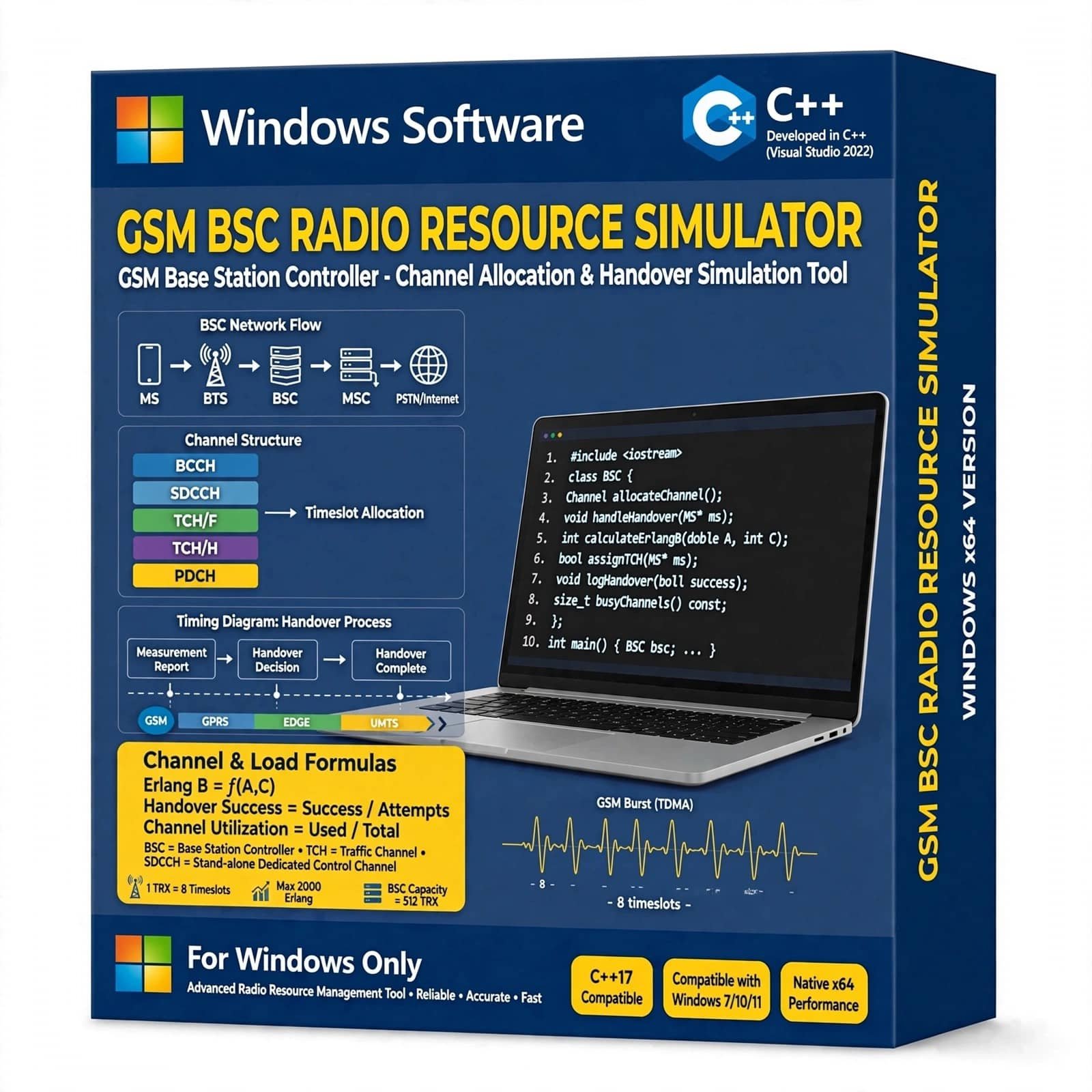
GSM BSC Radio Resource Simulator is a professional telecom training and development solution designed to simulate GSM Base Station Controller (BSC) radio resource management functions. It helps students, telecom engineers, researchers, and network professionals understand GSM radio resource allocation, channel management, call handling, handover concepts, and BSC-related network procedures in a controlled simulation environment.
Original price was: ₹750.00.₹100.00Current price is: ₹100.00. -
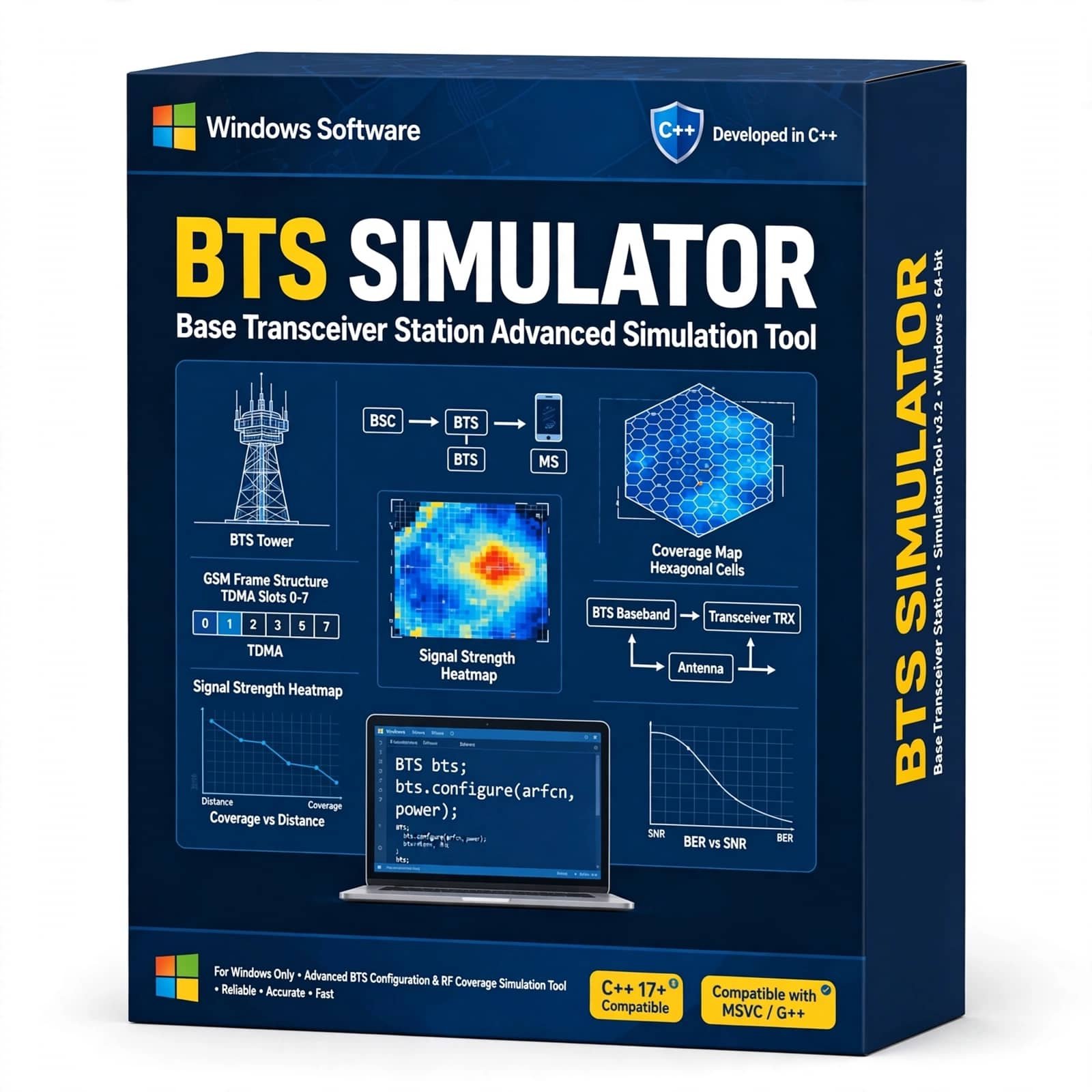
The BTS Simulator with C++ is a software-based Base Transceiver Station simulation tool designed for studying mobile communication, wireless networks, and telecommunications concepts. Developed using C++, it provides a practical environment for understanding BTS operation, communication processes, signal transmission and reception, and cellular network fundamentals. The simulator is ideal for telecommunication laboratories, engineering education, student projects, technical training, and communication-system research.
Original price was: ₹750.00.₹250.00Current price is: ₹250.00.


Reviews
There are no reviews yet.