
New
67% Off

5G Mobile Digital Twin Simulator


Original price was: ₹750.00.₹250.00Current price is: ₹250.00.
In Stock5G Mobile Digital Twin Simulator with Python is a Python-based simulation platform designed to model, analyze, and visualize 5G mobile network environments using Digital Twin technology. It can simulate mobile users, network conditions, communication parameters, mobility, latency, bandwidth, signal behavior, and other 5G network characteristics to support research, testing, optimization, and intelligent network
Description
5G Mobile Digital Twin Simulator
The 5G Mobile Digital Twin Simulator with Python is an advanced simulation and research platform designed to model real-world 5G mobile communication environments using Digital Twin technology and Python programming. The project provides a virtual representation of mobile network components, users, communication conditions, and network behavior, enabling researchers, students, developers, and telecommunications professionals to study and evaluate 5G networks in a controlled and flexible environment.
As 5G networks continue to evolve, network operators and researchers require efficient methods for testing network performance, analyzing mobile user behavior, evaluating communication scenarios, and optimizing network resources. A 5G Digital Twin provides a virtual environment where different network conditions and scenarios can be recreated without requiring a complete physical 5G infrastructure. This makes the simulator useful for experimentation, network planning, performance analysis, and intelligent telecommunications research.
Built with Python, the simulator can provide a flexible environment for implementing network models, simulation algorithms, data processing, visualization, and performance analysis. Python’s extensive ecosystem makes it suitable for integrating numerical computation, machine learning, artificial intelligence, data analytics, visualization, and network simulation techniques into a single research workflow.

The 5G Mobile Digital Twin Simulator can be designed to represent important elements of a mobile communication network, including mobile users, base stations, network coverage, wireless communication conditions, mobility patterns, traffic demand, latency, bandwidth, signal strength, and network resource utilization. By creating a virtual representation of these elements, researchers can experiment with different configurations and observe how network behavior changes under varying conditions.
One of the major advantages of a Digital Twin for 5G networks is the ability to perform virtual testing before deploying changes in a real-world environment. Researchers can create different network scenarios, modify parameters, introduce changing traffic conditions, simulate user mobility, and analyze network performance. This approach can help reduce the cost and complexity associated with physical network experimentation while providing a repeatable environment for testing.
The simulator can also support 5G network performance analysis by monitoring parameters such as latency, throughput, bandwidth utilization, signal quality, connectivity, packet transmission, and resource allocation. These metrics can be collected and analyzed to understand network behavior and identify potential optimization opportunities.
Another important application is mobile user mobility simulation. In real-world 5G networks, users continuously move between locations and may connect to different base stations. A Python-based simulator can model user movement and evaluate how mobility affects network connectivity, signal quality, latency, and resource allocation. Different mobility models can be incorporated to represent pedestrians, vehicles, or other mobile devices.
The project can also serve as a foundation for AI and machine learning research in 5G networks. Simulation data generated by the Digital Twin can be used to train and evaluate machine learning models for network optimization, traffic prediction, anomaly detection, resource management, intelligent handover, and network performance prediction. Combining Digital Twin technology with artificial intelligence can provide a powerful environment for experimenting with intelligent and autonomous network management concepts.
For students and academic researchers, the 5G Mobile Digital Twin Simulator using Python can be useful for projects involving wireless communication, telecommunications, computer networks, Internet of Things (IoT), edge computing, artificial intelligence, and network optimization. The simulator provides an environment in which complex 5G concepts can be explored through practical experimentation rather than relying only on theoretical analysis.

The project can also be extended to support 5G and IoT simulation, where large numbers of connected devices communicate with network infrastructure under different traffic and mobility conditions. Researchers can investigate network scalability, communication reliability, latency, bandwidth requirements, and resource utilization for IoT applications.
A modular Python architecture can make the simulator easier to customize and expand. Additional network models, mobility algorithms, performance metrics, visualization components, machine learning models, or optimization techniques can be incorporated according to specific research requirements. This flexibility makes the project suitable for academic demonstrations, proof-of-concept development, network research, and experimental studies.
The 5G Mobile Digital Twin Simulator with Python therefore provides a practical virtual environment for understanding and experimenting with next-generation mobile communication networks. By combining Python programming, Digital Twin technology, 5G network modeling, simulation, data analysis, and visualization, the project can help users investigate network behavior and develop innovative approaches to mobile network optimization.
Whether used for a university project, research paper, telecommunications experiment, prototype development, or advanced network simulation study, this Python-based 5G Digital Twin Simulator provides a foundation for exploring the behavior and performance of modern mobile networks in a virtual environment.

Related products
-
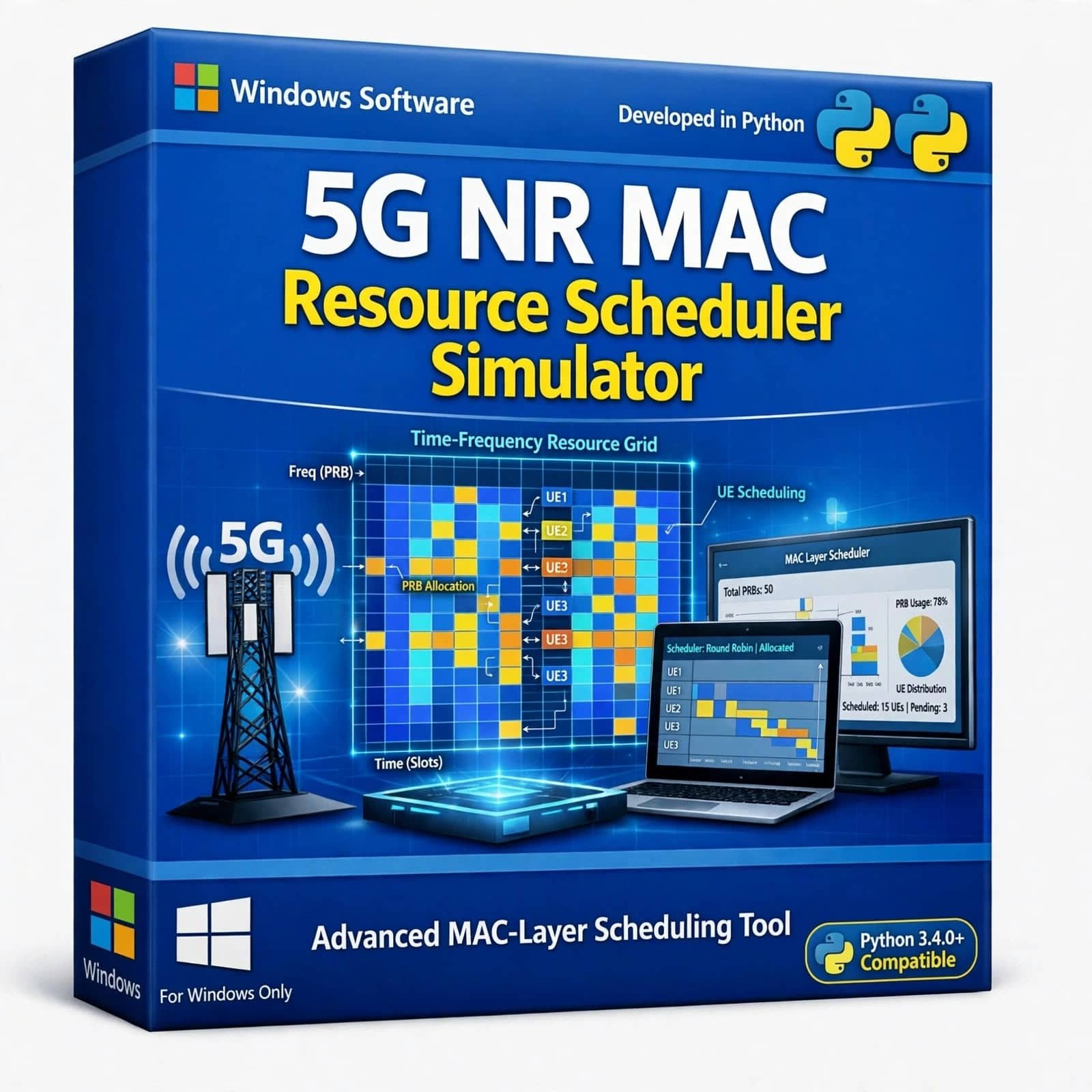
5G NR MAC Resource Scheduler Simulator is an advanced simulation solution for modeling and analyzing Medium Access Control (MAC) layer resource scheduling in 5G New Radio networks. It enables users to evaluate dynamic resource allocation, multi-UE scheduling, uplink and downlink resource management, QoS-aware scheduling, traffic conditions, and scheduling algorithms. The simulator supports analysis of throughput, latency, fairness, spectral efficiency, resource utilization, packet loss, and QoS performance, making it ideal for 5G NR research, scheduler algorithm development, academic projects, and wireless network optimization.
Original price was: ₹750.00.₹250.00Current price is: ₹250.00. -
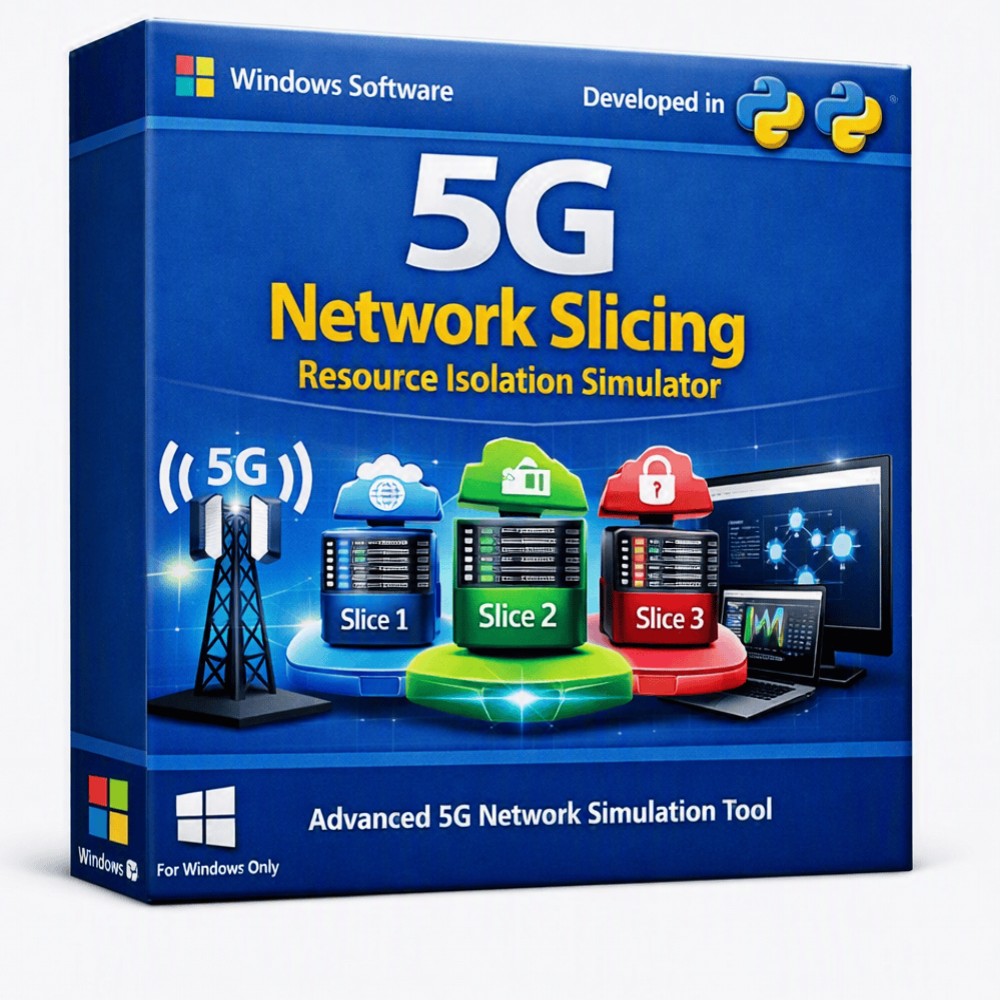
A Python-based 5G Network Slicing and Resource Isolation Simulator designed to model and analyze how multiple logical network slices can share physical 5G infrastructure while maintaining resource isolation. The simulator enables users to study CPU, memory, bandwidth, network capacity, traffic allocation, and resource management across different 5G network slices.
Ideal for 5G research, telecom engineering, academic projects, network optimization, resource allocation studies, and university laboratories.
Original price was: ₹750.00.₹250.00Current price is: ₹250.00. -
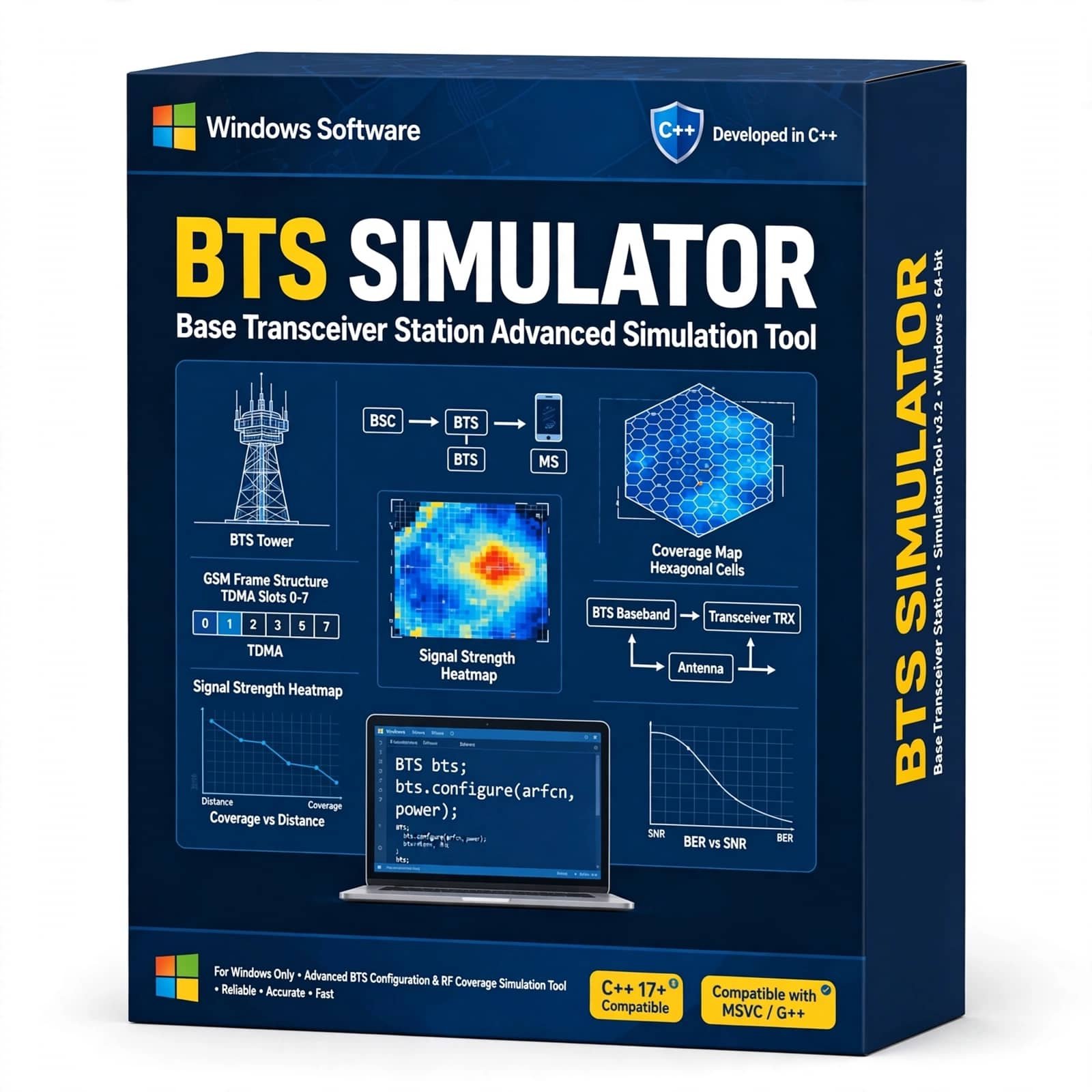
The BTS Simulator with C++ is a software-based Base Transceiver Station simulation tool designed for studying mobile communication, wireless networks, and telecommunications concepts. Developed using C++, it provides a practical environment for understanding BTS operation, communication processes, signal transmission and reception, and cellular network fundamentals. The simulator is ideal for telecommunication laboratories, engineering education, student projects, technical training, and communication-system research.
Original price was: ₹750.00.₹250.00Current price is: ₹250.00. -
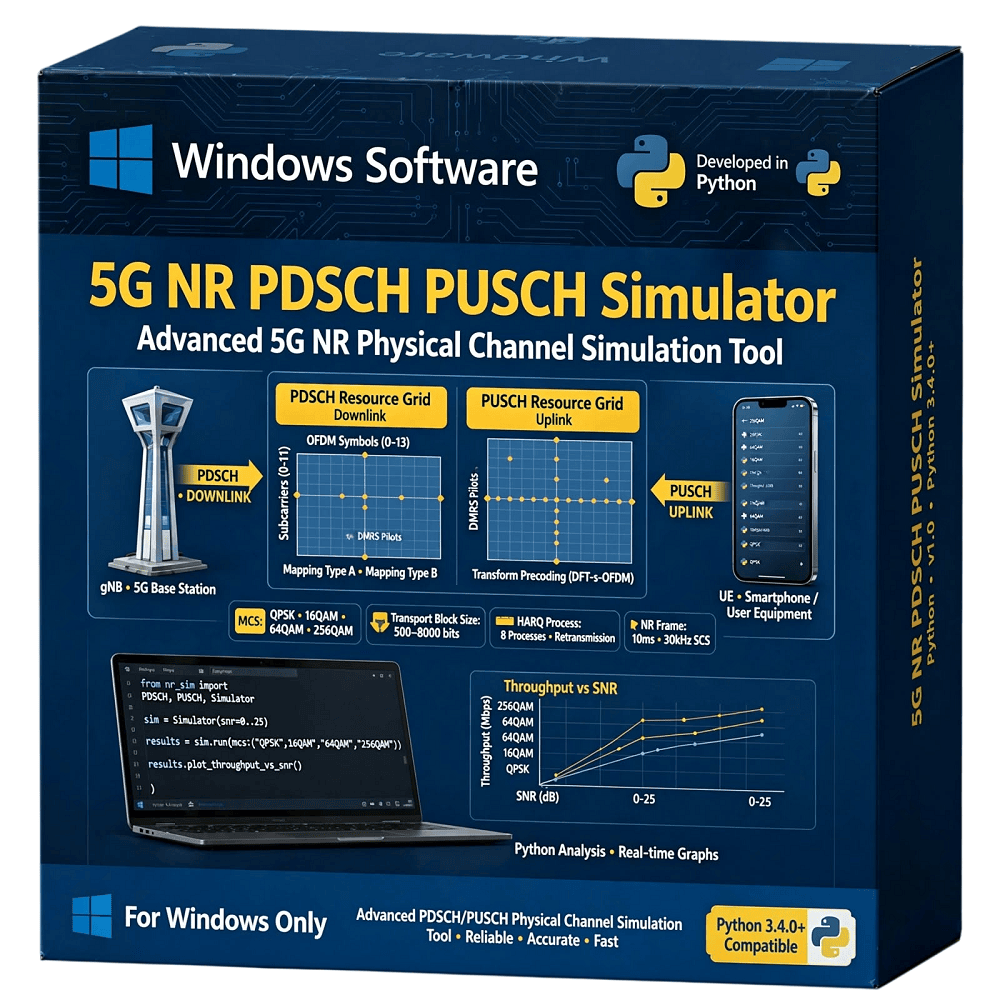
The 5G NR PDSCH PUSCH Simulator is a Python-based simulation software solution designed for researchers, engineers, students, and telecommunications professionals working with 5G New Radio (NR) physical-layer technologies. The simulator provides a practical environment for studying and experimenting with PDSCH (Physical Downlink Shared Channel) and PUSCH (Physical Uplink Shared Channel) transmission concepts.
Developed using Python, the simulator is suitable for academic research, algorithm development, demonstrations, testing, and educational applications related to 5G NR communication systems.
Available for sale as a software product. Contact us for product details, licensing, and purchase information.
Original price was: ₹750.00.₹250.00Current price is: ₹250.00. -
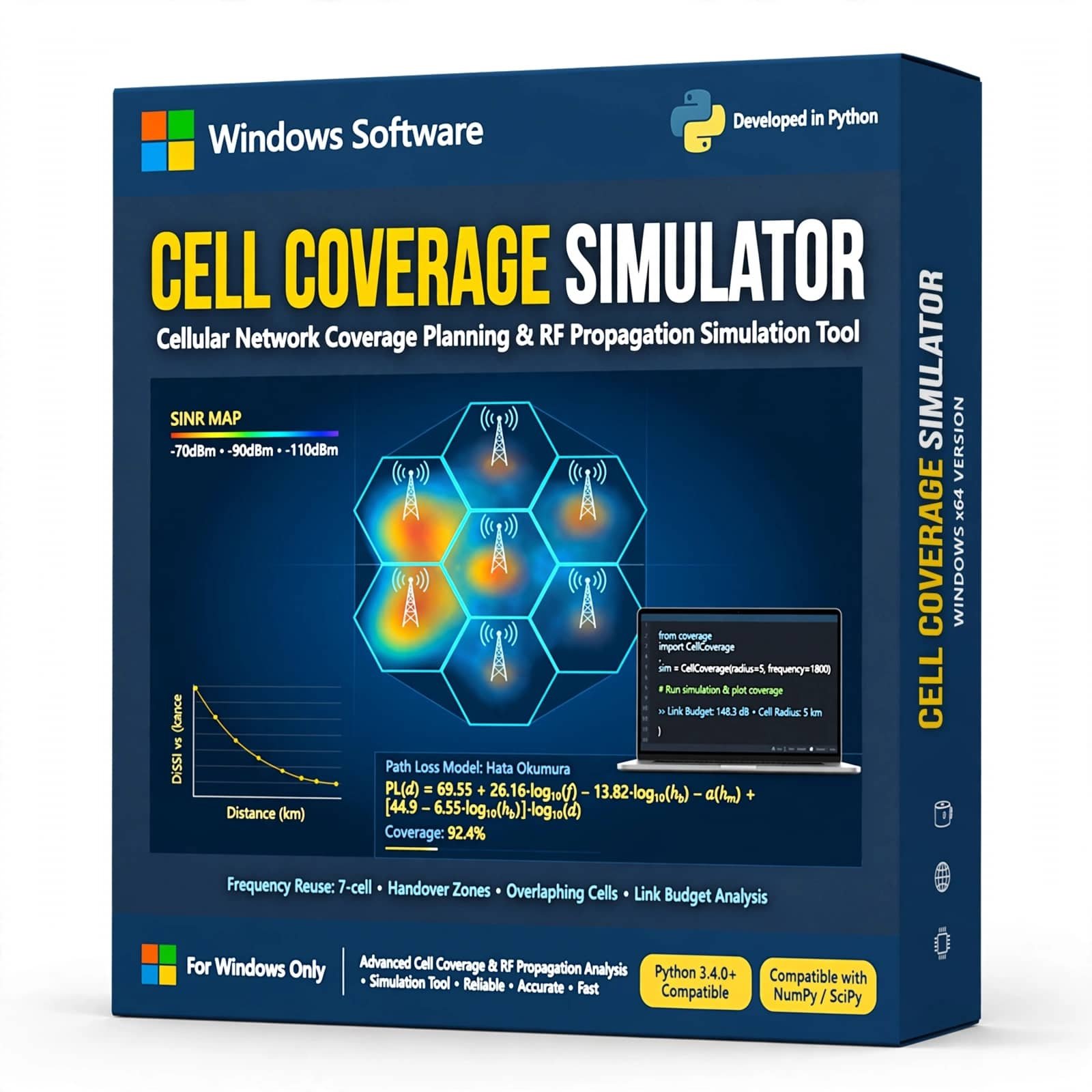
Cell Coverage Simulator is a wireless communication simulation tool designed to model and analyze cellular network coverage using Python. It helps students, researchers, and telecom professionals visualize cell coverage, signal propagation, coverage areas, and network planning concepts through practical simulation and analysis.
Original price was: ₹750.00.₹250.00Current price is: ₹250.00. -
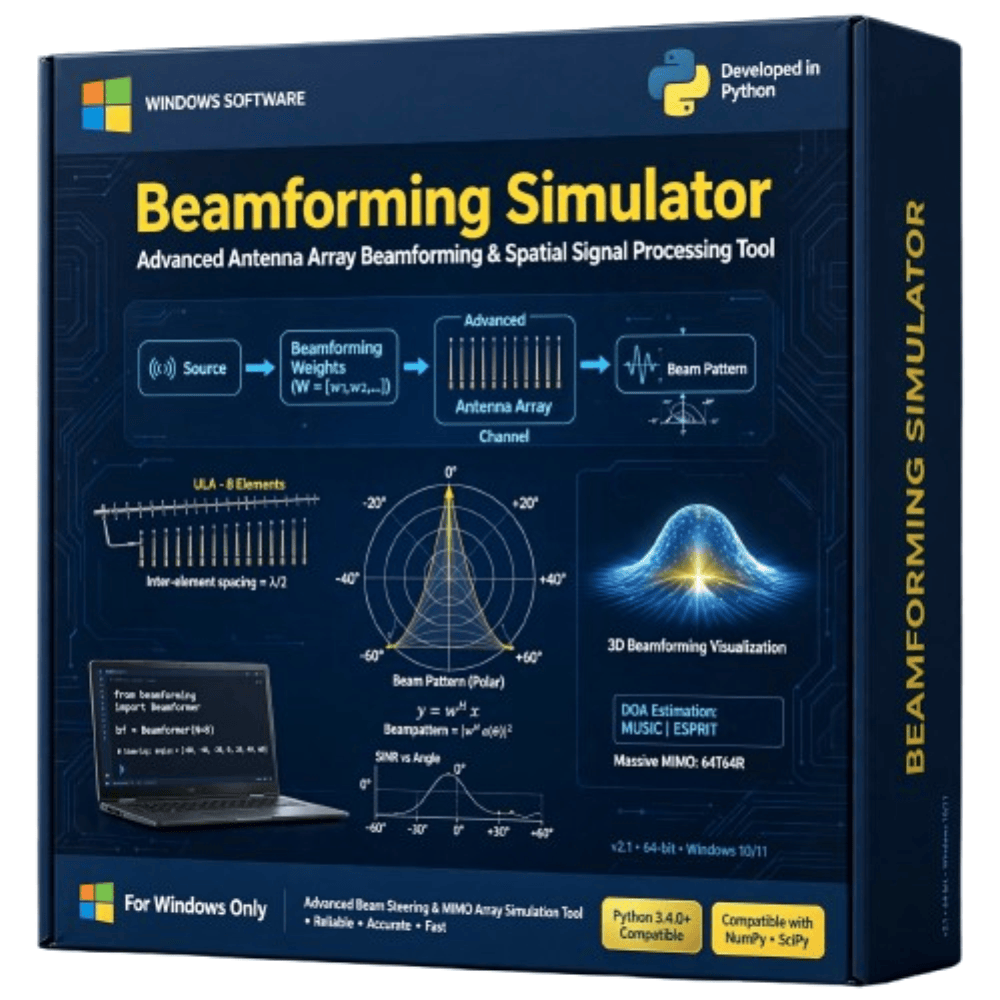
The Beamforming Simulator is a practical wireless communication simulation project designed to demonstrate how antenna arrays can control and direct radio-frequency signals toward desired users or directions. The simulator helps visualize beam patterns, signal direction, antenna-array behavior, and beam steering under different parameters. It is suitable for studying beamforming, antenna arrays, MIMO, 5G communication, wireless networks, and signal processing. This project is ideal for engineering students, researchers, and learners working on wireless communication and advanced antenna technologies.
Original price was: ₹750.00.₹250.00Current price is: ₹250.00.


Reviews
There are no reviews yet.