
New
67% Off

6G Cell-Free Massive MIMO Simulator


Original price was: ₹750.00.₹250.00Current price is: ₹250.00.
In Stock6G Cell-Free Massive MIMO Simulator with Python is a Python-based simulation platform for modeling and analyzing next-generation wireless communication systems using Cell-Free Massive MIMO technology. It can simulate distributed access points, user equipment, wireless channels, beamforming, pilot allocation, interference, spectral efficiency, energy efficiency, and resource allocation to support research and development of advanced 6G networks.
Description
6G Cell-Free Massive MIMO Simulator
The 6G Cell-Free Massive MIMO Simulator with Python is an advanced wireless communication simulation platform designed to model, analyze, and evaluate Cell-Free Massive MIMO (Multiple-Input Multiple-Output) systems for next-generation 6G networks. The project provides a flexible virtual environment for researchers, students, engineers, and telecommunications professionals to study distributed wireless communication, cooperative transmission, interference management, beamforming, resource allocation, and network performance.
Cell-Free Massive MIMO is an important research area for future wireless networks because it uses multiple distributed access points to serve users cooperatively rather than relying solely on conventional cellular cells. This distributed architecture can provide improved coverage, connectivity, and communication performance while reducing some of the limitations associated with traditional cellular network boundaries. A Python-based 6G Cell-Free Massive MIMO Simulator provides an efficient way to investigate these concepts through configurable simulation scenarios.
The simulator can represent a wireless environment containing multiple distributed access points, antennas, user equipment, communication channels, and network resources. Researchers can configure the number of access points, antennas, users, transmission power, channel characteristics, user locations, and other system parameters to evaluate different Cell-Free Massive MIMO configurations.
One of the primary applications of the project is 6G wireless network performance analysis. The simulator can calculate and analyze important metrics such as spectral efficiency, energy efficiency, throughput, signal-to-interference-plus-noise ratio (SINR), achievable data rate, outage probability, and communication reliability. These metrics can help researchers understand how different network configurations affect overall system performance.
The Python Cell-Free Massive MIMO Simulator can also be used to investigate distributed beamforming and precoding techniques. In a Cell-Free Massive MIMO architecture, multiple access points can cooperate to transmit signals to users. Simulation models can be used to compare different beamforming strategies and evaluate how they influence interference, signal quality, throughput, and spectral efficiency.
Another important research area is pilot allocation and pilot contamination. Wireless channel estimation requires pilot signals, and the reuse of pilot sequences among users can create interference. A simulation environment allows researchers to experiment with different pilot assignment strategies and study their impact on channel estimation accuracy and network performance.
The simulator can further support user association and resource allocation research. Multiple users may be served by different combinations of distributed access points, and efficient allocation of communication resources is essential for maintaining network performance. Researchers can develop and test algorithms for power control, access-point selection, bandwidth allocation, scheduling, and user grouping within the simulation environment.
Power control is another important component of Cell-Free Massive MIMO systems. The simulator can be configured to evaluate different transmit power strategies and investigate the relationship between communication quality and energy consumption. This makes the platform useful for research into energy-efficient 6G networks and sustainable wireless communication.

The project can also be integrated with Artificial Intelligence (AI) and Machine Learning (ML) techniques. Simulation data generated from different network configurations can be used to train machine learning models for power optimization, user association, beamforming, resource allocation, channel prediction, interference management, and network performance prediction. This provides a foundation for developing intelligent and adaptive 6G wireless networks.
Python is particularly suitable for this project because it provides a large ecosystem for scientific computing, numerical analysis, data processing, optimization, machine learning, and visualization. Researchers can use Python libraries and custom algorithms to create channel models, implement communication algorithms, generate simulation datasets, analyze results, and visualize network performance.
The 6G Cell-Free Massive MIMO simulation environment can also model different user distributions and access-point deployments. Users can be placed randomly or according to predefined scenarios, while distributed access points can be positioned throughout a geographic area. This makes it possible to investigate how network density, user location, access-point placement, and propagation conditions influence communication performance.
Visualization features can be incorporated to display access-point locations, user locations, wireless links, channel conditions, coverage areas, SINR distributions, throughput, spectral efficiency, and other performance metrics. Graphical analysis can help researchers understand complex interactions within distributed MIMO systems and compare multiple simulation scenarios.
For academic and research applications, the 6G Cell-Free Massive MIMO Simulator using Python can be used for projects involving wireless communications, massive MIMO, distributed antenna systems, 6G networks, signal processing, optimization, machine learning, and network performance analysis. It provides a practical environment for implementing theoretical models and testing algorithms before considering real-world deployment.
The simulator can also serve as a foundation for exploring advanced 6G technologies such as intelligent surfaces, integrated sensing and communication, edge computing, AI-native networks, distributed learning, and other emerging wireless communication concepts. Its modular design can allow researchers to add new channel models, optimization algorithms, antenna configurations, user mobility models, and machine learning techniques.
Overall, the 6G Cell-Free Massive MIMO Simulator with Python provides a flexible and research-oriented platform for studying distributed wireless communication systems. By combining Cell-Free Massive MIMO, Python programming, wireless channel modeling, beamforming, resource optimization, AI, and 6G network simulation, the project can help researchers and students explore the technologies and algorithms that may contribute to future high-performance wireless networks.
Related products
-
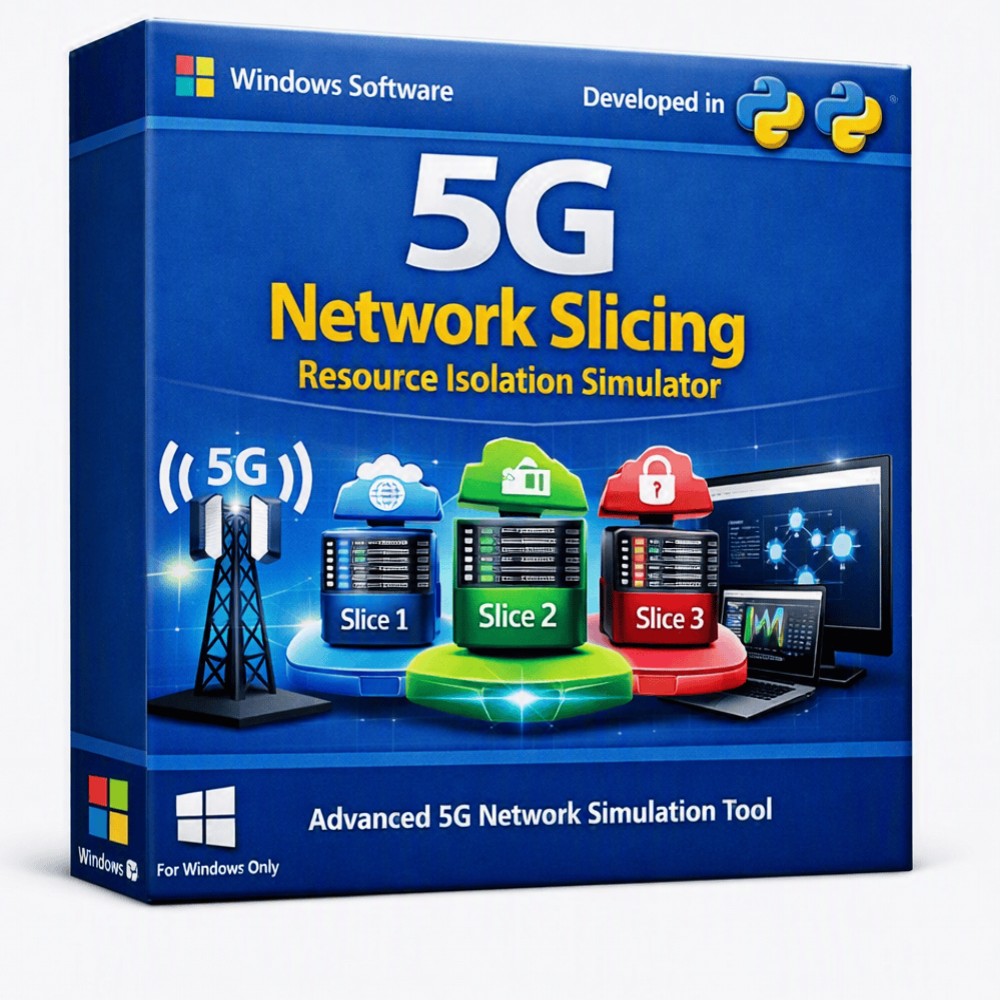
A Python-based 5G Network Slicing and Resource Isolation Simulator designed to model and analyze how multiple logical network slices can share physical 5G infrastructure while maintaining resource isolation. The simulator enables users to study CPU, memory, bandwidth, network capacity, traffic allocation, and resource management across different 5G network slices.
Ideal for 5G research, telecom engineering, academic projects, network optimization, resource allocation studies, and university laboratories.
Original price was: ₹750.00.₹250.00Current price is: ₹250.00. -
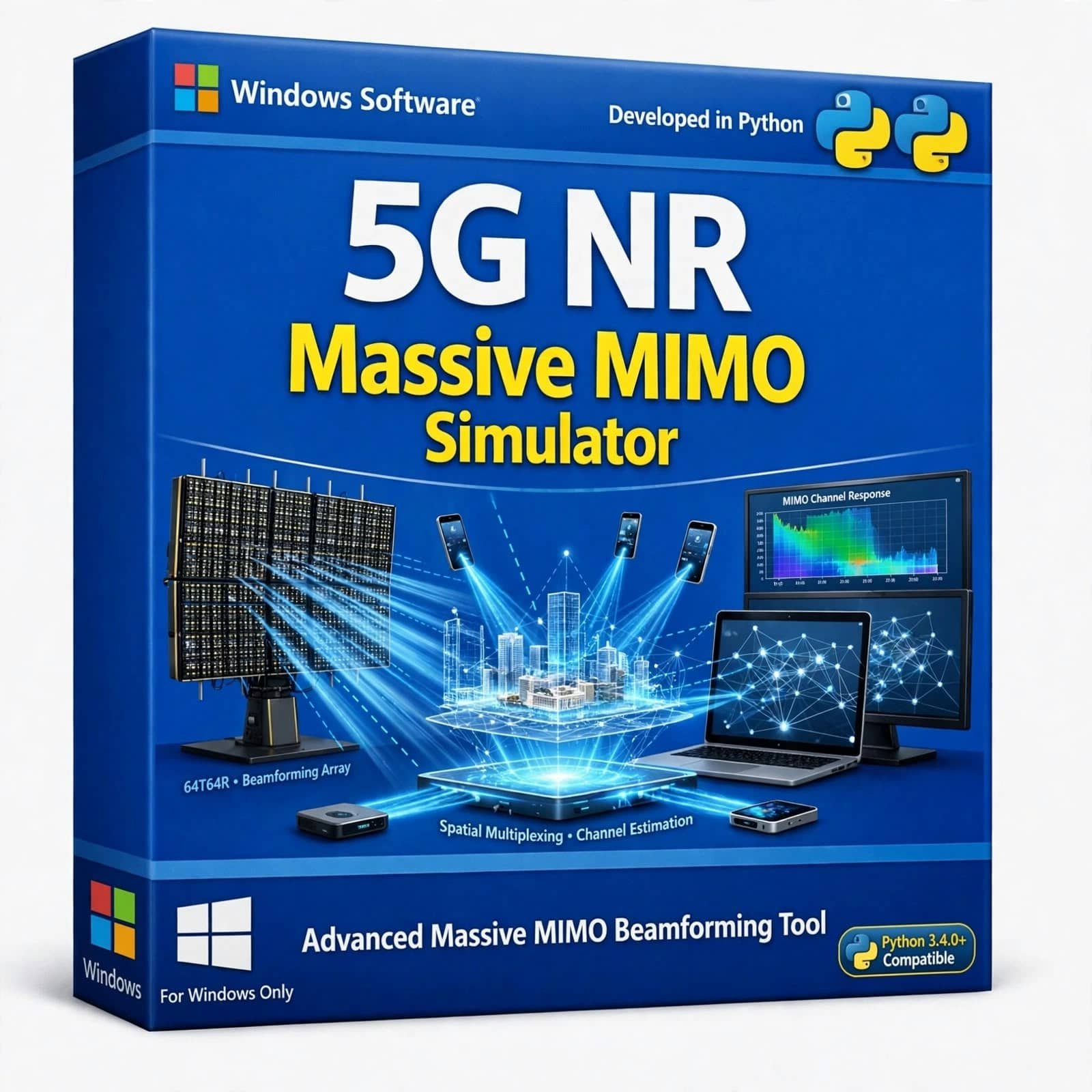
5G NR Massive MIMO Simulator is an advanced simulation solution for modeling and analyzing Massive Multiple-Input Multiple-Output (MIMO) technologies in 5G New Radio networks. It enables users to study large-scale antenna arrays, beamforming, precoding, spatial multiplexing, multi-user MIMO, channel estimation, and interference under configurable channel conditions. The simulator supports analysis of throughput, spectral efficiency, SINR, BER, BLER, MIMO capacity, beamforming gain, and multi-user performance, making it ideal for 5G NR research, algorithm development, academic projects, and 5G/6G wireless system optimization.
Original price was: ₹750.00.₹250.00Current price is: ₹250.00. -
A Python-based 5G Digital Twin solution for creating a virtual representation of 5G network environments, components, and operational behavior. Designed for 5G research, network analysis, simulation, optimization, and academic projects, it enables users to model network scenarios, monitor virtualized network behavior, and experiment with different configurations in a controlled software environment.
Ideal for telecom engineers, researchers, developers, students, and academic institutions working on 5G network planning, performance analysis, intelligent network management, and digital twin research.
Original price was: ₹750.00.₹250.00Current price is: ₹250.00. -
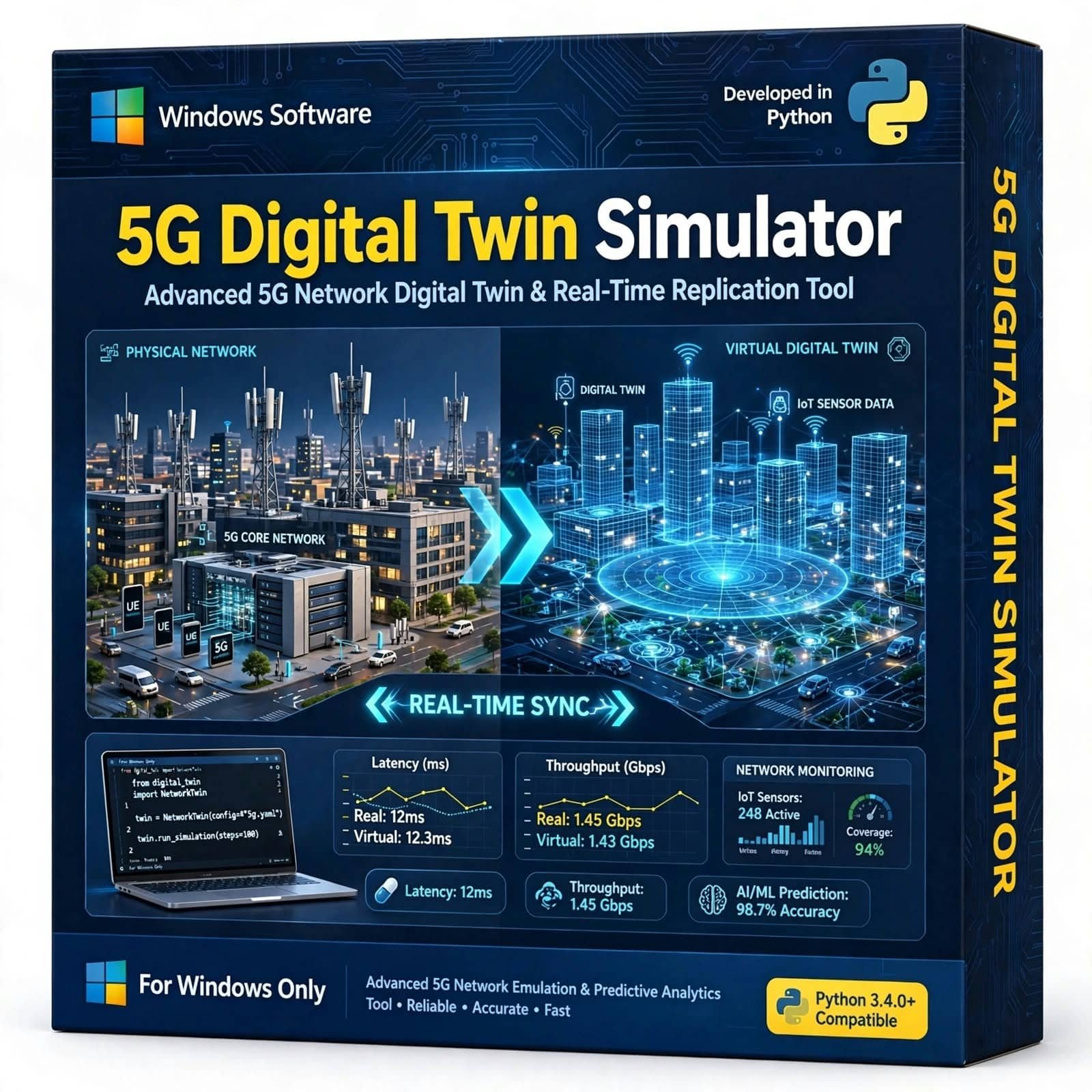
The 5G Digital Twin is a Python-based software solution designed for researchers, engineers, developers, students, and telecommunications professionals interested in modeling, simulating, and analyzing 5G communication networks and their real-world behavior in a virtual environment.
A digital twin provides a virtual representation of a physical or network system, enabling users to study system behavior, evaluate scenarios, analyze performance, and experiment with different configurations. Developed using Python, this 5G Digital Twin can support research, education, network analysis, experimentation, and proof-of-concept development.
Available for sale as a software product. Contact us for pricing, licensing, technical specifications, customization, and purchase information.
Original price was: ₹750.00.₹250.00Current price is: ₹250.00. -
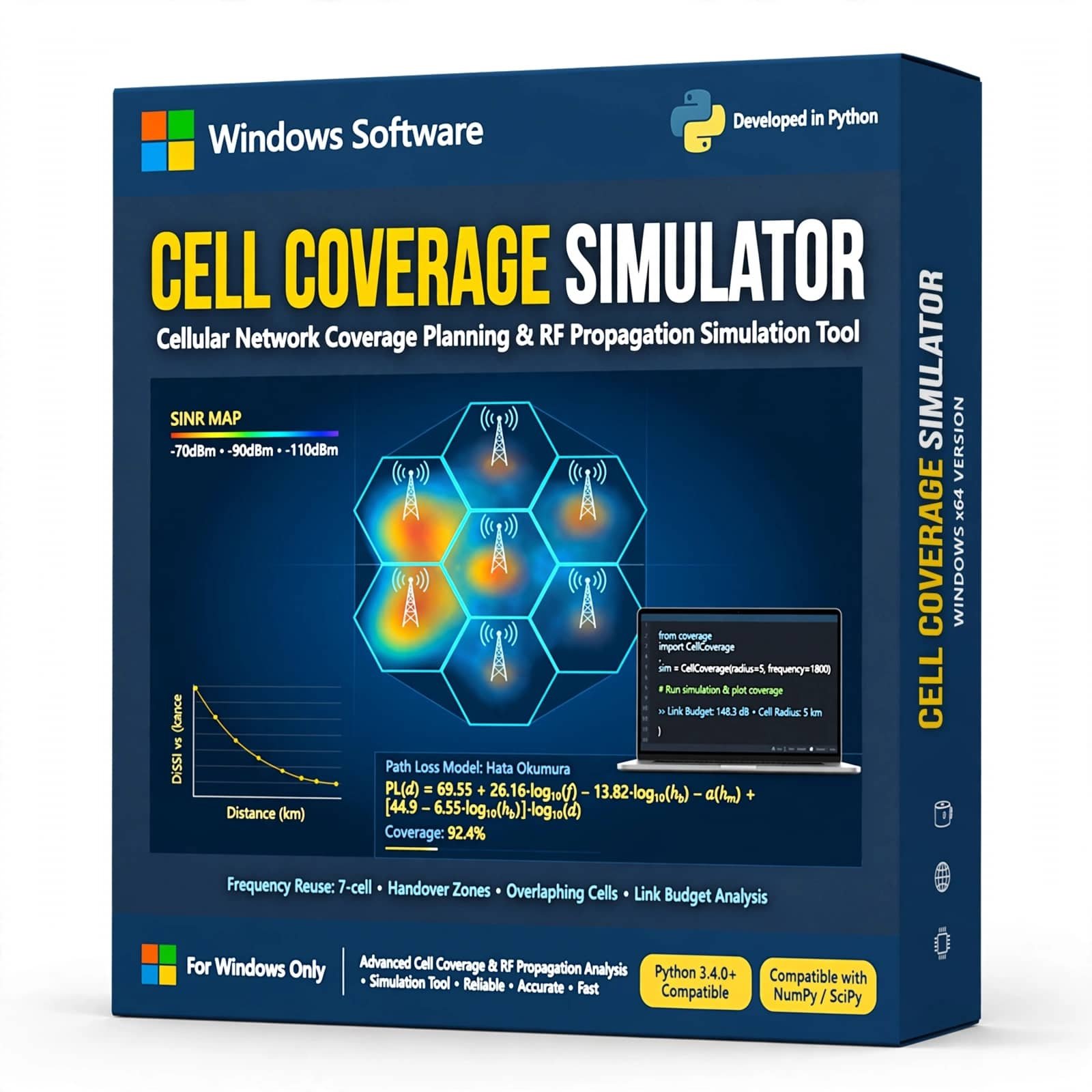
Cell Coverage Simulator is a wireless communication simulation tool designed to model and analyze cellular network coverage using Python. It helps students, researchers, and telecom professionals visualize cell coverage, signal propagation, coverage areas, and network planning concepts through practical simulation and analysis.
Original price was: ₹750.00.₹250.00Current price is: ₹250.00. -
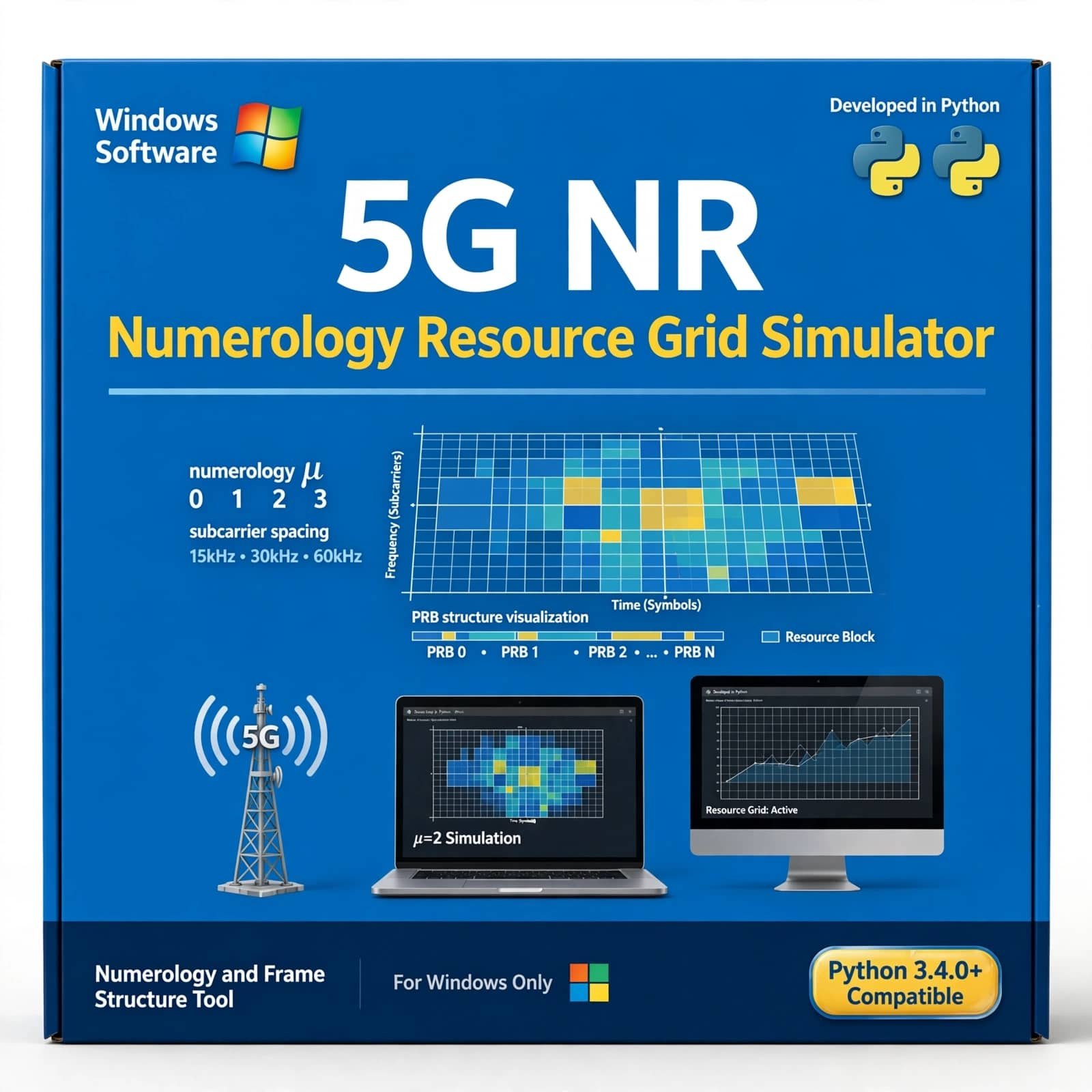
5G NR Numerology Resource Grid Simulator is an advanced simulation solution for modeling and analyzing 5G New Radio numerology and time-frequency resource grid structures. It enables users to study subcarrier spacing, OFDM symbols, slot structure, cyclic prefix, Physical Resource Blocks (PRBs), Resource Elements (REs), bandwidth configurations, and resource mapping. The simulator is ideal for 5G NR physical-layer research, numerology analysis, resource allocation studies, academic projects, waveform development, and 5G/6G wireless communication research.
Original price was: ₹750.00.₹250.00Current price is: ₹250.00.


Reviews
There are no reviews yet.