
New
90% Off

6G 1 Tbps Data Rate Simulator


Original price was: ₹250,000.00.₹25,000.00Current price is: ₹25,000.00.
In StockThe 6G 1 Tbps Data Rate Simulator is an advanced simulation solution designed to explore next-generation wireless communication systems targeting data rates of up to 1 terabit per second (Tbps). It supports the analysis of 6G network performance, ultra-high-speed data transmission, spectrum efficiency, latency, and emerging wireless technologies for future communication networks. Ideal for researchers, students, engineers, and developers working on 6G technology, terahertz communication, and next-generation network optimization.
Description
6G 1 Tbps Data Rate Simulator – Next-Generation Wireless Communication Simulation
The 6G 1 Tbps Data Rate Simulator is a next-generation wireless communication simulation solution designed to study ultra-high-speed data transmission and the potential capabilities of sixth-generation (6G) wireless networks. As communication technologies continue to evolve beyond 5G, 6G research focuses on significantly higher data rates, lower latency, improved connectivity, intelligent networking, and enhanced spectral efficiency. This simulator provides a platform for exploring the technologies and performance requirements associated with future wireless communication systems targeting data rates of up to 1 terabit per second (Tbps).
Key Features of the 6G Data Rate Simulator
The 6G 1 Tbps Data Rate Simulator can support the modeling and analysis of high-speed wireless communication scenarios, depending on its implementation. It can be used to investigate transmission performance, channel characteristics, bandwidth requirements, signal quality, and network efficiency. Researchers can evaluate different communication parameters and study how they influence data throughput and overall system performance.

Potential simulation capabilities include high-frequency wireless communication, terahertz (THz) communication models, advanced modulation techniques, massive multiple-input multiple-output (MIMO) systems, and intelligent resource allocation. These technologies are important research areas for achieving the extreme data rates envisioned for future 6G networks.
Explore Ultra-High-Speed Wireless Data Transmission
One of the major research objectives of 6G technology is to enable data rates far beyond conventional mobile communication systems. The 1 Tbps target represents an ambitious performance goal for selected future communication scenarios rather than a guaranteed data rate for every 6G connection. Using a suitable simulation framework, users can study the theoretical and simulated conditions required to approach such high transmission speeds.
The simulator can help analyze bandwidth utilization, transmission efficiency, channel capacity, and the effects of different propagation environments. These investigations can provide valuable insights into the challenges of designing reliable, high-capacity wireless communication networks.

Applications of 6G Simulation Technology
The 6G 1 Tbps Data Rate Simulator is relevant to academic research, wireless communication engineering, telecommunications development, and advanced networking projects. Potential application areas include ultra-high-definition media streaming, immersive extended reality (XR), holographic communication research, high-speed wireless backhaul, connected intelligent systems, and future industrial communication networks.
Students and researchers can use simulation-based experiments to compare communication parameters, evaluate network behavior, and develop new approaches to wireless system optimization. The simulator may also support research into integrated sensing and communication, AI-enabled networking, and emerging spectrum technologies when these features are included in the underlying implementation.
Benefits for Researchers and Developers
Simulation offers a practical way to investigate advanced wireless communication concepts before implementing them in physical test environments. By adjusting parameters and comparing results, users can study throughput, latency, spectral efficiency, and other relevant performance indicators. This approach can reduce early-stage experimentation costs and help identify promising system configurations.
The simulator is suitable for engineering students, postgraduate researchers, telecommunications professionals, and developers exploring next-generation wireless technologies. Its specific capabilities depend on the simulation software, supported models, and available configuration options.

Conclusion
The 6G 1 Tbps Data Rate Simulator provides a valuable starting point for investigating the future of ultra-high-speed wireless communication. By focusing on data transmission, network performance, and emerging 6G technologies, it supports research into the possibilities and technical challenges of next-generation connectivity. Whether used for academic projects, communication system modeling, or experimental network analysis, this simulator can help users explore the technologies that may shape future wireless networks.
Discover the potential of 6G communication and investigate the path toward terabit-per-second wireless data transmission through advanced simulation and performance analysis.
Related products
-
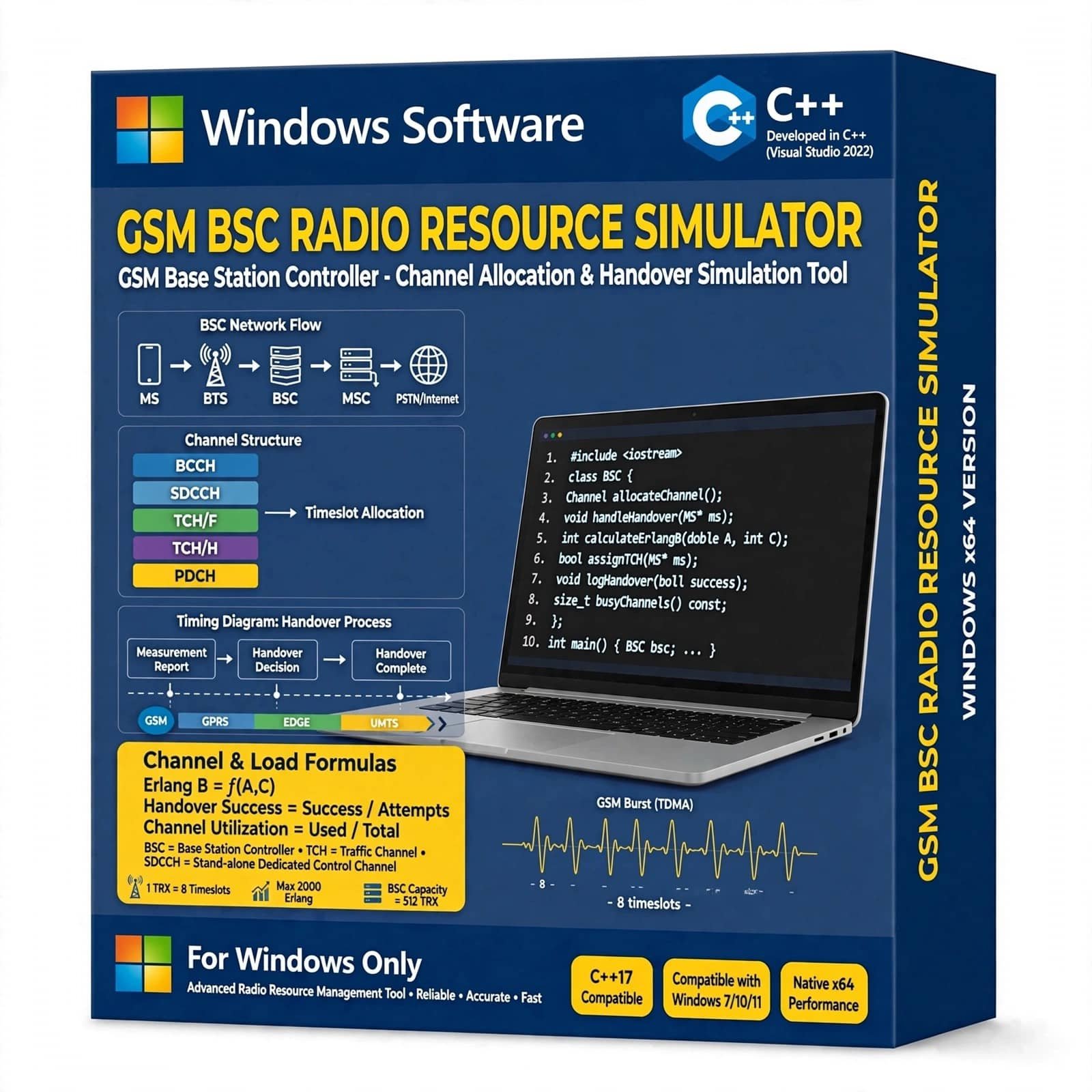
GSM BSC Radio Resource Simulator is a professional telecom training and development solution designed to simulate GSM Base Station Controller (BSC) radio resource management functions. It helps students, telecom engineers, researchers, and network professionals understand GSM radio resource allocation, channel management, call handling, handover concepts, and BSC-related network procedures in a controlled simulation environment.
Original price was: ₹750.00.₹100.00Current price is: ₹100.00. -
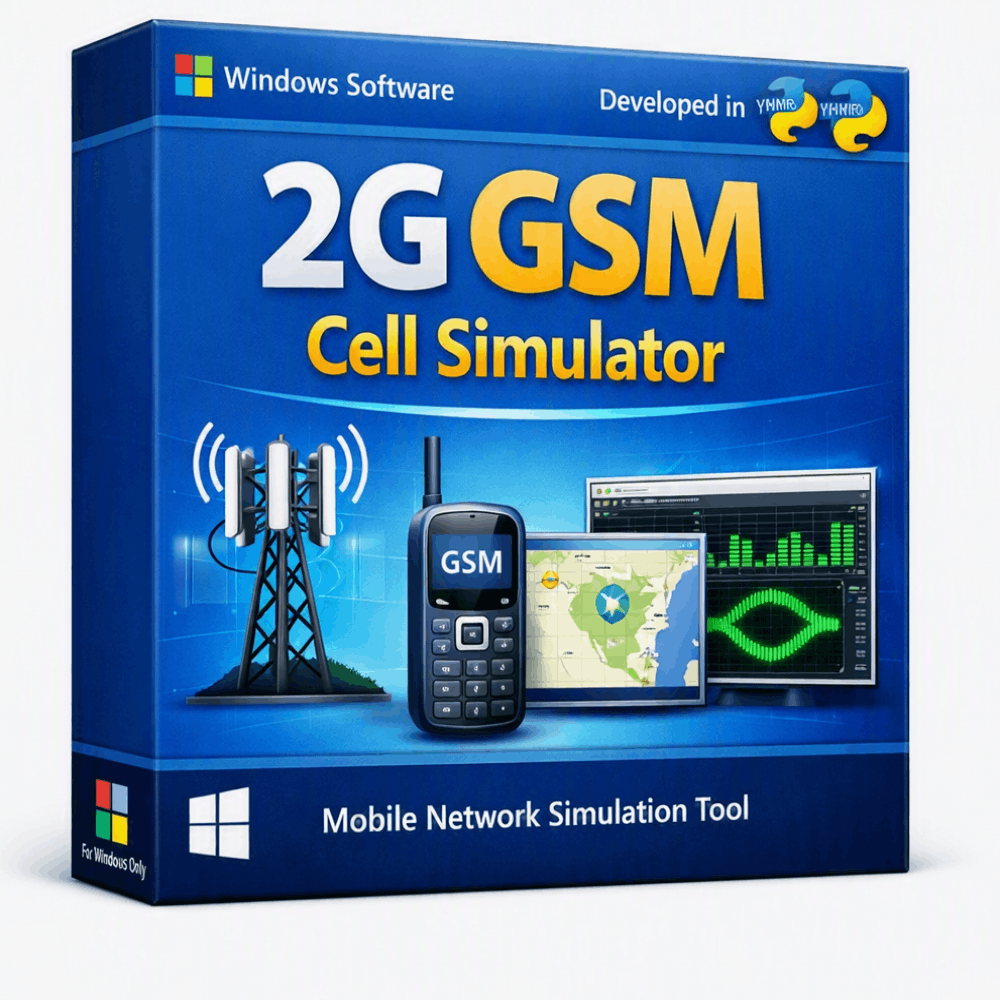
The 2G GSM Cell Simulator is a Python-based software project designed to simulate fundamental GSM cellular-network concepts. It provides a practical environment for understanding mobile stations, GSM cells, base stations, cellular coverage, mobility, communication channels, and basic network behavior. The project includes Python source code that can be studied, customized, and extended for academic projects, demonstrations, research, and learning. It is ideal for Electronics & Communication Engineering, Telecommunications, Computer Science, and related students looking to explore 2G GSM technology and cellular network simulation through a software-based implementation.
₹3,999.00 -
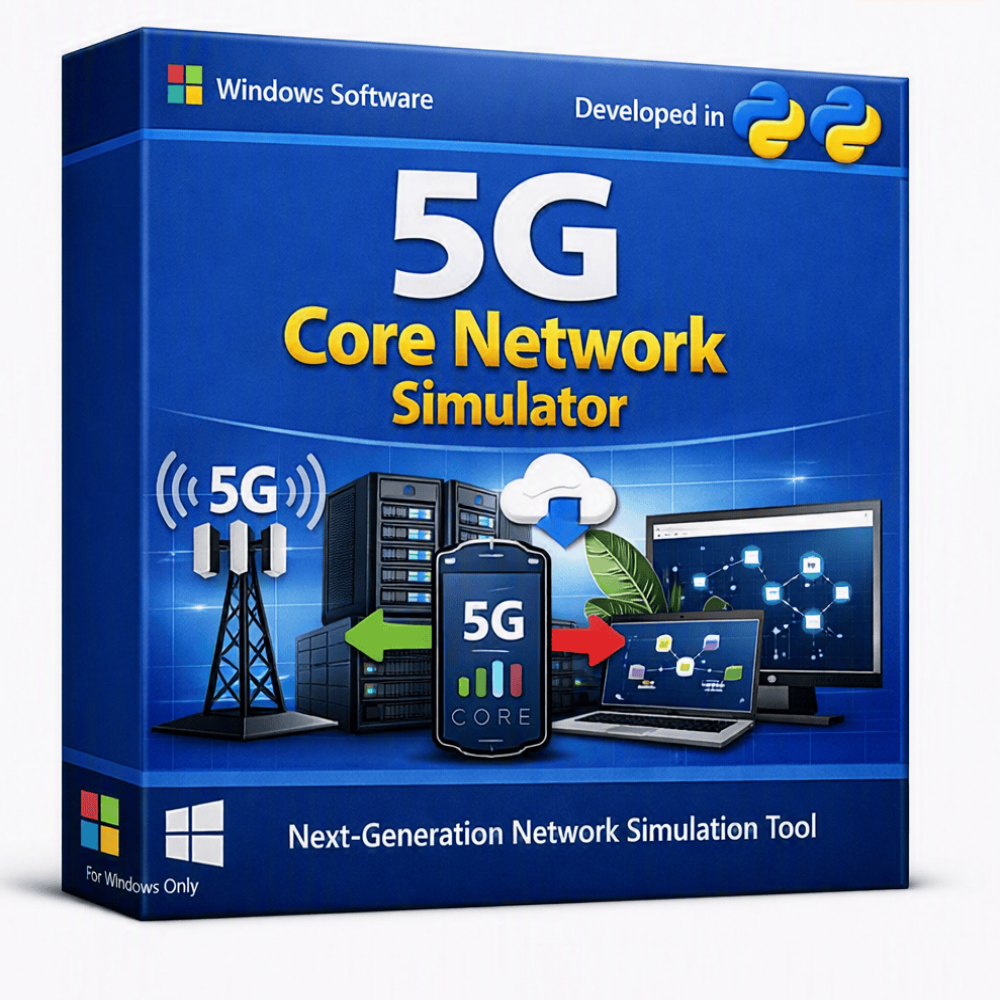
A Python-based 5G Core Network Simulator designed for studying, analyzing, and demonstrating 5G Core network architecture and procedures. Explore key 5G Network Functions such as AMF, SMF, UPF, AUSF, UDM, PCF, NRF, and NSSF, along with UE registration, authentication, session management, mobility, and signaling procedures.
Ideal for 5G research, telecom engineering, academic projects, university laboratories, protocol development, and network simulation. Provides a flexible software environment for experimenting with 5G Core concepts without requiring a complete commercial 5G network infrastructure.
Original price was: ₹74,999.00.₹19,999.00Current price is: ₹19,999.00. -
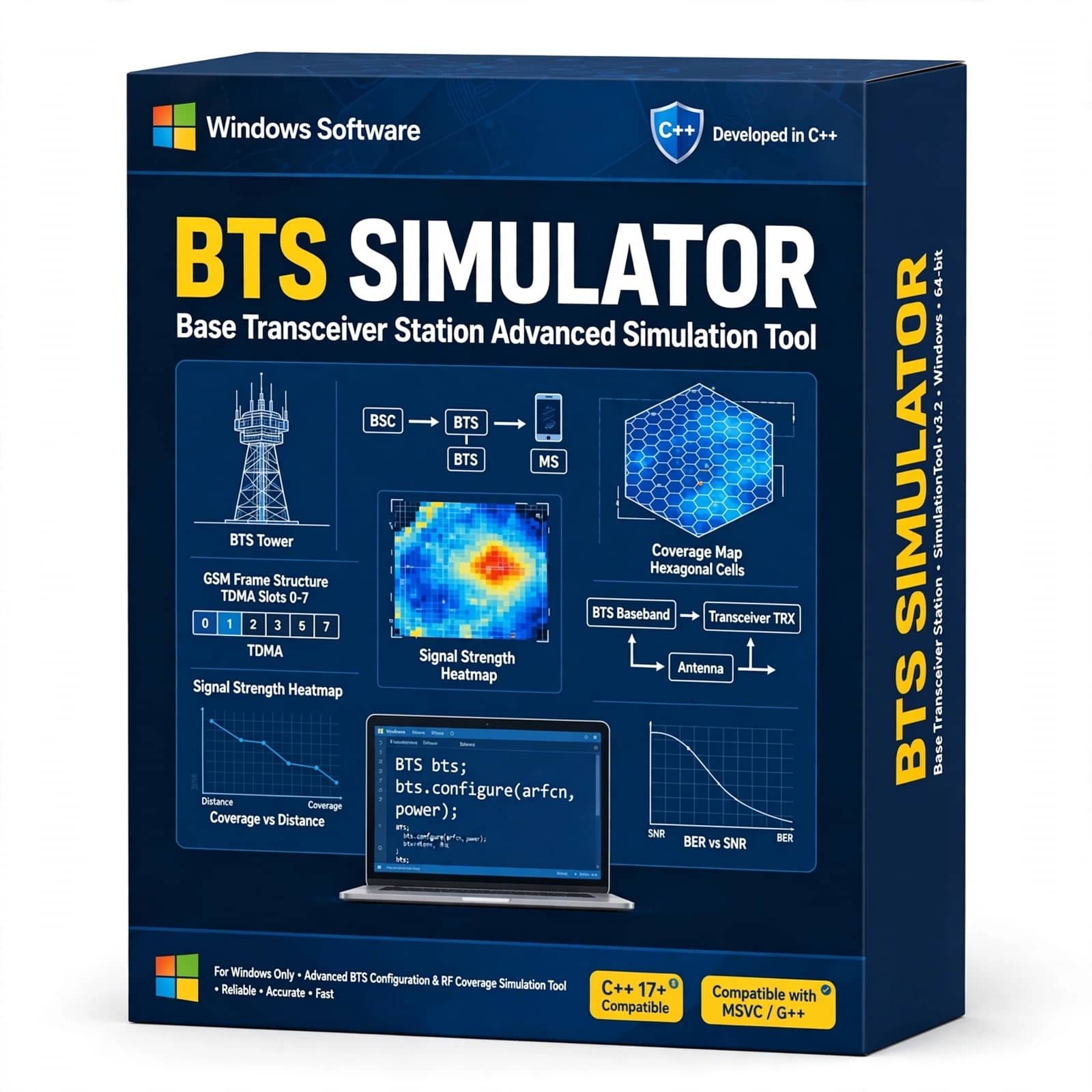
The BTS Simulator with C++ is a software-based Base Transceiver Station simulation tool designed for studying mobile communication, wireless networks, and telecommunications concepts. Developed using C++, it provides a practical environment for understanding BTS operation, communication processes, signal transmission and reception, and cellular network fundamentals. The simulator is ideal for telecommunication laboratories, engineering education, student projects, technical training, and communication-system research.
Original price was: ₹750.00.₹250.00Current price is: ₹250.00. -
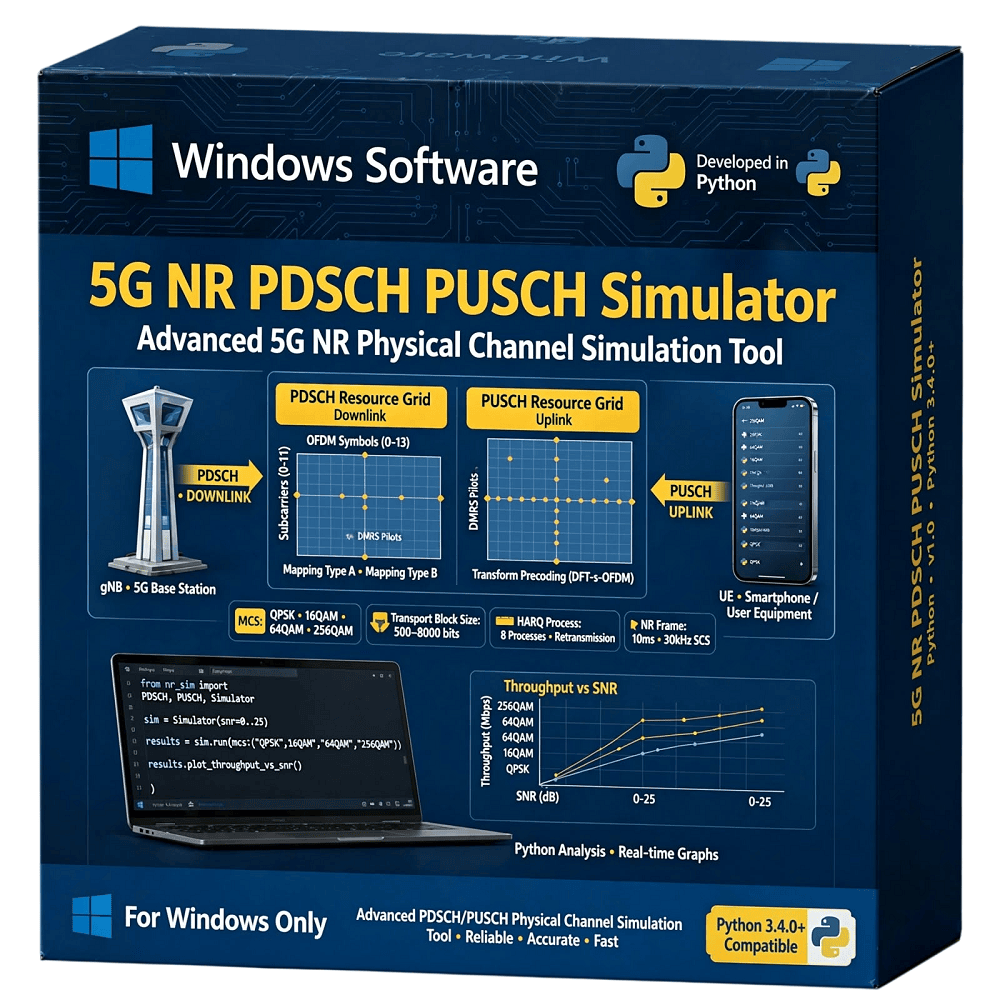
The 5G NR PDSCH PUSCH Simulator is a Python-based simulation software solution designed for researchers, engineers, students, and telecommunications professionals working with 5G New Radio (NR) physical-layer technologies. The simulator provides a practical environment for studying and experimenting with PDSCH (Physical Downlink Shared Channel) and PUSCH (Physical Uplink Shared Channel) transmission concepts.
Developed using Python, the simulator is suitable for academic research, algorithm development, demonstrations, testing, and educational applications related to 5G NR communication systems.
Available for sale as a software product. Contact us for product details, licensing, and purchase information.
Original price was: ₹129,999.00.₹12,999.00Current price is: ₹12,999.00. -
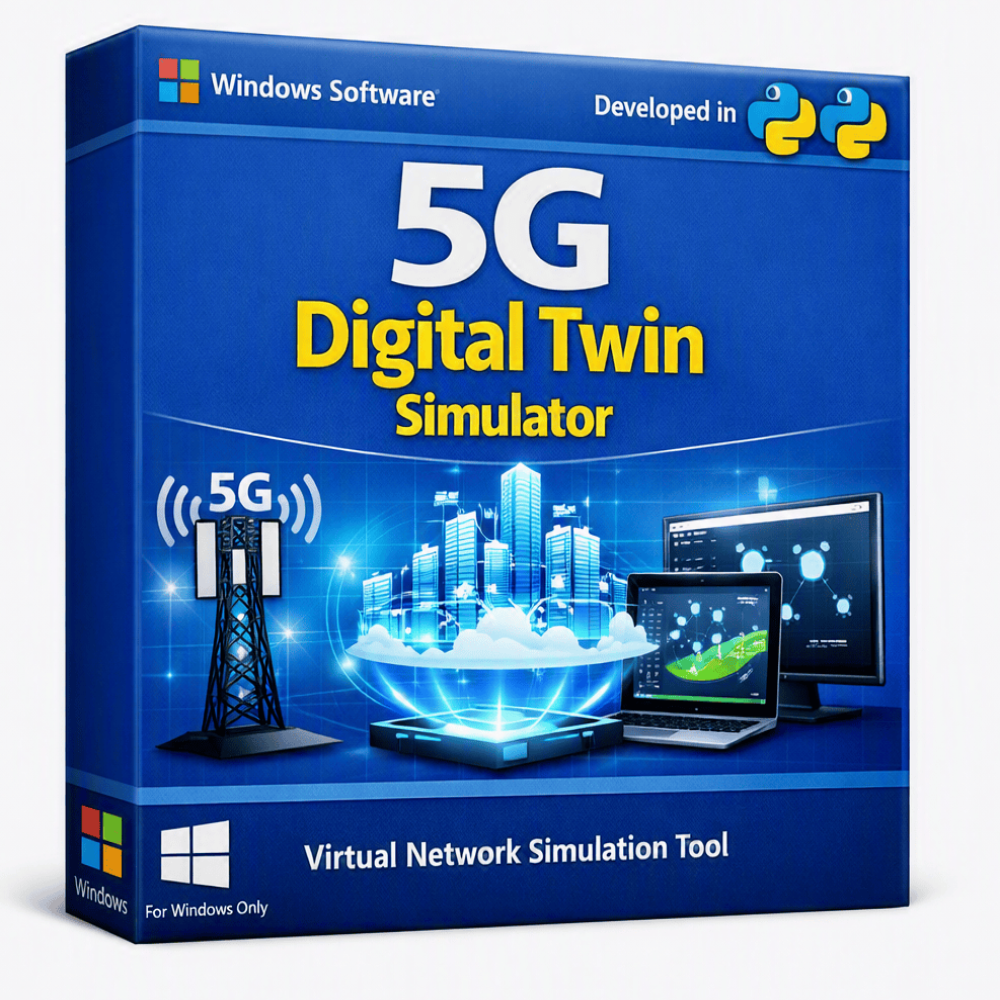
A Python-based 5G Digital Twin solution for creating a virtual representation of 5G network environments, components, and operational behavior. Designed for 5G research, network analysis, simulation, optimization, and academic projects, it enables users to model network scenarios, monitor virtualized network behavior, and experiment with different configurations in a controlled software environment.
Ideal for telecom engineers, researchers, developers, students, and academic institutions working on 5G network planning, performance analysis, intelligent network management, and digital twin research.
Original price was: ₹249,999.00.₹24,999.00Current price is: ₹24,999.00.


Reviews
There are no reviews yet.