
New
93% Off

6G Digital Twin Parametric Validation


Original price was: ₹1,000,000.00.₹75,000.00Current price is: ₹75,000.00.
In Stock6G Digital Twin Parametric Validation with Python is a simulation-based approach for modeling, testing, and validating key parameters of next-generation wireless communication networks. Using Python-based analysis, researchers can evaluate network configurations, channel characteristics, latency, throughput, resource allocation, and system performance under different operating conditions. Ideal for 6G research, digital twin modeling, wireless network optimization, and parametric performance validation, this solution supports data-driven experimentation and the development of intelligent next-generation communication systems.
Description
6G Digital Twin Parametric Validation with Python
6G Digital Twin Parametric Validation with Python is a simulation-based approach designed to evaluate and validate the performance of next-generation wireless communication systems using digital twin models. As telecommunications evolve beyond 5G, sixth-generation (6G) networks are expected to support advanced connectivity, intelligent automation, ultra-low latency, high data rates, and integrated sensing capabilities. Digital twin technology can help researchers create virtual representations of communication networks and study their behavior under different operating conditions.

Python provides a flexible environment for developing digital twin models, managing simulation parameters, analyzing experimental data, and comparing predicted performance with reference measurements. This approach supports systematic evaluation of network configurations before deploying changes in physical or experimental environments.
Key Features of Digital Twin Parametric Validation
Parametric validation involves changing selected model parameters and observing their effects on system behavior. In a 6G digital twin, these parameters may include transmission power, bandwidth, carrier frequency, antenna configuration, user density, channel conditions, traffic load, and network topology.

A Python-based framework can automate parameter sweeps, execute simulation experiments, calculate performance metrics, and generate visual reports. Depending on the implementation, it may also support sensitivity analysis, error measurement, scenario comparison, and model calibration.
These capabilities help researchers identify influential parameters, evaluate assumptions, and understand how variations in network conditions affect communication performance.
Python-Based 6G Digital Twin Modeling
Python is widely used for scientific computing, numerical analysis, data processing, and machine learning. Libraries such as NumPy, pandas, SciPy, and Matplotlib can support parameter management, statistical calculations, data analysis, and visualization. Additional simulation frameworks can be integrated when more detailed network or communication models are required.

A digital twin workflow may include creating a virtual network model, defining configurable parameters, running simulation scenarios, collecting performance metrics, and comparing outputs with reference data. When real-world measurements are available, the model can be calibrated and evaluated against those observations.
This process helps distinguish a theoretical simulation from a validated digital twin that demonstrates an appropriate level of agreement with a real system.
Applications in Next-Generation Wireless Networks
6G digital twin parametric validation can support research into radio access networks, intelligent resource allocation, edge computing, massive multiple-input multiple-output (MIMO), terahertz communication, and AI-assisted network optimization.

Researchers can use parameter-based experiments to investigate throughput, latency, spectral efficiency, energy consumption, and reliability under different scenarios. Digital twins may also support predictive maintenance, network planning, anomaly analysis, and evaluation of configuration changes before applying them to operational infrastructure.
The exact applications depend on the communication models, input data, and validation mechanisms implemented in the software.

Benefits for Researchers and Developers
Python-based digital twin validation offers flexibility, repeatability, and automation. Researchers can systematically vary model inputs, compare multiple scenarios, visualize results, and document performance differences. Automated testing can reduce repetitive manual work and improve the consistency of experimental procedures.
For students, engineers, and telecommunications researchers, this approach provides a practical way to explore digital twin concepts, develop simulation workflows, and study the relationship between network parameters and performance outcomes.
A well-designed validation process should define acceptance criteria, identify suitable reference data, quantify prediction errors, and document model limitations.

Conclusion
6G Digital Twin Parametric Validation with Python provides a useful framework for investigating the performance and behavior of emerging wireless communication systems. By combining digital twin modeling with systematic parameter testing and Python-based analysis, researchers can evaluate network configurations, identify performance bottlenecks, and improve model reliability.
Whether used for academic research, telecommunications experimentation, network optimization, or intelligent communication system development, this approach supports data-driven investigation of technologies that may shape future 6G networks.


Related products
-
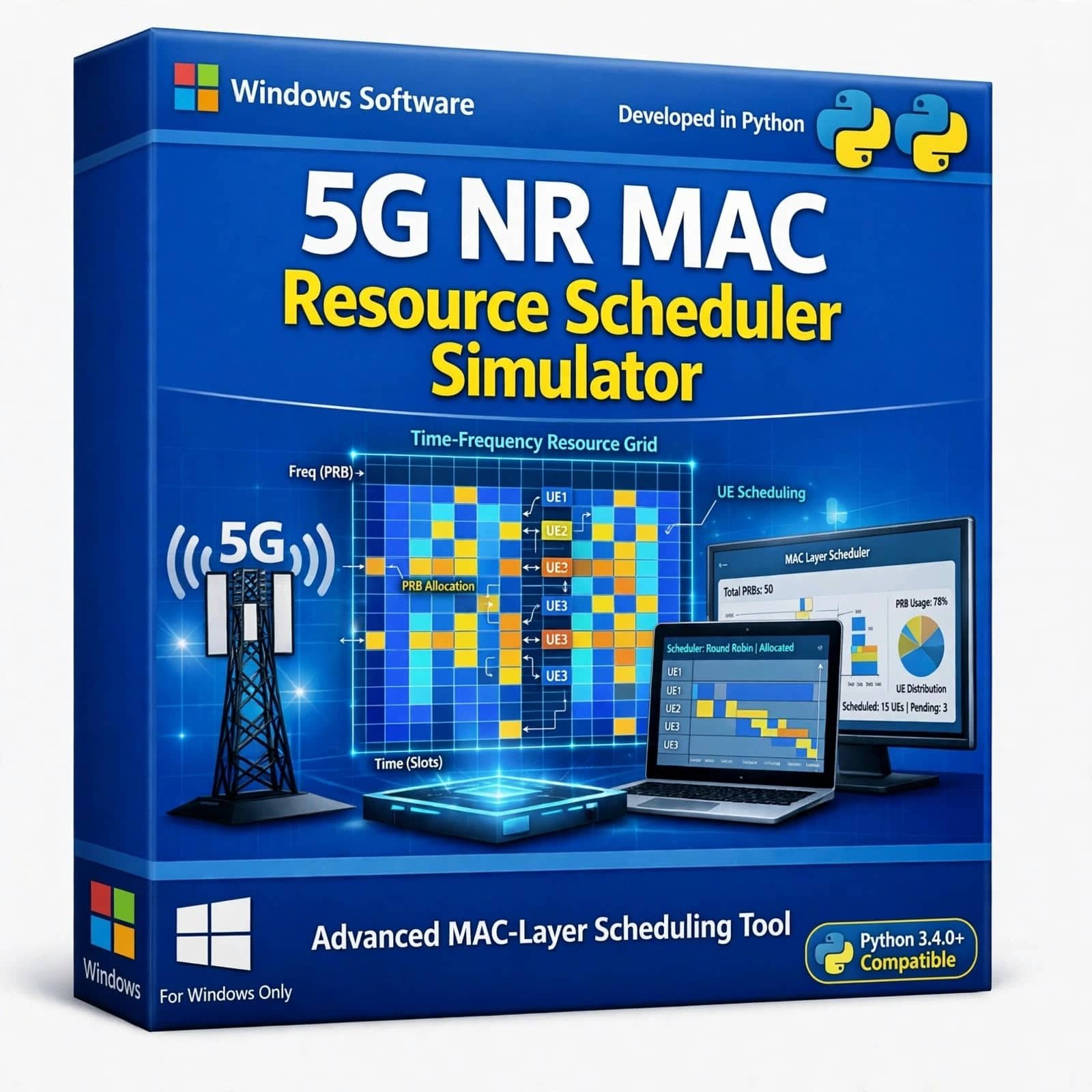
5G NR MAC Resource Scheduler Simulator is an advanced simulation solution for modeling and analyzing Medium Access Control (MAC) layer resource scheduling in 5G New Radio networks. It enables users to evaluate dynamic resource allocation, multi-UE scheduling, uplink and downlink resource management, QoS-aware scheduling, traffic conditions, and scheduling algorithms. The simulator supports analysis of throughput, latency, fairness, spectral efficiency, resource utilization, packet loss, and QoS performance, making it ideal for 5G NR research, scheduler algorithm development, academic projects, and wireless network optimization.
Original price was: ₹129,999.00.₹12,999.00Current price is: ₹12,999.00. -
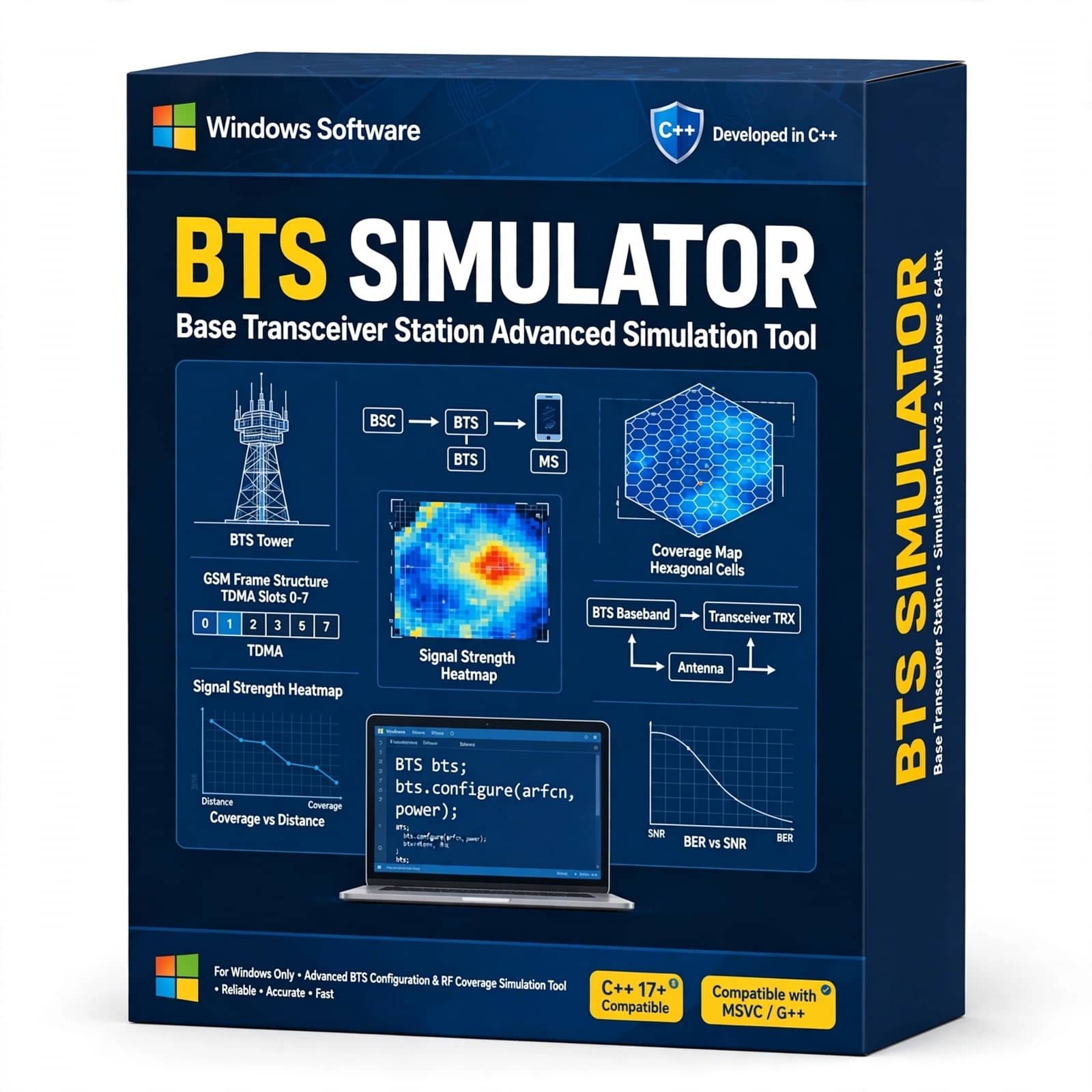
The BTS Simulator with C++ is a software-based Base Transceiver Station simulation tool designed for studying mobile communication, wireless networks, and telecommunications concepts. Developed using C++, it provides a practical environment for understanding BTS operation, communication processes, signal transmission and reception, and cellular network fundamentals. The simulator is ideal for telecommunication laboratories, engineering education, student projects, technical training, and communication-system research.
Original price was: ₹750.00.₹250.00Current price is: ₹250.00. -
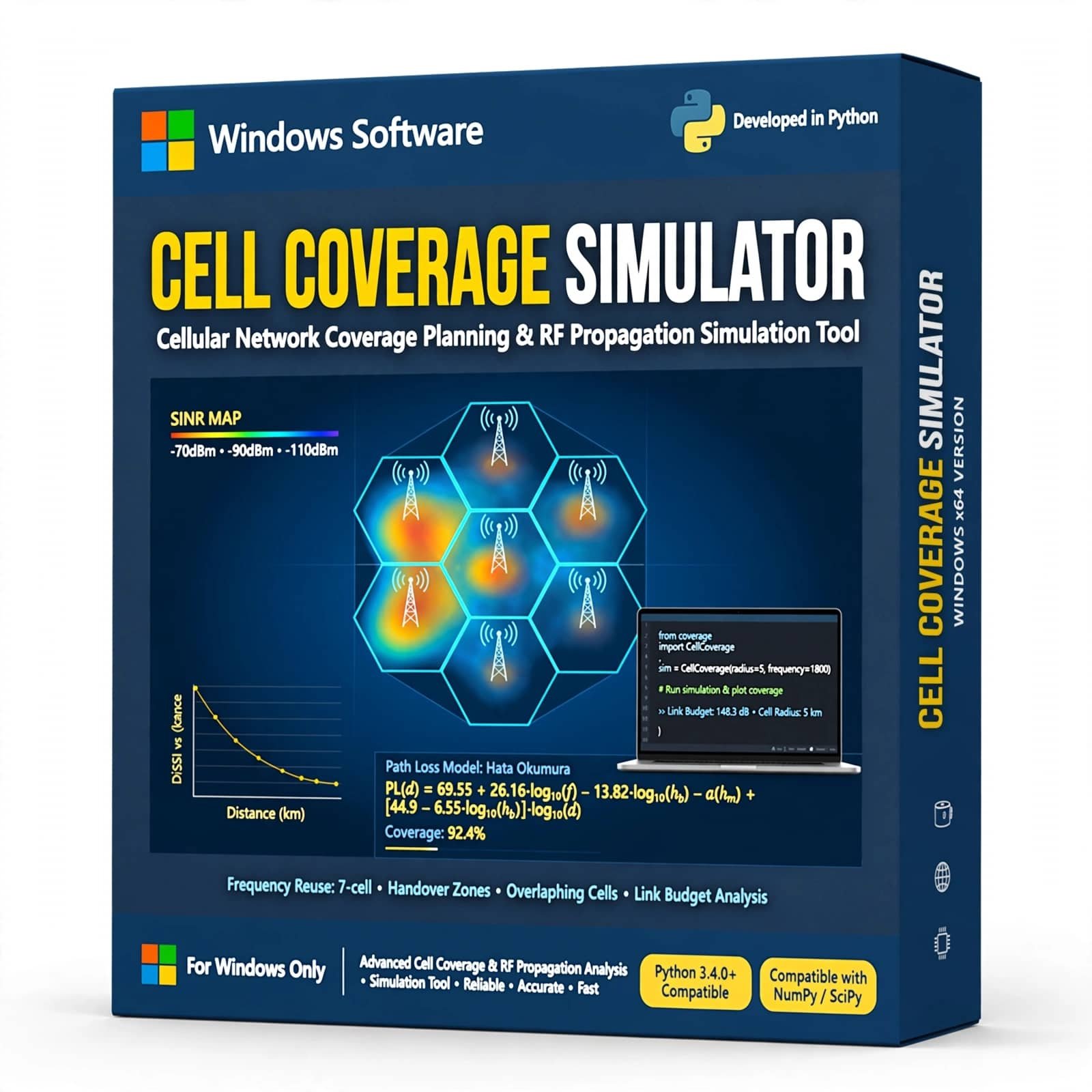
Cell Coverage Simulator is a wireless communication simulation tool designed to model and analyze cellular network coverage using Python. It helps students, researchers, and telecom professionals visualize cell coverage, signal propagation, coverage areas, and network planning concepts through practical simulation and analysis.
₹6,999.00 -
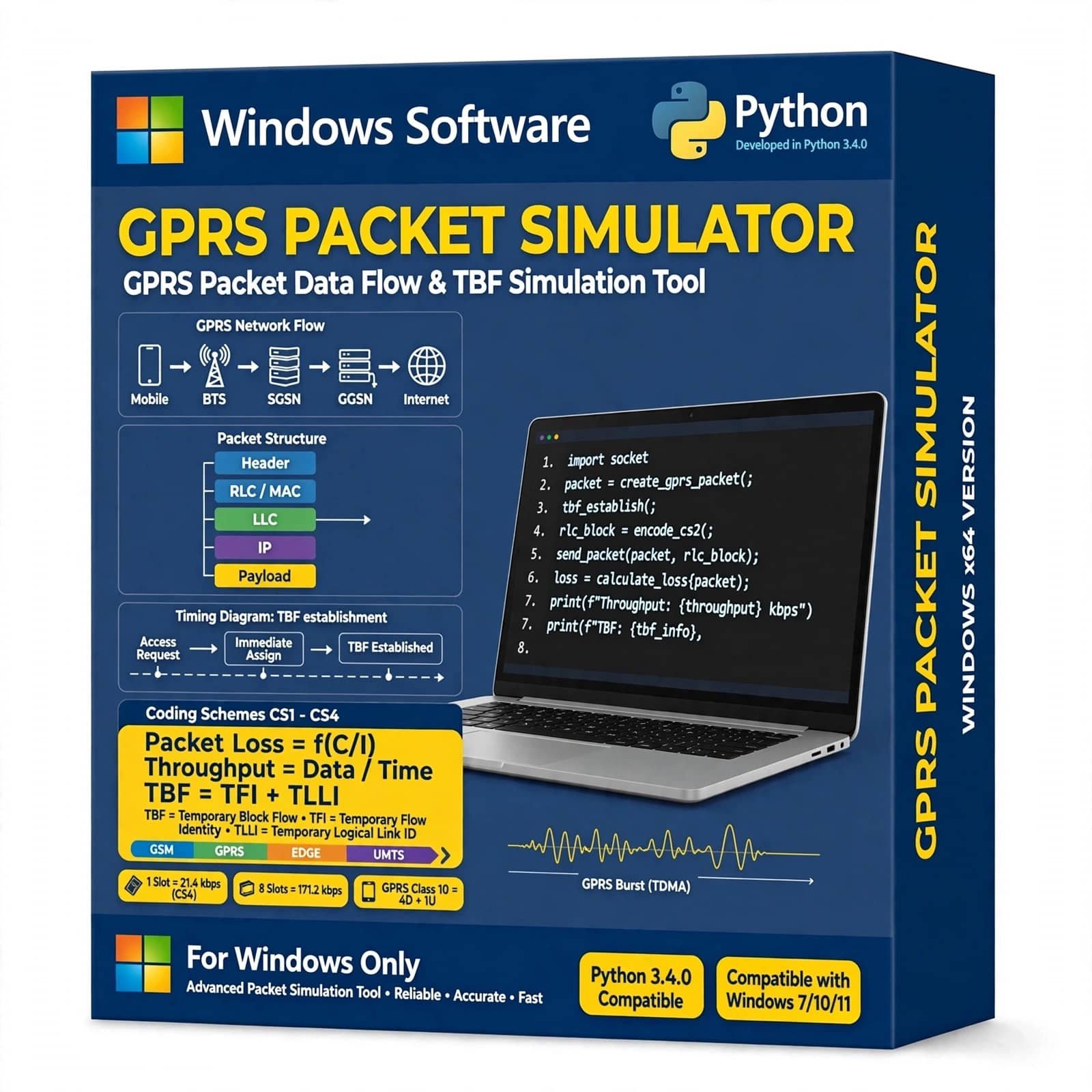
GPRS Packet Simulator is a powerful software solution for simulating GPRS data packets and testing GSM/GPRS communication systems. It helps developers, engineers, and testing teams generate, analyze, and validate packet-based communication in a controlled environment without requiring extensive physical network infrastructure. Ideal for GPRS testing, protocol development, IoT applications, and telecom system validation.
₹3,999.00 -
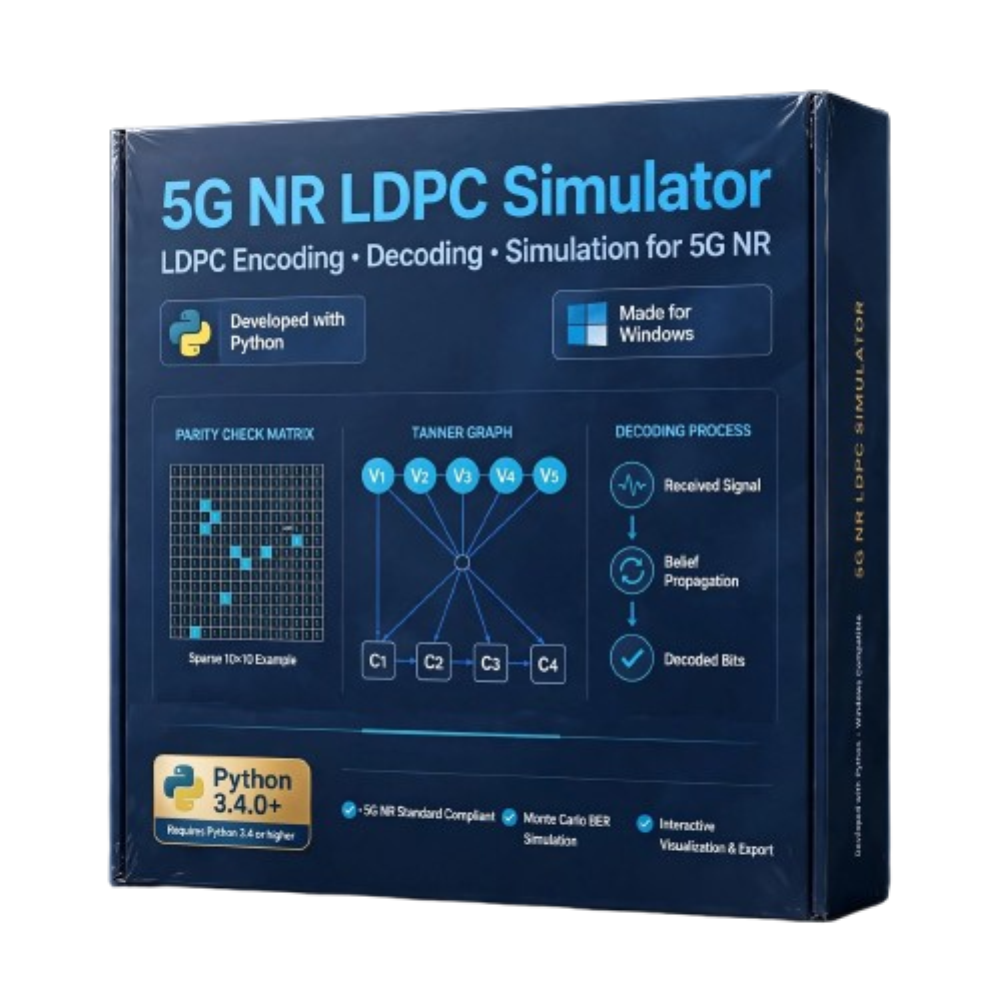
5G NR LDPC Simulator is an advanced simulation solution for modeling and analyzing Low-Density Parity-Check (LDPC) channel coding used in 5G New Radio systems. It enables users to simulate LDPC encoding and decoding, evaluate error correction performance, and analyze BER, BLER, SNR, coding rate, decoding iterations, throughput, and convergence under configurable channel conditions. The simulator is ideal for 5G NR channel coding research, algorithm development, academic projects, decoder performance analysis, and next-generation wireless communication system optimization.
Original price was: ₹129,999.00.₹12,999.00Current price is: ₹12,999.00. -
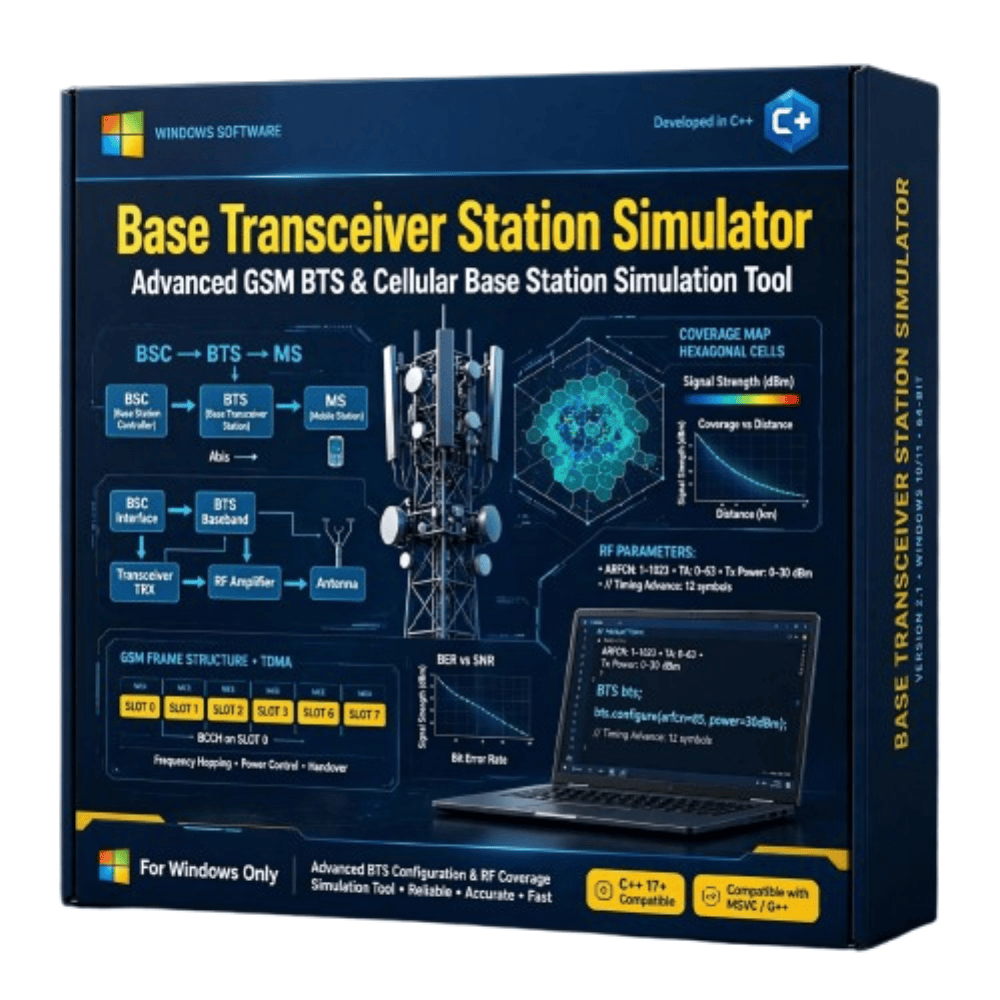
The Base Transceiver Station Simulator Using C++ is a practical cellular communication simulation project designed to demonstrate the basic operation of a BTS in a mobile communication network. Developed using C++, the simulator can model communication between mobile users and a base station, including signal handling, user connectivity, channel allocation, and basic network operations. This BTS Simulator project is suitable for engineering students, researchers, and learners working on GSM, wireless communication, cellular networks, and C++ programming projects.
Original price was: ₹750.00.₹250.00Current price is: ₹250.00.


Reviews
There are no reviews yet.