
New
67% Off

VLR Model Simulator

Original price was: ₹750.00.₹250.00Current price is: ₹250.00.
In StockVLR Model Simulator with Python is a telecommunications simulation tool designed to model Visitor Location Register (VLR) concepts in GSM and cellular networks. It can be used to study subscriber mobility, location management, location updates, roaming, and VLR–HLR interactions. Built for Python-based simulation, the tool is suitable for students, researchers, telecom engineers, and developers working on mobile communication, GSM architecture, wireless networks, and telecommunications research.
Description
VLR Model Simulator
The VLR Model Simulator with Python is a telecom and mobile-network simulation tool designed to help users understand and analyze the operation of the Visitor Location Register (VLR) within cellular communication networks. Developed for Python-based simulation and experimentation, the VLR Model Simulator provides a practical environment for studying subscriber mobility, location management, roaming, temporary subscriber information, and interactions between key components of a mobile network.
The Visitor Location Register is an important database component in traditional cellular network architectures such as GSM (Global System for Mobile Communications). It temporarily stores information about mobile subscribers who are currently located within the area served by a particular mobile switching center. Understanding how subscriber information is managed as users move between network areas is essential for studying mobile communication and cellular network architecture.
The VLR Model Simulator provides a software-based approach for exploring these concepts without requiring access to a physical telecom network. Using Python, students, researchers, developers, and telecommunications professionals can model subscriber movement and examine how location-related information can be managed within a simulated mobile network environment.
What Is a Visitor Location Register (VLR)?
A Visitor Location Register (VLR) is a database associated with a mobile switching area that maintains temporary information about subscribers currently visiting that area. In a traditional GSM network, the VLR works closely with the Home Location Register (HLR) and Mobile Switching Center (MSC) to support subscriber mobility and communication services.
When a subscriber moves into a new service area, the network needs to determine where the subscriber is currently located so that services such as incoming calls and signaling can be appropriately handled. The VLR plays an important role in maintaining temporary subscriber information associated with the visited network area.
The simulator helps users understand these location-management concepts through a controlled Python-based model.

Python-Based VLR Simulation
The VLR Model Simulator with Python is suitable for developers and researchers who want to simulate mobile-network concepts using Python. Python provides a flexible environment for implementing network models, processing subscriber information, analyzing mobility behavior, and visualizing simulation results.
Users can develop customized experiments around subscriber registration, location updates, mobility between service areas, and VLR database behavior. Python also makes it easier to integrate the VLR simulation with other network models or data-analysis workflows.
This makes the simulator useful for both educational projects and research-oriented experimentation.
Study Mobile Subscriber Mobility
Subscriber mobility is a fundamental characteristic of cellular networks. A mobile device can move from one location area or service region to another, requiring the network to update its knowledge of the subscriber’s current location.
The VLR Model Simulator can be used to study how subscriber movement affects location information and how a mobile network can manage temporary subscriber records. This provides an effective way to understand the relationship between mobile users, location areas, VLR, HLR, and mobile switching systems.
By experimenting with different subscriber and mobility scenarios, users can gain a clearer understanding of location management in cellular networks.

VLR and HLR Interaction
One of the important concepts associated with VLR operation is its relationship with the Home Location Register (HLR). The HLR maintains permanent subscriber-related information, while the VLR can maintain temporary information relevant to subscribers currently present within its service area.
Studying this interaction helps users understand how traditional GSM networks manage subscriber information as users move between different areas.
The simulator can serve as a useful platform for modeling these concepts and examining the flow of subscriber-location information within a simplified mobile-network architecture.
Mobile Network and GSM Architecture
The VLR Model Simulator is particularly useful for learning about GSM network architecture and cellular mobility management. GSM networks consist of several interconnected components that perform different functions, including subscriber management, switching, authentication, and location management.
By focusing on VLR behavior, the simulator allows users to explore one of the important elements involved in subscriber mobility and location tracking.
It can complement studies of other GSM components such as HLR, MSC, Base Station Subsystem (BSS), and mobile subscribers.

Applications of VLR Model Simulator
The VLR Model Simulator with Python can be used for:
- VLR database simulation
- GSM network simulation
- Mobile subscriber mobility analysis
- Location management simulation
- Cellular network research
- HLR and VLR concept studies
- Mobile network architecture learning
- Subscriber registration simulation
- Location update analysis
- Roaming and visitor management studies
- Telecom network modeling
- Python-based telecom simulation
- Communication engineering projects
- Telecommunications research
- Academic and laboratory projects

Educational Applications
The VLR Model Simulator is especially useful for students studying telecommunication engineering, mobile communication, GSM architecture, wireless networks, and network management.
Instead of learning VLR concepts only from diagrams and theoretical descriptions, students can use simulation to explore how subscriber information may change as mobile users move between network areas.
The Python environment also gives students an opportunity to understand how telecommunications concepts can be represented through software models and algorithms.
Research and Development
Researchers and developers can use the simulator as a starting point for investigating mobile-network location management concepts. A software-based model allows different subscriber scenarios to be tested repeatedly and provides an environment for experimenting with mobility and location-management algorithms.
Python can also be used for data processing, statistical analysis, visualization, and integration with other simulation components, making the VLR Model Simulator suitable for broader telecommunications research workflows.
Key Features
- Python-based VLR simulation
- Visitor Location Register modeling
- GSM network architecture simulation
- Mobile subscriber mobility analysis
- Location management simulation
- Subscriber location update modeling
- VLR and HLR concept simulation
- Telecom network modeling
- Cellular communication simulation
- Roaming and visitor management concepts
- Python-based experimentation
- Suitable for academic and research projects
- Useful for telecommunications education
- Supports mobile communication studies
Why Choose a VLR Model Simulator with Python?
The VLR Model Simulator with Python provides a practical way to study the role of the Visitor Location Register in cellular communication networks. It combines telecommunications concepts with Python-based simulation, allowing users to explore subscriber mobility, location management, and GSM network behavior in a controlled software environment.
Whether you are a student learning GSM architecture, a researcher studying mobile-network concepts, or a developer building a telecommunications simulation, this simulator provides a flexible platform for experimenting with VLR, HLR, subscriber mobility, location updates, and cellular network management.
By transforming theoretical VLR concepts into a software-based simulation, the tool can make mobile-network architecture easier to understand, analyze, and experiment with.
Related products
-
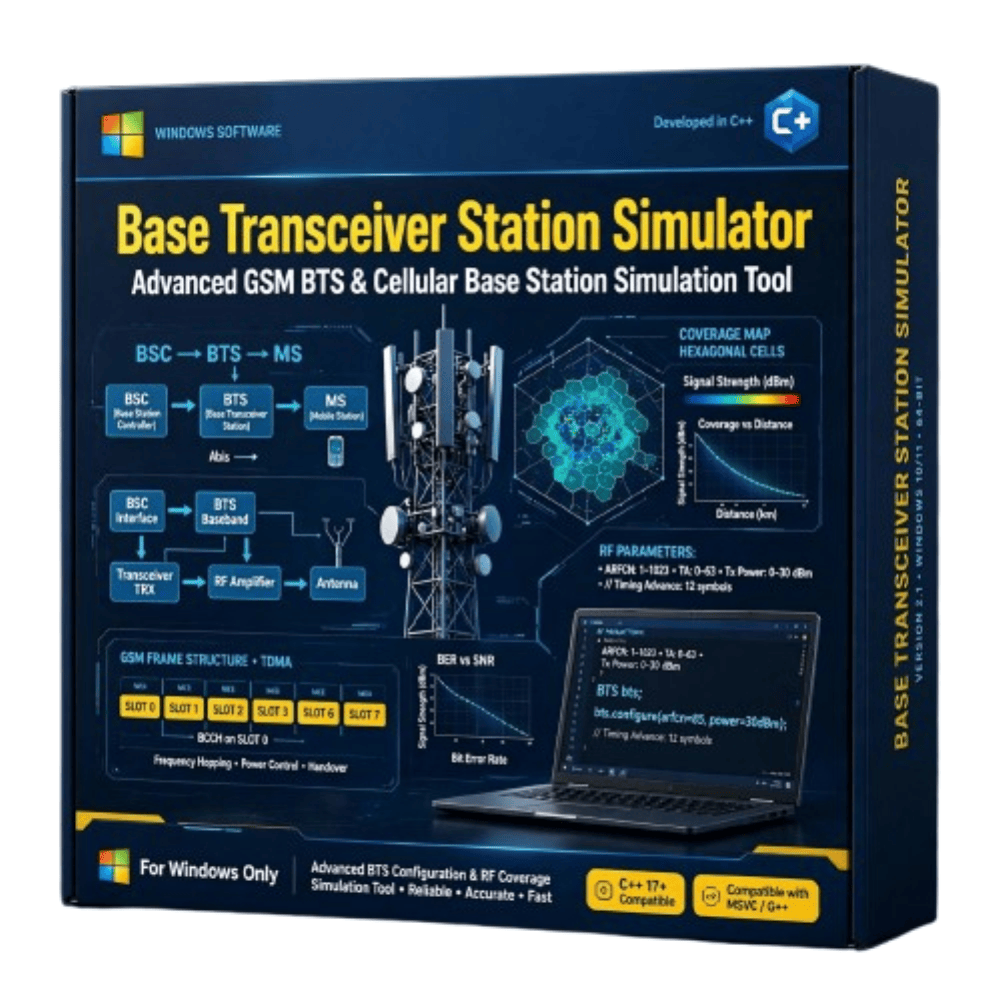
The Base Transceiver Station Simulator Using C++ is a practical cellular communication simulation project designed to demonstrate the basic operation of a BTS in a mobile communication network. Developed using C++, the simulator can model communication between mobile users and a base station, including signal handling, user connectivity, channel allocation, and basic network operations. This BTS Simulator project is suitable for engineering students, researchers, and learners working on GSM, wireless communication, cellular networks, and C++ programming projects.
Original price was: ₹750.00.₹250.00Current price is: ₹250.00. -
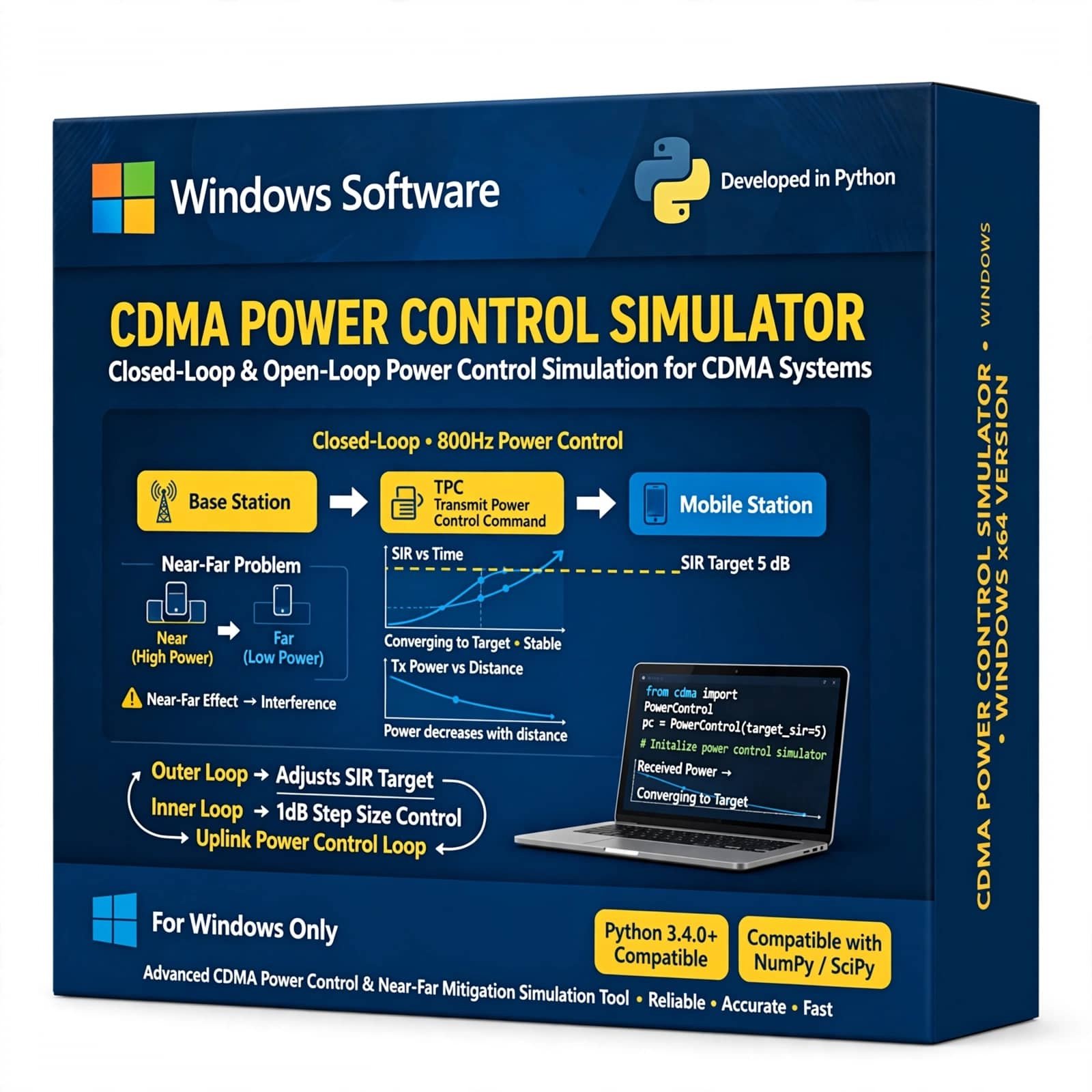
CDMA Power Control Simulator is an advanced communication engineering simulation tool designed to help students, researchers, and professionals understand and analyze power control techniques in Code Division Multiple Access (CDMA) wireless communication systems. It enables practical study of uplink and downlink power control, signal interference, power levels, and system performance.
Original price was: ₹750.00.₹250.00Current price is: ₹250.00. -
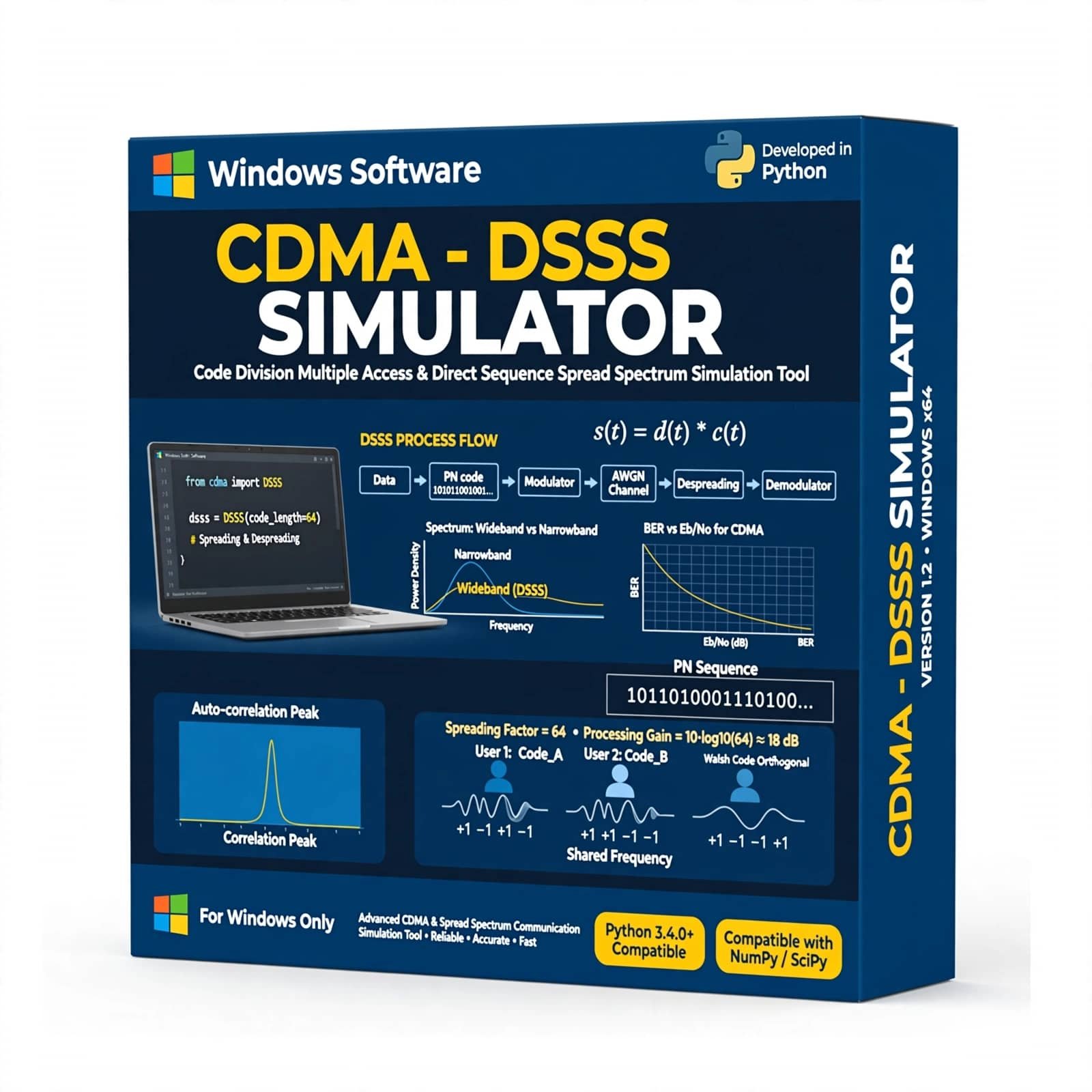
The CDMA – DSSS Simulator with Python is a software-based communication simulation tool designed to demonstrate and analyze Code Division Multiple Access (CDMA) and Direct Sequence Spread Spectrum (DSSS) techniques. Developed using Python, the simulator provides a practical environment for studying spreading codes, signal spreading and despreading, data transmission, multiple-access communication, interference, and signal recovery. It is ideal for digital communication and wireless communication laboratories, engineering education, student projects, technical training, and communication-system research.
Original price was: ₹750.00.₹250.00Current price is: ₹250.00. -
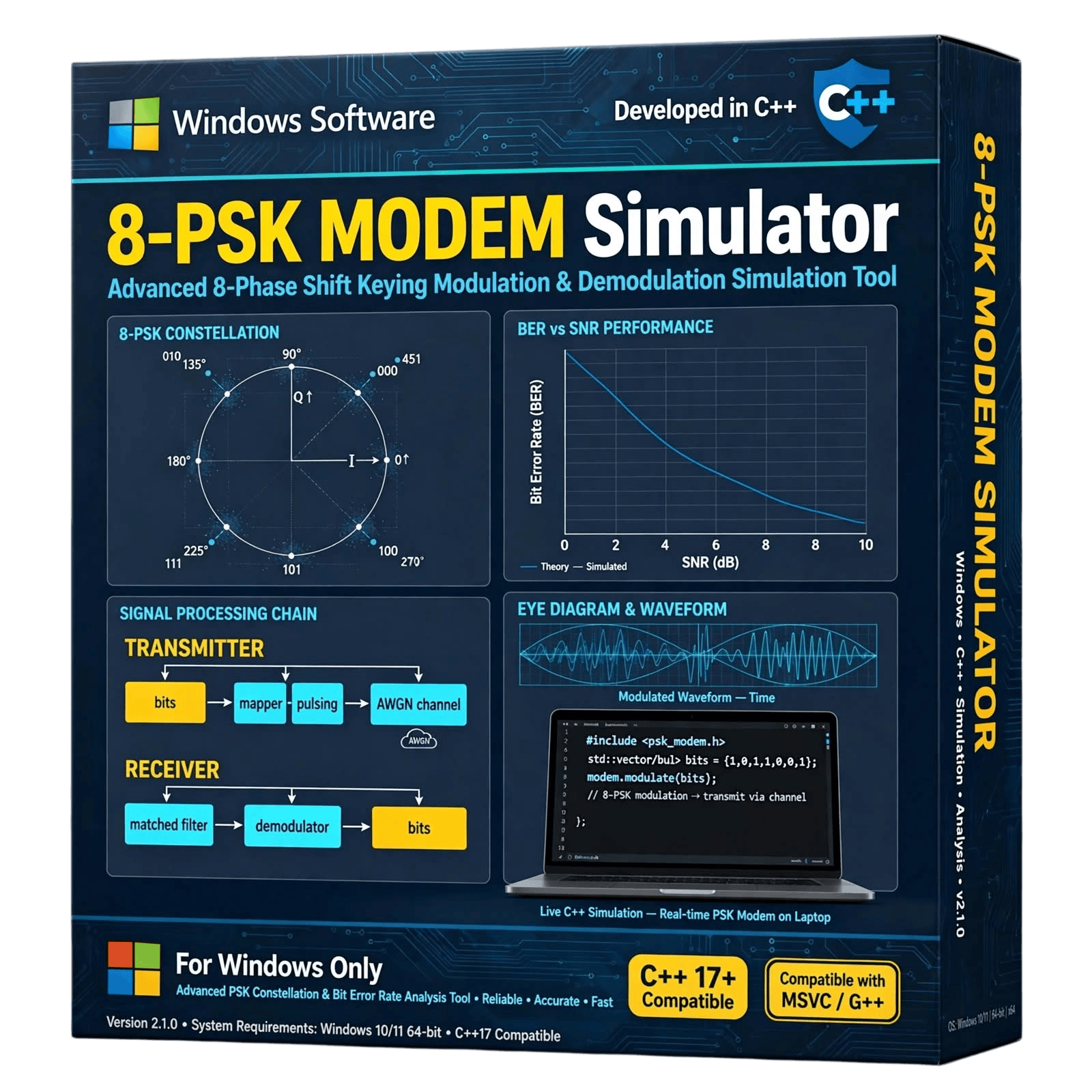
The 8-PSK Modem Simulator is a C++-based software solution designed for students, researchers, communication engineers, developers, and academic institutions working with digital communication and modulation techniques. The simulator provides a practical environment for studying 8-Phase Shift Keying (8-PSK) modulation and demodulation concepts.
Developed using C++, the simulator can be used for digital communication research, academic projects, laboratory demonstrations, signal-processing studies, experimentation, and educational purposes.
Available for sale as a software product. Contact us for pricing, licensing, technical specifications, customization, and purchase information.
Original price was: ₹750.00.₹250.00Current price is: ₹250.00. -
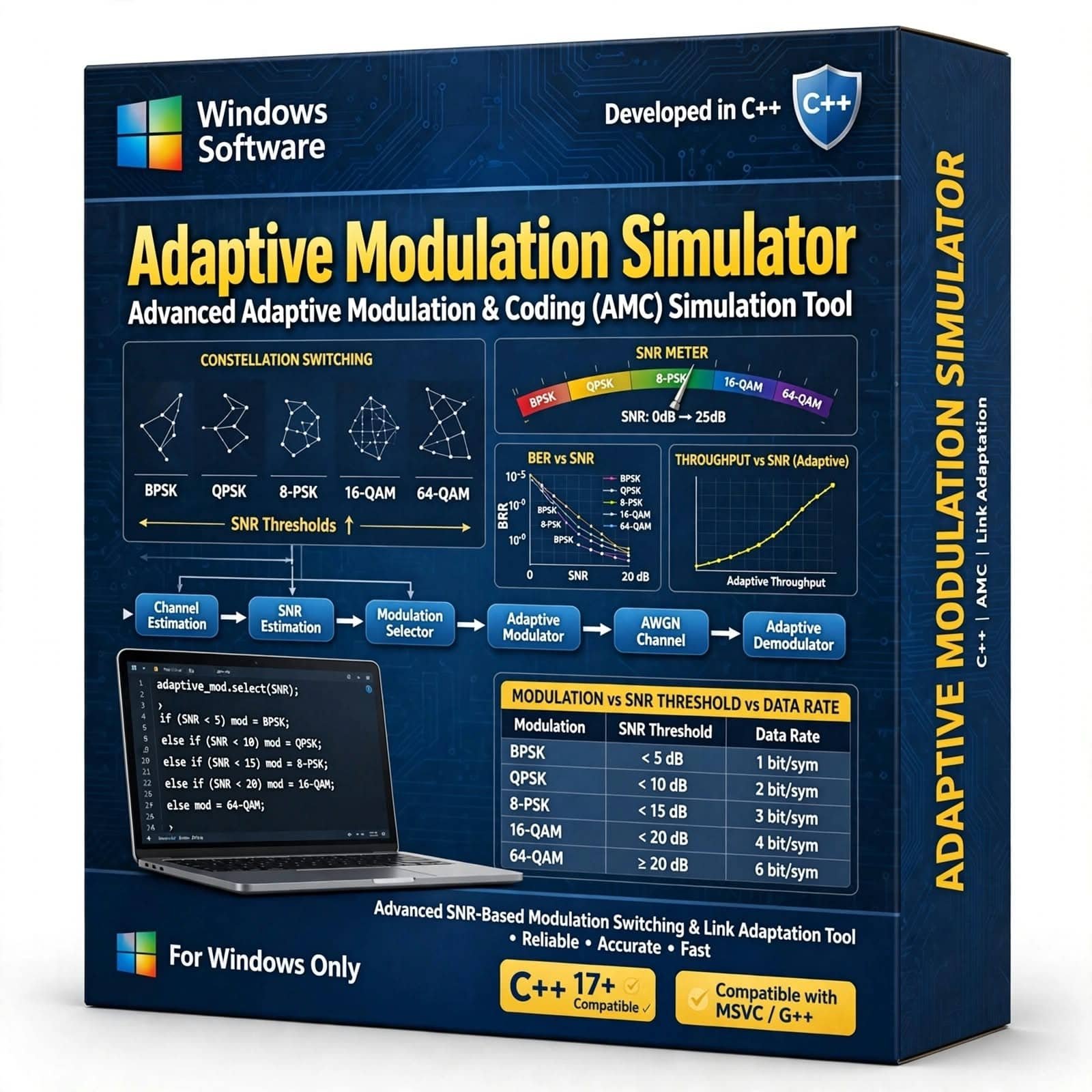
The Adaptive Modulation Simulator is a C++-based software solution designed for students, researchers, engineers, developers, and telecommunications professionals working with digital communication and adaptive modulation techniques. The simulator provides a practical environment for studying how modulation schemes can be selected or adapted according to communication-system conditions.
Developed using C++, the simulator is suitable for academic projects, digital communication research, laboratory demonstrations, signal-processing studies, algorithm development, and educational applications.
Available for sale as a software product. Contact us for pricing, licensing, technical specifications, customization, and purchase information.
Original price was: ₹750.00.₹250.00Current price is: ₹250.00. -
The 2G GSM Cell Simulator is a Python-based software project designed to simulate fundamental GSM cellular-network concepts. It provides a practical environment for understanding mobile stations, GSM cells, base stations, cellular coverage, mobility, communication channels, and basic network behavior. The project includes Python source code that can be studied, customized, and extended for academic projects, demonstrations, research, and learning. It is ideal for Electronics & Communication Engineering, Telecommunications, Computer Science, and related students looking to explore 2G GSM technology and cellular network simulation through a software-based implementation.
Original price was: ₹750.00.₹250.00Current price is: ₹250.00.


Reviews
There are no reviews yet.