
New
67% Off

Shadowing Simulator


Original price was: ₹750.00.₹250.00Current price is: ₹250.00.
In StockShadowing Simulator with Python is a wireless communication simulation tool for analyzing shadowing effects, path loss, wireless signal propagation, and channel behavior. It is suitable for studying log-normal shadowing, received signal variations, RF propagation, and wireless channel models. Designed for students, researchers, engineers, and Python developers, the simulator can support wireless communication research, network modeling, signal-processing studies, and academic projects.
Description
Shadowing Simulator
The Shadowing Simulator with Python is a wireless communication simulation tool designed to analyze shadowing effects, signal propagation, path loss, wireless channel behavior, and variations in received signal strength. It is suitable for students, researchers, communication engineers, Python developers, and professionals working on wireless networks, RF systems, telecommunications, digital communication, and wireless channel modeling.
Shadowing is an important phenomenon in wireless communication that occurs when obstacles such as buildings, walls, trees, terrain, and other physical objects obstruct or partially block the propagation path between a transmitter and receiver. These obstacles can cause variations in the received signal power even when the transmitter and receiver distance remains similar. The Shadowing Simulator provides a convenient software-based environment for studying these effects and understanding their impact on wireless communication systems.
With a Python-based implementation, the simulator provides a flexible platform for experimenting with wireless propagation models, analyzing signal variations, and developing customized communication simulations. Python’s capabilities for numerical computation, data analysis, visualization, and scientific programming make it particularly useful for wireless channel simulation and research.
Wireless Shadowing Simulation
The Shadowing Simulator helps users understand how environmental obstacles can affect wireless signal propagation. In practical wireless communication systems, the received signal is influenced not only by distance but also by the surrounding environment.
Buildings, structures, vegetation, terrain, and other obstructions can introduce additional signal attenuation. This phenomenon is commonly represented using shadowing models, including the log-normal shadowing model, which is widely used for wireless channel and propagation analysis.
By simulating shadowing effects, users can study variations in received signal strength and understand how environmental conditions influence wireless communication performance.
Log-Normal Shadowing and Path Loss Analysis
Path loss describes the reduction in signal power as a wireless signal travels from the transmitter to the receiver. Shadowing introduces additional variations around the average path-loss behavior.
The Shadowing Simulator can be used to explore the relationship between distance, path loss, shadowing, and received signal power. This makes it useful for studying wireless propagation characteristics and understanding how theoretical channel models can represent real-world communication environments.
Simulation-based analysis allows users to experiment with different channel conditions without requiring physical wireless hardware for every test.
Python-Based Wireless Channel Modeling
The Shadowing Simulator with Python is designed for users who want to perform wireless communication experiments using Python. Python provides an accessible and powerful environment for numerical analysis, scientific computing, visualization, and signal-processing applications.
Researchers and developers can use Python to build customized simulation workflows, process generated data, compare channel conditions, and integrate shadowing models into larger wireless communication projects.
The Python environment also makes the simulator useful for educational demonstrations and laboratory exercises where students need to understand the relationship between propagation conditions and wireless signal performance.
Study Signal Propagation Effects
Wireless signals rarely travel through completely unobstructed environments. As signals encounter physical objects and environmental obstacles, their power can decrease or fluctuate. Shadowing simulation provides a way to represent these variations mathematically and study their influence on communication systems.
The simulator can help users visualize and analyze how signal strength changes with propagation conditions. This is particularly useful when studying wireless network planning, channel modeling, mobile communication, and RF propagation.
Applications of Shadowing Simulator
The Shadowing Simulator with Python can be used for a variety of applications, including:
- Wireless channel simulation
- Shadowing and path loss analysis
- Log-normal shadowing simulation
- Wireless signal propagation studies
- RF propagation modeling
- Wireless network research
- Mobile communication analysis
- Telecommunications research
- Digital communication simulation
- Python-based signal processing
- Wireless channel characterization
- Communication system modeling
- Network planning research
- Academic and laboratory projects
- Wireless algorithm testing

Educational and Research Applications
The simulator is particularly useful for students and researchers studying wireless communication, telecommunications, RF engineering, digital communication, and signal propagation.
Students can use the simulator to better understand theoretical concepts such as path loss and shadowing by observing their effects through software-based experiments. Researchers can incorporate simulated shadowing conditions into wireless communication studies and use the generated data for further analysis.
Python support also enables users to modify simulation logic, automate experiments, perform statistical analysis, and develop customized wireless communication models.
Benefits of Shadowing Simulation
Using a software-based Shadowing Simulator provides an efficient way to experiment with wireless propagation conditions. Instead of relying solely on physical measurements, users can first evaluate different scenarios through simulation.
This can help with:
- Understanding wireless propagation behavior
- Studying variations in received signal power
- Evaluating path-loss models
- Investigating shadowing effects
- Testing communication algorithms
- Developing wireless channel models
- Supporting academic research
- Creating repeatable simulation experiments
Why Choose a Shadowing Simulator with Python?
The Shadowing Simulator with Python combines wireless propagation modeling with the flexibility of Python development. It provides a practical environment for studying the effects of obstacles and environmental variations on wireless signals.
Whether you are a student learning wireless communication, a researcher investigating channel models, or an engineer developing a wireless system, the simulator can provide valuable insight into shadowing, path loss, signal propagation, and wireless channel behavior.
By providing a controlled simulation environment, it can help users understand how wireless signals behave under different propagation conditions and support the development and evaluation of wireless communication systems.
Key Features
- Python-based shadowing simulation
- Wireless channel modeling
- Shadowing effect analysis
- Path loss analysis
- Log-normal shadowing support
- Wireless signal propagation analysis
- Received signal strength analysis
- RF and telecommunications research support
- Python-based experimentation
- Suitable for digital communication studies
- Useful for academic and engineering projects
- Wireless network simulation support
- Communication-system modeling
- Repeatable software-based experiments
Related products
-
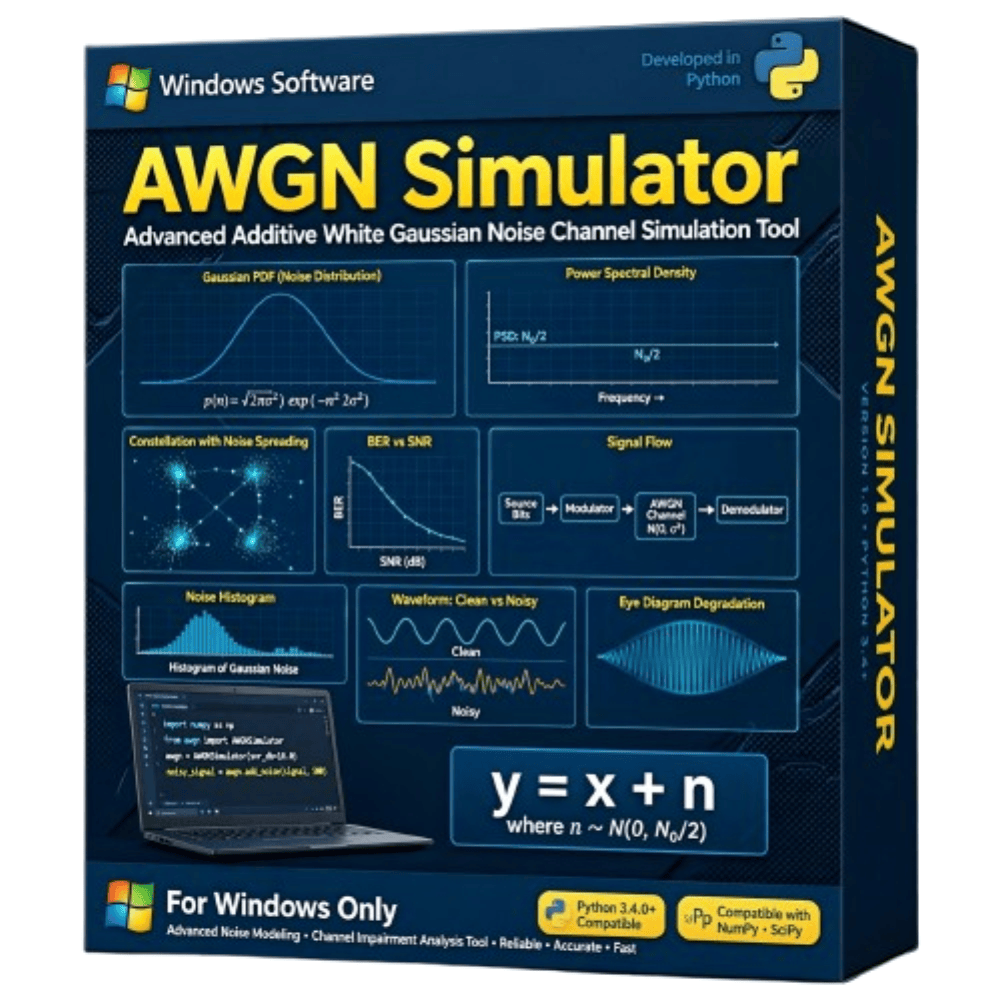
An AWGN Simulator i.e. Additive White Gaussian Noise Simulator developed using Python is a software-based tool designed to demonstrate and analyze the effect of Gaussian noise on digital communication signals. The simulator generates a clean input signal, adds controlled amounts of AWGN, and displays both the original and noisy signals for comparison. Users can vary parameters such as noise power, signal-to-noise ratio (SNR), and signal characteristics to observe how communication quality changes under different noise conditions. Python libraries such as NumPy, SciPy, and Matplotlib can be used for signal generation, noise modeling, numerical processing, and graphical visualization but this is purely from tkinter only. The simulator is useful for understanding fundamental concepts of wireless and digital communication systems.
Original price was: ₹750.00.₹250.00Current price is: ₹250.00. -
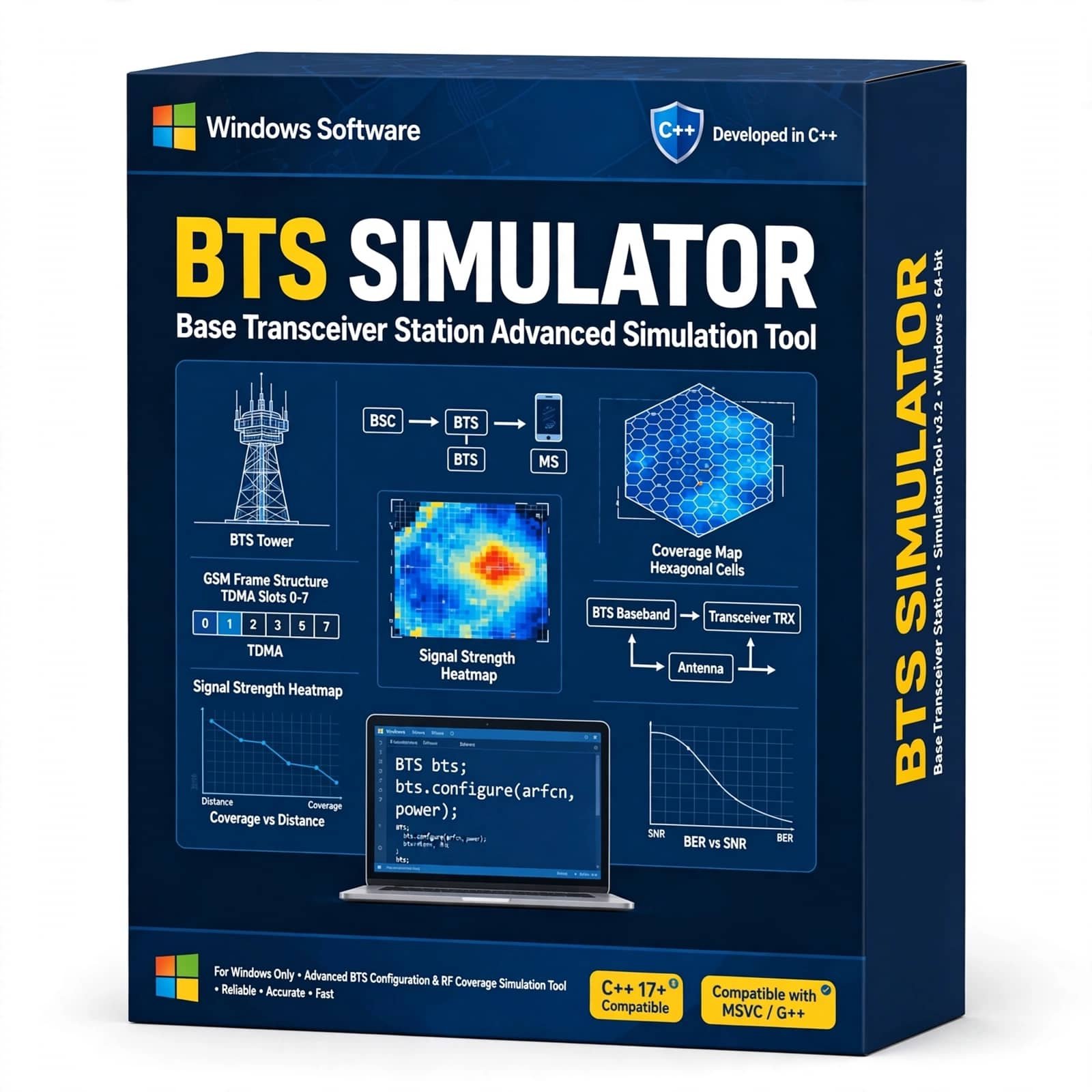
The BTS Simulator with C++ is a software-based Base Transceiver Station simulation tool designed for studying mobile communication, wireless networks, and telecommunications concepts. Developed using C++, it provides a practical environment for understanding BTS operation, communication processes, signal transmission and reception, and cellular network fundamentals. The simulator is ideal for telecommunication laboratories, engineering education, student projects, technical training, and communication-system research.
Original price was: ₹750.00.₹250.00Current price is: ₹250.00. -
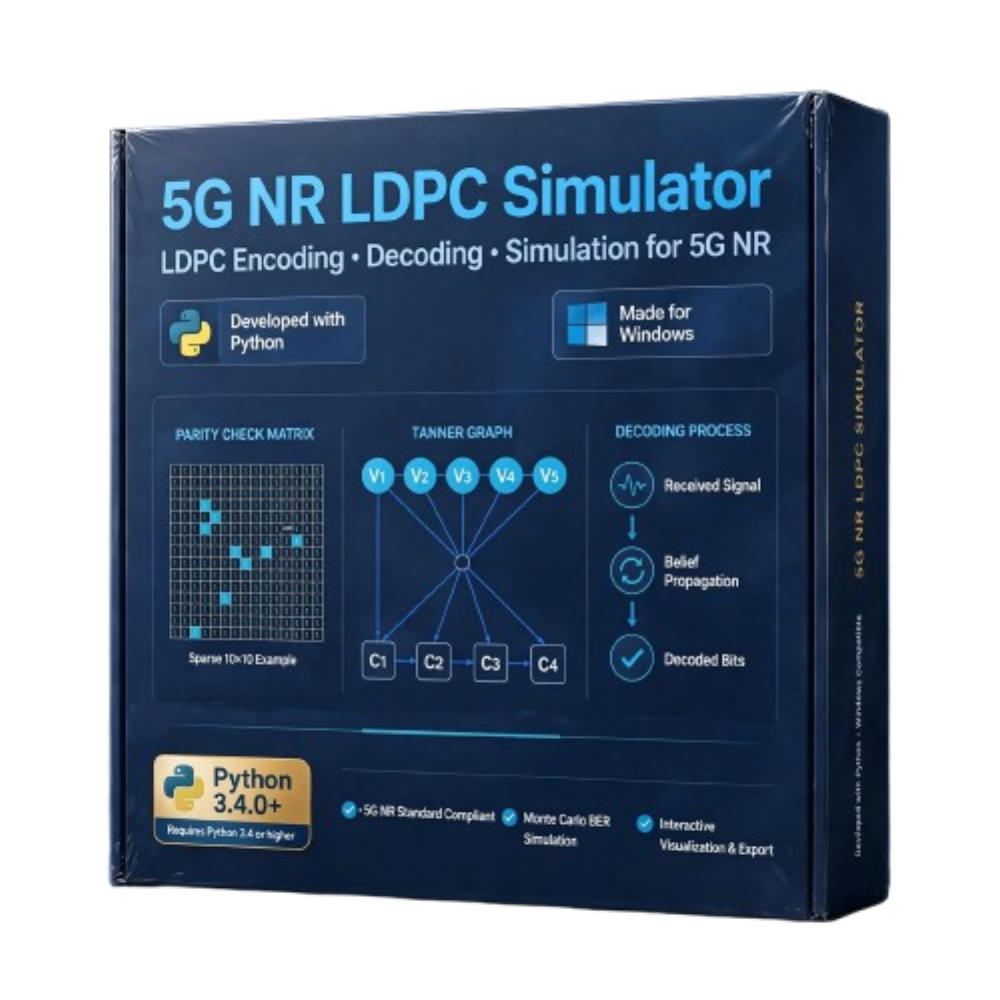
5G NR LDPC Simulator is an advanced simulation solution for modeling and analyzing Low-Density Parity-Check (LDPC) channel coding used in 5G New Radio systems. It enables users to simulate LDPC encoding and decoding, evaluate error correction performance, and analyze BER, BLER, SNR, coding rate, decoding iterations, throughput, and convergence under configurable channel conditions. The simulator is ideal for 5G NR channel coding research, algorithm development, academic projects, decoder performance analysis, and next-generation wireless communication system optimization.
Original price was: ₹750.00.₹250.00Current price is: ₹250.00. -
A Python-based 5G Core Network Simulator designed for studying, analyzing, and demonstrating 5G Core network architecture and procedures. Explore key 5G Network Functions such as AMF, SMF, UPF, AUSF, UDM, PCF, NRF, and NSSF, along with UE registration, authentication, session management, mobility, and signaling procedures.
Ideal for 5G research, telecom engineering, academic projects, university laboratories, protocol development, and network simulation. Provides a flexible software environment for experimenting with 5G Core concepts without requiring a complete commercial 5G network infrastructure.
Original price was: ₹750.00.₹250.00Current price is: ₹250.00. -
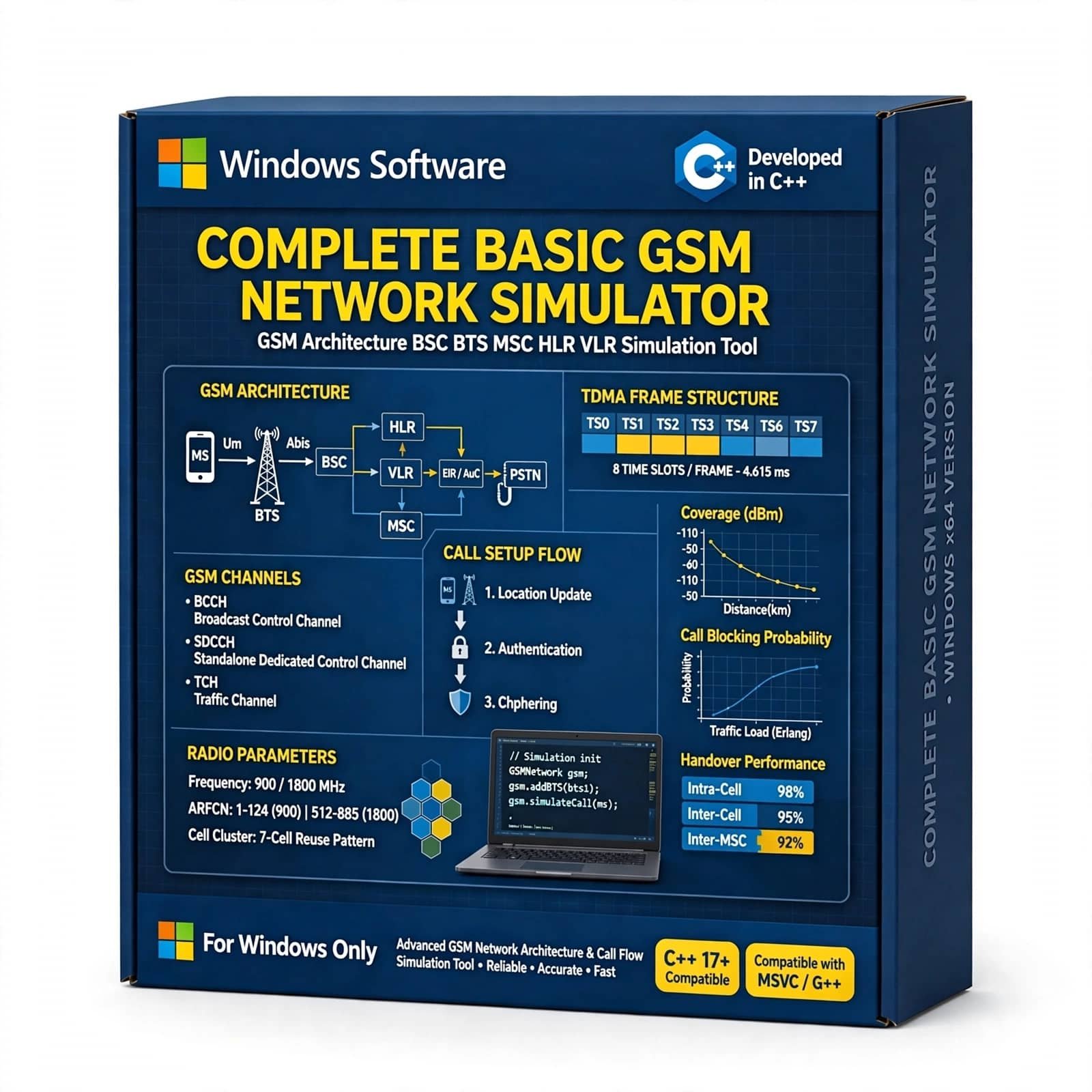
Complete Basic GSM Network with C++ is an educational and simulation-based project that demonstrates the fundamental architecture and operation of a GSM network using C++. It helps students and researchers understand GSM components, mobile communication, call and message handling, network signaling, and basic cellular network operations through a practical C++ implementation.
Original price was: ₹750.00.₹250.00Current price is: ₹250.00. -
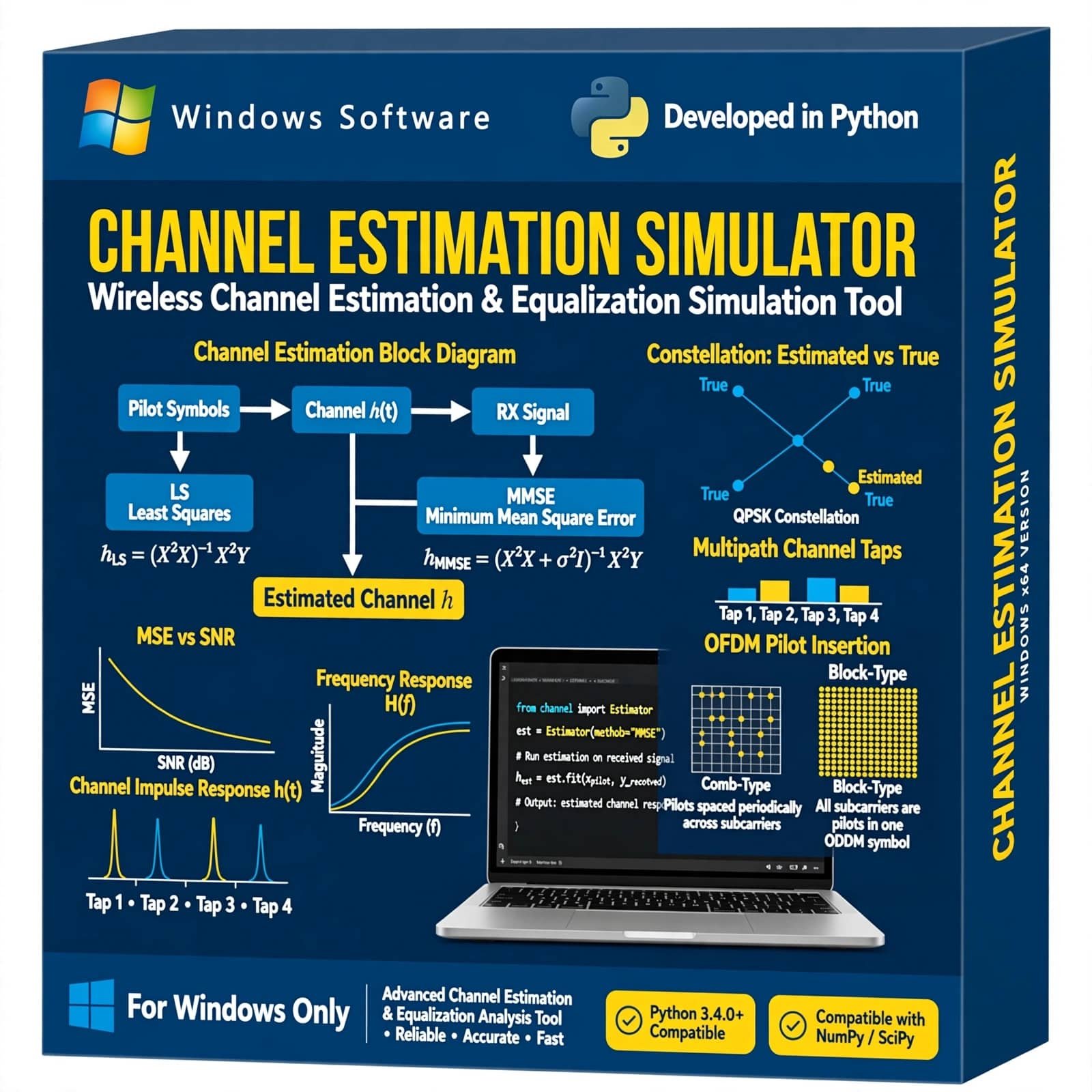
Channel Estimation Simulator is a wireless communication simulation tool designed to demonstrate and analyze channel estimation techniques in digital communication systems. It helps students, researchers, and communication engineers study channel effects, pilot-based estimation, signal distortion, and estimation performance through practical simulation.
Original price was: ₹750.00.₹250.00Current price is: ₹250.00.


Reviews
There are no reviews yet.