

GSM TDMA Simulator


₹3,999.00
In StockGSM TDMA Simulator with Python is a software-based telecom simulation tool for studying GSM Time Division Multiple Access (TDMA), time-slot allocation, GSM frame structures, channel sharing, and wireless communication concepts. Developed using Python, it is suitable for students, researchers, telecom engineers, universities, and laboratories for GSM education, practical experiments, network simulation, and academic projects.
Description
GSM TDMA Simulator
The GSM TDMA Simulator with Python is a practical wireless communication simulation solution designed for studying the principles of Time Division Multiple Access (TDMA) used in GSM cellular networks. It provides a software-based environment for exploring time-slot allocation, GSM frame organization, channel sharing, transmission scheduling, and fundamental radio communication concepts using Python.
TDMA is an important multiple-access technique used in GSM to allow multiple users or logical communication channels to share a common radio carrier by transmitting during different time intervals. Understanding this concept is essential for students and professionals studying GSM, mobile communication, wireless networks, digital communication, cellular technology, and radio resource management.
The GSM TDMA Simulator with Python helps transform these theoretical concepts into practical simulation exercises, allowing users to explore the behavior of a time-based communication system in a controlled environment.
Learn GSM TDMA Through Simulation
GSM uses a structured TDMA approach in which communication resources are organized into defined time slots. These time slots form part of the GSM transmission framework and are used to support communication over shared radio resources.
With the GSM TDMA Simulator, users can study how time-based access works and understand the relationship between users, channels, frames, and time slots.

Depending on the specific implementation, the simulator can be used to explore concepts such as:
- GSM TDMA operation
- TDMA time-slot allocation
- GSM frame structure
- Radio channel sharing
- Transmission scheduling
- Multiple-access techniques
- GSM radio resources
- Digital cellular communication
- Wireless channel access
- Time-based resource allocation
- GSM communication concepts
- Cellular network simulation
This makes the simulator useful for practical education as well as selected research and development activities.
Python-Based TDMA Simulation
The simulator is developed using Python, making it suitable for students and researchers who want to combine programming with wireless communication concepts.
Python is widely used for simulation, data analysis, algorithm development, and academic research. Using Python to model TDMA communication provides learners with an opportunity to understand how communication-system concepts can be represented through software.
Students can use the simulator as a learning platform for developing Python programming skills while exploring GSM and TDMA principles. Researchers can also use Python-based simulation for experimenting with communication scenarios and analyzing simulated results, depending on the capabilities of the implementation.
The combination of Python programming and GSM TDMA simulation makes this product suitable for academic laboratories, engineering projects, wireless communication research, and telecom training.
Understand TDMA Time Slots
A fundamental concept in GSM is the use of time slots to organize communication over shared radio resources. By dividing transmission opportunities into time intervals, TDMA allows multiple communication channels to use the same carrier without transmitting at the same instant.

The GSM TDMA Simulator can help users understand this concept through simulation.
Students can study how:
- Time slots are organized
- Transmission opportunities are scheduled
- Multiple users can share communication resources
- GSM frames are structured
- Radio resources can be allocated
- Communication events can be associated with specific time intervals
This practical approach can make TDMA concepts easier to understand than studying frame and slot diagrams alone.

GSM Frame Structure Simulation
The organization of GSM transmission into structured frames is an important topic in mobile communication. Understanding the relationship between frames and time slots provides a foundation for studying GSM physical-layer concepts and radio resource utilization.
The GSM TDMA Simulator with Python can be used to demonstrate the basic concepts associated with GSM frame organization and time-based transmission. This can be particularly useful in classroom demonstrations and laboratory exercises.
Instructors can use simulation scenarios to explain how multiple communication streams can be accommodated within a structured TDMA framework.

GSM TDMA Simulator for Academic Education
The product is suitable for engineering colleges, universities, telecom laboratories, wireless communication institutes, and technical training organizations.
It can support practical learning for subjects including:
- GSM and Mobile Communication
- Wireless Communication
- Digital Communication
- Cellular Networks
- TDMA and Multiple Access Techniques
- Communication Systems
- Radio Communication
- Network Simulation
- Python Programming
- Telecommunication Engineering
Instead of relying exclusively on theoretical explanations, students can use simulation to explore the basic operation of TDMA and understand how shared communication resources are organized.
Python GSM Simulator for Research
The GSM TDMA Simulator can also be used as a foundation for selected wireless communication and GSM research projects.
Simulation provides a controlled environment where different parameters and scenarios can be examined without requiring physical GSM network equipment. Researchers and students can use software simulation to investigate concepts related to time-slot allocation, communication scheduling, resource utilization, and TDMA-based transmission.
The Python implementation can also make the simulator useful for projects involving algorithm development, communication-system modeling, simulation analysis, and visualization.
Key Benefits
GSM-focused TDMA simulation: Study TDMA principles specifically in the context of GSM mobile communication.
Python based: Apply Python programming to wireless communication and telecom simulation.
Time-slot analysis: Understand the role of time slots in shared radio communication.
GSM frame studies: Explore the organization of GSM transmission frames.
Practical learning: Convert theoretical GSM and TDMA concepts into simulation-based exercises.
Academic project support: Suitable for engineering projects, laboratory work, demonstrations, and research.
Controlled simulation environment: Study communication behavior without requiring a live GSM network.
Flexible learning platform: Useful for students, instructors, researchers, and telecom professionals.
Applications of GSM TDMA Simulator
The GSM TDMA Simulator with Python can be used for:
- GSM TDMA simulation
- TDMA time-slot allocation studies
- GSM frame structure demonstrations
- Wireless communication laboratory experiments
- Multiple-access technique studies
- GSM network simulation
- Radio resource allocation demonstrations
- Python communication projects
- Telecom engineering projects
- GSM research
- Cellular network modeling
- Communication system simulation
- TDMA training
- Academic demonstrations
The simulator can also be used to support presentations and classroom demonstrations where visualizing time-based communication concepts can improve student understanding.
Who Can Use the GSM TDMA Simulator?
This product is suitable for:
- Telecom engineering students
- Electronics and communication engineering students
- Wireless communication students
- Computer science students working on network simulation
- Python programming students
- GSM researchers
- Wireless network researchers
- Telecom engineers
- Engineering colleges and universities
- Telecom training institutes
- Academic laboratories
- Final-year project teams
It is particularly valuable for learners who want to combine Python programming with GSM and TDMA communication concepts.
Why Choose GSM TDMA Simulator with Python?
TDMA is a fundamental concept for understanding GSM radio communication, but its operation can be difficult to visualize using theory alone. A simulator allows users to examine the organization of time slots, frames, and communication resources in a controlled software environment.
The GSM TDMA Simulator with Python combines GSM technology, TDMA concepts, wireless communication, and programming into a practical simulation solution.
By experimenting with time-based transmission and resource allocation, users can develop a stronger understanding of how GSM uses TDMA to organize communication over shared radio resources.
For educational institutions, the simulator can complement GSM and mobile communication courses. For students, it can support practical assignments and final-year projects. For researchers, it can provide a software environment for selected TDMA and wireless communication experiments.
Conclusion
The GSM TDMA Simulator with Python is a practical solution for learning and researching GSM Time Division Multiple Access, time-slot allocation, GSM frame structures, radio resource utilization, and wireless communication.
Its Python-based approach makes it suitable for students, researchers, educators, and telecom professionals who want to combine programming with GSM simulation.
Whether you are working on a GSM project, TDMA simulation project, Python telecom project, wireless communication laboratory experiment, or cellular network research study, this simulator provides a controlled environment for exploring time-based multiple-access concepts.
For users searching for a GSM TDMA simulator, GSM simulator with Python, TDMA simulator with Python, GSM time-slot simulator, GSM frame simulator, Python wireless communication simulator, TDMA simulation software, or GSM network simulation tool, this product provides a useful platform for education, experimentation, training, and research.
Related products
-
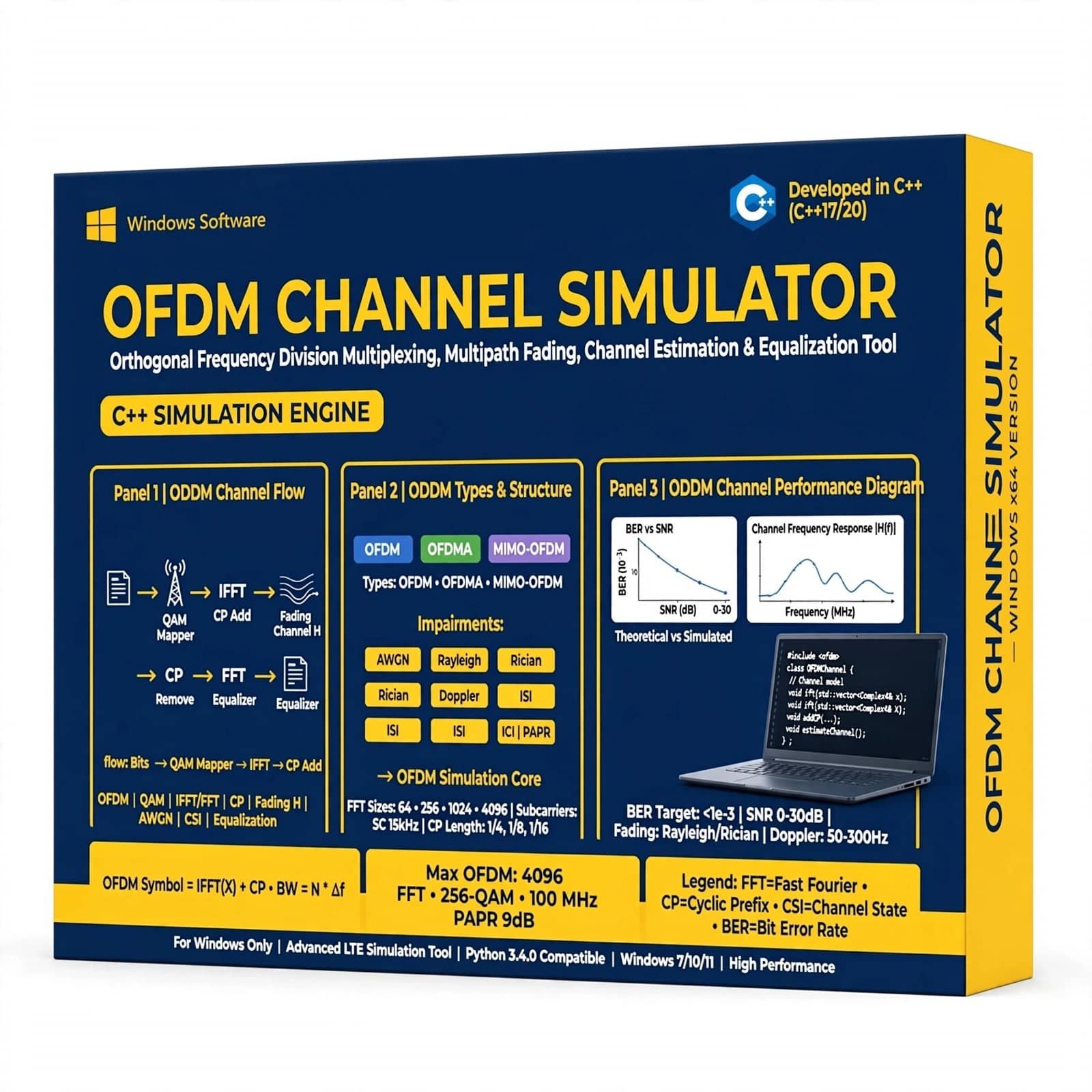
OFDM Channel Simulator – C++ Educational Software is an interactive simulation tool designed to help students, educators, researchers, and communication-engineering learners understand Orthogonal Frequency Division Multiplexing (OFDM) and wireless channel effects. Developed using C++, the simulator demonstrates FFT/IFFT processing, cyclic prefix, QPSK and QAM modulation, multipath channels, delay spread, channel frequency response, equalization, BER, EVM, and constellation diagrams through an intuitive graphical interface.
₹1,999.00 -
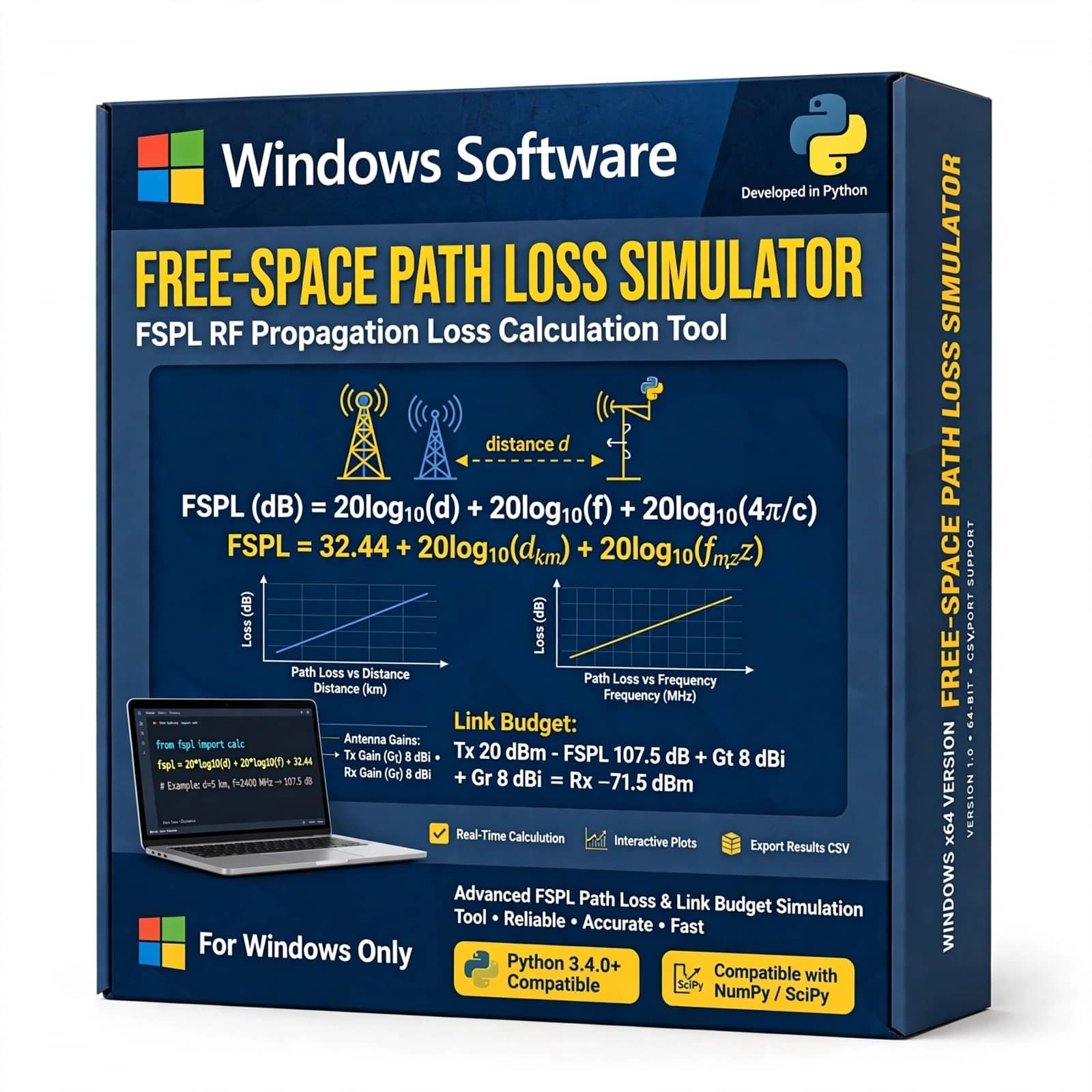
Free-Space Path Loss Simulator is an educational RF and wireless communication simulation tool designed to help students, engineers, researchers, and telecom professionals understand how radio signals lose power as they propagate through free space. It enables users to analyze the impact of frequency, distance, antenna characteristics, and transmission parameters on received signal strength and path loss.
Original price was: ₹1,999.00.₹749.00Current price is: ₹749.00. -
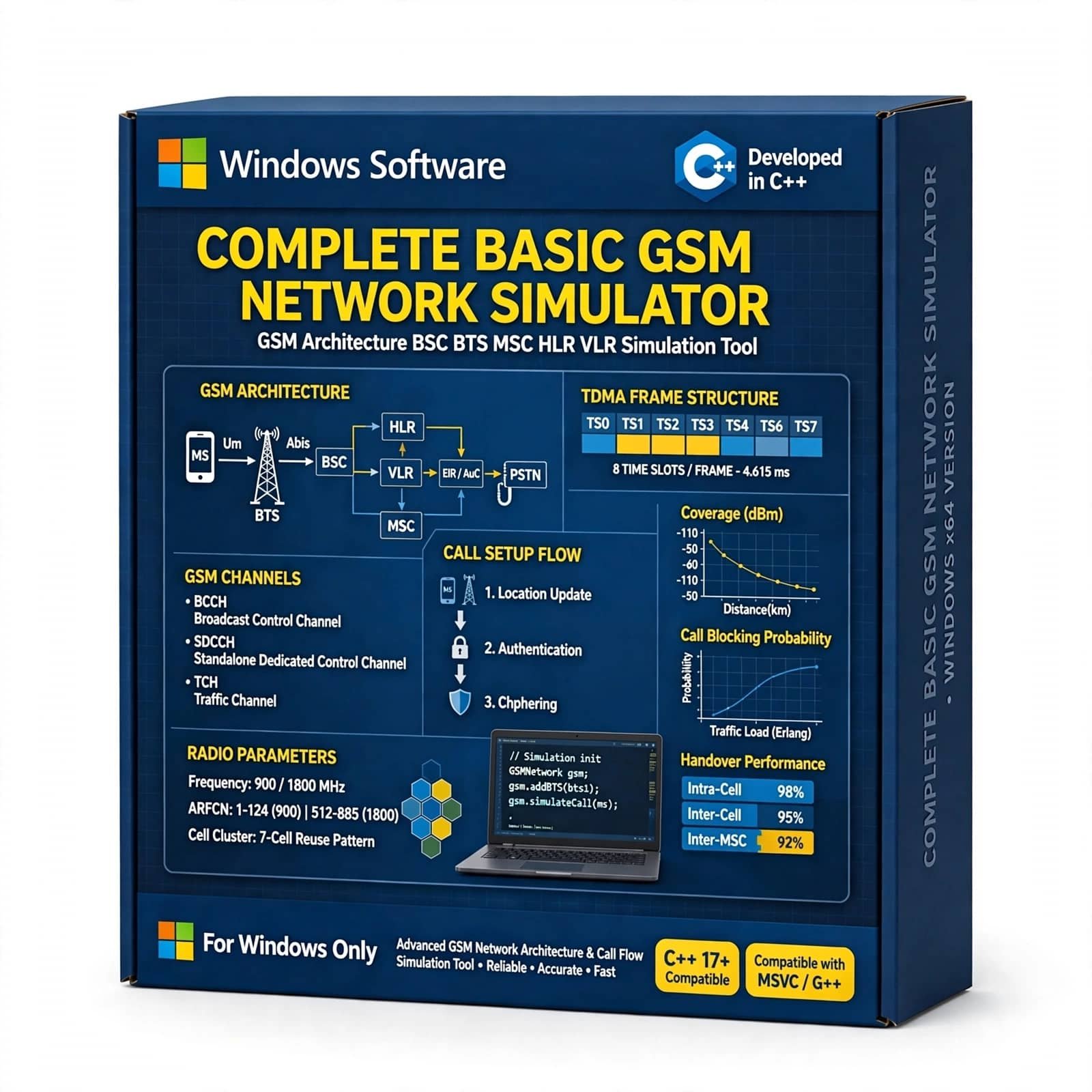
Complete Basic GSM Network with C++ is an educational and simulation-based project that demonstrates the fundamental architecture and operation of a GSM network using C++. It helps students and researchers understand GSM components, mobile communication, call and message handling, network signaling, and basic cellular network operations through a practical C++ implementation.
Original price was: ₹3,999.00.₹2,399.00Current price is: ₹2,399.00. -
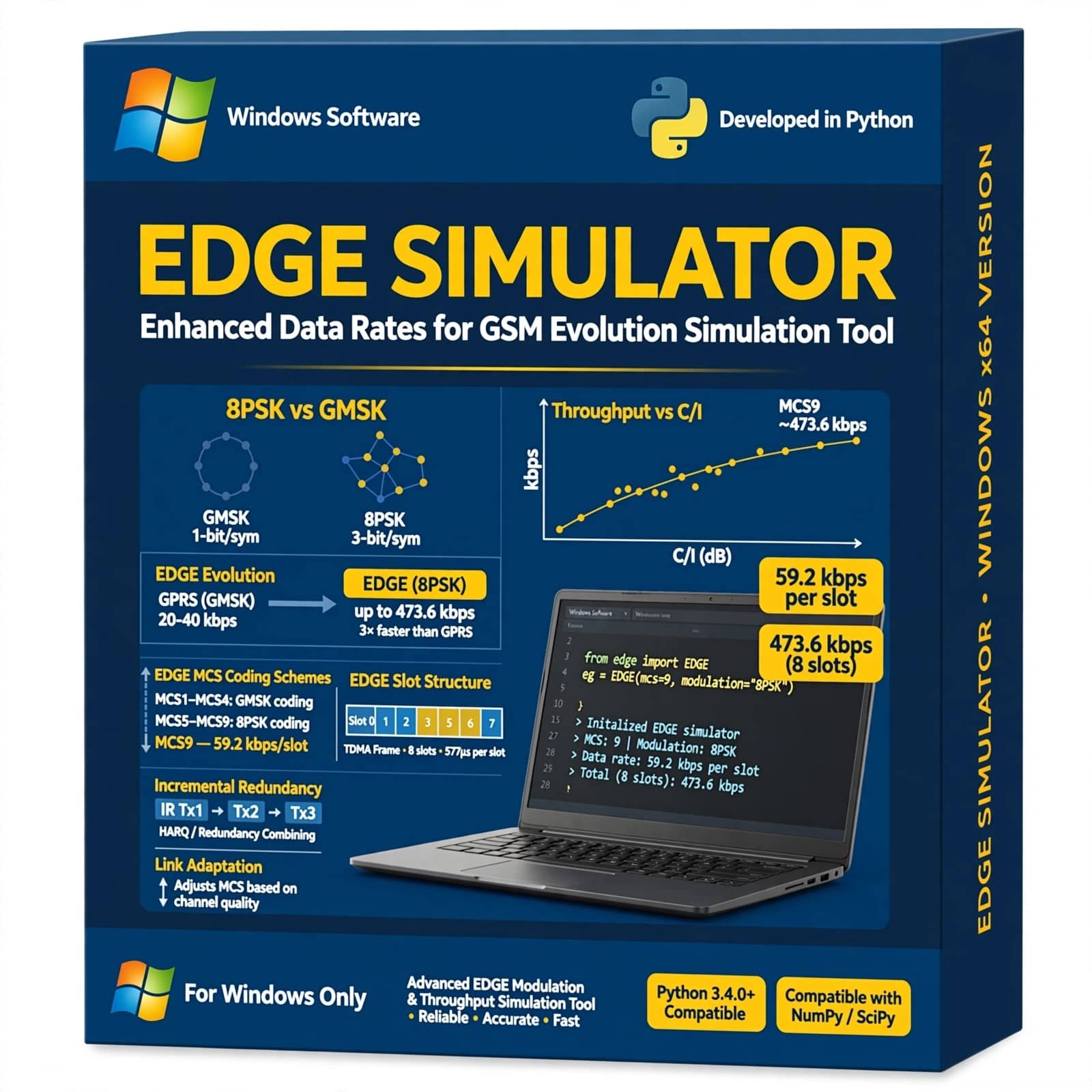
EDGE Simulator Using Python is a practical mobile communication simulation tool designed to demonstrate and analyze Enhanced Data rates for GSM Evolution (EDGE) technology. It helps students, researchers, and communication engineers study GSM/EDGE data transmission, modulation, channel conditions, bit error rate, data rates, and wireless communication performance using Python-based simulation.
₹3,499.00 -
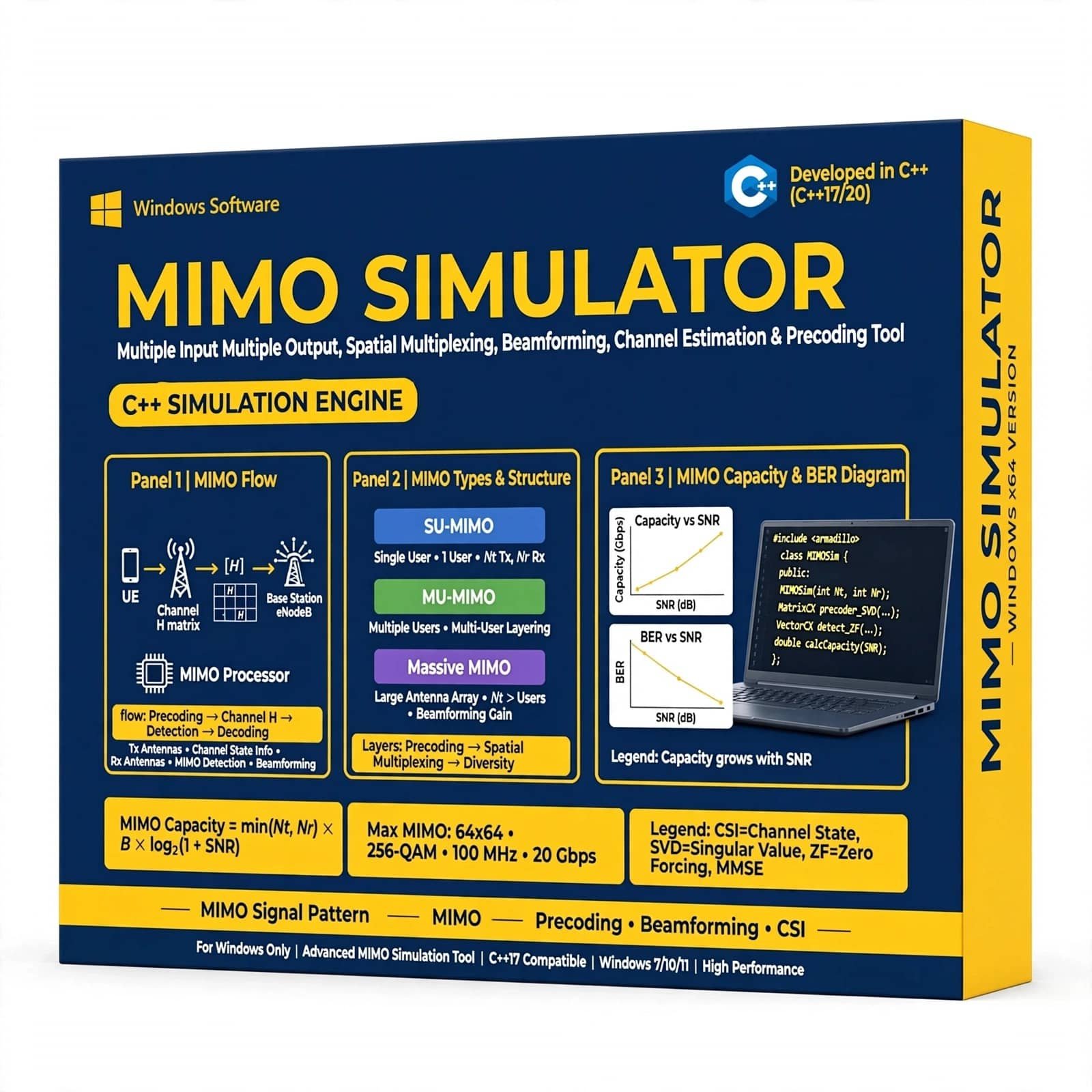
MIMO Simulator with C++ is a powerful wireless communication simulation solution designed for students, researchers, engineers, and communication professionals. Simulate Multiple-Input Multiple-Output (MIMO) systems, analyze channel performance, evaluate BER and SNR, and study different modulation, detection, and fading techniques using efficient C++ implementation.
₹3,999.00 -
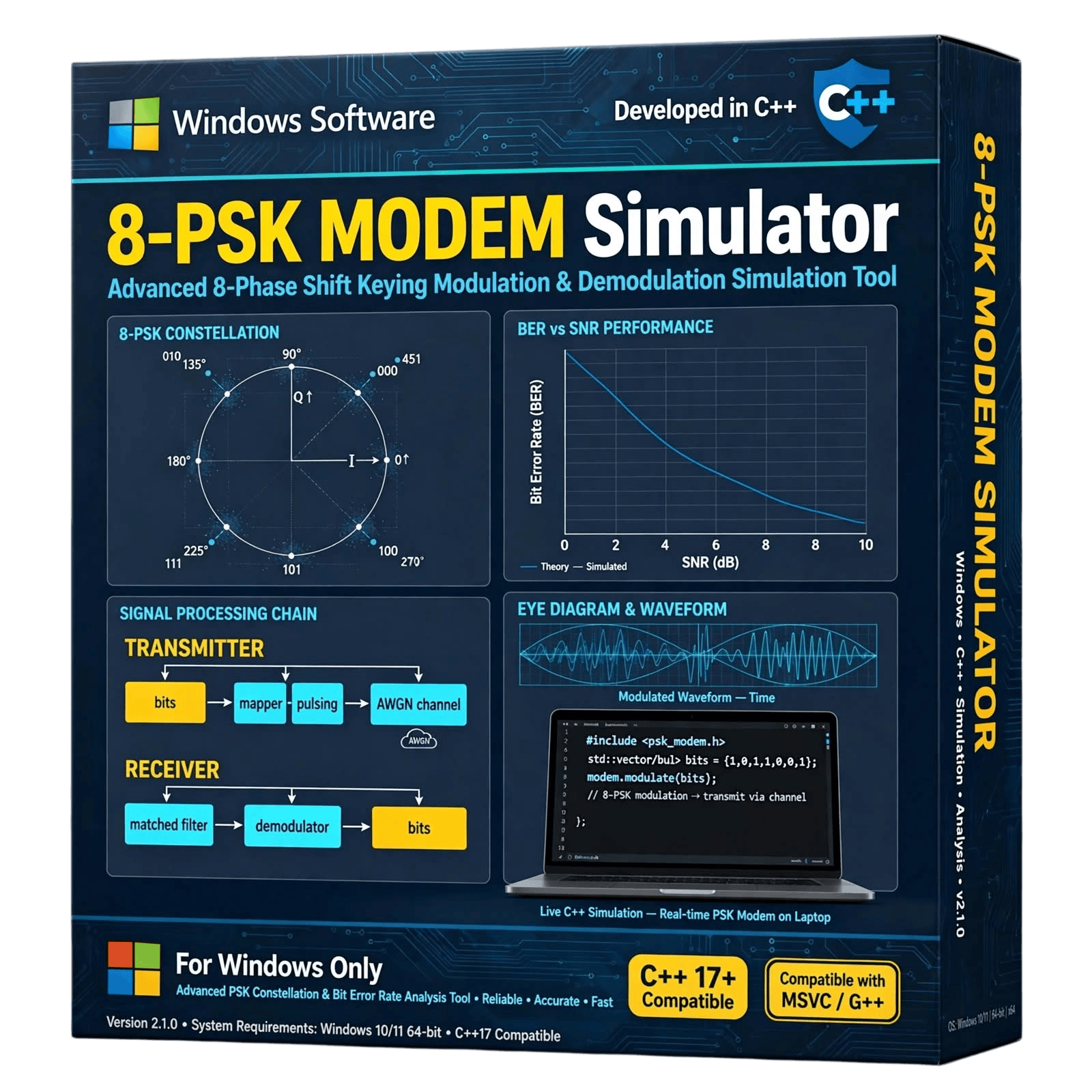
The 8-PSK Modem Simulator is a C++-based software solution designed for students, researchers, communication engineers, developers, and academic institutions working with digital communication and modulation techniques. The simulator provides a practical environment for studying 8-Phase Shift Keying (8-PSK) modulation and demodulation concepts.
Developed using C++, the simulator can be used for digital communication research, academic projects, laboratory demonstrations, signal-processing studies, experimentation, and educational purposes.
Available for sale as a software product. Contact us for pricing, licensing, technical specifications, customization, and purchase information.
₹1,999.00


Reviews
There are no reviews yet.