
87% Off

GSM Network Message Flow Simulator


₹750.00 Original price was: ₹750.00.₹100.00Current price is: ₹100.00.
GSM Network Message Flow Simulator with C++ is a telecom simulation solution for studying GSM signaling, network message exchange, call and mobility procedures, and communication between GSM network elements. Developed using C++, it is suitable for telecom students, researchers, engineers, universities, and laboratories for GSM protocol analysis, network simulation, practical training, and academic projects.
SKU: GSMB-NMFS
Categories: GSM, C++
Tags: C++ Simulator, Cellular Network, GSM Call Flow, GSM Message Flow, GSM Network Simulator, GSM Protocol, GSM Signaling, GSM Simulator, GSM Training, Mobile Communication, Network Simulation, Telecom Simulator
Description
GSM Network Message Flow Simulator
The GSM Network Message Flow Simulator with C++ is a specialized telecommunications simulation solution designed to help students, researchers, engineers, and network professionals understand the flow of signaling messages within a GSM mobile communication network. Developed using C++, the simulator provides a controlled environment for studying GSM message sequences, signaling procedures, network entity interactions, call flows, mobility-related procedures, and cellular network communication.
GSM networks consist of multiple interconnected components that work together to provide mobile communication services. Understanding how these components exchange signaling messages is essential for learning GSM architecture and network operation. The GSM Network Message Flow Simulator provides a practical approach to studying these message exchanges without requiring access to a live cellular network.
Understand GSM Network Message Flow
In a GSM network, different network elements exchange messages to perform communication, mobility, authentication, switching, and other network functions. Studying these message sequences helps learners understand what happens behind the scenes when a mobile device connects to or communicates through a cellular network.
The simulator can be used to visualize and study GSM network message flow and understand how signaling information moves between different network components.
Depending on the implementation and supported scenarios, users can explore concepts related to:
- GSM signaling messages
- GSM call flow
- Mobile-originated call procedures
- Mobile-terminated call procedures
- Call establishment and release
- Mobility management
- Location update concepts
- Authentication procedures
- Network registration concepts
- Handover-related signaling
- BTS, BSC, and MSC interaction
- GSM core network message exchange
This makes the simulator useful for both introductory GSM education and more advanced telecom research.
C++ Based GSM Message Flow Simulator
The C++ implementation makes this product particularly valuable for students and researchers who want to combine telecommunications knowledge with programming and software simulation.
C++ can be used to model network entities, signaling events, message sequences, state transitions, and communication procedures. By examining GSM message flows through a C++ simulation environment, users can develop a better understanding of how network protocols and telecom systems can be represented programmatically.
This combination of GSM network simulation and C++ programming makes the product suitable for engineering projects, academic research, laboratory exercises, and communication protocol studies.
Study GSM Signaling and Protocol Procedures
GSM signaling involves a series of messages exchanged between mobile and network components. These messages support different procedures required to establish communication and maintain network connectivity.
A message flow simulator allows users to focus on the sequence and relationship between these events. Rather than studying individual messages in isolation, users can examine how multiple signaling steps form a complete network procedure.
The simulator can support learning around topics such as:
Call signaling: Understand the sequence of signaling events associated with mobile communication.
Registration and mobility: Study concepts related to mobile registration, location updates, and mobility management.
Authentication: Explore the role of authentication-related signaling within GSM network procedures.
Handover: Understand the signaling concepts involved when a mobile device moves between network coverage areas, where supported by the simulator.
Network entity interaction: Study how GSM components such as the mobile station, BTS, BSC, MSC, and other network elements interact.
GSM Message Flow Simulation for Education
The simulator is particularly suitable for telecom engineering colleges, universities, research laboratories, and technical training institutions.
It can be used as a practical teaching aid for subjects including:
- Mobile Communication
- GSM Architecture
- Wireless Communication
- Cellular Networks
- Telecommunication Systems
- Communication Protocols
- Network Simulation
- Digital Communication
- C++ Programming
- Telecom Network Engineering
Students can use message flow simulations to connect theoretical GSM concepts with practical network behavior. Instructors can also use the simulator to demonstrate signaling procedures and explain the relationships between different GSM network entities.
GSM Network Simulator for Research Projects
The GSM Network Message Flow Simulator can also be used for academic and research projects involving GSM protocol analysis, cellular network modeling, signaling studies, and communication system simulation.
Simulation provides a repeatable and controlled environment in which users can examine selected GSM procedures and analyze how messages are generated, exchanged, and processed.
For researchers, a C++-based simulation environment can provide flexibility for exploring software models of network entities and communication events. It can also serve as a foundation for projects involving network protocol behavior, signaling analysis, message sequencing, and cellular communication systems.
Key Benefits
GSM message flow simulation: Study signaling message sequences and network communication procedures.
C++ based implementation: Combine telecom concepts with C++ programming and simulation.
Practical GSM learning: Understand network signaling through simulated message exchanges.
Controlled environment: Explore GSM procedures without requiring access to a live cellular network.
Protocol-oriented learning: Analyze the relationship between messages, network entities, and communication procedures.
Academic project support: Suitable for engineering projects, laboratory demonstrations, and university research.
Telecom training: Helps students and professionals develop a deeper understanding of GSM signaling and network architecture.

Applications
The GSM Network Message Flow Simulator with C++ can be used for:
- GSM message flow simulation
- GSM signaling analysis
- GSM protocol studies
- Call flow simulation
- Mobile communication laboratory experiments
- GSM network architecture demonstrations
- Network signaling training
- C++ telecom programming projects
- Cellular network simulation
- GSM research projects
- Communication protocol analysis
- Engineering final-year projects
- Telecom education and training
The simulator can also be useful for demonstrating how signaling events are sequenced during different GSM network procedures.
Who Can Use This GSM Network Simulator?
The product is suitable for:
- Telecom engineering students
- Electronics and communication engineering students
- Wireless communication researchers
- GSM researchers
- Telecom engineers
- Network simulation developers
- C++ developers interested in telecommunications
- Universities and engineering colleges
- Telecom training institutes
- Academic laboratories
- Final-year project teams
It is especially useful for users who want to understand GSM signaling and message flow while developing practical C++ programming skills.
Why Choose a GSM Network Message Flow Simulator?
GSM signaling can be complex because a single network procedure may involve multiple messages exchanged between several network elements. A simulation-based approach helps simplify these concepts by allowing users to examine the message sequence and understand the purpose of individual network events.
The GSM Network Message Flow Simulator with C++ brings together GSM protocol learning, network simulation, message flow analysis, and C++ programming in one educational and research-oriented platform.
By studying simulated message exchanges, users can develop a stronger understanding of how GSM network components communicate and coordinate to provide mobile communication services.
Conclusion
The GSM Network Message Flow Simulator with C++ is a practical solution for studying GSM signaling, network message exchange, call procedures, mobility management, and cellular network architecture. Its C++ foundation makes it particularly suitable for students, researchers, and developers interested in combining telecommunications and software simulation.
Whether you are working on a GSM academic project, telecom laboratory experiment, GSM protocol study, cellular network research project, or C++ communication simulation, this simulator provides a controlled environment for exploring GSM network message flows and signaling procedures.
For organizations and individuals searching for a GSM message flow simulator, GSM network simulator, GSM signaling simulator, C++ GSM simulator, GSM protocol simulator, or GSM call flow simulator, this product can provide a valuable platform for practical learning, experimentation, training, and research.
Be the first to review “GSM Network Message Flow Simulator” Cancel reply
Related products
-
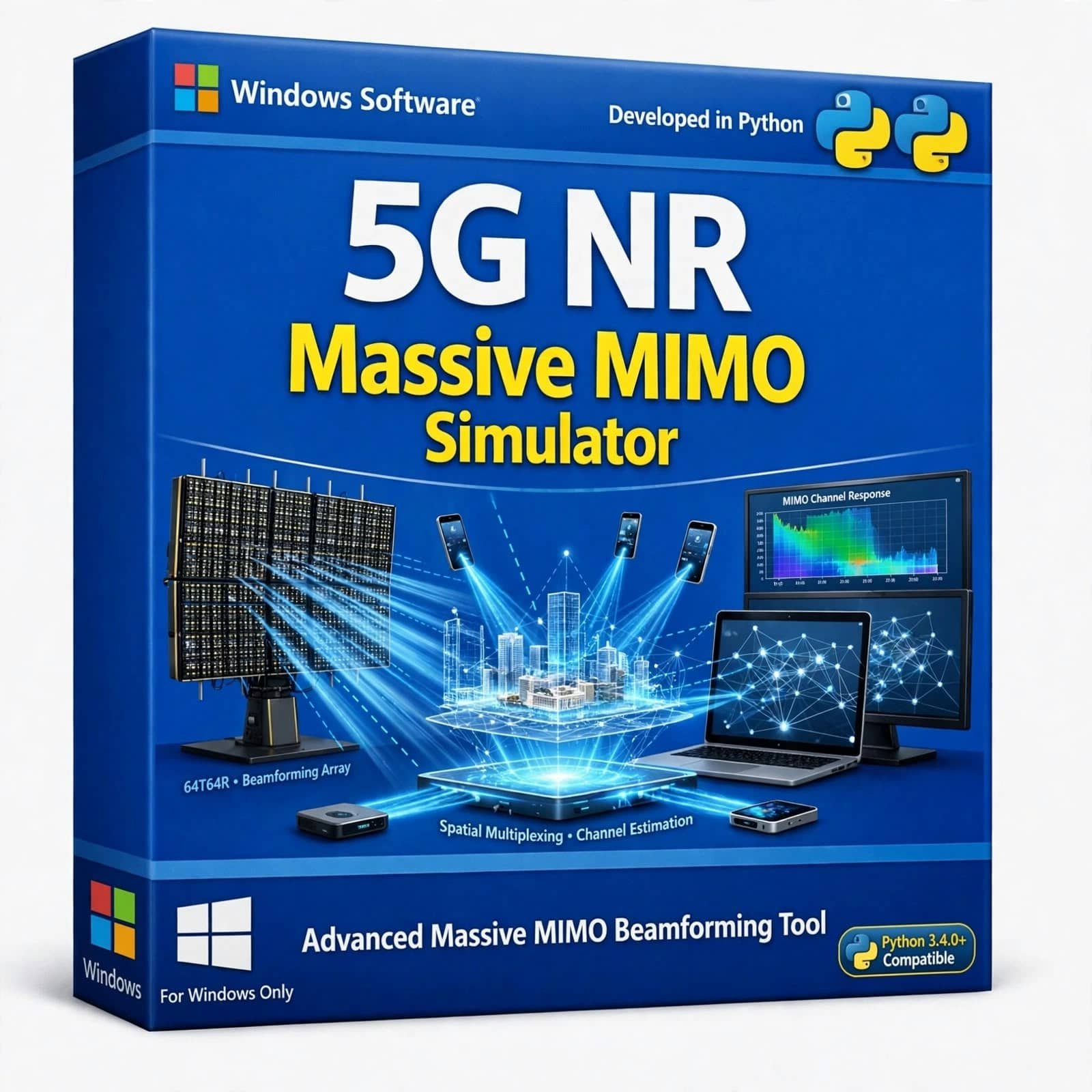
5G NR Massive MIMO Simulator
0 out of 5(0)5G NR Massive MIMO Simulator is an advanced simulation solution for modeling and analyzing Massive Multiple-Input Multiple-Output (MIMO) technologies in 5G New Radio networks. It enables users to study large-scale antenna arrays, beamforming, precoding, spatial multiplexing, multi-user MIMO, channel estimation, and interference under configurable channel conditions. The simulator supports analysis of throughput, spectral efficiency, SINR, BER, BLER, MIMO capacity, beamforming gain, and multi-user performance, making it ideal for 5G NR research, algorithm development, academic projects, and 5G/6G wireless system optimization.
₹149,999.00Original price was: ₹149,999.00.₹14,999.00Current price is: ₹14,999.00. -
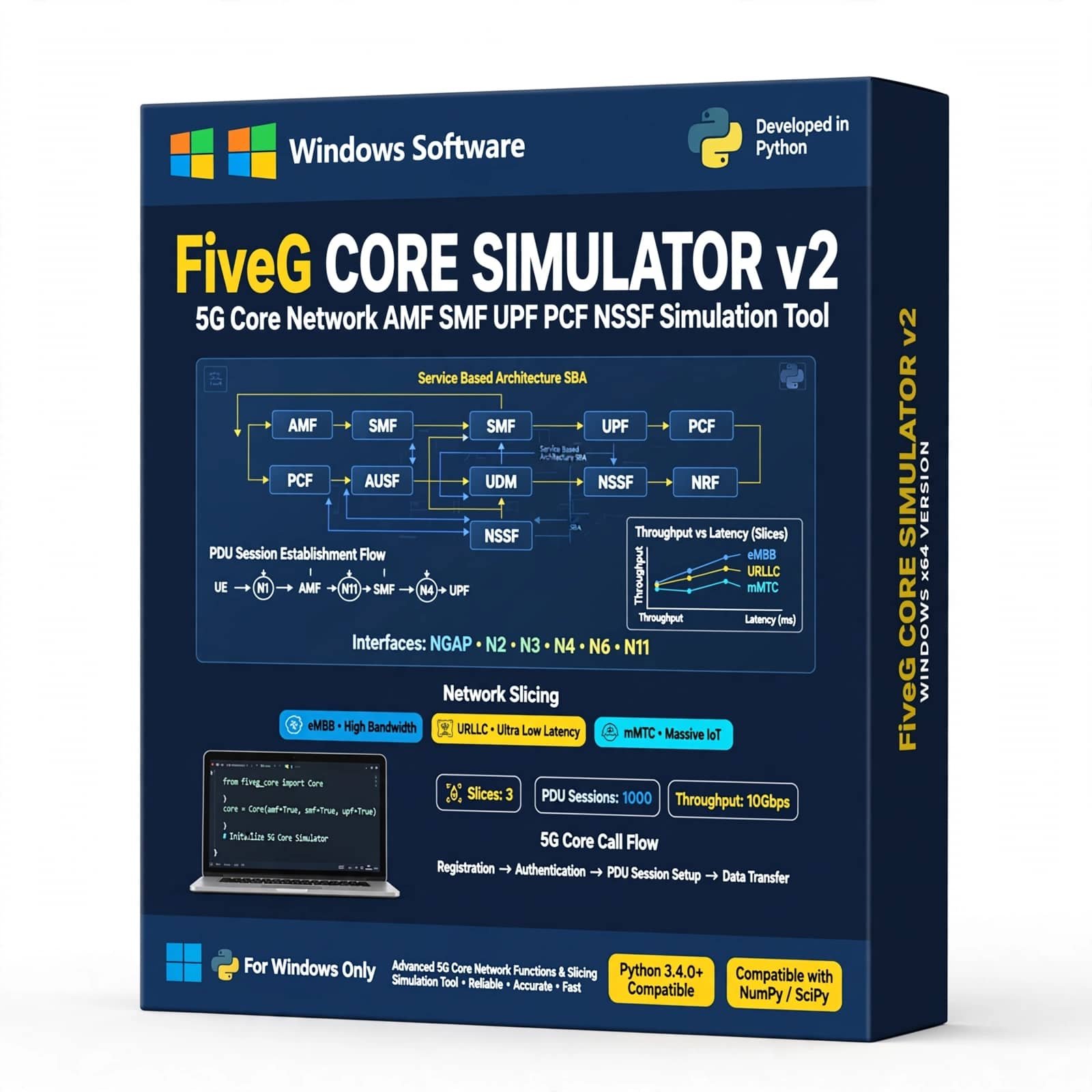
FiveG Core Simulator v2
0 out of 5(0)FiveG Core Simulator v2 is an educational 5G Core Network simulation tool designed to help students, educators, researchers, and telecom professionals understand 5G core architecture, network functions, signaling procedures, latency, and protocol interactions through an interactive topology and signaling animation environment.
₹19,999.00 -
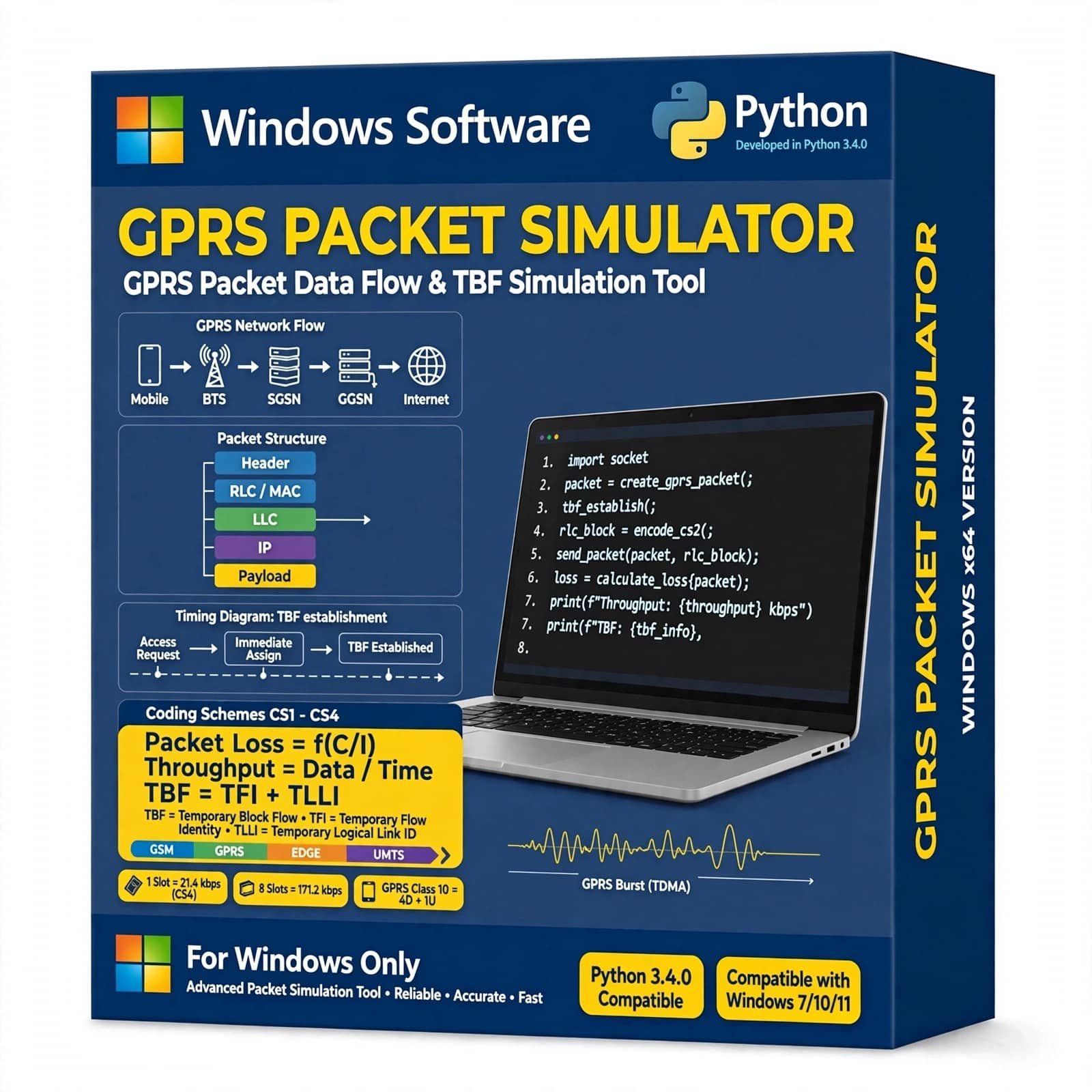
GPRS Packet Simulator
0 out of 5(0)GPRS Packet Simulator is a powerful software solution for simulating GPRS data packets and testing GSM/GPRS communication systems. It helps developers, engineers, and testing teams generate, analyze, and validate packet-based communication in a controlled environment without requiring extensive physical network infrastructure. Ideal for GPRS testing, protocol development, IoT applications, and telecom system validation.
₹3,999.00 -
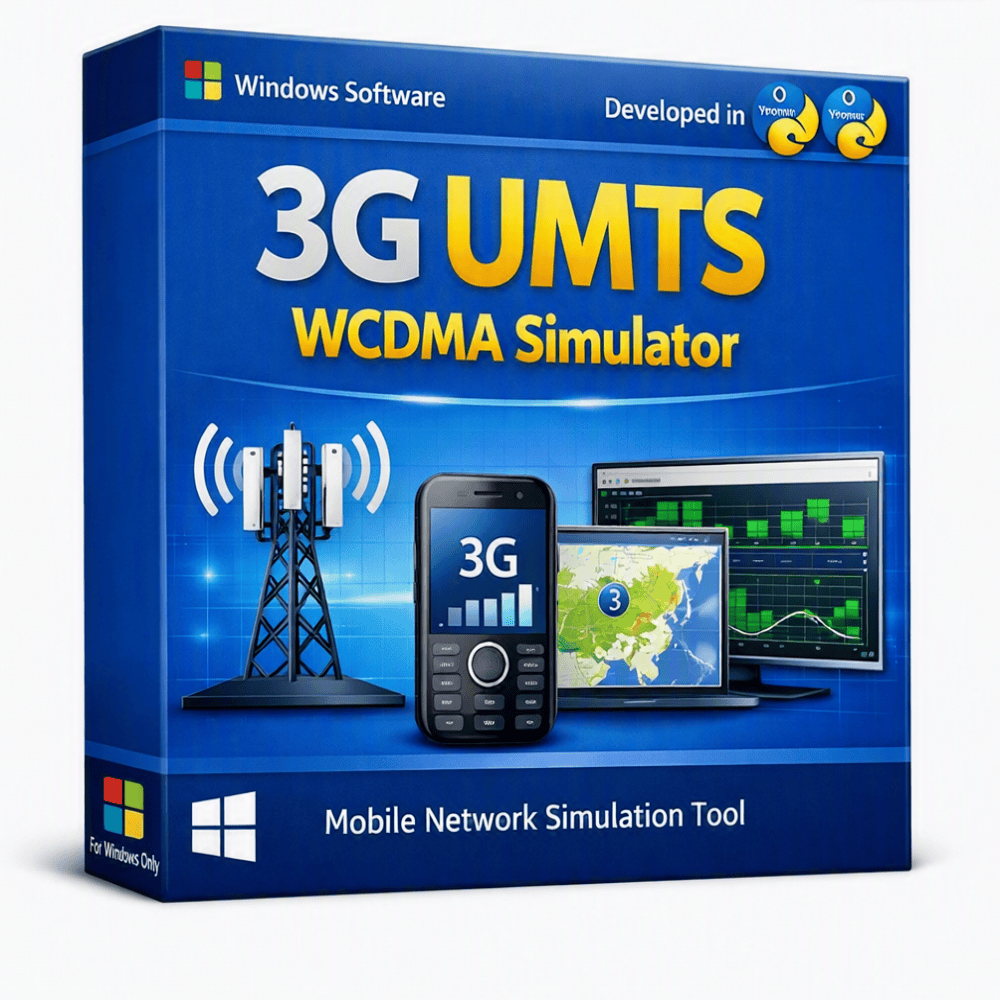
3G UMTS – WCDMA Simulator
0 out of 5(0)The 3G UMTS – WCDMA Simulator is a software-based simulation project designed to demonstrate the fundamental concepts of 3G Universal Mobile Telecommunications System (UMTS) and Wideband Code Division Multiple Access (WCDMA) technology. It provides a practical environment for studying cellular communication, spreading codes, signal transmission, mobile users, network connectivity, and WCDMA-based communication principles. The simulator is suitable for students, researchers, and developers working on telecommunications and wireless communication projects. It can be used for academic demonstrations, engineering projects, research, experimentation, and learning about 3G mobile communication and WCDMA network technologies.
₹3,999.00 -
BTS Simulator
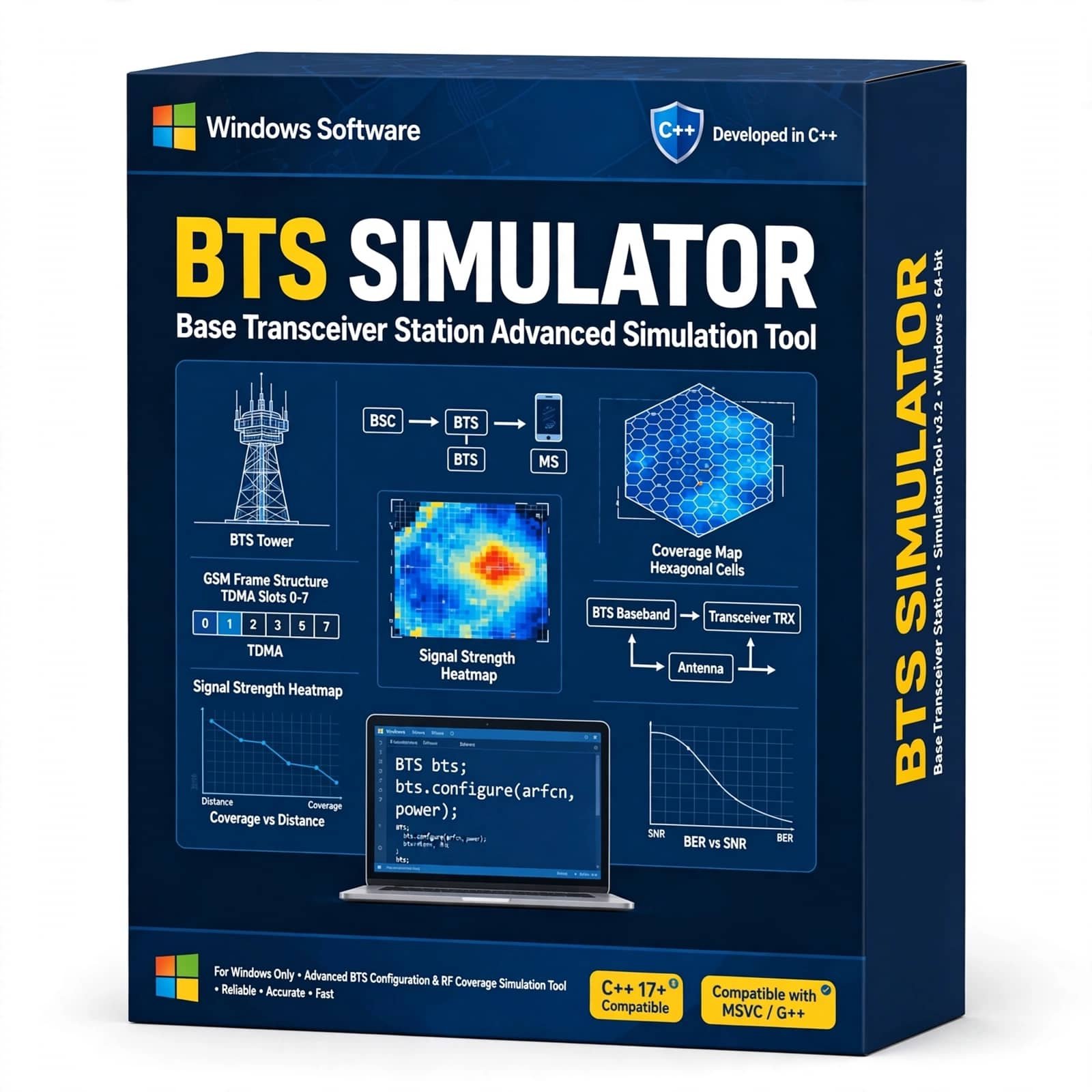
0 out of 5(0)The BTS Simulator with C++ is a software-based Base Transceiver Station simulation tool designed for studying mobile communication, wireless networks, and telecommunications concepts. Developed using C++, it provides a practical environment for understanding BTS operation, communication processes, signal transmission and reception, and cellular network fundamentals. The simulator is ideal for telecommunication laboratories, engineering education, student projects, technical training, and communication-system research.
₹750.00Original price was: ₹750.00.₹250.00Current price is: ₹250.00. -
5G Digital Twin v2
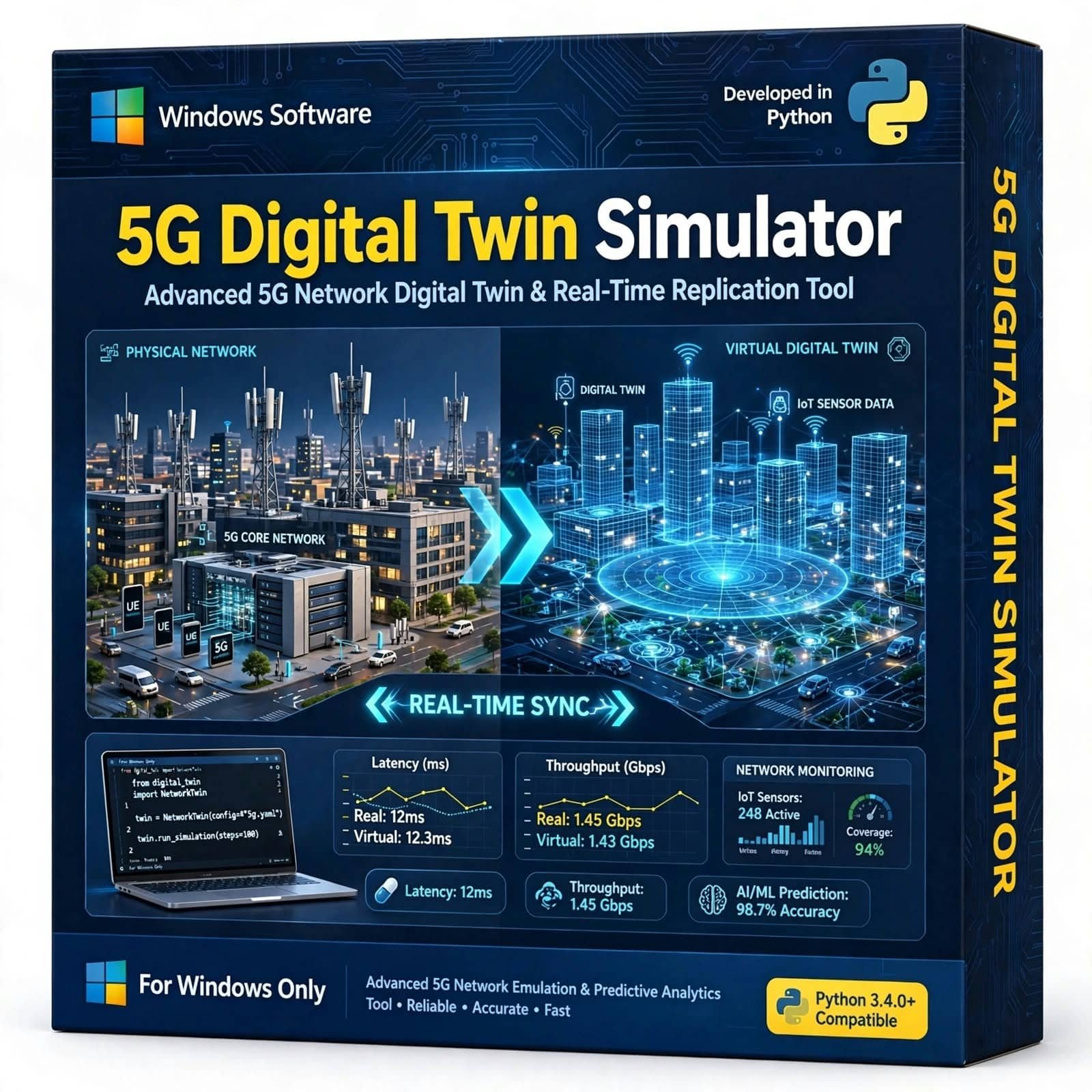
0 out of 5(0)The 5G Digital Twin is a Python-based software solution designed for researchers, engineers, developers, students, and telecommunications professionals interested in modeling, simulating, and analyzing 5G communication networks and their real-world behavior in a virtual environment.
A digital twin provides a virtual representation of a physical or network system, enabling users to study system behavior, evaluate scenarios, analyze performance, and experiment with different configurations. Developed using Python, this 5G Digital Twin can support research, education, network analysis, experimentation, and proof-of-concept development.
Available for sale as a software product. Contact us for pricing, licensing, technical specifications, customization, and purchase information.
₹9,999.00


Reviews
There are no reviews yet.