
89% Off

GSM Call Simulator


Original price was: ₹750.00.₹80.00Current price is: ₹80.00.
In StockGSM Call Simulator with C++ is a telecom simulation and development solution designed for studying GSM call procedures and mobile communication concepts using C++. It is suitable for students, researchers, telecom engineers, and academic institutions working on GSM, cellular networks, call flow analysis, communication protocols, and C++-based network simulation projects.
Description
GSM Call Simulator
The GSM Call Simulator with C++ is a specialized simulation solution designed for learning, development, research, and practical experimentation with GSM call procedures and mobile communication systems. Developed around C++, the simulator provides an effective environment for understanding GSM call handling, network signaling concepts, call establishment and release procedures, and the interaction between different elements of a cellular communication network.
GSM, or Global System for Mobile Communications, is one of the foundational technologies in the evolution of modern cellular networks. Although newer generations such as 4G LTE and 5G have become dominant, GSM remains highly relevant for understanding the fundamentals of mobile communication, cellular architecture, signaling, mobility, and radio network operation.
The GSM Call Simulator with C++ provides a practical approach to studying these concepts through software-based simulation rather than relying solely on theoretical explanations.
Learn GSM Call Flow with C++
Understanding the complete process involved in establishing and releasing a mobile call can be challenging when learned only through diagrams or textbooks. A GSM call simulator allows users to explore call-related procedures in a controlled environment and understand how different network elements and signaling processes work together.
Using C++, the simulator can serve as an excellent platform for students and researchers interested in both telecommunication protocols and C++ programming. It can also be useful for developing academic projects involving GSM call flow, mobile communication, cellular network simulation, and communication protocol analysis.
Depending on the supported implementation and configuration, users can study concepts related to call initiation, signaling, connection establishment, call handling, and call termination.
GSM Call Simulation for Academic and Research Applications
The GSM Call Simulator is particularly useful for engineering colleges, universities, telecom laboratories, research institutions, and communication technology training centers. It can be used as part of practical laboratory exercises and academic projects related to GSM and mobile communication.
Students can use the simulator to understand the sequence of events associated with GSM calls and relate those events to concepts learned in courses such as:
- Mobile Communication
- Wireless Communication
- Digital Communication
- Cellular Networks
- Telecommunication Systems
- Computer Networks
- Communication Protocols
- Network Simulation
- C++ Programming
- Embedded and Communication Systems
The combination of GSM simulation and C++ programming makes this solution especially useful for students who want to connect software development skills with practical telecom concepts.
C++ Based GSM Simulation
C++ is widely used for applications where performance, structured programming, and system-level control are important. Using C++ for GSM simulation enables students and developers to examine the underlying program logic and understand how communication scenarios can be represented through software.
A C++-based GSM Call Simulator can also provide an opportunity to study simulation logic, event handling, network entities, call states, signaling sequences, and other aspects of software-based telecom modeling.
This makes the product useful not only as a GSM training simulator, but also as a starting point for academic programming projects and research-oriented simulation work.
Understand GSM Call Procedures
A major benefit of using a GSM call simulator is the ability to visualize and analyze the different stages involved in a mobile call. Users can study how a call progresses through different states and how network signaling supports communication between mobile and network components.
Simulation-based learning can help users understand concepts such as:
- GSM call initiation
- Call establishment
- Call connection procedures
- Call release and termination
- GSM signaling concepts
- Mobile communication call flow
- Network entity interaction
- Call state management
- Cellular network behavior
- Protocol and event sequencing
The exact procedures available will depend on the implementation and features of the particular simulator.
Key Benefits
C++ based simulation: Provides a practical platform for combining GSM concepts with C++ programming.
Practical learning: Helps students understand GSM call procedures through simulation and experimentation.
Telecom education: Suitable for GSM and mobile communication laboratory activities.
Research support: Can be used as a foundation for selected GSM and cellular communication research projects.
Controlled environment: Allows users to study call scenarios without requiring access to a live GSM network.
Programming experience: Helps learners understand how communication scenarios and network events can be modeled using C++.
Academic project support: Suitable for final-year projects, laboratory demonstrations, and communication engineering assignments.

Applications of GSM Call Simulator
The GSM Call Simulator with C++ can be used for a wide range of educational and research applications, including:
- GSM call flow simulation
- Mobile communication laboratory experiments
- GSM signaling demonstrations
- C++ telecom programming projects
- Cellular network simulation
- GSM protocol studies
- Communication engineering projects
- Telecom training
- Network behavior analysis
- Academic research
- GSM architecture demonstrations
- Call procedure visualization
It can also be used by instructors to demonstrate GSM call concepts in a classroom or laboratory environment, helping students connect theoretical knowledge with software-based practical experimentation.
Who Can Use This GSM Call Simulator?
The product is suitable for:
- Telecom engineering students
- Electronics and communication engineering students
- Computer science students working on network simulation
- Wireless communication researchers
- GSM and cellular network researchers
- C++ developers interested in telecom applications
- Engineering colleges and universities
- Telecom training institutes
- Academic laboratories
- Final-year engineering project teams
For students, it can help build an understanding of both GSM call processing and C++ programming. For researchers, it can provide a controlled software environment for investigating selected cellular network and call simulation scenarios.
Why Choose GSM Call Simulator with C++?
A practical simulation environment can make complex communication concepts easier to understand. Instead of studying GSM call procedures only from theoretical diagrams, users can explore the underlying sequence of events through a software-based simulator.
The GSM Call Simulator with C++ combines telecom education with programming, making it a useful solution for academic institutions, research laboratories, and individuals working on GSM and mobile communication projects.
It can be especially valuable when the objective is to understand how call flows, signaling events, network states, and communication procedures can be represented within a C++ simulation environment.
Conclusion
The GSM Call Simulator with C++ is a practical solution for studying GSM call procedures, mobile communication concepts, and software-based cellular network simulation. Its C++ foundation makes it suitable for students and researchers who want to combine programming knowledge with telecommunications concepts.
Whether you are developing a GSM academic project, studying mobile communication, conducting telecom research, teaching GSM call procedures, or exploring C++ network simulation, this simulator can provide a useful controlled environment for practical learning and experimentation.
Related products
-
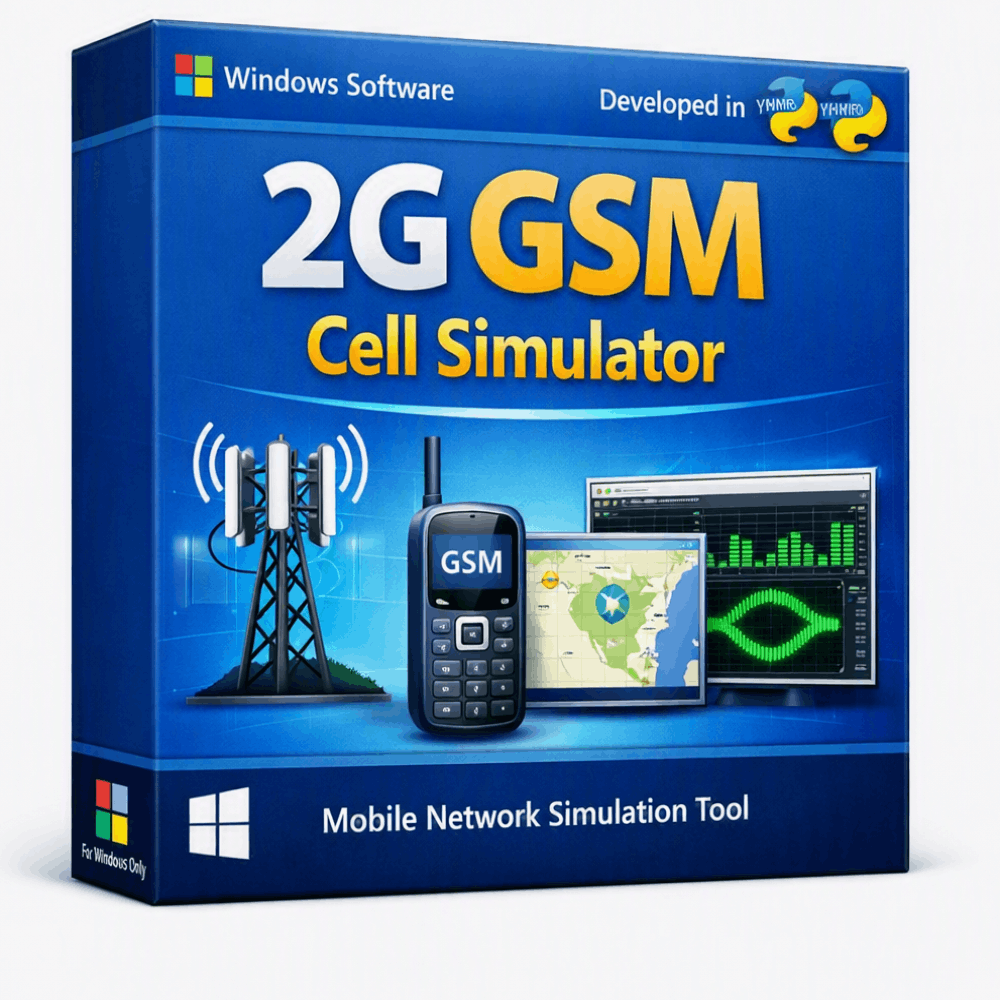
The 2G GSM Cell Simulator is a Python-based software project designed to simulate fundamental GSM cellular-network concepts. It provides a practical environment for understanding mobile stations, GSM cells, base stations, cellular coverage, mobility, communication channels, and basic network behavior. The project includes Python source code that can be studied, customized, and extended for academic projects, demonstrations, research, and learning. It is ideal for Electronics & Communication Engineering, Telecommunications, Computer Science, and related students looking to explore 2G GSM technology and cellular network simulation through a software-based implementation.
₹3,999.00 -
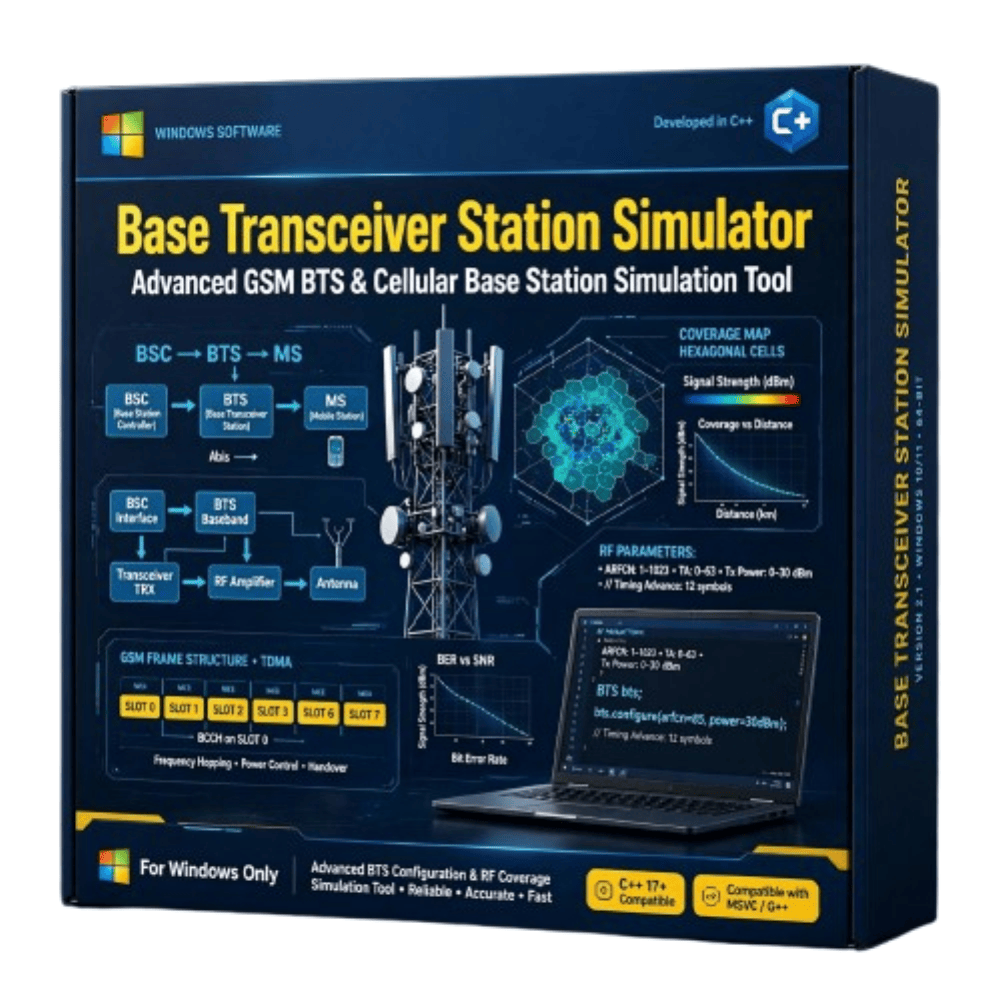
The Base Transceiver Station Simulator Using C++ is a practical cellular communication simulation project designed to demonstrate the basic operation of a BTS in a mobile communication network. Developed using C++, the simulator can model communication between mobile users and a base station, including signal handling, user connectivity, channel allocation, and basic network operations. This BTS Simulator project is suitable for engineering students, researchers, and learners working on GSM, wireless communication, cellular networks, and C++ programming projects.
Original price was: ₹750.00.₹250.00Current price is: ₹250.00. -
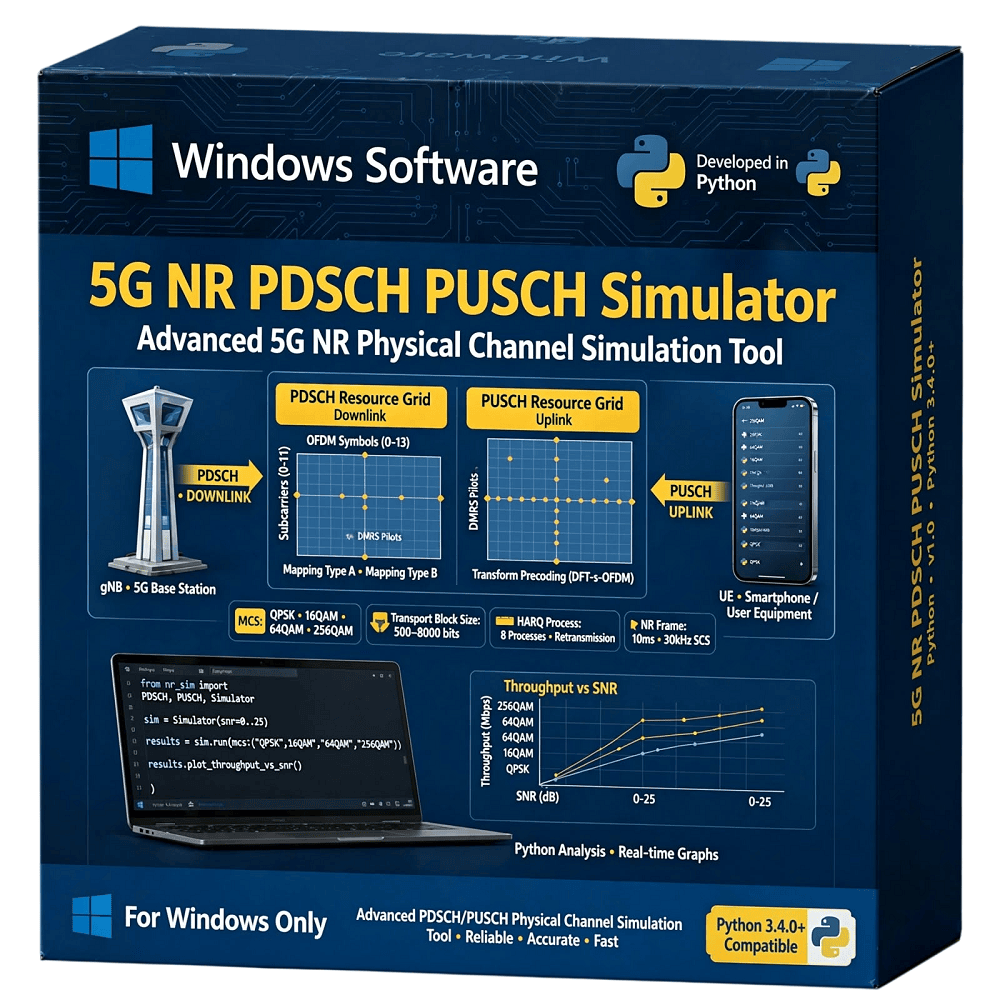
The 5G NR PDSCH PUSCH Simulator is a Python-based simulation software solution designed for researchers, engineers, students, and telecommunications professionals working with 5G New Radio (NR) physical-layer technologies. The simulator provides a practical environment for studying and experimenting with PDSCH (Physical Downlink Shared Channel) and PUSCH (Physical Uplink Shared Channel) transmission concepts.
Developed using Python, the simulator is suitable for academic research, algorithm development, demonstrations, testing, and educational applications related to 5G NR communication systems.
Available for sale as a software product. Contact us for product details, licensing, and purchase information.
Original price was: ₹129,999.00.₹12,999.00Current price is: ₹12,999.00. -
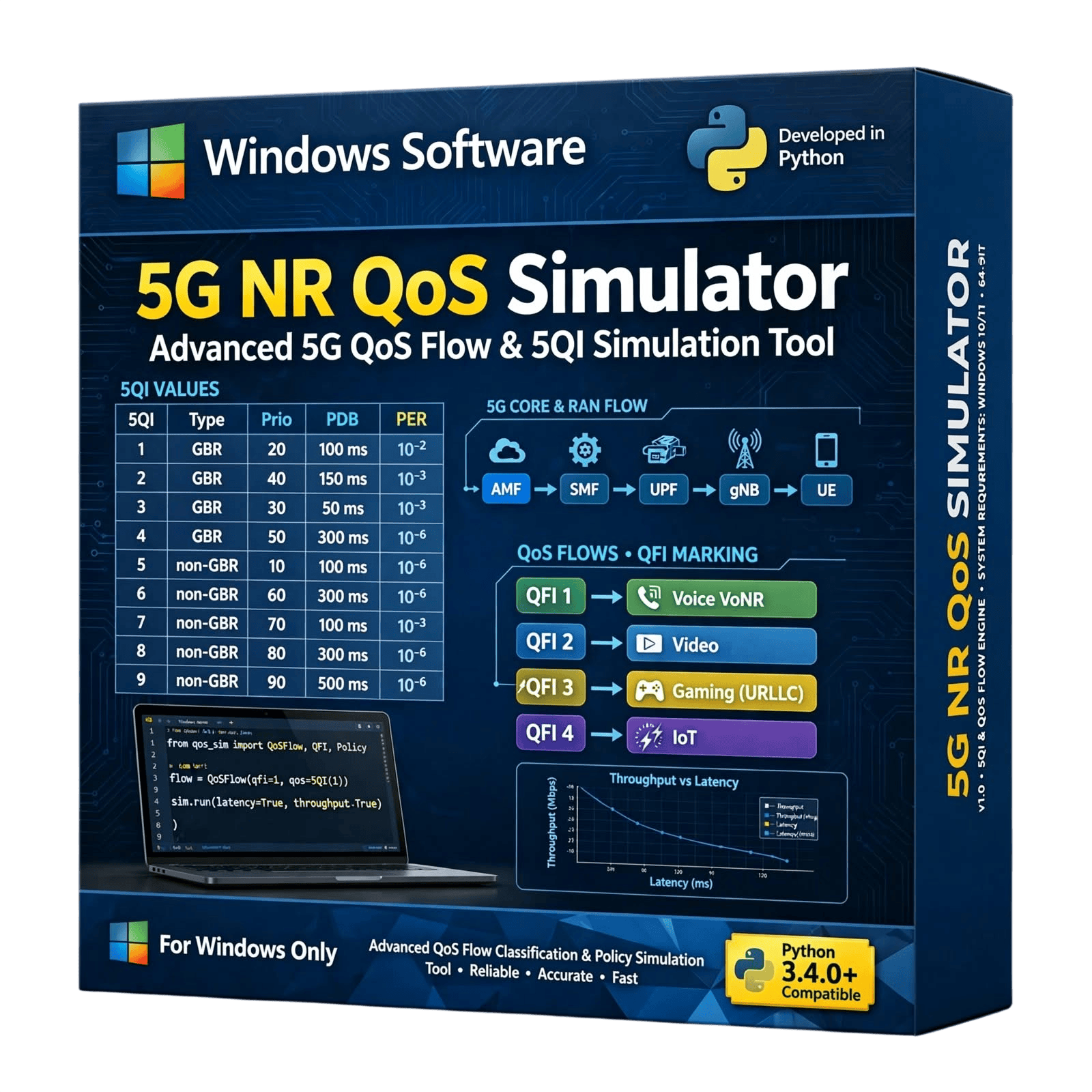
The 5G QoS Simulator is a Python-based software solution designed for researchers, engineers, students, developers, and telecommunications professionals working with 5G Quality of Service (QoS) concepts. The simulator provides a software-based environment for studying and analyzing QoS-related aspects of 5G communication networks, including service performance, traffic behavior, resource management, and network performance evaluation.
Developed using Python, the simulator is suitable for academic research, telecommunications projects, demonstrations, experimentation, algorithm development, and educational applications.
Available for sale as a software product. Contact us for pricing, licensing, features, customization, and purchase information.
Original price was: ₹74,999.00.₹9,999.00Current price is: ₹9,999.00. -
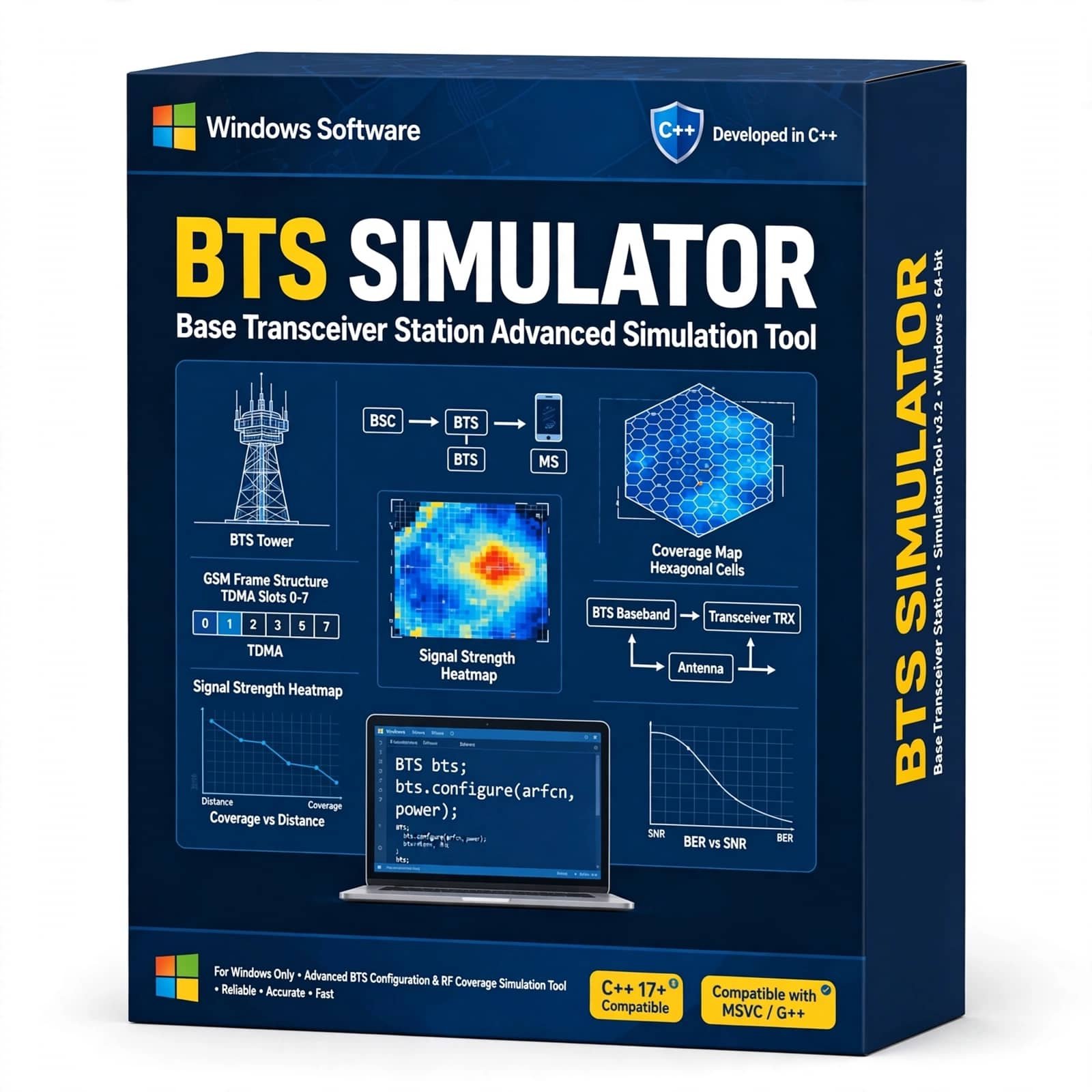
The BTS Simulator with C++ is a software-based Base Transceiver Station simulation tool designed for studying mobile communication, wireless networks, and telecommunications concepts. Developed using C++, it provides a practical environment for understanding BTS operation, communication processes, signal transmission and reception, and cellular network fundamentals. The simulator is ideal for telecommunication laboratories, engineering education, student projects, technical training, and communication-system research.
Original price was: ₹750.00.₹250.00Current price is: ₹250.00. -
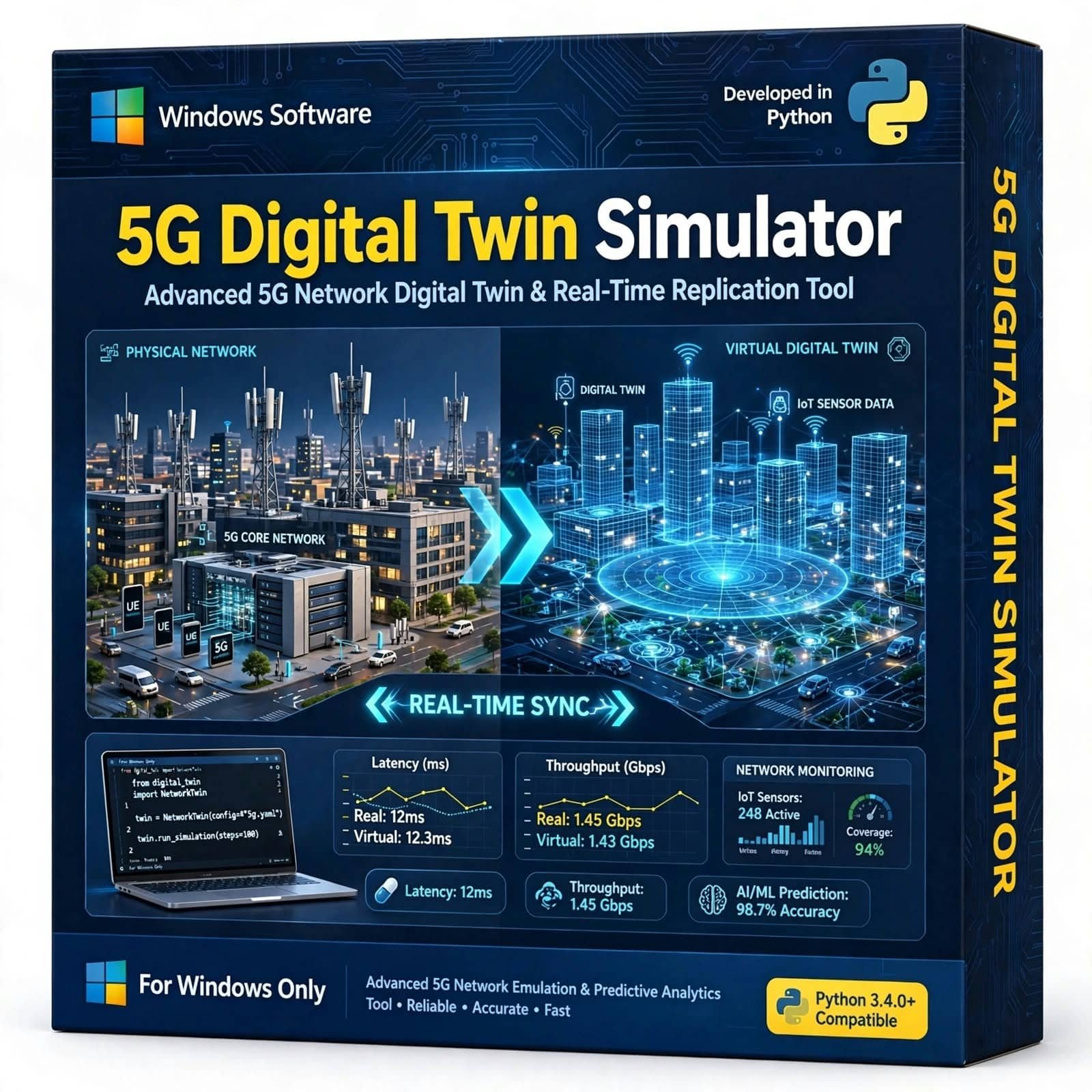
The 5G Digital Twin is a Python-based software solution designed for researchers, engineers, developers, students, and telecommunications professionals interested in modeling, simulating, and analyzing 5G communication networks and their real-world behavior in a virtual environment.
A digital twin provides a virtual representation of a physical or network system, enabling users to study system behavior, evaluate scenarios, analyze performance, and experiment with different configurations. Developed using Python, this 5G Digital Twin can support research, education, network analysis, experimentation, and proof-of-concept development.
Available for sale as a software product. Contact us for pricing, licensing, technical specifications, customization, and purchase information.
₹9,999.00


Reviews
There are no reviews yet.