
New
67% Off

LUT Simulator


Original price was: ₹750.00.₹250.00Current price is: ₹250.00.
In StockLUT Simulator with Python is an educational digital logic project that demonstrates Look-Up Tables (LUTs) used in programmable gate array and FPGA-based systems. Explore binary inputs, truth tables, stored LUT values, Boolean functions, and combinational logic through a practical Python simulation. Ideal for students, electronics enthusiasts, FPGA learners, and digital design projects.
Description
LUT Simulator
Explore programmable digital logic with the LUT Simulator with Python, an educational and practical project designed to demonstrate how Look-Up Tables (LUTs) work in the context of Programmable Gate Arrays (PGAs) and FPGA-based digital systems. This project provides a visual and programming-based approach to understanding one of the fundamental building blocks used in programmable digital logic.
Unlike image-processing LUTs that are used for modifying colours or pixel values, this LUT Simulator with Python focuses on digital logic and programmable hardware. It helps learners understand how a LUT can implement Boolean functions by storing predefined output values for different combinations of binary inputs.
The project is ideal for students, electronics enthusiasts, FPGA learners, digital design students, Python programmers, and anyone interested in understanding programmable logic architecture through simulation.

Understand LUTs in Programmable Logic
A Look-Up Table is an important concept in programmable digital logic. In FPGA architectures, LUTs are commonly used to implement combinational logic functions. Rather than building every logic function from individual physical gates, a LUT can store the required output for each possible combination of inputs.
The LUT Simulator with Python provides an accessible way to visualise this concept through software. Users can experiment with input combinations, observe corresponding outputs, and understand how a programmed truth table can represent a digital logic function.
This makes the project particularly useful for learning FPGA architecture, programmable logic, digital circuit design, Boolean logic, and combinational circuits.
Python-Based LUT Simulation
Python provides a convenient environment for creating educational simulations because of its readable syntax and flexible programming capabilities. With this LUT simulator, users can explore how digital logic behaviour can be represented programmatically.

The project can demonstrate the relationship between:
- Binary inputs
- LUT addresses
- Stored LUT values
- Truth tables
- Boolean functions
- Combinational logic
- Programmable logic
- FPGA architecture concepts
By interacting with the simulation, learners can move beyond theoretical explanations and gain a more practical understanding of how LUT-based logic operates.
Learn FPGA and PGA Concepts
The LUT Simulator with Python is especially useful for learners studying programmable hardware. LUTs are closely associated with FPGA logic resources and are an important topic in digital system design.
Understanding the basic operation of a LUT helps students build a foundation for exploring more advanced concepts such as FPGA logic blocks, configurable logic, combinational logic implementation, truth tables, hardware description languages, and digital circuit architecture.

The simulator can therefore be used as a stepping stone before moving into more advanced FPGA development environments and hardware implementation.
Visualise Truth Tables and Logic Functions
One of the most useful aspects of a LUT simulator is the ability to connect a truth table with an actual logic implementation.
For a given number of binary inputs, a LUT contains a corresponding set of output values. Each input combination can be treated as an address, with the LUT returning the stored output associated with that address.
For example, learners can experiment with different input combinations and LUT contents to understand how various Boolean functions can be represented. This provides a straightforward way to explore concepts that may otherwise seem abstract when studying digital logic theory.
The Python implementation makes it possible to modify the LUT configuration and experiment with different logic functions without requiring physical FPGA hardware.

Ideal for Digital Electronics Students
The LUT Simulator with Python can be a useful educational resource for students studying electronics, electrical engineering, computer engineering, computer science, embedded systems, and digital design.
It can be used for:
- Digital electronics projects
- FPGA learning projects
- Python mini projects
- Programmable logic demonstrations
- Digital logic assignments
- Boolean logic experiments
- Truth table demonstrations
- Combinational circuit simulations
- Engineering academic projects
- Student programming portfolios
The project can help students connect programming knowledge with hardware-oriented concepts, making it particularly useful for interdisciplinary learning.

A Practical FPGA Learning Project
Learning FPGA architecture can be challenging when concepts are presented only through block diagrams and technical documentation. A software-based simulator offers another way to approach the subject.
With the LUT Simulator with Python, learners can experiment with LUT inputs and stored outputs and observe the resulting logic behaviour. This creates an interactive learning environment where users can test different configurations and develop an intuitive understanding of programmable logic.
The project can also serve as a foundation for more advanced simulations involving multiple LUTs, logic blocks, configurable inputs, and larger digital circuits.
Customise and Expand the LUT Simulator
Because the simulator is developed using Python, users can extend the project according to their learning objectives. Beginners can study the basic LUT operation, while advanced users can add additional features and create more sophisticated digital logic simulations.
Possible extensions may include support for multiple inputs, multiple outputs, configurable truth tables, Boolean function generation, logic-function testing, visual circuit representations, or multiple interconnected LUTs.
These possibilities make the project useful not only as a finished educational application but also as a starting point for experimentation and further development.
Why Choose the LUT Simulator with Python?
The LUT Simulator with Python combines programming with digital hardware concepts to create a practical learning experience. It is particularly valuable for users who want to understand how programmable logic can implement combinational functions without immediately working with physical FPGA hardware.

By experimenting with LUT configurations and binary input combinations, learners can strengthen their understanding of digital logic, Boolean functions, truth tables, programmable logic, and FPGA architecture.
Whether you are looking for a Python FPGA project, LUT simulation project, digital electronics project, programmable logic project, or Python-based digital logic simulator, this project provides an accessible foundation for learning and experimentation.
Key Features and Benefits
- Python-based LUT simulation
- Focused on programmable digital logic
- Designed around PGA/FPGA-related LUT concepts
- Demonstrates truth tables and Boolean functions
- Helps explain combinational logic
- Useful for FPGA and digital design learning
- Suitable for students and beginners
- No physical FPGA hardware required for basic simulation
- Customisable Python project
- Useful for academic projects and demonstrations
Start exploring programmable logic with the LUT Simulator with Python and develop a clearer understanding of how Look-Up Tables can be used to implement digital logic functions in programmable hardware.
Related products
-
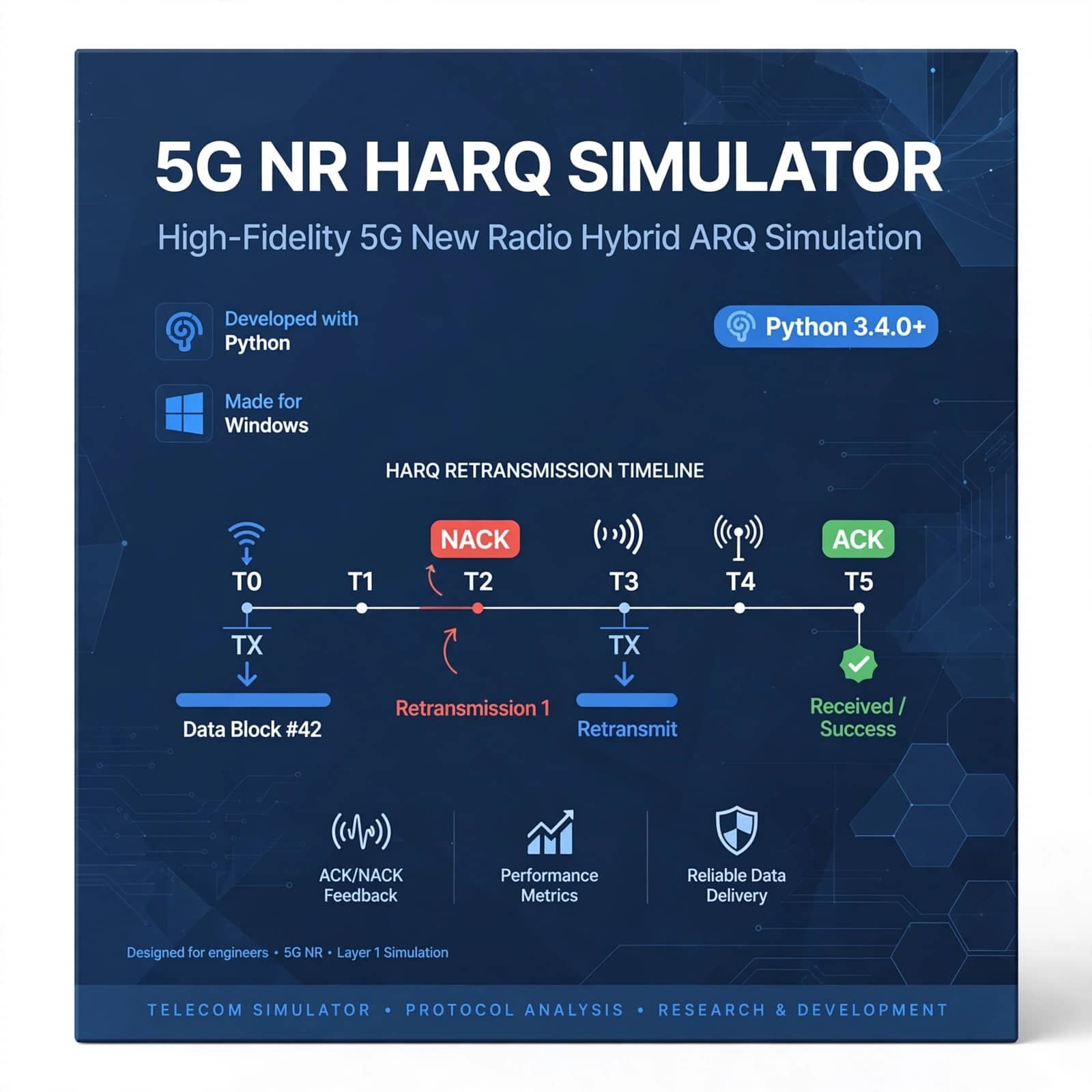
5G NR HARQ Simulator is an advanced simulation solution for modeling and analyzing Hybrid Automatic Repeat Request (HARQ) mechanisms in 5G New Radio networks. It enables users to study HARQ processes, ACK/NACK feedback, retransmissions, link adaptation, channel errors, and communication reliability under configurable network conditions. The simulator supports analysis of throughput, BLER, latency, retransmission rate, packet errors, spectral efficiency, and other key performance metrics, making it suitable for 5G NR research, algorithm development, academic projects, and wireless communication system optimization.
Original price was: ₹750.00.₹250.00Current price is: ₹250.00. -
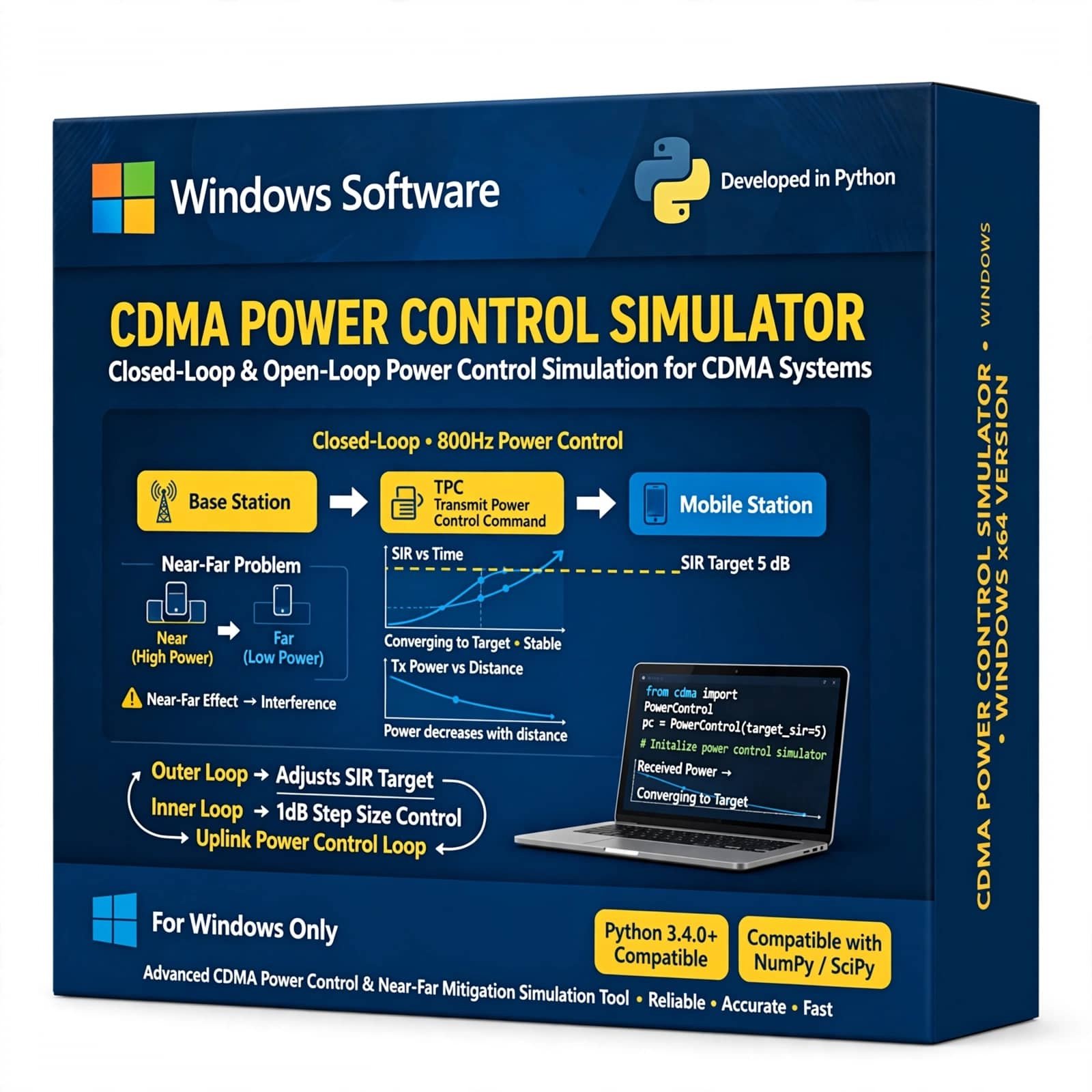
CDMA Power Control Simulator is an advanced communication engineering simulation tool designed to help students, researchers, and professionals understand and analyze power control techniques in Code Division Multiple Access (CDMA) wireless communication systems. It enables practical study of uplink and downlink power control, signal interference, power levels, and system performance.
Original price was: ₹750.00.₹250.00Current price is: ₹250.00. -
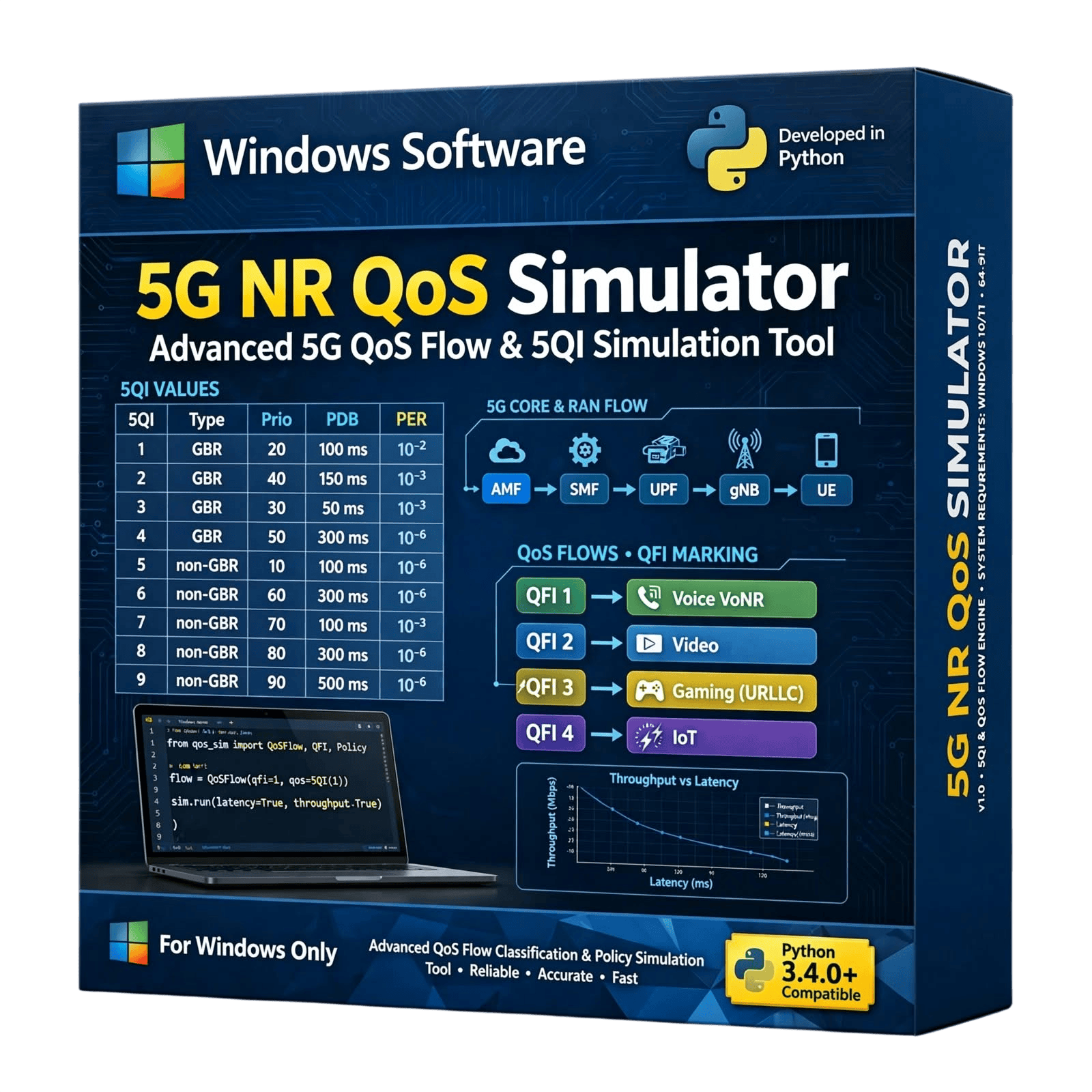
The 5G QoS Simulator is a Python-based software solution designed for researchers, engineers, students, developers, and telecommunications professionals working with 5G Quality of Service (QoS) concepts. The simulator provides a software-based environment for studying and analyzing QoS-related aspects of 5G communication networks, including service performance, traffic behavior, resource management, and network performance evaluation.
Developed using Python, the simulator is suitable for academic research, telecommunications projects, demonstrations, experimentation, algorithm development, and educational applications.
Available for sale as a software product. Contact us for pricing, licensing, features, customization, and purchase information.
Original price was: ₹750.00.₹250.00Current price is: ₹250.00. -
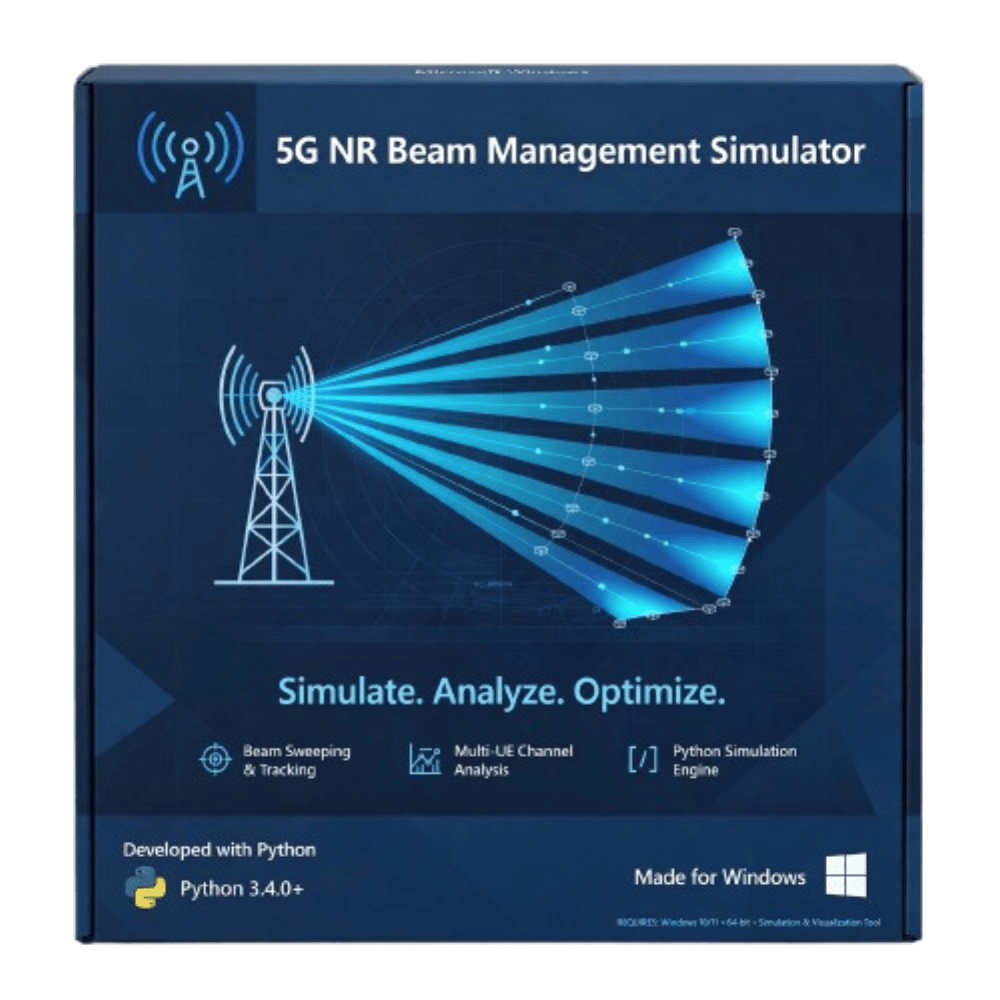
5G NR Beam Management Simulator is an advanced simulation solution designed to model, analyze, and optimize beam management procedures in 5G New Radio (NR) networks. It enables engineers and researchers to evaluate beam sweeping, beam measurement, beam selection, beam reporting, and beam recovery under diverse network and channel conditions. The simulator supports performance analysis of directional communication, helping users assess beamforming strategies, mobility scenarios, link reliability, and system-level performance before real-world deployment.
Original price was: ₹750.00.₹250.00Current price is: ₹250.00. -
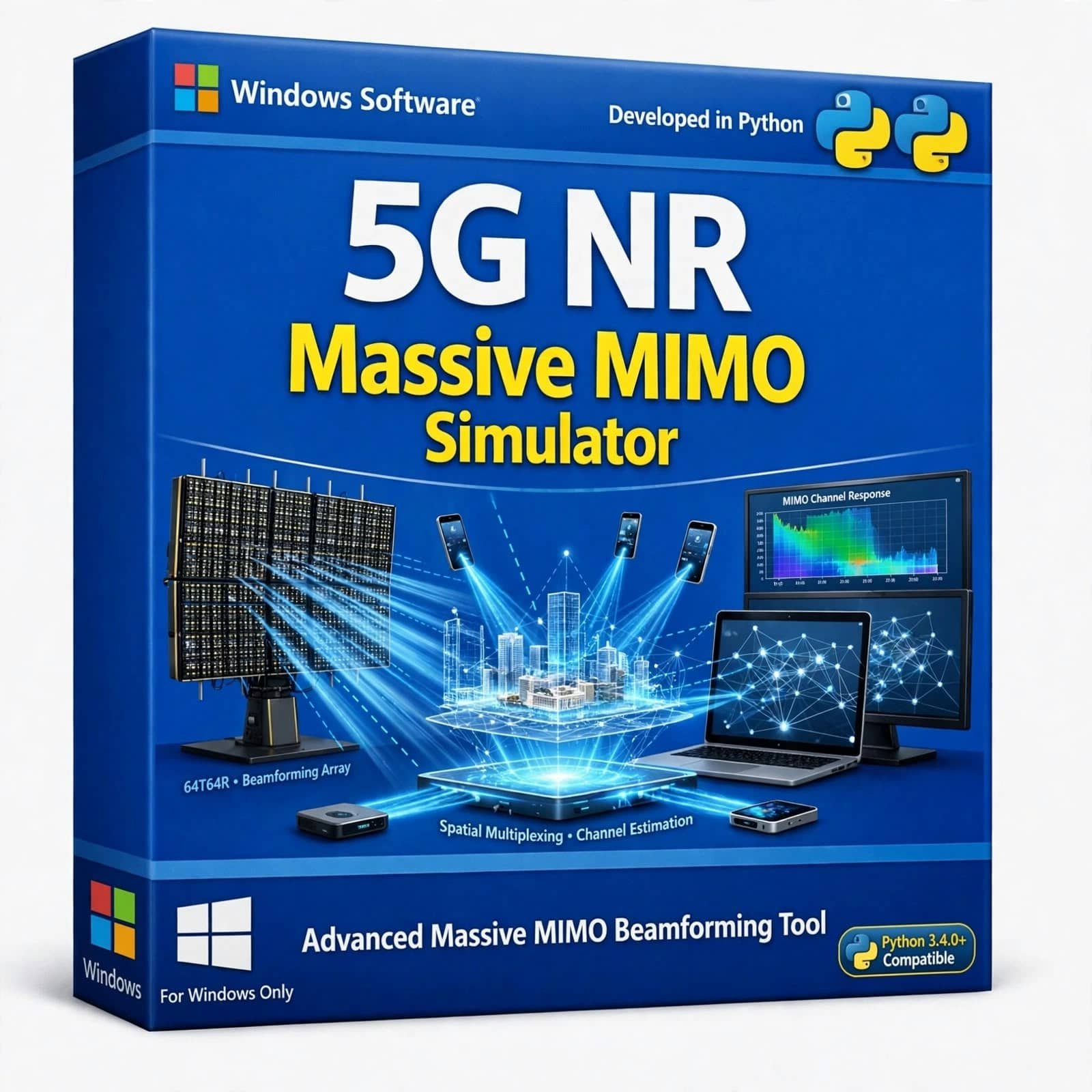
5G NR Massive MIMO Simulator is an advanced simulation solution for modeling and analyzing Massive Multiple-Input Multiple-Output (MIMO) technologies in 5G New Radio networks. It enables users to study large-scale antenna arrays, beamforming, precoding, spatial multiplexing, multi-user MIMO, channel estimation, and interference under configurable channel conditions. The simulator supports analysis of throughput, spectral efficiency, SINR, BER, BLER, MIMO capacity, beamforming gain, and multi-user performance, making it ideal for 5G NR research, algorithm development, academic projects, and 5G/6G wireless system optimization.
Original price was: ₹750.00.₹250.00Current price is: ₹250.00. -
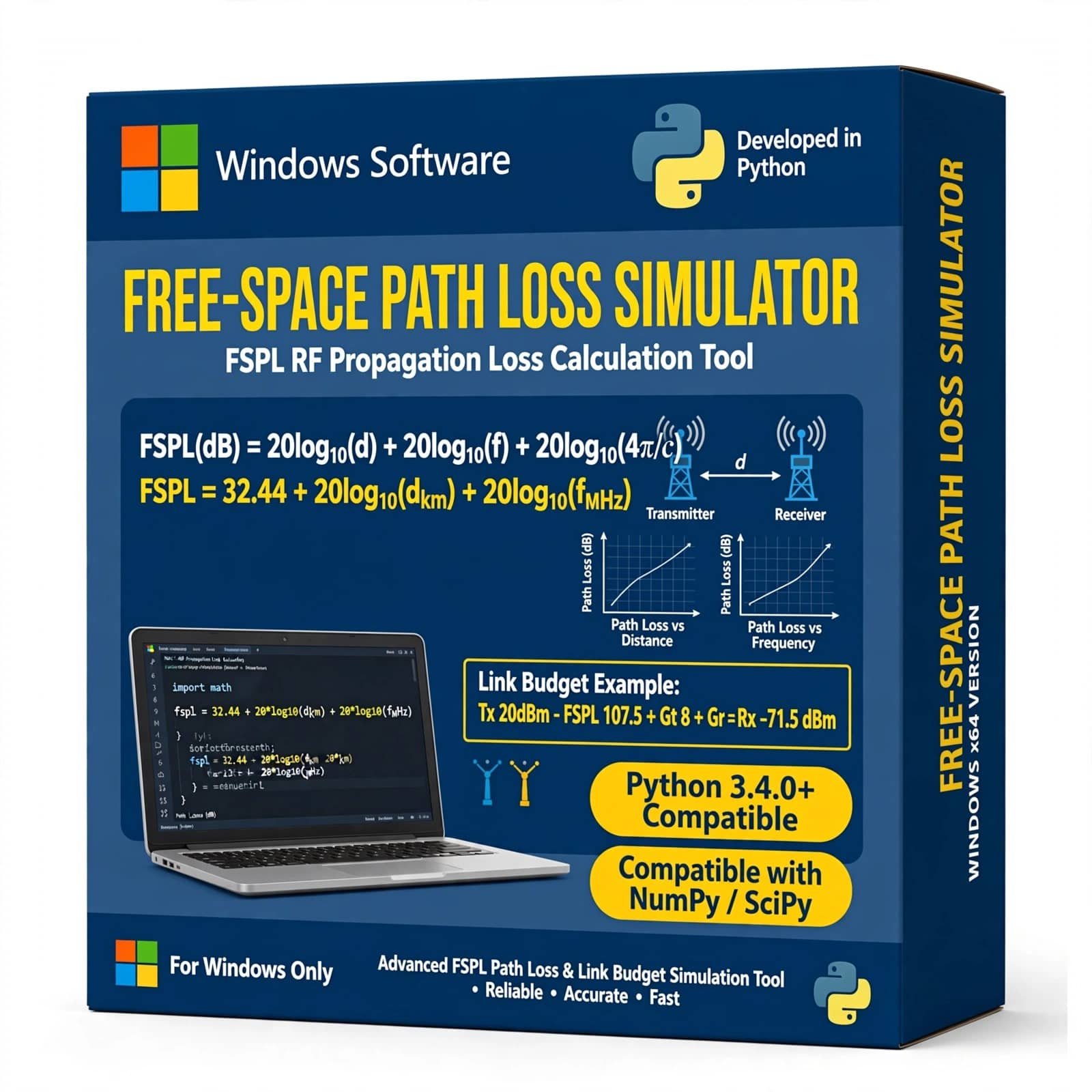
Free Space Path Loss Simulator Using Python is a practical wireless communication simulation project designed to calculate and visualize signal power loss as a radio wave travels through free space. Developed using Python, this simulator helps students, researchers, and communication engineers understand Free Space Path Loss (FSPL), transmission distance, frequency, received signal power, and wireless link performance.
The project provides an easy-to-understand simulation environment for analyzing how distance and operating frequency affect signal propagation. It is suitable for B.Tech, M.Tech, engineering students, academic projects, wireless communication studies, RF analysis, and Python-based simulation projects.
Original price was: ₹750.00.₹250.00Current price is: ₹250.00.


Reviews
There are no reviews yet.