
New
67% Off

Assembly Programming Studio

Original price was: ₹750.00.₹250.00Current price is: ₹250.00.
In StockAssembly Programming Studio for x86-64 with Python is a practical software environment for learning, writing, testing, and experimenting with x86-64 assembly programming. Designed for students, developers, educators, and computer architecture enthusiasts, it combines assembly-language concepts with Python-based tools for exploring registers, memory, instructions, addressing modes, control flow, and low-level program execution. Ideal for assembly programming courses, computer architecture projects, reverse-engineering education, and low-level software development.
Description
Assembly Programming Studio for x86-64
Assembly Programming Studio Simulator – Understanding how modern processors execute software requires knowledge of low-level programming and instruction-set architecture. x86-64 assembly language provides simulated direct access to processor instructions, registers, memory operations, and control-flow mechanisms. The Assembly Programming Studio for x86-64 with Python provides a practical software environment for learning and experimenting with x86-64 assembly programming.
Mainly designed for students, educators but also helps to software developers, researchers, and computer architecture enthusiasts, this studio provides a convenient environment for exploring assembly instructions and low-level programming concepts. Python can be used alongside the assembly-focused workflow to support experimentation, automation, analysis, and educational demonstrations.
Learn x86-64 Assembly Programming
x86-64 is a widely used 64-bit instruction-set architecture found in modern desktop and server computing environments. Learning its assembly language can provide valuable insight into how high-level programs are translated into low-level processor instructions.
The studio provides an environment for studying instructions, registers, memory, addressing modes, arithmetic operations, logical operations, branching, and other fundamental concepts associated with x86-64 programming.
Instead of treating assembly language as a collection of isolated instructions, users can use the simulator and programming environment to explore how instructions work together to implement complete program logic.
Python-Based Assembly Learning Environment
Python is a popular language for education, automation, data analysis, and software development. Combining Python with an assembly programming environment provides an accessible way to experiment with low-level programming concepts.
The Assembly Programming Studio for x86-64 with Python can be useful for developing educational tools, testing programming concepts, analyzing instruction behavior, and creating experimental workflows involving assembly and Python.
This combination can be particularly valuable for students who are learning both high-level and low-level programming.
Explore x86-64 Registers
Registers are among the most important components of assembly programming. x86-64 provides a collection of general-purpose and specialized registers that are used for calculations, data movement, addressing, function calls, and program control.
The studio provides an environment for learning how registers are used by assembly instructions. Users can experiment with data movement, arithmetic operations, logical operations, and other instructions while developing an understanding of processor state.
Understand Memory and Addressing
Assembly programming requires a clear understanding of how programs access memory. x86-64 provides multiple addressing mechanisms that allow instructions to work with memory locations and data structures.
By experimenting with memory-related instructions and addressing concepts, users can develop practical knowledge of how processors access and manipulate data.
This is particularly useful for computer architecture, systems programming, operating systems, and low-level software development courses.
Study Control Flow and Branching
Conditional branches, jumps, loops, calls, and returns are essential components of assembly programs. They determine how instructions are executed and allow developers to implement decisions, repetition, and function-based program structures.
The programming studio provides an environment for experimenting with these concepts and understanding how high-level control structures can be represented using x86-64 instructions.
Useful for Computer Architecture Projects
The studio can support a wide range of academic and technical projects involving low-level programming and processor architecture.
Typical applications include:
- x86-64 assembly programming
- Computer architecture education
- Assembly language laboratory projects
- Low-level software development
- CPU instruction-set studies
- Systems programming education
- Compiler and code-generation studies
- Reverse-engineering education
- Operating-system programming concepts
- Python and assembly programming experiments

Assembly Programming for Students
Assembly language can initially be challenging because it exposes details that are normally hidden by high-level programming languages. A practical development environment can help students gradually understand these concepts.
Students can experiment with instructions, registers, memory, and control flow while developing programs and observing their behavior. This practical approach can reinforce concepts taught in computer architecture and systems programming courses.
The studio can also be used for assignments, laboratory exercises, demonstrations, and independent learning.
Low-Level Software Development
Knowledge of assembly language can be useful when studying operating systems, embedded systems, compilers, debugging, performance analysis, and processor architecture.
The studio provides a controlled environment for exploring these low-level concepts. Developers can use it to strengthen their understanding of how software interacts with processor instructions and machine-level operations.
Reverse Engineering and Debugging Education
Understanding assembly instructions is also an important foundation for learning software debugging and reverse engineering. By becoming familiar with registers, memory access, control flow, and instruction sequences, users can develop the skills needed to interpret low-level program behavior.
The studio can therefore serve as an educational platform for studying machine-level code and processor execution concepts.
Python Integration
Python can complement assembly programming by providing scripting, automation, data processing, and experimentation capabilities. Users can use Python to create supporting tools and workflows around their assembly programming studies.
This makes the environment useful for users who want to combine low-level programming concepts with the flexibility of Python.
Key Benefits
- x86-64 assembly programming environment
- Python-based learning and experimentation
- Useful for computer architecture education
- Helps understand x86-64 instructions and registers
- Supports memory and addressing studies
- Useful for branching and control-flow experiments
- Suitable for systems programming education
- Useful for assembly programming projects
- Supports low-level programming experimentation
- Suitable for students, educators, and developers
Who Can Use This Product?
Assembly Programming Studio for x86-64 with Python is suitable for computer science students, computer engineering students, software developers, educators, researchers, systems programmers, and anyone interested in low-level programming.
It is particularly useful for users studying x86-64 architecture, assembly language, computer organization, operating systems, compilers, debugging, and systems programming.
Product Summary
The Assembly Programming Studio for x86-64 with Python provides a practical environment for learning and experimenting with x86-64 assembly programming. It helps users explore processor instructions, registers, memory, addressing modes, arithmetic and logical operations, branching, and low-level program execution.
By combining assembly programming concepts with Python-based experimentation, the studio provides a flexible environment for education, development, research, and hands-on learning.
Whether you are learning assembly language, teaching computer architecture, developing a systems-programming project, or exploring low-level software concepts, this studio can help you build practical knowledge of x86-64 programming.
Explore x86-64 assembly programming with Python and develop practical skills in processor instructions, registers, memory, addressing, control flow, and low-level software development.
Related products
-
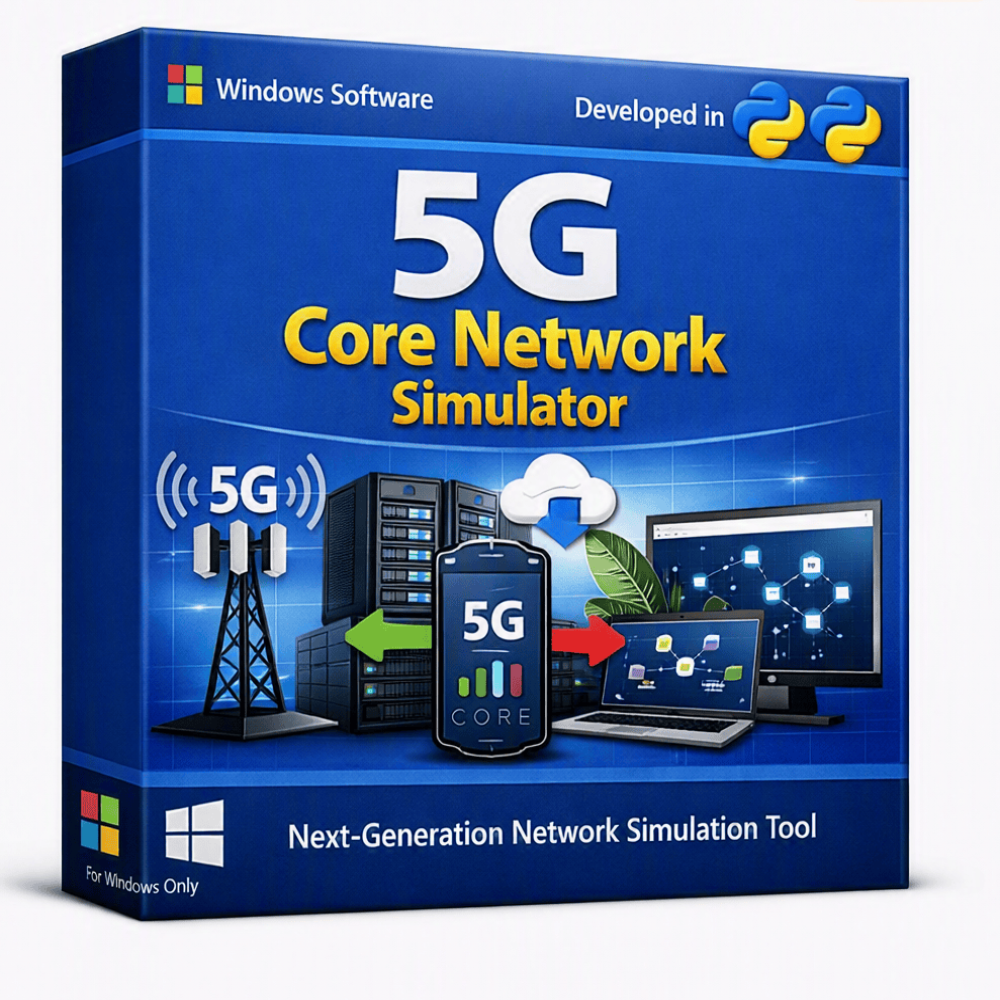
A Python-based 5G Core Network Simulator designed for studying, analyzing, and demonstrating 5G Core network architecture and procedures. Explore key 5G Network Functions such as AMF, SMF, UPF, AUSF, UDM, PCF, NRF, and NSSF, along with UE registration, authentication, session management, mobility, and signaling procedures.
Ideal for 5G research, telecom engineering, academic projects, university laboratories, protocol development, and network simulation. Provides a flexible software environment for experimenting with 5G Core concepts without requiring a complete commercial 5G network infrastructure.
Original price was: ₹750.00.₹250.00Current price is: ₹250.00. -
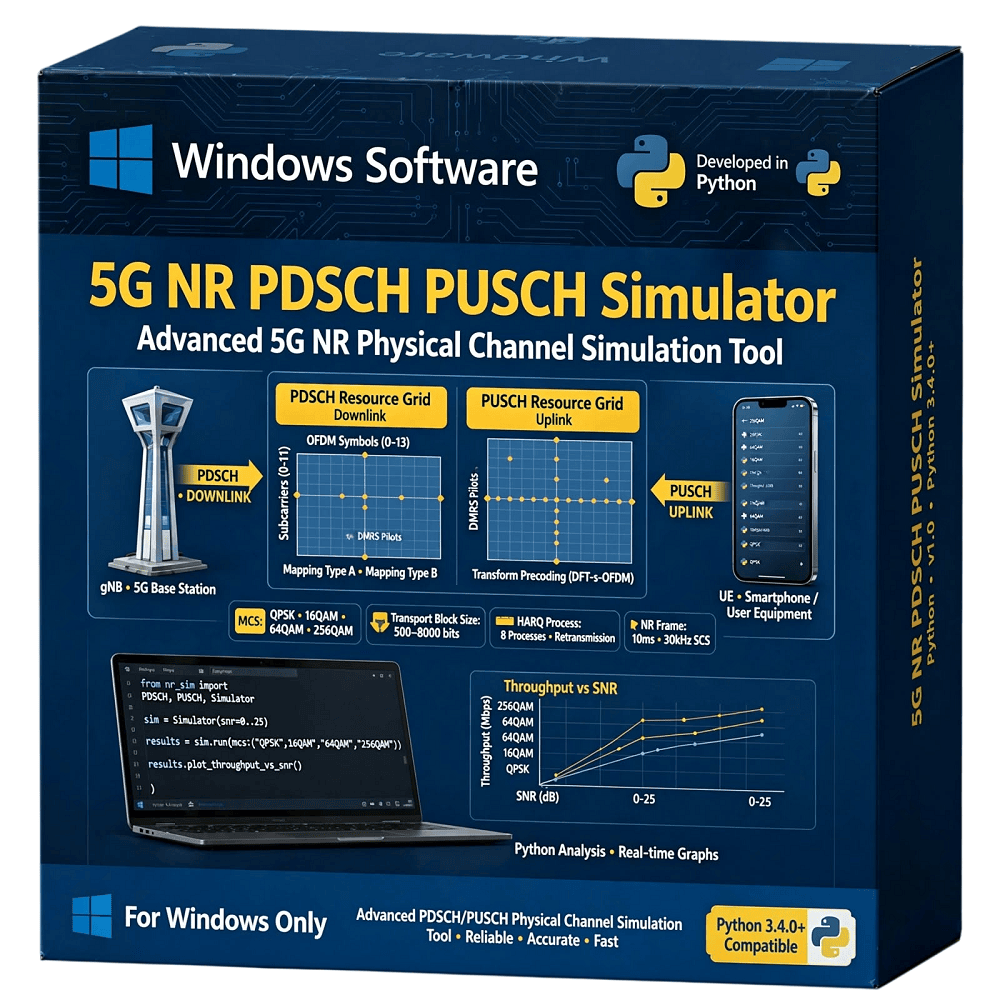
The 5G NR PDSCH PUSCH Simulator is a Python-based simulation software solution designed for researchers, engineers, students, and telecommunications professionals working with 5G New Radio (NR) physical-layer technologies. The simulator provides a practical environment for studying and experimenting with PDSCH (Physical Downlink Shared Channel) and PUSCH (Physical Uplink Shared Channel) transmission concepts.
Developed using Python, the simulator is suitable for academic research, algorithm development, demonstrations, testing, and educational applications related to 5G NR communication systems.
Available for sale as a software product. Contact us for product details, licensing, and purchase information.
Original price was: ₹750.00.₹250.00Current price is: ₹250.00. -
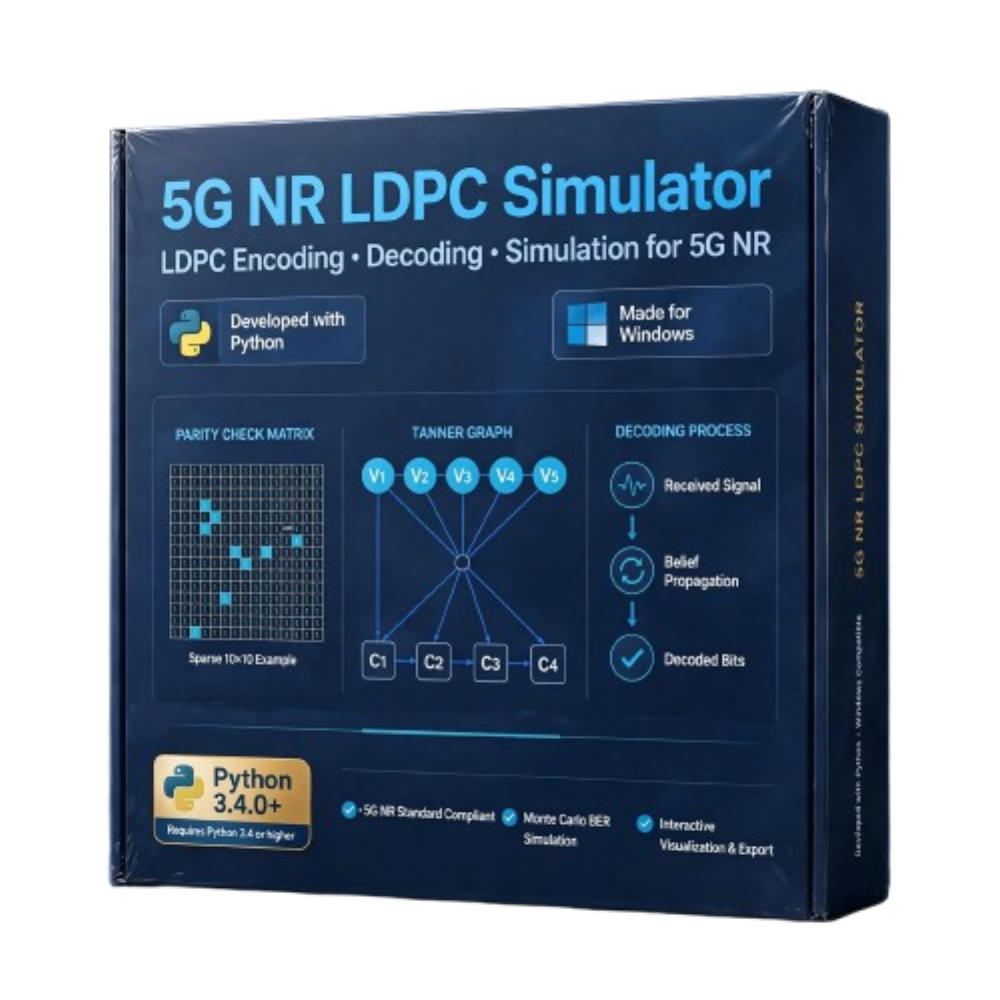
5G NR LDPC Simulator is an advanced simulation solution for modeling and analyzing Low-Density Parity-Check (LDPC) channel coding used in 5G New Radio systems. It enables users to simulate LDPC encoding and decoding, evaluate error correction performance, and analyze BER, BLER, SNR, coding rate, decoding iterations, throughput, and convergence under configurable channel conditions. The simulator is ideal for 5G NR channel coding research, algorithm development, academic projects, decoder performance analysis, and next-generation wireless communication system optimization.
Original price was: ₹750.00.₹250.00Current price is: ₹250.00. -
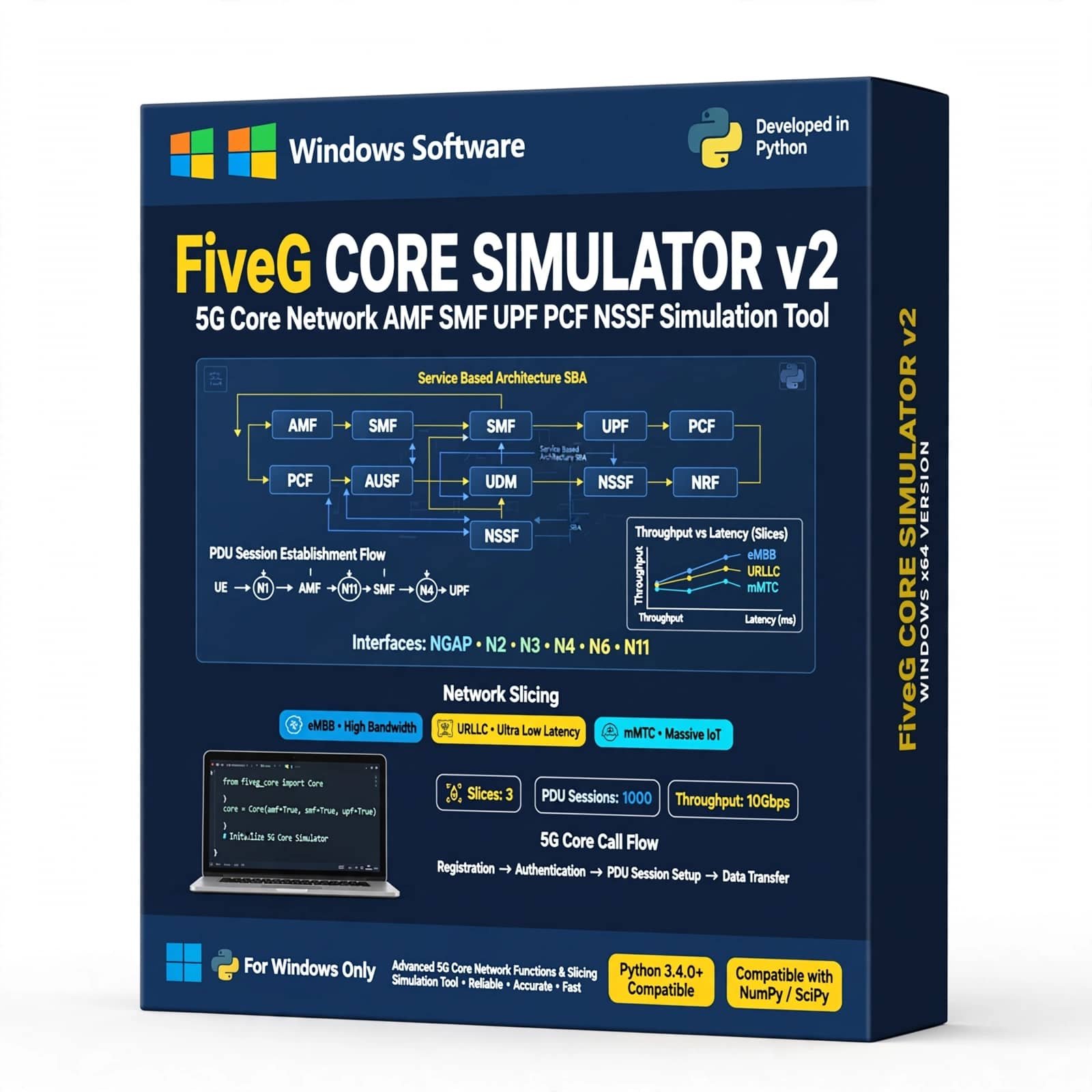
FiveG Core Simulator v2 is an educational 5G Core Network simulation tool designed to help students, educators, researchers, and telecom professionals understand 5G core architecture, network functions, signaling procedures, latency, and protocol interactions through an interactive topology and signaling animation environment.
Original price was: ₹750.00.₹250.00Current price is: ₹250.00. -
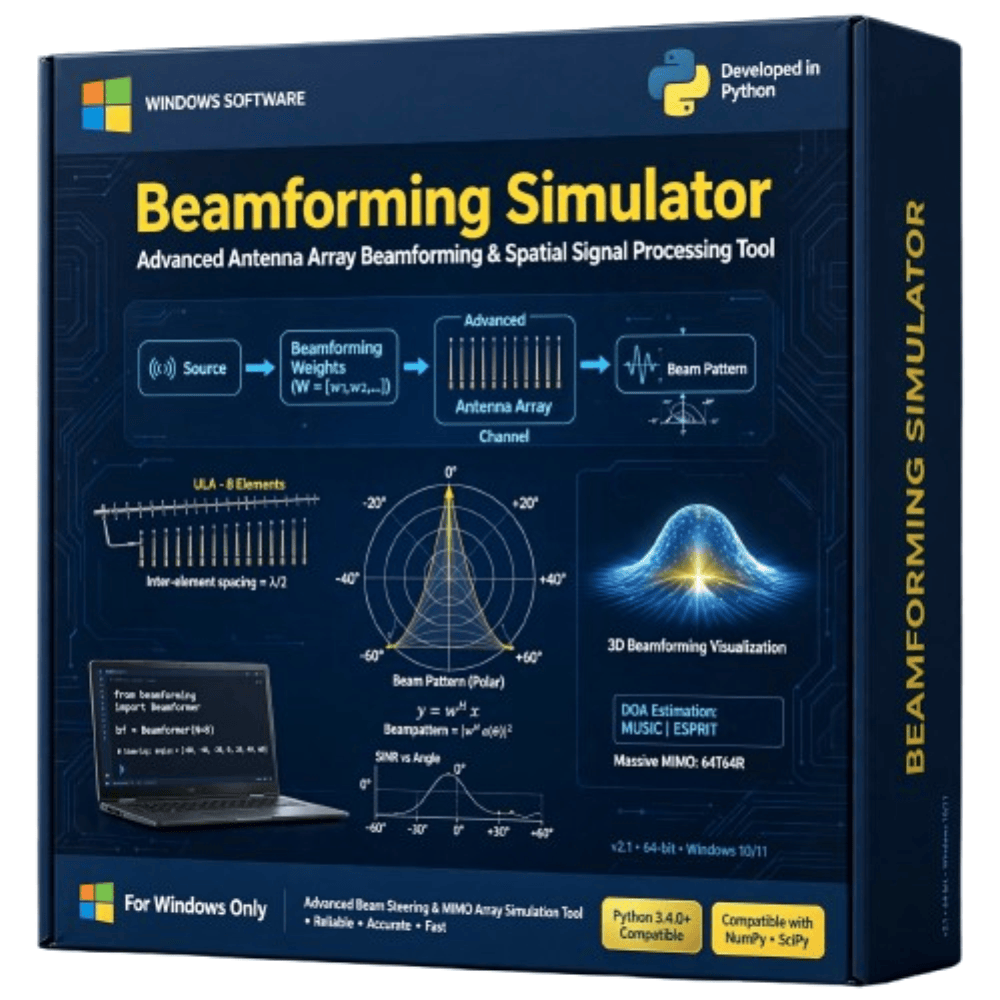
The Beamforming Simulator is a practical wireless communication simulation project designed to demonstrate how antenna arrays can control and direct radio-frequency signals toward desired users or directions. The simulator helps visualize beam patterns, signal direction, antenna-array behavior, and beam steering under different parameters. It is suitable for studying beamforming, antenna arrays, MIMO, 5G communication, wireless networks, and signal processing. This project is ideal for engineering students, researchers, and learners working on wireless communication and advanced antenna technologies.
Original price was: ₹750.00.₹250.00Current price is: ₹250.00. -
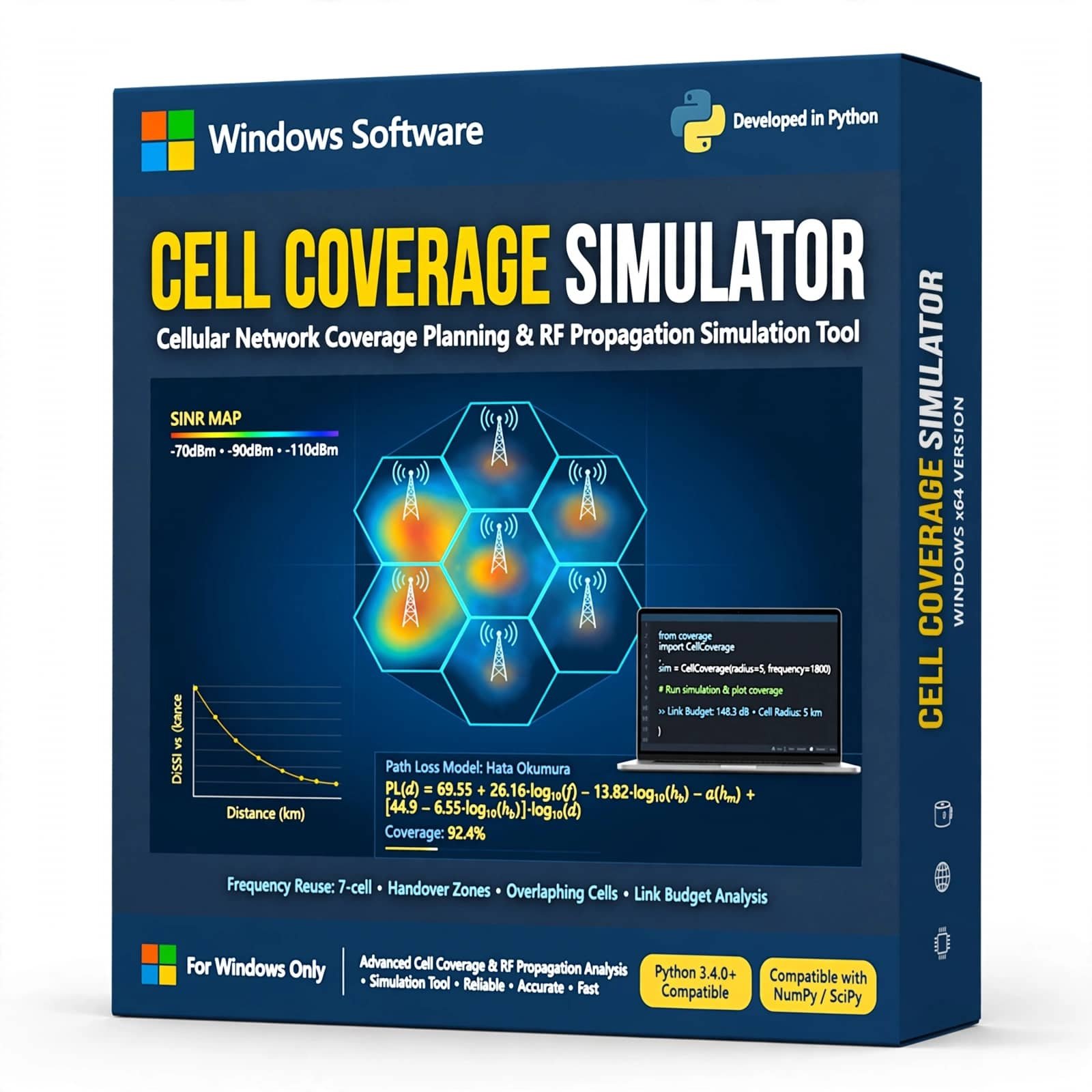
Cell Coverage Simulator is a wireless communication simulation tool designed to model and analyze cellular network coverage using Python. It helps students, researchers, and telecom professionals visualize cell coverage, signal propagation, coverage areas, and network planning concepts through practical simulation and analysis.
Original price was: ₹750.00.₹250.00Current price is: ₹250.00.

Reviews
There are no reviews yet.