

CDMA – DSSS Simulator
₹3,999.00
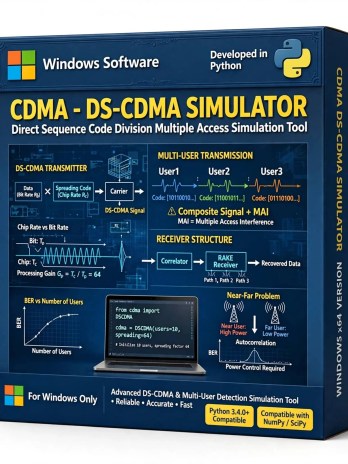
In StockThe CDMA – DSSS Simulator with Python is a software-based communication simulation tool designed to demonstrate and analyze Code Division Multiple Access (CDMA) and Direct Sequence Spread Spectrum (DSSS) techniques. Developed using Python, the simulator provides a practical environment for studying spreading codes, signal spreading and despreading, data transmission, multiple-access communication, interference, and signal recovery. It is ideal for digital communication and wireless communication laboratories, engineering education, student projects, technical training, and communication-system research.
Description
CDMA – DSSS Simulator
The CDMA – DSSS Simulator with Python is a software-based digital communication simulation tool designed for studying, demonstrating, and analyzing Code Division Multiple Access (CDMA) and Direct Sequence Spread Spectrum (DSSS) communication techniques. Developed using Python, the simulator provides a practical environment for understanding spread-spectrum communication, spreading codes, signal transmission, despreading, multiple-access communication, interference, and recovery of transmitted data.
CDMA and DSSS are important concepts in wireless and digital communication systems. They demonstrate how multiple users can share a communication medium while using different spreading codes to distinguish their transmitted signals. The CDMA–DSSS Simulator helps students, educators, researchers, and communication engineers understand these concepts through software-based experimentation rather than relying only on theoretical equations and block diagrams.
CDMA and DSSS Simulation
Code Division Multiple Access (CDMA) is a multiple-access technique in which users can share the same communication channel by using different codes. The transmitted information is combined with a spreading code, allowing the receiver to identify and recover the desired signal using the corresponding code.
Direct Sequence Spread Spectrum (DSSS) is a spread-spectrum technique in which the original data signal is multiplied or combined with a higher-rate spreading sequence. This increases the bandwidth occupied by the signal while providing important communication characteristics such as improved resistance to certain types of interference and the ability to distinguish signals using their spreading codes.
The CDMA–DSSS Simulator provides an opportunity to explore these principles in a controlled software environment. Users can study how input data is processed using spreading sequences, how signals from multiple users can be combined, and how the receiver uses the appropriate code to recover the desired information.
Python-Based Communication Simulator
The CDMA–DSSS Simulator is developed using Python, making it suitable for demonstrating how communication algorithms can be implemented using a high-level programming language. Python provides an accessible programming environment for numerical processing, algorithm development, data analysis, and communication-system simulation.
The Python implementation allows users to connect communication theory with practical programming concepts. Students can gain an understanding of how operations such as data generation, code generation, signal spreading, signal combining, despreading, correlation, and data recovery can be represented through software algorithms.
This combination of Python programming and digital communication simulation makes the product suitable for engineering students and developers who want to explore both communication technology and software-based implementation.

Understanding DSSS Signal Spreading
One of the primary applications of the simulator is demonstrating the DSSS spreading process. Users can observe how a data sequence is combined with a spreading code to produce a spread signal. The spreading process provides an effective way to understand the relationship between the original information signal, the spreading sequence, and the resulting transmitted signal.
At the receiver, the corresponding despreading operation can be studied. The receiver uses the appropriate spreading code to process the received signal and recover the original information. This provides a practical demonstration of an important principle of spread-spectrum communication.
The simulator can therefore help users understand concepts such as chip sequences, spreading codes, data bits, spread signals, despreading, correlation, and signal recovery.
CDMA Multiple-User Communication
The simulator can also be used to demonstrate the fundamental concept of multiple-access communication using CDMA. Multiple users can be represented using different spreading codes, allowing their signals to occupy the same communication channel in the simulation.
Users can study how individual signals are combined and how a receiver can use a selected code to extract the required user’s information. This provides an intuitive understanding of code-based user separation and demonstrates the importance of spreading-code selection in CDMA systems.
The simulation can be particularly useful for explaining how multiple users can communicate over a shared medium while using different code sequences for signal identification.
Signal Analysis and Communication Experiments
The CDMA–DSSS Simulator with Python can be used to examine signals at different stages of the communication process. Depending on the implemented simulation features, users can study the original data, spreading codes, spread signals, combined signals, despread signals, and recovered data.
This makes the simulator suitable for practical laboratory experiments involving DSSS modulation, spreading and despreading, CDMA communication, spreading-code analysis, multiple-user signal combination, correlation, interference studies, and data recovery.
Observing these stages through simulation helps learners develop a clearer understanding of the mathematical and signal-processing operations involved in spread-spectrum communication.
Interference and Communication-Channel Studies
An important aspect of CDMA and DSSS systems is their behavior in the presence of interference and other communication-channel conditions. The simulator can provide a controlled environment for studying how signal quality and interference can influence the spreading, transmission, despreading, and recovery processes.
By experimenting with different simulation parameters where supported, users can investigate the relationship between spreading codes, interference, signal detection, and recovered data. These experiments can help demonstrate why spread-spectrum techniques are useful in communication systems.
The software-based approach also allows experiments to be repeated under different conditions, making it suitable for systematic laboratory analysis and academic experimentation.
Applications of CDMA–DSSS Simulator
The CDMA–DSSS Simulator developed with Python is suitable for a wide range of educational and technical applications, including:
- Digital communication laboratories
- Wireless communication laboratories
- Spread-spectrum communication experiments
- CDMA concept demonstrations
- DSSS signal-processing experiments
- Communication-system simulation
- Python-based engineering projects
- Student mini-projects and final-year projects
- Telecommunications training
- Digital signal processing education
- Academic demonstrations and workshops
- Communication-system research
The simulator can be used by electronics and communication engineering students, electrical engineering students, telecommunications students, educators, researchers, and communication-system developers.
Educational Benefits
The simulator helps bridge the gap between theoretical communication concepts and practical software implementation. Students can study CDMA and DSSS concepts while simultaneously gaining experience with Python programming, numerical processing, communication algorithms, and signal analysis.
Instead of studying spreading and despreading only through mathematical expressions, users can observe the different stages of the communication process and analyze how data changes as it moves through the simulated system.
This makes the simulator especially useful for institutions that want to introduce practical software-based experimentation into their digital communication and wireless communication curriculum.
Why Choose the CDMA–DSSS Simulator with Python?
The CDMA–DSSS Simulator with Python provides a practical and accessible platform for understanding important spread-spectrum and multiple-access communication techniques. By combining CDMA and DSSS concepts in a single software environment, it enables users to explore spreading codes, signal spreading, multiple-user communication, despreading, correlation, interference, and data recovery.
Its Python-based implementation also provides an opportunity to understand how communication algorithms can be developed and simulated through software. This makes the product relevant to both communication engineering and programming education.
Overall, the CDMA–DSSS Simulator with Python is a useful solution for digital communication laboratories, wireless communication education, telecommunications training, student projects, technical demonstrations, and communication-system research. It provides a structured simulation environment for exploring the principles of CDMA and DSSS while helping users develop practical knowledge of Python-based communication-system simulation.
Related products
-
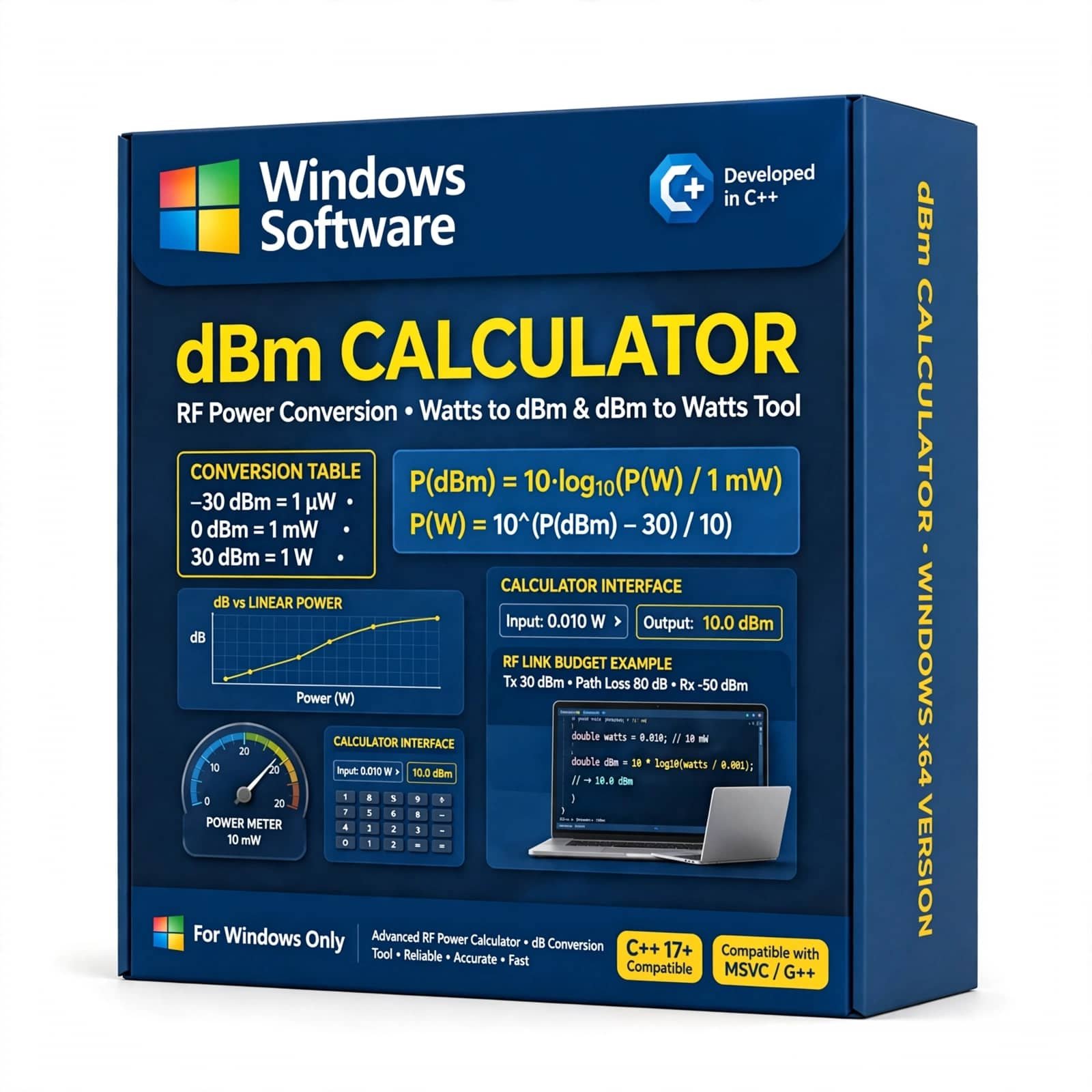
dBm Calculator Using C++ is a practical software tool for calculating and converting radio frequency and electrical power values in dBm. It helps students, researchers, and communication engineers understand power measurements, signal strength, dBm-to-watt conversions, and RF calculations through a simple C++ implementation.
Original price was: ₹750.00.₹100.00Current price is: ₹100.00. -
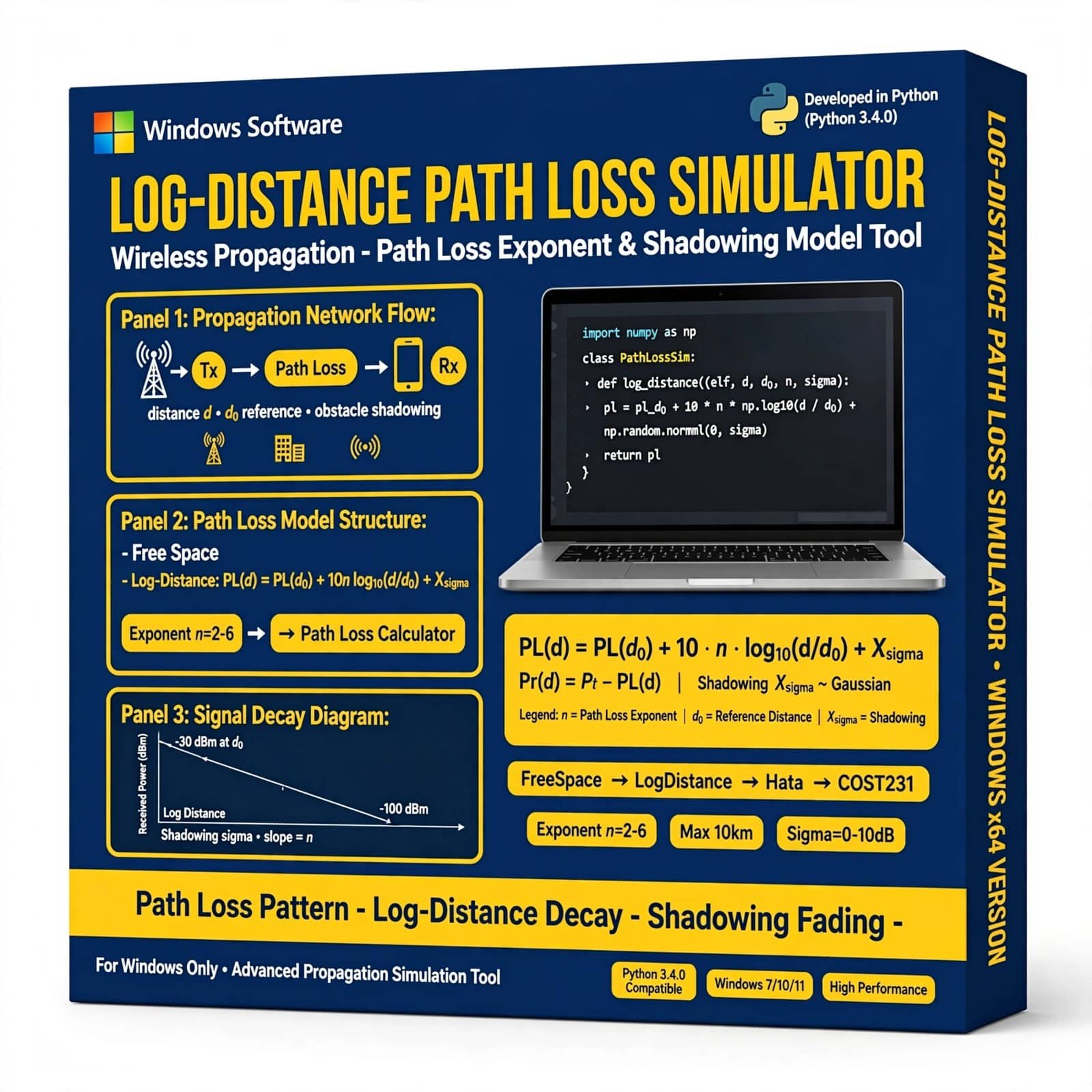
The Log-Distance Path Loss Simulator is a powerful wireless communication simulation tool designed to analyze and visualize signal attenuation over distance. It helps students, researchers, engineers, and RF professionals understand path loss, received signal strength, wireless propagation, and network performance using the log-distance path loss model. Ideal for academic projects, RF research, wireless network analysis, and communication system simulations.
₹6,999.00 -
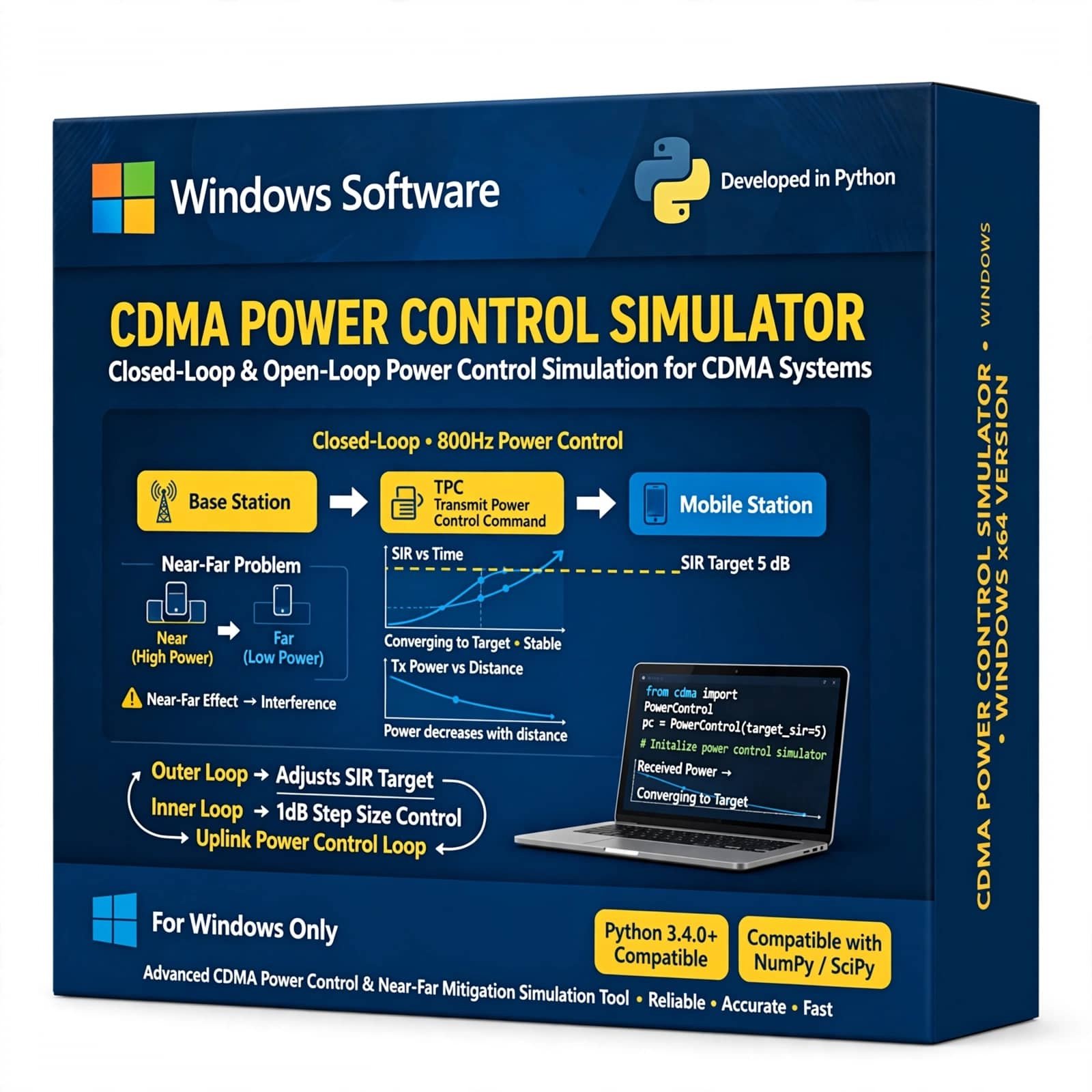
CDMA Power Control Simulator is an advanced communication engineering simulation tool designed to help students, researchers, and professionals understand and analyze power control techniques in Code Division Multiple Access (CDMA) wireless communication systems. It enables practical study of uplink and downlink power control, signal interference, power levels, and system performance.
₹3,999.00 -
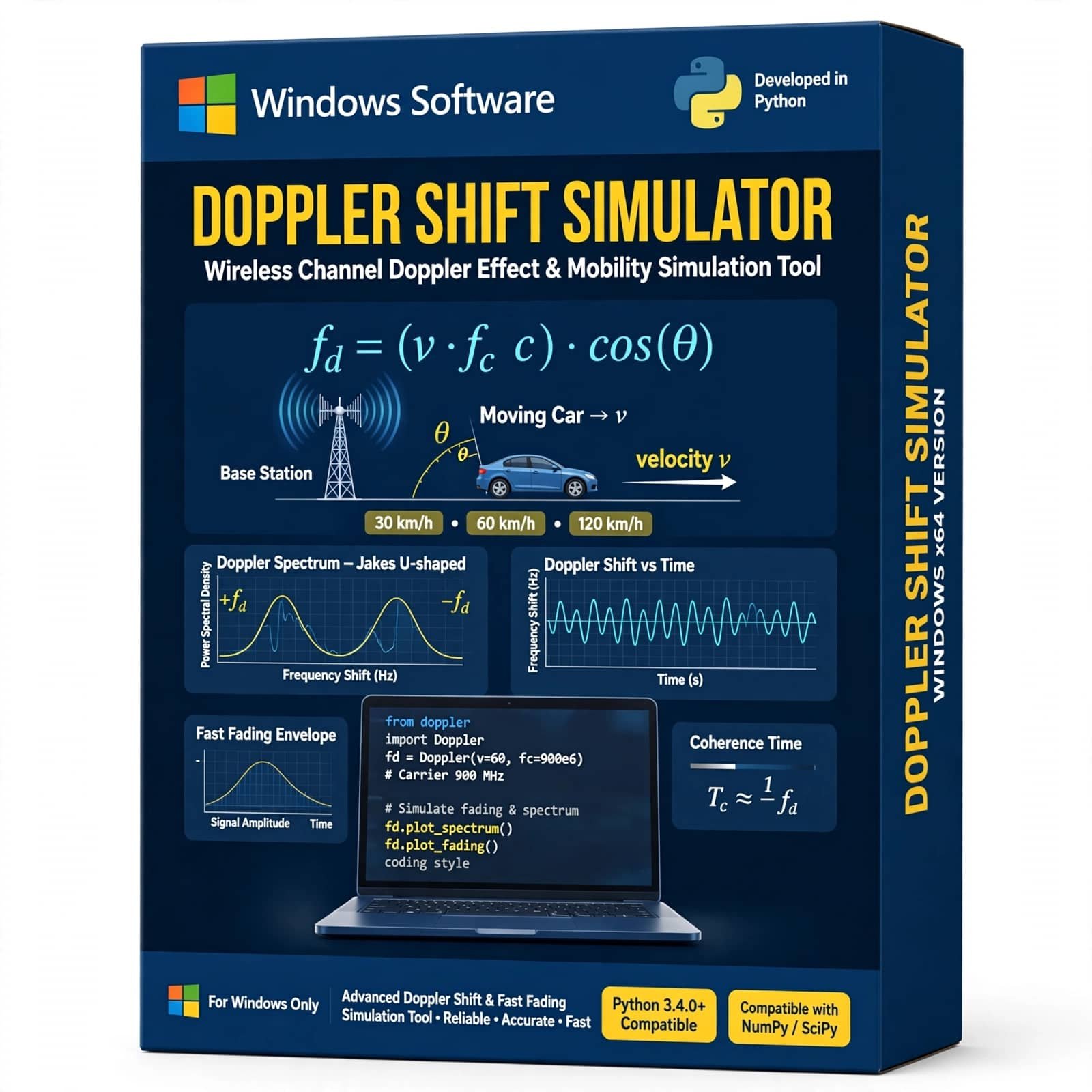
Doppler Shift Simulator Using Python is a practical wireless communication simulation tool for studying the Doppler effect and frequency shift caused by relative motion between a transmitter and receiver. It helps students, researchers, and communication engineers analyze Doppler frequency, carrier frequency, velocity, and mobile channel effects through Python-based simulation.
Original price was: ₹6,999.00.₹2,499.00Current price is: ₹2,499.00. -
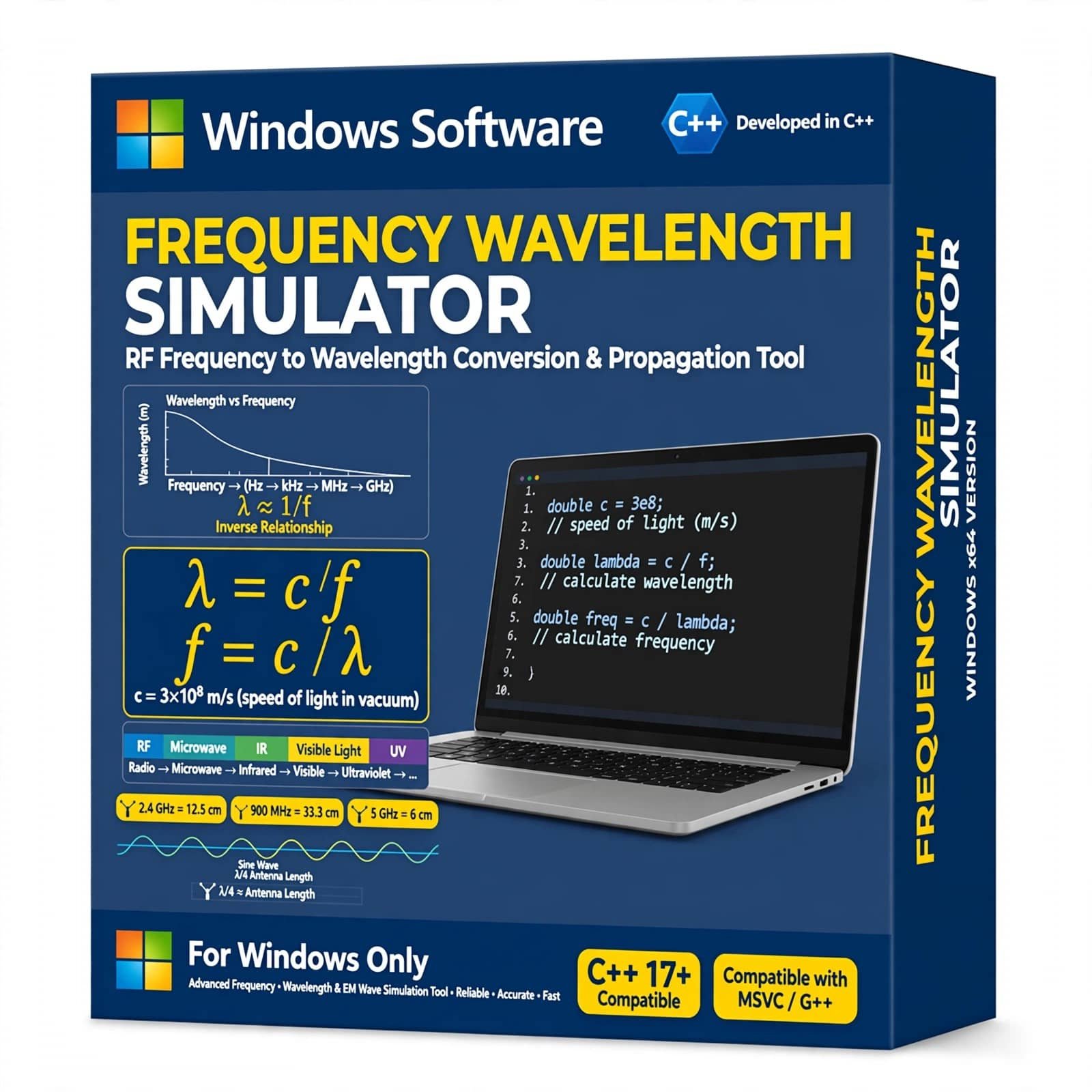
Frequency Wavelength Simulator with C++ is a practical simulation project designed to calculate and analyze the relationship between frequency, wavelength, and wave velocity. Developed using C++, this project provides an easy way to understand fundamental concepts of electromagnetic and communication waves through computer-based calculations.
It is ideal for B.Tech, M.Tech, ECE, electronics, telecommunication, physics, and engineering students looking for a useful C++ academic project. The simulator can be used to calculate wavelength from frequency, explore different frequency values, and understand how frequency and wavelength are related in wireless communication and electromagnetic wave propagation.
₹1,999.00 -
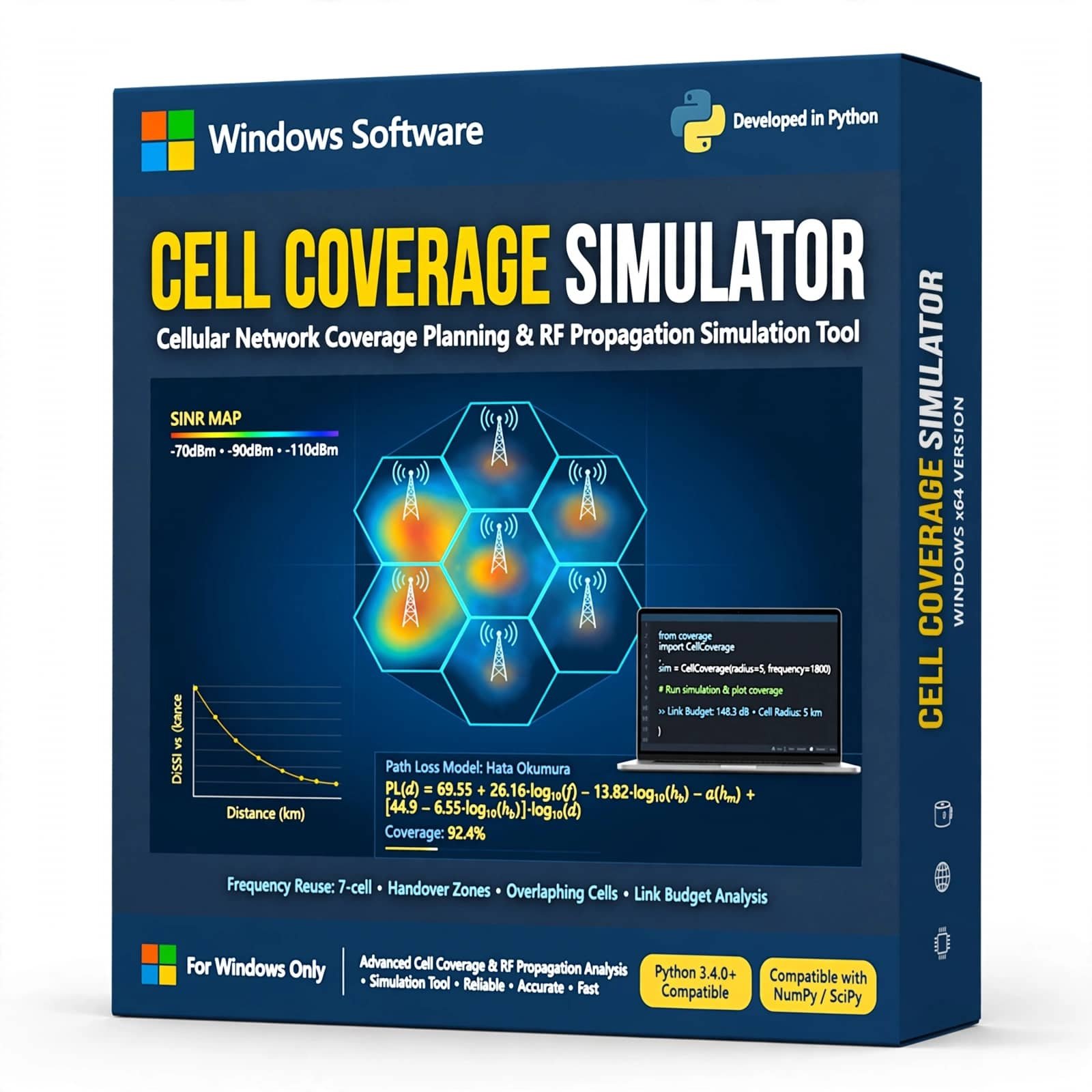
Cell Coverage Simulator is a wireless communication simulation tool designed to model and analyze cellular network coverage using Python. It helps students, researchers, and telecom professionals visualize cell coverage, signal propagation, coverage areas, and network planning concepts through practical simulation and analysis.
₹6,999.00


Reviews
There are no reviews yet.