
New
67% Off

EDGE Simulator

Original price was: ₹750.00.₹250.00Current price is: ₹250.00.
In StockEDGE Simulator Using Python is a practical mobile communication simulation tool designed to demonstrate and analyze Enhanced Data rates for GSM Evolution (EDGE) technology. It helps students, researchers, and communication engineers study GSM/EDGE data transmission, modulation, channel conditions, bit error rate, data rates, and wireless communication performance using Python-based simulation.
Description
EDGE Simulator
The EDGE Simulator Using Python is an educational and simulation-based project designed to help students, researchers, educators, and communication engineers understand the fundamental principles of Enhanced Data rates for GSM Evolution (EDGE) technology. It provides a practical environment for studying packet-based mobile communication, digital modulation, wireless channel behavior, data transmission, and communication-system performance through Python-based simulation.
EDGE, also known as Enhanced GPRS (EGPRS), was introduced as an enhancement to GSM/GPRS networks to provide higher data rates and improved packet data performance. It represents an important stage in the evolution of mobile communication technologies between traditional GSM/GPRS systems and later generations of mobile broadband networks.
The EDGE Simulator Using Python provides a convenient way to explore the basic concepts behind EDGE communication without requiring a physical cellular network or specialized telecommunications hardware.
Understand EDGE Mobile Communication
EDGE technology improves GSM packet data capabilities through enhanced modulation and coding techniques. One of the important technologies associated with EDGE is 8-PSK (8-Phase Shift Keying), which enables more bits to be transmitted per symbol compared with the GMSK modulation traditionally associated with GSM.
Through simulation, users can study how modulation, channel conditions, noise, and transmission parameters can influence the performance of a wireless communication system.
The Python EDGE Simulator can therefore be used as a practical learning platform for understanding concepts related to GSM, GPRS, EDGE, packet data transmission, modulation techniques, wireless channels, and mobile communication.
Python-Based EDGE Simulation
Python is widely used for scientific computing, communication-system modeling, signal processing, and data analysis. Implementing an EDGE simulation using Python allows students to combine programming skills with telecommunications concepts.
The project can demonstrate how communication-system parameters can be represented computationally and how simulation results can be analyzed under different conditions.
Students can experiment with different inputs and observe their effects on parameters such as data transmission, signal quality, modulation performance, and error rates. This makes the project suitable for both Python programming education and mobile communication laboratory applications.
Key Features and Simulation Capabilities
Depending on the implementation and configured modules, the EDGE Simulator Using Python can be used to explore a range of mobile communication concepts, including:
- EDGE network fundamentals
- GSM and GPRS concepts
- Enhanced GPRS operation
- EDGE data transmission
- 8-PSK modulation
- GMSK modulation concepts
- Digital signal transmission
- Wireless channel modeling
- Additive noise effects
- Bit error rate analysis
- Signal-to-noise ratio analysis
- Data-rate comparison
- Modulation performance
- Packet-based communication concepts
- Python-based communication simulation
These capabilities provide students with a practical way to understand how enhanced GSM packet data technology works and how different communication parameters influence system performance.

Study 8-PSK Modulation
One of the key concepts associated with EDGE is 8-PSK modulation. Compared with binary modulation schemes, 8-PSK can represent more bits per symbol, allowing higher data rates under suitable channel conditions.
The simulator can provide an opportunity to study the basic principles of 8-PSK and understand how digital information can be mapped onto different signal phases.
Students can use simulation results to investigate how modulation choices affect communication performance and how noise and channel conditions can influence the received signal.
Explore GSM, GPRS, and EDGE Evolution
EDGE is part of the evolution of GSM-based mobile communication technology. Studying EDGE provides useful context for understanding the progression from GSM voice services to packet-based mobile data.
The simulator can help learners understand the relationship between:
- GSM
- GPRS
- EGPRS
- EDGE
- 2G packet data
- Mobile data communication
This historical and technical perspective is useful for students studying mobile communication, cellular networks, telecommunications, and wireless communication engineering.
Analyze Wireless Channel Performance
Wireless signals can experience noise, fading, interference, and other channel impairments during transmission. These factors can affect the quality and reliability of received data.
The EDGE Simulator Using Python can be used to model selected channel conditions and analyze how these conditions influence communication performance. Users can study parameters such as signal-to-noise ratio (SNR), bit error rate (BER), received signal quality, and transmission reliability.
Such experiments provide practical insight into the challenges involved in transmitting digital information over wireless channels.
Study Bit Error Rate
Bit Error Rate (BER) is an important performance measurement in digital communication systems. It indicates the number of incorrectly received bits compared with the total number of transmitted bits.
By incorporating BER analysis into an EDGE simulation, users can study how communication performance changes under different noise or channel conditions.
This makes the simulator particularly useful for laboratory experiments involving digital modulation, wireless channels, communication performance, and error analysis.
Educational and Laboratory Applications
The EDGE Simulator Using Python can be used by engineering colleges, universities, telecommunications laboratories, research institutions, and technical training organizations.
It can support:
- Mobile communication laboratory experiments
- GSM and EDGE demonstrations
- Python programming projects
- Digital communication experiments
- Wireless communication projects
- Telecommunications assignments
- Final-year engineering projects
- Mini projects
- Communication-system research
- Classroom demonstrations
Students can use the simulator to connect theoretical concepts with practical experimentation and simulation-based analysis.
Benefits of EDGE Simulation
A software-based EDGE simulation provides a flexible and cost-effective method for studying mobile communication technology. Users can modify parameters, repeat experiments, compare scenarios, and analyze system behavior without deploying an actual GSM/EDGE network.
The EDGE Simulator Using Python can help users:
- Understand the fundamentals of EDGE technology.
- Learn the relationship between GSM, GPRS, and EDGE.
- Study packet-based mobile communication.
- Understand 8-PSK modulation.
- Explore wireless data transmission.
- Analyze BER and SNR.
- Study the impact of noise and channel conditions.
- Experiment with communication parameters.
- Develop Python programming skills.
- Support wireless communication laboratory work.
- Build academic and final-year projects.
Suitable for Academic and Final-Year Projects
The project is particularly useful for students working on Python-based mobile communication projects, GSM/EDGE projects, wireless communication projects, digital communication projects, and telecommunications engineering projects.
The basic simulator can also be extended with additional functionality such as different modulation schemes, fading-channel models, packet-error analysis, adaptive modulation and coding, throughput analysis, graphical signal visualization, and comparative studies between GSM, GPRS, and EDGE.
These extensions can transform the project into a more comprehensive mobile communication simulation platform.
Learn Mobile Data Communication
The transition from traditional GSM services toward packet-based technologies such as GPRS and EDGE represents an important development in mobile communications. Studying these technologies provides learners with a foundation for understanding later generations of cellular networks.
The EDGE Simulator Using Python allows users to explore these concepts through practical simulation, helping bridge the gap between theoretical telecommunications concepts and computational implementation.
Conclusion
The EDGE Simulator Using Python provides a practical platform for learning and analyzing the fundamental concepts of Enhanced Data rates for GSM Evolution. It enables students and researchers to explore EDGE data transmission, GSM/GPRS evolution, 8-PSK modulation, wireless channel effects, BER, SNR, and mobile communication performance through Python-based simulation.
Whether used for a mobile communication laboratory, Python programming project, GSM/EDGE experiment, digital communication course, telecommunications project, or final-year engineering project, the EDGE Simulator Using Python provides an effective way to study the principles and performance of enhanced GSM packet data communication.
Related products
-
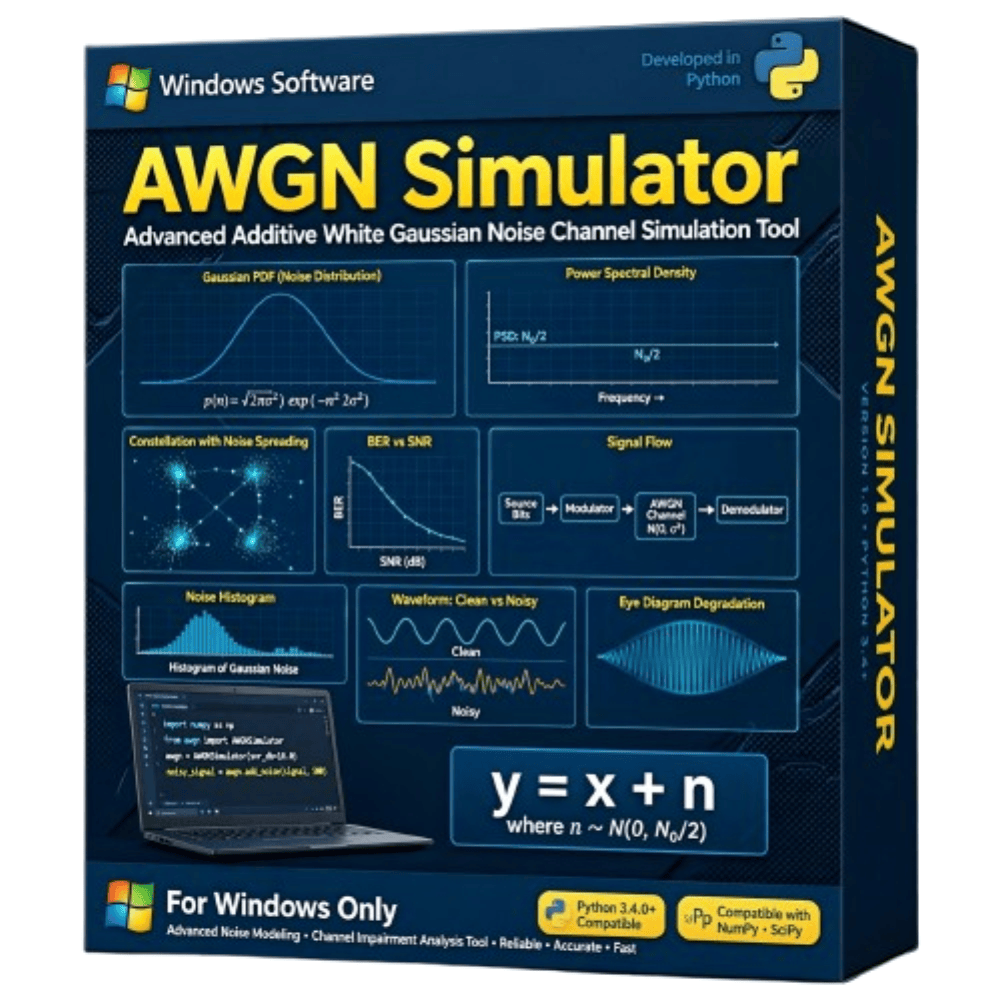
An AWGN Simulator i.e. Additive White Gaussian Noise Simulator developed using Python is a software-based tool designed to demonstrate and analyze the effect of Gaussian noise on digital communication signals. The simulator generates a clean input signal, adds controlled amounts of AWGN, and displays both the original and noisy signals for comparison. Users can vary parameters such as noise power, signal-to-noise ratio (SNR), and signal characteristics to observe how communication quality changes under different noise conditions. Python libraries such as NumPy, SciPy, and Matplotlib can be used for signal generation, noise modeling, numerical processing, and graphical visualization but this is purely from tkinter only. The simulator is useful for understanding fundamental concepts of wireless and digital communication systems.
Original price was: ₹750.00.₹250.00Current price is: ₹250.00. -
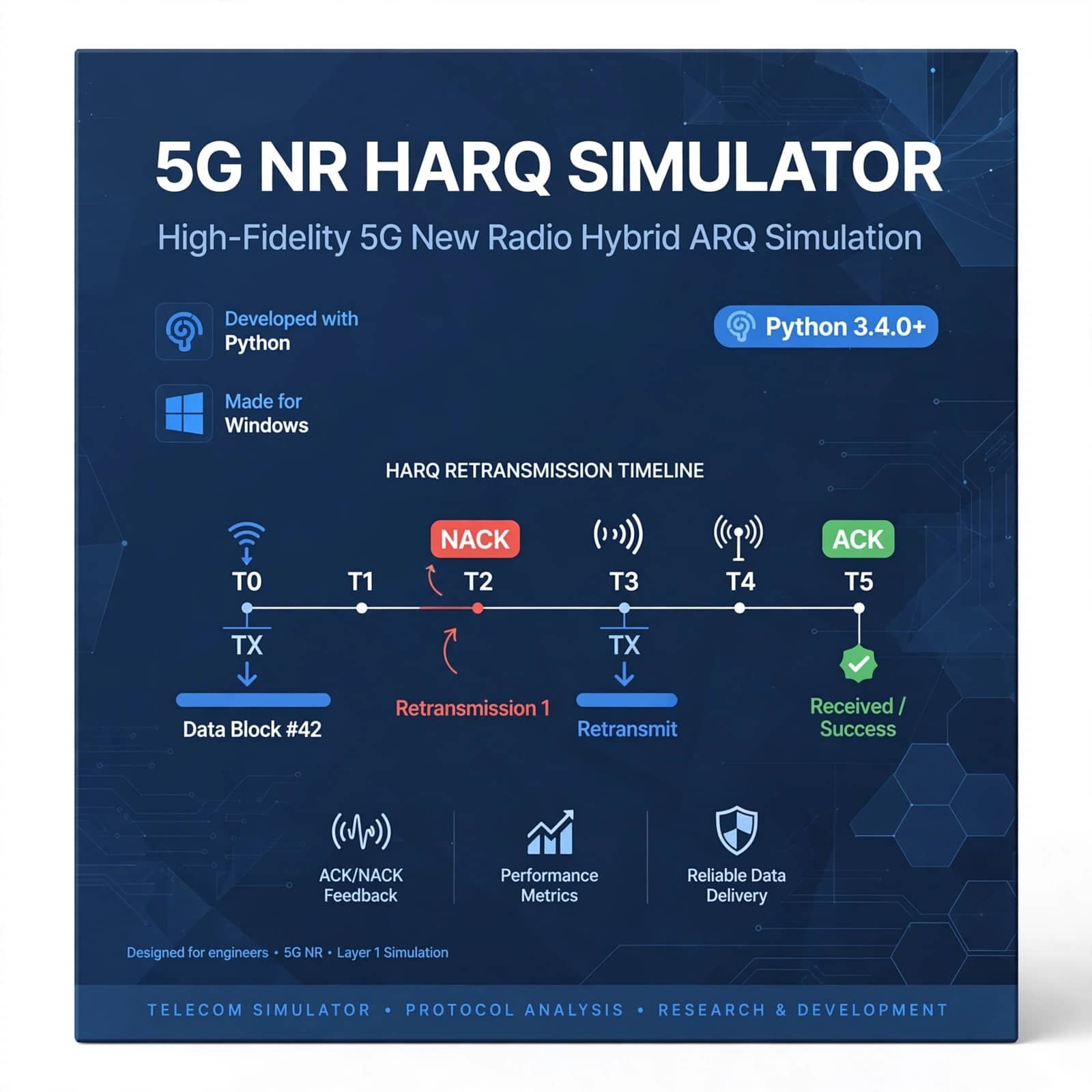
5G NR HARQ Simulator is an advanced simulation solution for modeling and analyzing Hybrid Automatic Repeat Request (HARQ) mechanisms in 5G New Radio networks. It enables users to study HARQ processes, ACK/NACK feedback, retransmissions, link adaptation, channel errors, and communication reliability under configurable network conditions. The simulator supports analysis of throughput, BLER, latency, retransmission rate, packet errors, spectral efficiency, and other key performance metrics, making it suitable for 5G NR research, algorithm development, academic projects, and wireless communication system optimization.
Original price was: ₹750.00.₹250.00Current price is: ₹250.00. -
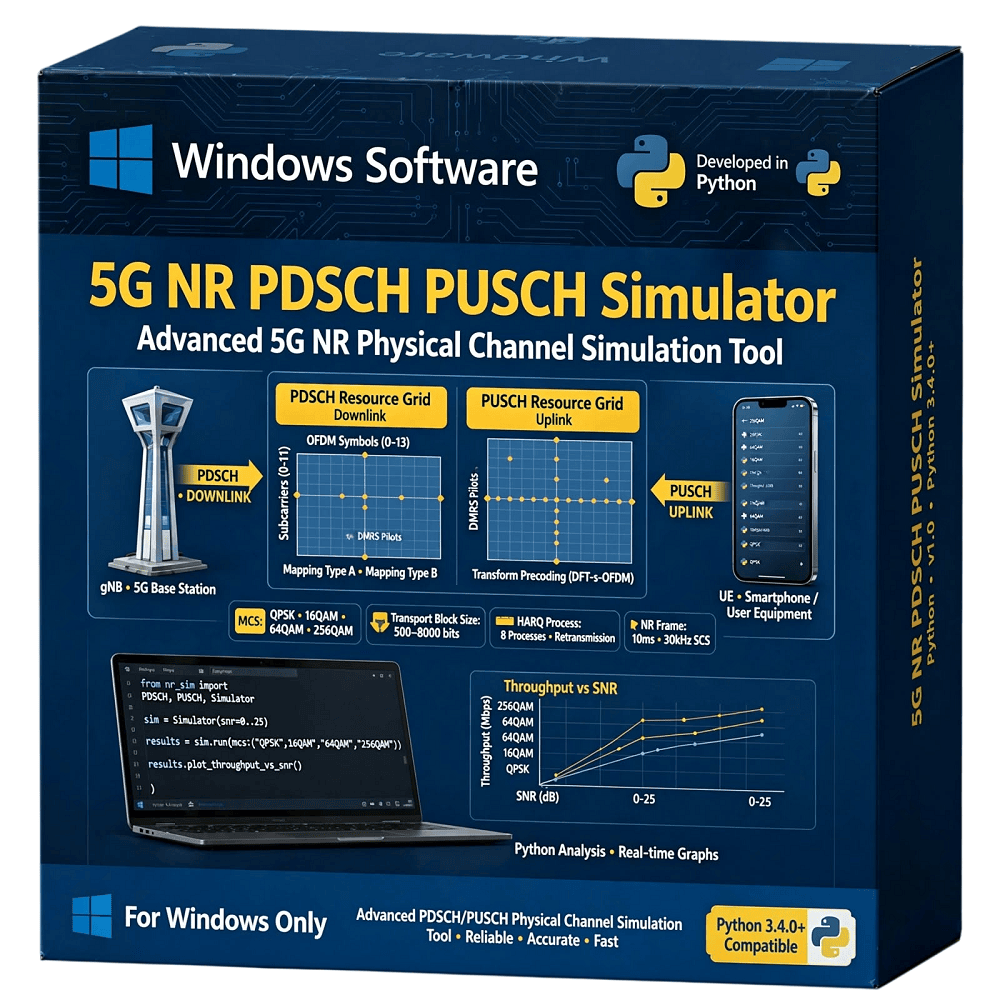
The 5G NR PDSCH PUSCH Simulator is a Python-based simulation software solution designed for researchers, engineers, students, and telecommunications professionals working with 5G New Radio (NR) physical-layer technologies. The simulator provides a practical environment for studying and experimenting with PDSCH (Physical Downlink Shared Channel) and PUSCH (Physical Uplink Shared Channel) transmission concepts.
Developed using Python, the simulator is suitable for academic research, algorithm development, demonstrations, testing, and educational applications related to 5G NR communication systems.
Available for sale as a software product. Contact us for product details, licensing, and purchase information.
Original price was: ₹750.00.₹250.00Current price is: ₹250.00. -
CDMA Power Control Simulator is an advanced communication engineering simulation tool designed to help students, researchers, and professionals understand and analyze power control techniques in Code Division Multiple Access (CDMA) wireless communication systems. It enables practical study of uplink and downlink power control, signal interference, power levels, and system performance.
Original price was: ₹750.00.₹250.00Current price is: ₹250.00. -
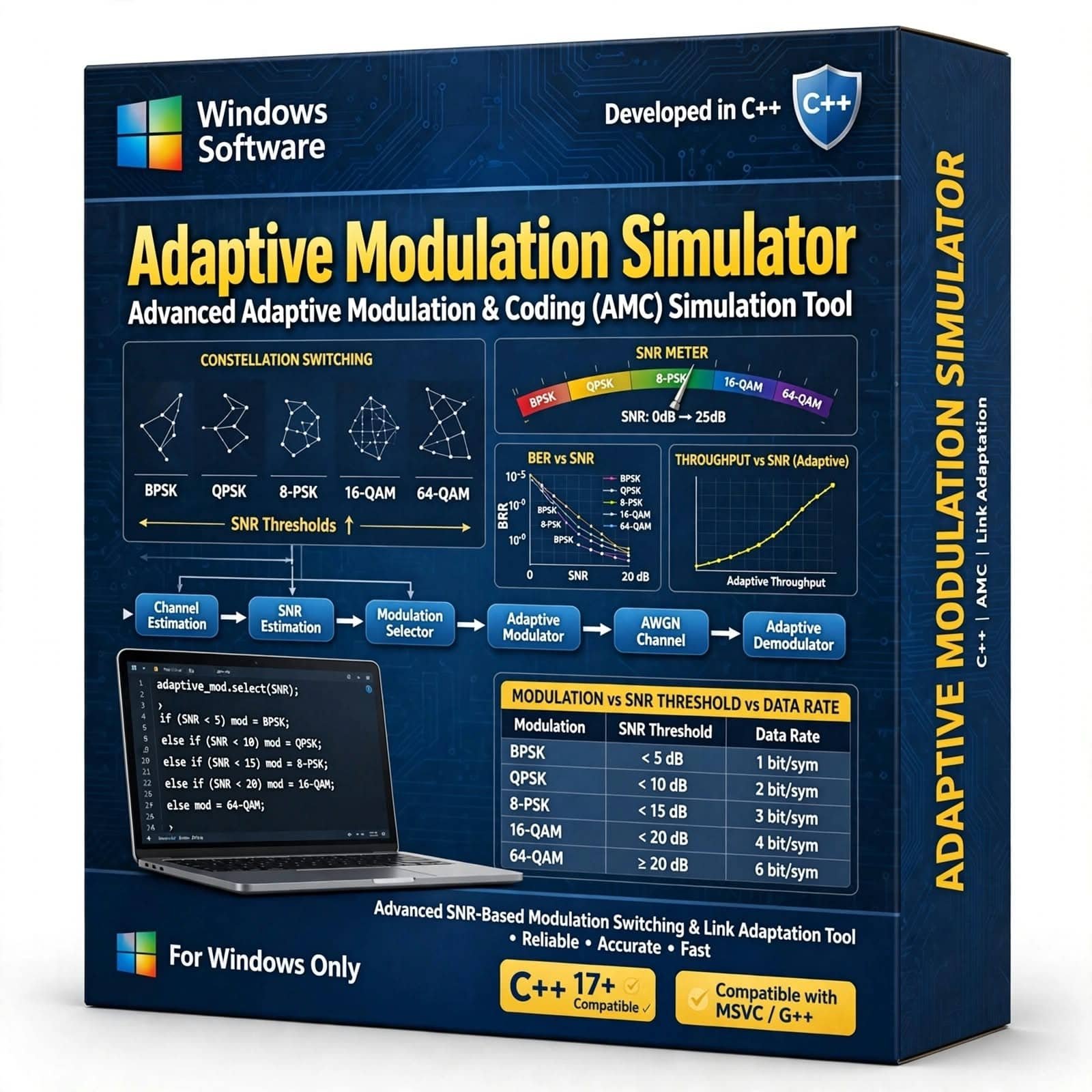
The Adaptive Modulation Simulator is a C++-based software solution designed for students, researchers, engineers, developers, and telecommunications professionals working with digital communication and adaptive modulation techniques. The simulator provides a practical environment for studying how modulation schemes can be selected or adapted according to communication-system conditions.
Developed using C++, the simulator is suitable for academic projects, digital communication research, laboratory demonstrations, signal-processing studies, algorithm development, and educational applications.
Available for sale as a software product. Contact us for pricing, licensing, technical specifications, customization, and purchase information.
Original price was: ₹750.00.₹250.00Current price is: ₹250.00. -
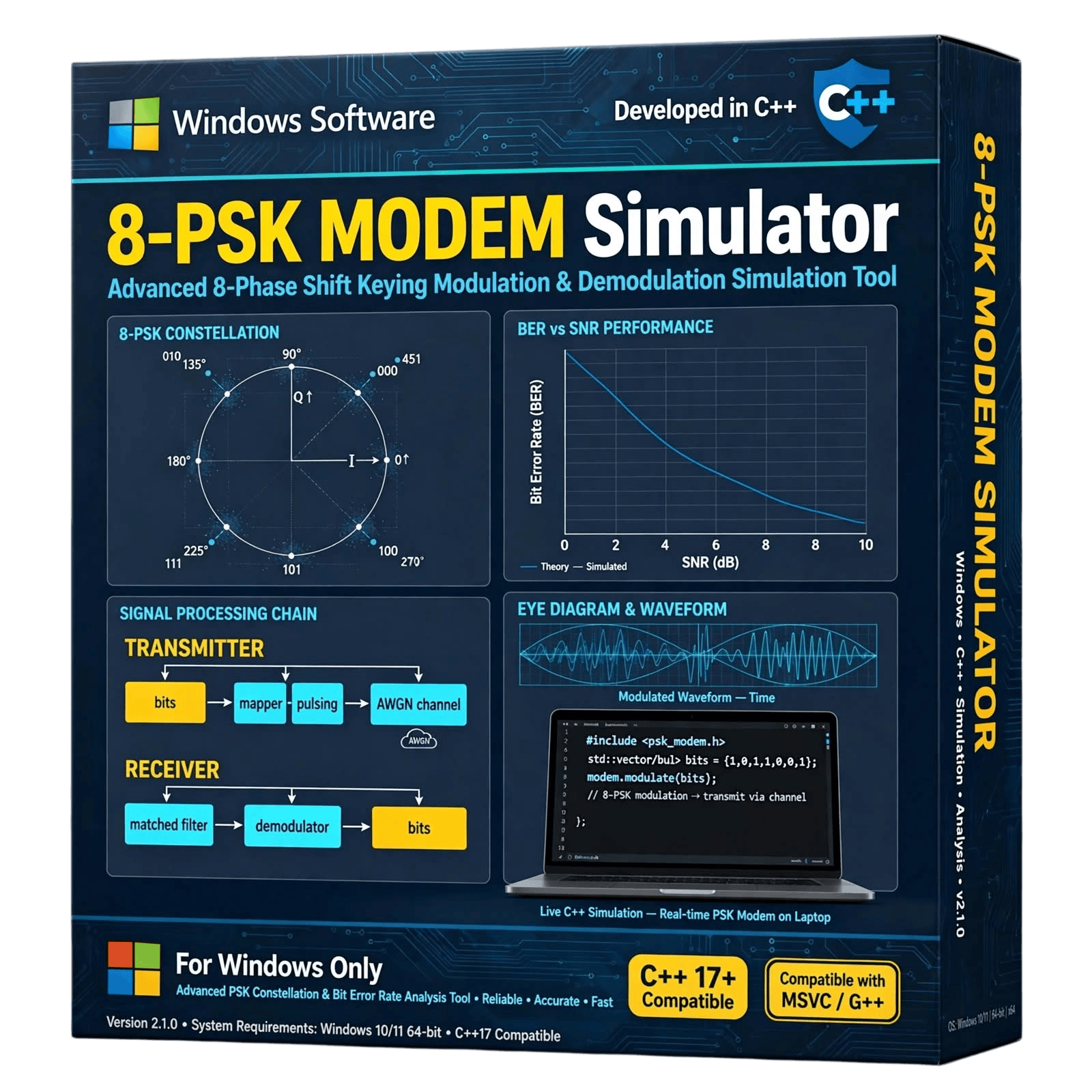
The 8-PSK Modem Simulator is a C++-based software solution designed for students, researchers, communication engineers, developers, and academic institutions working with digital communication and modulation techniques. The simulator provides a practical environment for studying 8-Phase Shift Keying (8-PSK) modulation and demodulation concepts.
Developed using C++, the simulator can be used for digital communication research, academic projects, laboratory demonstrations, signal-processing studies, experimentation, and educational purposes.
Available for sale as a software product. Contact us for pricing, licensing, technical specifications, customization, and purchase information.
Original price was: ₹750.00.₹250.00Current price is: ₹250.00.



Reviews
There are no reviews yet.