

Beamforming Simulator


₹1,999.00
In StockThe Beamforming Simulator is a practical wireless communication simulation project designed to demonstrate how antenna arrays can control and direct radio-frequency signals toward desired users or directions. The simulator helps visualize beam patterns, signal direction, antenna-array behavior, and beam steering under different parameters. It is suitable for studying beamforming, antenna arrays, MIMO, 5G communication, wireless networks, and signal processing. This project is ideal for engineering students, researchers, and learners working on wireless communication and advanced antenna technologies.
Description
Beamforming Simulator
The Beamforming Simulator is a practical software-based simulation project designed to demonstrate the principles and applications of beamforming in modern wireless communication systems. Beamforming is a signal-processing technique that uses multiple antennas to control the direction and strength of transmitted or received signals. By appropriately adjusting the phase and amplitude of signals across an antenna array, the system can focus energy toward a desired direction while reducing interference from unwanted directions.
This Beamforming Simulation Project provides an easy-to-understand environment for studying antenna-array behavior, beam steering, radiation patterns, and directional signal transmission. It can be useful for students, researchers, and communication engineers who want to explore beamforming concepts without requiring physical antenna-array hardware.
How the Beamforming Simulator Works
The simulator models a group of antennas arranged in an array. Signals are generated for individual antenna elements and combined using appropriate beamforming weights. By modifying the phase and amplitude of these signals, the simulator can steer the resulting beam toward a selected direction.
The simulation can generate and display beam patterns to show how the transmitted signal changes as the beam direction is modified. Users can experiment with different antenna configurations, steering angles, frequencies, and other parameters to understand how these factors influence the resulting radiation pattern.
The visualization of main lobes, side lobes, and nulls provides a practical understanding of how antenna arrays can be used to improve wireless communication performance.
Key Features
- Beamforming simulation for wireless communication systems
- Antenna-array modeling and analysis
- Adjustable beam-steering direction
- Visualization of antenna radiation patterns
- Analysis of main lobe and side lobe behavior
- Configurable number of antenna elements
- Signal phase and amplitude control
- Directional signal transmission simulation
- Suitable for MIMO and 5G communication studies
- Easy to customize and extend
- Useful for academic and research applications

Applications
The Beamforming Simulator can be used for a wide range of educational and research applications, including:
- Beamforming and antenna-array projects
- Wireless communication simulations
- 5G and next-generation communication studies
- MIMO communication projects
- Antenna radiation-pattern analysis
- Signal-processing projects
- Wireless network research
- RF and communication engineering projects
- B.Tech and BE engineering projects
- M.Tech and postgraduate research
- Academic demonstrations and laboratory experiments
Educational Benefits
This simulator helps users understand the relationship between antenna arrays and directional wireless signal transmission. Instead of studying beamforming only through mathematical equations, users can modify simulation parameters and observe the resulting beam pattern.
The project can help demonstrate important concepts such as beam steering, antenna gain, array factor, main lobe, side lobes, null formation, interference reduction, and spatial signal processing. It provides a practical foundation for students interested in wireless communication, antennas, RF engineering, and signal processing.
Beamforming and Modern Wireless Communication
Beamforming is an important technology in modern wireless communication systems, particularly in MIMO and 5G networks. Multiple antennas can be used to direct signal energy toward specific users, potentially improving coverage, signal quality, and spectral efficiency.
The Beamforming Simulator can therefore serve as a useful starting point for understanding advanced wireless technologies. Depending on the implementation, the project can be extended to simulate multiple users, adaptive beamforming, interference management, beam tracking, and multi-antenna communication scenarios.
Customization and Extension
The simulator can be customized to support different antenna-array configurations, frequencies, steering angles, and channel conditions. Advanced versions can include adaptive beamforming, digital beamforming, analog beamforming, hybrid beamforming, MIMO systems, multi-user beamforming, and beamforming optimization.
Additional performance measurements can also be incorporated to evaluate signal strength, interference levels, beamwidth, antenna gain, and communication quality under different operating conditions.
Why Choose This Beamforming Simulator?
The Beamforming Simulator combines wireless communication theory with practical simulation and visualization. It is suitable for users looking for a Beamforming Simulation Project, 5G project, MIMO project, antenna-array simulator, wireless communication project, or signal-processing project.
Because the project is software-based, users can experiment with different configurations without requiring specialized RF or antenna hardware. It can also be used as a foundation for developing more advanced wireless communication simulations.
Conclusion
The Beamforming Simulator provides a practical approach to understanding directional signal transmission using antenna arrays. Through configurable parameters and graphical beam-pattern visualization, the project demonstrates how beamforming can control signal direction and improve the efficiency of wireless communication systems.
It is suitable for engineering students, researchers, and developers interested in beamforming, antenna arrays, MIMO, 5G, wireless communication, RF engineering, and signal processing.
Related products
-
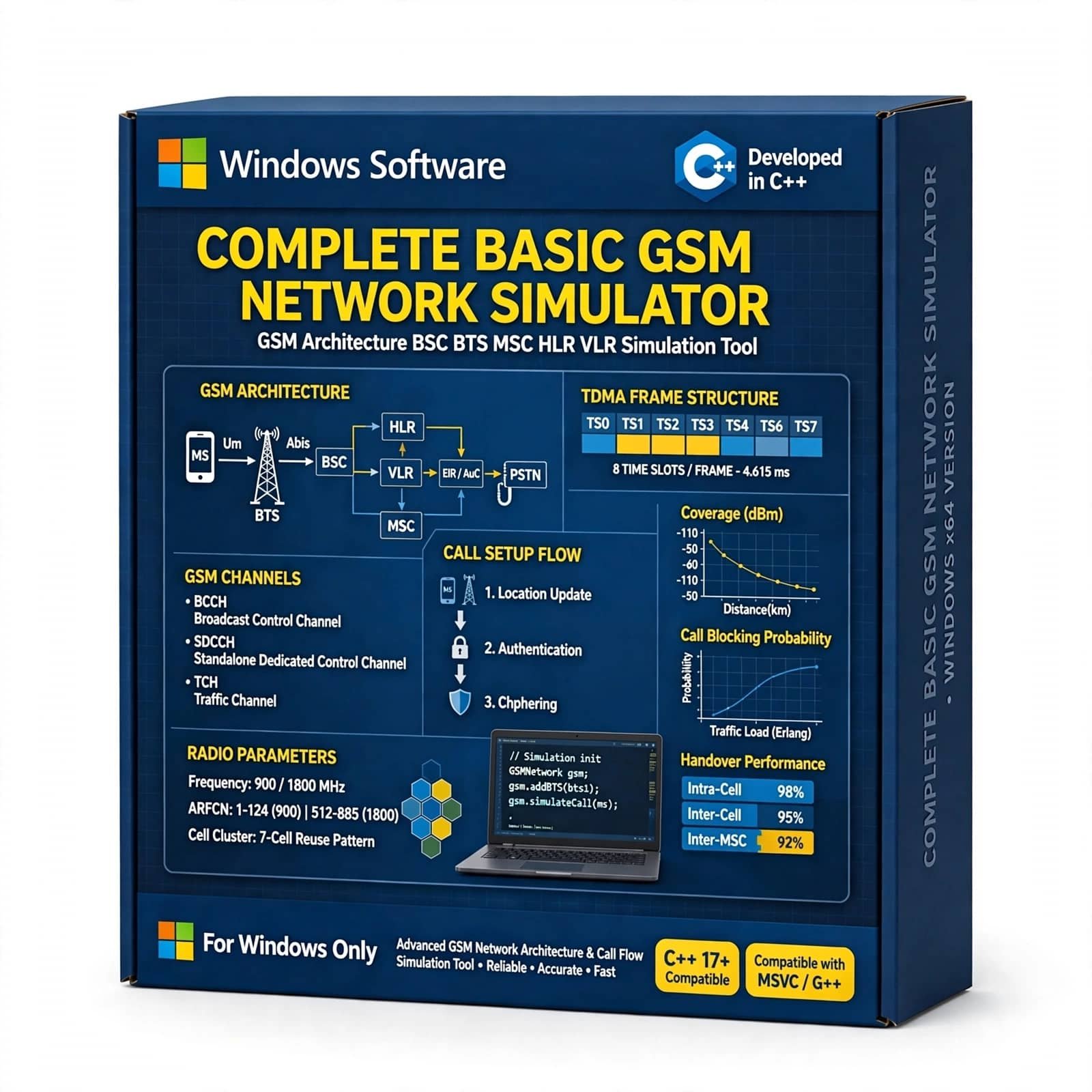
Complete Basic GSM Network with C++ is an educational and simulation-based project that demonstrates the fundamental architecture and operation of a GSM network using C++. It helps students and researchers understand GSM components, mobile communication, call and message handling, network signaling, and basic cellular network operations through a practical C++ implementation.
Original price was: ₹3,999.00.₹2,399.00Current price is: ₹2,399.00. -
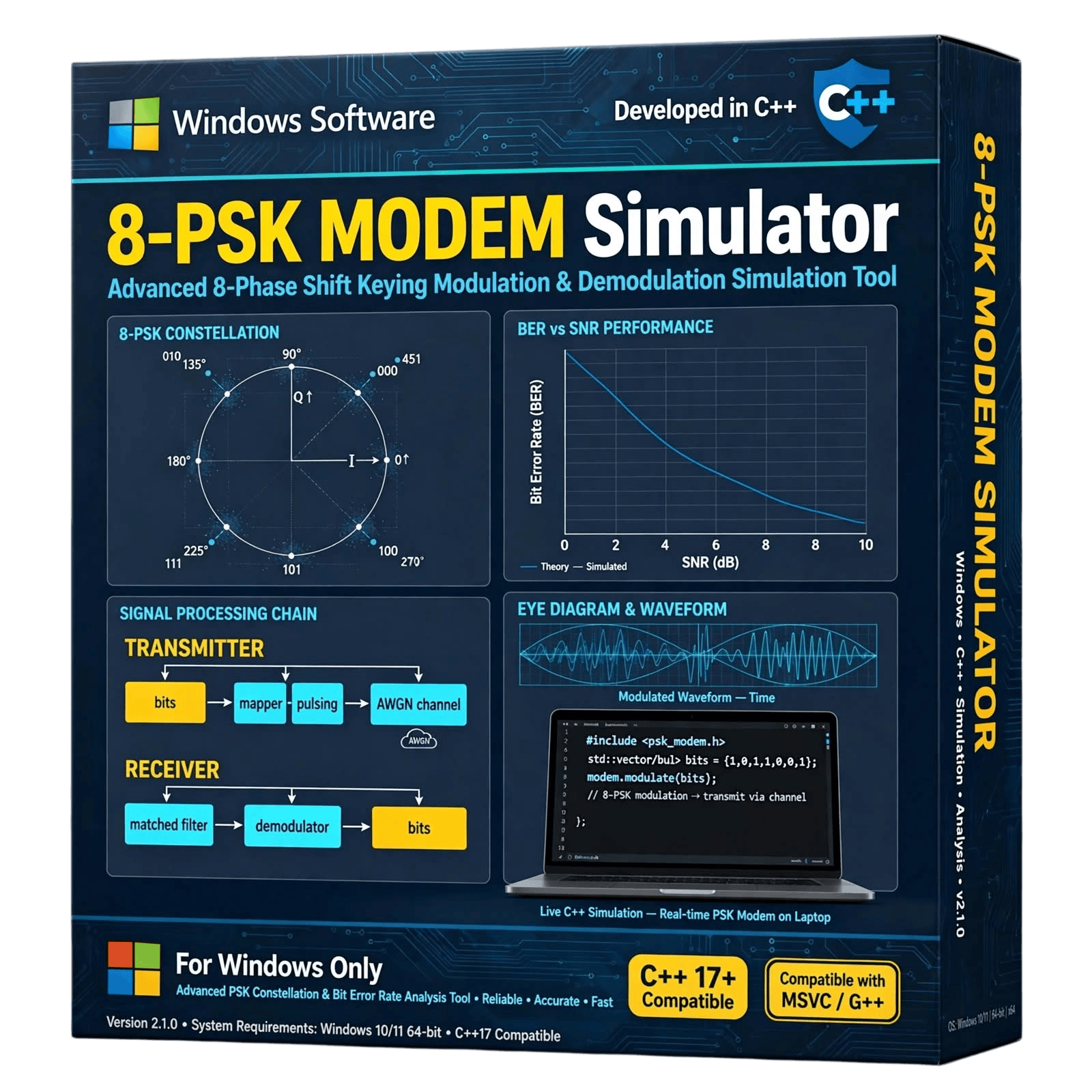
The 8-PSK Modem Simulator is a C++-based software solution designed for students, researchers, communication engineers, developers, and academic institutions working with digital communication and modulation techniques. The simulator provides a practical environment for studying 8-Phase Shift Keying (8-PSK) modulation and demodulation concepts.
Developed using C++, the simulator can be used for digital communication research, academic projects, laboratory demonstrations, signal-processing studies, experimentation, and educational purposes.
Available for sale as a software product. Contact us for pricing, licensing, technical specifications, customization, and purchase information.
₹1,999.00 -
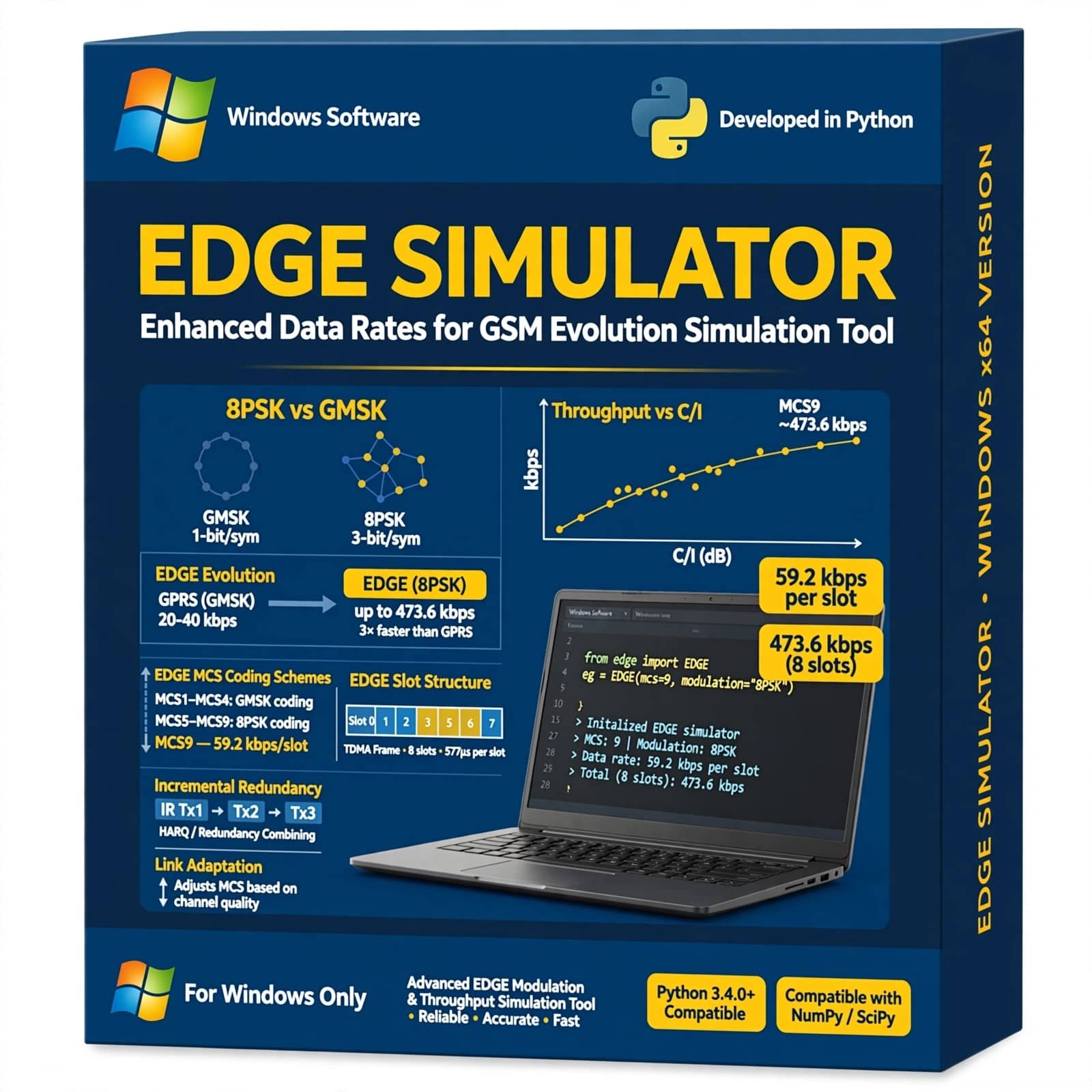
EDGE Simulator Using Python is a practical mobile communication simulation tool designed to demonstrate and analyze Enhanced Data rates for GSM Evolution (EDGE) technology. It helps students, researchers, and communication engineers study GSM/EDGE data transmission, modulation, channel conditions, bit error rate, data rates, and wireless communication performance using Python-based simulation.
₹3,499.00 -
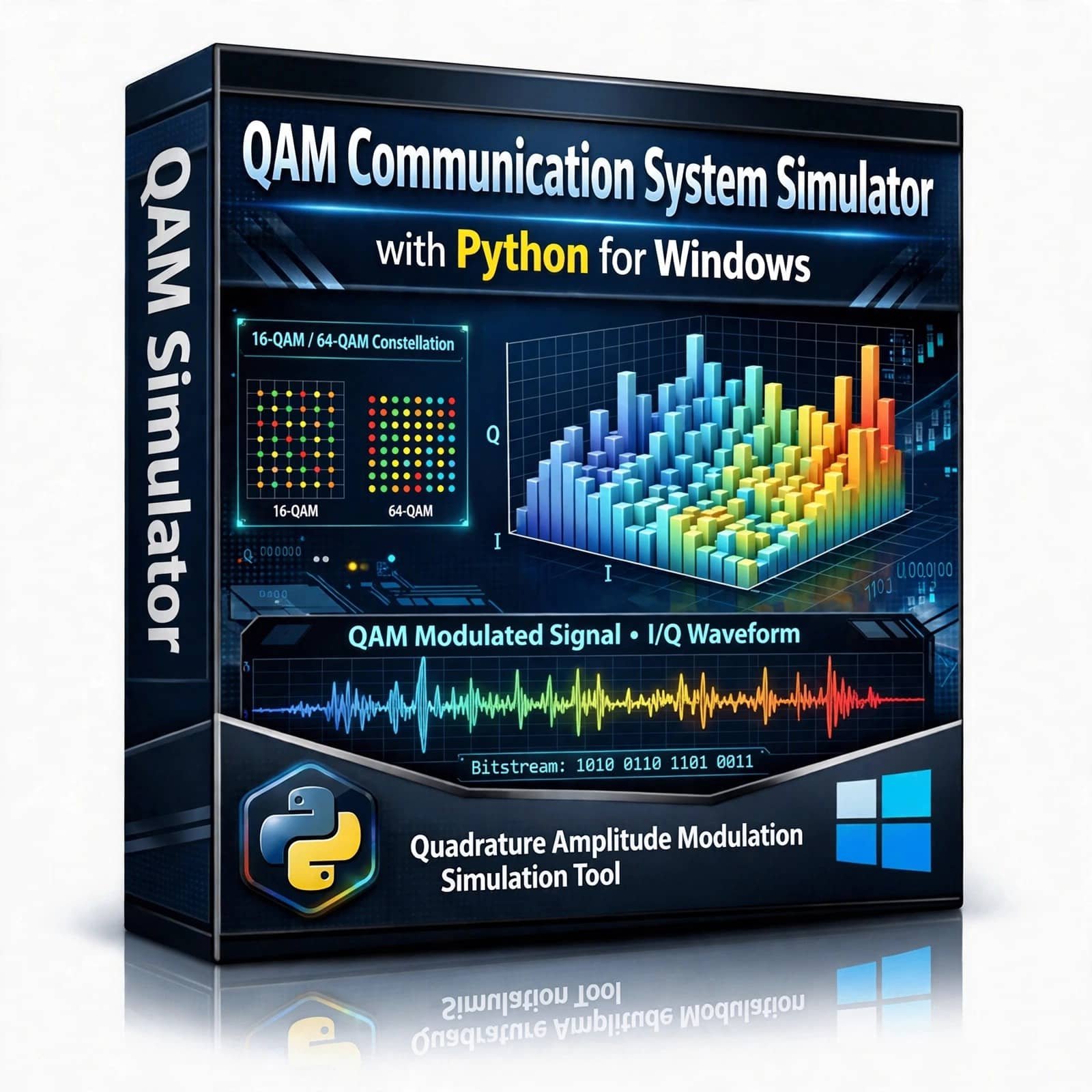
QAM Communication System Simulator – Explore and simulate Quadrature Amplitude Modulation (QAM) with this Python-based Communication System Simulator. Designed for students, researchers, and communication engineering enthusiasts, this project provides an interactive way to understand QAM modulation, signal transmission, noise effects, constellation diagrams, demodulation, and communication system performance using Python.
₹1,999.00 -
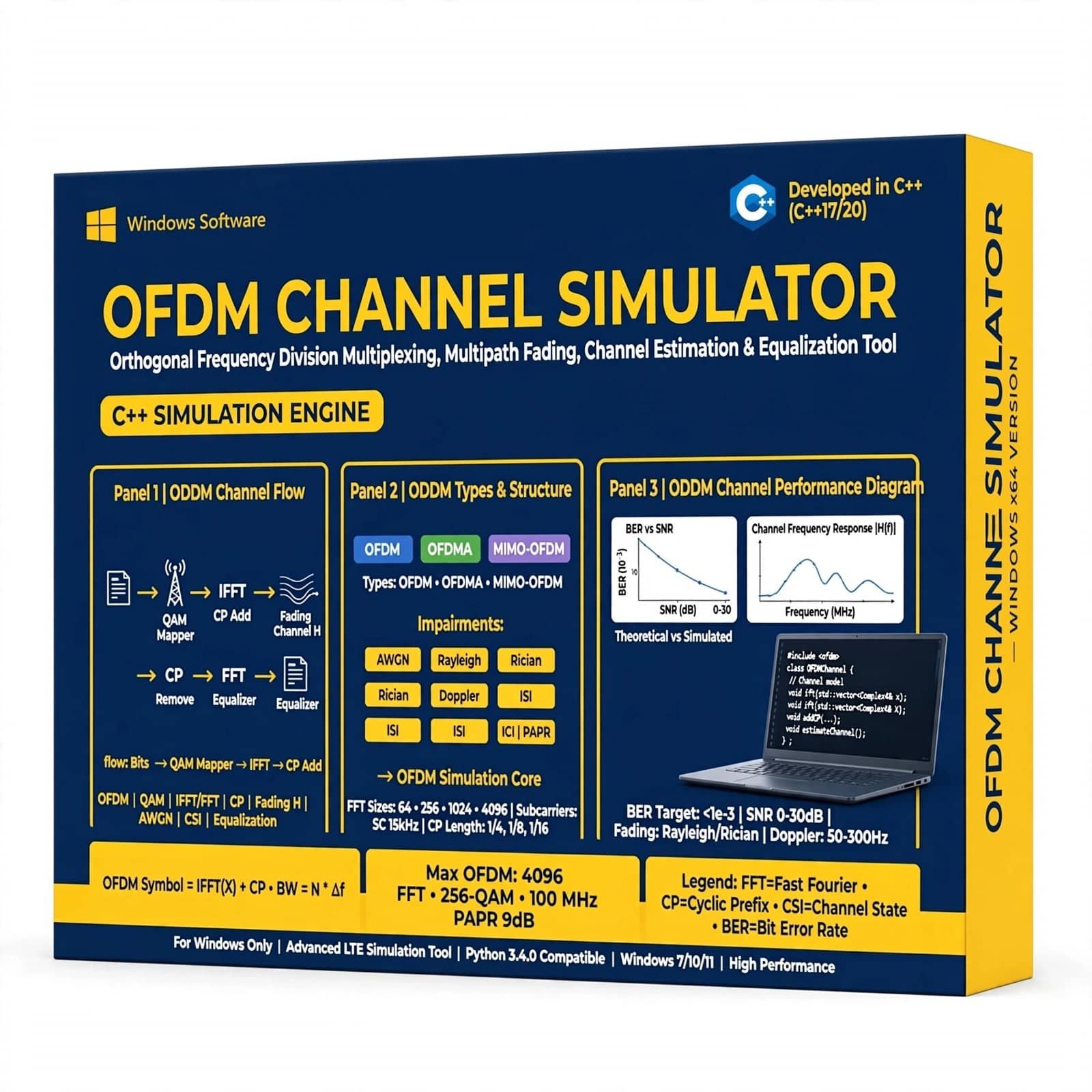
OFDM Channel Simulator – C++ Educational Software is an interactive simulation tool designed to help students, educators, researchers, and communication-engineering learners understand Orthogonal Frequency Division Multiplexing (OFDM) and wireless channel effects. Developed using C++, the simulator demonstrates FFT/IFFT processing, cyclic prefix, QPSK and QAM modulation, multipath channels, delay spread, channel frequency response, equalization, BER, EVM, and constellation diagrams through an intuitive graphical interface.
₹1,999.00 -
dBm Calculator Using C++ is a practical software tool for calculating and converting radio frequency and electrical power values in dBm. It helps students, researchers, and communication engineers understand power measurements, signal strength, dBm-to-watt conversions, and RF calculations through a simple C++ implementation.
Original price was: ₹750.00.₹100.00Current price is: ₹100.00.



Reviews
There are no reviews yet.