
New
67% Off

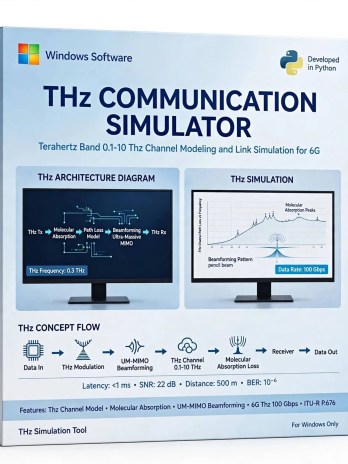
ISAC Simulator – 6G Sensing Results Application

Original price was: ₹750.00.₹250.00Current price is: ₹250.00.
In StockISAC Simulator – 6G Sensing Results Application with Python is a practical Python-based project for exploring 6G Integrated Sensing and Communication (ISAC), sensing results, wireless simulation, and next-generation communication technologies. Ideal for students, researchers, and developers working on 6G, signal processing, Python, wireless communication, and academic projects.
Description
ISAC Simulator – 6G Sensing Results Application
The ISAC Simulator – 6G Sensing Results Application with Python is a practical software project designed for students, researchers, developers, and wireless communication enthusiasts interested in 6G technology, Integrated Sensing and Communication (ISAC), sensing applications, and Python-based simulation. The project provides an application-oriented approach to exploring and presenting sensing results generated within next-generation wireless communication environments.
Integrated Sensing and Communication, commonly referred to as ISAC, is an emerging area of wireless technology that aims to combine communication and sensing capabilities within a shared system. As research into 6G networks continues, sensing is expected to play an important role in applications that require information about objects, environments, movement, location, and other physical characteristics.
The 6G Sensing Results Application provides a useful software platform for working with and understanding sensing-related simulation results. By using Python, the project can help learners connect programming concepts with wireless communication, signal processing, and next-generation sensing technologies.
What Is a 6G ISAC Sensing Application?
An ISAC sensing application focuses on the sensing capabilities of a wireless system while considering the interaction between sensing and communication functions. In an integrated system, wireless signals can potentially serve both communication and sensing purposes, creating opportunities for more efficient use of network infrastructure.
A sensing results application can help users examine, organize, visualize, or interpret information produced by a simulation. This makes it particularly useful for academic demonstrations and research projects where understanding simulation output is an important part of the development process.
The ISAC Simulator – 6G Sensing Results Application with Python is designed as a practical foundation for exploring these concepts through software rather than relying exclusively on theoretical study.
Learn 6G Sensing with Python
Python is widely used in scientific computing, data analysis, engineering, signal processing, and research applications. Its flexibility makes it suitable for developing simulation tools and applications that process and present technical results.
By combining Python with 6G ISAC sensing concepts, this project gives users an opportunity to explore the connection between software development and wireless technology. Students can study how a Python application can be used to work with sensing-related results and create a foundation for more advanced wireless simulation applications.
The project can be especially useful for students working on Python projects, 6G projects, wireless communication projects, ISAC projects, signal processing applications, and engineering research.
Key Features
- Python-based 6G ISAC application
- Focused on sensing results and simulation output
- Explores Integrated Sensing and Communication concepts
- Suitable for 6G wireless communication studies
- Useful for academic and research-oriented projects
- Provides a practical approach to understanding sensing applications
- Combines Python programming with wireless technology
- Suitable for simulation result analysis and presentation
- Can be extended with additional sensing functionality
- Useful as a foundation for advanced ISAC research and development
Why Use a 6G Sensing Results Application?
Simulation plays an important role in wireless communication research because it allows researchers and students to investigate technical concepts in a controlled software environment. Instead of immediately depending on physical hardware, users can study system behavior, examine results, and experiment with different configurations through software.
A dedicated 6G sensing results application can make simulation output easier to examine and understand. Depending on the implementation, sensing results may provide information that can be used to study aspects of a simulated environment, system performance, or sensing behavior.
Using Python for this type of application also creates opportunities for customization. Developers can potentially integrate additional data-processing methods, visualization techniques, analysis functions, or simulation parameters according to their requirements.
Understand Integrated Sensing and Communication
Traditional communication systems primarily focus on transferring information between users or devices. Sensing systems, on the other hand, can be used to obtain information about physical environments and objects.
ISAC brings these concepts together by investigating how the same wireless infrastructure or signals can support both communication and sensing functions. This creates an important area of research for future wireless networks.
The ISAC Simulator – 6G Sensing Results Application with Python provides an accessible way to explore the sensing side of this technology. It can help users understand how sensing results can be generated, processed, displayed, and studied within a software-based environment.

Suitable for Students and Researchers
This Python-based ISAC project is suitable for students from electronics and communication engineering, electrical engineering, computer science, information technology, telecommunications, and related technical disciplines.
It can be used for mini-projects, final-year projects, demonstrations, laboratory assignments, research prototypes, and educational presentations. Students can use the project to demonstrate how Python programming can be applied to an emerging wireless technology.
Researchers and developers can also use the project as a starting point for extending the application with additional algorithms, sensing parameters, data-processing methods, performance metrics, and visualization features.
Potential Applications
The project can support a variety of educational and research applications, including:
- 6G wireless communication projects
- Integrated Sensing and Communication research
- Python-based wireless simulation
- Sensing result visualization
- Signal processing projects
- Telecommunications research
- Wireless sensing experiments
- Academic demonstrations
- Engineering final-year projects
- Next-generation wireless technology studies
The application can also serve as a foundation for developing more advanced ISAC systems. Depending on project requirements, additional features can be incorporated to analyze sensing performance, compare simulation scenarios, process datasets, or visualize results.
Expand and Customize the Python Project
One of the advantages of developing an ISAC application with Python is the ability to customize and expand the software. Developers can potentially add new sensing scenarios, data-analysis methods, visualization components, simulation parameters, or performance calculations.
Additional Python libraries can also be incorporated where appropriate for numerical processing, data analysis, graphical representation, or scientific computation. This flexibility makes the project useful not only as a finished academic demonstration but also as a starting point for further experimentation.
Explore the Future of 6G Sensing
The development of 6G technologies is expanding research beyond traditional wireless communication. Integrated sensing, intelligent wireless environments, advanced signal processing, and resource-aware communication are important areas being explored for future networks.
The ISAC Simulator – 6G Sensing Results Application with Python provides a practical way to explore these concepts through software. It combines Python programming with 6G sensing and ISAC concepts, making it suitable for learners and researchers who want hands-on experience with next-generation wireless applications.
Whether you are developing a 6G academic project, exploring Integrated Sensing and Communication, learning Python-based simulation, or researching wireless sensing applications, this project provides a practical foundation for experimentation and further development.
ISAC Simulator – 6G Sensing Results Application with Python brings together Python programming, sensing results, wireless communication, and 6G ISAC concepts in an application designed for learning, simulation, research, and academic project development.
Related products
-
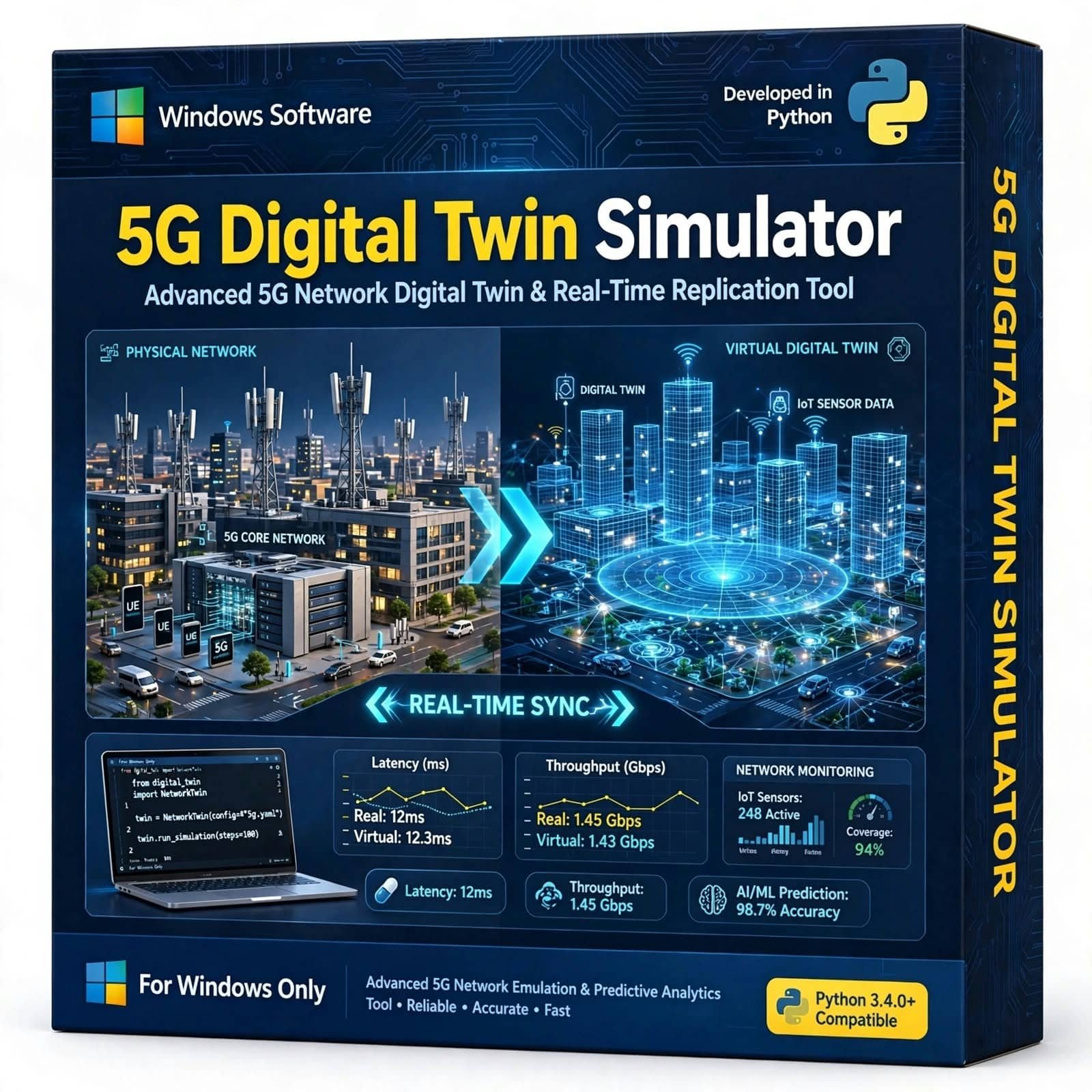
The 5G Digital Twin is a Python-based software solution designed for researchers, engineers, developers, students, and telecommunications professionals interested in modeling, simulating, and analyzing 5G communication networks and their real-world behavior in a virtual environment.
A digital twin provides a virtual representation of a physical or network system, enabling users to study system behavior, evaluate scenarios, analyze performance, and experiment with different configurations. Developed using Python, this 5G Digital Twin can support research, education, network analysis, experimentation, and proof-of-concept development.
Available for sale as a software product. Contact us for pricing, licensing, technical specifications, customization, and purchase information.
Original price was: ₹750.00.₹250.00Current price is: ₹250.00. -
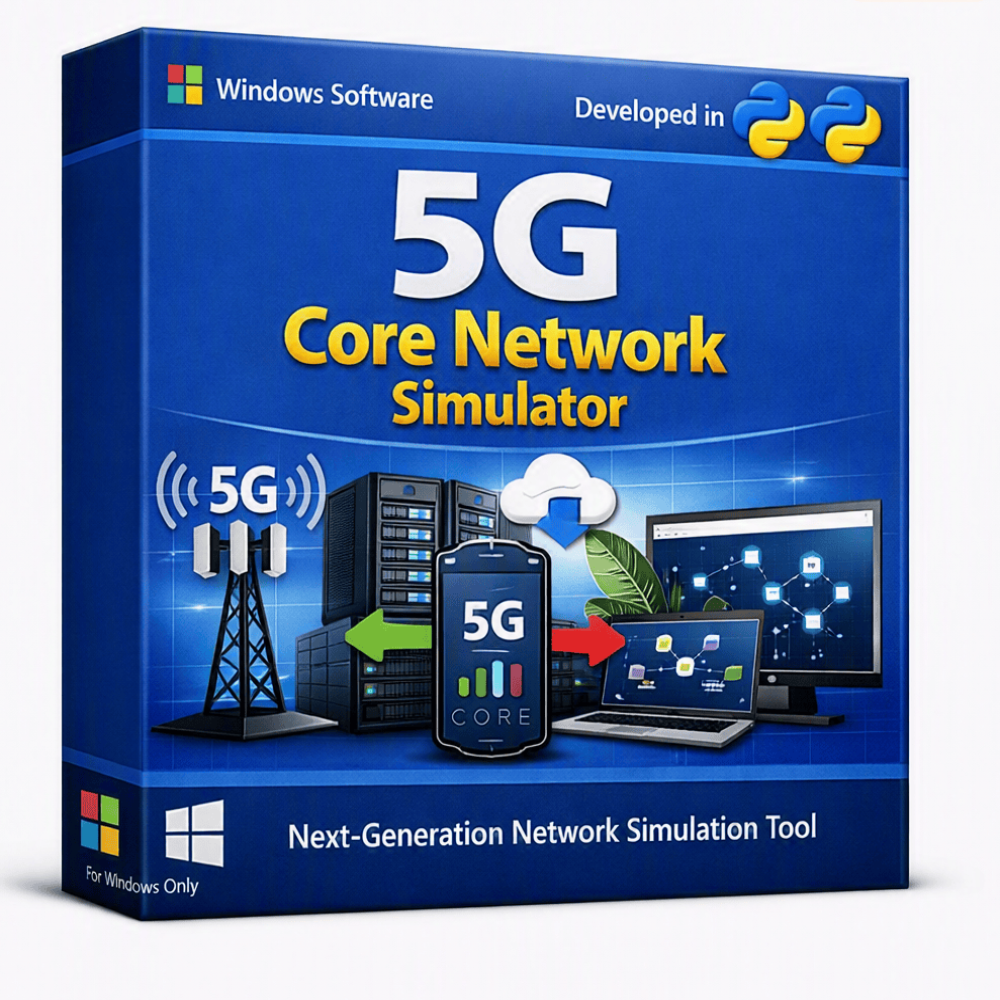
A Python-based 5G Core Network Simulator designed for studying, analyzing, and demonstrating 5G Core network architecture and procedures. Explore key 5G Network Functions such as AMF, SMF, UPF, AUSF, UDM, PCF, NRF, and NSSF, along with UE registration, authentication, session management, mobility, and signaling procedures.
Ideal for 5G research, telecom engineering, academic projects, university laboratories, protocol development, and network simulation. Provides a flexible software environment for experimenting with 5G Core concepts without requiring a complete commercial 5G network infrastructure.
Original price was: ₹750.00.₹250.00Current price is: ₹250.00. -
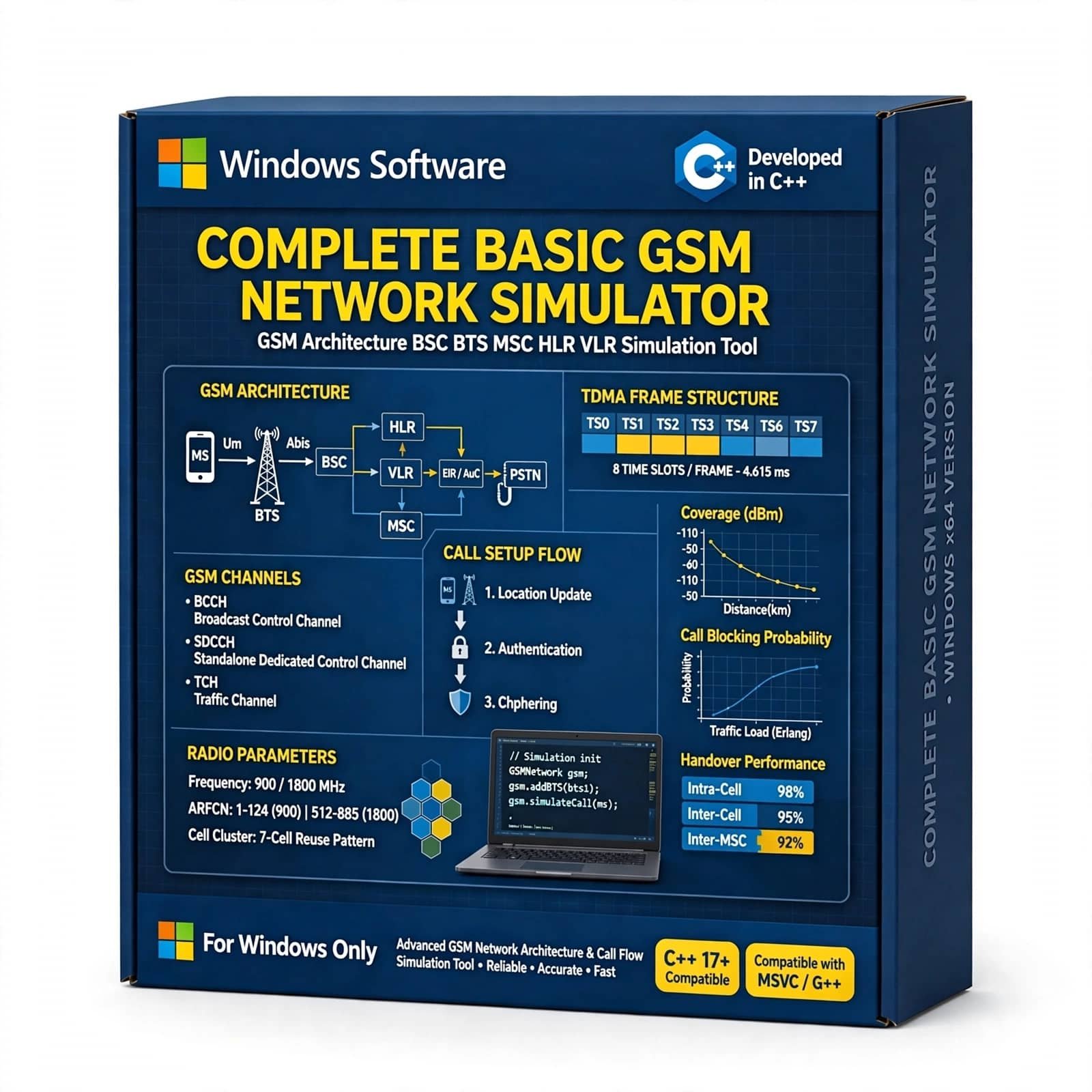
Complete Basic GSM Network with C++ is an educational and simulation-based project that demonstrates the fundamental architecture and operation of a GSM network using C++. It helps students and researchers understand GSM components, mobile communication, call and message handling, network signaling, and basic cellular network operations through a practical C++ implementation.
Original price was: ₹750.00.₹250.00Current price is: ₹250.00. -
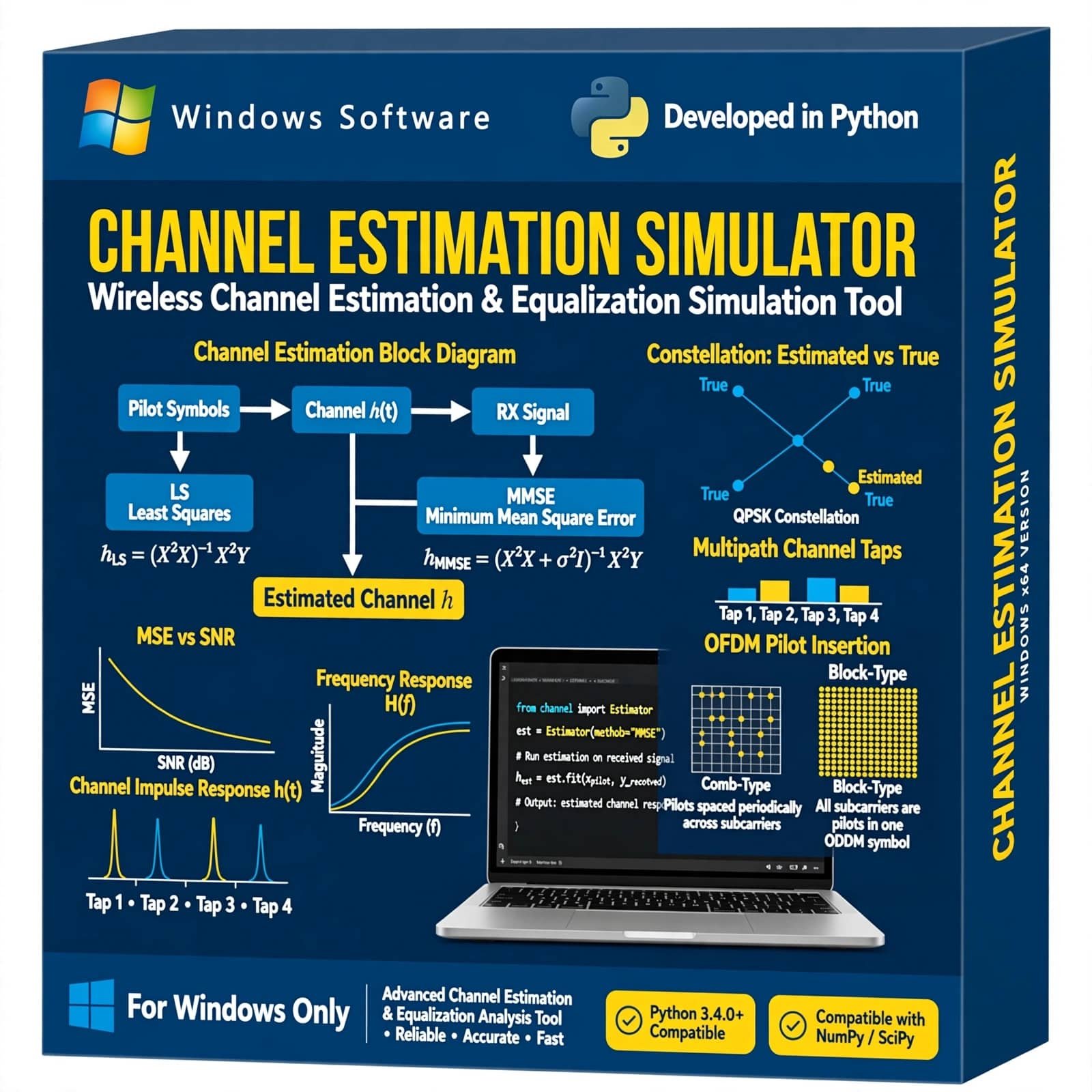
Channel Estimation Simulator is a wireless communication simulation tool designed to demonstrate and analyze channel estimation techniques in digital communication systems. It helps students, researchers, and communication engineers study channel effects, pilot-based estimation, signal distortion, and estimation performance through practical simulation.
Original price was: ₹750.00.₹250.00Current price is: ₹250.00. -
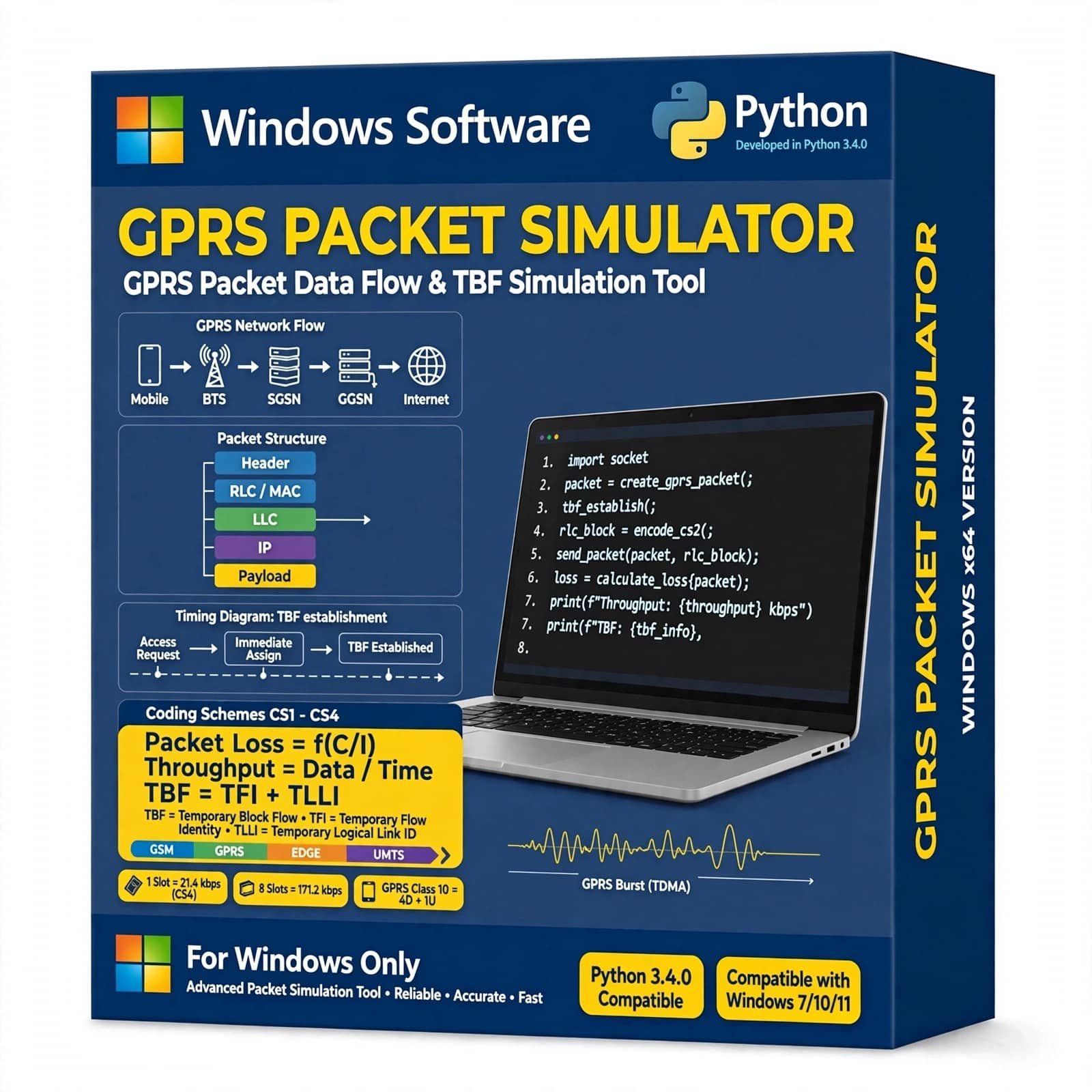
GPRS Packet Simulator is a powerful software solution for simulating GPRS data packets and testing GSM/GPRS communication systems. It helps developers, engineers, and testing teams generate, analyze, and validate packet-based communication in a controlled environment without requiring extensive physical network infrastructure. Ideal for GPRS testing, protocol development, IoT applications, and telecom system validation.
Original price was: ₹750.00.₹250.00Current price is: ₹250.00. -
The 2G GSM Cell Simulator is a Python-based software project designed to simulate fundamental GSM cellular-network concepts. It provides a practical environment for understanding mobile stations, GSM cells, base stations, cellular coverage, mobility, communication channels, and basic network behavior. The project includes Python source code that can be studied, customized, and extended for academic projects, demonstrations, research, and learning. It is ideal for Electronics & Communication Engineering, Telecommunications, Computer Science, and related students looking to explore 2G GSM technology and cellular network simulation through a software-based implementation.
Original price was: ₹750.00.₹250.00Current price is: ₹250.00.


Reviews
There are no reviews yet.