
87% Off

5G NR HARQ Simulator


Original price was: ₹74,999.00.₹9,999.00Current price is: ₹9,999.00.
In Stock5G NR HARQ Simulator is an advanced simulation solution for modeling and analyzing Hybrid Automatic Repeat Request (HARQ) mechanisms in 5G New Radio networks. It enables users to study HARQ processes, ACK/NACK feedback, retransmissions, link adaptation, channel errors, and communication reliability under configurable network conditions. The simulator supports analysis of throughput, BLER, latency, retransmission rate, packet errors, spectral efficiency, and other key performance metrics, making it suitable for 5G NR research, algorithm development, academic projects, and wireless communication system optimization.
Description
5G NR HARQ Simulator
The 5G NR HARQ Simulator is an advanced simulation software solution designed for researchers, wireless communication engineers, telecom developers, students, and academic professionals working with 5G New Radio (NR), Hybrid Automatic Repeat Request (HARQ), link adaptation, retransmission mechanisms, and wireless communication systems. The simulator provides a flexible environment for modeling, analyzing, and optimizing HARQ procedures and retransmission performance under different 5G NR network and channel conditions.
Key Features
- 5G NR HARQ Simulation: Model and analyze Hybrid Automatic Repeat Request procedures in 5G New Radio systems.
- HARQ Process Analysis: Evaluate multiple HARQ processes and their behavior during data transmission and retransmission.
- ACK/NACK Modeling: Simulate acknowledgment and negative acknowledgment mechanisms for reliable packet delivery.
- Retransmission Analysis: Study the impact of retransmissions on throughput, latency, reliability, and spectral efficiency.
- Link Adaptation Studies: Evaluate the relationship between HARQ performance, modulation and coding schemes, and changing channel conditions.
- Channel Condition Modeling: Analyze HARQ performance under fading, interference, path loss, noise, and varying radio propagation conditions.
- Error Performance Evaluation: Measure packet errors, block errors, retransmission rates, and successful data delivery.
- Latency Analysis: Evaluate the effect of HARQ retransmissions and processing delays on end-to-end communication performance.
- Performance Metrics: Analyze throughput, BLER, packet error rate, retransmission rate, latency, spectral efficiency, and reliability.
- Algorithm Development: Provide an environment for developing, testing, and comparing HARQ-related algorithms and configurations.

5G NR HARQ Simulation and Analysis
Hybrid Automatic Repeat Request (HARQ) is an important mechanism for improving the reliability of wireless data transmission. The 5G NR HARQ Simulator enables users to model HARQ operation and evaluate how retransmission strategies can improve data delivery under different radio conditions.
The simulator can be configured to represent different transmission scenarios and channel conditions, allowing users to investigate the relationship between initial transmission success, error detection, feedback signaling, and retransmission. This provides valuable insight into how HARQ contributes to reliable and efficient communication in 5G NR networks.
Users can analyze ACK and NACK feedback behavior and study how retransmission decisions affect overall system performance. Different configurations can be compared to determine how HARQ processes respond to changing signal quality, interference, mobility, and channel fading.
HARQ Process and Retransmission Evaluation
The simulator provides an environment for studying multiple HARQ processes and their interaction with data transmission. Researchers can evaluate how HARQ process configuration influences resource utilization, transmission efficiency, and communication latency.
Retransmission performance can be analyzed under different error conditions to determine how frequently packets or transport blocks require retransmission. This makes the simulator useful for studying the trade-off between reliability and system efficiency.
The simulation environment can also be used to investigate how retransmissions influence throughput and latency. By comparing different channel and transmission conditions, users can identify configurations that provide an appropriate balance between reliable data delivery and efficient use of radio resources.
Link Adaptation and Channel Analysis
The performance of HARQ is closely related to radio channel quality and transmission parameters. The 5G NR HARQ Simulator allows users to evaluate HARQ behavior under configurable channel conditions, including noise, interference, fading, path loss, and changing signal quality.
Researchers can study the impact of different modulation and coding configurations on block error performance and retransmission requirements. This makes the simulator useful for research involving link adaptation, coding strategies, modulation schemes, and reliable 5G NR data transmission.
Performance Metrics
The simulator can be used to evaluate a wide range of important communication performance parameters, including:
- Throughput
- Block Error Rate (BLER)
- Packet Error Rate
- HARQ retransmission rate
- ACK/NACK statistics
- Transmission success rate
- Latency
- Spectral efficiency
- Resource utilization
- Link reliability
These performance indicators help users understand the effectiveness of different HARQ configurations and identify potential opportunities for optimization.
Applications
The 5G NR HARQ Simulator can be used for:
- 5G NR HARQ research and development
- Hybrid ARQ algorithm development
- Wireless communication system simulation
- Link adaptation studies
- Retransmission performance analysis
- BLER and packet error analysis
- Throughput and latency evaluation
- 5G NR protocol research
- Academic projects and thesis research
- Telecom algorithm validation
- Massive MIMO and advanced wireless research
- 5G/6G technology development
Ideal for Research and Education
The simulator is suitable for universities, research institutions, telecom companies, wireless technology developers, and students working on advanced communication systems. It provides a controlled simulation environment for testing different HARQ configurations and transmission scenarios without requiring dedicated physical test equipment for every experiment.
Students and researchers can use the simulator to understand the practical behavior of HARQ mechanisms and investigate the relationship between retransmission, reliability, throughput, and latency. It can also support academic projects, laboratory experiments, research publications, dissertations, and algorithm development.
Why Choose the 5G NR HARQ Simulator?
The 5G NR HARQ Simulator provides a practical and flexible platform for studying reliable data transmission in modern 5G NR networks. By enabling users to simulate HARQ processes, ACK/NACK feedback, retransmissions, channel errors, and link adaptation scenarios, it simplifies the evaluation of complex wireless communication mechanisms.
Whether you are developing a new HARQ algorithm, evaluating retransmission performance, conducting academic research, or studying the reliability of 5G NR communication, this simulator provides an effective environment for HARQ simulation, performance analysis, optimization, and 5G/6G wireless research.
Related products
-
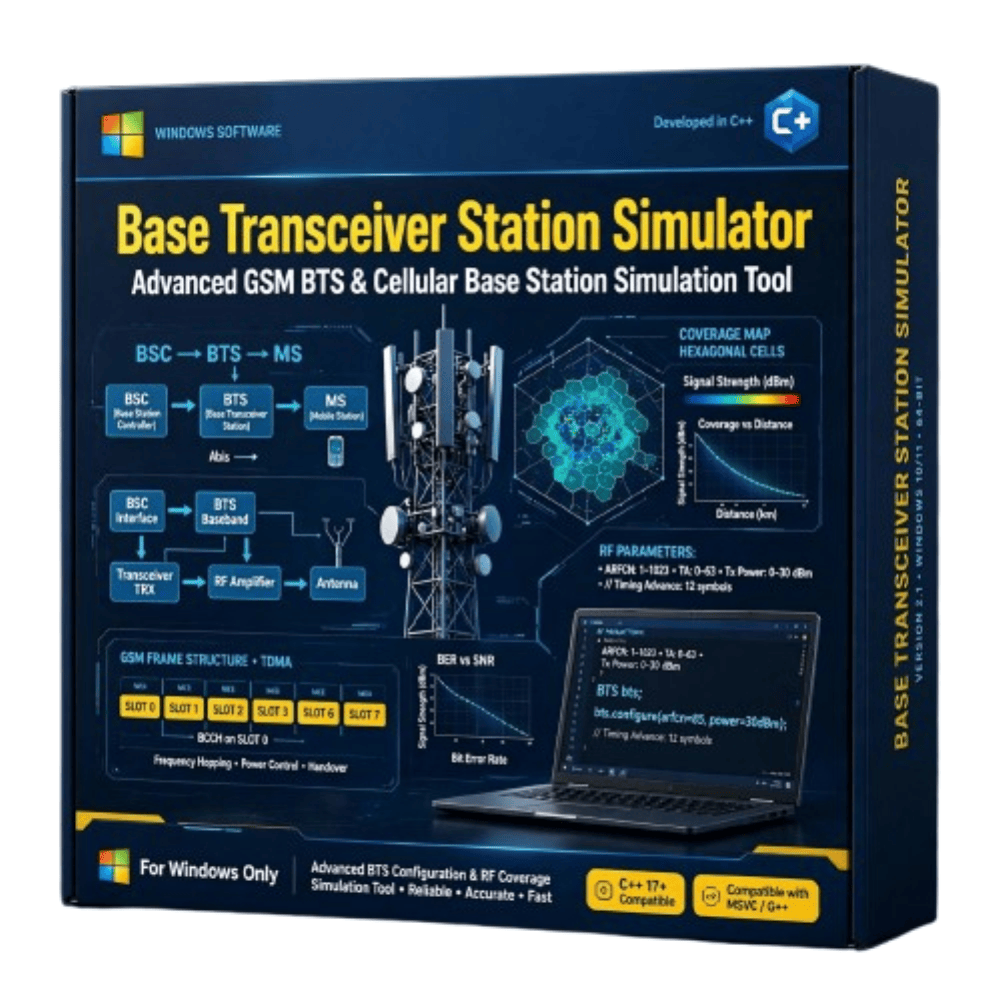
The BTS Simulator with C++ is a software-based Base Transceiver Station simulation tool designed for studying mobile communication, wireless networks, and telecommunications concepts. Developed using C++, it provides a practical environment for understanding BTS operation, communication processes, signal transmission and reception, and cellular network fundamentals. The simulator is ideal for telecommunication laboratories, engineering education, student projects, technical training, and communication-system research.
Original price was: ₹750.00.₹250.00Current price is: ₹250.00. -
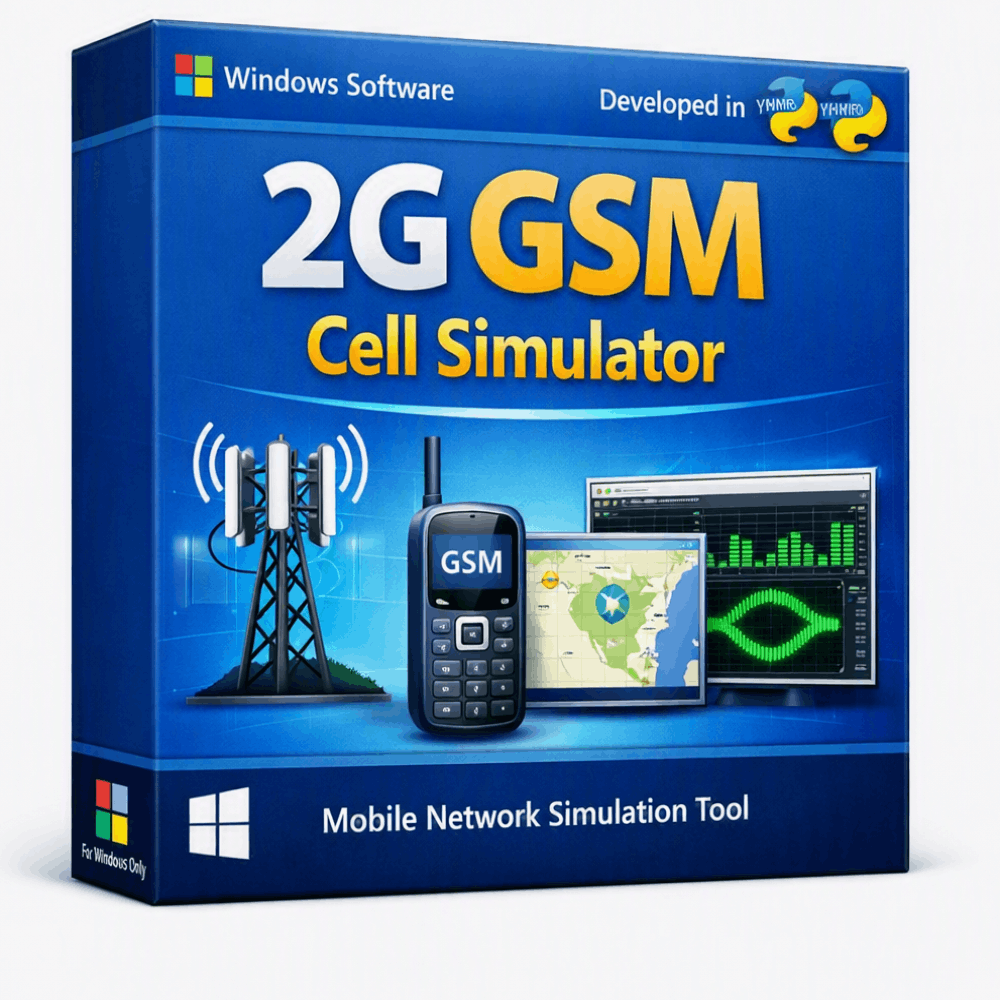
The 2G GSM Cell Simulator is a Python-based software project designed to simulate fundamental GSM cellular-network concepts. It provides a practical environment for understanding mobile stations, GSM cells, base stations, cellular coverage, mobility, communication channels, and basic network behavior. The project includes Python source code that can be studied, customized, and extended for academic projects, demonstrations, research, and learning. It is ideal for Electronics & Communication Engineering, Telecommunications, Computer Science, and related students looking to explore 2G GSM technology and cellular network simulation through a software-based implementation.
₹3,999.00 -
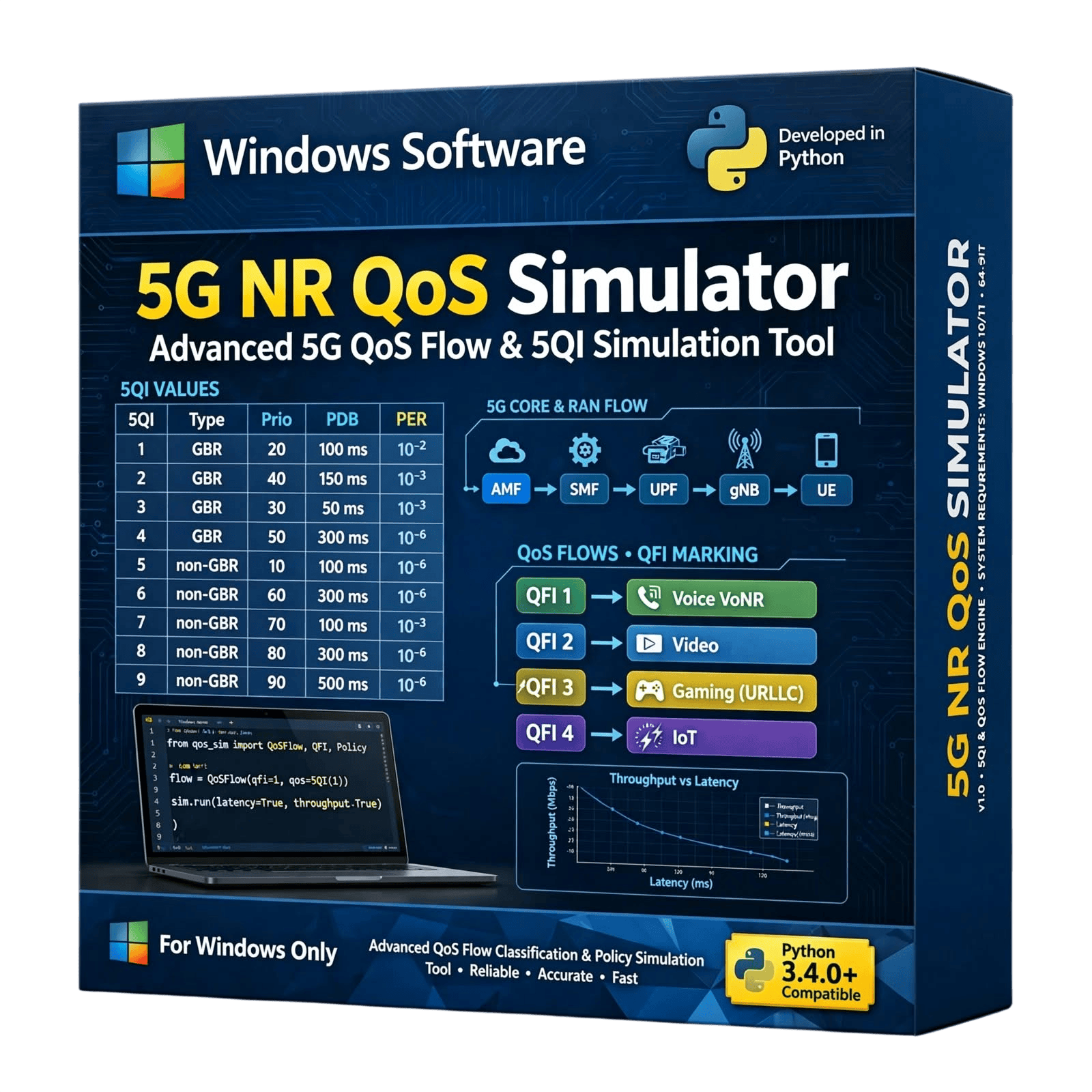
The 5G QoS Simulator is a Python-based software solution designed for researchers, engineers, students, developers, and telecommunications professionals working with 5G Quality of Service (QoS) concepts. The simulator provides a software-based environment for studying and analyzing QoS-related aspects of 5G communication networks, including service performance, traffic behavior, resource management, and network performance evaluation.
Developed using Python, the simulator is suitable for academic research, telecommunications projects, demonstrations, experimentation, algorithm development, and educational applications.
Available for sale as a software product. Contact us for pricing, licensing, features, customization, and purchase information.
Original price was: ₹74,999.00.₹9,999.00Current price is: ₹9,999.00. -
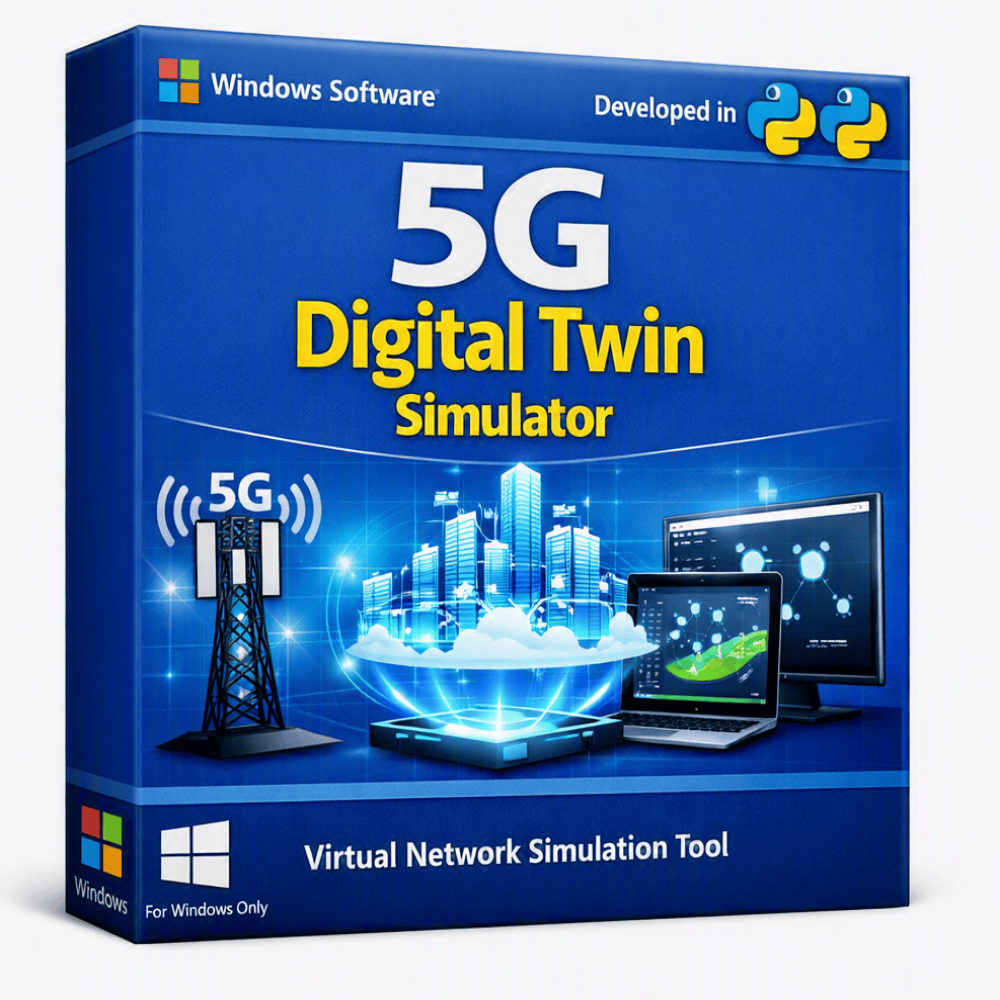
A Python-based 5G Digital Twin solution for creating a virtual representation of 5G network environments, components, and operational behavior. Designed for 5G research, network analysis, simulation, optimization, and academic projects, it enables users to model network scenarios, monitor virtualized network behavior, and experiment with different configurations in a controlled software environment.
Ideal for telecom engineers, researchers, developers, students, and academic institutions working on 5G network planning, performance analysis, intelligent network management, and digital twin research.
Original price was: ₹249,999.00.₹24,999.00Current price is: ₹24,999.00. -
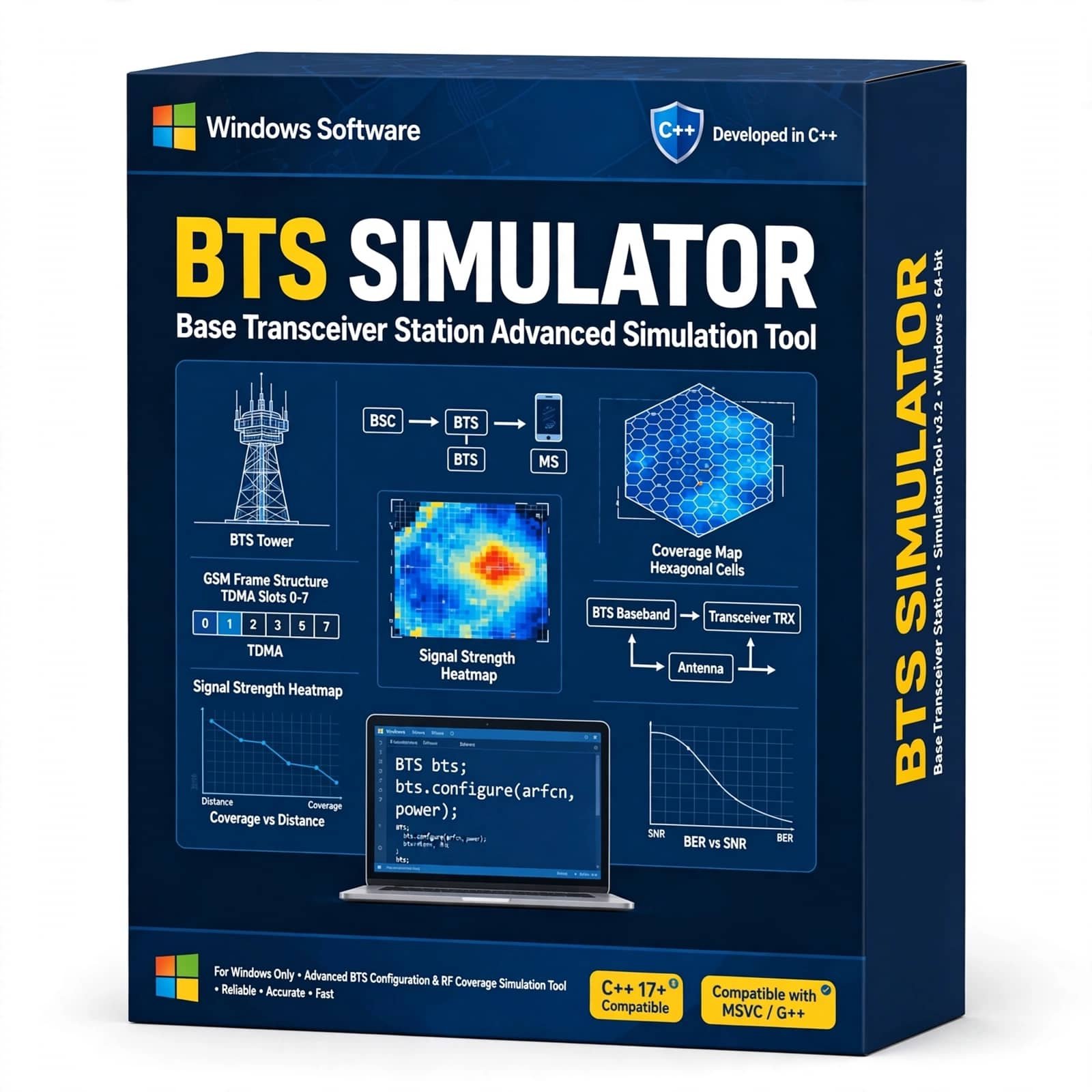
The Base Transceiver Station Simulator Using C++ is a practical cellular communication simulation project designed to demonstrate the basic operation of a BTS in a mobile communication network. Developed using C++, the simulator can model communication between mobile users and a base station, including signal handling, user connectivity, channel allocation, and basic network operations. This BTS Simulator project is suitable for engineering students, researchers, and learners working on GSM, wireless communication, cellular networks, and C++ programming projects.
Original price was: ₹750.00.₹250.00Current price is: ₹250.00. -
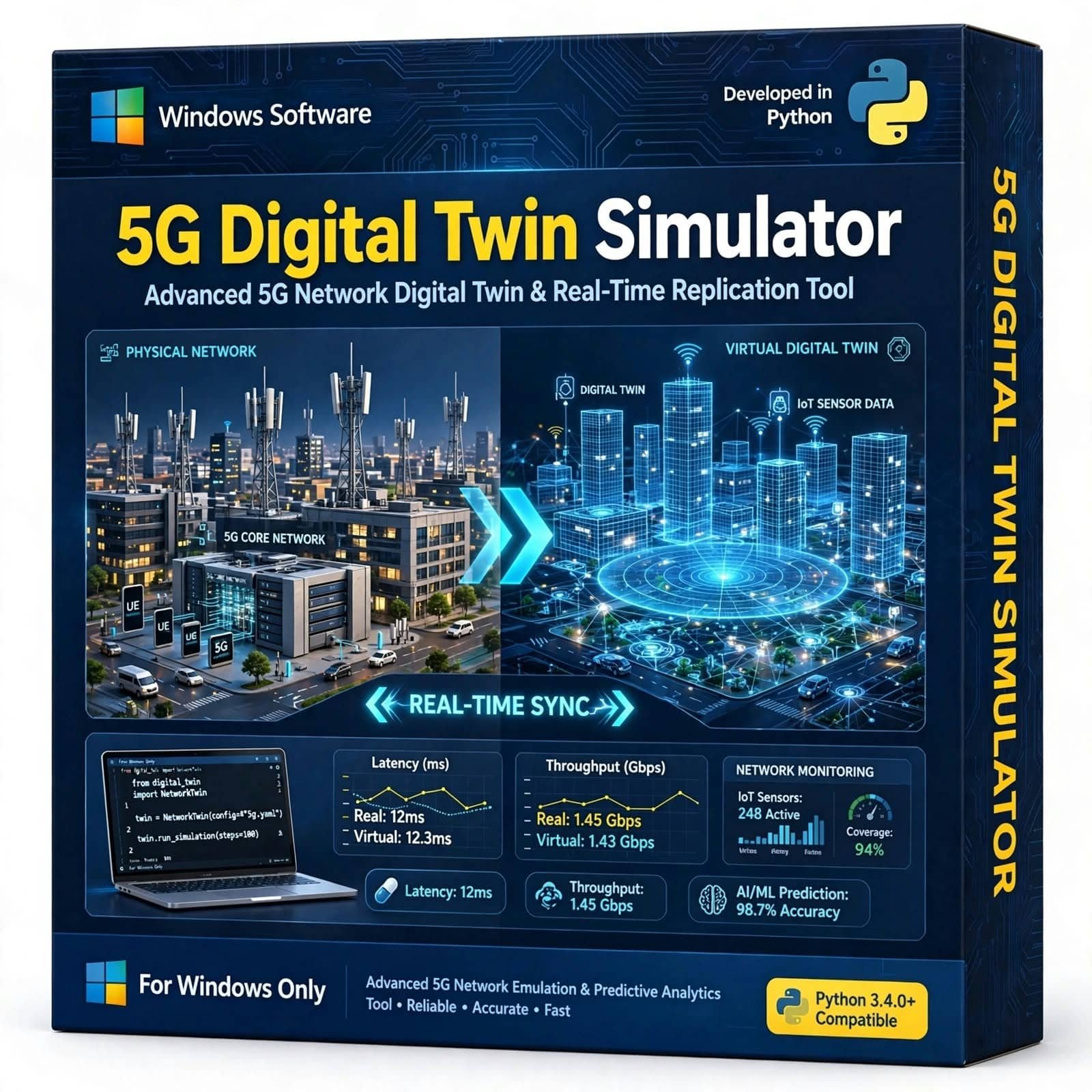
The 5G Digital Twin is a Python-based software solution designed for researchers, engineers, developers, students, and telecommunications professionals interested in modeling, simulating, and analyzing 5G communication networks and their real-world behavior in a virtual environment.
A digital twin provides a virtual representation of a physical or network system, enabling users to study system behavior, evaluate scenarios, analyze performance, and experiment with different configurations. Developed using Python, this 5G Digital Twin can support research, education, network analysis, experimentation, and proof-of-concept development.
Available for sale as a software product. Contact us for pricing, licensing, technical specifications, customization, and purchase information.
₹9,999.00


Reviews
There are no reviews yet.