

5G Digital Twin v2


₹9,999.00
In StockThe 5G Digital Twin is a Python-based software solution designed for researchers, engineers, developers, students, and telecommunications professionals interested in modeling, simulating, and analyzing 5G communication networks and their real-world behavior in a virtual environment.
A digital twin provides a virtual representation of a physical or network system, enabling users to study system behavior, evaluate scenarios, analyze performance, and experiment with different configurations. Developed using Python, this 5G Digital Twin can support research, education, network analysis, experimentation, and proof-of-concept development.
Available for sale as a software product. Contact us for pricing, licensing, technical specifications, customization, and purchase information.
Description
5G Digital Twin
The 5G Digital Twin is a specialized software solution developed in Python for modeling and studying 5G communication networks through a virtual representation of network components, behavior, and operating conditions. The concept of a digital twin is becoming increasingly important across modern engineering and telecommunications because it provides a way to represent a physical or operational system in a digital environment.
In the context of 5G networks, a digital twin can provide researchers and developers with a controlled environment in which they can explore network behavior, evaluate different scenarios, analyze performance, and experiment with potential changes without directly modifying a live network.
This Python-based 5G Digital Twin is intended as a useful platform for academic research, telecommunications development, network studies, demonstrations, simulation projects, and educational applications.
Python-Based 5G Digital Twin
The software is written in Python, making it suitable for users working with Python-based research, simulation, data analysis, and engineering workflows.
Python is widely adopted in scientific computing, artificial intelligence, machine learning, data processing, network research, and communication-system development. A Python implementation can therefore provide researchers and developers with a flexible environment for experimenting with digital-twin concepts and extending simulations according to their project requirements.
The software can serve as a foundation for users who want to explore how digital representations can be applied to next-generation communication networks.
Virtual Representation of 5G Networks
A key concept behind a digital twin is the creation of a virtual representation of a real-world system. For 5G applications, this can involve representing relevant network elements, operating conditions, traffic scenarios, configurations, and performance characteristics within a software environment.
Such a virtual environment can help users investigate how a network may behave under different conditions. Instead of relying exclusively on physical infrastructure, researchers can use simulation and modeling to explore hypothetical scenarios and compare different approaches.
The 5G Digital Twin can therefore be useful for studying network behavior, experimenting with configurations, and supporting the development of new concepts for future wireless networks.
5G Research and Development
The 5G Digital Twin can be used as a research and development platform for projects involving wireless communication, network simulation, network optimization, digital-twin technology, and next-generation telecommunications.
Researchers can use digital-twin concepts to develop models, evaluate scenarios, and analyze potential network changes. This can be particularly useful during the early stages of research and development, when testing ideas on physical infrastructure may be expensive, difficult, or impractical.
The simulator can support proof-of-concept development and provide a foundation for experimentation with different 5G network scenarios.
Academic and Educational Applications
The software can also be valuable for universities, engineering colleges, research laboratories, students, and academic institutions.
Potential academic applications include:
- 5G network simulation projects
- Digital twin research
- Wireless communication studies
- Telecommunications projects
- Final-year engineering projects
- Master’s and PhD research
- Network performance studies
- Digital transformation research
- Simulation and modeling assignments
- Research demonstrations
- Proof-of-concept implementations
Students can use the Python-based environment to understand the principles of digital twins while applying them to modern 5G communication systems.

Potential Applications
The 5G Digital Twin can be considered for a variety of research and development applications, including 5G network modeling, virtual network representation, network performance analysis, scenario evaluation, network optimization research, simulation-based experimentation, and digital-twin technology studies.
It may also be used as a starting point for projects that combine 5G communication with technologies such as data analytics, automation, artificial intelligence, machine learning, and intelligent network management, depending on the user’s implementation requirements.
Benefits of a 5G Digital Twin
A digital-twin approach provides researchers with the ability to investigate network scenarios within a virtual environment. This can make it easier to repeat experiments, compare different configurations, study hypothetical situations, and evaluate potential changes.
For 5G research, a digital twin can help bridge the gap between theoretical models and real-world network environments. Researchers can use virtual representations to study network concepts before considering implementation or deployment in physical systems.
The Python-based nature of this product also makes it convenient for users who want to integrate simulation activities with Python-based data processing, analysis, and research workflows.
Suitable for Researchers, Engineers, and Developers
The 5G Digital Twin is designed for a broad range of users, including telecommunications researchers, wireless communication engineers, software developers, students, academic institutions, and organizations working on 5G and next-generation network technologies.
It can be used for learning, experimentation, research prototyping, demonstrations, and development of digital-twin-based communication-system concepts.
Key Highlights
- 5G Digital Twin software
- Developed using Python
- Designed for 5G network modeling and simulation
- Supports digital representation and virtual experimentation concepts
- Suitable for 5G research and development
- Useful for academic and educational projects
- Suitable for telecommunications engineers and researchers
- Useful for simulation and proof-of-concept development
- Flexible Python-based development environment
- Can be used for network analysis and scenario evaluation
- Suitable for universities, laboratories, and technology organizations
- Available for sale
- Licensing and customization options available through the seller
Software Product – Available for Sale
The 5G Digital Twin is available for sale as a software product for customers interested in digital-twin technology and its application to 5G communication networks.
Whether you are a researcher, telecommunications engineer, software developer, student, university, research laboratory, or technology organization, this Python-based solution can provide a practical starting point for exploring 5G digital-twin concepts.
For information about pricing, licensing, installation, source-code availability, technical specifications, supported features, customization, and purchase options, please contact the seller.
Conclusion
The 5G Digital Twin provides a Python-based environment for exploring the application of digital-twin concepts to 5G communication networks. By creating a virtual representation of a network or system, users can investigate different scenarios, study network behavior, perform experiments, and develop research prototypes in a controlled software environment.
With applications spanning 5G research, telecommunications, network simulation, digital-twin studies, academic projects, and technology development, this software can be a valuable tool for organizations and individuals looking to explore the future of intelligent and virtualized communication networks.
The 5G Digital Twin is available for sale. Contact us today for product details, pricing, licensing, and purchase information.
Related products
-
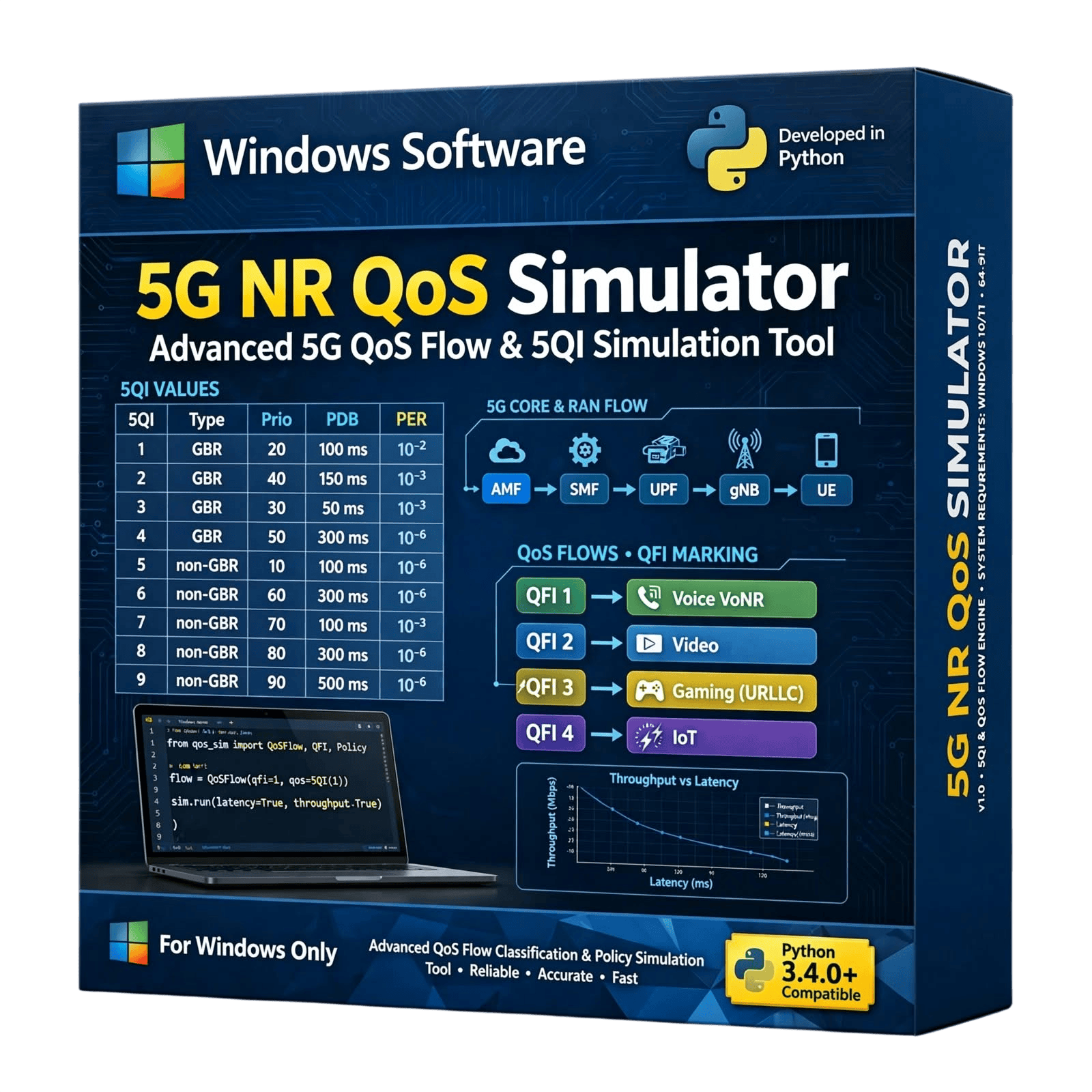
The 5G QoS Simulator is a Python-based software solution designed for researchers, engineers, students, developers, and telecommunications professionals working with 5G Quality of Service (QoS) concepts. The simulator provides a software-based environment for studying and analyzing QoS-related aspects of 5G communication networks, including service performance, traffic behavior, resource management, and network performance evaluation.
Developed using Python, the simulator is suitable for academic research, telecommunications projects, demonstrations, experimentation, algorithm development, and educational applications.
Available for sale as a software product. Contact us for pricing, licensing, features, customization, and purchase information.
Original price was: ₹74,999.00.₹9,999.00Current price is: ₹9,999.00. -
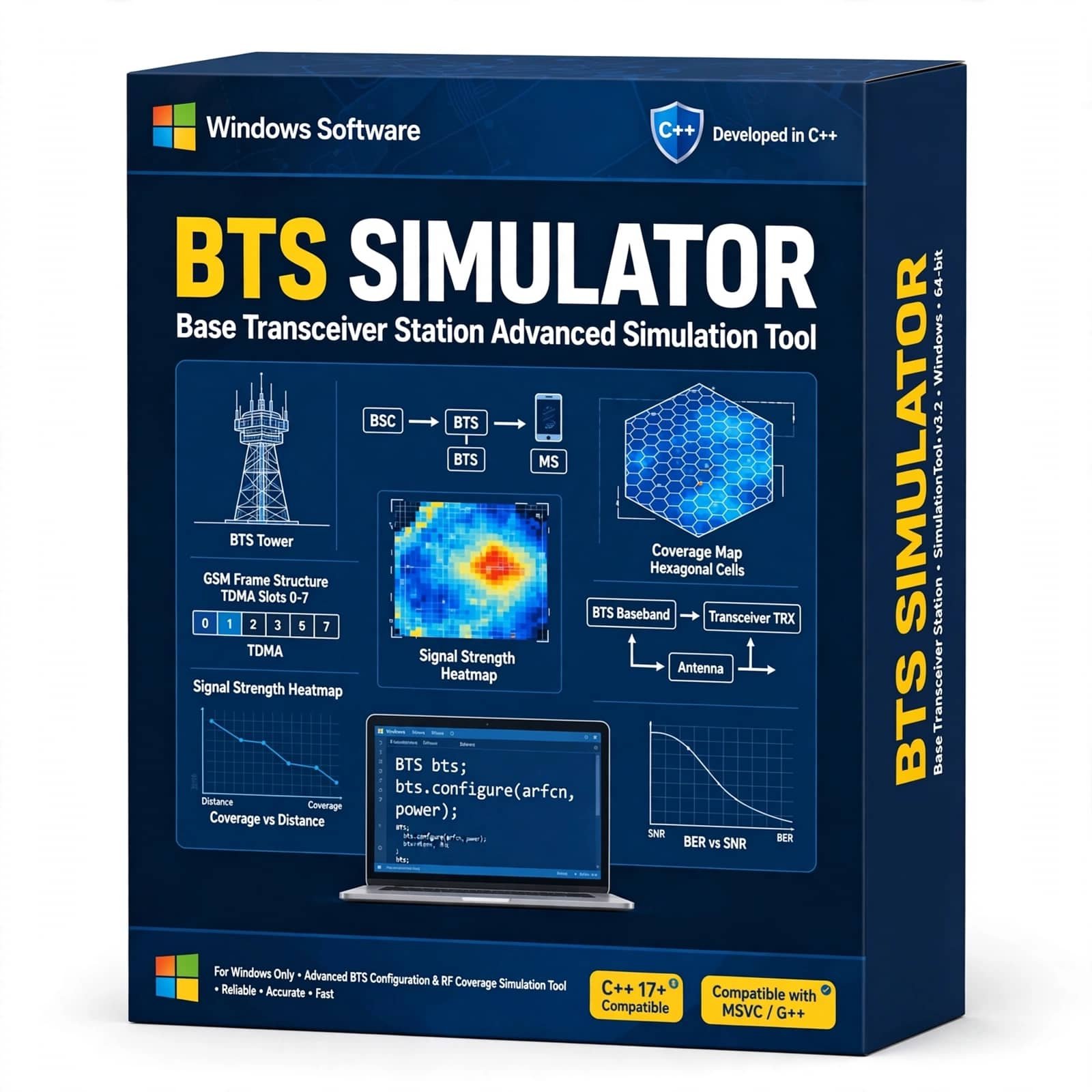
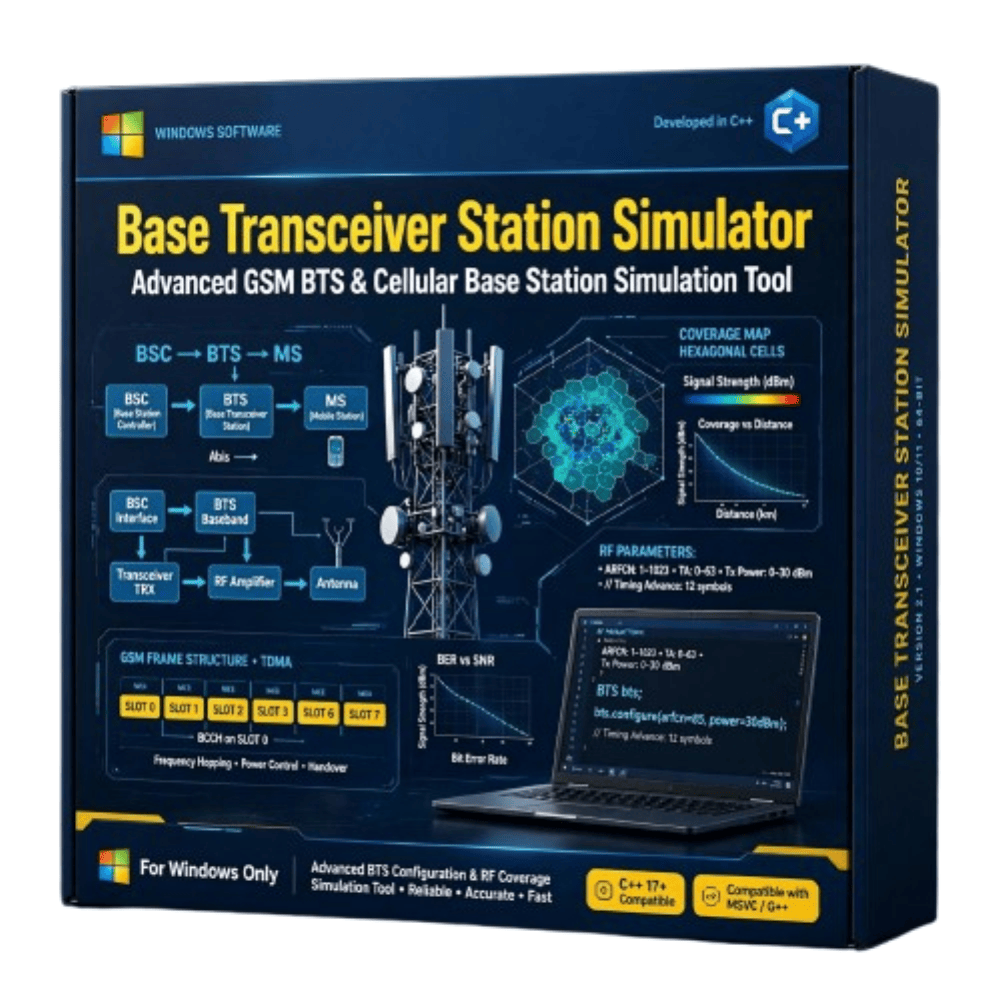
The BTS Simulator with C++ is a software-based Base Transceiver Station simulation tool designed for studying mobile communication, wireless networks, and telecommunications concepts. Developed using C++, it provides a practical environment for understanding BTS operation, communication processes, signal transmission and reception, and cellular network fundamentals. The simulator is ideal for telecommunication laboratories, engineering education, student projects, technical training, and communication-system research.
Original price was: ₹750.00.₹250.00Current price is: ₹250.00. -
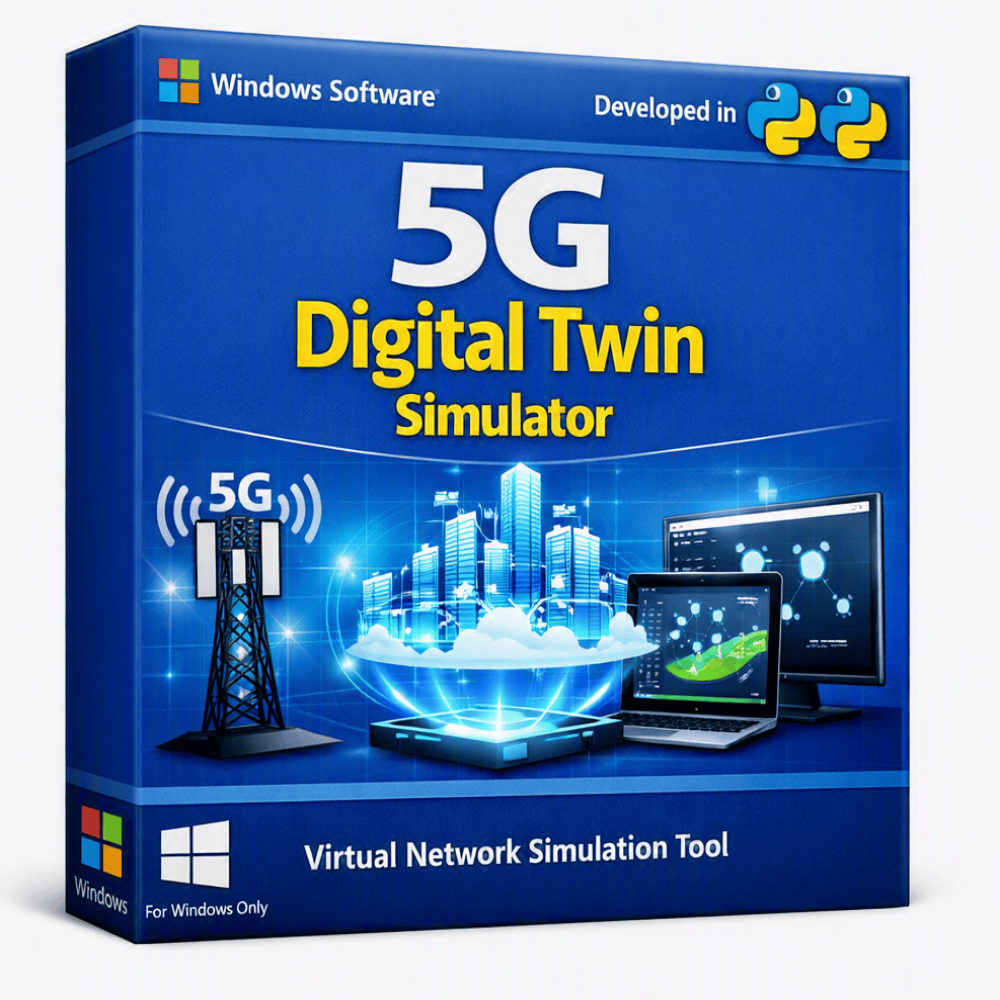
A Python-based 5G Digital Twin solution for creating a virtual representation of 5G network environments, components, and operational behavior. Designed for 5G research, network analysis, simulation, optimization, and academic projects, it enables users to model network scenarios, monitor virtualized network behavior, and experiment with different configurations in a controlled software environment.
Ideal for telecom engineers, researchers, developers, students, and academic institutions working on 5G network planning, performance analysis, intelligent network management, and digital twin research.
Original price was: ₹249,999.00.₹24,999.00Current price is: ₹24,999.00. -
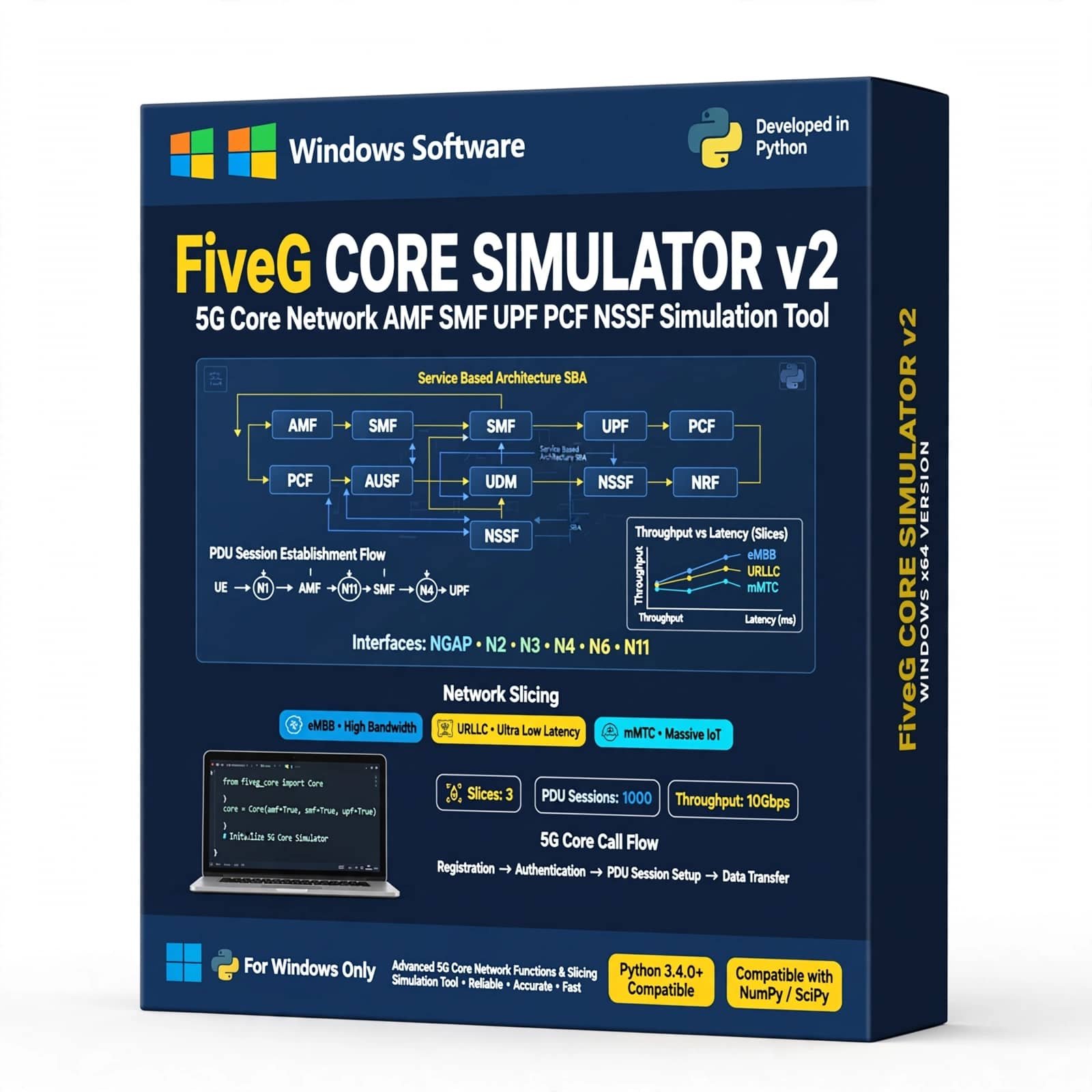
FiveG Core Simulator v2 is an educational 5G Core Network simulation tool designed to help students, educators, researchers, and telecom professionals understand 5G core architecture, network functions, signaling procedures, latency, and protocol interactions through an interactive topology and signaling animation environment.
₹19,999.00 -
The Base Transceiver Station Simulator Using C++ is a practical cellular communication simulation project designed to demonstrate the basic operation of a BTS in a mobile communication network. Developed using C++, the simulator can model communication between mobile users and a base station, including signal handling, user connectivity, channel allocation, and basic network operations. This BTS Simulator project is suitable for engineering students, researchers, and learners working on GSM, wireless communication, cellular networks, and C++ programming projects.
Original price was: ₹750.00.₹250.00Current price is: ₹250.00. -
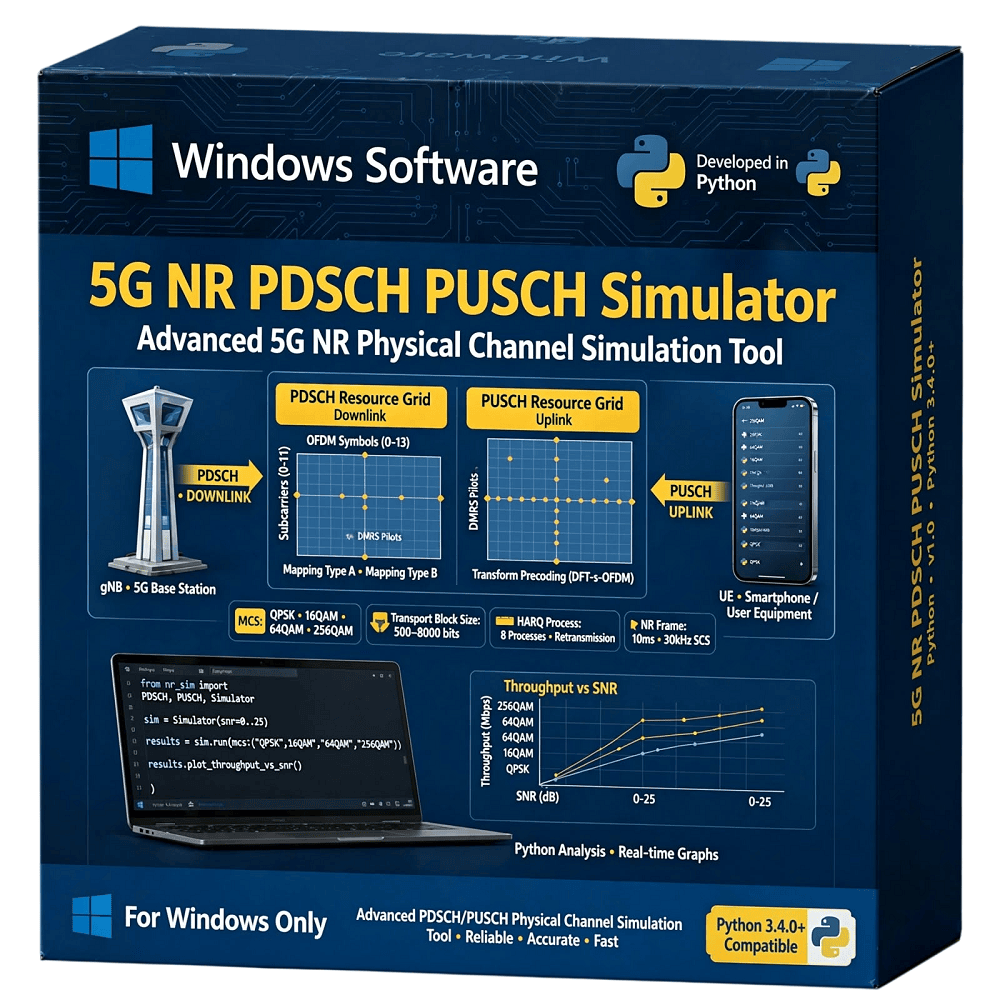
The 5G NR PDSCH PUSCH Simulator is a Python-based simulation software solution designed for researchers, engineers, students, and telecommunications professionals working with 5G New Radio (NR) physical-layer technologies. The simulator provides a practical environment for studying and experimenting with PDSCH (Physical Downlink Shared Channel) and PUSCH (Physical Uplink Shared Channel) transmission concepts.
Developed using Python, the simulator is suitable for academic research, algorithm development, demonstrations, testing, and educational applications related to 5G NR communication systems.
Available for sale as a software product. Contact us for product details, licensing, and purchase information.
Original price was: ₹129,999.00.₹12,999.00Current price is: ₹12,999.00.


Reviews
There are no reviews yet.