

LTE MIMO Simulator


₹6,999.00
In StockLTE MIMO Simulator developed with Python is a software-based simulation solution designed to study and analyze Multiple-Input Multiple-Output (MIMO) communication techniques used in 4G LTE wireless networks. It provides a practical environment for exploring multiple antenna transmission, spatial multiplexing, diversity techniques, signal processing, channel behavior, and LTE MIMO performance. Ideal for wireless communication research, academic projects, engineering students, telecom development, and Python-based LTE simulation.
Description
LTE MIMO Simulator
The LTE MIMO Simulator developed with Python is a software-based simulation solution designed to help students, researchers, telecom engineers, and developers understand and experiment with Multiple-Input Multiple-Output (MIMO) communication techniques used in 4G LTE wireless networks.
MIMO technology uses multiple antennas at the transmitter, receiver, or both to improve wireless communication performance. It is an important technology in modern cellular communication because it can help increase data throughput, improve transmission reliability, and make more efficient use of available radio resources.
Understanding MIMO systems can be challenging when working only with theoretical equations and architecture diagrams. An LTE MIMO Simulator provides a practical environment where users can explore multiple-antenna communication, signal transmission, channel effects, spatial processing, and performance evaluation through software simulation.
Developed using Python, this LTE MIMO simulation solution provides a flexible platform for academic learning, research, algorithm experimentation, and telecom project development.
Understand MIMO Technology in LTE
Multiple-Input Multiple-Output is a key technology used in LTE to enhance wireless communication capabilities. Instead of relying on a single transmit and receive antenna, MIMO systems use multiple antennas to transmit and receive signals.
The multiple signals can be processed to improve communication performance through techniques such as spatial multiplexing and spatial diversity. These techniques can be studied through simulation to understand how multiple antenna configurations influence wireless communication.
The LTE MIMO Simulator developed with Python can help users explore these concepts in a controlled software environment and gain practical insight into how MIMO contributes to LTE network performance.
Python-Based LTE MIMO Simulation
The simulator is developed using Python, a widely used programming language for scientific computing, data analysis, signal processing, networking, and research applications.
Python provides an accessible environment for implementing and experimenting with wireless communication algorithms. Researchers and students can use a Python-based MIMO simulator to investigate different antenna configurations, channel conditions, signal-processing approaches, and performance parameters according to their project requirements.
This makes the simulator suitable for combining Python programming skills with LTE and wireless communication research.
Explore Multiple Antenna Communication
A major purpose of an LTE MIMO simulation environment is to demonstrate how multiple transmit and receive antennas interact during wireless communication.
Users can study the concept of multiple signal paths and investigate how antenna configurations can affect communication performance. This can provide a practical foundation for understanding the mathematical and engineering principles behind MIMO systems.
For students, simulation can make complex wireless communication concepts easier to visualize and understand. For researchers, it provides a controlled environment for testing different MIMO scenarios.
Study Spatial Multiplexing
Spatial multiplexing is one of the important techniques associated with MIMO communication. It allows multiple data streams to be transmitted through different spatial paths, potentially increasing data throughput under suitable channel conditions.
The LTE MIMO Simulator in Python can be used to study the basic principles of spatial multiplexing and understand how multiple data streams can be represented and processed in a MIMO communication system.
Such experiments can be useful for academic assignments, laboratory demonstrations, research studies, and projects related to LTE and wireless communication.
Explore Spatial Diversity
MIMO can also be used to improve communication reliability through spatial diversity. Multiple antennas can provide alternative transmission or reception paths, helping the communication system deal with challenging wireless channel conditions.
Through simulation, users can explore how antenna diversity can influence signal reception and transmission reliability. This makes the simulator useful for understanding the relationship between antenna configuration, wireless channels, and system performance.
LTE MIMO Channel Simulation
Wireless signals can experience different channel effects as they travel between transmitters and receivers. Multipath propagation, fading, interference, and other channel characteristics can influence signal quality.
A software-based LTE MIMO simulation environment can provide a controlled way to investigate how MIMO systems behave under different channel conditions. Users can experiment with channel parameters and examine how communication performance changes.
This makes the simulator useful for projects involving wireless channel modeling, LTE performance analysis, signal processing, and MIMO algorithm research.
Applications of LTE MIMO Simulator
The LTE MIMO Simulator can be useful across a wide range of academic and research applications, including:
- 4G LTE MIMO simulation
- Multiple antenna communication studies
- Wireless communication research
- Spatial multiplexing experiments
- Spatial diversity analysis
- LTE channel modeling
- Signal processing research
- Telecommunications academic projects
- Final-year engineering projects
- LTE performance analysis
- Python-based wireless communication projects
- MIMO algorithm development
- LTE protocol and technology demonstrations
It is suitable for students and researchers studying telecommunications, electronics and communication engineering, wireless communication, computer networks, information technology, and related technical disciplines.
Ideal for Academic and Final-Year Projects
The Python LTE MIMO Simulator can serve as a practical foundation for university assignments, laboratory work, research projects, and final-year engineering projects.
Students can use the simulator to demonstrate MIMO principles and investigate how antenna configurations and wireless channel conditions influence system behavior. It can also be used to support presentations and project demonstrations by providing a software-based representation of multiple-antenna communication.
For research-oriented projects, the simulator can provide a starting point for implementing customized algorithms, evaluating different configurations, or studying specific MIMO scenarios.
Analyze LTE Wireless Communication Performance
MIMO performance can depend on several factors, including antenna configuration, channel characteristics, signal conditions, and the selected transmission technique.
An LTE MIMO simulation in Python provides an environment for investigating these relationships. Researchers can create controlled scenarios and examine how changes in simulation parameters influence communication performance.
This can help users develop a better understanding of important wireless communication concepts such as throughput, signal quality, diversity, spatial processing, and channel behavior.

Flexible Platform for MIMO Research
A software simulator eliminates the need for a complete physical LTE test environment for many early-stage experiments and educational demonstrations. Users can create repeatable scenarios, modify parameters, test algorithms, and observe simulated results.
The Python implementation also makes the simulator suitable for experimentation and customization. Developers with Python knowledge can potentially extend the simulation according to their academic or research requirements.
This makes the solution useful for MIMO research, LTE education, wireless algorithm development, and telecom simulation projects.
Benefits of LTE MIMO Simulator
A Python-based LTE MIMO simulation solution provides several potential benefits:
- Practical understanding of MIMO technology
- Python-based programmable environment
- Multiple antenna communication simulation
- Spatial multiplexing and diversity studies
- Controlled wireless channel experiments
- Useful for academic demonstrations
- Suitable for telecom research
- Supports wireless communication learning
- Can provide a foundation for customized simulation projects
By combining theoretical MIMO concepts with software-based experimentation, users can gain a deeper understanding of how multiple-antenna techniques are applied in LTE networks.
Why Choose an LTE MIMO Simulator?
MIMO is an important technology in 4G LTE and modern wireless communication systems. Understanding how multiple antennas, spatial processing, and wireless channels interact is valuable for students, researchers, and engineers working in telecommunications.
The LTE MIMO Simulator developed with Python combines these wireless communication concepts with the flexibility of Python programming. It provides a practical environment for exploring MIMO technology without requiring an extensive physical wireless test setup.
Conclusion
The LTE MIMO Simulator developed with Python provides a practical software environment for studying multiple-antenna communication techniques used in 4G LTE networks. It can help users understand MIMO architecture, spatial multiplexing, spatial diversity, antenna configurations, wireless channel behavior, and LTE performance concepts.
Whether you are working on an LTE academic project, final-year engineering project, wireless communication research project, MIMO algorithm study, signal-processing experiment, or Python-based telecom simulation, this simulator can provide a useful foundation for learning and experimentation.
Explore LTE MIMO simulation with Python and gain practical insight into the multiple-antenna technologies that help improve capacity, reliability, and performance in modern 4G LTE wireless communication systems.
Related products
-
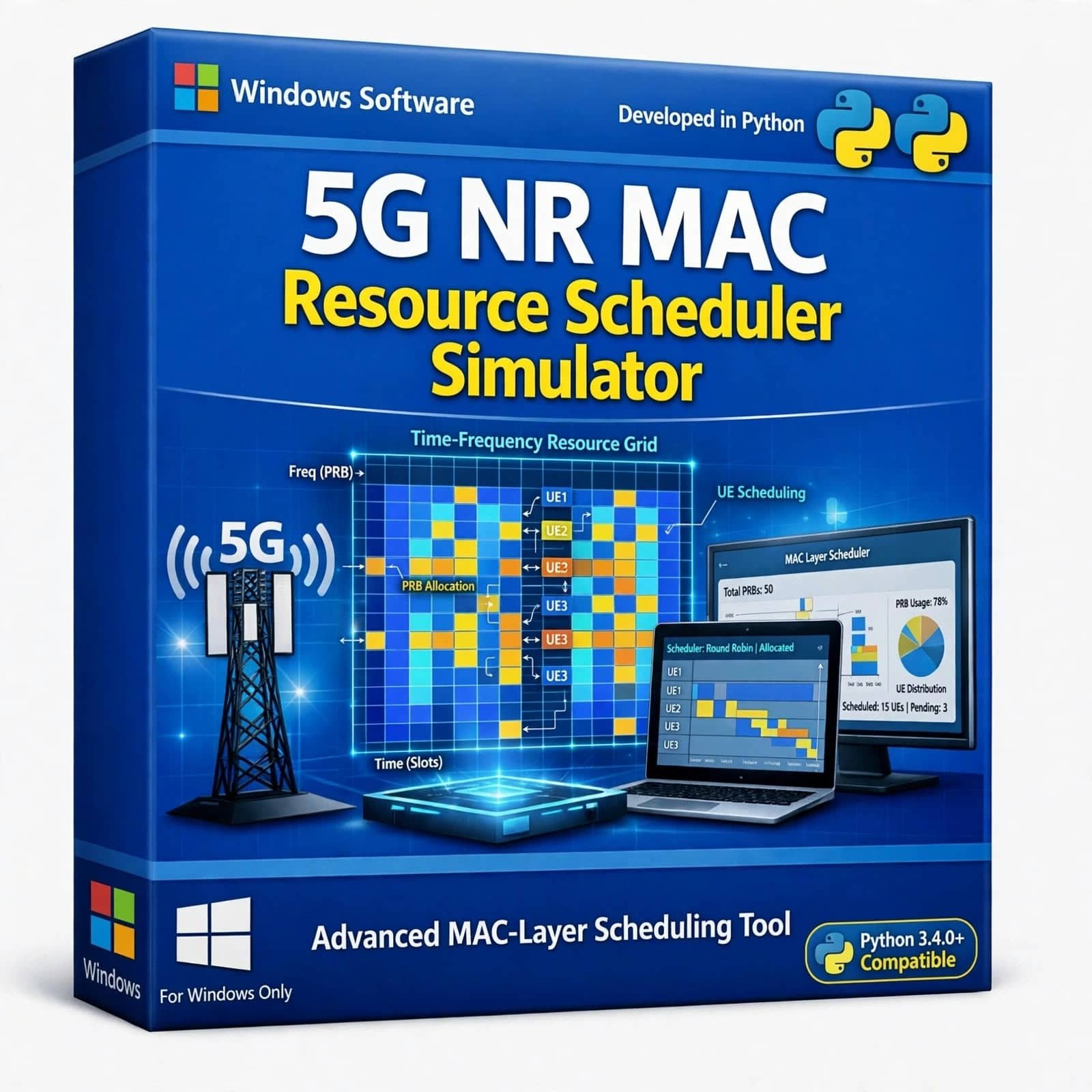
5G NR MAC Resource Scheduler Simulator is an advanced simulation solution for modeling and analyzing Medium Access Control (MAC) layer resource scheduling in 5G New Radio networks. It enables users to evaluate dynamic resource allocation, multi-UE scheduling, uplink and downlink resource management, QoS-aware scheduling, traffic conditions, and scheduling algorithms. The simulator supports analysis of throughput, latency, fairness, spectral efficiency, resource utilization, packet loss, and QoS performance, making it ideal for 5G NR research, scheduler algorithm development, academic projects, and wireless network optimization.
Original price was: ₹129,999.00.₹12,999.00Current price is: ₹12,999.00. -
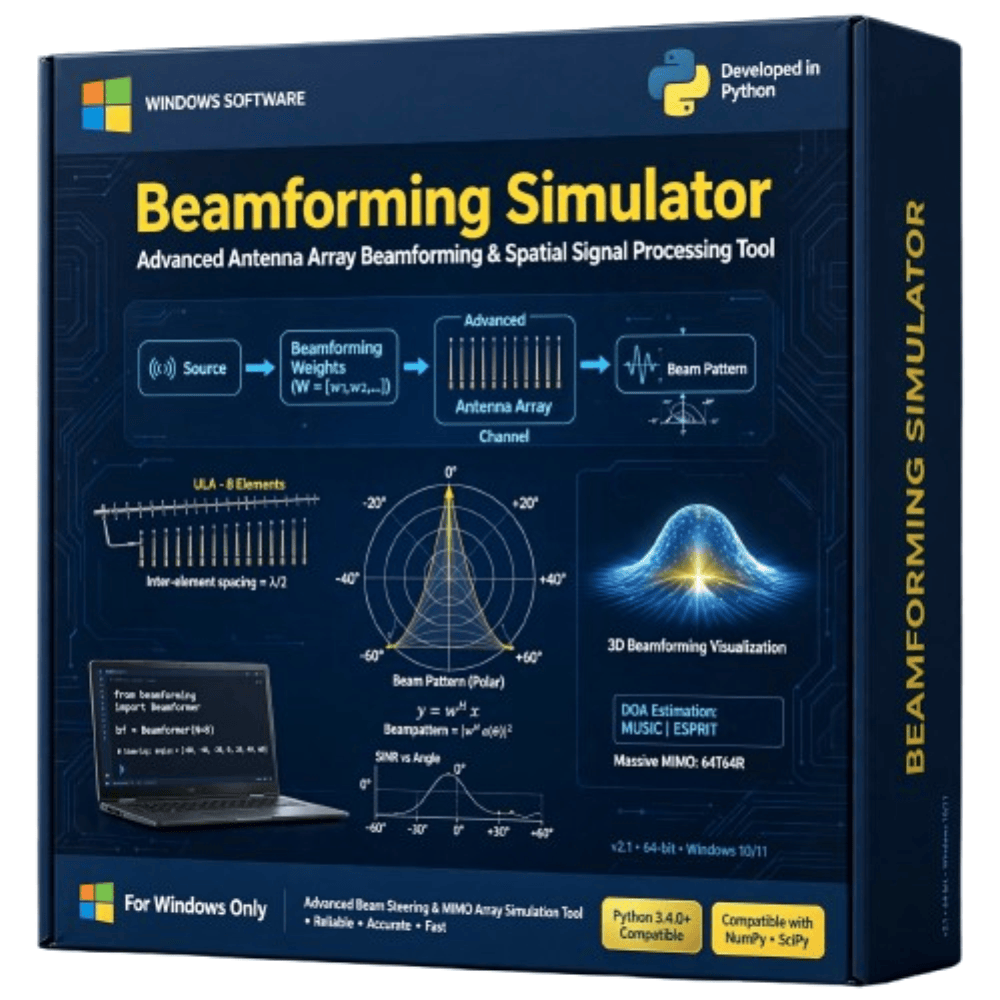
The Beamforming Simulator is a practical wireless communication simulation project designed to demonstrate how antenna arrays can control and direct radio-frequency signals toward desired users or directions. The simulator helps visualize beam patterns, signal direction, antenna-array behavior, and beam steering under different parameters. It is suitable for studying beamforming, antenna arrays, MIMO, 5G communication, wireless networks, and signal processing. This project is ideal for engineering students, researchers, and learners working on wireless communication and advanced antenna technologies.
₹1,999.00 -
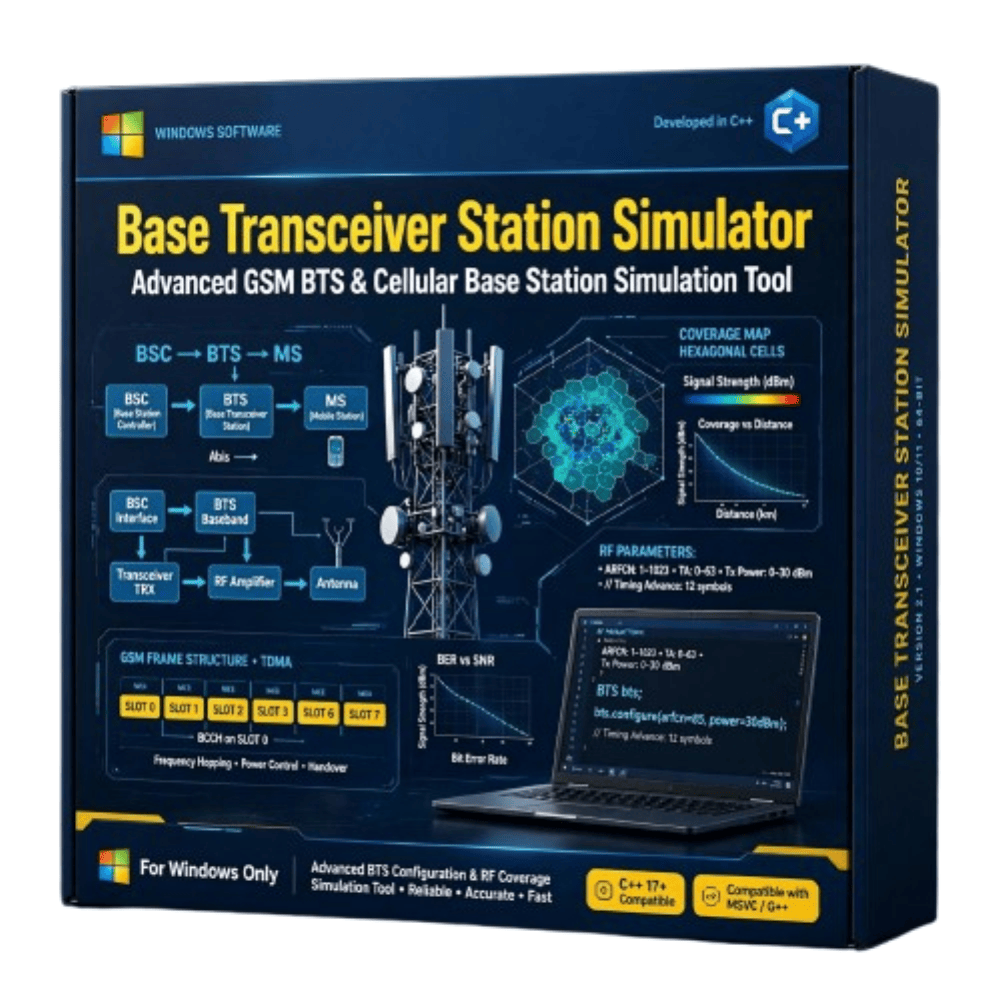
The Base Transceiver Station Simulator Using C++ is a practical cellular communication simulation project designed to demonstrate the basic operation of a BTS in a mobile communication network. Developed using C++, the simulator can model communication between mobile users and a base station, including signal handling, user connectivity, channel allocation, and basic network operations. This BTS Simulator project is suitable for engineering students, researchers, and learners working on GSM, wireless communication, cellular networks, and C++ programming projects.
Original price was: ₹750.00.₹250.00Current price is: ₹250.00. -
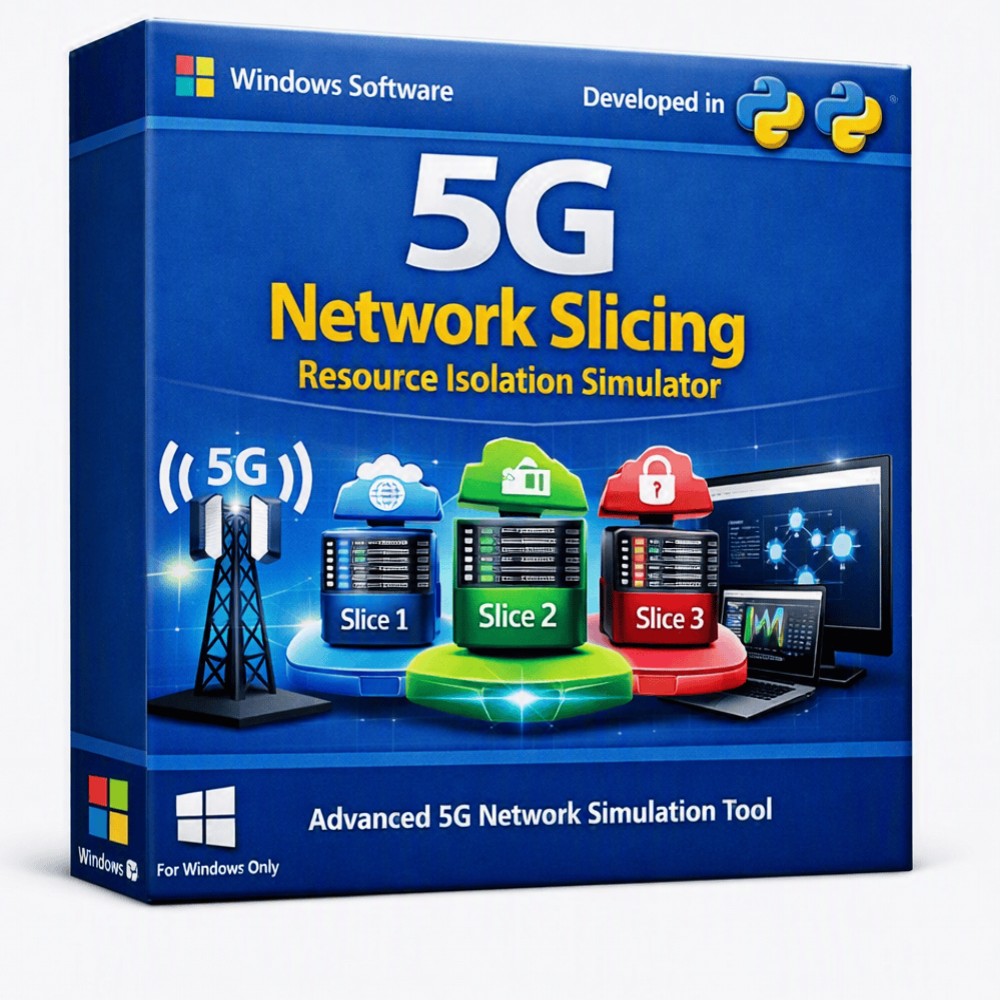
A Python-based 5G Network Slicing and Resource Isolation Simulator designed to model and analyze how multiple logical network slices can share physical 5G infrastructure while maintaining resource isolation. The simulator enables users to study CPU, memory, bandwidth, network capacity, traffic allocation, and resource management across different 5G network slices.
Ideal for 5G research, telecom engineering, academic projects, network optimization, resource allocation studies, and university laboratories.
Original price was: ₹199,999.00.₹19,999.00Current price is: ₹19,999.00. -
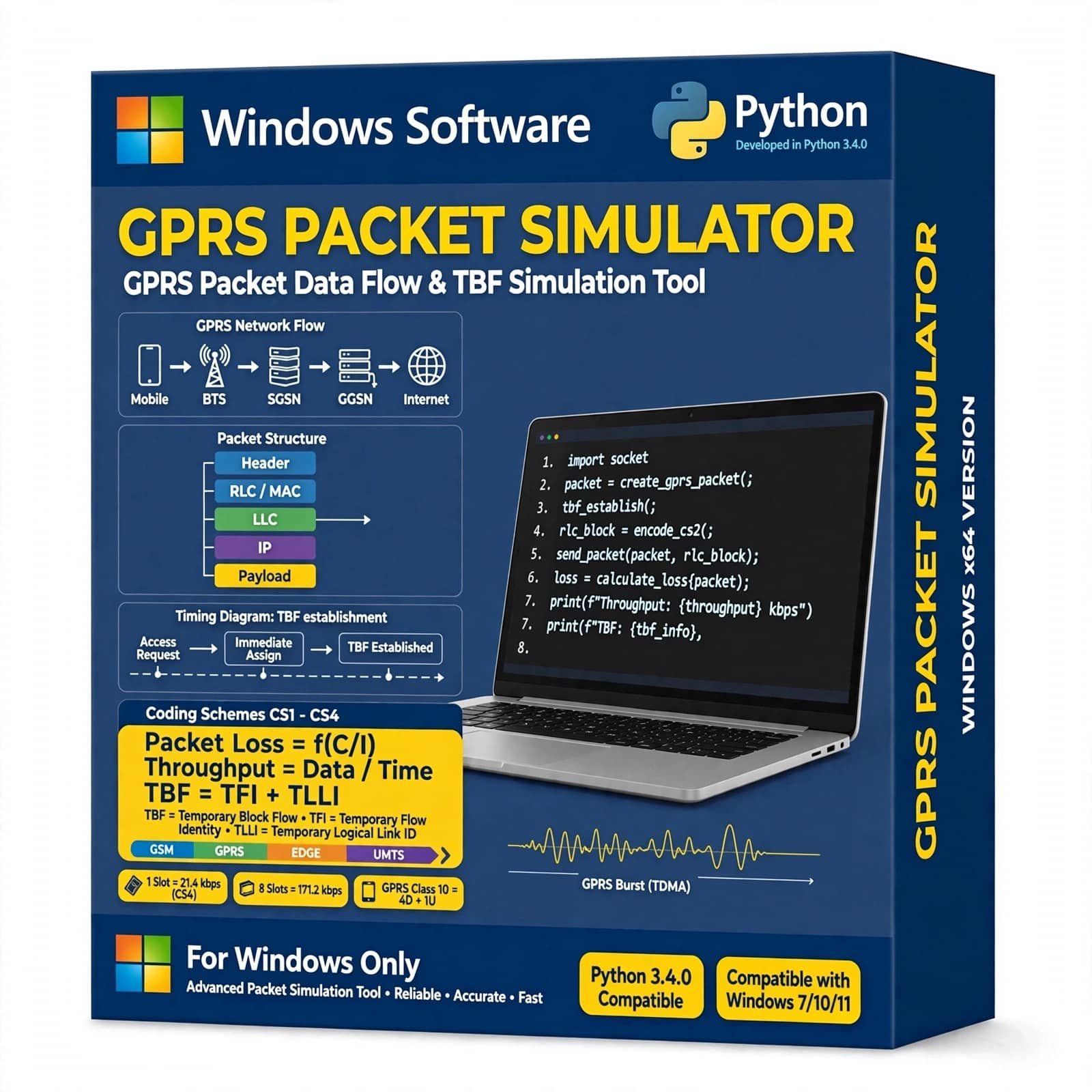
GPRS Packet Simulator is a powerful software solution for simulating GPRS data packets and testing GSM/GPRS communication systems. It helps developers, engineers, and testing teams generate, analyze, and validate packet-based communication in a controlled environment without requiring extensive physical network infrastructure. Ideal for GPRS testing, protocol development, IoT applications, and telecom system validation.
₹3,999.00 -
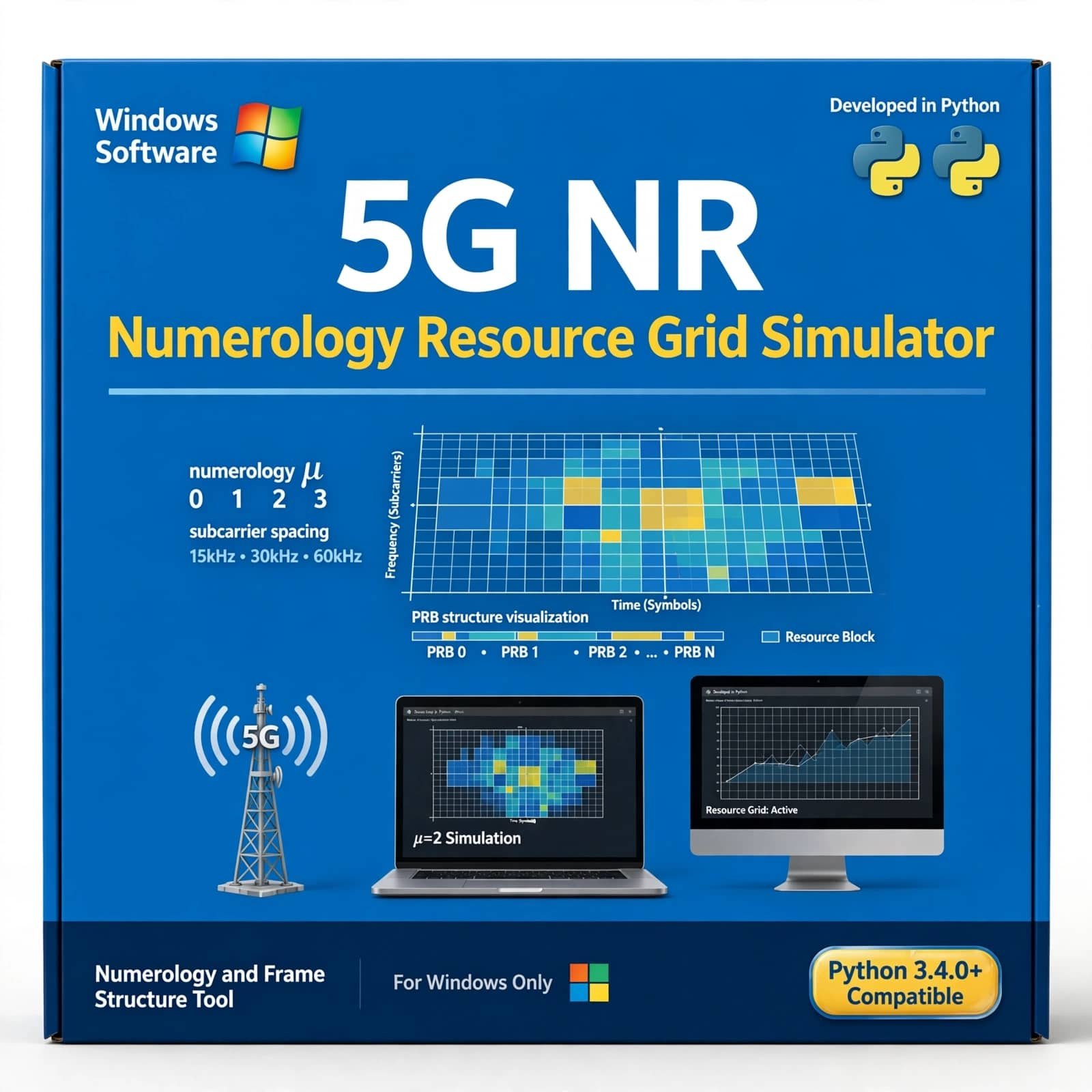
5G NR Numerology Resource Grid Simulator is an advanced simulation solution for modeling and analyzing 5G New Radio numerology and time-frequency resource grid structures. It enables users to study subcarrier spacing, OFDM symbols, slot structure, cyclic prefix, Physical Resource Blocks (PRBs), Resource Elements (REs), bandwidth configurations, and resource mapping. The simulator is ideal for 5G NR physical-layer research, numerology analysis, resource allocation studies, academic projects, waveform development, and 5G/6G wireless communication research.
Original price was: ₹99,999.00.₹9,999.00Current price is: ₹9,999.00.


Reviews
There are no reviews yet.