

LTE HARQ Simulator


₹6,999.00
In StockLTE HARQ Simulator developed with Python is a software-based simulation solution for studying Hybrid Automatic Repeat Request (HARQ) mechanisms used in 4G LTE wireless communication systems. It provides a practical environment for understanding data transmission, error detection, retransmission, ACK/NACK procedures, packet recovery, and communication reliability. The simulator is suitable for LTE research, academic projects, engineering demonstrations, wireless communication studies, and Python-based telecom simulations.
Description
LTE HARQ Simulator
The LTE HARQ Simulator developed with Python is a software-based simulation solution designed to study and demonstrate the Hybrid Automatic Repeat Request (HARQ) mechanism used in 4G LTE wireless communication systems. HARQ is an important error-control technique that combines forward error correction with retransmission mechanisms to improve the reliability and efficiency of wireless data transmission.
In a wireless communication environment, transmitted data can be affected by interference, noise, fading, and changing radio conditions. When a receiver detects that a transmitted data block has not been successfully decoded, a retransmission may be requested. HARQ helps manage this process by coordinating acknowledgments, negative acknowledgments, and retransmissions.
This Python-based LTE HARQ Simulator provides a practical environment for students, researchers, telecom engineers, and developers to explore these concepts through software simulation rather than relying solely on theoretical models.
Understand HARQ in 4G LTE
Hybrid Automatic Repeat Request is an essential mechanism for improving data transmission reliability in LTE networks. It combines error-correction techniques with retransmission strategies so that incorrectly received data can be transmitted again when necessary.
The LTE HARQ process involves the transmission of data, reception and decoding, error detection, and feedback indicating whether the transmission was successfully received. Depending on the result, the transmitting side can continue with new data or perform an appropriate retransmission.
Using an LTE HARQ Simulator, users can study these communication cycles and gain a better understanding of how HARQ contributes to reliable packet transmission in cellular networks.
Python-Based LTE HARQ Simulation
The simulator is developed using Python, providing a flexible and programmable environment for studying HARQ behavior. Python is widely used in research, data analysis, networking, scientific computing, and simulation, making it a practical choice for implementing experimental wireless communication models.
A Python-based simulator can also provide researchers and students with an opportunity to understand the relationship between simulation parameters and communication performance. Depending on the implementation, users can customize scenarios and investigate different transmission and retransmission conditions.
This makes the solution useful for both telecommunications education and research-oriented experimentation.
Study ACK and NACK Procedures
ACK and NACK feedback is an important part of HARQ operation. An acknowledgment indicates successful reception, while a negative acknowledgment indicates that retransmission may be required.
The LTE HARQ Simulator developed with Python can be used to demonstrate these feedback mechanisms and help users understand how transmitter and receiver operations are coordinated.
By observing simulated transmission and feedback cycles, students can develop a practical understanding of how error detection and retransmission work together to improve wireless communication reliability.
Explore LTE Retransmission Mechanisms
Retransmission is a fundamental aspect of HARQ. When a data transmission is unsuccessful, the system can initiate another transmission attempt according to the configured HARQ procedure.
A simulation environment provides a controlled way to study retransmission behavior under different conditions. Researchers can use such simulations to explore how transmission errors affect communication performance and how retransmission mechanisms can help recover unsuccessful transmissions.
The simulator can therefore be useful for projects involving LTE retransmission, packet recovery, error control, wireless reliability, and network performance analysis.
Applications of LTE HARQ Simulator
The LTE HARQ Simulator can be useful for a variety of academic, research, and development applications, including:
- 4G LTE network simulation
- HARQ algorithm studies
- Wireless communication research
- Error-control mechanism analysis
- ACK/NACK procedure demonstrations
- LTE retransmission experiments
- Telecommunications academic projects
- Final-year engineering projects
- LTE protocol learning
- Python-based telecom projects
- Network performance studies
- LTE communication system research
It can be particularly valuable for students and researchers studying wireless communication, telecommunications, electronics and communication engineering, computer networks, information technology, and related fields.
Ideal for Academic and Final-Year Projects
The Python LTE HARQ Simulator can provide a practical foundation for academic projects focused on wireless communication and LTE technologies. Students can use the simulation environment to demonstrate HARQ concepts, investigate transmission errors, and analyze retransmission behavior.
Instead of relying only on diagrams and theoretical descriptions, a simulator can help students visualize communication processes and experiment with different scenarios.
It can also serve as a starting point for research projects where additional algorithms, performance measurements, or customized simulation scenarios need to be explored.
Analyze Wireless Transmission Reliability
Reliable data transmission is a major requirement of modern cellular networks. Wireless channels are susceptible to various impairments, making mechanisms such as error detection, forward error correction, and retransmission important for maintaining communication quality.

An LTE HARQ simulation in Python allows users to investigate how transmission errors and retransmissions can influence the overall communication process. Researchers can use controlled simulation scenarios to examine factors such as successful transmissions, failed transmissions, retransmission attempts, and feedback behavior.
These experiments can provide useful insights into the relationship between error-control mechanisms and network performance.
Flexible Environment for LTE Research
One of the advantages of software-based simulation is the ability to conduct repeatable experiments without requiring a complete physical LTE network. Researchers can create controlled scenarios, modify simulation parameters, observe outcomes, and repeat experiments as needed.
The Python implementation further supports experimentation because developers can examine and extend the simulation logic based on their research requirements.
The simulator can therefore be used as a foundation for LTE protocol research, wireless communication experiments, telecom education, and algorithm development.
Benefits of LTE HARQ Simulator
A Python-based LTE HARQ simulation solution offers several benefits:
- Practical understanding of HARQ mechanisms
- Python-based programmable environment
- Controlled transmission and retransmission scenarios
- Useful for ACK/NACK demonstrations
- Suitable for academic and research applications
- Helps visualize LTE error-control concepts
- Useful for wireless communication experiments
- Can serve as a foundation for customized research
By studying HARQ through simulation, users can connect theoretical wireless communication concepts with practical software-based experimentation.
Why Choose an LTE HARQ Simulator?
HARQ is an important component of reliable LTE data communication. Understanding how transmission errors are detected and how retransmission procedures operate can help students and researchers develop a stronger understanding of modern cellular network technologies.
The LTE HARQ Simulator developed with Python combines LTE communication concepts with the flexibility of Python programming. This makes it suitable for academic demonstrations, research experiments, telecom projects, and developers interested in implementing or analyzing wireless communication mechanisms.
Conclusion
The LTE HARQ Simulator developed with Python provides a practical environment for studying Hybrid Automatic Repeat Request mechanisms in 4G LTE networks. It can help users understand data transmission, error detection, ACK/NACK feedback, retransmission procedures, and the role of HARQ in improving wireless communication reliability.
Whether you are working on an LTE academic project, final-year engineering project, wireless communication research project, HARQ algorithm study, or Python-based telecom simulation, this simulator can provide a useful foundation for experimentation and learning.
Explore LTE HARQ simulation with Python and gain practical insight into the error-control and retransmission mechanisms that support reliable data communication in 4G LTE networks.
Related products
-
5G NR Massive MIMO Simulator is an advanced simulation solution for modeling and analyzing Massive Multiple-Input Multiple-Output (MIMO) technologies in 5G New Radio networks. It enables users to study large-scale antenna arrays, beamforming, precoding, spatial multiplexing, multi-user MIMO, channel estimation, and interference under configurable channel conditions. The simulator supports analysis of throughput, spectral efficiency, SINR, BER, BLER, MIMO capacity, beamforming gain, and multi-user performance, making it ideal for 5G NR research, algorithm development, academic projects, and 5G/6G wireless system optimization.
Original price was: ₹149,999.00.₹14,999.00Current price is: ₹14,999.00. -
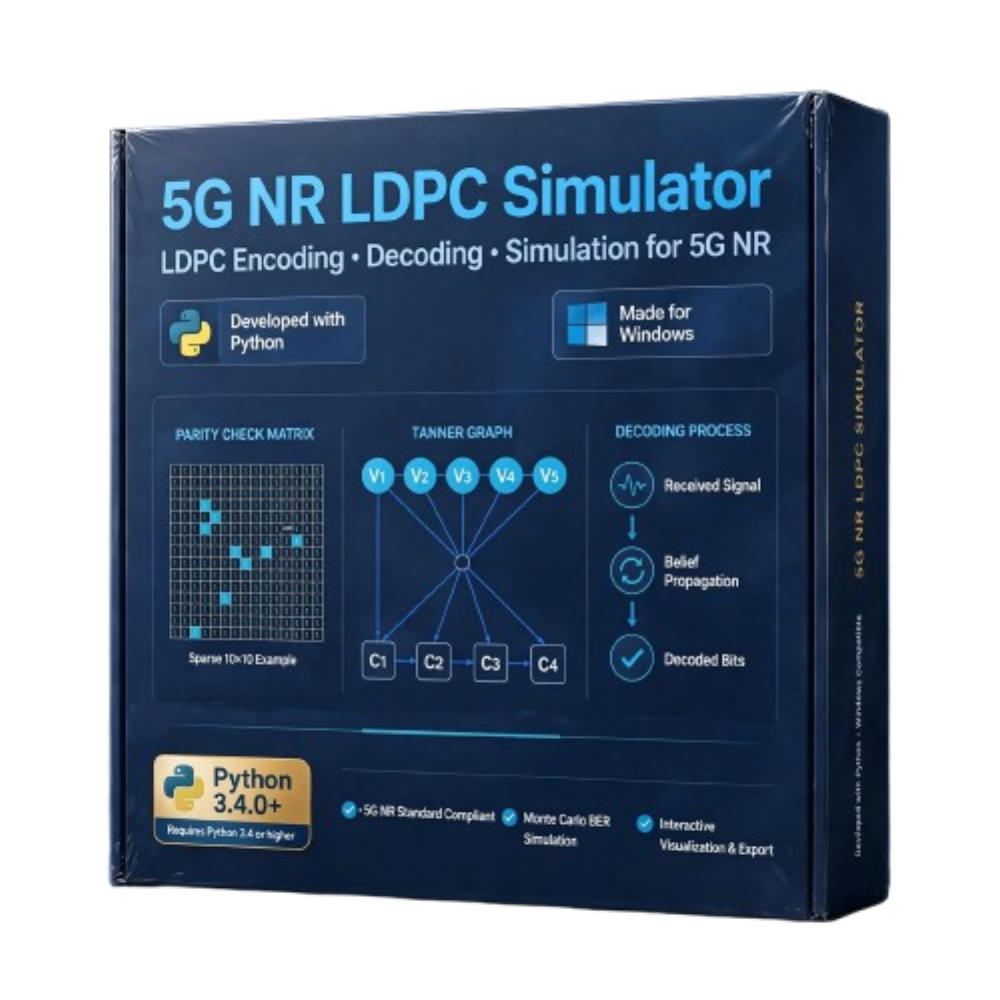
5G NR LDPC Simulator is an advanced simulation solution for modeling and analyzing Low-Density Parity-Check (LDPC) channel coding used in 5G New Radio systems. It enables users to simulate LDPC encoding and decoding, evaluate error correction performance, and analyze BER, BLER, SNR, coding rate, decoding iterations, throughput, and convergence under configurable channel conditions. The simulator is ideal for 5G NR channel coding research, algorithm development, academic projects, decoder performance analysis, and next-generation wireless communication system optimization.
Original price was: ₹129,999.00.₹12,999.00Current price is: ₹12,999.00. -
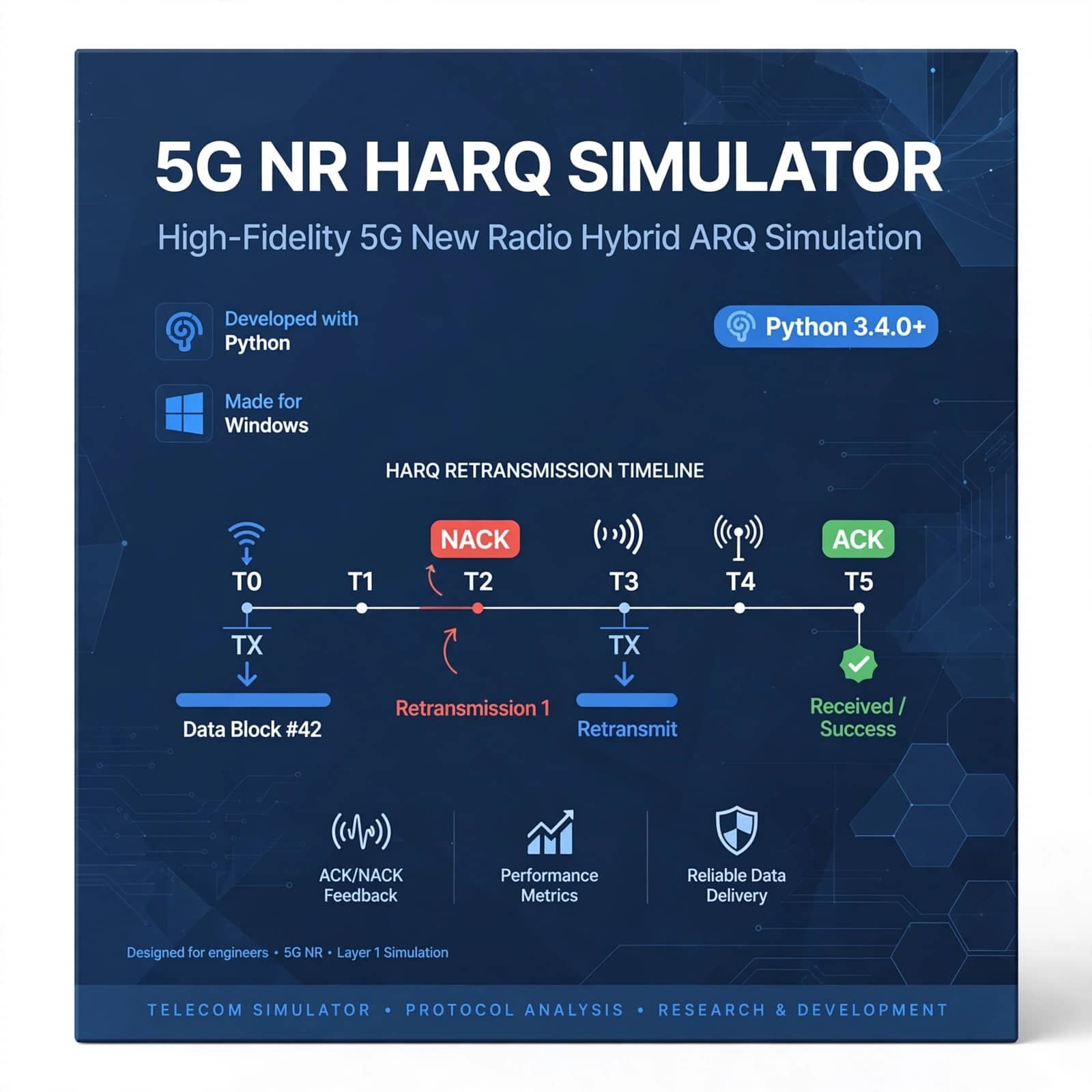
5G NR HARQ Simulator is an advanced simulation solution for modeling and analyzing Hybrid Automatic Repeat Request (HARQ) mechanisms in 5G New Radio networks. It enables users to study HARQ processes, ACK/NACK feedback, retransmissions, link adaptation, channel errors, and communication reliability under configurable network conditions. The simulator supports analysis of throughput, BLER, latency, retransmission rate, packet errors, spectral efficiency, and other key performance metrics, making it suitable for 5G NR research, algorithm development, academic projects, and wireless communication system optimization.
Original price was: ₹74,999.00.₹9,999.00Current price is: ₹9,999.00. -

The 2G GSM Cell Simulator is a Python-based software project designed to simulate fundamental GSM cellular-network concepts. It provides a practical environment for understanding mobile stations, GSM cells, base stations, cellular coverage, mobility, communication channels, and basic network behavior. The project includes Python source code that can be studied, customized, and extended for academic projects, demonstrations, research, and learning. It is ideal for Electronics & Communication Engineering, Telecommunications, Computer Science, and related students looking to explore 2G GSM technology and cellular network simulation through a software-based implementation.
₹3,999.00 -
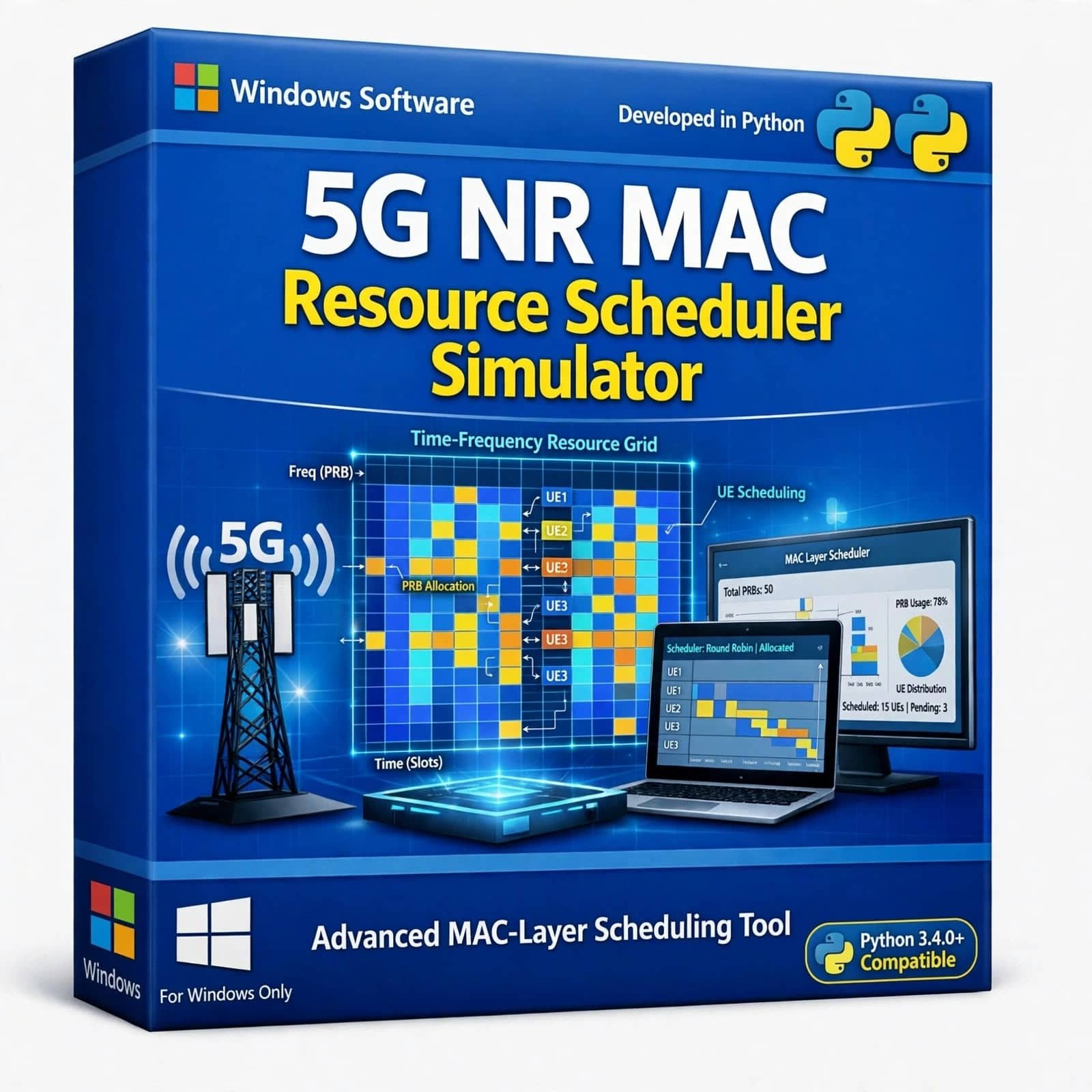
5G NR MAC Resource Scheduler Simulator is an advanced simulation solution for modeling and analyzing Medium Access Control (MAC) layer resource scheduling in 5G New Radio networks. It enables users to evaluate dynamic resource allocation, multi-UE scheduling, uplink and downlink resource management, QoS-aware scheduling, traffic conditions, and scheduling algorithms. The simulator supports analysis of throughput, latency, fairness, spectral efficiency, resource utilization, packet loss, and QoS performance, making it ideal for 5G NR research, scheduler algorithm development, academic projects, and wireless network optimization.
Original price was: ₹129,999.00.₹12,999.00Current price is: ₹12,999.00. -
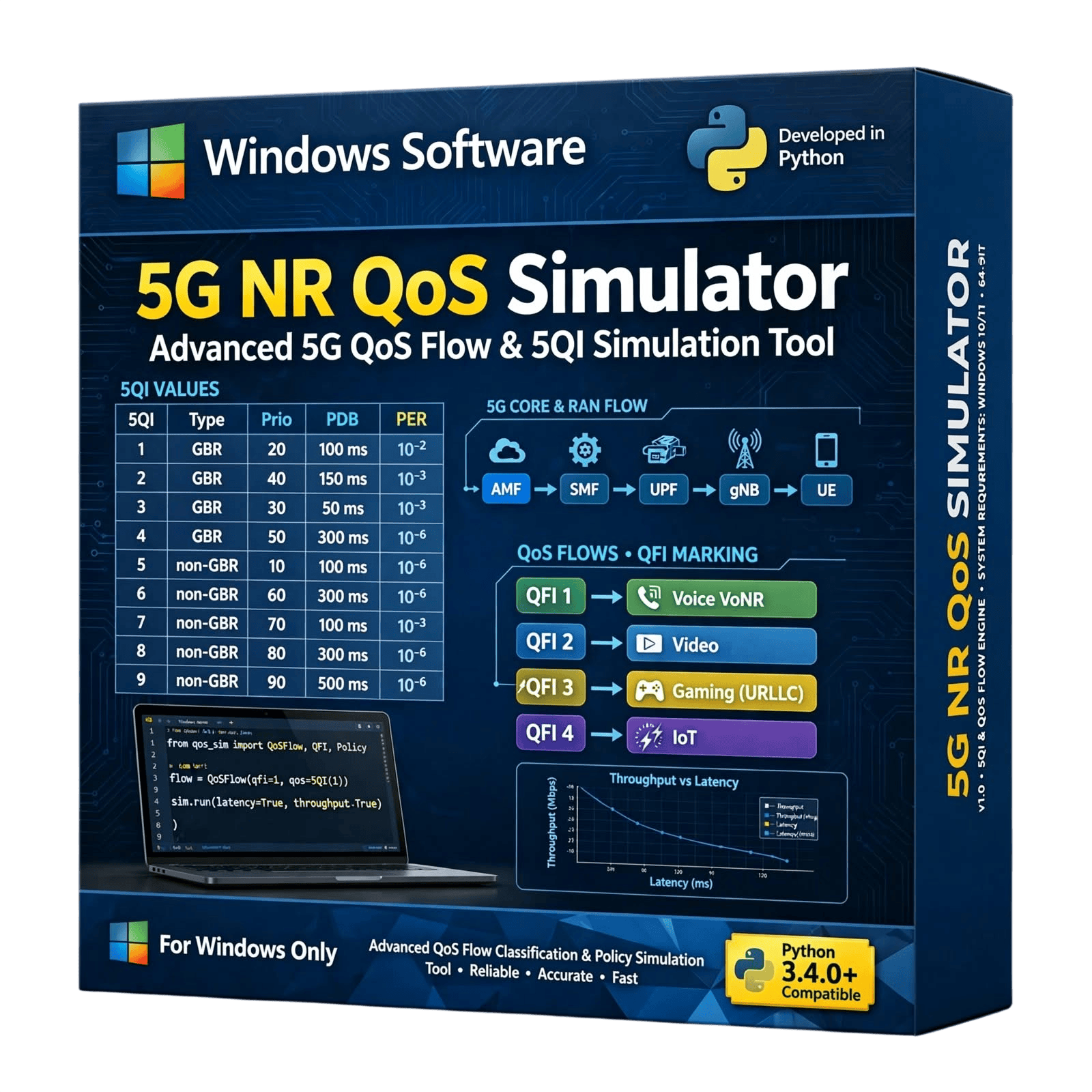
The 5G QoS Simulator is a Python-based software solution designed for researchers, engineers, students, developers, and telecommunications professionals working with 5G Quality of Service (QoS) concepts. The simulator provides a software-based environment for studying and analyzing QoS-related aspects of 5G communication networks, including service performance, traffic behavior, resource management, and network performance evaluation.
Developed using Python, the simulator is suitable for academic research, telecommunications projects, demonstrations, experimentation, algorithm development, and educational applications.
Available for sale as a software product. Contact us for pricing, licensing, features, customization, and purchase information.
Original price was: ₹74,999.00.₹9,999.00Current price is: ₹9,999.00.



Reviews
There are no reviews yet.