
New
67% Off

VSAT Uplink Downlink Simulator

Original price was: ₹750.00.₹250.00Current price is: ₹250.00.
In StockThe VSAT Uplink Downlink Simulator with Python is a professional tool for modeling satellite communication links. It simulates both uplink (earth station to satellite) and downlink (satellite to earth station) paths, incorporating ITU‑R standards for accurate attenuation and propagation analysis. With customizable parameters such as frequency, antenna size, polarization, and transmit power, users can evaluate link budgets, carrier‑to‑noise ratios, and overall system reliability.
Built in Python, the simulator offers flexibility, scalability, and graphical outputs for clear visualization. It is ideal for engineers, researchers, and educators working in satellite communication, RF engineering, and telecom industries. Whether you are designing resilient VSAT networks, conducting academic research, or training students, this simulator provides a powerful environment to understand and optimize uplink and downlink performance.
Description
VSAT Uplink Downlink Simulator
The VSAT Uplink Downlink Simulator with Python is a specialized software solution designed to model, analyze, and optimize satellite communication links. In modern VSAT (Very Small Aperture Terminal) networks, the uplink (earth station to satellite) and downlink (satellite to earth station) are critical pathways that determine overall system performance. Factors such as atmospheric attenuation, free‑space path loss, antenna gain, polarization mismatch, and interference can significantly affect link quality. This simulator provides a Python‑based environment to replicate these conditions, enabling engineers, researchers, and students to understand and mitigate challenges in satellite communication systems.
Unlike generic network simulators, this tool focuses specifically on uplink and downlink dynamics, making it invaluable for professionals working with Ku‑band, Ka‑band, and emerging Q/V‑band systems. By integrating ITU‑R recommendations and customizable parameters, the simulator offers a realistic representation of satellite link behavior under varying conditions.

Key Features
- Python Integration: Built entirely in Python, ensuring flexibility, scalability, and compatibility with modern workflows.
- Uplink & Downlink Modeling: Simulates both transmission paths, including free‑space loss, atmospheric absorption, and rain attenuation.
- ITU‑R Standards: Implements ITU‑R P.618, P.837, and P.676 models for accurate attenuation and propagation analysis.
- Customizable Parameters: Adjust frequency, elevation angle, antenna size, polarization, and transmit power.
- Graphical Output: Visualize link budgets, carrier‑to‑noise ratios (C/N), and effective isotropic radiated power (EIRP).
- Educational Utility: Ideal for teaching satellite communication fundamentals in academic institutions.
- Industry Application: Supports telecom operators, satellite service providers, and defense organizations.
 Technical Benefits
- Accurate Link Budgeting: Calculate uplink and downlink budgets with precision, including antenna gain, path loss, and atmospheric effects.
- Performance Testing: Evaluate modulation schemes, coding strategies, and adaptive techniques under varying conditions.
- Cost Efficiency: Reduce reliance on expensive field trials by simulating conditions virtually.
- Scalability: Extend functionality with Python libraries such as NumPy, SciPy, and Matplotlib.
- Cross‑Platform: Runs seamlessly on Windows, macOS, and Linux.

Use Cases
- VSAT Network Design: Optimize satellite internet services by balancing uplink and downlink performance.
- Academic Research: Support thesis projects and publications in RF engineering and satellite communication.
- Training & Education: Provide hands‑on learning for students in communication systems courses.
- Telecom Industry: Help operators plan resilient networks in diverse geographic regions.
- Defense & Aerospace: Ensure secure communication links under challenging conditions.
Why Choose This Simulator?
The VSAT Uplink Downlink Simulator with Python stands out because it combines scientific accuracy with practical usability. It is not just a teaching tool but a professional solution for real‑world satellite communication challenges. By modeling both uplink and downlink paths, it provides a holistic view of system performance, helping engineers design robust networks that withstand environmental and technical challenges.

Python’s open‑source ecosystem ensures extensibility, allowing integration with machine learning frameworks for predictive analysis or automation of large‑scale simulations. This makes the simulator future‑proof and adaptable to evolving industry needs.
VSAT Uplink Downlink Simulator, Python Satellite Communication Tool, Satellite Link Budget Analysis, Ku‑band and Ka‑band Simulation, ITU‑R Propagation Models, Adaptive Modulation Testing, RF Engineering Educational Tool, VSAT Network Reliability, Satellite Communication Training Software, Uplink Downlink Performance Analysis
Related products
-
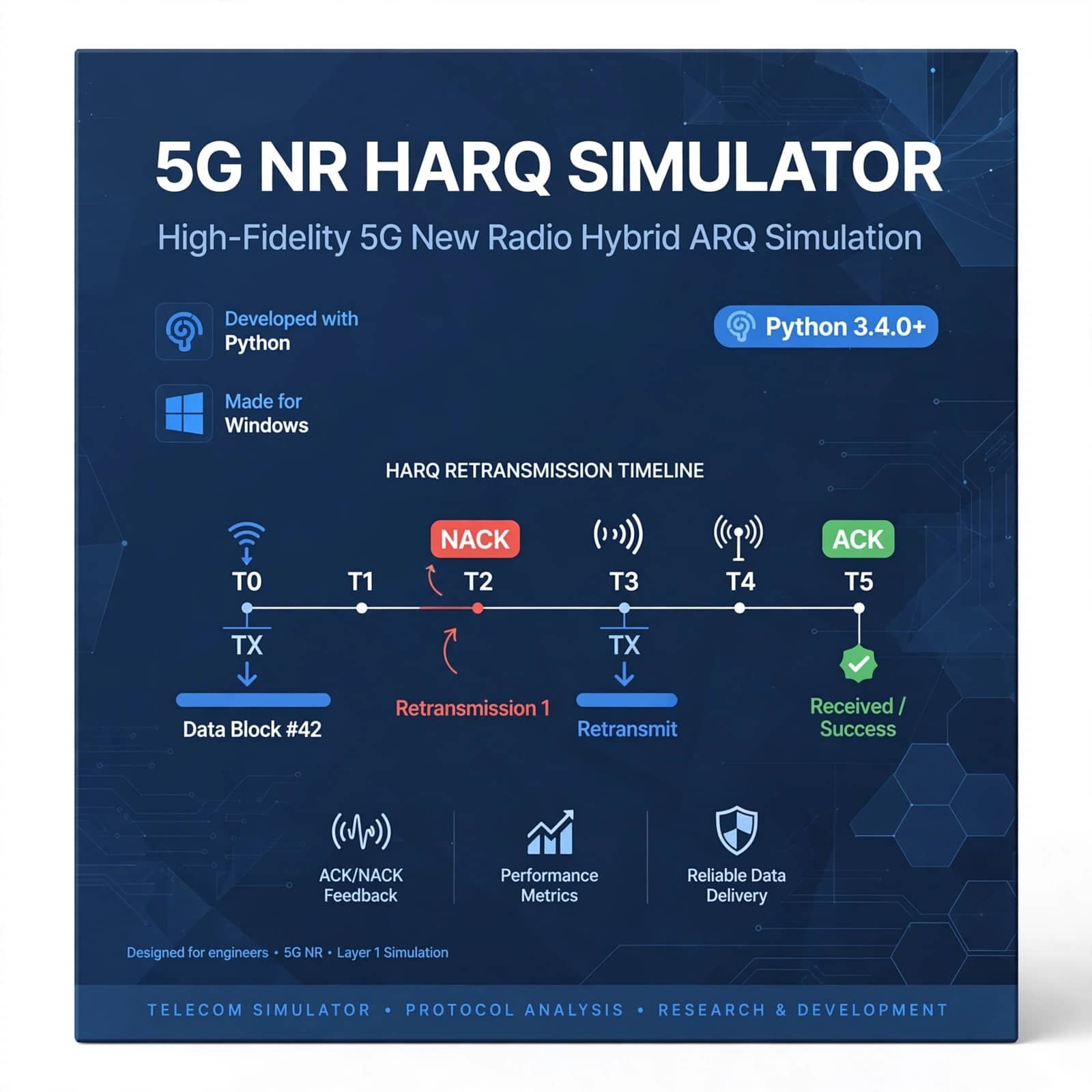
5G NR HARQ Simulator is an advanced simulation solution for modeling and analyzing Hybrid Automatic Repeat Request (HARQ) mechanisms in 5G New Radio networks. It enables users to study HARQ processes, ACK/NACK feedback, retransmissions, link adaptation, channel errors, and communication reliability under configurable network conditions. The simulator supports analysis of throughput, BLER, latency, retransmission rate, packet errors, spectral efficiency, and other key performance metrics, making it suitable for 5G NR research, algorithm development, academic projects, and wireless communication system optimization.
Original price was: ₹750.00.₹250.00Current price is: ₹250.00. -
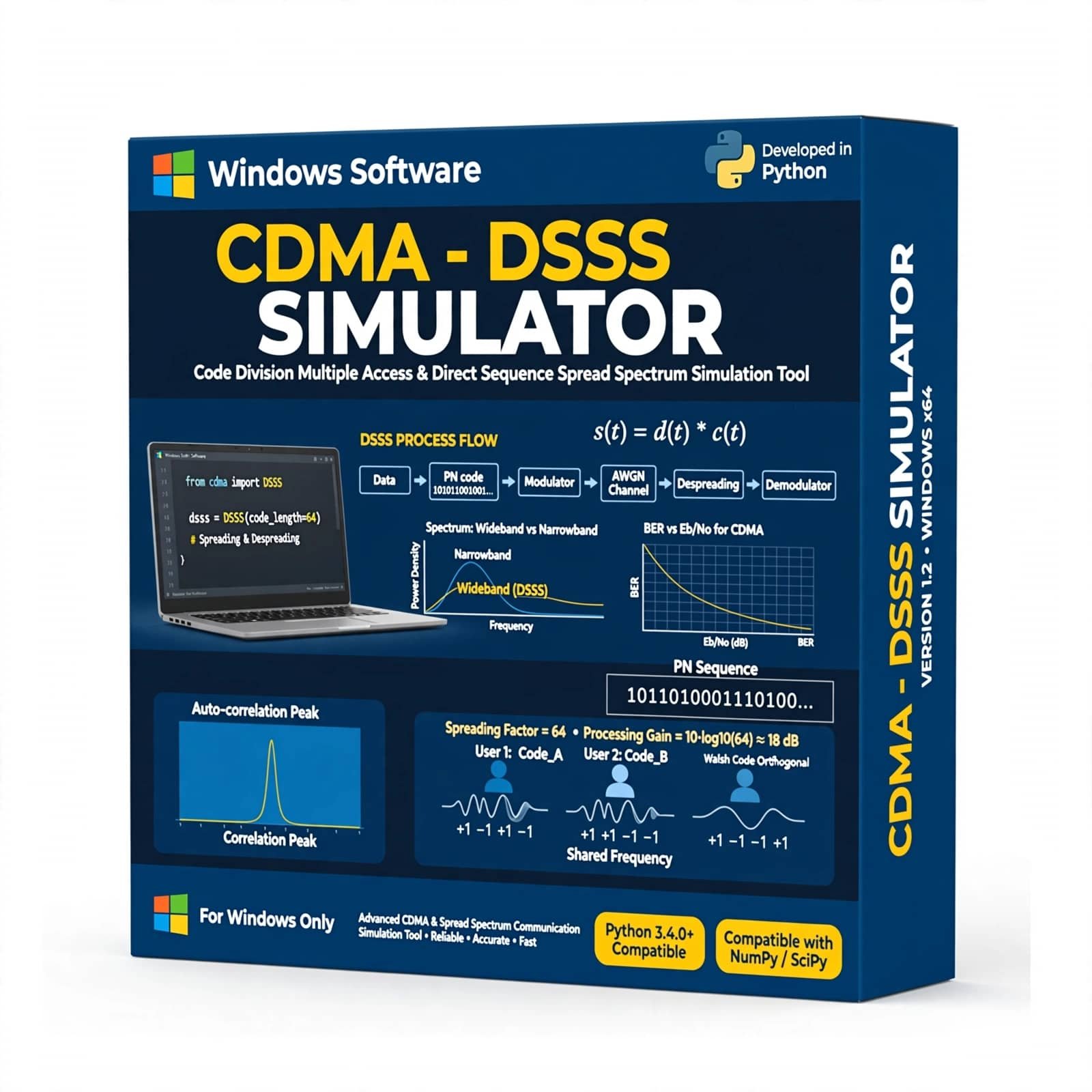
The CDMA – DSSS Simulator with Python is a software-based communication simulation tool designed to demonstrate and analyze Code Division Multiple Access (CDMA) and Direct Sequence Spread Spectrum (DSSS) techniques. Developed using Python, the simulator provides a practical environment for studying spreading codes, signal spreading and despreading, data transmission, multiple-access communication, interference, and signal recovery. It is ideal for digital communication and wireless communication laboratories, engineering education, student projects, technical training, and communication-system research.
Original price was: ₹750.00.₹250.00Current price is: ₹250.00. -
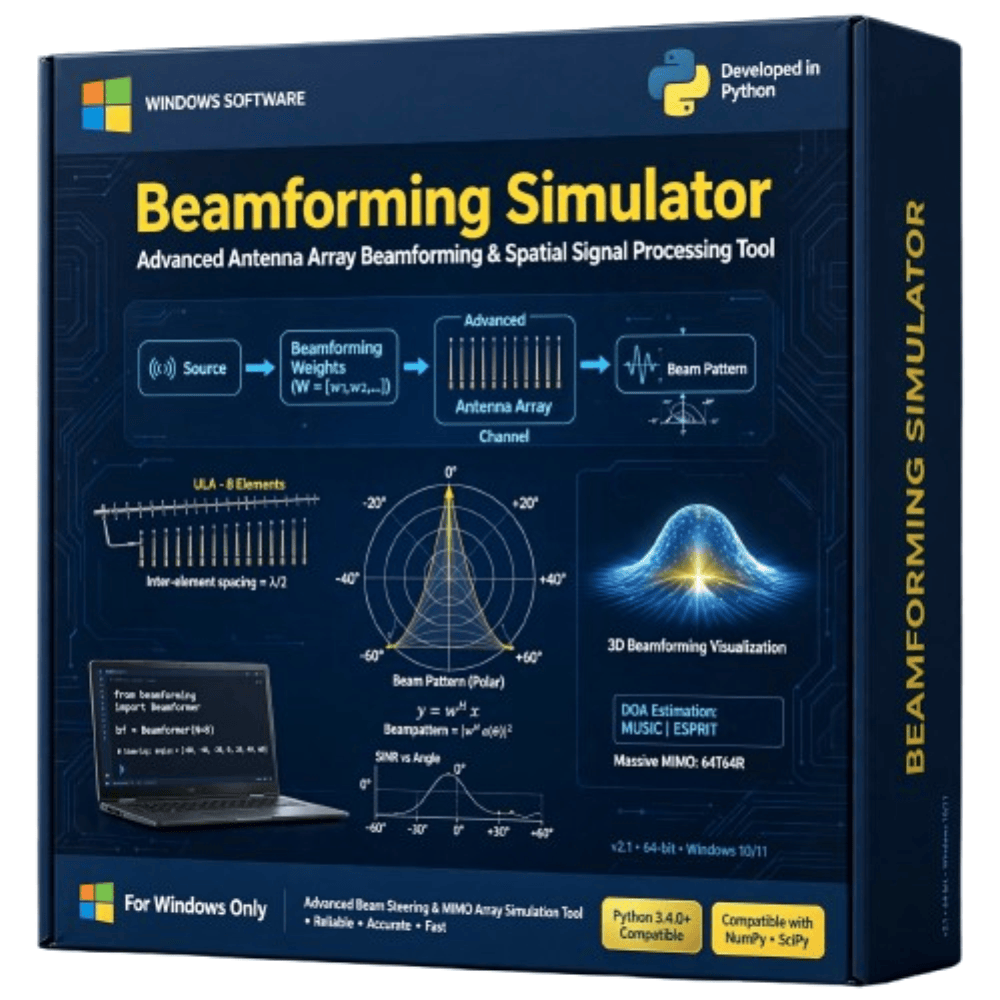
The Beamforming Simulator is a practical wireless communication simulation project designed to demonstrate how antenna arrays can control and direct radio-frequency signals toward desired users or directions. The simulator helps visualize beam patterns, signal direction, antenna-array behavior, and beam steering under different parameters. It is suitable for studying beamforming, antenna arrays, MIMO, 5G communication, wireless networks, and signal processing. This project is ideal for engineering students, researchers, and learners working on wireless communication and advanced antenna technologies.
Original price was: ₹750.00.₹250.00Current price is: ₹250.00. -
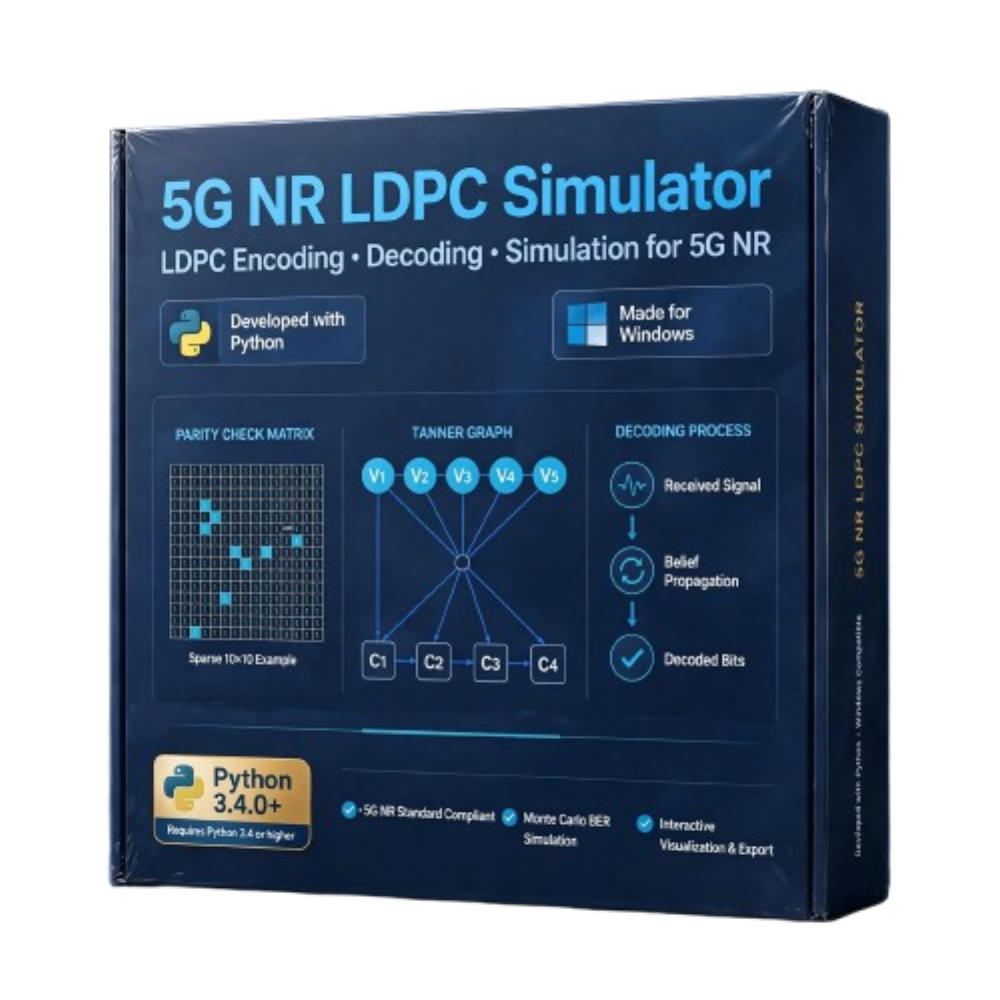
5G NR LDPC Simulator is an advanced simulation solution for modeling and analyzing Low-Density Parity-Check (LDPC) channel coding used in 5G New Radio systems. It enables users to simulate LDPC encoding and decoding, evaluate error correction performance, and analyze BER, BLER, SNR, coding rate, decoding iterations, throughput, and convergence under configurable channel conditions. The simulator is ideal for 5G NR channel coding research, algorithm development, academic projects, decoder performance analysis, and next-generation wireless communication system optimization.
Original price was: ₹750.00.₹250.00Current price is: ₹250.00. -
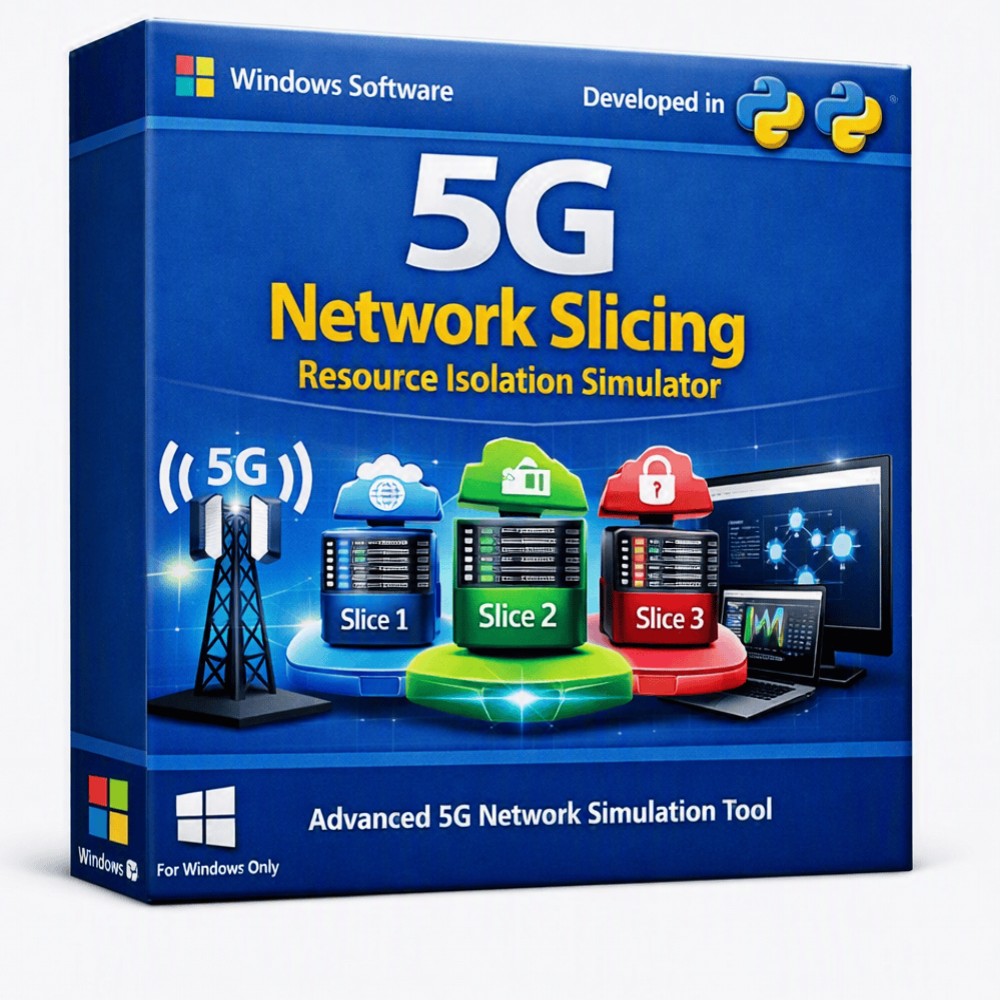
A Python-based 5G Network Slicing and Resource Isolation Simulator designed to model and analyze how multiple logical network slices can share physical 5G infrastructure while maintaining resource isolation. The simulator enables users to study CPU, memory, bandwidth, network capacity, traffic allocation, and resource management across different 5G network slices.
Ideal for 5G research, telecom engineering, academic projects, network optimization, resource allocation studies, and university laboratories.
Original price was: ₹750.00.₹250.00Current price is: ₹250.00. -
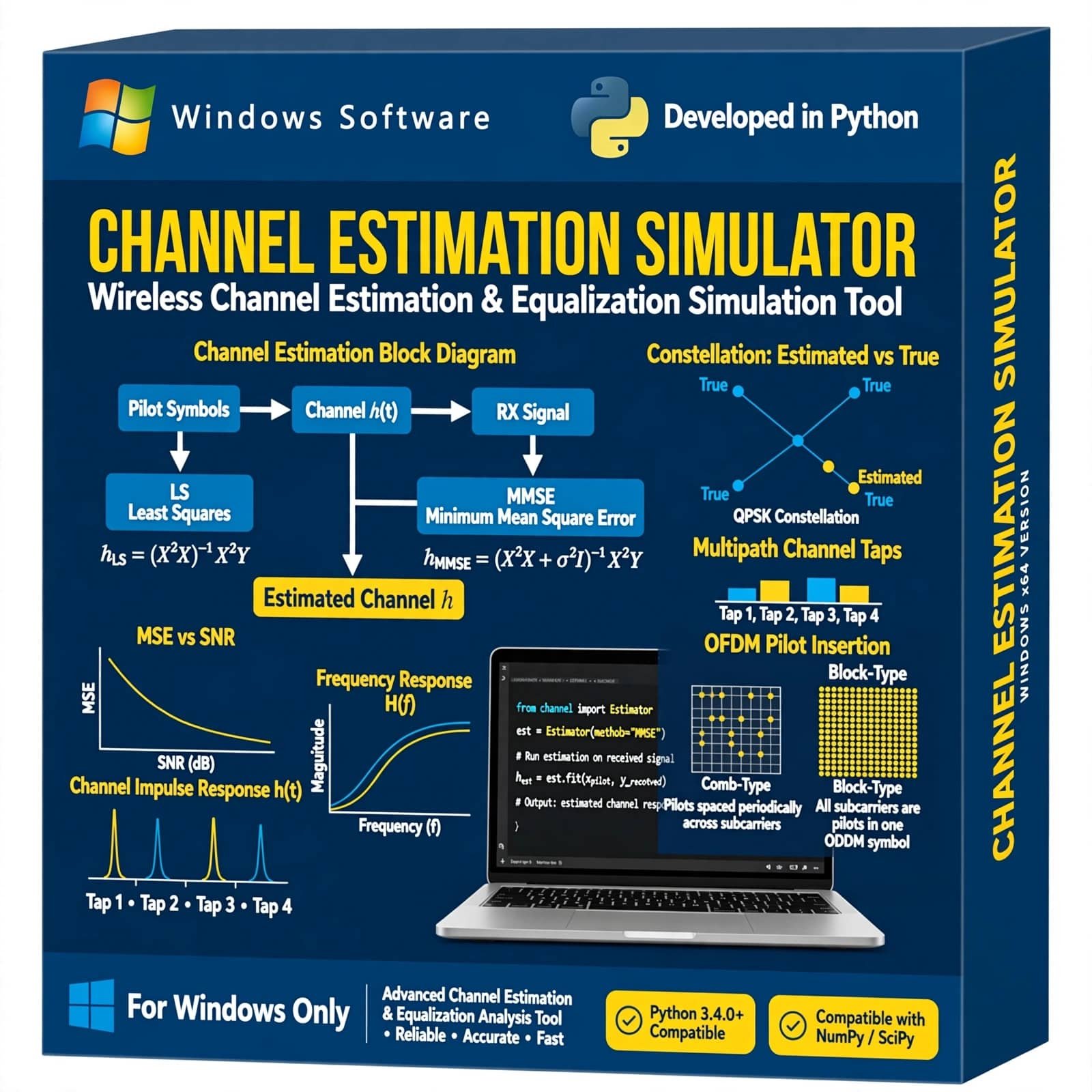
Channel Estimation Simulator is a wireless communication simulation tool designed to demonstrate and analyze channel estimation techniques in digital communication systems. It helps students, researchers, and communication engineers study channel effects, pilot-based estimation, signal distortion, and estimation performance through practical simulation.
Original price was: ₹750.00.₹250.00Current price is: ₹250.00.


Reviews
There are no reviews yet.