
New
67% Off

VSAT Return-Link Capacity Simulator

Original price was: ₹750.00.₹250.00Current price is: ₹250.00.
In StockVSAT Return-Link Capacity Simulator with Python is a software-based simulation tool for modeling and analyzing VSAT return-link capacity, bandwidth utilization, traffic demand, resource allocation, and network throughput. It supports multiple-terminal scenarios and configurable capacity experiments, making it suitable for B.Tech, M.Tech, MSc, PhD, satellite communication, telecommunications, and Python-based research projects.
Description
VSAT Return-Link Capacity Simulator
The VSAT Return-Link Capacity Simulator with Python is a software-based simulation tool designed for modeling, analyzing, and evaluating the capacity and performance of VSAT return links in satellite communication networks. Developed using Python, this simulator provides a practical environment for students, researchers, satellite communication engineers, and developers to study how multiple VSAT terminals share limited return-link resources and how traffic demand, bandwidth, modulation, coding, and resource allocation influence network capacity.
In a VSAT network, the return link carries traffic from remote terminals toward a central hub or gateway through a satellite. Efficient management of return-link resources is essential because multiple terminals may simultaneously generate traffic while competing for available satellite bandwidth and transmission resources. The VSAT Return-Link Capacity Simulator with Python provides a controlled software environment for experimenting with these scenarios without requiring physical satellite communication equipment.

Python-Based VSAT Capacity Simulation
Python offers a flexible platform for developing communication-system models and analyzing satellite network performance. The Python VSAT Return-Link Simulator can be used to model different terminal populations, traffic conditions, bandwidth allocations, transmission rates, and resource-management strategies.
Users can configure simulation parameters according to their research or project requirements. For example, the number of VSAT terminals, available bandwidth, traffic demand, channel allocation, transmission capacity, and other network parameters can be varied to examine their impact on return-link utilization and overall system capacity.
This makes the simulator suitable for satellite communication projects, VSAT network research, academic studies, engineering demonstrations, and Python-based communication simulations.

VSAT Return-Link Capacity Analysis
The return link is a critical part of a VSAT communication system because it must accommodate traffic generated by geographically distributed terminals. Depending on the network architecture and access mechanism, terminals may share return-link resources using techniques such as TDMA, MF-TDMA, SCPC, or other multiple-access mechanisms.
The VSAT Return-Link Capacity Simulator provides an environment for studying important concepts such as:
- VSAT return-link capacity
- Satellite bandwidth allocation
- Multiple-terminal traffic
- Return-channel resource utilization
- User traffic demand
- Channel allocation
- Transmission rate analysis
- Bandwidth efficiency
- Network capacity planning
- Traffic load analysis
- Throughput evaluation
- Resource allocation strategies
By adjusting network parameters, users can investigate how increasing terminal traffic or changing available resources can affect the capacity and utilization of the return link.

Traffic and Resource Modeling
One of the important applications of a VSAT capacity simulator is studying the relationship between user traffic and available satellite resources. A network may have many remote terminals generating different amounts of traffic, making resource allocation an important consideration.
The Python simulation environment can be used to represent different traffic conditions and examine how available return-link resources are utilized. Users can experiment with low, moderate, and high traffic scenarios and analyze changes in throughput, resource utilization, and network capacity.
Such simulations can help researchers understand capacity constraints and evaluate different resource-management approaches before considering real-world implementation.
Useful for Academic and Research Projects
The VSAT Return-Link Capacity Simulator with Python is suitable for B.Tech, M.Tech, MSc, PhD, electronics and communication engineering, telecommunications, satellite communication, and networking projects.

Students can use the simulator for project development, laboratory demonstrations, technical presentations, and thesis experiments. Researchers can use it as a foundation for studying satellite network capacity, return-link resource allocation, traffic modeling, and performance optimization.
The Python implementation also makes it possible for users with programming knowledge to modify the simulation logic, introduce additional traffic models, implement resource-allocation algorithms, or add custom performance metrics.
Bandwidth and Capacity Evaluation
Satellite communication systems operate with finite bandwidth and transmission resources. Understanding how those resources are consumed by multiple terminals is essential for effective network planning.
The VSAT Return-Link Capacity Simulator can be used to evaluate different bandwidth and capacity scenarios. Users can study how available bandwidth, transmission rates, number of terminals, and traffic demand influence system behavior.

Simulation results can support analysis of metrics such as:
- Return-link throughput
- Bandwidth utilization
- Traffic load
- User capacity
- Resource utilization
- Transmission efficiency
- Network congestion
- Available capacity
These metrics can be useful when comparing different network configurations or studying the effect of resource-allocation policies.
Flexible Python Simulation Environment
A major advantage of using Python for VSAT network simulation is the ability to customize the model. Researchers can extend the simulator with additional channel models, traffic patterns, scheduling mechanisms, capacity calculations, visualization, or statistical analysis.
The simulator can therefore be used as a foundation for developing more advanced VSAT return-link capacity analysis tools. Depending on project requirements, users can implement additional algorithms for dynamic resource allocation, traffic prioritization, scheduling, or capacity optimization.

Applications of VSAT Return-Link Capacity Simulator
The simulator can be applied to several areas of satellite and communication-system research, including:
- VSAT network capacity planning
- Return-link performance analysis
- Satellite bandwidth management
- Traffic and capacity modeling
- Resource allocation research
- Multiple-access network simulation
- Satellite network optimization studies
- Throughput and utilization analysis
- VSAT engineering projects
- Python-based satellite communication research
Why Use a VSAT Return-Link Simulator?
Analyzing satellite communication networks using physical infrastructure can be expensive and technically demanding. A software-based simulator provides a controlled environment where researchers and students can experiment with network configurations and capacity scenarios without requiring dedicated satellite hardware.
The VSAT Return-Link Capacity Simulator with Python allows users to model multiple terminals, vary traffic conditions, adjust available resources, and evaluate the resulting network behavior.
It can therefore be useful for understanding the relationship between VSAT traffic demand, return-link bandwidth, resource allocation, and network capacity.
Key Features
- Python-based VSAT return-link simulation
- Return-link capacity modeling
- Multiple VSAT terminal simulation
- Traffic demand modeling
- Bandwidth allocation analysis
- Resource utilization evaluation
- Throughput analysis
- Capacity planning experiments
- Configurable simulation parameters
- Support for satellite communication research
- Extendable Python simulation environment
- Suitable for academic and engineering projects
Ideal for Satellite Communication Projects
Whether you are developing a VSAT network project, satellite communication thesis, return-link capacity analysis, Python simulation project, or network resource-allocation study, the VSAT Return-Link Capacity Simulator with Python provides a practical environment for experimentation.

By combining Python programming with VSAT network and satellite capacity concepts, the simulator enables students, researchers, and communication engineers to investigate different return-link scenarios, analyze available resources, and study how traffic demand influences satellite network performance.
Related products
-
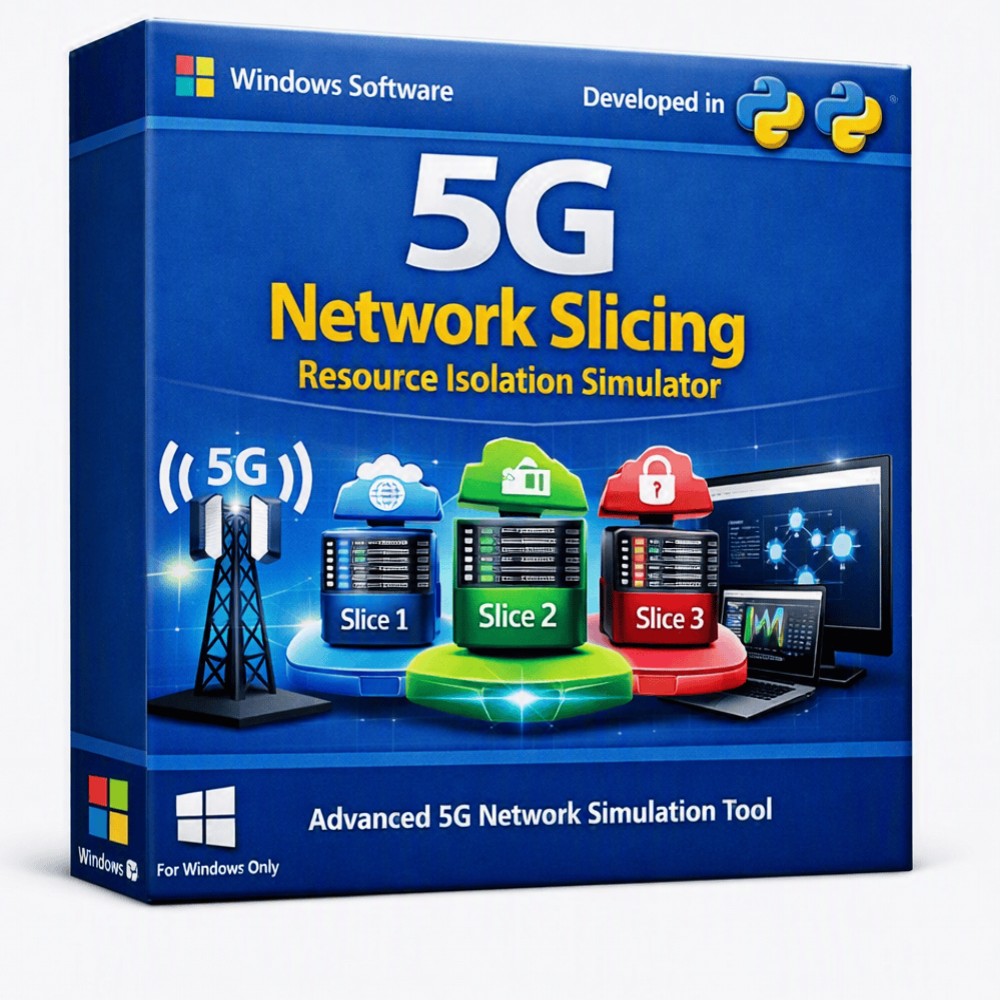
A Python-based 5G Network Slicing and Resource Isolation Simulator designed to model and analyze how multiple logical network slices can share physical 5G infrastructure while maintaining resource isolation. The simulator enables users to study CPU, memory, bandwidth, network capacity, traffic allocation, and resource management across different 5G network slices.
Ideal for 5G research, telecom engineering, academic projects, network optimization, resource allocation studies, and university laboratories.
Original price was: ₹750.00.₹250.00Current price is: ₹250.00. -
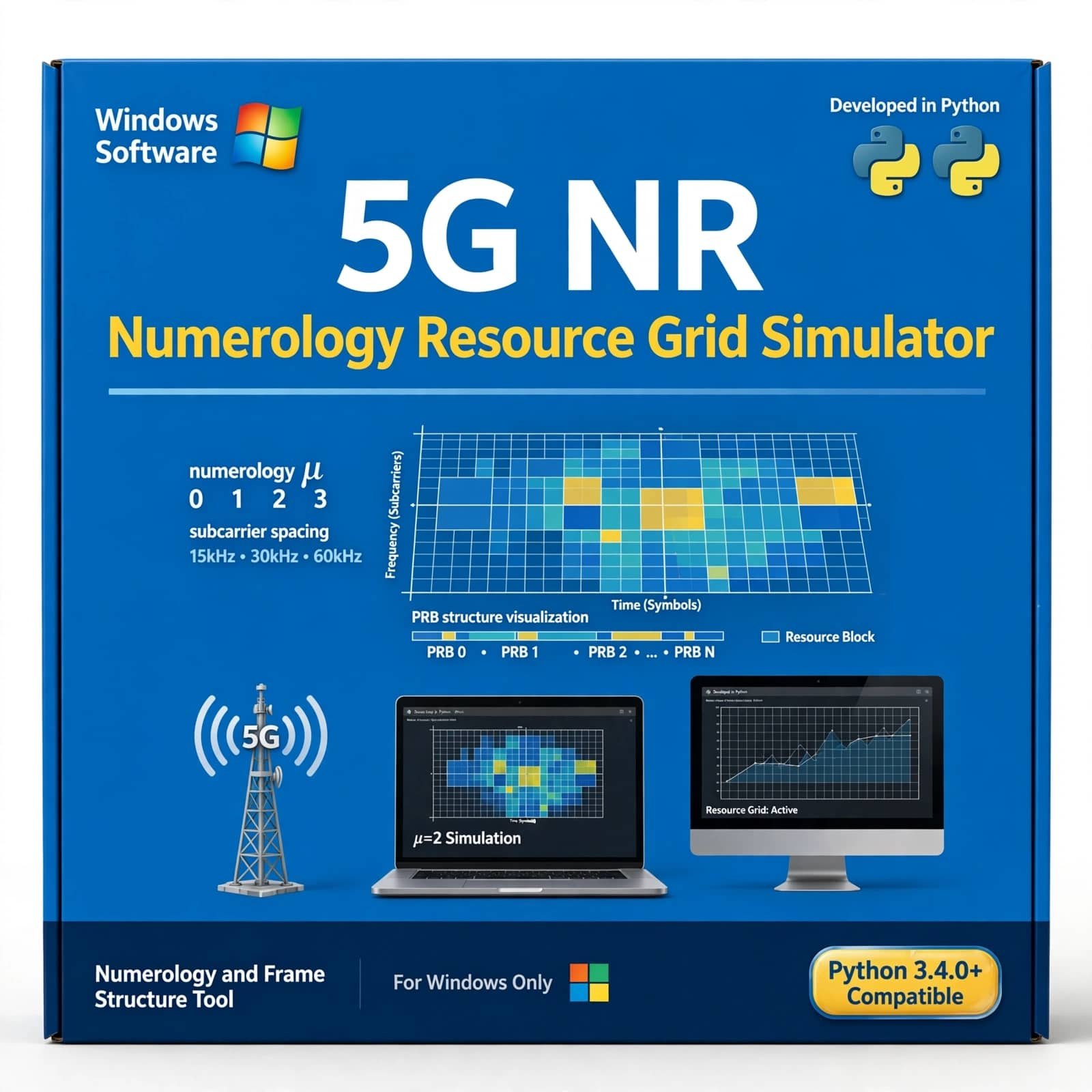
5G NR Numerology Resource Grid Simulator is an advanced simulation solution for modeling and analyzing 5G New Radio numerology and time-frequency resource grid structures. It enables users to study subcarrier spacing, OFDM symbols, slot structure, cyclic prefix, Physical Resource Blocks (PRBs), Resource Elements (REs), bandwidth configurations, and resource mapping. The simulator is ideal for 5G NR physical-layer research, numerology analysis, resource allocation studies, academic projects, waveform development, and 5G/6G wireless communication research.
Original price was: ₹750.00.₹250.00Current price is: ₹250.00. -
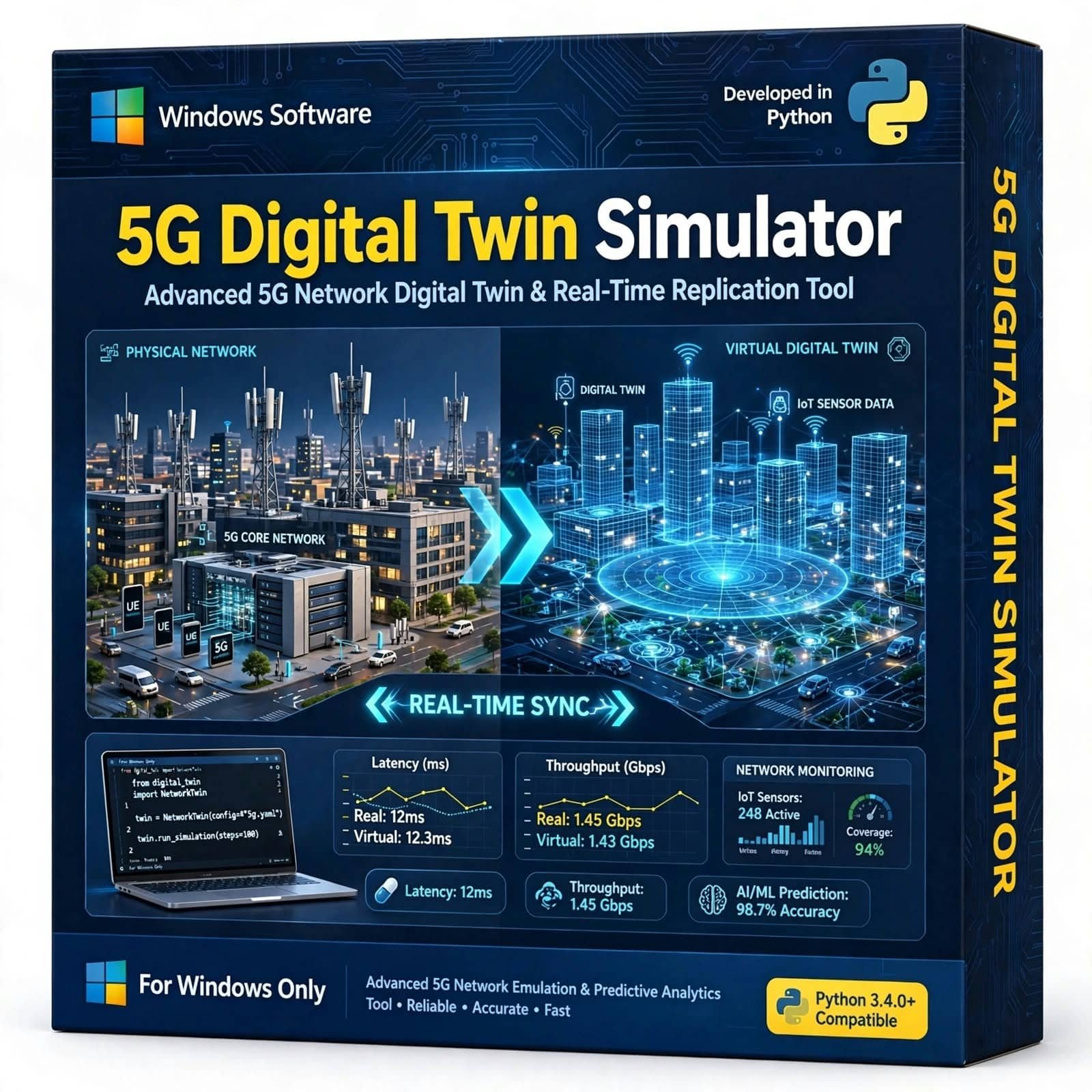
The 5G Digital Twin is a Python-based software solution designed for researchers, engineers, developers, students, and telecommunications professionals interested in modeling, simulating, and analyzing 5G communication networks and their real-world behavior in a virtual environment.
A digital twin provides a virtual representation of a physical or network system, enabling users to study system behavior, evaluate scenarios, analyze performance, and experiment with different configurations. Developed using Python, this 5G Digital Twin can support research, education, network analysis, experimentation, and proof-of-concept development.
Available for sale as a software product. Contact us for pricing, licensing, technical specifications, customization, and purchase information.
Original price was: ₹750.00.₹250.00Current price is: ₹250.00. -
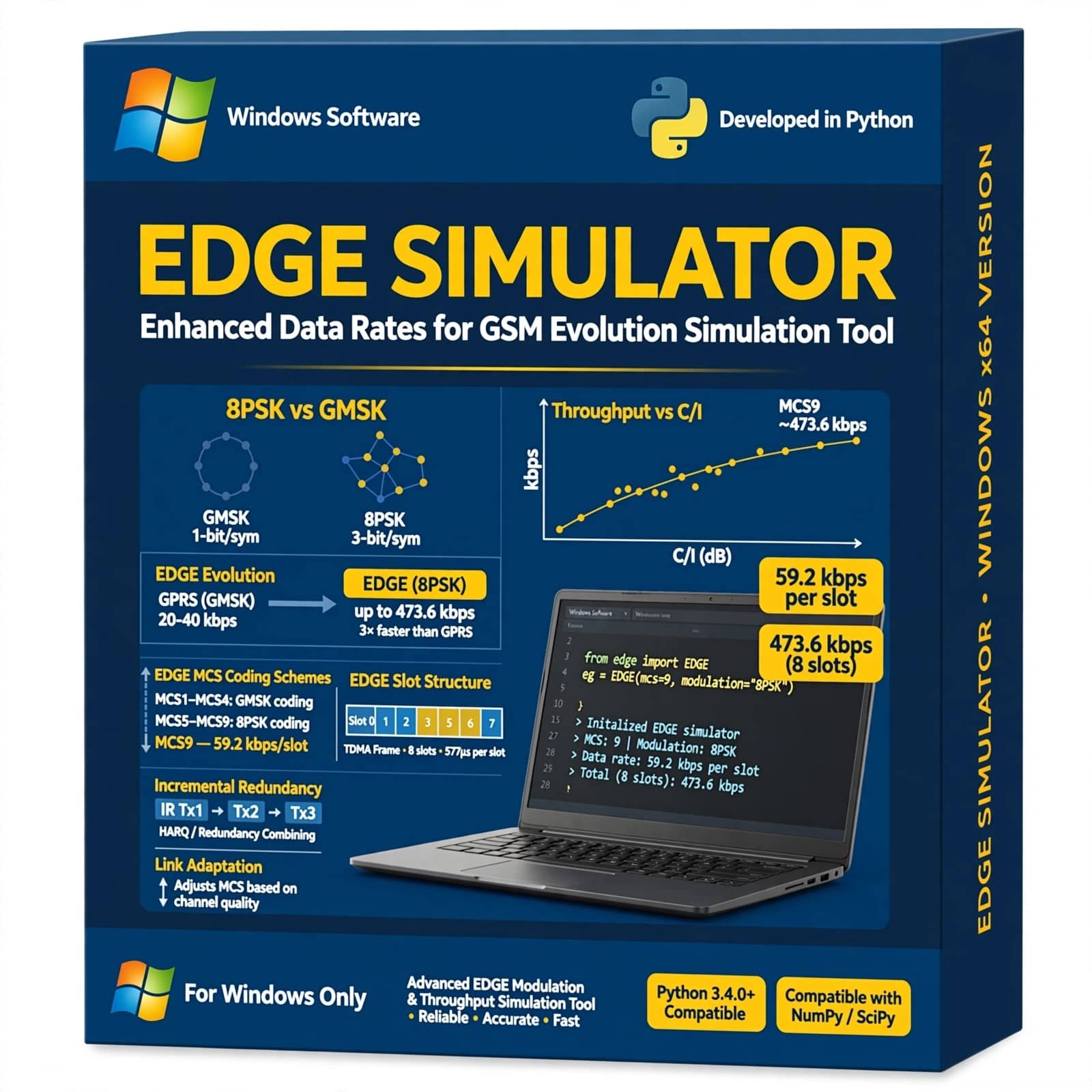
EDGE Simulator Using Python is a practical mobile communication simulation tool designed to demonstrate and analyze Enhanced Data rates for GSM Evolution (EDGE) technology. It helps students, researchers, and communication engineers study GSM/EDGE data transmission, modulation, channel conditions, bit error rate, data rates, and wireless communication performance using Python-based simulation.
Original price was: ₹750.00.₹250.00Current price is: ₹250.00. -
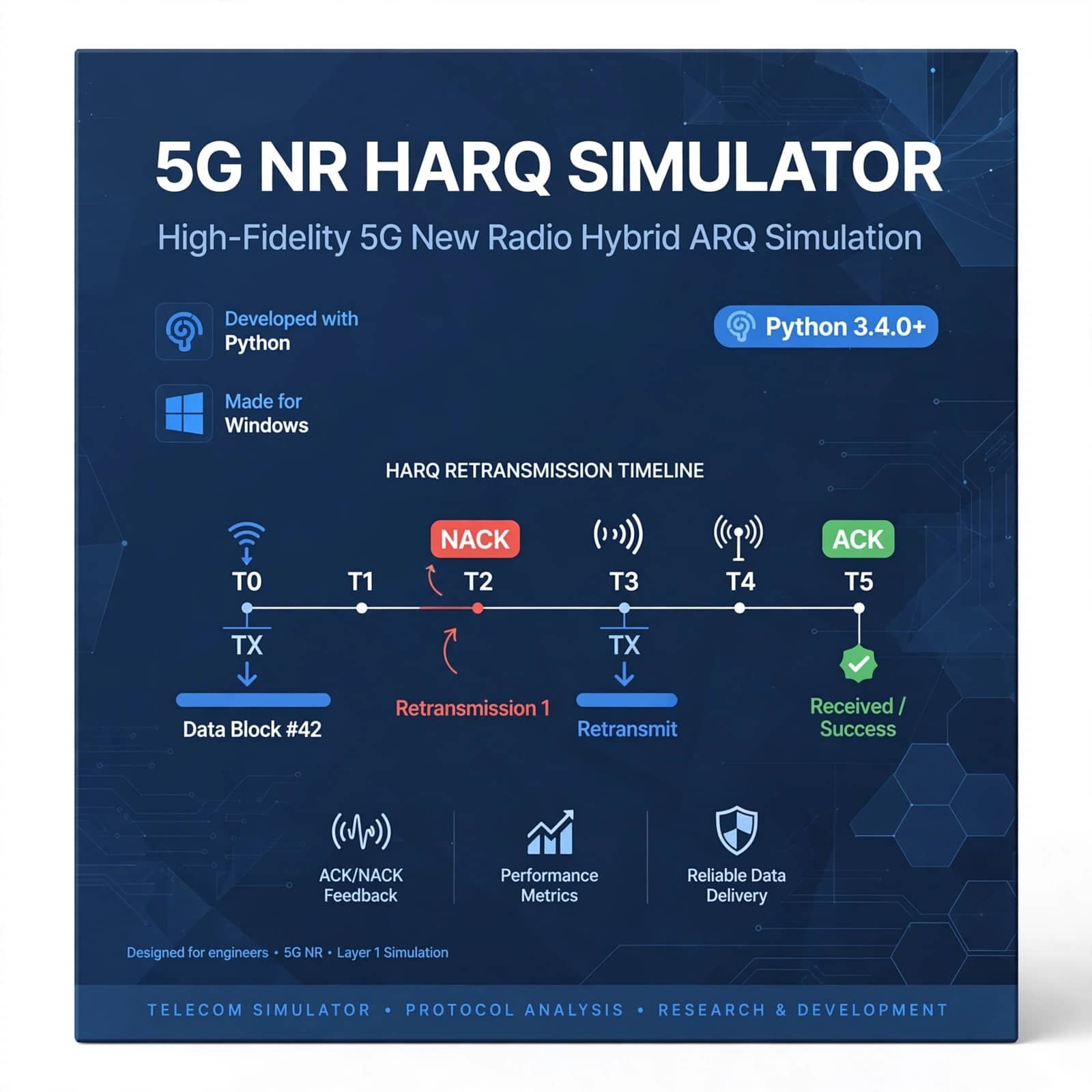
5G NR HARQ Simulator is an advanced simulation solution for modeling and analyzing Hybrid Automatic Repeat Request (HARQ) mechanisms in 5G New Radio networks. It enables users to study HARQ processes, ACK/NACK feedback, retransmissions, link adaptation, channel errors, and communication reliability under configurable network conditions. The simulator supports analysis of throughput, BLER, latency, retransmission rate, packet errors, spectral efficiency, and other key performance metrics, making it suitable for 5G NR research, algorithm development, academic projects, and wireless communication system optimization.
Original price was: ₹750.00.₹250.00Current price is: ₹250.00. -
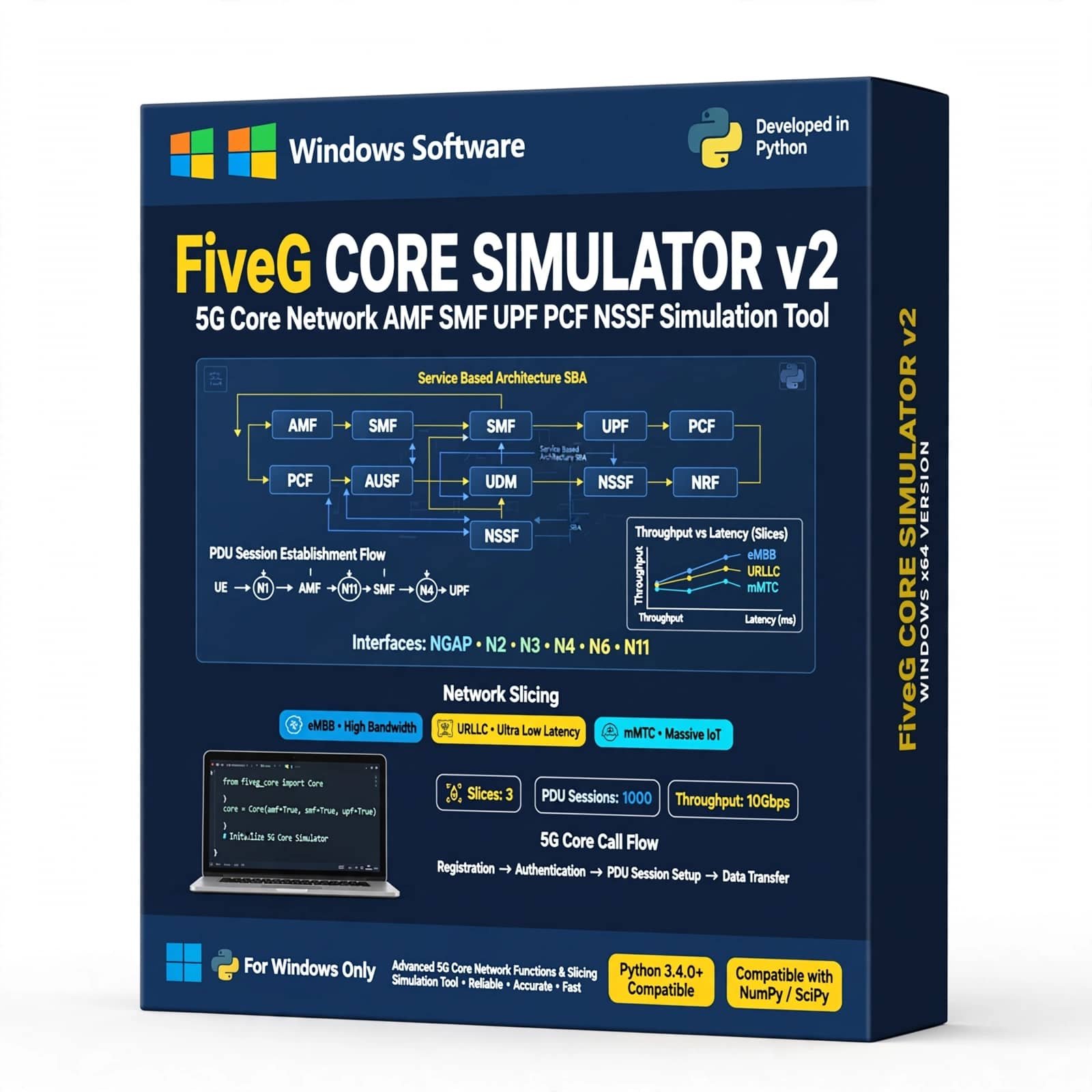
FiveG Core Simulator v2 is an educational 5G Core Network simulation tool designed to help students, educators, researchers, and telecom professionals understand 5G core architecture, network functions, signaling procedures, latency, and protocol interactions through an interactive topology and signaling animation environment.
Original price was: ₹750.00.₹250.00Current price is: ₹250.00.


Reviews
There are no reviews yet.