
New
67% Off

VSAT Rain Fade Simulator


Original price was: ₹750.00.₹250.00Current price is: ₹250.00.
In StockVSAT Rain Fade Simulator with Python is a professional tool for modeling and analyzing rain attenuation in satellite communication systems. Built in Python, it supports ITU‑R models, real‑time simulation, and graphical outputs—ideal for engineers, researchers, and educators designing resilient VSAT networks.
Description
VSAT Rain Fade Simulator
The VSAT Rain Fade Simulator with Python is a cutting‑edge tool designed for engineers, researchers, and satellite communication professionals who need to model, analyze, and mitigate the effects of rain attenuation on Very Small Aperture Terminal (VSAT) systems. Rain fade is one of the most critical challenges in Ku‑band and Ka‑band satellite communication links, where heavy precipitation can cause significant signal degradation, leading to reduced throughput, increased latency, or even complete link outages.
This simulator provides a Python‑based environment that allows users to replicate real‑world rain fade scenarios, test adaptive coding and modulation techniques, and evaluate link reliability under varying weather conditions. Whether you are a student learning satellite communication fundamentals or a professional designing robust VSAT networks, this simulator bridges the gap between theory and practice.

Key Features
- Python Integration: Built entirely in Python, ensuring flexibility, scalability, and compatibility with modern data science workflows.
- Rain Attenuation Models: Implements ITU‑R rain attenuation prediction models, including specific attenuation coefficients for different frequencies and polarizations.
- Real‑Time Simulation: Generate dynamic rain fade scenarios to test adaptive modulation and coding schemes.
- Customizable Parameters: Adjust frequency, elevation angle, polarization, and rainfall rate to replicate diverse geographic conditions.
- Graphical Output: Visualize attenuation curves, link margin variations, and outage probabilities with clear plots.
- Educational Use: Perfect for academic institutions teaching satellite communication, wireless networking, or RF engineering.
- Industry Application: Useful for satellite operators, VSAT service providers, and telecommunication engineers designing resilient networks.

Technical Benefits
- Accurate Modeling: Incorporates ITU‑R P.618 and P.837 recommendations for rain attenuation, ensuring globally recognized accuracy.
- Performance Testing: Evaluate how adaptive coding and modulation (ACM) strategies respond to varying rain intensities.
- Cost Efficiency: Reduce the need for expensive field trials by simulating conditions virtually.
- Scalability: Python’s modular design allows integration with machine learning frameworks for predictive rain fade analysis.
- Cross‑Platform: Runs seamlessly on Windows, macOS, and Linux environments.

Use Cases
- VSAT Network Design: Optimize link budgets for satellite internet providers.
- Academic Research: Support thesis projects and publications in satellite communication.
- Training & Education: Provide hands‑on learning for students in RF engineering courses.
- Telecom Industry: Help operators plan resilient networks in tropical and high‑rainfall regions.
- Military & Defense: Ensure secure communication links under adverse weather conditions.
Why Choose This Simulator?
Unlike generic network simulators, the VSAT Rain Fade Simulator with Python is tailored specifically for satellite communication challenges. It combines scientific accuracy with practical usability, making it a unique product in the market. The Python foundation ensures that users can extend functionality, integrate with existing workflows, and even automate large‑scale simulations.
By investing in this simulator, organizations and individuals gain a powerful tool to predict, analyze, and mitigate rain fade, ultimately improving network reliability and customer satisfaction.

VSAT Rain Fade Simulator, Python Satellite Communication Tool, Rain Attenuation Modeling Software, Ku‑band and Ka‑band Simulation, ITU‑R Rain Fade Models, Adaptive Coding and Modulation Testing, Satellite Link Budget Analysis, RF Engineering Educational Tool, VSAT Network Reliability, Rain Fade Prediction Software
Sample Python Code
#!/usr/bin/env python3
“””
VSAT Rain-Fade Simulator
Single-file, standard-library desktop application for Python 3.4+.
No pip packages are required. Run with:
python vsat_rain_fade_simulator.py
The propagation equations are engineering approximations intended for
simulation, visualization, and link-budget exploration. Validate critical
designs against the current ITU-R recommendations and certified RF tools.
“””
from __future__ import division
import csv
import math
import random
import sys
import time
try:
import tkinter as tk
from tkinter import filedialog, messagebox, ttk
except ImportError:
raise SystemExit(“This application requires Python 3 with tkinter support.”)
NAVY = “#082450”
DARK_NAVY = “#061a37”
YELLOW = “#FFD60A”
BLUE = “#2477e8”
ORANGE = “#f28a25”
GREEN = “#16815e”
INK = “#17233a”
MUTED = “#6f7f94”
GRID = “#dfe6ee”
PANEL = “#ffffff”
SURFACE = “#f3f6fa”
BORDER = “#d6dee8”
def clamp(value, minimum, maximum):
return max(minimum, min(maximum, value))
def number(value, fallback=0.0):
try:
return float(value)
except (TypeError, ValueError):
return fallback
def downsample(values, maximum=600):
if len(values) <= maximum:
return values
step = int(math.ceil(len(values) / float(maximum)))
result = values[::step]
if (len(values) – 1) % step != 0:
result.append(values[-1])
return result
class ScrollableFrame(ttk.Frame):
“””A vertically scrollable frame for the parameter column.”””
def __init__(self, parent):
ttk.Frame.__init__(self, parent)
self.canvas = tk.Canvas(self, background=PANEL, highlightthickness=0)
self.scrollbar = ttk.Scrollbar(self, orient=”vertical”, command=self.canvas.yview)
self.inner = ttk.Frame(self.canvas, style=”Panel.TFrame”)
self.window = self.canvas.create_window((0, 0), window=self.inner, anchor=”nw”)
self.canvas.configure(yscrollcommand=self.scrollbar.set)
self.canvas.pack(side=”left”, fill=”both”, expand=True)
self.scrollbar.pack(side=”right”, fill=”y”)
self.inner.bind(“<Configure>”, self._update_region)
self.canvas.bind(“<Configure>”, self._update_width)
self.canvas.bind_all(“<MouseWheel>”, self._wheel)
self.canvas.bind_all(“<Button-4>”, self._wheel_linux)
self.canvas.bind_all(“<Button-5>”, self._wheel_linux)
def _update_region(self, event=None):
self.canvas.configure(scrollregion=self.canvas.bbox(“all”))
def _update_width(self, event):
self.canvas.itemconfigure(self.window, width=event.width)
def _wheel(self, event):
if self.winfo_containing(event.x_root, event.y_root) in self._descendants():
self.canvas.yview_scroll(int(-event.delta / 120), “units”)
def _wheel_linux(self, event):
if self.winfo_containing(event.x_root, event.y_root) in self._descendants():
self.canvas.yview_scroll(-1 if event.num == 4 else 1, “units”)
def _descendants(self):
items = [self, self.canvas, self.inner]
pending = list(self.inner.winfo_children())
while pending:
item = pending.pop()
items.append(item)
pending.extend(item.winfo_children())
return items
class VSATSimulator(tk.Tk):
def __init__(self):
tk.Tk.__init__(self)
self.title(“VSAT Rain-Fade Simulator”)
self.geometry(“1366×768”)
self.minsize(1060, 690)
self.configure(background=DARK_NAVY)
self.running = False
self.run_started = 0.0
self.animation_index = 0
self.series = []
self.uploaded_rain = []
self.uploaded_name = “rain_rate.csv”
self.chart_canvases = []
self.metric_items = []
self._create_variables()
self._configure_styles()
self._build_layout()
self._bind_variables()
self.update_idletasks()
self.calculate_look_angles()
self.generate_series()
self.refresh_all()
def _create_variables(self):
self.latitude = tk.StringVar(value=”35.6895″)
self.longitude = tk.StringVar(value=”139.6922″)
self.station_altitude = tk.StringVar(value=”40″)
self.satellite_longitude = tk.StringVar(value=”110.0″)
self.elevation = tk.StringVar(value=”42.3″)
self.azimuth = tk.StringVar(value=”210.5″)
self.frequency = tk.StringVar(value=”12 GHz”)
self.polarization = tk.StringVar(value=”Linear Horizontal”)
self.r001 = tk.StringVar(value=”50″)
self.rain_height = tk.StringVar(value=”4.86″)
self.gas_loss = tk.BooleanVar(value=True)
self.cloud_loss = tk.BooleanVar(value=True)
self.eirp = tk.DoubleVar(value=52.0)
self.antenna_gain = tk.StringVar(value=”44.5″)
self.gt = tk.StringVar(value=”19.2″)
self.fspl = tk.StringVar(value=”206.4″)
self.other_losses = tk.StringVar(value=”1.5″)
self.noise_temp = tk.StringVar(value=”145″)
self.bandwidth = tk.StringVar(value=”72″)
self.symbol_rate = tk.StringVar(value=”45″)
self.bit_rate = tk.StringVar(value=”55″)
………………….cntd.
Related products
-
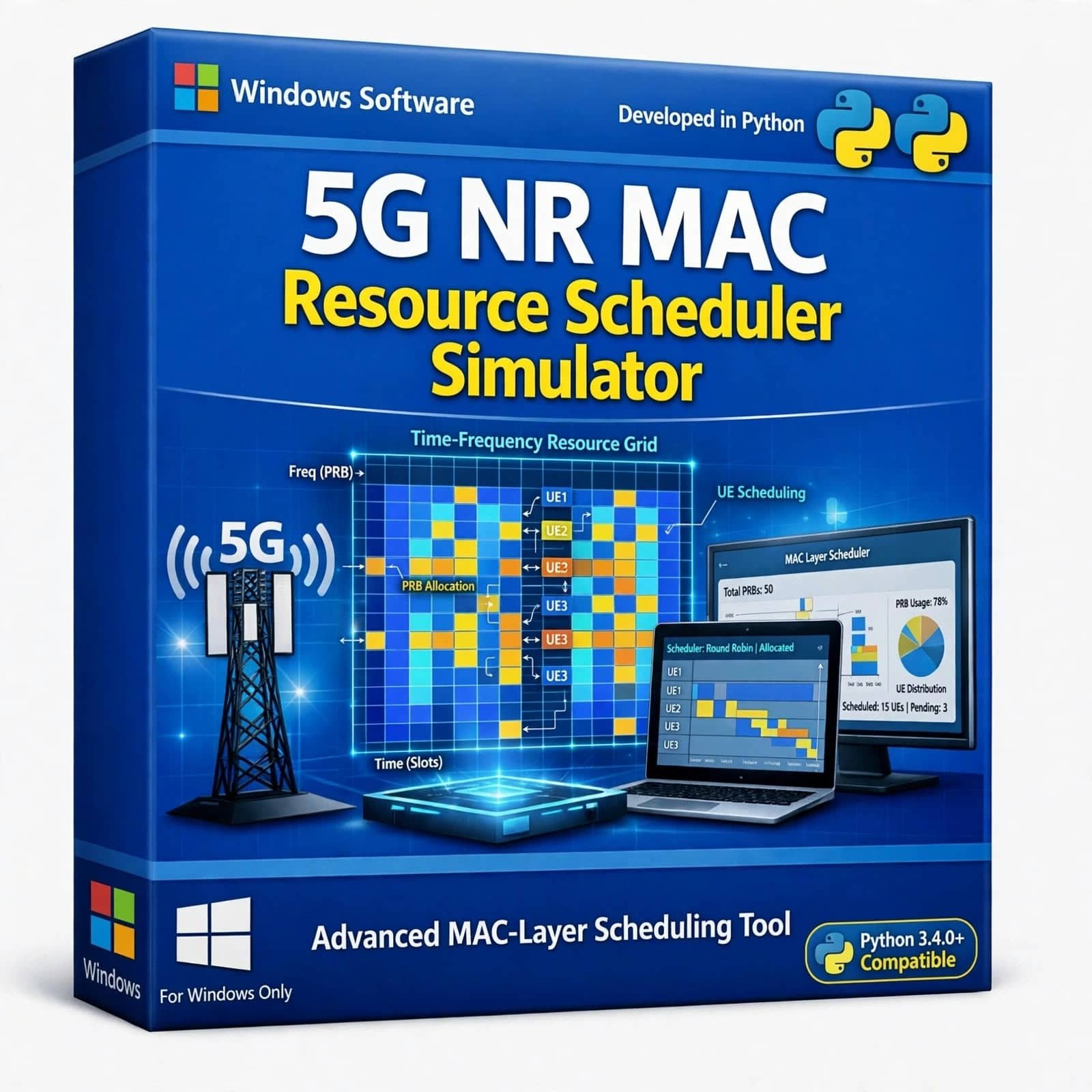
5G NR MAC Resource Scheduler Simulator is an advanced simulation solution for modeling and analyzing Medium Access Control (MAC) layer resource scheduling in 5G New Radio networks. It enables users to evaluate dynamic resource allocation, multi-UE scheduling, uplink and downlink resource management, QoS-aware scheduling, traffic conditions, and scheduling algorithms. The simulator supports analysis of throughput, latency, fairness, spectral efficiency, resource utilization, packet loss, and QoS performance, making it ideal for 5G NR research, scheduler algorithm development, academic projects, and wireless network optimization.
Original price was: ₹750.00.₹250.00Current price is: ₹250.00. -
A Python-based 5G Digital Twin solution for creating a virtual representation of 5G network environments, components, and operational behavior. Designed for 5G research, network analysis, simulation, optimization, and academic projects, it enables users to model network scenarios, monitor virtualized network behavior, and experiment with different configurations in a controlled software environment.
Ideal for telecom engineers, researchers, developers, students, and academic institutions working on 5G network planning, performance analysis, intelligent network management, and digital twin research.
Original price was: ₹750.00.₹250.00Current price is: ₹250.00. -
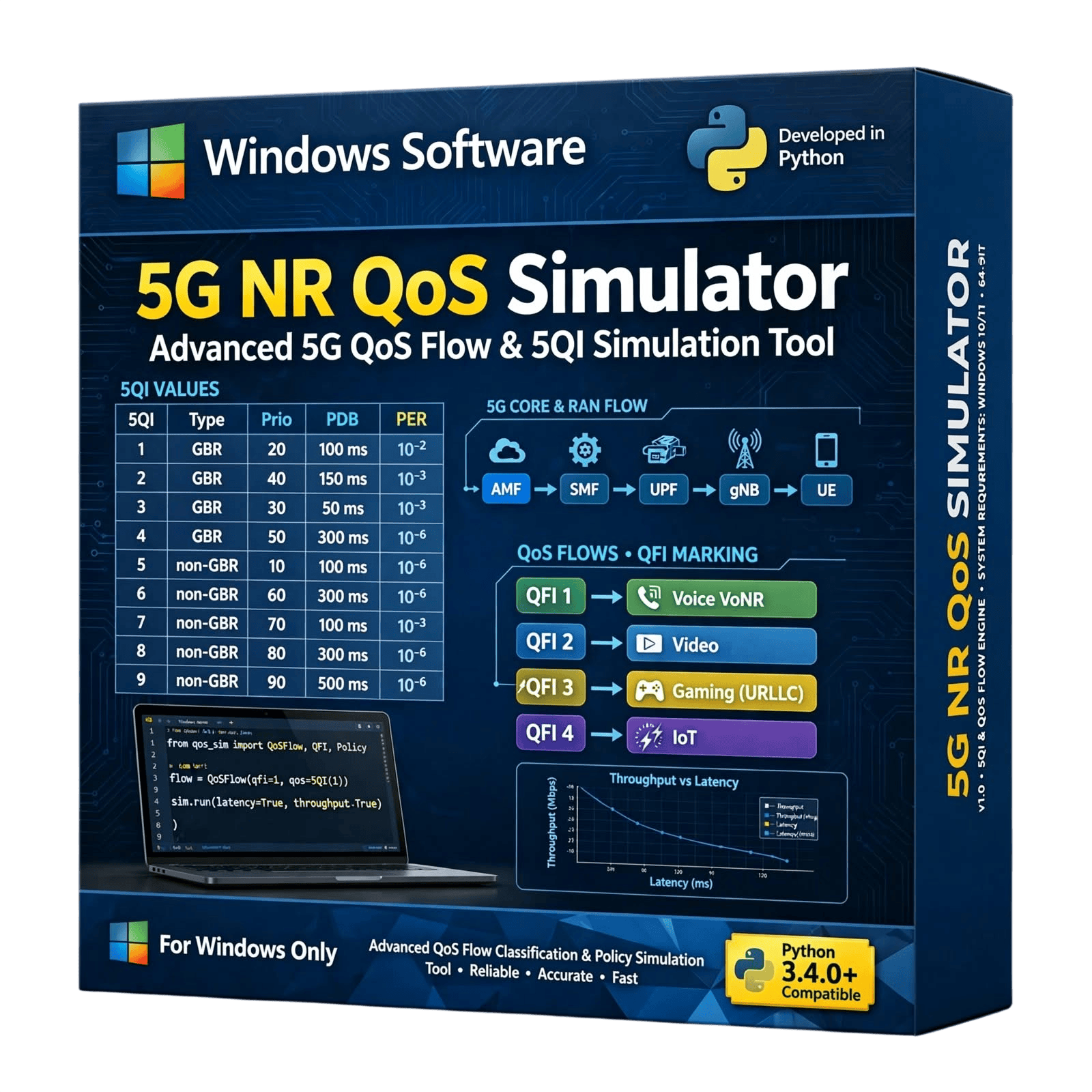
The 5G QoS Simulator is a Python-based software solution designed for researchers, engineers, students, developers, and telecommunications professionals working with 5G Quality of Service (QoS) concepts. The simulator provides a software-based environment for studying and analyzing QoS-related aspects of 5G communication networks, including service performance, traffic behavior, resource management, and network performance evaluation.
Developed using Python, the simulator is suitable for academic research, telecommunications projects, demonstrations, experimentation, algorithm development, and educational applications.
Available for sale as a software product. Contact us for pricing, licensing, features, customization, and purchase information.
Original price was: ₹750.00.₹250.00Current price is: ₹250.00. -
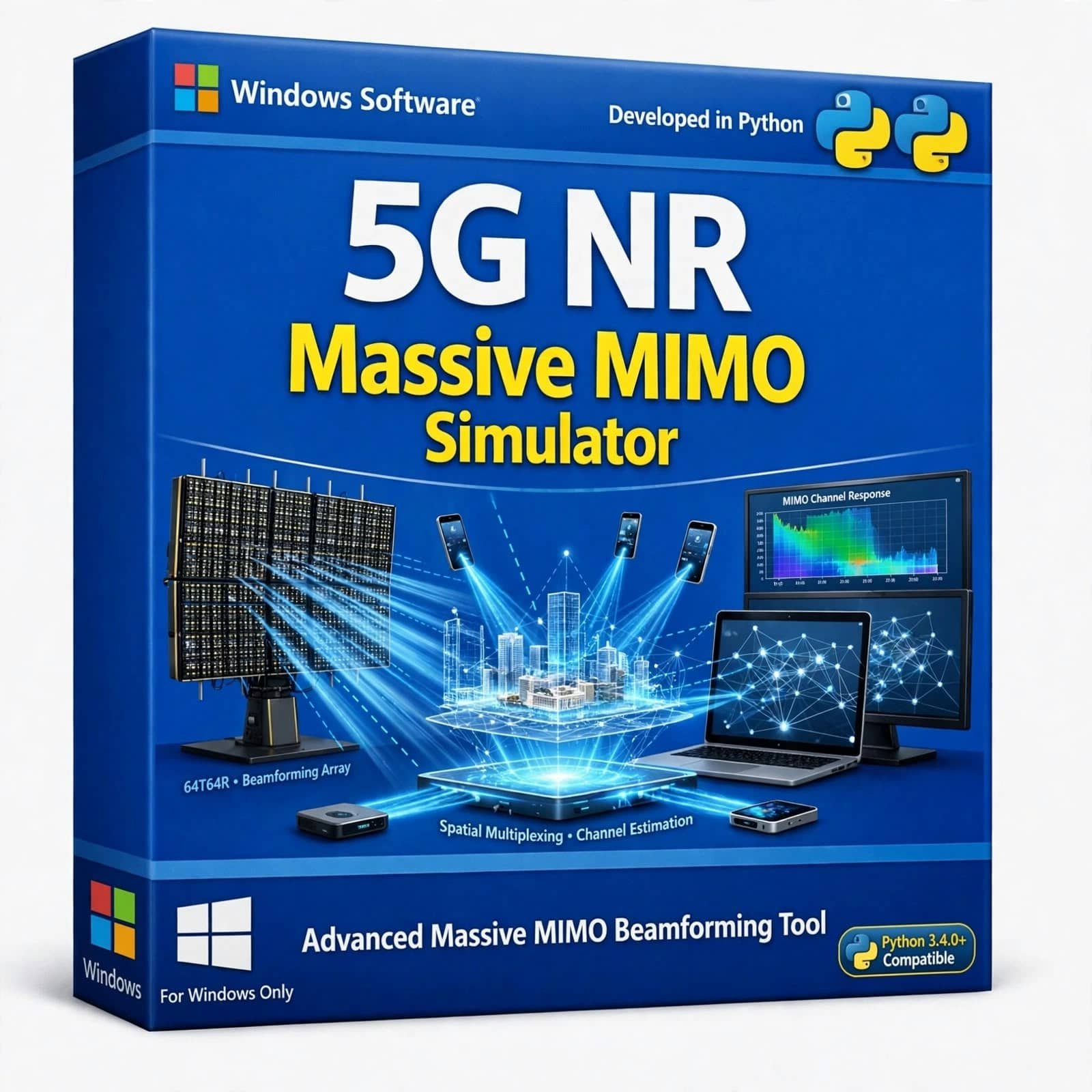
5G NR Massive MIMO Simulator is an advanced simulation solution for modeling and analyzing Massive Multiple-Input Multiple-Output (MIMO) technologies in 5G New Radio networks. It enables users to study large-scale antenna arrays, beamforming, precoding, spatial multiplexing, multi-user MIMO, channel estimation, and interference under configurable channel conditions. The simulator supports analysis of throughput, spectral efficiency, SINR, BER, BLER, MIMO capacity, beamforming gain, and multi-user performance, making it ideal for 5G NR research, algorithm development, academic projects, and 5G/6G wireless system optimization.
Original price was: ₹750.00.₹250.00Current price is: ₹250.00. -
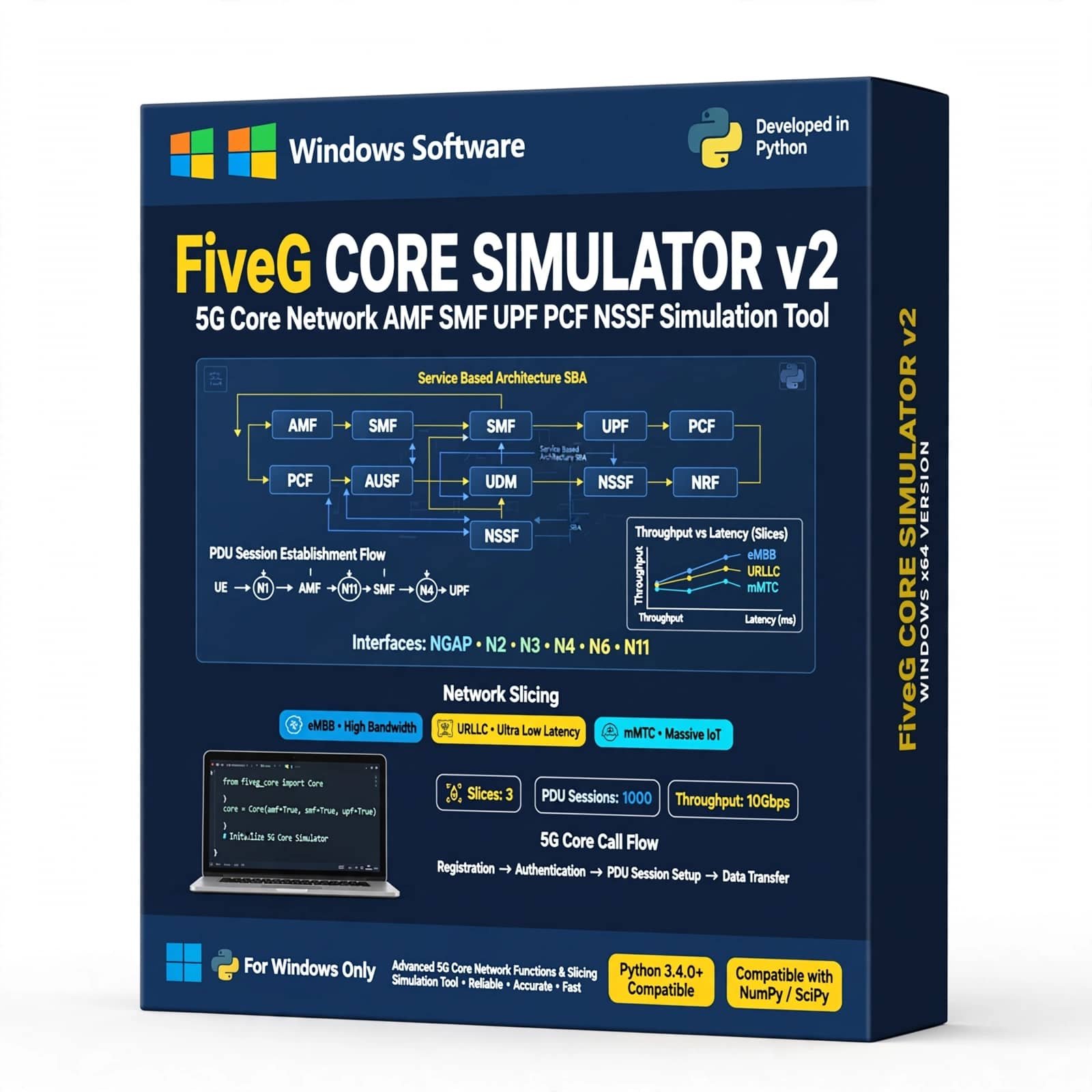
FiveG Core Simulator v2 is an educational 5G Core Network simulation tool designed to help students, educators, researchers, and telecom professionals understand 5G core architecture, network functions, signaling procedures, latency, and protocol interactions through an interactive topology and signaling animation environment.
Original price was: ₹750.00.₹250.00Current price is: ₹250.00. -
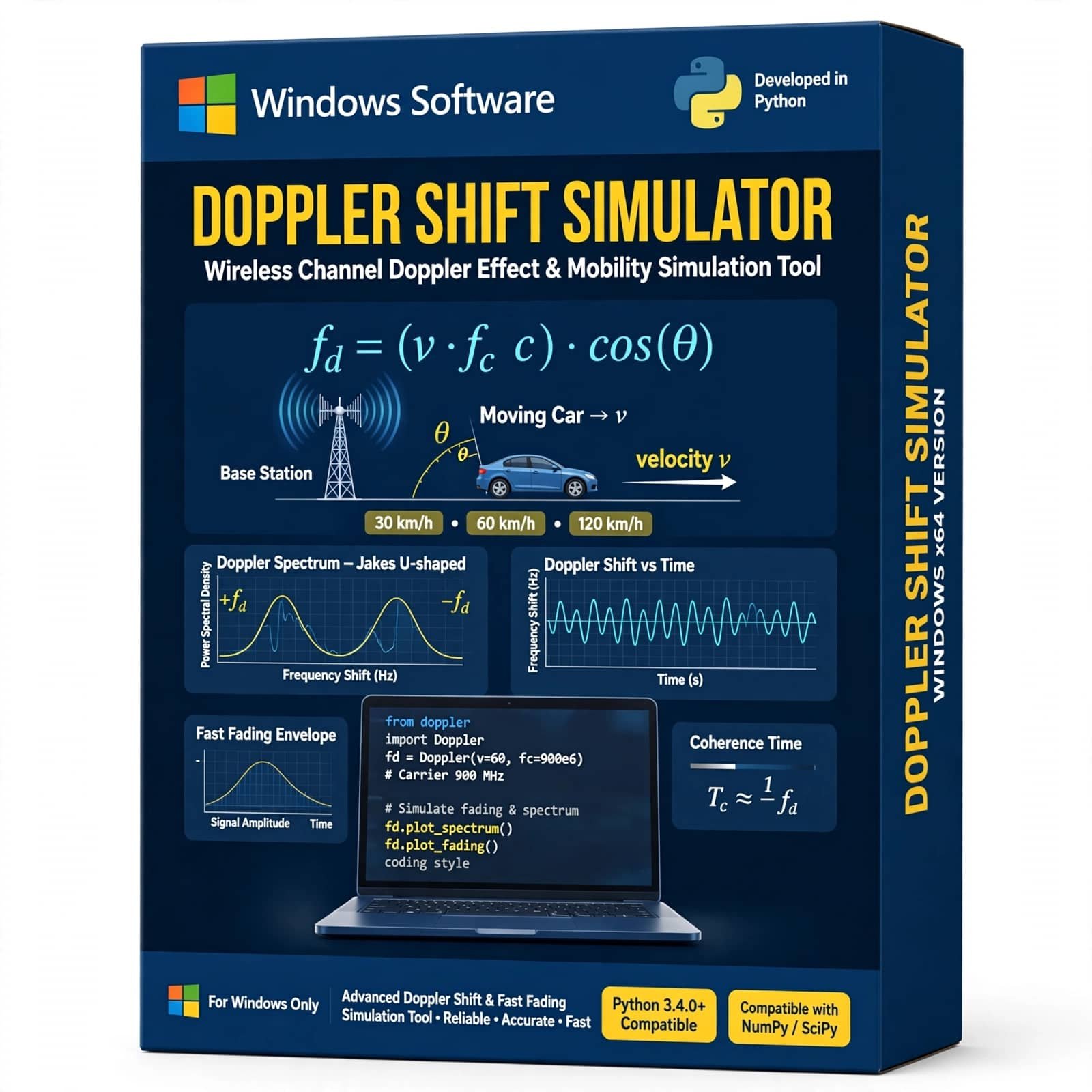
Doppler Shift Simulator Using Python is a practical wireless communication simulation tool for studying the Doppler effect and frequency shift caused by relative motion between a transmitter and receiver. It helps students, researchers, and communication engineers analyze Doppler frequency, carrier frequency, velocity, and mobile channel effects through Python-based simulation.
Original price was: ₹750.00.₹250.00Current price is: ₹250.00.



Reviews
There are no reviews yet.