New
67% Off

VSAT Atmospheric Loss Simulator


Original price was: ₹750.00.₹250.00Current price is: ₹250.00.
In StockVSAT Atmospheric Loss Simulator with Python is a software-based simulation solution for analyzing atmospheric propagation losses in VSAT and satellite communication links. Developed with Python, it provides a flexible environment for studying the effects of atmospheric conditions on satellite signals, including frequency-dependent propagation effects, and can be used for link-budget analysis, research, education, system design, and VSAT communication simulations.
Description
VSAT Atmospheric Loss Simulator
The VSAT Atmospheric Loss Simulator with Python is designed for engineers, researchers, students, educators, and developers who need to study the impact of atmospheric propagation on VSAT and satellite communication links.
When a satellite signal travels between a ground-based VSAT terminal and a satellite, it passes through the Earth’s atmosphere. Atmospheric conditions can influence signal propagation and contribute to additional losses in a communication link. Understanding and modeling these effects is an important part of satellite link analysis and VSAT system planning.
This Python-based simulator provides a software environment for studying atmospheric loss effects and incorporating propagation considerations into satellite communication simulations.
Python-Based Atmospheric Loss Simulation
Built using Python, the simulator offers a programmable approach to atmospheric propagation analysis. Python provides an accessible and flexible environment for performing calculations, running different simulation scenarios, processing results, and developing customized analysis workflows.
Users can modify relevant simulation parameters and evaluate how changes affect calculated atmospheric loss. This makes the simulator useful for both educational demonstrations and technical research where repeatable atmospheric propagation calculations are required.

Atmospheric Effects on VSAT Links
Atmospheric propagation can introduce additional attenuation into satellite communication links. Depending on the communication frequency, atmospheric conditions, elevation angle, and other parameters, different propagation effects may need to be considered when analyzing a VSAT link.
The simulator provides a framework for exploring these effects in a controlled software environment. It can be used alongside other satellite communication calculations to help users understand how atmospheric losses can contribute to the overall link budget.
Useful for Satellite Link-Budget Analysis
The VSAT Atmospheric Loss Simulator can be used as part of a broader satellite link-budget simulation workflow. Link budgets account for various gains and losses between a transmitter and receiver, and atmospheric propagation is one of the factors that may need to be included in a realistic analysis.
By modeling atmospheric loss separately, users can study its contribution and combine the results with other simulated parameters such as antenna characteristics, path loss, transmitter power, receiver parameters, and system margins.
This makes the simulator useful for preliminary analysis, academic projects, engineering studies, and research applications.

Frequency-Dependent Propagation Studies
Atmospheric effects can vary with operating frequency. This is particularly relevant when analyzing satellite communication systems operating in different frequency ranges.
The simulator can provide a foundation for investigating how atmospheric propagation loss changes under different frequency and environmental scenarios. Users can use Python-based calculations to compare simulation results and develop a better understanding of frequency-dependent satellite communication behavior.
Educational Applications
The VSAT Atmospheric Loss Simulator with Python is well suited for universities, engineering colleges, satellite communication courses, technical institutes, and research laboratories.
Students can use the simulator to explore concepts such as:
- Atmospheric propagation
- Satellite signal attenuation
- VSAT communication links
- Satellite link budgets
- Frequency-dependent propagation effects
- Elevation-angle considerations
- RF communication systems
- Satellite communication engineering
- Python-based engineering simulation
- Communication system analysis
It can also support practical demonstrations in which students change simulation parameters and observe their effect on atmospheric loss calculations.

Research and Engineering Applications
For researchers and engineers, a software simulator can provide a repeatable environment for evaluating atmospheric propagation scenarios without requiring a physical satellite communication setup.
Python programmability makes it possible to automate multiple simulations, perform parameter sweeps, process numerical results, generate plots, and integrate atmospheric loss calculations with other satellite communication models.
The simulator can therefore serve as a useful component within larger research and development workflows.
Customizable Python Environment
One of the primary advantages of a Python-based simulator is customization. Developers and researchers can adapt simulation workflows to suit their specific requirements.
Python scripts can be used to automate calculations, compare different scenarios, process output data, and integrate the simulator with other numerical or communication-system analysis tools.
This flexibility makes the VSAT Atmospheric Loss Simulator suitable for academic research as well as engineering prototyping and software-based satellite communication studies.
Applications
The VSAT Atmospheric Loss Simulator with Python can be used for:
- VSAT atmospheric loss simulation
- Satellite propagation loss analysis
- Satellite link-budget studies
- Atmospheric attenuation modeling
- RF propagation research
- Satellite communication research
- VSAT system analysis
- Python-based satellite simulations
- Academic and university projects
- Engineering training and demonstrations
- Communication system modeling
- Satellite network research and development
Key Benefits
The simulator provides a practical software-based method for studying atmospheric propagation effects in VSAT communication systems. It allows users to investigate different simulation conditions and analyze how atmospheric loss can affect a satellite communication link.
Using Python also enables automation and customization, making it possible to develop repeatable simulation scenarios and integrate atmospheric calculations into broader satellite communication models.
For educational users, it provides a practical way to connect theoretical propagation concepts with computational analysis. For researchers and engineers, it provides a programmable foundation for developing and testing atmospheric-loss simulation workflows.

Who Can Use This Product?
This product is suitable for VSAT engineers, satellite communication engineers, RF engineers, propagation researchers, antenna engineers, Python developers, students, educators, universities, technical institutes, and R&D teams.
It is especially useful for users working on satellite communication projects where atmospheric propagation effects need to be studied or incorporated into link-budget calculations.
Build Your VSAT Propagation Simulation
The VSAT Atmospheric Loss Simulator with Python provides a flexible environment for studying atmospheric propagation and its role in satellite communication systems. By combining Python programmability with VSAT-focused atmospheric loss analysis, it can support education, research, engineering studies, system modeling, and customized simulation development.
If you are looking for a VSAT atmospheric loss simulator, satellite propagation loss simulator, Python satellite communication simulator, atmospheric attenuation simulator, or VSAT link-budget analysis software, this solution provides a practical foundation for developing and evaluating software-based satellite communication scenarios.
Related products
-
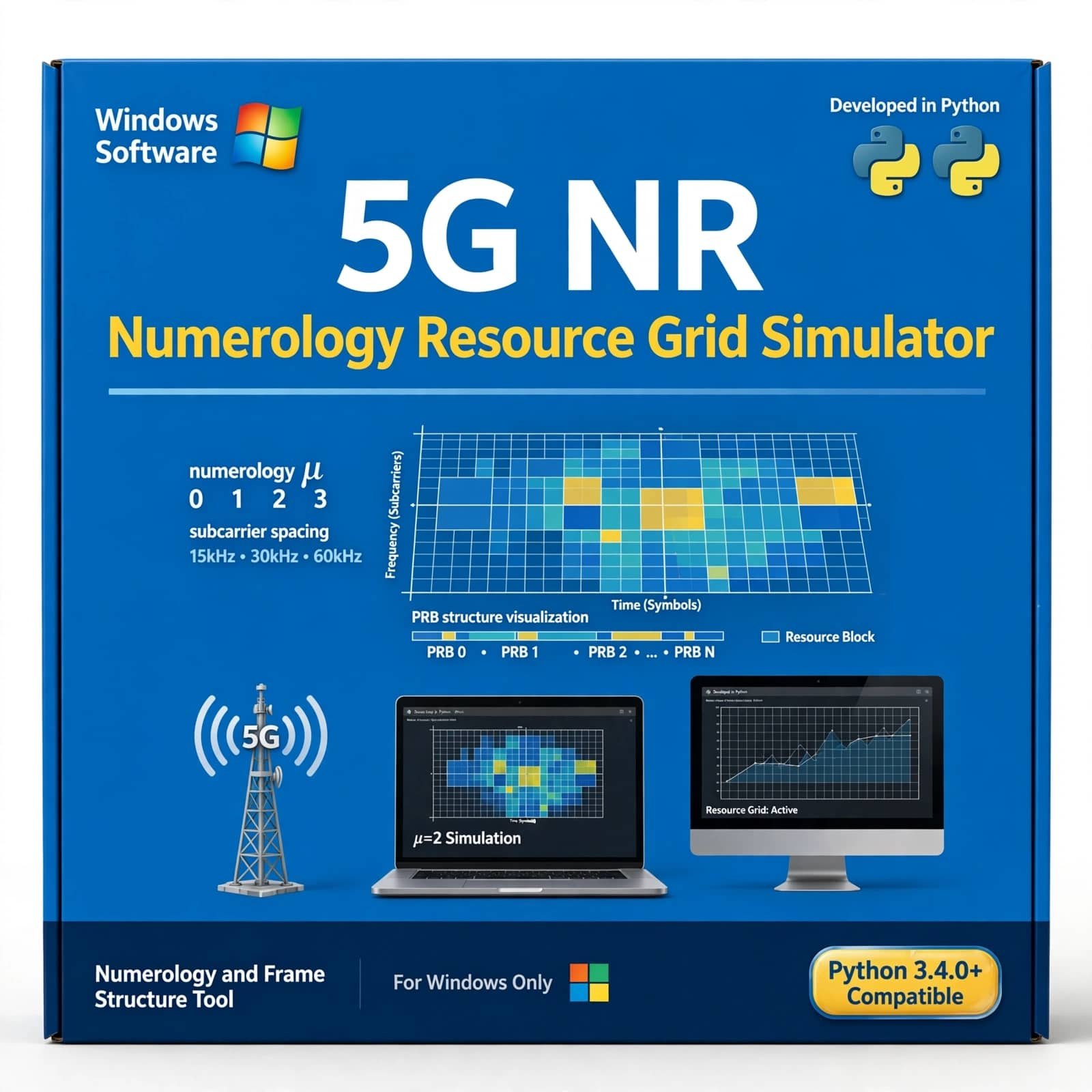
5G NR Numerology Resource Grid Simulator is an advanced simulation solution for modeling and analyzing 5G New Radio numerology and time-frequency resource grid structures. It enables users to study subcarrier spacing, OFDM symbols, slot structure, cyclic prefix, Physical Resource Blocks (PRBs), Resource Elements (REs), bandwidth configurations, and resource mapping. The simulator is ideal for 5G NR physical-layer research, numerology analysis, resource allocation studies, academic projects, waveform development, and 5G/6G wireless communication research.
Original price was: ₹750.00.₹250.00Current price is: ₹250.00. -
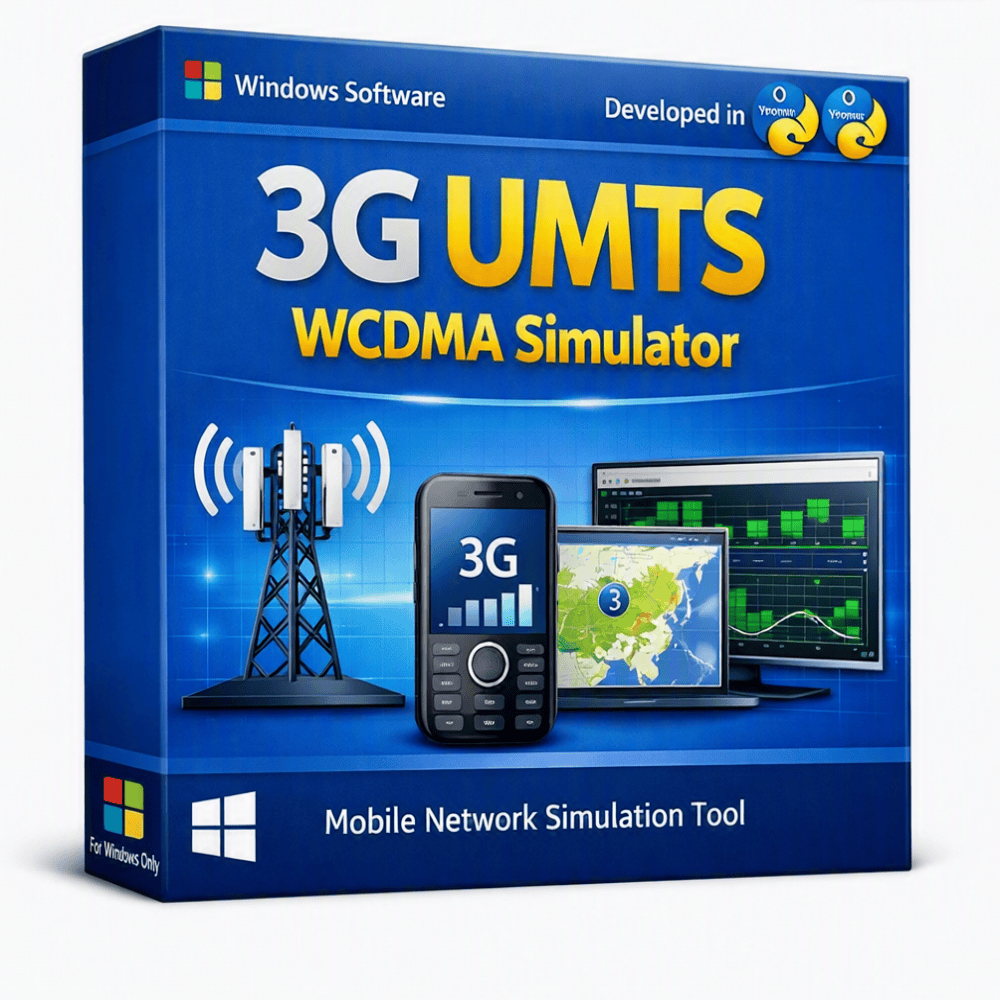
The 3G UMTS – WCDMA Simulator is a software-based simulation project designed to demonstrate the fundamental concepts of 3G Universal Mobile Telecommunications System (UMTS) and Wideband Code Division Multiple Access (WCDMA) technology. It provides a practical environment for studying cellular communication, spreading codes, signal transmission, mobile users, network connectivity, and WCDMA-based communication principles. The simulator is suitable for students, researchers, and developers working on telecommunications and wireless communication projects. It can be used for academic demonstrations, engineering projects, research, experimentation, and learning about 3G mobile communication and WCDMA network technologies.
Original price was: ₹750.00.₹250.00Current price is: ₹250.00. -
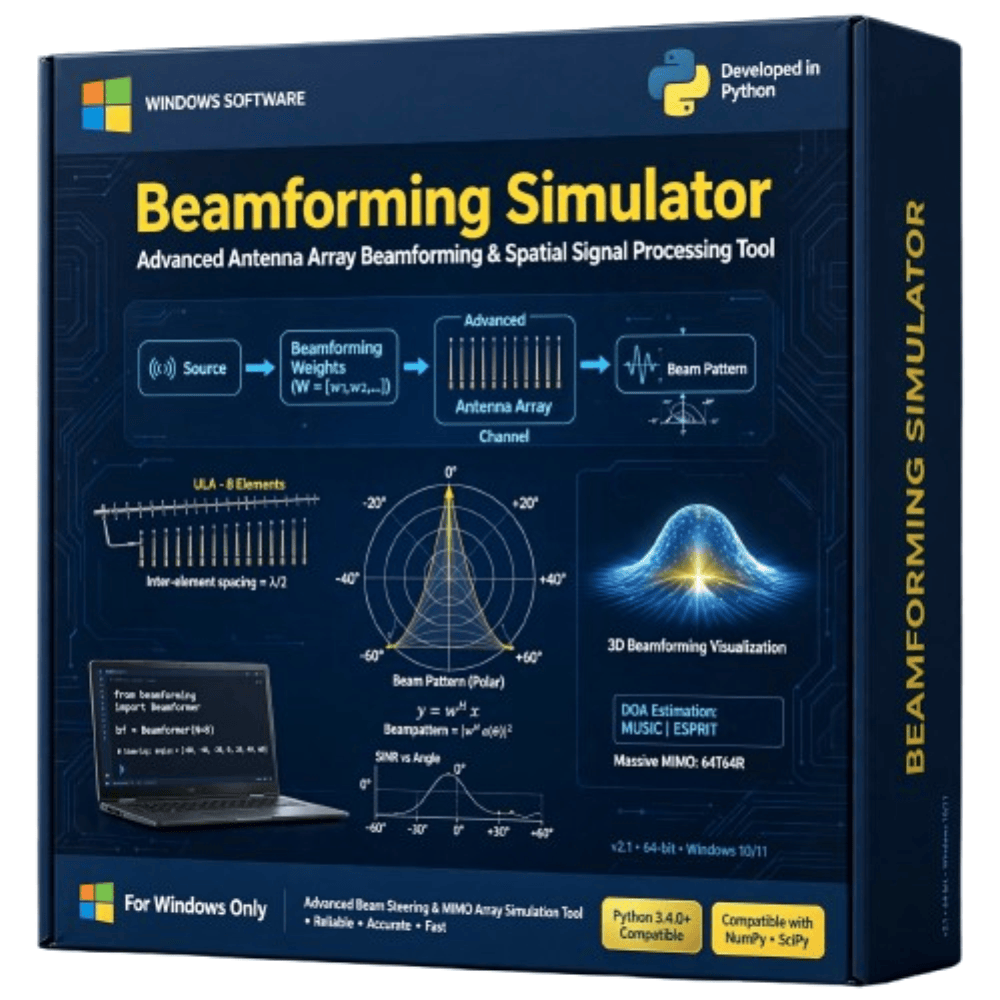
The Beamforming Simulator is a practical wireless communication simulation project designed to demonstrate how antenna arrays can control and direct radio-frequency signals toward desired users or directions. The simulator helps visualize beam patterns, signal direction, antenna-array behavior, and beam steering under different parameters. It is suitable for studying beamforming, antenna arrays, MIMO, 5G communication, wireless networks, and signal processing. This project is ideal for engineering students, researchers, and learners working on wireless communication and advanced antenna technologies.
Original price was: ₹750.00.₹250.00Current price is: ₹250.00. -
5G NR Massive MIMO Simulator is an advanced simulation solution for modeling and analyzing Massive Multiple-Input Multiple-Output (MIMO) technologies in 5G New Radio networks. It enables users to study large-scale antenna arrays, beamforming, precoding, spatial multiplexing, multi-user MIMO, channel estimation, and interference under configurable channel conditions. The simulator supports analysis of throughput, spectral efficiency, SINR, BER, BLER, MIMO capacity, beamforming gain, and multi-user performance, making it ideal for 5G NR research, algorithm development, academic projects, and 5G/6G wireless system optimization.
Original price was: ₹750.00.₹250.00Current price is: ₹250.00. -
A Python-based 5G Core Network Simulator designed for studying, analyzing, and demonstrating 5G Core network architecture and procedures. Explore key 5G Network Functions such as AMF, SMF, UPF, AUSF, UDM, PCF, NRF, and NSSF, along with UE registration, authentication, session management, mobility, and signaling procedures.
Ideal for 5G research, telecom engineering, academic projects, university laboratories, protocol development, and network simulation. Provides a flexible software environment for experimenting with 5G Core concepts without requiring a complete commercial 5G network infrastructure.
Original price was: ₹750.00.₹250.00Current price is: ₹250.00. -
A Python-based 5G Digital Twin solution for creating a virtual representation of 5G network environments, components, and operational behavior. Designed for 5G research, network analysis, simulation, optimization, and academic projects, it enables users to model network scenarios, monitor virtualized network behavior, and experiment with different configurations in a controlled software environment.
Ideal for telecom engineers, researchers, developers, students, and academic institutions working on 5G network planning, performance analysis, intelligent network management, and digital twin research.
Original price was: ₹750.00.₹250.00Current price is: ₹250.00.


Reviews
There are no reviews yet.