
New
67% Off

VSAT Antenna Simulator


Original price was: ₹750.00.₹250.00Current price is: ₹250.00.
In StockVSAT Antenna Simulator with Python for Ka, Ku, and C Band is a software-based simulation solution for modeling and analyzing VSAT antenna and satellite communication scenarios across Ka-band, Ku-band, and C-band frequencies. Developed with Python, it provides a flexible environment for antenna parameter analysis, link-budget studies, satellite communication experiments, educational demonstrations, and customized VSAT system simulations.
Description
VSAT Antenna Simulator
The VSAT Antenna Simulator with Python is designed for engineers, researchers, students, educators, and developers working with Very Small Aperture Terminal (VSAT) and satellite communication systems. Supporting simulation scenarios for Ka-band, Ku-band, and C-band, the software provides a programmable environment for studying antenna characteristics and satellite communication parameters without requiring physical VSAT equipment for every stage of development and testing.
VSAT systems are widely used for satellite-based connectivity, remote communications, enterprise networks, broadcasting, maritime applications, disaster recovery, and other communication scenarios where terrestrial infrastructure may be limited. Antenna performance plays an important role in these systems, making simulation a valuable approach for analyzing system parameters and experimenting with different configurations.
Python-Based VSAT Simulation
Built around Python, the VSAT Antenna Simulator provides flexibility for technical users who want to customize simulations and integrate antenna analysis with other engineering workflows. Python can be used to automate calculations, process simulation data, visualize results, perform parameter sweeps, and develop customized analysis routines.
The simulator can serve as a software foundation for studying different VSAT antenna configurations and satellite communication scenarios. Users can modify relevant parameters and evaluate their effect on simulated system performance.

Ka-Band, Ku-Band, and C-Band Support
A key feature of this solution is its applicability across three commonly used satellite communication frequency bands:
- Ka-band – suitable for studying higher-frequency satellite communication scenarios and modern broadband-oriented systems.
- Ku-band – widely associated with VSAT, satellite broadband, broadcast, and enterprise communication applications.
- C-band – commonly used in satellite communication applications where propagation characteristics and link availability are important considerations.
The simulator allows users to build and compare scenarios involving these frequency bands, making it useful for education, research, system studies, and engineering experimentation.
VSAT Antenna Parameter Analysis
Antenna parameters are essential when evaluating satellite communication links. A software-based simulator provides a controlled environment for experimenting with antenna-related variables and observing their impact on a simulated communication scenario.
Depending on the implemented model, users can work with parameters such as antenna diameter, operating frequency, antenna gain, beam characteristics, pointing considerations, free-space path loss, and other link-related parameters.
This makes the simulator useful for understanding the relationship between antenna design parameters and overall satellite communication performance.

Satellite Link Budget Simulation
The VSAT Antenna Simulator can also be used as a foundation for satellite link-budget analysis. Link-budget calculations help engineers understand the relationship between transmitted power, antenna characteristics, propagation losses, receiver parameters, and other factors affecting a communication link.
With Python-based simulation, users can automate calculations and evaluate multiple configurations efficiently. For example, different antenna sizes, frequencies, satellite distances, or system parameters can be incorporated into simulation scenarios to study their effect on calculated link characteristics.
Educational and Academic Applications
The VSAT Antenna Simulator with Python is suitable for universities, engineering colleges, technical institutes, research laboratories, and satellite communication training programs.
Students can use the simulator for projects involving:
- VSAT antenna modeling
- Satellite communication systems
- Antenna gain calculations
- Link-budget analysis
- Ka-band communication studies
- Ku-band communication studies
- C-band communication studies
- RF engineering experiments
- Python-based communication simulations
- Satellite network research
For educators, the simulator can provide a practical software environment for demonstrating theoretical concepts and allowing students to experiment with different system parameters.
Research and Development
Researchers and R&D teams can use the simulator to develop repeatable software-based experiments before moving toward physical implementation. Python provides opportunities to connect the simulation with numerical analysis, visualization, optimization, and data-processing workflows.
Users can create scripts to run multiple scenarios, compare different antenna configurations, analyze simulation outputs, and generate data for further engineering evaluation.

Flexible and Customizable Environment
Because the simulator uses Python, developers can adapt the software to specific project requirements. Custom calculations, parameter models, visualization functions, and analysis routines can be incorporated according to the intended application.
This flexibility makes the VSAT Antenna Simulator useful not only as an educational tool but also as a starting point for customized satellite communication simulation projects.
Applications
The VSAT Antenna Simulator with Python can be used for:
- VSAT antenna simulation
- Satellite communication system modeling
- Ka-band antenna studies
- Ku-band antenna studies
- C-band antenna studies
- Satellite link-budget analysis
- Antenna gain and parameter analysis
- RF engineering education
- Satellite communication research
- Python-based engineering projects
- Academic and university projects
- Communication system prototyping
- Technical demonstrations and training
Key Benefits
The simulator provides a convenient software-based approach to studying VSAT antenna and satellite communication concepts. It can help reduce the need for physical equipment during early-stage experimentation and provide a repeatable environment for testing different theoretical configurations.
With Ka-band, Ku-band, and C-band support, users can explore multiple frequency scenarios within a single simulation environment. The Python-based architecture further enables automation, customization, data analysis, and integration with other Python engineering tools.
Who Is This Simulator For?
This product is suitable for VSAT engineers, satellite communication engineers, RF engineers, antenna researchers, Python developers, students, educators, universities, technical institutes, and R&D organizations.
It is particularly useful for anyone looking to develop a Python-based VSAT antenna simulation, perform satellite communication calculations, demonstrate antenna concepts, or create customized simulation and analysis workflows.
Explore VSAT Antenna Simulation with Python
The VSAT Antenna Simulator with Python for Ka, Ku, and C Band provides a flexible software environment for exploring antenna parameters and satellite communication scenarios. Its combination of multi-band support and Python programmability makes it suitable for education, research, engineering analysis, prototyping, and customized VSAT simulation projects.
If you are searching for a VSAT antenna simulator, Python satellite communication simulator, Ka-band simulator, Ku-band simulator, C-band simulator, or VSAT link-budget simulation software, this solution provides a practical platform for building and analyzing software-based satellite communication models.
Related products
-
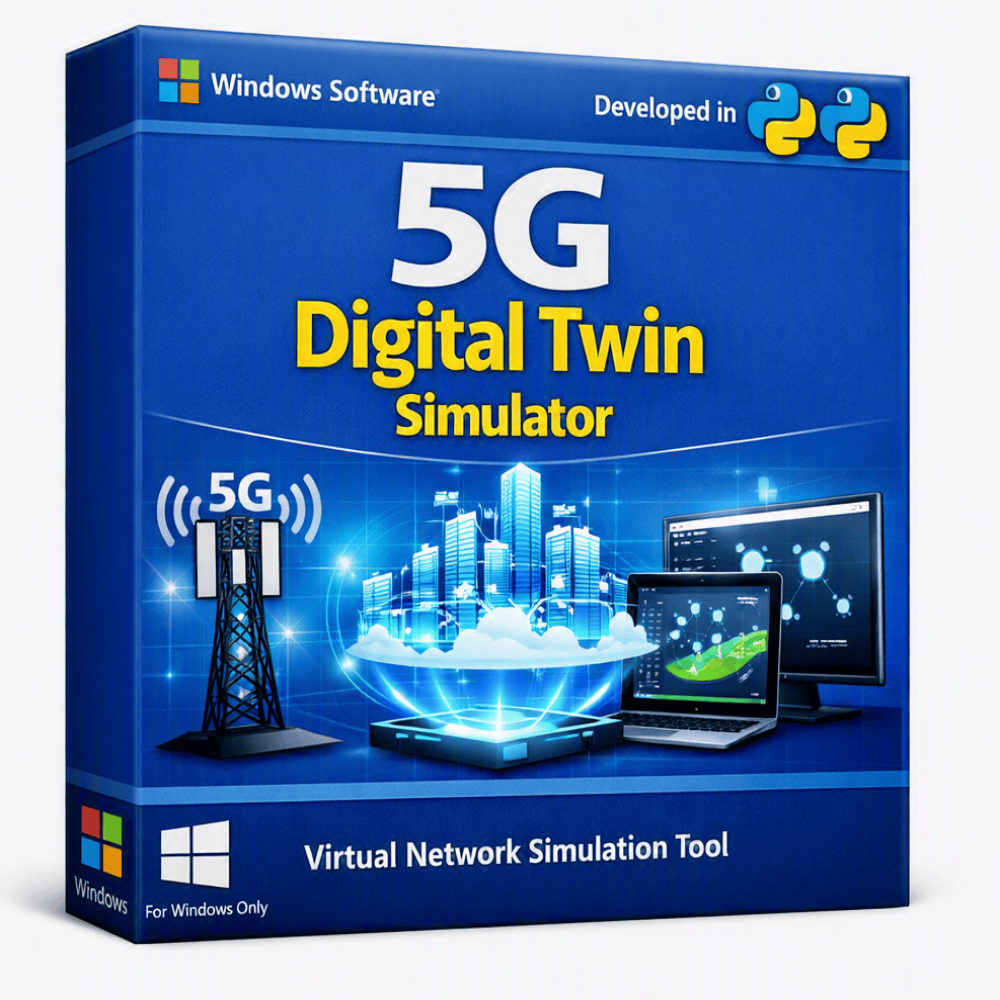
A Python-based 5G Digital Twin solution for creating a virtual representation of 5G network environments, components, and operational behavior. Designed for 5G research, network analysis, simulation, optimization, and academic projects, it enables users to model network scenarios, monitor virtualized network behavior, and experiment with different configurations in a controlled software environment.
Ideal for telecom engineers, researchers, developers, students, and academic institutions working on 5G network planning, performance analysis, intelligent network management, and digital twin research.
Original price was: ₹750.00.₹250.00Current price is: ₹250.00. -
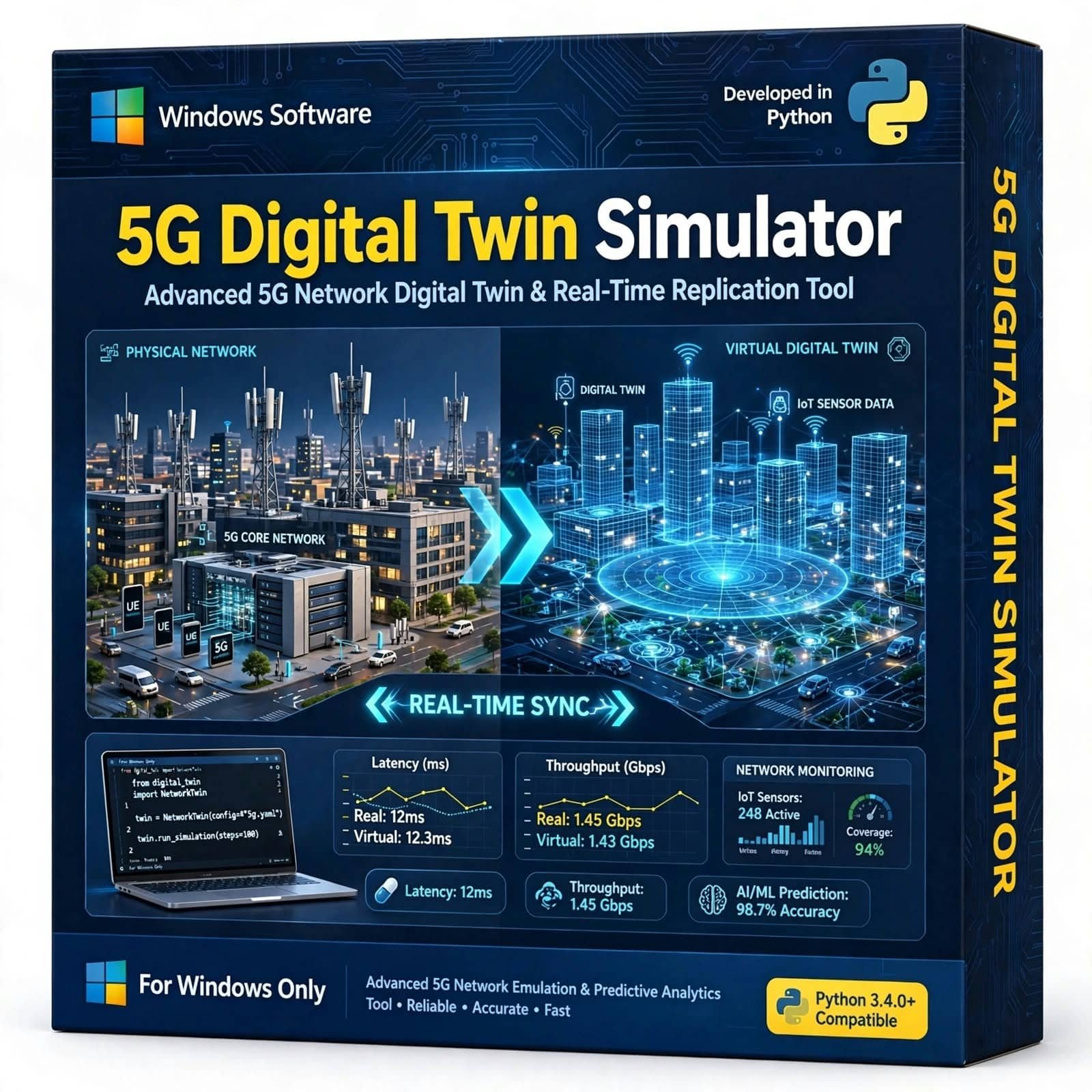
The 5G Digital Twin is a Python-based software solution designed for researchers, engineers, developers, students, and telecommunications professionals interested in modeling, simulating, and analyzing 5G communication networks and their real-world behavior in a virtual environment.
A digital twin provides a virtual representation of a physical or network system, enabling users to study system behavior, evaluate scenarios, analyze performance, and experiment with different configurations. Developed using Python, this 5G Digital Twin can support research, education, network analysis, experimentation, and proof-of-concept development.
Available for sale as a software product. Contact us for pricing, licensing, technical specifications, customization, and purchase information.
Original price was: ₹750.00.₹250.00Current price is: ₹250.00. -
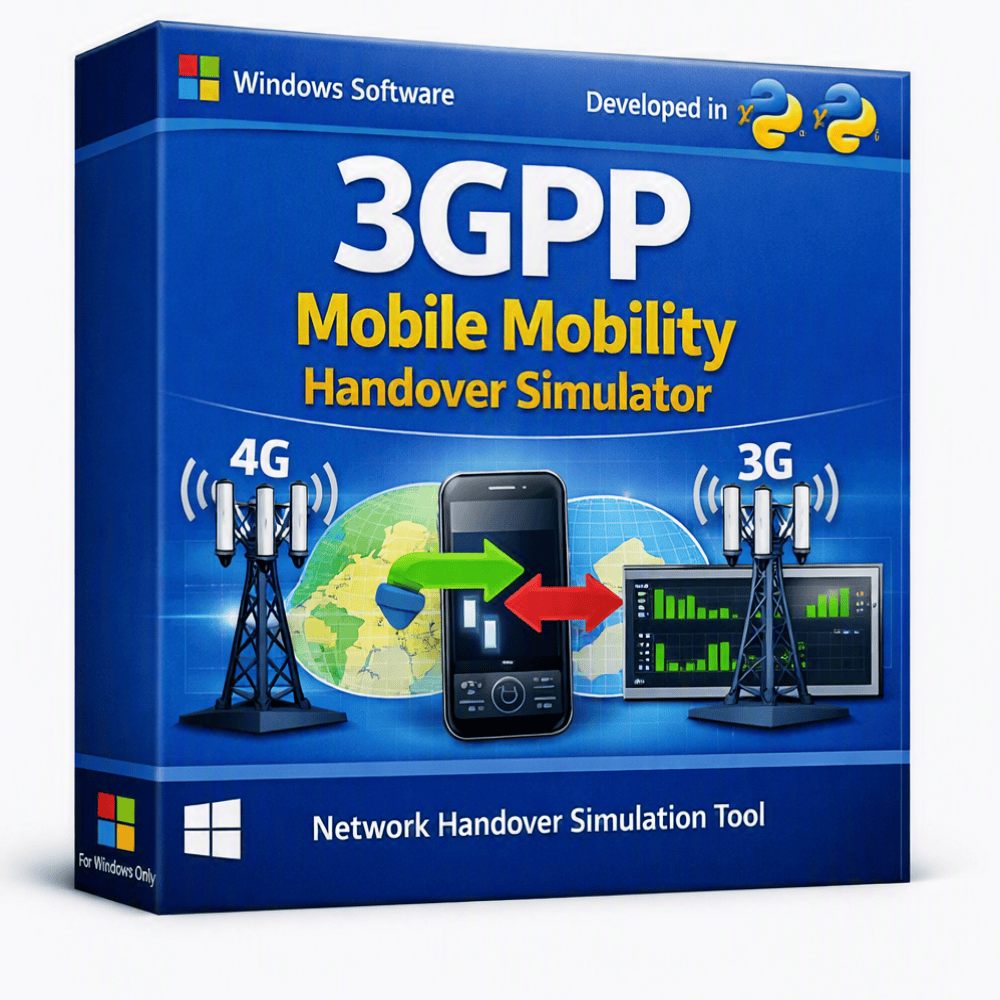
A powerful simulation tool for analyzing and validating 3GPP mobile mobility and handover procedures. The simulator enables users to model mobile network scenarios, study handover behavior, and evaluate mobility performance under different network conditions.
Key Features:
- 3GPP-compliant mobility and handover simulation
- Configurable network and mobility scenarios
- Analysis of handover performance and behavior
- Supports research, testing, and network optimization
- Useful for telecom engineers, researchers, and academic projects
Ideal for 5G/4G/3G mobility research, protocol testing, network planning, and academic simulation studies.
Original price was: ₹750.00.₹250.00Current price is: ₹250.00. -
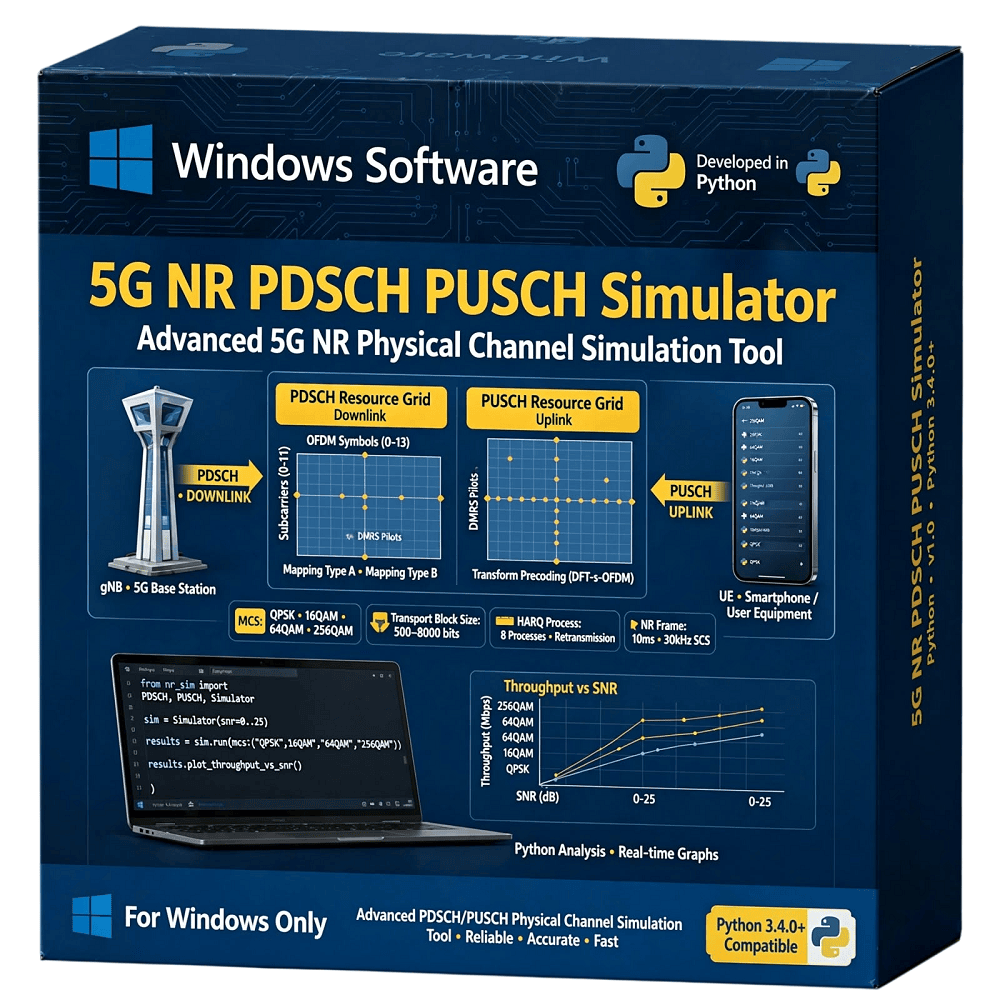
The 5G NR PDSCH PUSCH Simulator is a Python-based simulation software solution designed for researchers, engineers, students, and telecommunications professionals working with 5G New Radio (NR) physical-layer technologies. The simulator provides a practical environment for studying and experimenting with PDSCH (Physical Downlink Shared Channel) and PUSCH (Physical Uplink Shared Channel) transmission concepts.
Developed using Python, the simulator is suitable for academic research, algorithm development, demonstrations, testing, and educational applications related to 5G NR communication systems.
Available for sale as a software product. Contact us for product details, licensing, and purchase information.
Original price was: ₹750.00.₹250.00Current price is: ₹250.00. -
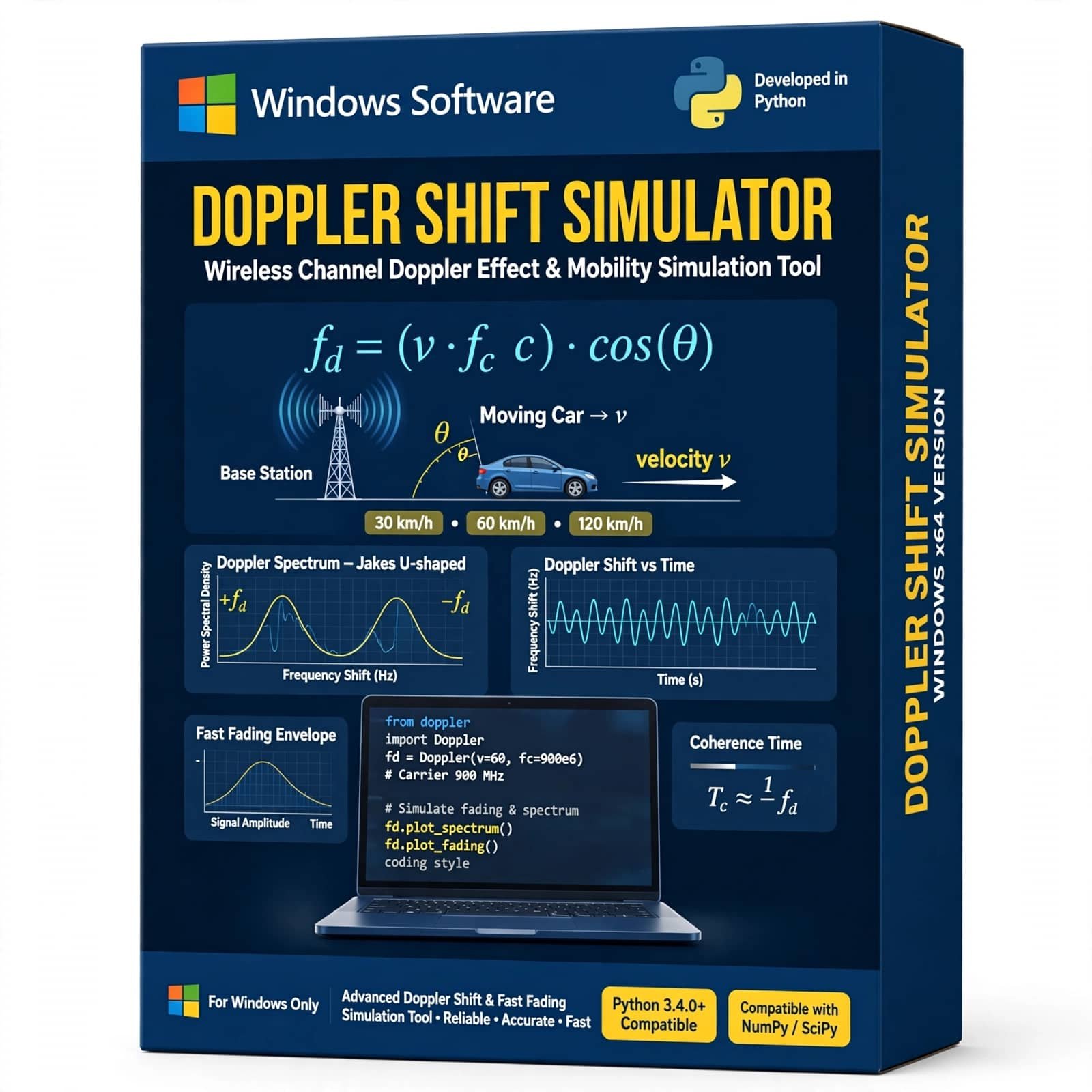
Doppler Shift Simulator Using Python is a practical wireless communication simulation tool for studying the Doppler effect and frequency shift caused by relative motion between a transmitter and receiver. It helps students, researchers, and communication engineers analyze Doppler frequency, carrier frequency, velocity, and mobile channel effects through Python-based simulation.
Original price was: ₹750.00.₹250.00Current price is: ₹250.00. -
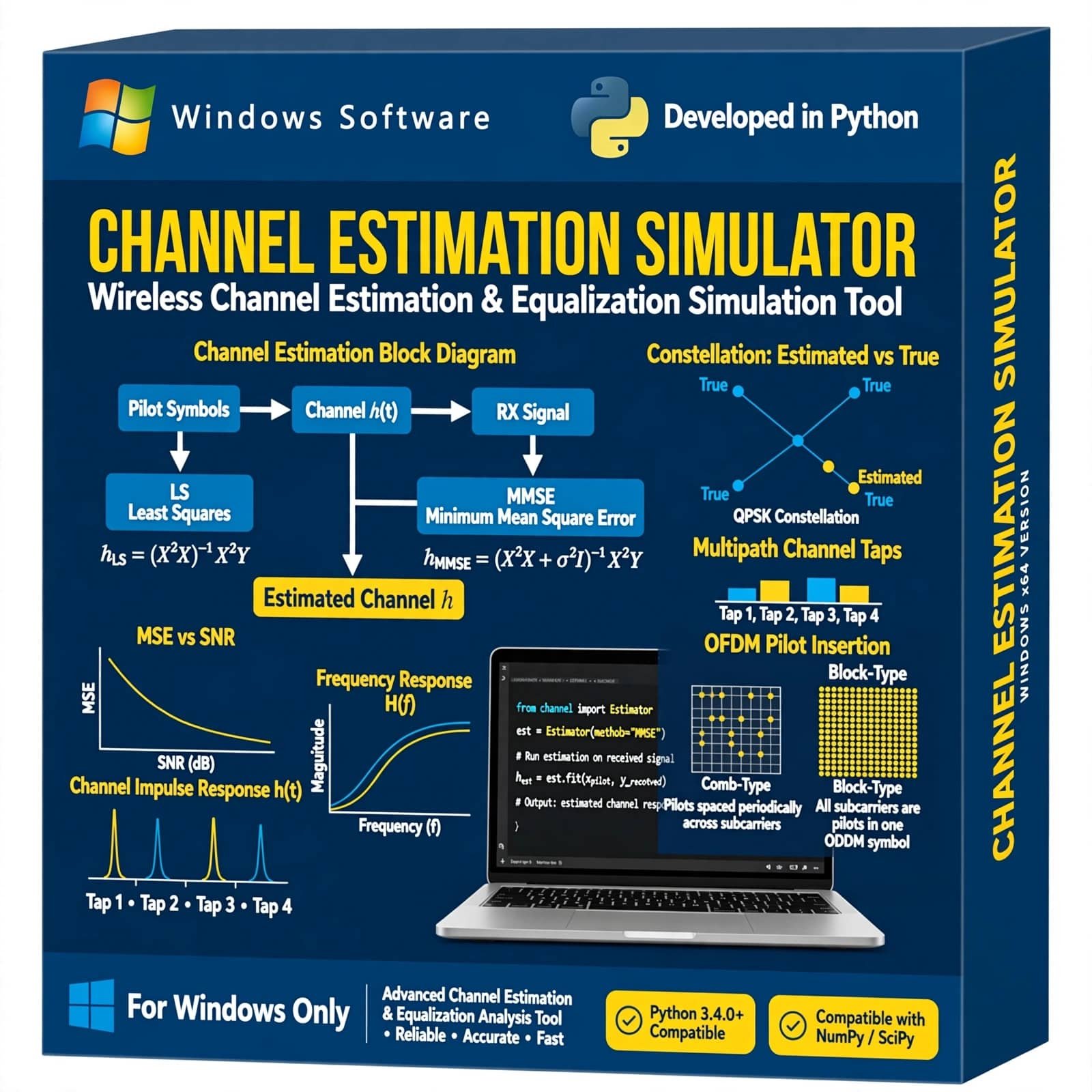
Channel Estimation Simulator is a wireless communication simulation tool designed to demonstrate and analyze channel estimation techniques in digital communication systems. It helps students, researchers, and communication engineers study channel effects, pilot-based estimation, signal distortion, and estimation performance through practical simulation.
Original price was: ₹750.00.₹250.00Current price is: ₹250.00.


Reviews
There are no reviews yet.