
New
67% Off

Slotted ALOHA Simulator

Original price was: ₹750.00.₹250.00Current price is: ₹250.00.
In StockSlotted ALOHA Simulator with Python is a software-based simulation tool for modeling and analyzing the Slotted ALOHA random access protocol. It supports multiple-node communication, time-slot-based transmission, packet generation, collision detection, retransmission, offered traffic, throughput, and channel utilization analysis. Ideal for B.Tech, M.Tech, MSc, PhD, computer networking, wireless communication, and academic research projects.
Description
Slotted ALOHA Simulator
The Slotted ALOHA Simulator with Python is a software-based simulation tool designed to model, analyze, and understand the Slotted ALOHA random access protocol used in computer networks and communication systems. Developed using Python, this simulator provides a practical environment for students, researchers, network engineers, and developers to study how multiple users share a common communication channel and how transmission collisions affect network performance.
Slotted ALOHA is a random access protocol in which time is divided into discrete slots, and users are permitted to transmit only at the beginning of a time slot. When multiple users transmit during the same slot, a collision can occur, requiring retransmission. The Slotted ALOHA Simulator with Python makes it possible to experiment with these concepts and evaluate protocol behavior under different traffic and network conditions.

Python-Based Slotted ALOHA Simulation
Python provides a flexible platform for developing and experimenting with network protocol simulations. The Python Slotted ALOHA Simulator allows users to create communication scenarios involving multiple transmitting nodes, time slots, packet generation, transmission attempts, successful transmissions, and packet collisions.
Users can modify simulation parameters such as the number of nodes, packet-generation rate, offered traffic, number of time slots, transmission probability, and simulation duration. These parameters can then be used to investigate how network traffic and user activity influence collisions, successful transmissions, and overall system performance.
The simulator is particularly useful for academic projects, computer networking laboratories, research experiments, protocol analysis, and Python-based network simulation projects.

Slotted ALOHA Protocol Simulation
Slotted ALOHA is an important random access protocol and is commonly studied when learning about medium access control and shared-channel communication. Unlike continuous-time random access approaches, Slotted ALOHA divides channel access into discrete time intervals.
The Slotted ALOHA simulator provides an environment for exploring important concepts such as:
- Time-slot-based channel access
- Random packet transmission
- Multiple-user communication
- Packet collisions
- Successful packet transmission
- Retransmission behavior
- Offered traffic
- Channel utilization
- Throughput analysis
- Collision probability
- Network load
- Transmission performance

By simulating these events, users can gain a practical understanding of how random access protocols behave when multiple devices compete for the same communication resource.
Throughput and Collision Analysis
One of the primary uses of a Slotted ALOHA simulation is analyzing the relationship between offered traffic and system throughput. As the number of transmission attempts increases, the probability of collisions can also increase. The simulator can help users investigate this relationship through controlled experiments.
Simulation results can be used to study successful transmissions, collision events, retransmissions, channel utilization, and throughput under different traffic conditions.
This makes the Slotted ALOHA Simulator with Python useful for demonstrating networking concepts that can otherwise be difficult to understand using theory alone. Students and researchers can run multiple scenarios and compare the resulting performance.

Useful for Academic and Research Projects
The simulator is suitable for B.Tech, M.Tech, MSc, PhD, computer science, information technology, electronics and communication engineering, and networking projects.
Students can use the simulator to understand random access protocols and prepare practical demonstrations, project reports, laboratory experiments, and academic presentations. Researchers can use the simulation environment as a foundation for studying channel access techniques, collision behavior, traffic models, and network performance.
Because the simulator is implemented in Python, users with programming knowledge can also modify the simulation logic and introduce additional features or experimental scenarios.

Flexible Network Simulation Environment
A Python-based simulation environment provides flexibility for customization. Users can modify node behavior, traffic-generation mechanisms, transmission probabilities, slot configuration, and performance calculations according to their research or project requirements.
The simulator can also be extended with additional performance metrics, visualization, statistical analysis, packet-generation models, or alternative random access mechanisms. This makes it suitable not only for learning the basic Slotted ALOHA protocol but also for developing more advanced networking experiments.
Applications of Slotted ALOHA Simulator
The Slotted ALOHA Simulator with Python can be used for studying computer networks, wireless communication, random access protocols, medium access control, shared-channel communication, packet transmission, and network performance.

Typical applications include:
- Computer networking laboratory experiments
- Random access protocol research
- Wireless communication studies
- MAC protocol analysis
- Collision and throughput analysis
- Network traffic simulation
- Academic project development
- Python networking projects
- Protocol performance evaluation
- Communication-system demonstrations
Why Use a Slotted ALOHA Simulator?
Testing random access protocols on physical networks can require multiple devices and a controlled networking environment. A software simulator provides a convenient way to reproduce communication scenarios and experiment with protocol parameters without requiring specialized hardware.

The Slotted ALOHA Simulator with Python enables users to model multiple nodes competing for a shared communication channel and observe how transmission attempts, collisions, successful packets, and retransmissions affect network performance.
It can therefore serve as a practical tool for learning, teaching, research, and development related to random access communication protocols.
Key Features
- Python-based Slotted ALOHA simulation
- Time-slot-based transmission modeling
- Multiple-node communication
- Random packet transmission
- Packet collision simulation
- Successful transmission analysis
- Retransmission modeling
- Offered traffic analysis
- Throughput analysis
- Collision analysis
- Channel utilization evaluation
- Configurable simulation parameters
- Suitable for academic and research projects
- Extendable Python simulation environment
 Ideal for Networking and Communication Projects
Whether you are working on a computer networking project, Python simulation project, wireless communication project, MAC protocol research, or academic thesis, the Slotted ALOHA Simulator with Python provides a practical environment for experimenting with random access communication.
It combines Python programming with fundamental networking concepts, allowing users to simulate transmission attempts, investigate collision behavior, measure throughput, and study how network load affects protocol performance.
The simulator is therefore suitable for students, researchers, educators, and developers who want to gain practical experience with Slotted ALOHA protocol simulation using Python.
Related products
-
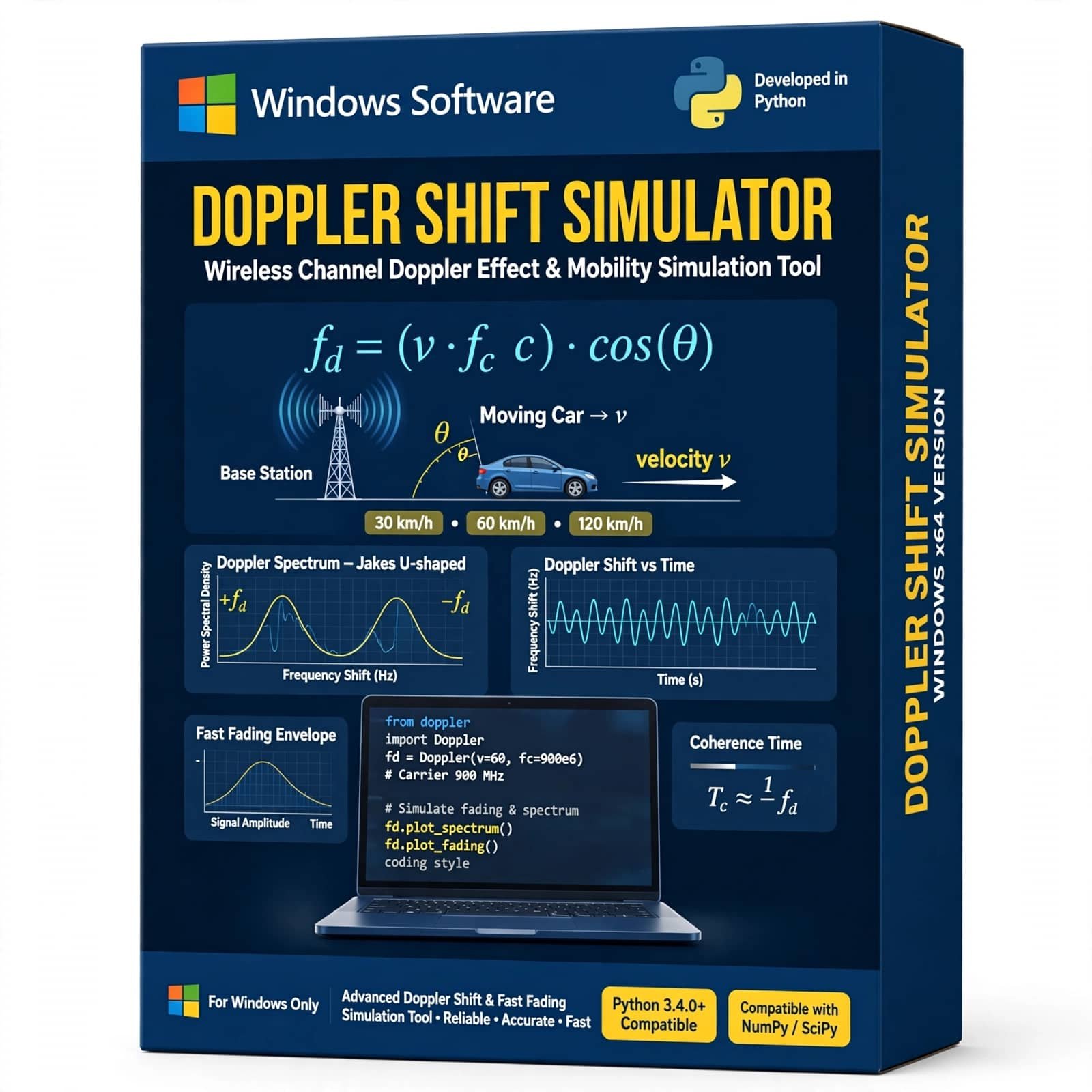
Doppler Shift Simulator Using Python is a practical wireless communication simulation tool for studying the Doppler effect and frequency shift caused by relative motion between a transmitter and receiver. It helps students, researchers, and communication engineers analyze Doppler frequency, carrier frequency, velocity, and mobile channel effects through Python-based simulation.
Original price was: ₹750.00.₹250.00Current price is: ₹250.00. -
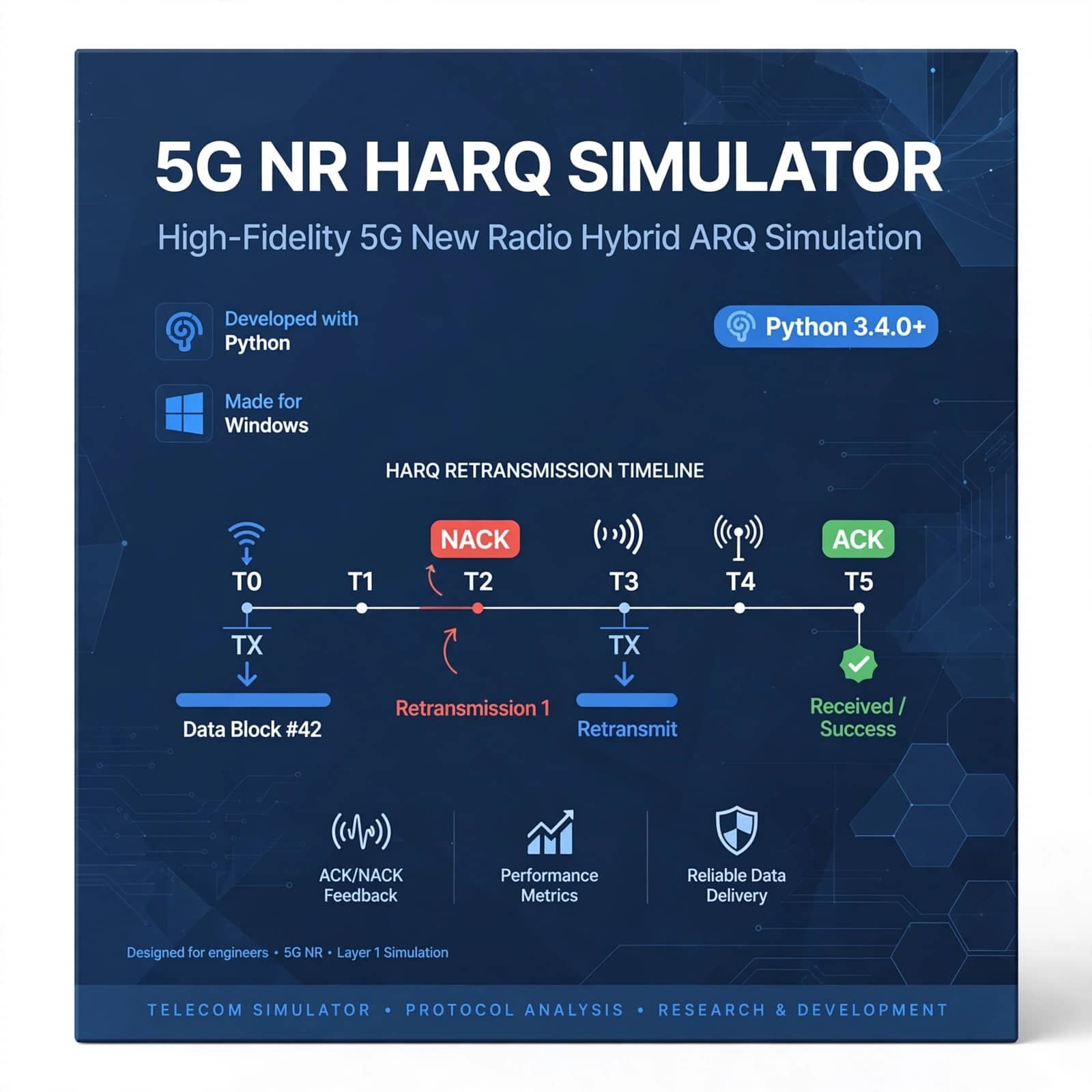
5G NR HARQ Simulator is an advanced simulation solution for modeling and analyzing Hybrid Automatic Repeat Request (HARQ) mechanisms in 5G New Radio networks. It enables users to study HARQ processes, ACK/NACK feedback, retransmissions, link adaptation, channel errors, and communication reliability under configurable network conditions. The simulator supports analysis of throughput, BLER, latency, retransmission rate, packet errors, spectral efficiency, and other key performance metrics, making it suitable for 5G NR research, algorithm development, academic projects, and wireless communication system optimization.
Original price was: ₹750.00.₹250.00Current price is: ₹250.00. -
FiveG Core Simulator v2 is an educational 5G Core Network simulation tool designed to help students, educators, researchers, and telecom professionals understand 5G core architecture, network functions, signaling procedures, latency, and protocol interactions through an interactive topology and signaling animation environment.
Original price was: ₹750.00.₹250.00Current price is: ₹250.00. -
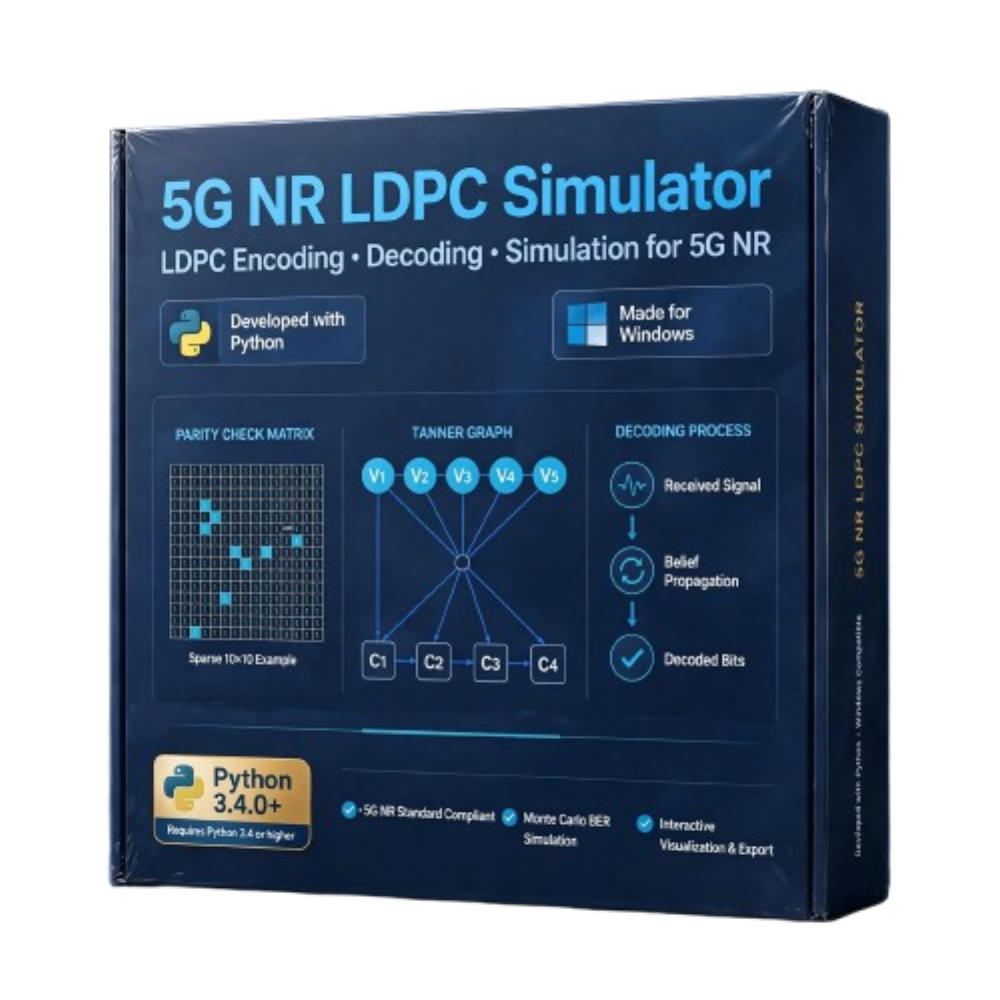
5G NR LDPC Simulator is an advanced simulation solution for modeling and analyzing Low-Density Parity-Check (LDPC) channel coding used in 5G New Radio systems. It enables users to simulate LDPC encoding and decoding, evaluate error correction performance, and analyze BER, BLER, SNR, coding rate, decoding iterations, throughput, and convergence under configurable channel conditions. The simulator is ideal for 5G NR channel coding research, algorithm development, academic projects, decoder performance analysis, and next-generation wireless communication system optimization.
Original price was: ₹750.00.₹250.00Current price is: ₹250.00. -
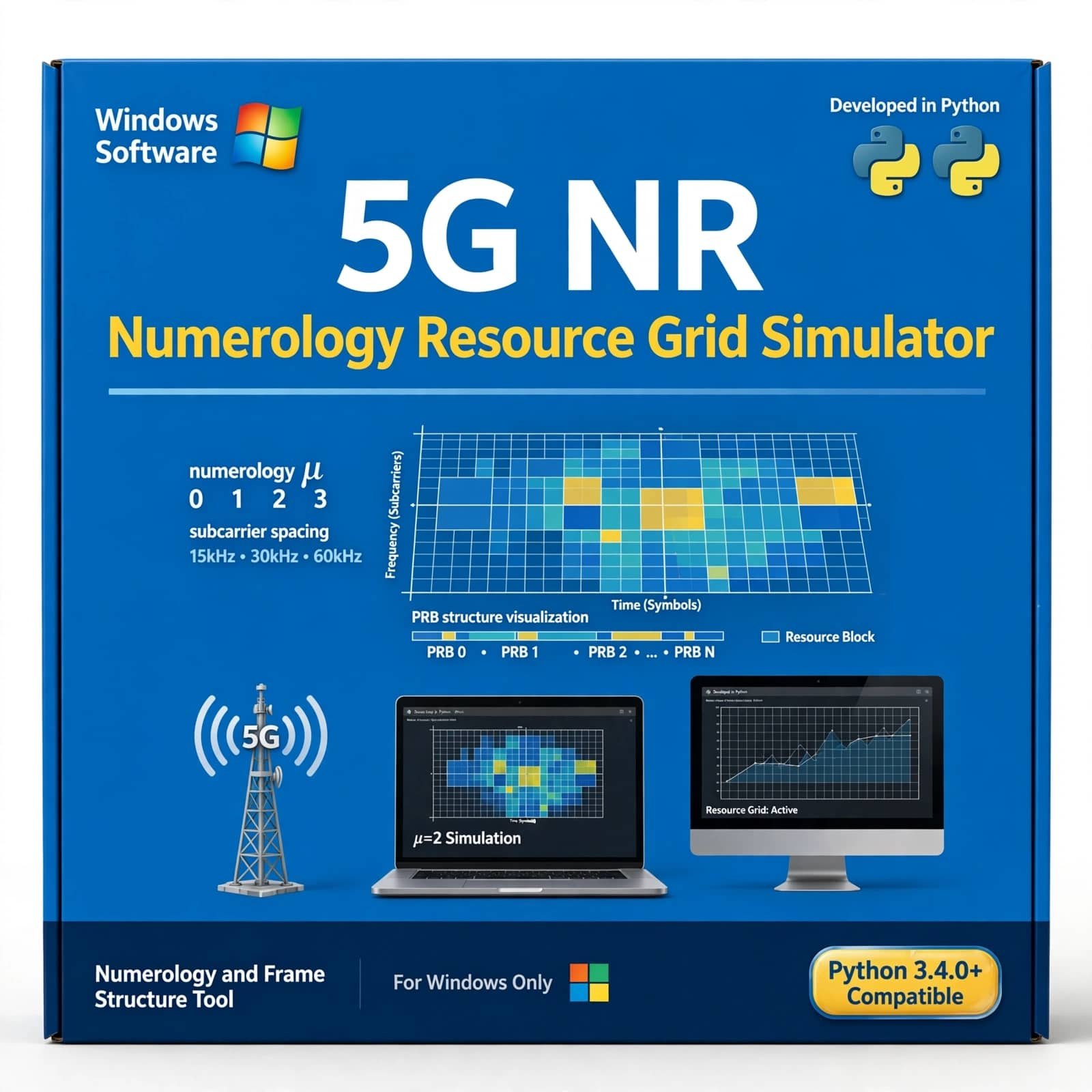
5G NR Numerology Resource Grid Simulator is an advanced simulation solution for modeling and analyzing 5G New Radio numerology and time-frequency resource grid structures. It enables users to study subcarrier spacing, OFDM symbols, slot structure, cyclic prefix, Physical Resource Blocks (PRBs), Resource Elements (REs), bandwidth configurations, and resource mapping. The simulator is ideal for 5G NR physical-layer research, numerology analysis, resource allocation studies, academic projects, waveform development, and 5G/6G wireless communication research.
Original price was: ₹750.00.₹250.00Current price is: ₹250.00. -
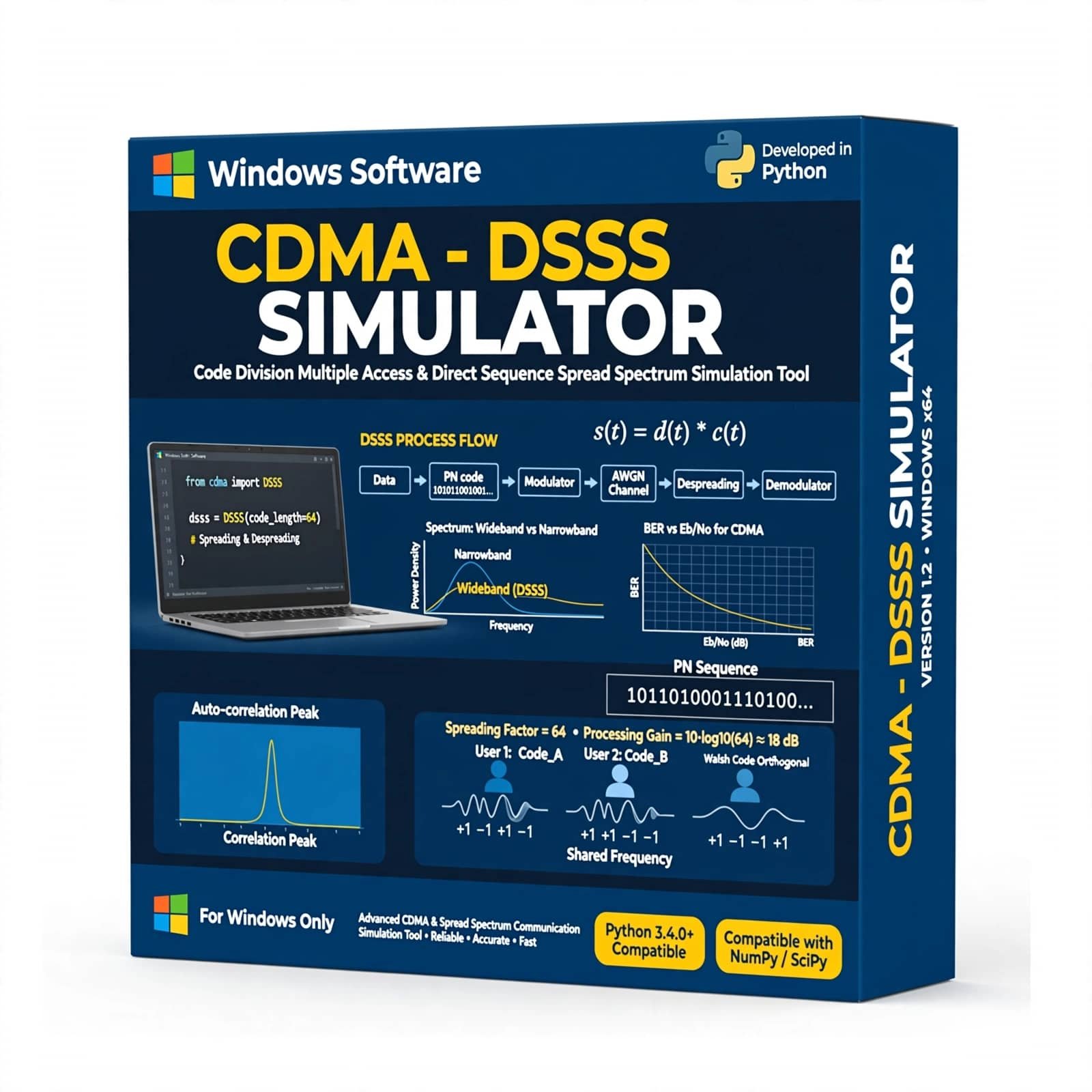
The CDMA – DSSS Simulator with Python is a software-based communication simulation tool designed to demonstrate and analyze Code Division Multiple Access (CDMA) and Direct Sequence Spread Spectrum (DSSS) techniques. Developed using Python, the simulator provides a practical environment for studying spreading codes, signal spreading and despreading, data transmission, multiple-access communication, interference, and signal recovery. It is ideal for digital communication and wireless communication laboratories, engineering education, student projects, technical training, and communication-system research.
Original price was: ₹750.00.₹250.00Current price is: ₹250.00.



Reviews
There are no reviews yet.