
New
67% Off

MPLS Label Switching Simulator

Original price was: ₹750.00.₹250.00Current price is: ₹250.00.
In StockMPLS Label Switching Simulator is a Python-based networking simulation tool designed to demonstrate and analyze Multiprotocol Label Switching (MPLS) concepts. Simulate label assignment, label switching, packet forwarding, LSP paths, and MPLS routing in an easy-to-understand environment. Ideal for networking students, researchers, developers, and academic projects.
Description
MPLS Label Switching Simulator
Learn, demonstrate, and experiment with Multiprotocol Label Switching (MPLS) using the MPLS Label Switching Simulator, a Python-based networking simulation project designed for understanding how label-based packet forwarding works in modern computer networks.
MPLS is an important networking technology used to improve packet forwarding, traffic engineering, and network service delivery. However, understanding concepts such as labels, Label Switching Routers (LSRs), Label Edge Routers (LERs), and Label Switched Paths (LSPs) can be challenging when learning only from theoretical diagrams. This MPLS Simulator in Python provides a practical way to visualize and understand the basic operations involved in MPLS networks.
What Is the MPLS Label Switching Simulator?
The MPLS Label Switching Simulator is a software project developed using Python to simulate the fundamental behavior of an MPLS-enabled network. Instead of relying exclusively on physical networking equipment, users can create and study a simulated environment where packets are forwarded according to assigned MPLS labels.
The simulator can be useful for demonstrating how packets enter an MPLS network, receive labels, travel through Label Switching Routers, and are forwarded toward their destination. This makes it a valuable learning resource for computer networking courses, academic demonstrations, research activities, and Python-based networking projects.
Understand MPLS Label Switching
One of the primary purposes of this MPLS simulation software is to make label switching easier to understand.
In a traditional IP network, routers generally examine the destination IP address to determine where a packet should be forwarded. In an MPLS network, packets can be associated with labels that are used by intermediate routers to make forwarding decisions.
With this simulator, users can explore concepts such as:
- MPLS label assignment
- Label-based packet forwarding
- Label Switching Routers (LSRs)
- Label Edge Routers (LERs)
- Label Switched Paths (LSPs)
- Packet movement through an MPLS network
- MPLS routing concepts
- Network topology and path selection
- Label swapping and forwarding behavior
By experimenting with these concepts in a simulated environment, learners can develop a stronger practical understanding of how MPLS networks operate.
Python-Based MPLS Simulator
The simulator is written in Python, making it particularly suitable for students and developers who want to study networking concepts alongside Python programming.
Python is widely used for networking automation, simulation, education, and research because of its flexibility and extensive ecosystem. Using Python for an MPLS networking project also provides an opportunity to examine how networking logic can be represented programmatically.
Users interested in computer networks can study the source code, understand the simulation workflow, modify network scenarios, and extend the project according to their academic or research requirements.
Useful for Networking Students and Academic Projects
The MPLS Label Switching Simulator can be useful for students working on computer networking assignments, laboratory demonstrations, mini projects, final-year projects, and academic presentations.
Instead of simply reading about MPLS terminology, students can use the simulator to demonstrate how packets and labels behave within a simulated network.
It can help learners build familiarity with important networking concepts while also gaining practical experience with Python programming.
Explore MPLS Network Simulation
A major advantage of using an MPLS network simulator is the ability to experiment without requiring a physical MPLS network infrastructure.
Users can investigate different network scenarios and observe how packets move through simulated nodes. This can make complex networking concepts easier to explain during classroom demonstrations, project presentations, and technical discussions.
The simulator can also serve as a foundation for further development. Developers and researchers can modify the implementation, add additional networking functionality, introduce different routing scenarios, or build new visualization and analysis features.
Who Can Use This MPLS Simulator?
This Python-based MPLS simulator is suitable for a variety of users, including:
- Computer networking students
- BCA, MCA, B.Tech, M.Tech, and engineering students
- Networking professionals and learners
- Python developers interested in networking
- Academic researchers
- Networking project developers
- Teachers and instructors demonstrating MPLS concepts
- Students developing networking mini projects and final-year projects

Key Benefits
The MPLS Label Switching Simulator provides a practical approach to learning and demonstrating MPLS concepts. Its Python implementation makes the project accessible to users who want to combine programming knowledge with networking fundamentals.
Key benefits include:
- Python-based implementation
- Practical MPLS network simulation
- Demonstration of label switching concepts
- Better understanding of packet forwarding
- Useful for academic and educational purposes
- Suitable for networking project demonstrations
- Customizable source code for further development
- Helps connect theoretical MPLS concepts with practical simulation
Start Learning MPLS Through Simulation
Understanding MPLS becomes easier when theoretical concepts can be explored through practical examples. The MPLS Label Switching Simulator written in Python provides a useful platform for studying label-based forwarding, simulated network paths, and fundamental MPLS operations.
Whether you are a networking student looking for an MPLS networking project, a Python developer exploring network simulation, or an instructor searching for a practical MPLS demonstration tool, this simulator can help turn complex networking concepts into an interactive learning experience.
Get the MPLS Label Switching Simulator and explore the fundamentals of Multiprotocol Label Switching through a Python-based simulation environment.
Related products
-
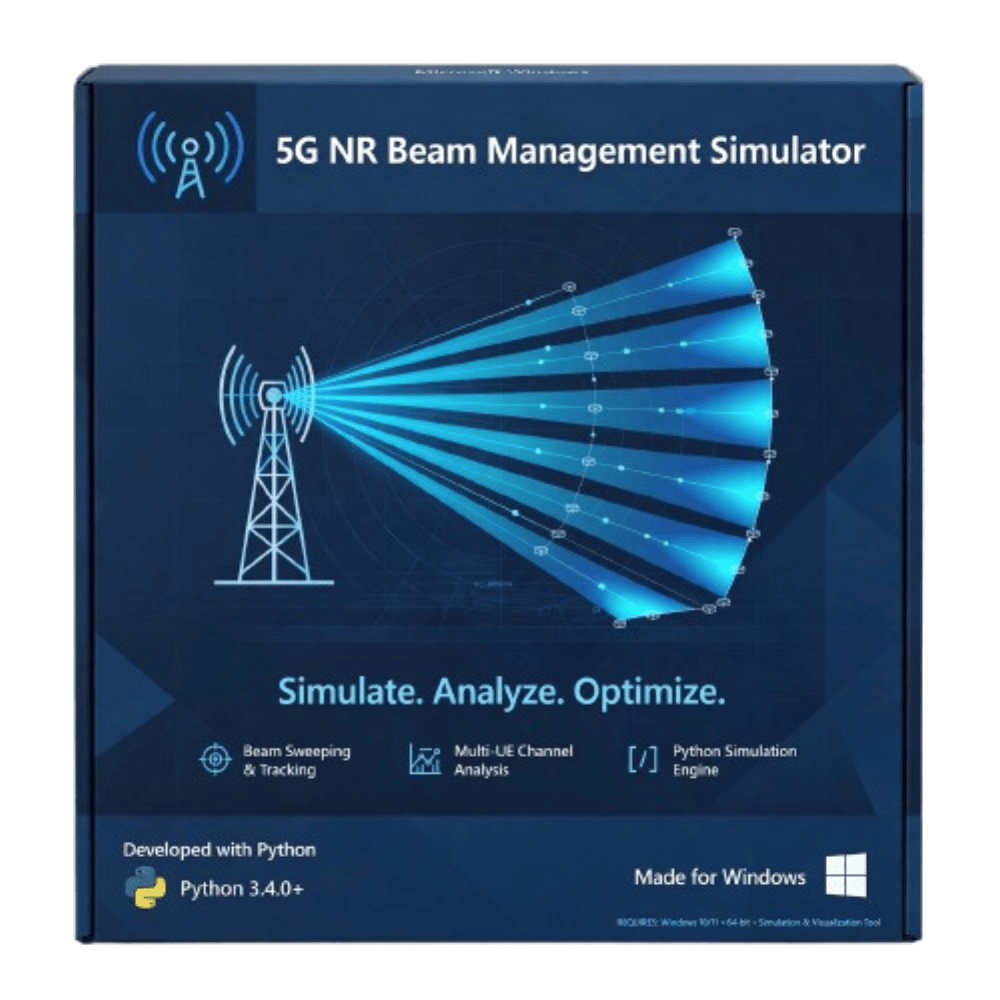
5G NR Beam Management Simulator is an advanced simulation solution designed to model, analyze, and optimize beam management procedures in 5G New Radio (NR) networks. It enables engineers and researchers to evaluate beam sweeping, beam measurement, beam selection, beam reporting, and beam recovery under diverse network and channel conditions. The simulator supports performance analysis of directional communication, helping users assess beamforming strategies, mobility scenarios, link reliability, and system-level performance before real-world deployment.
Original price was: ₹750.00.₹250.00Current price is: ₹250.00. -
The 2G GSM Cell Simulator is a Python-based software project designed to simulate fundamental GSM cellular-network concepts. It provides a practical environment for understanding mobile stations, GSM cells, base stations, cellular coverage, mobility, communication channels, and basic network behavior. The project includes Python source code that can be studied, customized, and extended for academic projects, demonstrations, research, and learning. It is ideal for Electronics & Communication Engineering, Telecommunications, Computer Science, and related students looking to explore 2G GSM technology and cellular network simulation through a software-based implementation.
Original price was: ₹750.00.₹250.00Current price is: ₹250.00. -
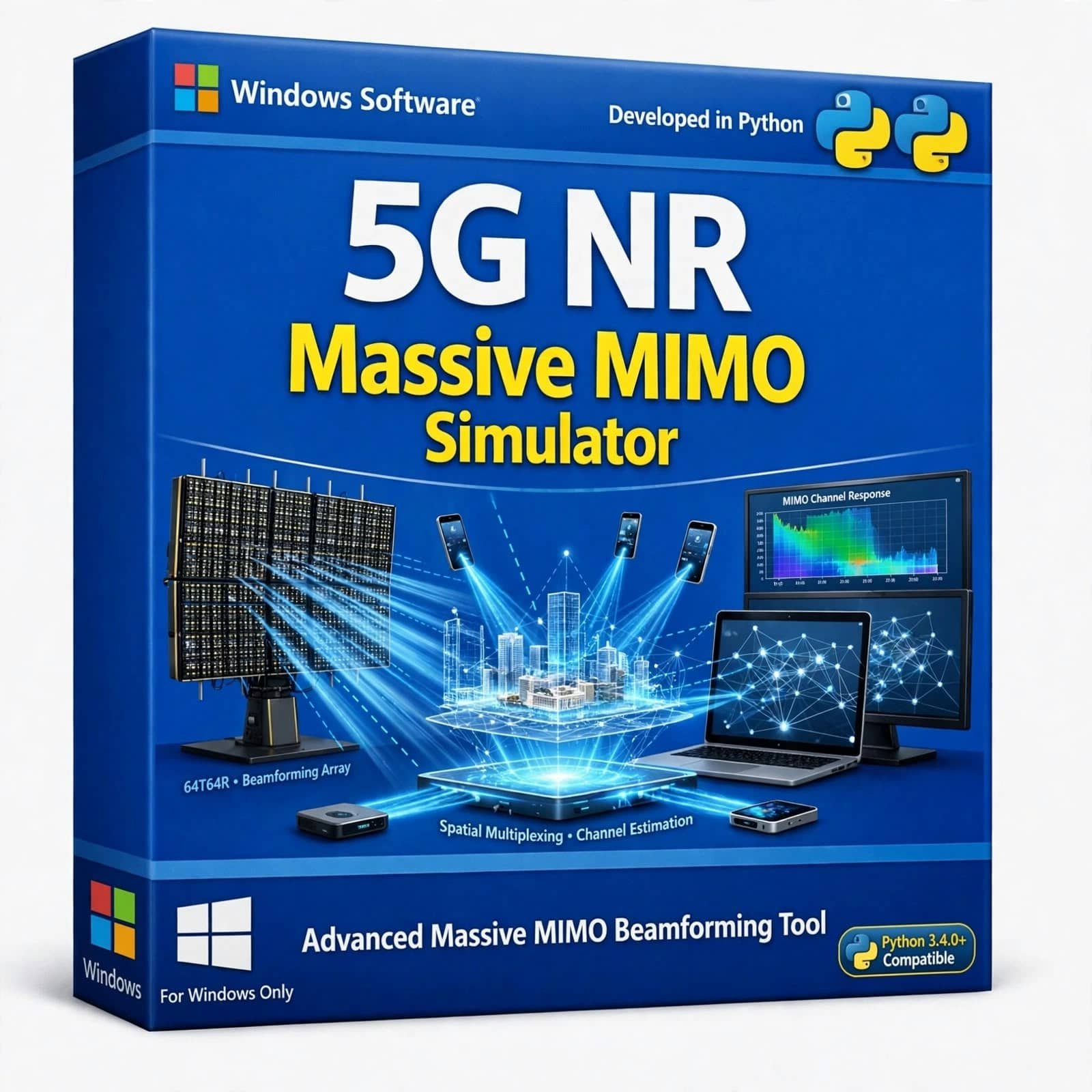
5G NR Massive MIMO Simulator is an advanced simulation solution for modeling and analyzing Massive Multiple-Input Multiple-Output (MIMO) technologies in 5G New Radio networks. It enables users to study large-scale antenna arrays, beamforming, precoding, spatial multiplexing, multi-user MIMO, channel estimation, and interference under configurable channel conditions. The simulator supports analysis of throughput, spectral efficiency, SINR, BER, BLER, MIMO capacity, beamforming gain, and multi-user performance, making it ideal for 5G NR research, algorithm development, academic projects, and 5G/6G wireless system optimization.
Original price was: ₹750.00.₹250.00Current price is: ₹250.00. -
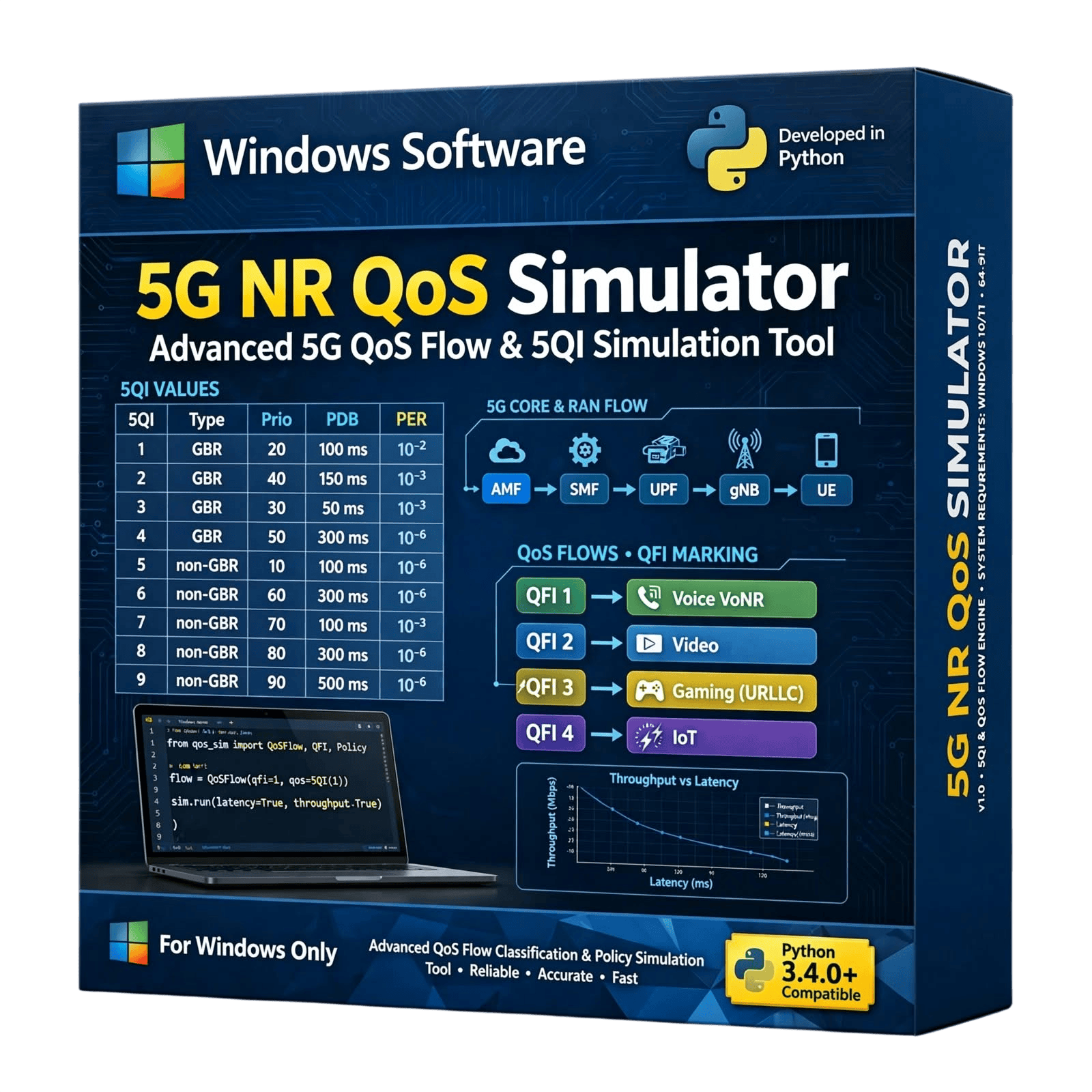
The 5G QoS Simulator is a Python-based software solution designed for researchers, engineers, students, developers, and telecommunications professionals working with 5G Quality of Service (QoS) concepts. The simulator provides a software-based environment for studying and analyzing QoS-related aspects of 5G communication networks, including service performance, traffic behavior, resource management, and network performance evaluation.
Developed using Python, the simulator is suitable for academic research, telecommunications projects, demonstrations, experimentation, algorithm development, and educational applications.
Available for sale as a software product. Contact us for pricing, licensing, features, customization, and purchase information.
Original price was: ₹750.00.₹250.00Current price is: ₹250.00. -
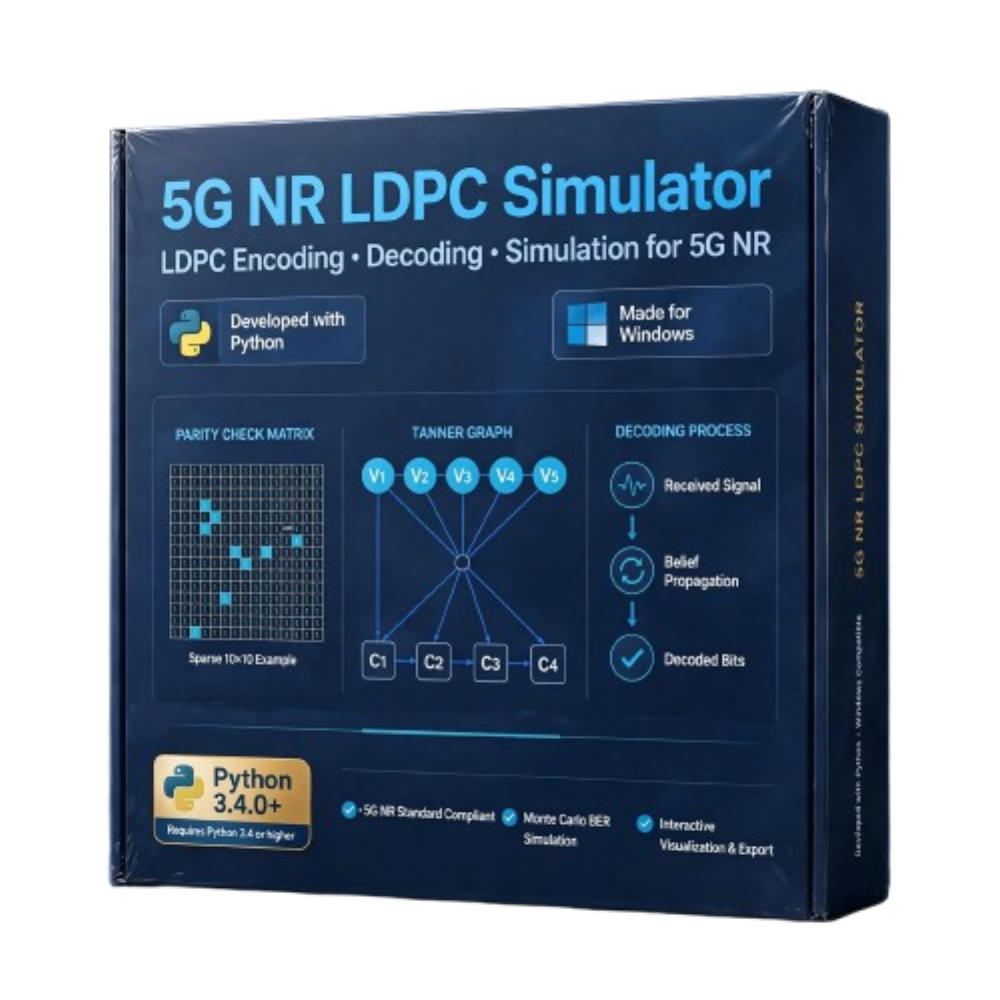
5G NR LDPC Simulator is an advanced simulation solution for modeling and analyzing Low-Density Parity-Check (LDPC) channel coding used in 5G New Radio systems. It enables users to simulate LDPC encoding and decoding, evaluate error correction performance, and analyze BER, BLER, SNR, coding rate, decoding iterations, throughput, and convergence under configurable channel conditions. The simulator is ideal for 5G NR channel coding research, algorithm development, academic projects, decoder performance analysis, and next-generation wireless communication system optimization.
Original price was: ₹750.00.₹250.00Current price is: ₹250.00. -
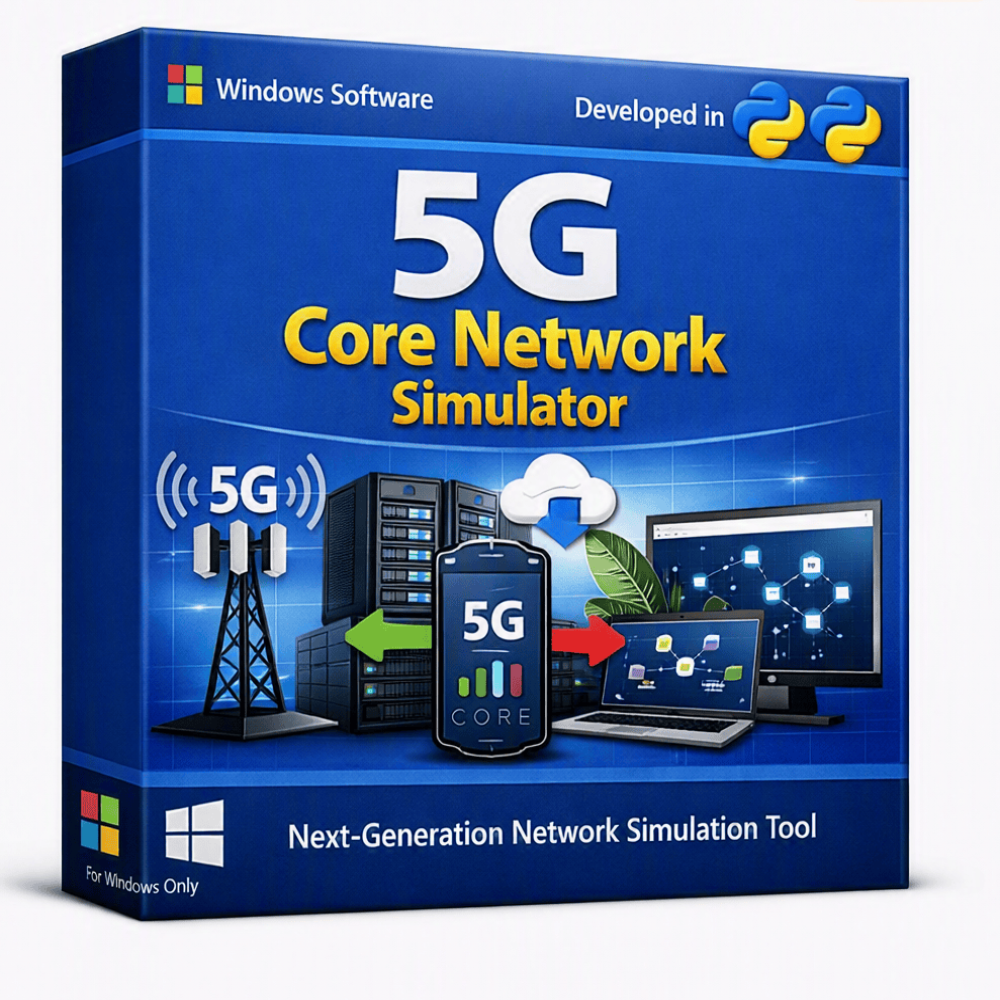
A Python-based 5G Core Network Simulator designed for studying, analyzing, and demonstrating 5G Core network architecture and procedures. Explore key 5G Network Functions such as AMF, SMF, UPF, AUSF, UDM, PCF, NRF, and NSSF, along with UE registration, authentication, session management, mobility, and signaling procedures.
Ideal for 5G research, telecom engineering, academic projects, university laboratories, protocol development, and network simulation. Provides a flexible software environment for experimenting with 5G Core concepts without requiring a complete commercial 5G network infrastructure.
Original price was: ₹750.00.₹250.00Current price is: ₹250.00.


Reviews
There are no reviews yet.