

LTE Resource Grid Simulator


₹6,999.00
In StockLTE Resource Grid Simulator developed with C++ is a software-based simulation solution designed to visualize, study, and analyze the LTE physical-layer resource grid used in 4G wireless communication systems. It provides a practical environment for understanding LTE resource elements, resource blocks, subcarriers, OFDM symbols, time-frequency mapping, and physical-channel resource allocation. Ideal for LTE research, academic projects, telecom engineering studies, signal-processing experiments, and C++-based wireless communication simulation.
Description
LTE Resource Grid Simulator
The LTE Resource Grid Simulator developed with C++ is a software-based simulation solution designed to help students, researchers, telecom engineers, and developers understand and experiment with the LTE physical-layer resource grid used in 4G wireless communication systems.
The LTE resource grid is a fundamental concept in the physical layer of an LTE system. It represents the organization and mapping of radio resources across the time and frequency domains. Understanding how resource elements, resource blocks, subcarriers, and OFDM symbols are arranged is essential for studying LTE signal transmission and physical-layer operations.
This C++-based LTE Resource Grid Simulator provides a practical software environment for exploring these concepts through simulation. It can be used for academic learning, LTE research, physical-layer experimentation, signal-processing studies, and telecom engineering projects.
Understand the LTE Resource Grid
In an LTE system, radio resources are organized using a two-dimensional structure commonly referred to as the resource grid. The grid represents resources across frequency and time and provides a framework for mapping different physical signals and channels.
The LTE resource grid consists of resource elements, which are associated with specific OFDM symbols and subcarriers. Groups of resource elements form resource blocks that are used as fundamental units for organizing and allocating radio resources.
An LTE Resource Grid Simulator can help users visualize this structure and understand how information is represented within the LTE physical layer.
Python-Free, C++-Based LTE Simulation
This simulator is developed using C++, making it suitable for users interested in high-performance software development and wireless communication simulation.
C++ is widely used for telecommunications, embedded systems, networking, signal processing, and performance-oriented applications. Its efficiency and control over system resources make it a suitable language for implementing simulation and physical-layer processing concepts.
The C++ implementation also provides students and researchers with an opportunity to combine LTE technology knowledge with practical C++ programming and simulation skills.
Explore Resource Elements and Resource Blocks
Resource elements and resource blocks are important building blocks of the LTE resource grid.
A resource element represents a specific time-frequency location within the grid. Resource blocks group multiple resource elements and provide a convenient structure for resource allocation and physical-layer processing.
Using the LTE Resource Grid Simulator developed with C++, users can explore how these resources are organized and how information can be mapped onto the LTE time-frequency grid.
This is particularly useful for students who want to understand LTE physical-layer concepts beyond theoretical diagrams.
Study OFDM Symbols and Subcarriers
LTE uses Orthogonal Frequency Division Multiplexing (OFDM)-based transmission concepts in its downlink physical layer. The LTE resource grid represents OFDM symbols along the time dimension and subcarriers along the frequency dimension.
The simulator can be used to study this time-frequency organization and understand how OFDM symbols and subcarriers form the foundation of the LTE resource grid.
By working with simulated grids, students and researchers can develop a clearer understanding of the relationship between OFDM, subcarriers, resource elements, and LTE physical-layer transmission.
Visualize LTE Time-Frequency Mapping
One of the primary benefits of a resource grid simulator is the ability to represent LTE resources visually or structurally within a controlled software environment.
Users can study how different resources occupy positions in the time-frequency domain and explore the mapping of signals and channels onto the grid.
This can be valuable for understanding complex physical-layer concepts that may otherwise be difficult to interpret from mathematical descriptions alone.
Applications of LTE Resource Grid Simulator
The LTE Resource Grid Simulator can be useful for a wide range of educational, research, and development applications, including:
- LTE physical-layer simulation
- 4G LTE resource grid visualization
- Resource element analysis
- Resource block studies
- OFDM symbol simulation
- Subcarrier mapping experiments
- LTE signal-processing research
- Physical-channel mapping studies
- LTE academic projects
- Final-year engineering projects
- Telecommunications laboratory demonstrations
- C++ wireless communication projects
- LTE protocol and physical-layer learning
- 4G network research
The simulator is particularly useful for students and researchers studying telecommunications, electronics and communication engineering, wireless communication, signal processing, computer engineering, and related technical fields.

Ideal for Academic and Final-Year Projects
The C++ LTE Resource Grid Simulator can serve as a practical foundation for university assignments, laboratory exercises, research projects, and final-year engineering projects.
Students can use the simulator to demonstrate how LTE resources are organized in the time-frequency domain and explain concepts such as resource elements, resource blocks, OFDM symbols, and subcarriers.
It can also support project presentations by providing a software-based demonstration of LTE physical-layer resource organization.
For researchers, the simulator can provide a starting point for developing customized LTE resource-mapping experiments and investigating physical-layer concepts.
Study LTE Physical Layer Concepts
The LTE physical layer is responsible for transmitting information over the wireless channel. It involves multiple processes related to modulation, coding, resource mapping, reference signals, physical channels, and radio transmission.
The resource grid provides an important framework for representing many of these physical-layer operations.
An LTE Resource Grid Simulator in C++ can help users understand how physical-layer information can be represented within a structured time-frequency resource environment.
This makes it a useful educational and research tool for connecting theoretical LTE specifications with practical simulation concepts.
Flexible Environment for LTE Research
A software-based simulation environment allows users to perform experiments without requiring a complete physical LTE network. Researchers can create controlled scenarios, modify simulation parameters, observe resource-grid behavior, and repeat experiments.
The C++ implementation can also be suitable for performance-oriented simulation and further development. Developers can use the simulator as a foundation for implementing additional LTE physical-layer functionality based on their research or project requirements.
This flexibility makes the simulator suitable for LTE research, wireless communication education, signal-processing experiments, and telecom software development.
Benefits of LTE Resource Grid Simulator
A C++-based LTE Resource Grid Simulator offers several potential benefits:
- Practical understanding of LTE resource-grid concepts
- C++-based simulation environment
- Study of resource elements and resource blocks
- Time-frequency resource visualization
- OFDM symbol and subcarrier analysis
- Useful for LTE physical-layer education
- Suitable for academic and research projects
- Supports wireless communication experimentation
- Can serve as a foundation for customized LTE simulations
By combining LTE physical-layer concepts with software-based simulation, users can gain practical insight into how radio resources are structured and utilized in a 4G LTE system.
Why Choose an LTE Resource Grid Simulator?
The LTE resource grid is a fundamental concept for understanding how information and physical-layer signals are organized within an LTE transmission. A clear understanding of time-frequency resource mapping can help students and researchers better understand LTE physical-layer architecture.
The LTE Resource Grid Simulator developed with C++ provides a practical way to explore these concepts while also developing programming and simulation skills.
Its focus on resource elements, resource blocks, OFDM symbols, subcarriers, and time-frequency organization makes it a useful addition to LTE-related academic and research projects.
Conclusion
The LTE Resource Grid Simulator developed with C++ provides a practical software environment for studying and understanding the LTE physical-layer resource grid used in 4G wireless communication systems. It can help users explore resource elements, resource blocks, OFDM symbols, subcarriers, time-frequency mapping, and physical-layer resource organization.
Whether you are working on an LTE academic project, final-year engineering project, physical-layer research project, wireless communication experiment, signal-processing study, or C++ telecom simulation, this simulator can provide a useful foundation for learning and experimentation.
Explore LTE Resource Grid simulation with C++ and gain practical insight into the time-frequency resource structure that forms an essential part of 4G LTE physical-layer communication.
Related products
-
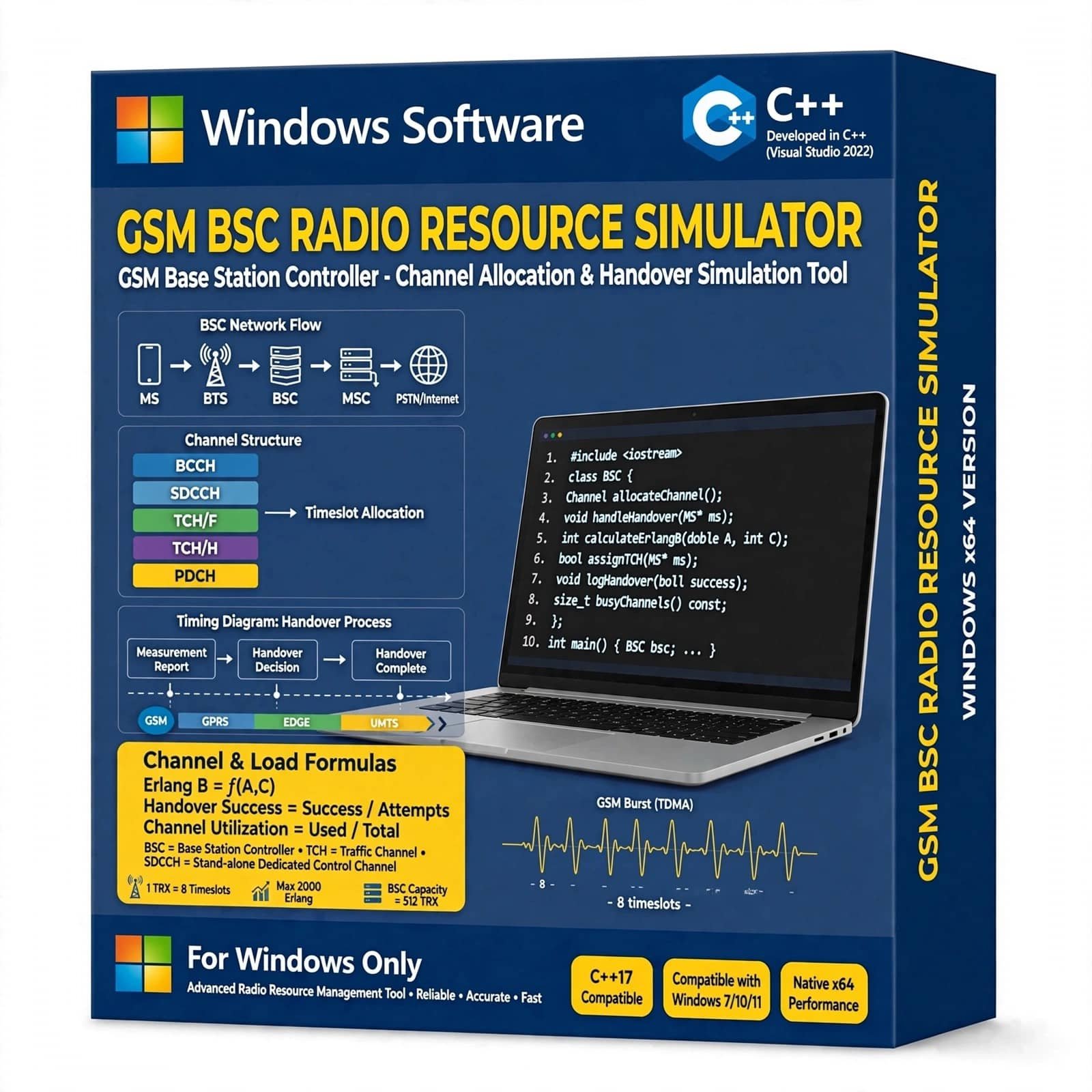
GSM BSC Radio Resource Simulator is a professional telecom training and development solution designed to simulate GSM Base Station Controller (BSC) radio resource management functions. It helps students, telecom engineers, researchers, and network professionals understand GSM radio resource allocation, channel management, call handling, handover concepts, and BSC-related network procedures in a controlled simulation environment.
Original price was: ₹750.00.₹100.00Current price is: ₹100.00. -
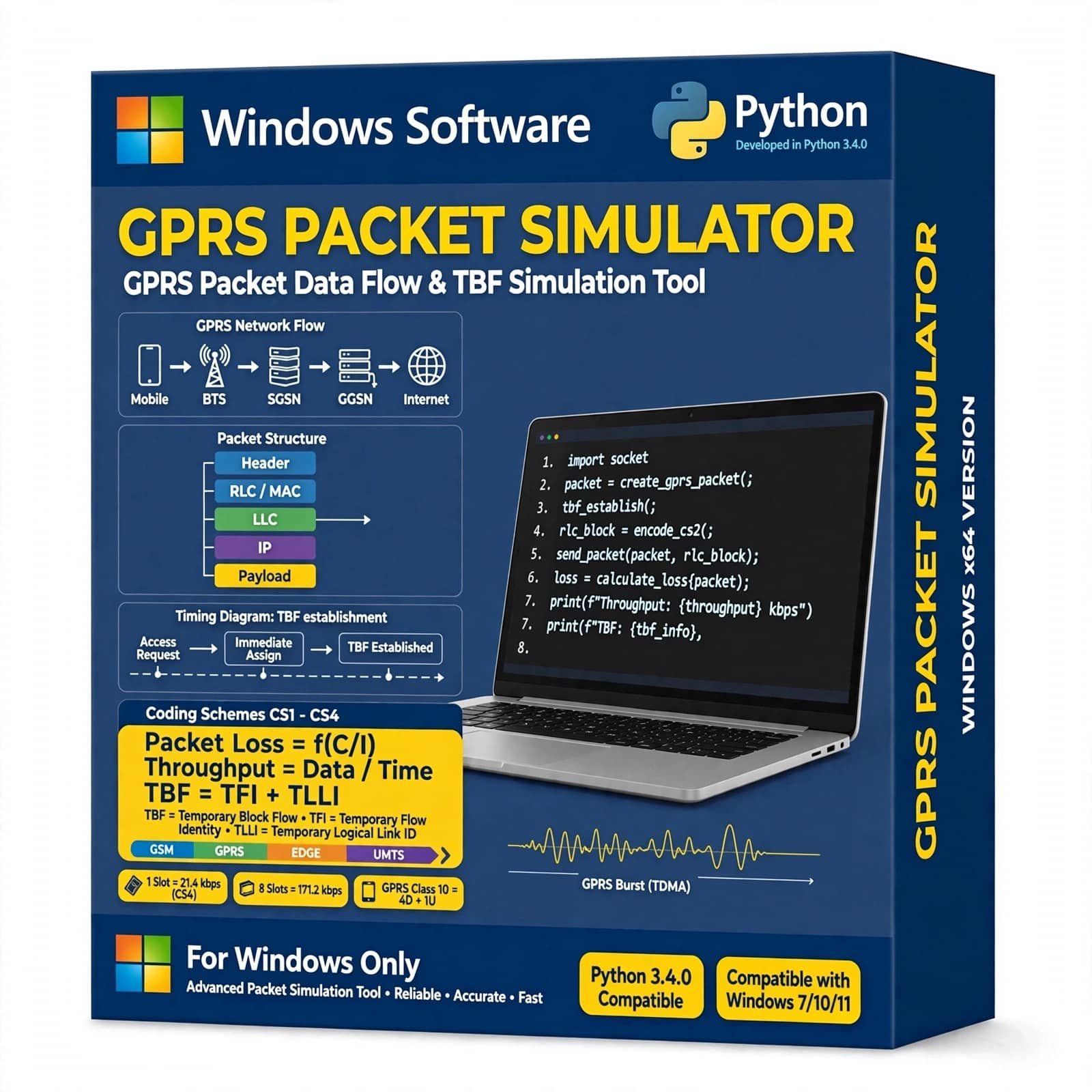
GPRS Packet Simulator is a powerful software solution for simulating GPRS data packets and testing GSM/GPRS communication systems. It helps developers, engineers, and testing teams generate, analyze, and validate packet-based communication in a controlled environment without requiring extensive physical network infrastructure. Ideal for GPRS testing, protocol development, IoT applications, and telecom system validation.
₹3,999.00 -
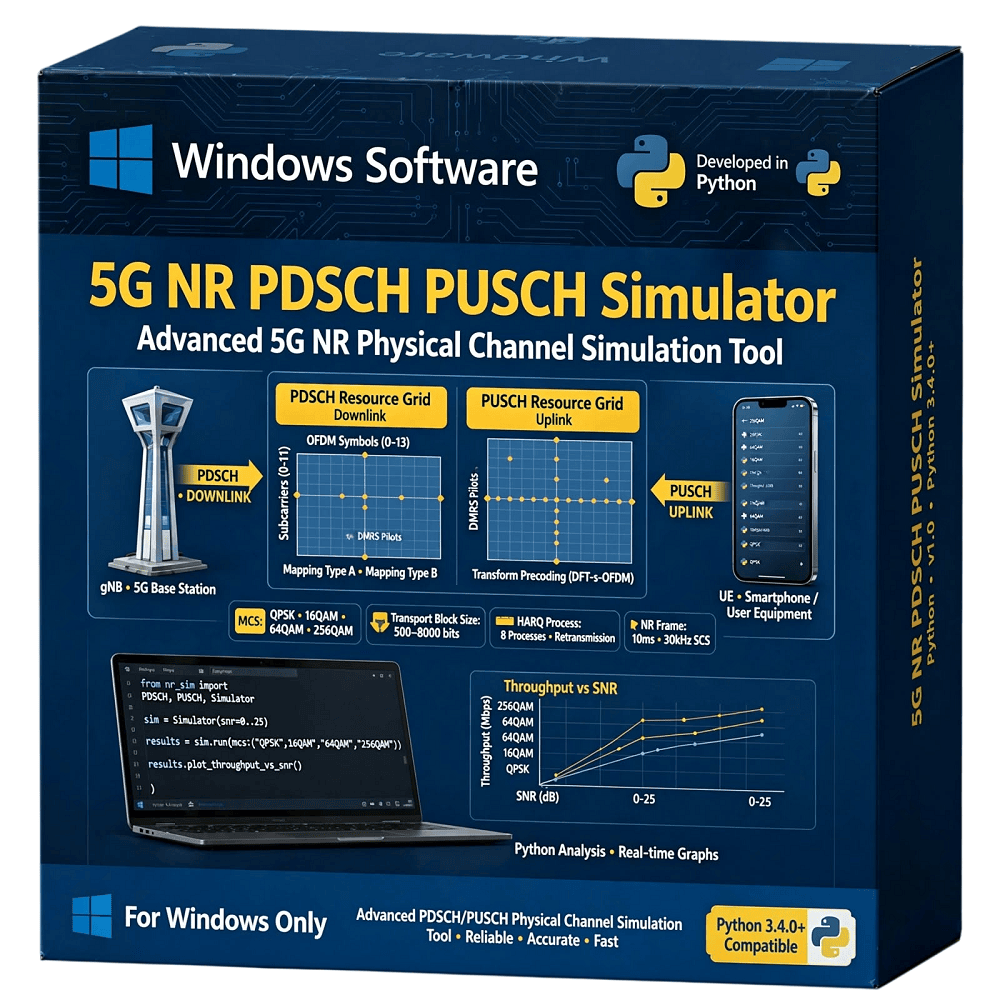
The 5G NR PDSCH PUSCH Simulator is a Python-based simulation software solution designed for researchers, engineers, students, and telecommunications professionals working with 5G New Radio (NR) physical-layer technologies. The simulator provides a practical environment for studying and experimenting with PDSCH (Physical Downlink Shared Channel) and PUSCH (Physical Uplink Shared Channel) transmission concepts.
Developed using Python, the simulator is suitable for academic research, algorithm development, demonstrations, testing, and educational applications related to 5G NR communication systems.
Available for sale as a software product. Contact us for product details, licensing, and purchase information.
Original price was: ₹129,999.00.₹12,999.00Current price is: ₹12,999.00. -
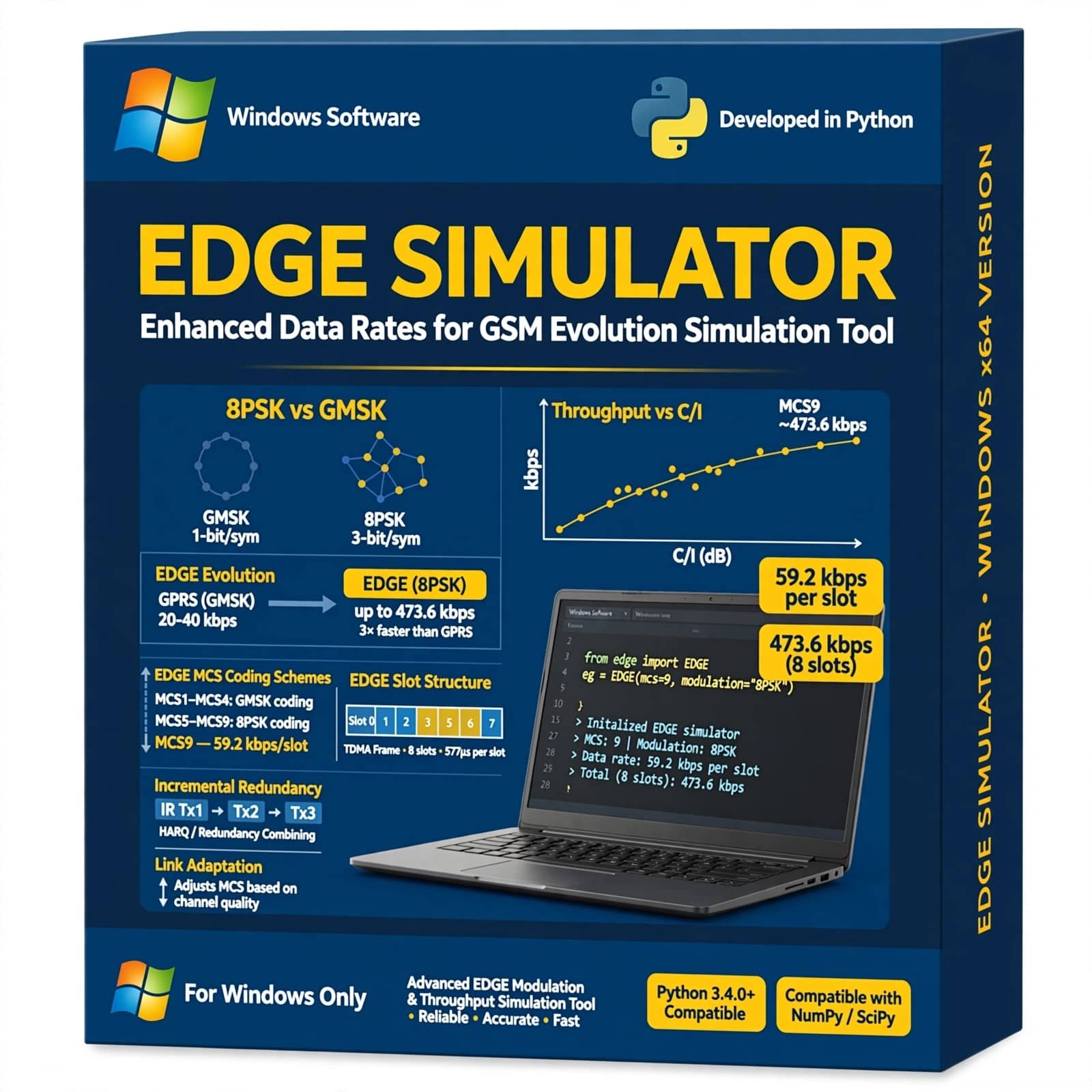
EDGE Simulator Using Python is a practical mobile communication simulation tool designed to demonstrate and analyze Enhanced Data rates for GSM Evolution (EDGE) technology. It helps students, researchers, and communication engineers study GSM/EDGE data transmission, modulation, channel conditions, bit error rate, data rates, and wireless communication performance using Python-based simulation.
₹3,499.00 -
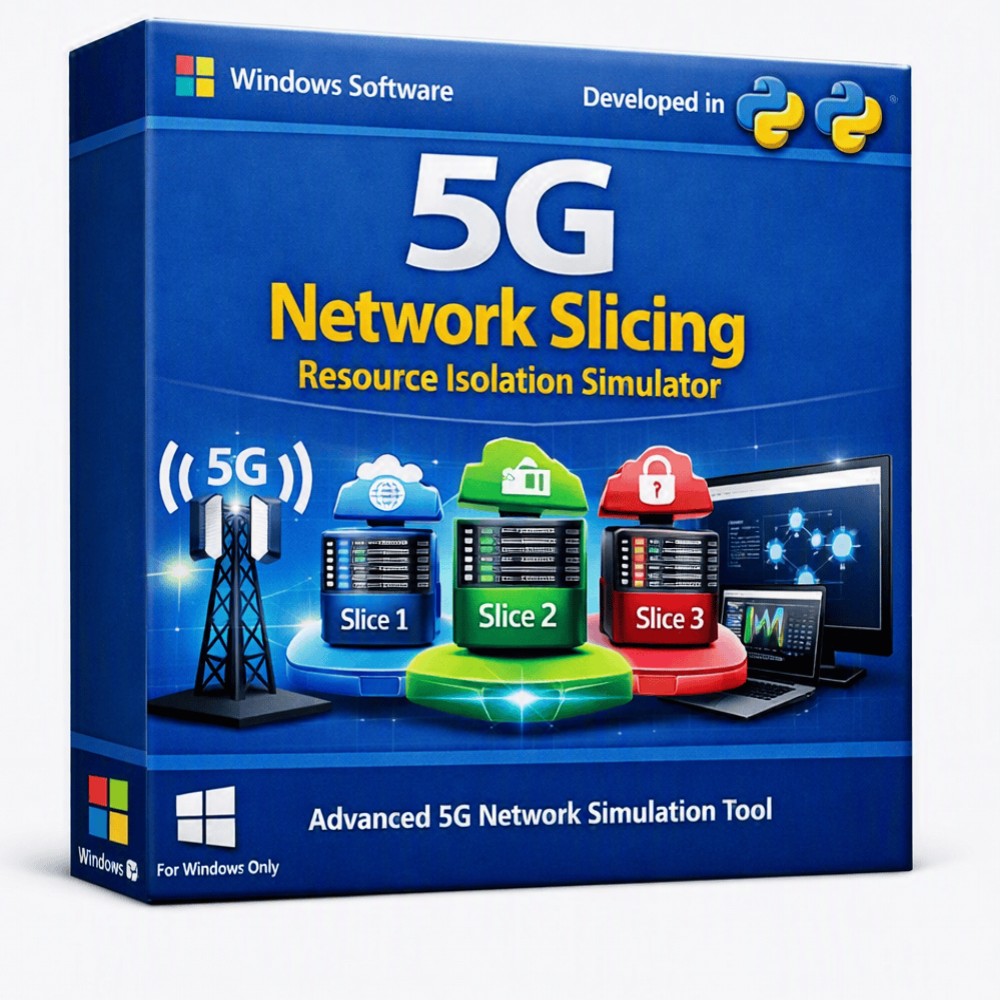
A Python-based 5G Network Slicing and Resource Isolation Simulator designed to model and analyze how multiple logical network slices can share physical 5G infrastructure while maintaining resource isolation. The simulator enables users to study CPU, memory, bandwidth, network capacity, traffic allocation, and resource management across different 5G network slices.
Ideal for 5G research, telecom engineering, academic projects, network optimization, resource allocation studies, and university laboratories.
Original price was: ₹199,999.00.₹19,999.00Current price is: ₹19,999.00. -
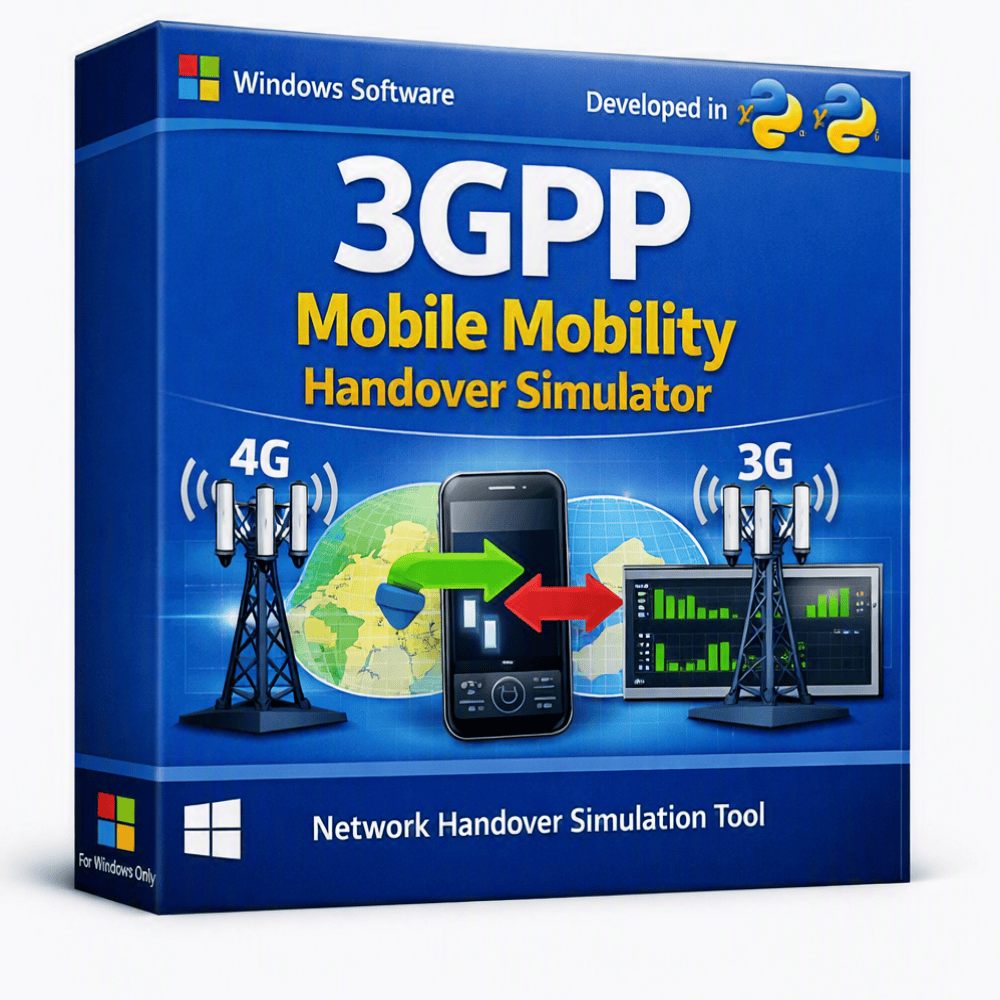
A powerful simulation tool for analyzing and validating 3GPP mobile mobility and handover procedures. The simulator enables users to model mobile network scenarios, study handover behavior, and evaluate mobility performance under different network conditions.
Key Features:
- 3GPP-compliant mobility and handover simulation
- Configurable network and mobility scenarios
- Analysis of handover performance and behavior
- Supports research, testing, and network optimization
- Useful for telecom engineers, researchers, and academic projects
Ideal for 5G/4G/3G mobility research, protocol testing, network planning, and academic simulation studies.
₹3,999.00


Reviews
There are no reviews yet.