
New
67% Off

Rayleigh Fading Simulator

Original price was: ₹750.00.₹250.00Current price is: ₹250.00.
In StockRayleigh Fading Simulator – Study and simulate the effects of Rayleigh fading in wireless communication systems using this Python-based Rayleigh Fading Simulator. Designed for students, researchers, and communication engineering professionals, the project provides a practical environment for generating Rayleigh fading channels, analyzing signal variations, visualizing fading characteristics, and understanding the impact of multipath propagation on wireless signals.
Description
Rayleigh Fading Simulator
The Rayleigh Fading Simulator is a Python-based simulation project designed to help users understand, generate, visualize, and analyze Rayleigh fading channels used in wireless communication systems.
Wireless signals rarely travel through a single, unobstructed path between a transmitter and receiver. Instead, signals can reflect, diffract, and scatter from buildings, vehicles, terrain, and other objects before reaching the receiving antenna. These multiple propagation paths can cause variations in the received signal amplitude and phase, a phenomenon commonly referred to as multipath fading.
Rayleigh fading is an important statistical model used to represent wireless channels where there is no dominant direct line-of-sight component between the transmitter and receiver. Understanding this channel model is essential for students and researchers working in wireless communication, digital communication, mobile communication, RF engineering, telecommunications, and signal processing.
This Rayleigh Fading Simulator in Python provides a practical way to explore these concepts through software-based simulation and visualization.
Simulate Rayleigh Fading Channels with Python
The simulator uses Python to model the behavior of a wireless communication channel affected by Rayleigh fading. Users can generate fading samples and observe how the channel can cause rapid variations in the received signal.
Python is particularly suitable for communication-system simulation because of its mathematical, numerical computing, and visualization capabilities. A Python implementation allows learners to connect theoretical probability and communication concepts with practical signal-processing experiments.
The project can be used to study the statistical behavior of a Rayleigh fading channel and examine how wireless signals change as they pass through a multipath environment.
Understand Multipath Propagation
Multipath propagation is one of the fundamental challenges in wireless communication.
When a transmitted signal encounters physical objects, portions of the signal can travel along different paths. These copies can arrive at the receiver at different times, amplitudes, and phases. Depending on their relationship, the signals can reinforce or cancel one another.
This can result in significant fluctuations in the received signal level.
The Rayleigh Fading Simulator provides an educational environment for observing these variations and understanding why wireless communication systems require techniques capable of dealing with fading channels.

Rayleigh Distribution and Channel Modeling
A key concept behind Rayleigh fading is the Rayleigh probability distribution, which is commonly used to model the amplitude of a complex wireless channel when the received signal consists of multiple scattered components without a dominant line-of-sight path.
Using the simulator, users can generate Rayleigh-distributed channel samples and visualize their characteristics.
This makes the project useful for studying:
- Rayleigh random variables
- Probability distributions
- Channel amplitude variations
- Multipath propagation
- Random fading processes
- Wireless channel modeling
- Signal attenuation
- Statistical channel analysis
Visualize Wireless Channel Behavior
Visualization is an important part of understanding fading channels.
The Python-based simulator can be used to display and analyze generated channel data through graphs and plots. Visual representations can make it easier to understand how fading affects signal amplitude and how rapidly the channel characteristics can change.
Depending on the implementation, users can visualize channel coefficients, fading envelopes, probability distributions, signal variations, and other simulation results.
These graphical outputs are especially useful for engineering laboratory demonstrations, academic presentations, project reports, and research experiments.

Useful for Digital and Wireless Communication Studies
Rayleigh fading is an important topic in digital communication because channel variations can affect the reliability of transmitted information.
A Rayleigh fading channel can be incorporated into communication-system simulations to study how modulation schemes behave when signals experience multipath fading. This makes the simulator a useful foundation for experiments involving digital modulation, wireless links, receiver performance, and communication-channel analysis.
Students can use the simulator to build a better understanding of the relationship between a transmitted signal, wireless channel, and received signal.
Python-Based Communication Channel Simulator
The project is developed using Python, making it suitable for students and developers who want to learn wireless channel modeling through programming.
Python source code can provide insight into how mathematical channel models are implemented computationally. Users with Python knowledge can study the algorithms, modify simulation parameters, generate additional plots, or integrate the fading model into larger communication-system simulations.
The project can also serve as a foundation for implementing more advanced wireless channel models and performance analysis.
Suitable for Academic and Engineering Projects
The Rayleigh Fading Simulator can be used for a wide range of educational and engineering applications, including:
- Wireless Communication Projects
- Digital Communication Projects
- Python Projects
- Telecommunication Projects
- Mobile Communication Projects
- RF Engineering Projects
- Signal Processing Projects
- Communication Channel Modeling
- Final-Year Engineering Projects
- Electronics and Telecommunication Projects
- Communication Laboratory Experiments
- Academic Research
- Wireless Channel Analysis
- Python Simulation Projects
It is especially useful for students who need a practical implementation of a wireless channel model for an academic project or demonstration.

Explore Wireless Signal Fading
One of the primary benefits of the simulator is that it allows users to move beyond theoretical descriptions of fading and actually observe simulated channel behavior.
By generating fading samples and analyzing their statistical properties, users can explore how wireless channels differ from ideal communication channels.
The simulator can also provide a starting point for studying more advanced concepts such as signal-to-noise ratio (SNR), bit error rate (BER), outage probability, diversity techniques, channel estimation, and fading mitigation, depending on how the project is extended.
Key Features
- Python-based Rayleigh Fading Simulator
- Rayleigh fading channel generation
- Wireless multipath channel modeling
- Rayleigh-distributed channel samples
- Channel amplitude simulation
- Statistical analysis of fading
- Wireless signal variation visualization
- Graphical representation of simulation results
- Suitable for digital communication experiments
- Useful for wireless communication studies
- Python source code for learning and customization
- Expandable for advanced communication-system simulations
Ideal for Students, Researchers, and Engineers
The simulator is suitable for anyone interested in wireless communication channel simulation and Python-based signal processing.
Students can use it to understand the practical behavior of Rayleigh fading, while researchers and developers can use the source code as a foundation for additional experiments.
It can also be used by instructors to demonstrate the statistical nature of wireless channels and the challenges introduced by multipath propagation.
Expandable Python Wireless Communication Project
Because the project is implemented in Python, it can be extended with additional communication-system functionality. Advanced users may integrate the Rayleigh fading model with different modulation schemes and compare system performance under ideal and fading-channel conditions.
Possible extensions can include BER versus SNR analysis, QPSK or QAM transmission through a Rayleigh channel, AWGN integration, diversity simulation, channel estimation, outage analysis, and comparison with other fading models such as Rician fading.
This makes the Rayleigh Fading Simulator a useful foundation for developing more comprehensive wireless communication simulation systems.
Why Choose the Rayleigh Fading Simulator?
If you are looking for a Rayleigh Fading Simulator in Python, wireless channel simulation project, or practical communication engineering project, this software provides an effective way to explore the effects of multipath fading through simulation and visualization.
Rather than studying Rayleigh fading only through probability equations, users can generate channel data, visualize fading behavior, and experiment with wireless communication concepts using Python.
The Rayleigh Fading Simulator is therefore an excellent educational and development project for exploring wireless channel modeling, multipath propagation, statistical fading behavior, and Python-based communication-system simulation.
Product Highlights
- Python Rayleigh Fading Simulator
- Wireless channel modeling
- Multipath fading simulation
- Rayleigh distribution analysis
- Channel amplitude and fading visualization
- Statistical wireless channel simulation
- Useful for communication engineering projects
- Suitable for Python academic projects
- Ideal for wireless and mobile communication studies
- Expandable Python source code
- Suitable for students, researchers, and engineers
Get the Rayleigh Fading Simulator in Python and explore the behavior of wireless communication channels affected by multipath propagation and Rayleigh fading through practical simulation.
Related products
-
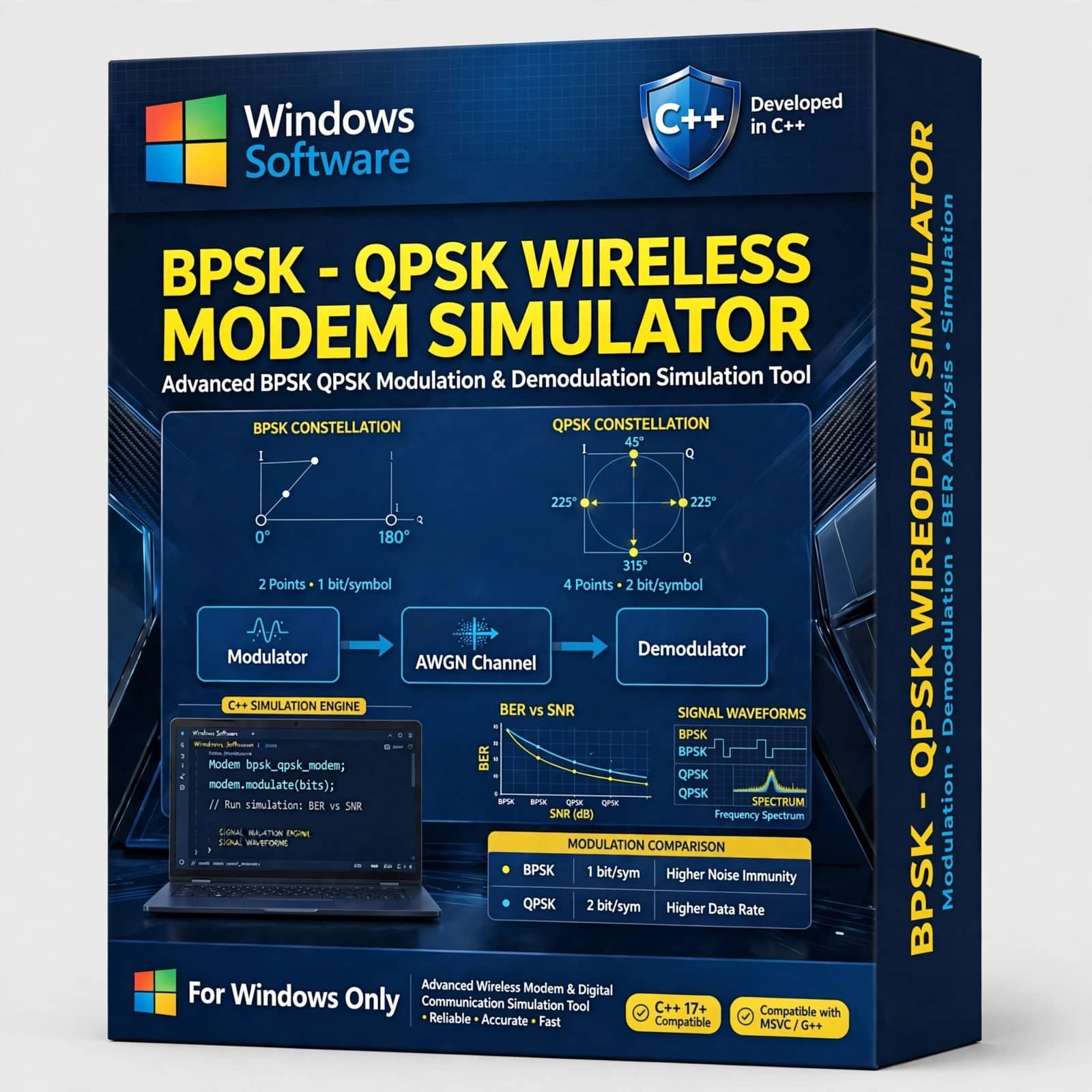
The BPSK – QPSK WIRELESS MODEM SIMULATOR with C++ is a software-based digital communication simulation tool designed for studying, demonstrating, and analyzing BPSK and QPSK modulation and demodulation techniques. Developed using C++, this wireless modem simulator provides a practical environment for understanding how digital information is converted into modulated signals, transmitted through a communication channel, received, and recovered at the receiver.
Designed for electronics and communication engineering laboratories, universities, colleges, research institutions, and technical training environments, the BPSK–QPSK simulator helps students and professionals connect digital communication theory with practical software implementation. It is suitable for learning fundamental concepts related to digital modulation, wireless communication, signal processing, modem technology, and communication system design.
Original price was: ₹750.00.₹250.00Current price is: ₹250.00. -
5G NR Beam Management Simulator is an advanced simulation solution designed to model, analyze, and optimize beam management procedures in 5G New Radio (NR) networks. It enables engineers and researchers to evaluate beam sweeping, beam measurement, beam selection, beam reporting, and beam recovery under diverse network and channel conditions. The simulator supports performance analysis of directional communication, helping users assess beamforming strategies, mobility scenarios, link reliability, and system-level performance before real-world deployment.
Original price was: ₹750.00.₹250.00Current price is: ₹250.00. -
5G NR Massive MIMO Simulator is an advanced simulation solution for modeling and analyzing Massive Multiple-Input Multiple-Output (MIMO) technologies in 5G New Radio networks. It enables users to study large-scale antenna arrays, beamforming, precoding, spatial multiplexing, multi-user MIMO, channel estimation, and interference under configurable channel conditions. The simulator supports analysis of throughput, spectral efficiency, SINR, BER, BLER, MIMO capacity, beamforming gain, and multi-user performance, making it ideal for 5G NR research, algorithm development, academic projects, and 5G/6G wireless system optimization.
Original price was: ₹750.00.₹250.00Current price is: ₹250.00. -
The 5G Digital Twin is a Python-based software solution designed for researchers, engineers, developers, students, and telecommunications professionals interested in modeling, simulating, and analyzing 5G communication networks and their real-world behavior in a virtual environment.
A digital twin provides a virtual representation of a physical or network system, enabling users to study system behavior, evaluate scenarios, analyze performance, and experiment with different configurations. Developed using Python, this 5G Digital Twin can support research, education, network analysis, experimentation, and proof-of-concept development.
Available for sale as a software product. Contact us for pricing, licensing, technical specifications, customization, and purchase information.
Original price was: ₹750.00.₹250.00Current price is: ₹250.00. -
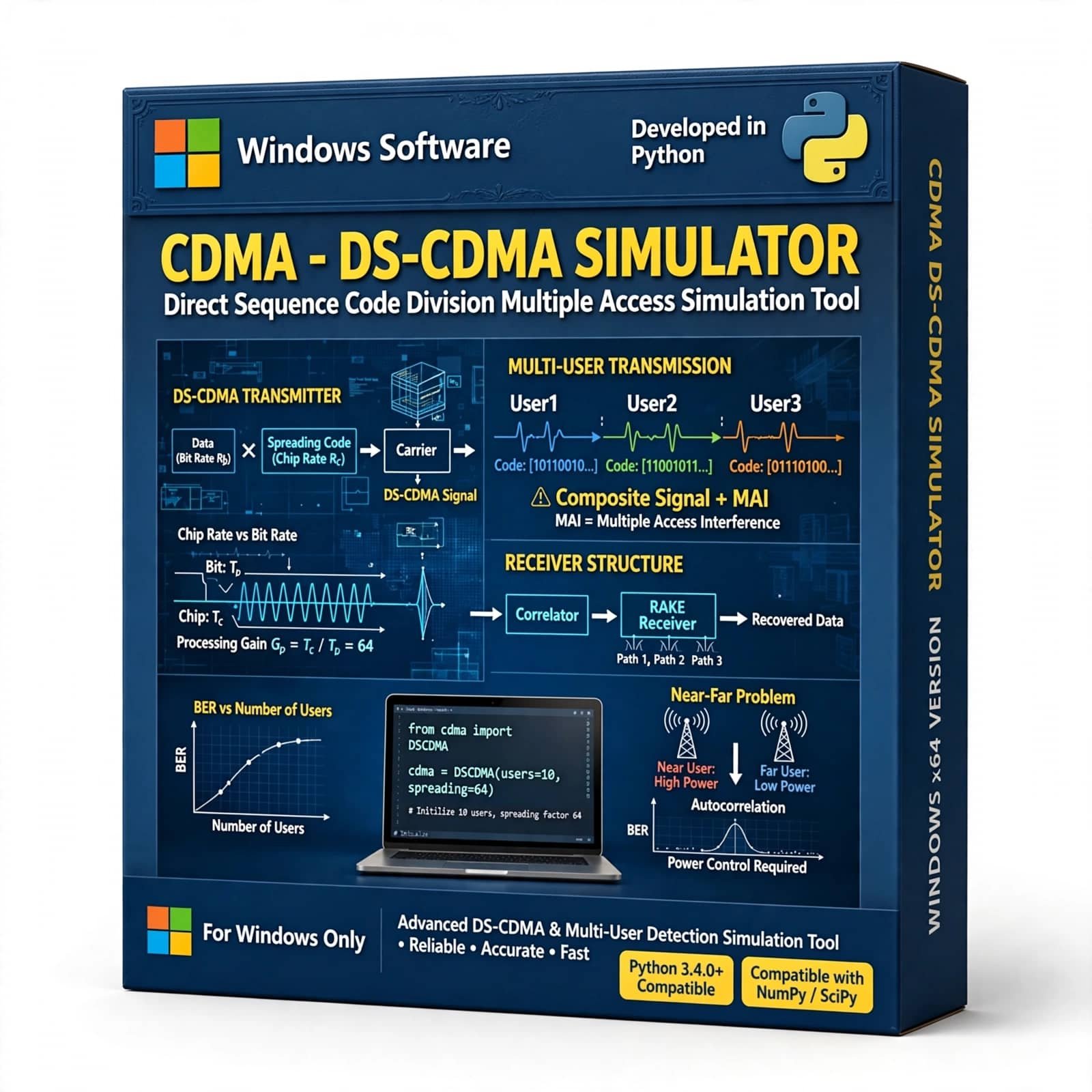
The CDMA DS-CDMA Simulator with Python is a software-based communication simulation tool designed to demonstrate and analyze Direct Sequence Code Division Multiple Access (DS-CDMA) technology. Developed using Python, the simulator provides a practical environment for studying spreading codes, chip sequences, multiple-user communication, signal spreading and despreading, interference, correlation, and transmitted-data recovery. It is suitable for digital communication laboratories, wireless communication education, telecommunications training, student projects, and communication-system research.
Original price was: ₹750.00.₹250.00Current price is: ₹250.00. -
The 16QAM Modem Simulator is a C++-based software application designed to simulate and analyze a 16-QAM digital communication system. It demonstrates the complete modulation and demodulation process, including symbol mapping, signal generation, transmission, and data recovery. The simulator helps users understand key concepts of digital communication and evaluate system performance under different channel conditions.
Original price was: ₹750.00.₹250.00Current price is: ₹250.00.





Reviews
There are no reviews yet.