
New
67% Off

HLR Simulator


Original price was: ₹750.00.₹250.00Current price is: ₹250.00.
In StockHLR Simulator using Python is a GSM Home Location Register database simulation tool designed to demonstrate subscriber information management using CRUD operations. Built with Python, it provides a practical environment for creating, viewing, updating, and deleting simulated subscriber records while learning HLR concepts, GSM subscriber databases, and telecom database management.
Description
HLR Simulator
The HLR Simulator using Python is a practical telecom database simulation tool designed to demonstrate the functionality and concepts of a Home Location Register (HLR) in a GSM network. Unlike a traditional network simulator focused primarily on signaling or radio communication, this simulator focuses on the database-oriented role of the HLR and provides a practical environment for managing simulated GSM subscriber information using CRUD operations.
HLR is an important component of the GSM core network. It maintains subscriber-related information required by the network to identify and manage mobile subscribers. Understanding how subscriber information is stored, accessed, modified, and removed provides valuable insight into both GSM architecture and telecom database systems.
The HLR Simulator using Python allows students, researchers, developers, and telecom professionals to explore these concepts through a simple and controlled database simulation environment.
What is an HLR?
The Home Location Register (HLR) is a central subscriber database associated with a GSM network. It stores important information related to mobile subscribers and supports network operations that require access to subscriber records.
From an educational perspective, the HLR provides an excellent example of how a telecommunications system can use a structured database to maintain subscriber information.
The HLR Simulator demonstrates this database-oriented functionality by allowing users to work with simulated subscriber records. Instead of connecting to a real mobile network or production HLR, users can create and manage sample records within the simulation environment.
HLR Database Simulator with CRUD Operations
A key feature of this product is its focus on CRUD operations:
- Create – Add a new simulated subscriber record to the HLR database.
- Read – View or retrieve stored subscriber information.
- Update – Modify existing subscriber details.
- Delete – Remove a subscriber record from the simulated database.
These four operations represent the fundamental functions of database management and make the HLR Simulator particularly useful for students learning both telecommunications and database programming.
By implementing CRUD functionality around an HLR-style subscriber database, users can understand how subscriber information can be managed programmatically.
Python-Based HLR Simulator
The HLR Simulator is developed using Python, making it suitable for students and developers who want to combine programming skills with GSM and database concepts.
Python provides a straightforward environment for implementing data structures, database operations, business logic, and user interaction. Students can examine how subscriber records can be represented and manipulated using Python code.
The simulator can therefore be used for projects involving:
- Python programming
- Database management
- CRUD applications
- GSM architecture
- HLR concepts
- Telecom software development
- Subscriber database simulation
- Network database modeling
The combination of Python, CRUD operations, and GSM HLR concepts makes this product especially useful for academic and training environments.

Simulate GSM Subscriber Database Management
The HLR Simulator provides a controlled environment for managing simulated subscriber information. Users can create sample subscriber records and perform database operations to understand how subscriber information could be maintained within a GSM network environment.
Depending on the implementation, subscriber records may contain fields representing different types of subscriber-related information. The simulator can be adapted or configured according to the database structure and fields supported by the specific implementation.
This makes the product useful for demonstrating how telecom applications can interact with subscriber databases.
Practical Learning of CRUD Operations
CRUD operations are fundamental to almost every database-driven application. By implementing CRUD functionality within a GSM HLR context, students can learn database concepts through a real-world telecommunications use case.
For example, an academic exercise could involve creating a simulated subscriber, retrieving the subscriber’s information, updating selected details, and finally deleting the record.
This provides an easy-to-understand workflow for demonstrating:
Create: Insert new subscriber information.
Read: Search for and display existing subscriber information.
Update: Change information associated with an existing subscriber.
Delete: Remove a subscriber from the simulated HLR database.
The approach can help bridge the gap between theoretical database concepts and practical telecom applications.
HLR Simulator for Academic Projects
The HLR Simulator using Python is well suited for engineering colleges, universities, computer science laboratories, telecom laboratories, and technical training institutes.
It can support practical learning in subjects such as:
- GSM and Mobile Communication
- Telecommunication Systems
- Database Management Systems
- Python Programming
- Object-Oriented Programming
- Computer Networks
- Wireless Communication
- Network Architecture
- Software Development
- Database Applications
Students can use the simulator for laboratory exercises, demonstrations, assignments, mini-projects, and final-year engineering projects.
Telecom Database Simulation
The HLR is an excellent example of a database-driven component in a telecommunications system. A simulated HLR allows students to understand this relationship without requiring access to an actual operator-grade HLR system.
The simulator can demonstrate how an application can store subscriber information and perform database operations on that information.
This makes it useful not only for telecom students but also for computer science and software engineering students interested in understanding how database concepts are applied in communication systems.
Python HLR Simulator for Research and Development
Researchers and developers can use the HLR Simulator as a foundation for selected projects involving telecom databases, subscriber management, GSM architecture, Python applications, and database-driven network systems.
A simulated database environment allows developers to test data management logic without interacting with a live telecom infrastructure.
It can also be useful for experimenting with database schemas, subscriber data models, CRUD workflows, and application-level logic associated with a simulated HLR.
The exact database technology, fields, interfaces, and supported functionality depend on the implementation of the simulator.
Key Benefits
HLR database simulation: Learn the database-oriented role of the GSM Home Location Register.
CRUD functionality: Practice Create, Read, Update, and Delete operations using simulated subscriber records.
Python based: Combine Python programming with GSM and database concepts.
Subscriber management: Create and manage simulated GSM subscriber information.
Practical learning: Apply database concepts to a real-world telecommunications use case.
Academic project support: Suitable for laboratory exercises, demonstrations, assignments, and final-year projects.
Controlled environment: Study HLR database concepts without requiring access to a live GSM network.
Telecom and database integration: Provides an effective way to connect GSM architecture with database programming.
Applications
The HLR Simulator using Python can be used for:
- GSM HLR simulation
- Home Location Register simulation
- GSM subscriber database simulation
- Subscriber information management
- CRUD database demonstrations
- Python database projects
- GSM academic projects
- Telecom database training
- Database management laboratory exercises
- GSM architecture demonstrations
- Python programming projects
- Telecom software development
- Database-driven telecom applications
- Mobile communication education
It can also be used to demonstrate how a subscriber-oriented database can be integrated into a larger simulated GSM network environment.
Who Can Use the HLR Simulator?
The product is suitable for:
- Telecom engineering students
- Electronics and communication engineering students
- Computer science students
- Software engineering students
- Python programming students
- Database management students
- GSM researchers
- Telecom researchers
- Engineering colleges and universities
- Telecom training institutes
- Academic laboratories
- Final-year project teams
It is particularly useful for learners who want to combine Python programming, database CRUD operations, and GSM telecommunications concepts.
Why Choose an HLR Simulator with CRUD?
Learning database operations in isolation can sometimes make it difficult for students to understand their practical applications. The HLR Simulator using Python provides a telecommunications context for CRUD operations, making database concepts more meaningful and application-oriented.
Students can learn how subscriber information can be created, retrieved, modified, and deleted while simultaneously understanding the role of the HLR within GSM architecture.
For telecom students, the product provides practical exposure to subscriber database concepts. For computer science students, it offers a real-world use case for Python and CRUD programming. For researchers, it provides a controlled environment for experimenting with simulated subscriber data management.
Conclusion
The HLR Simulator using Python is a practical database-oriented GSM simulation tool designed to demonstrate Home Location Register concepts, subscriber information management, and CRUD operations.
By combining Python programming with a simulated GSM subscriber database, the product provides an accessible environment for learning how telecom databases can store and manage subscriber information.
Whether you are working on a GSM HLR project, Python CRUD project, telecom database project, GSM simulation project, database management laboratory, or mobile communication research project, this simulator can provide a useful platform for practical learning and experimentation.
For users searching for an HLR Simulator, HLR database simulator, GSM HLR simulator with Python, GSM subscriber database simulator, HLR CRUD simulator, Python CRUD telecom project, Home Location Register simulation, or GSM database simulation software, this product provides a practical combination of telecommunications and database programming concepts.
V4 with C++ image

Related products
-
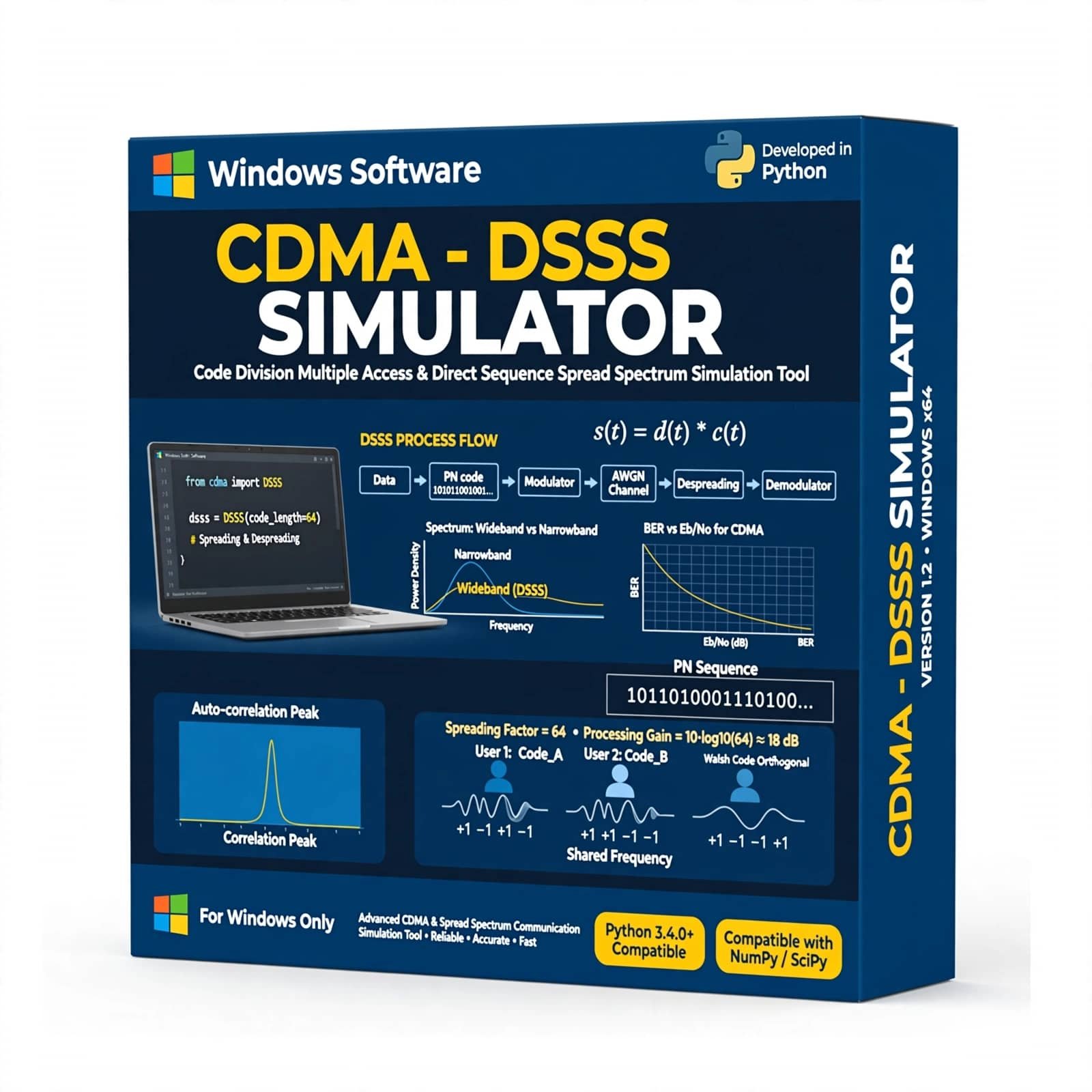
The CDMA – DSSS Simulator with Python is a software-based communication simulation tool designed to demonstrate and analyze Code Division Multiple Access (CDMA) and Direct Sequence Spread Spectrum (DSSS) techniques. Developed using Python, the simulator provides a practical environment for studying spreading codes, signal spreading and despreading, data transmission, multiple-access communication, interference, and signal recovery. It is ideal for digital communication and wireless communication laboratories, engineering education, student projects, technical training, and communication-system research.
Original price was: ₹750.00.₹250.00Current price is: ₹250.00. -
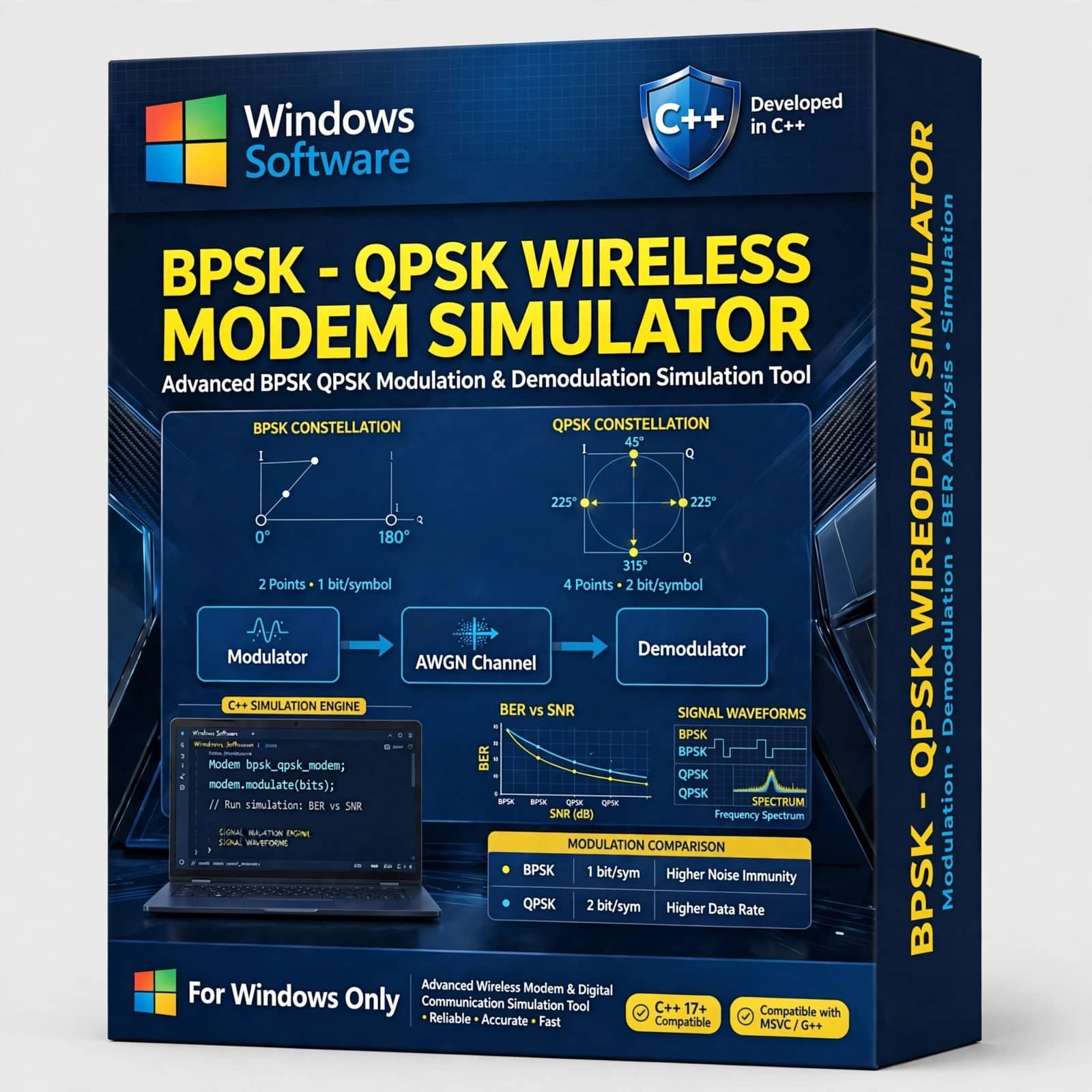
The BPSK – QPSK WIRELESS MODEM SIMULATOR with C++ is a software-based digital communication simulation tool designed for studying, demonstrating, and analyzing BPSK and QPSK modulation and demodulation techniques. Developed using C++, this wireless modem simulator provides a practical environment for understanding how digital information is converted into modulated signals, transmitted through a communication channel, received, and recovered at the receiver.
Designed for electronics and communication engineering laboratories, universities, colleges, research institutions, and technical training environments, the BPSK–QPSK simulator helps students and professionals connect digital communication theory with practical software implementation. It is suitable for learning fundamental concepts related to digital modulation, wireless communication, signal processing, modem technology, and communication system design.
Original price was: ₹750.00.₹250.00Current price is: ₹250.00. -
A Python-based 5G Digital Twin solution for creating a virtual representation of 5G network environments, components, and operational behavior. Designed for 5G research, network analysis, simulation, optimization, and academic projects, it enables users to model network scenarios, monitor virtualized network behavior, and experiment with different configurations in a controlled software environment.
Ideal for telecom engineers, researchers, developers, students, and academic institutions working on 5G network planning, performance analysis, intelligent network management, and digital twin research.
Original price was: ₹750.00.₹250.00Current price is: ₹250.00. -
The 3G UMTS – WCDMA Simulator is a software-based simulation project designed to demonstrate the fundamental concepts of 3G Universal Mobile Telecommunications System (UMTS) and Wideband Code Division Multiple Access (WCDMA) technology. It provides a practical environment for studying cellular communication, spreading codes, signal transmission, mobile users, network connectivity, and WCDMA-based communication principles. The simulator is suitable for students, researchers, and developers working on telecommunications and wireless communication projects. It can be used for academic demonstrations, engineering projects, research, experimentation, and learning about 3G mobile communication and WCDMA network technologies.
Original price was: ₹750.00.₹250.00Current price is: ₹250.00. -
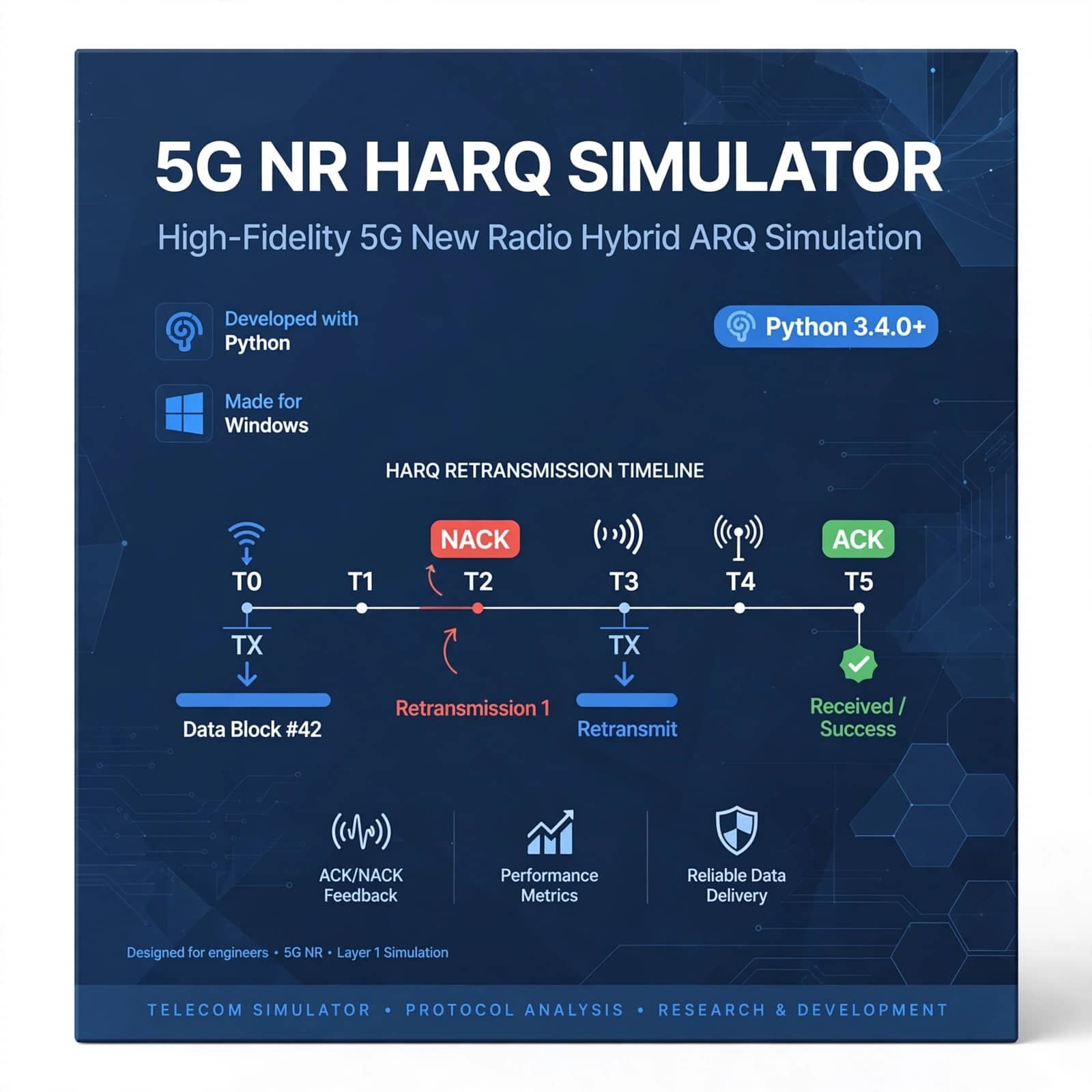
5G NR HARQ Simulator is an advanced simulation solution for modeling and analyzing Hybrid Automatic Repeat Request (HARQ) mechanisms in 5G New Radio networks. It enables users to study HARQ processes, ACK/NACK feedback, retransmissions, link adaptation, channel errors, and communication reliability under configurable network conditions. The simulator supports analysis of throughput, BLER, latency, retransmission rate, packet errors, spectral efficiency, and other key performance metrics, making it suitable for 5G NR research, algorithm development, academic projects, and wireless communication system optimization.
Original price was: ₹750.00.₹250.00Current price is: ₹250.00. -
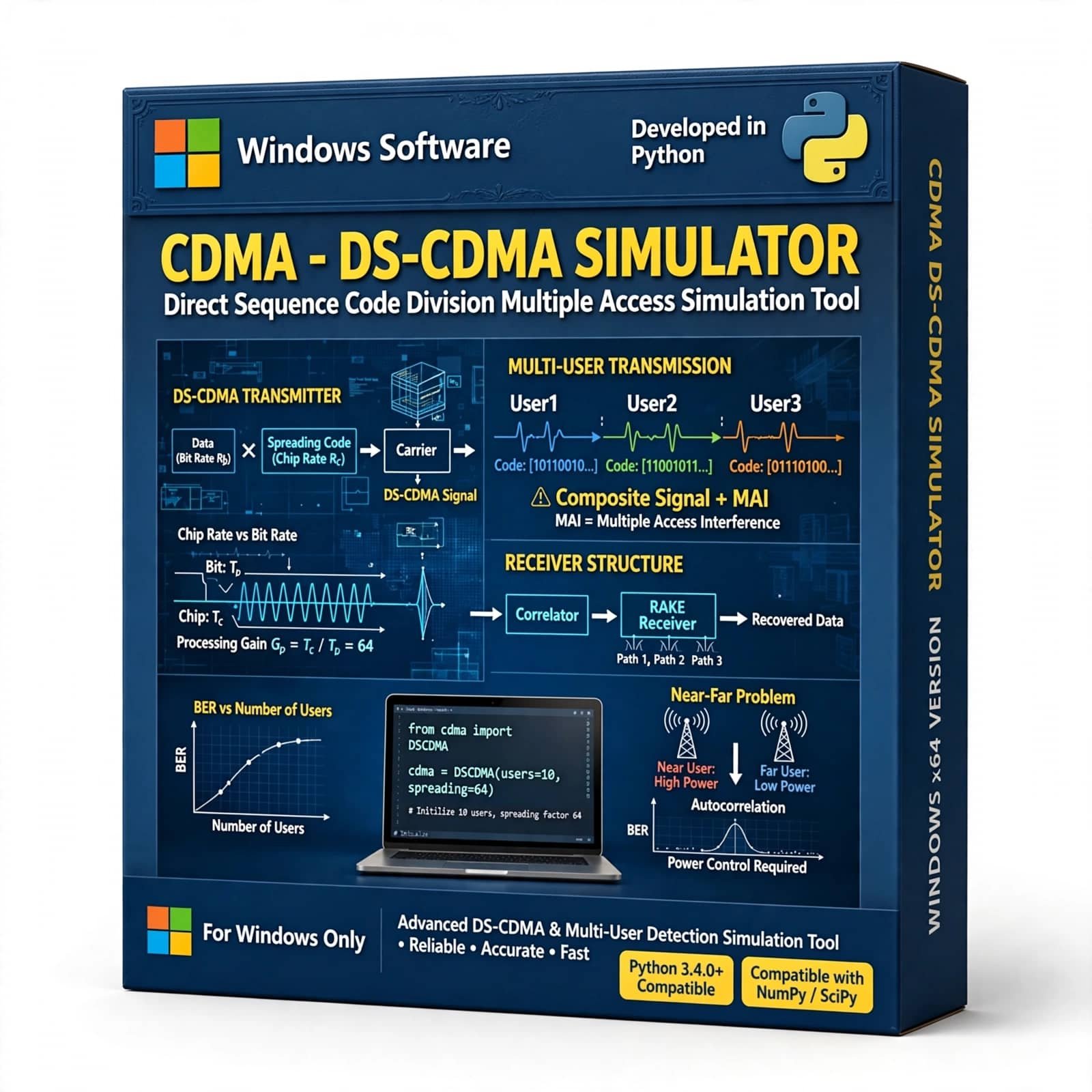
The CDMA DS-CDMA Simulator with Python is a software-based communication simulation tool designed to demonstrate and analyze Direct Sequence Code Division Multiple Access (DS-CDMA) technology. Developed using Python, the simulator provides a practical environment for studying spreading codes, chip sequences, multiple-user communication, signal spreading and despreading, interference, correlation, and transmitted-data recovery. It is suitable for digital communication laboratories, wireless communication education, telecommunications training, student projects, and communication-system research.
Original price was: ₹750.00.₹250.00Current price is: ₹250.00.


Reviews
There are no reviews yet.