
67% Off

Channel Estimation Simulator
Original price was: ₹750.00.₹250.00Current price is: ₹250.00.
In StockChannel Estimation Simulator is a wireless communication simulation tool designed to demonstrate and analyze channel estimation techniques in digital communication systems. It helps students, researchers, and communication engineers study channel effects, pilot-based estimation, signal distortion, and estimation performance through practical simulation.
Description
Channel Estimation Simulator
The Channel Estimation Simulator is a practical simulation tool designed to help students, researchers, educators, and communication engineers understand the fundamentals of channel estimation in wireless communication systems. It provides a simulation-based environment for studying how wireless channels affect transmitted signals and how channel estimation techniques can be used to determine and compensate for these effects.
In modern digital and wireless communication systems, signals travel through channels that can introduce attenuation, noise, fading, delay, and other forms of distortion. At the receiver, accurate knowledge of the communication channel is essential for recovering the transmitted information reliably. Channel estimation plays a critical role in many wireless technologies by allowing the receiver to estimate the characteristics of the channel and use this information for improved signal detection and decoding.
The Channel Estimation Simulator provides an effective way to study these concepts through practical experimentation and simulation.
Understand Wireless Channel Estimation
A wireless communication channel is constantly affected by environmental and transmission conditions. Multipath propagation can cause a transmitted signal to arrive at the receiver through multiple paths, resulting in phenomena such as fading and signal distortion. Noise and interference can further affect the received signal.
The Channel Estimation Simulator helps users understand how these channel effects influence communication performance and why channel estimation is necessary. By simulating different channel conditions and estimation scenarios, users can observe how accurately the receiver can determine the channel characteristics.
This provides a practical foundation for learning important concepts related to wireless channel modeling, channel estimation algorithms, fading channels, pilot signals, signal-to-noise ratio (SNR), and communication system performance.
Key Features and Simulation Capabilities
Depending on the configured simulation model, the Channel Estimation Simulator can be used to explore a range of channel estimation concepts and techniques, including:
- Wireless channel modeling
- Channel response estimation
- Pilot or training signal-based estimation
- Received signal analysis
- Channel fading effects
- Additive noise effects
- Signal-to-noise ratio (SNR) analysis
- Channel impulse response
- Channel frequency response
- Estimated versus actual channel comparison
- Channel estimation error analysis
- Communication system performance evaluation
These capabilities make the simulator useful for demonstrating the relationship between transmitted signals, channel effects, received signals, and estimated channel characteristics.
Study Channel Estimation Techniques
Channel estimation techniques are widely used in modern communication systems. A receiver can use known pilot or training signals to estimate the characteristics of an unknown communication channel. The quality of this estimation can directly influence the performance of subsequent signal detection and data recovery.
With the Channel Estimation Simulator, users can explore the basic working principles behind channel estimation and compare how changing channel or noise conditions can affect estimation accuracy.
The simulation environment can help learners understand concepts such as pilot-based channel estimation, channel coefficients, estimation error, fading, noise, and signal recovery without requiring a physical wireless communication setup.
Practical Wireless Communication Learning
The simulator is particularly valuable for academic institutions and communication engineering laboratories. Students can use it to supplement theoretical lessons with practical simulation experiments.
Instead of studying channel estimation only through mathematical equations, learners can experiment with different parameters and observe the corresponding changes in simulation results. This makes complicated concepts easier to understand and provides a stronger connection between communication theory and practical system behavior.
The Channel Estimation Simulator can support subjects and laboratory work related to:
- Digital communication
- Wireless communication
- Mobile communication
- Digital signal processing
- Communication systems
- LTE and modern wireless technologies
- OFDM-based communication
- MIMO communication
- Signal processing
- Wireless channel modeling

Analyze the Effects of Noise and Fading
Noise and fading are important factors that can affect the accuracy of channel estimation. As communication conditions change, the receiver may have more difficulty determining the actual channel characteristics.
The simulator provides an environment for studying how different channel conditions influence the estimated response. Users can analyze the relationship between SNR and channel estimation accuracy and observe how communication performance changes as the simulated environment becomes more challenging.
Such experiments are useful for understanding why robust channel estimation techniques are essential for reliable wireless communication.
Estimated and Actual Channel Comparison
One useful aspect of channel estimation simulation is the ability to compare the actual channel response with the estimated channel response. This comparison helps users understand estimation accuracy and identify the effects of noise and other channel impairments.
By examining differences between the actual and estimated channel characteristics, students and researchers can study channel estimation error and evaluate the effectiveness of different simulation approaches.
This makes the tool suitable for demonstrations, laboratory experiments, academic projects, and research involving wireless communication systems.
Applications in Education and Research
The Channel Estimation Simulator can be used by engineering colleges, universities, communication laboratories, research institutions, and technical training organizations.
Students can use the simulator for laboratory experiments, assignments, demonstrations, mini-projects, and final-year engineering projects. Faculty members can use it to demonstrate channel estimation concepts in an interactive and visual manner.
Researchers and postgraduate students can also use the simulation environment as a starting point for studying channel estimation algorithms and investigating the effects of different channel conditions.
Benefits of Channel Estimation Simulation
Simulation offers a cost-effective and flexible method for experimenting with communication systems. Users can repeat experiments, modify parameters, compare results, and evaluate different conditions without requiring expensive physical wireless hardware.
The Channel Estimation Simulator can help users:
- Understand the fundamentals of channel estimation.
- Study the effects of wireless channel impairments.
- Analyze fading and noise.
- Explore pilot-based channel estimation.
- Compare actual and estimated channel responses.
- Investigate channel estimation errors.
- Study the influence of SNR on estimation performance.
- Perform wireless communication laboratory experiments.
- Support academic and final-year projects.
- Develop practical knowledge of communication system modeling.
- Build a foundation for advanced wireless communication research.
Ideal for Communication Engineering Laboratories
The Channel Estimation Simulator is a valuable addition to a digital communication or wireless communication laboratory. It enables learners to investigate important concepts through simulation while developing practical skills in communication system analysis.
By combining theoretical knowledge with hands-on experimentation, the simulator can help students develop a clearer understanding of how wireless channels affect signals and how channel estimation techniques help receivers compensate for these effects.
Conclusion
The Channel Estimation Simulator provides a practical and effective platform for studying channel estimation and wireless channel behavior. It enables users to investigate channel effects, noise, fading, pilot-based estimation, estimation accuracy, and communication performance in a controlled simulation environment.
Whether used for a wireless communication laboratory, digital communication course, engineering project, academic demonstration, or research application, the Channel Estimation Simulator helps students and professionals gain practical insight into one of the most important processes in modern digital and wireless communication systems.
Related products
-
The 3G UMTS – WCDMA Simulator is a software-based simulation project designed to demonstrate the fundamental concepts of 3G Universal Mobile Telecommunications System (UMTS) and Wideband Code Division Multiple Access (WCDMA) technology. It provides a practical environment for studying cellular communication, spreading codes, signal transmission, mobile users, network connectivity, and WCDMA-based communication principles. The simulator is suitable for students, researchers, and developers working on telecommunications and wireless communication projects. It can be used for academic demonstrations, engineering projects, research, experimentation, and learning about 3G mobile communication and WCDMA network technologies.
₹3,999.00 -
The 16QAM Modem Simulator is a C++-based software application designed to simulate and analyze a 16-QAM digital communication system. It demonstrates the complete modulation and demodulation process, including symbol mapping, signal generation, transmission, and data recovery. The simulator helps users understand key concepts of digital communication and evaluate system performance under different channel conditions.
₹1,999.00 -
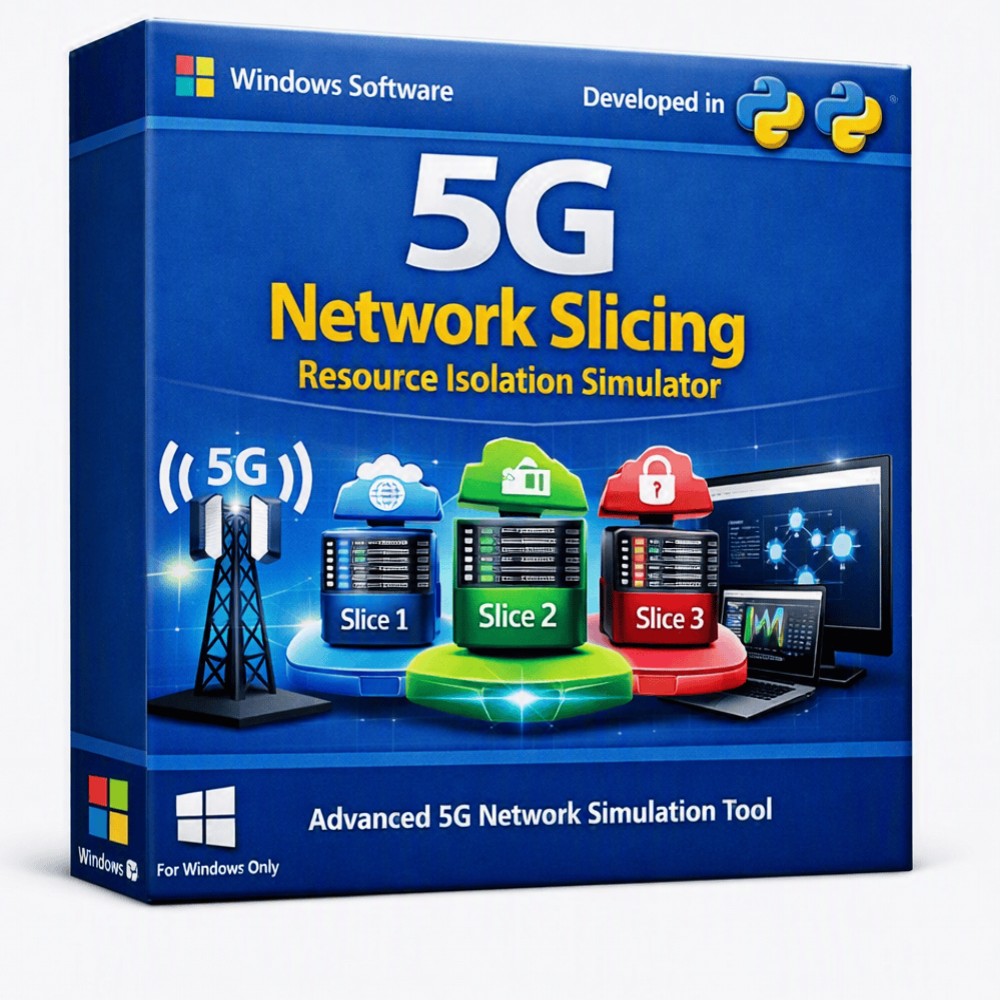
A Python-based 5G Network Slicing and Resource Isolation Simulator designed to model and analyze how multiple logical network slices can share physical 5G infrastructure while maintaining resource isolation. The simulator enables users to study CPU, memory, bandwidth, network capacity, traffic allocation, and resource management across different 5G network slices.
Ideal for 5G research, telecom engineering, academic projects, network optimization, resource allocation studies, and university laboratories.
Original price was: ₹199,999.00.₹19,999.00Current price is: ₹19,999.00. -
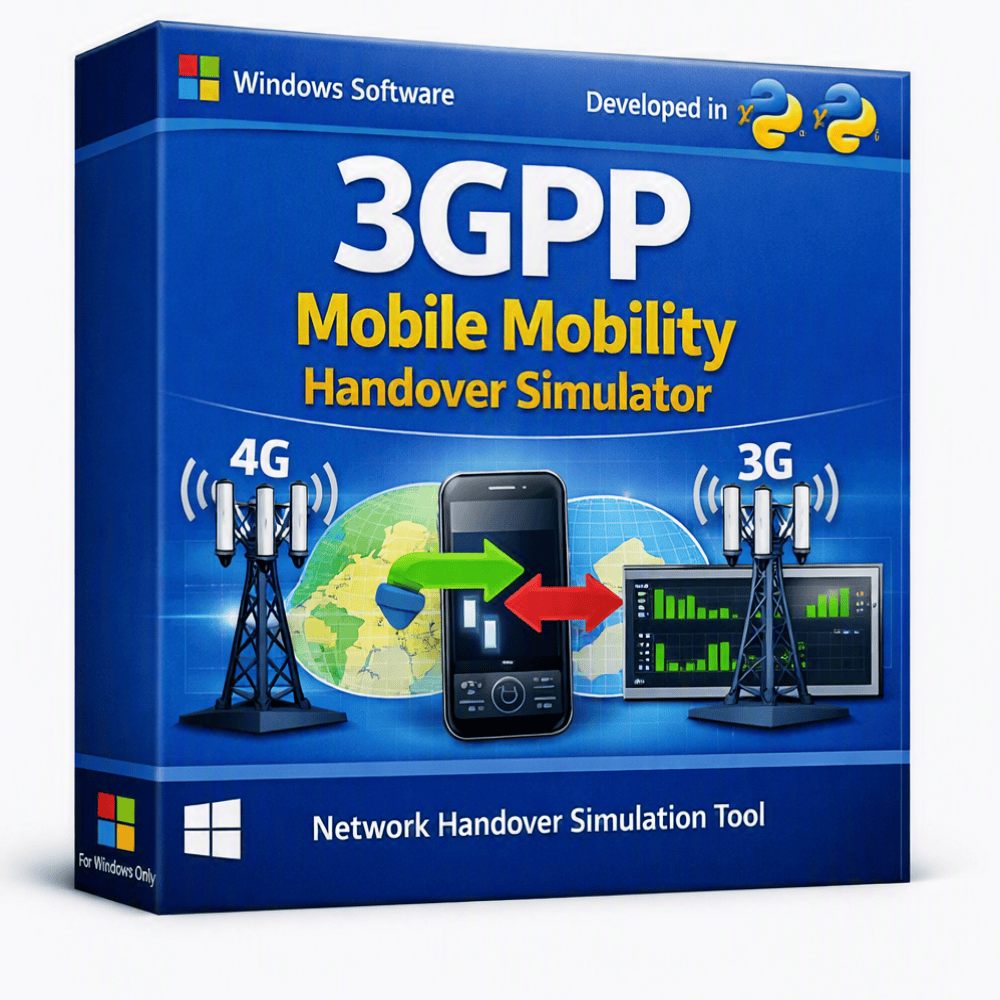
A powerful simulation tool for analyzing and validating 3GPP mobile mobility and handover procedures. The simulator enables users to model mobile network scenarios, study handover behavior, and evaluate mobility performance under different network conditions.
Key Features:
- 3GPP-compliant mobility and handover simulation
- Configurable network and mobility scenarios
- Analysis of handover performance and behavior
- Supports research, testing, and network optimization
- Useful for telecom engineers, researchers, and academic projects
Ideal for 5G/4G/3G mobility research, protocol testing, network planning, and academic simulation studies.
₹3,999.00 -
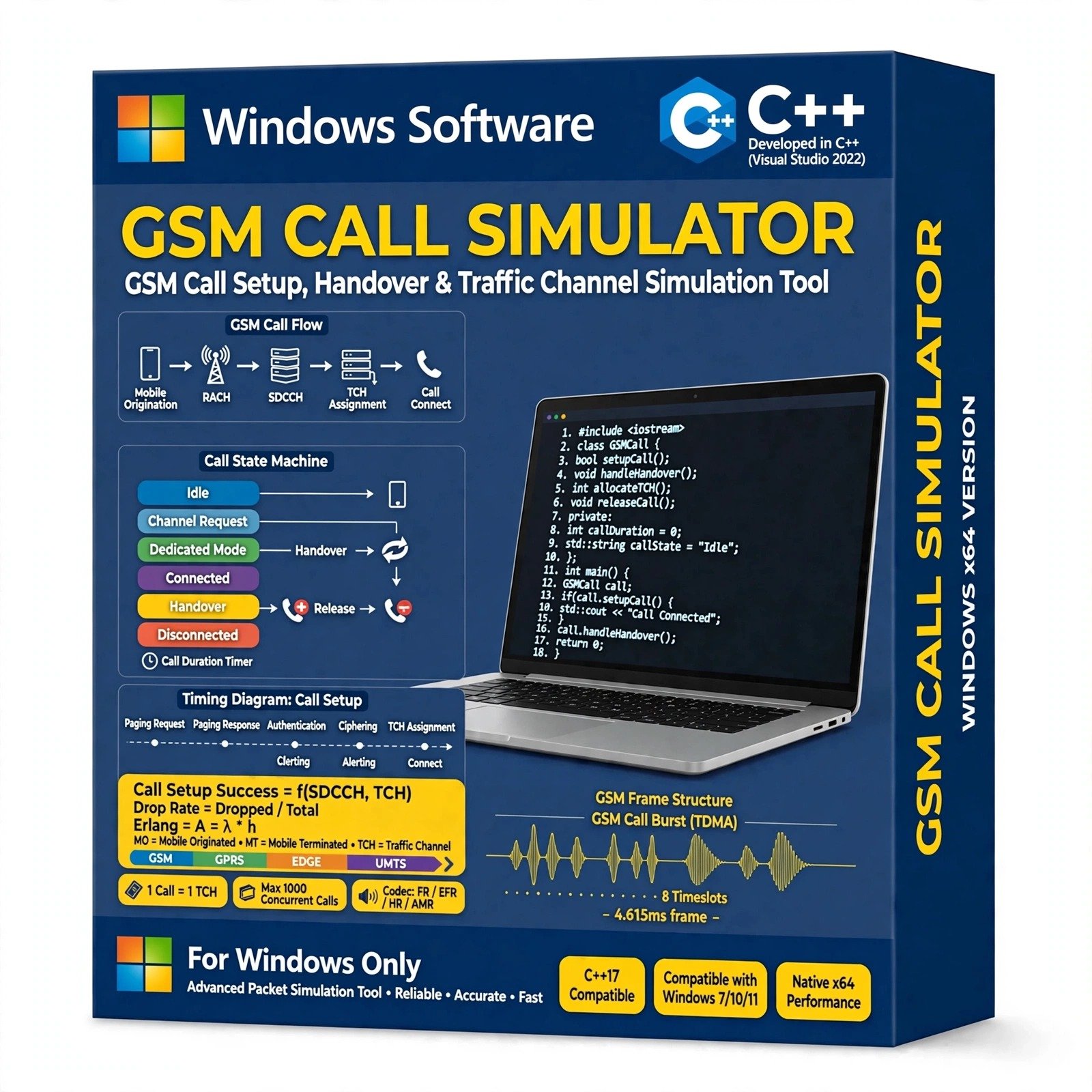
GSM Call Simulator with C++ is a telecom simulation and development solution designed for studying GSM call procedures and mobile communication concepts using C++. It is suitable for students, researchers, telecom engineers, and academic institutions working on GSM, cellular networks, call flow analysis, communication protocols, and C++-based network simulation projects.
Original price was: ₹750.00.₹80.00Current price is: ₹80.00. -
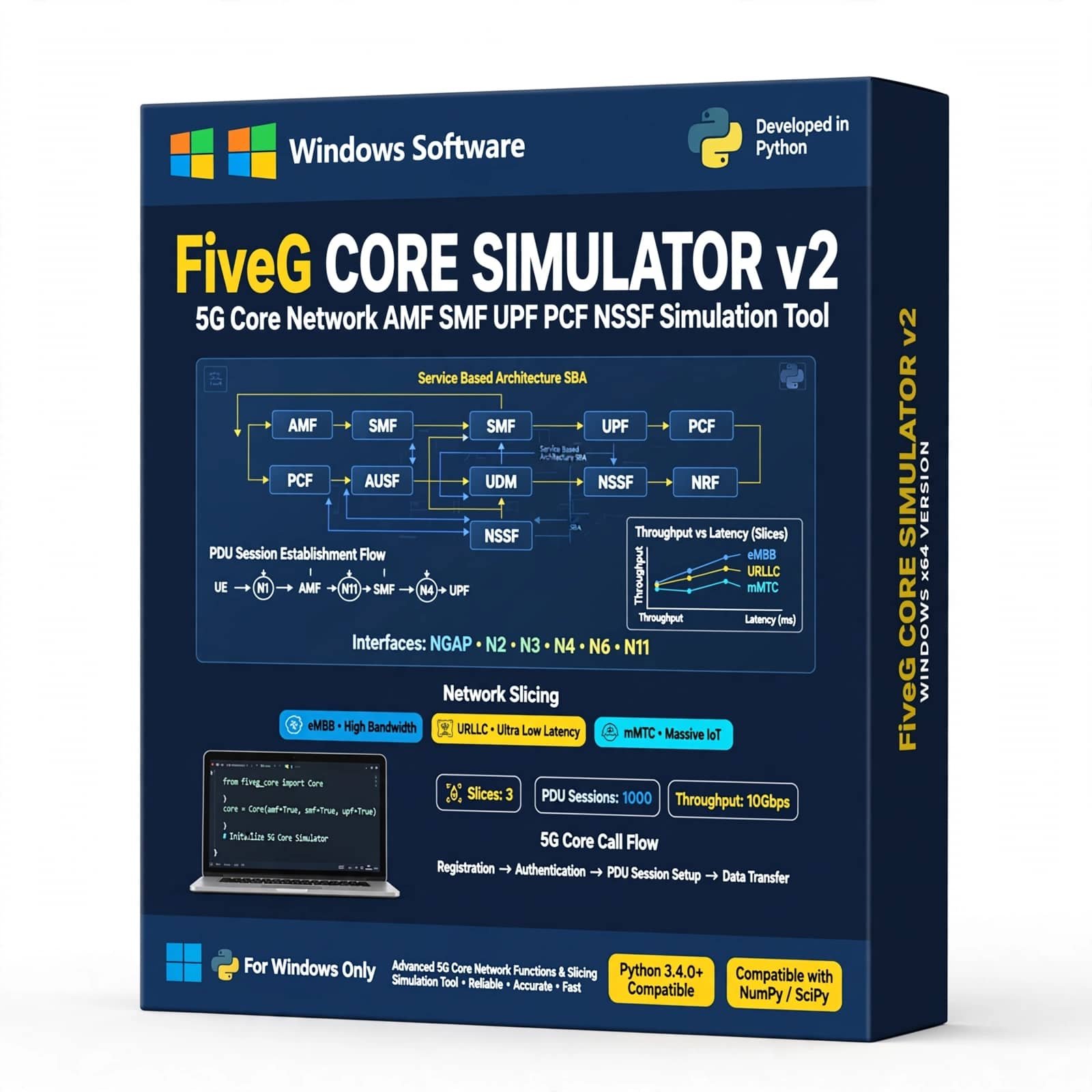
FiveG Core Simulator v2 is an educational 5G Core Network simulation tool designed to help students, educators, researchers, and telecom professionals understand 5G core architecture, network functions, signaling procedures, latency, and protocol interactions through an interactive topology and signaling animation environment.
₹19,999.00

Reviews
There are no reviews yet.