
New
87% Off
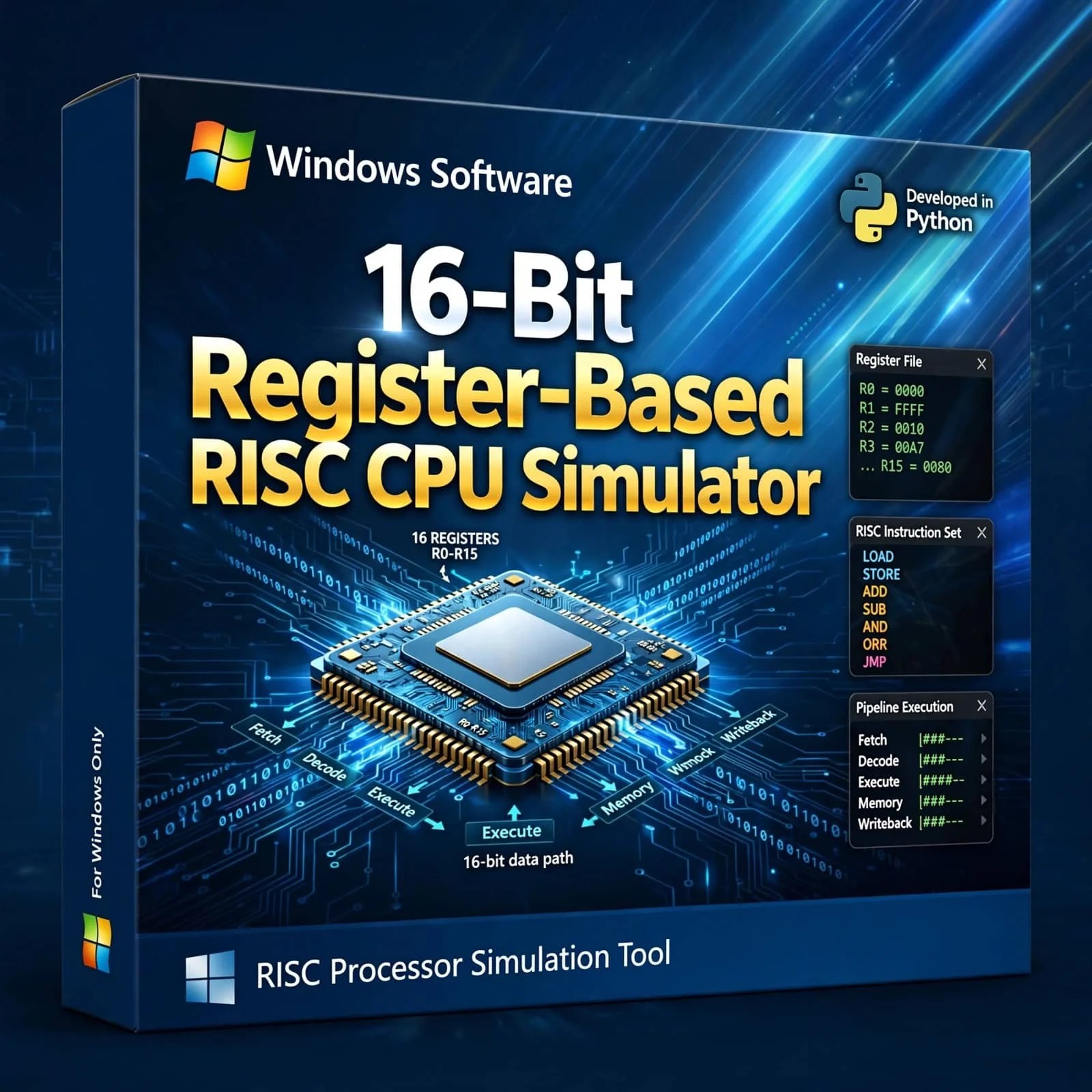
16-bit register-based RISC CPU Simulator

Original price was: ₹750.00.₹100.00Current price is: ₹100.00.
In StockThe 16-bit Register-Based RISC CPU Simulator (Python for Windows) is more than just a tool—it’s a gateway to mastering RISC architecture. Whether you’re a beginner exploring assembly language or an expert revisiting the foundations of modern CPU design, this simulator provides clarity, precision, and interactivity. Add it to your toolkit today and unlock the secrets of the processor architecture that shaped modern computing.
Description
16-bit register-based RISC CPU Simulator
The 16-bit Register-Based RISC CPU Simulator written in Python for Windows is a powerful and interactive tool designed to help learners, educators, and professionals explore the principles of Reduced Instruction Set Computing (RISC). By simulating a simplified yet realistic 16-bit CPU architecture, this product provides a hands-on environment for mastering computer architecture, assembly language programming, and processor design concepts.
Core Features
- Register-Based Architecture: Implements a clean RISC design with a fixed set of general-purpose registers, making instruction execution straightforward and efficient.
- 16-bit Instruction Set: Supports a carefully selected set of instructions for arithmetic, logic, data transfer, and control flow operations.
- Python Implementation: Written entirely in Python, ensuring cross-platform flexibility while optimized for Windows users with easy installation and execution.
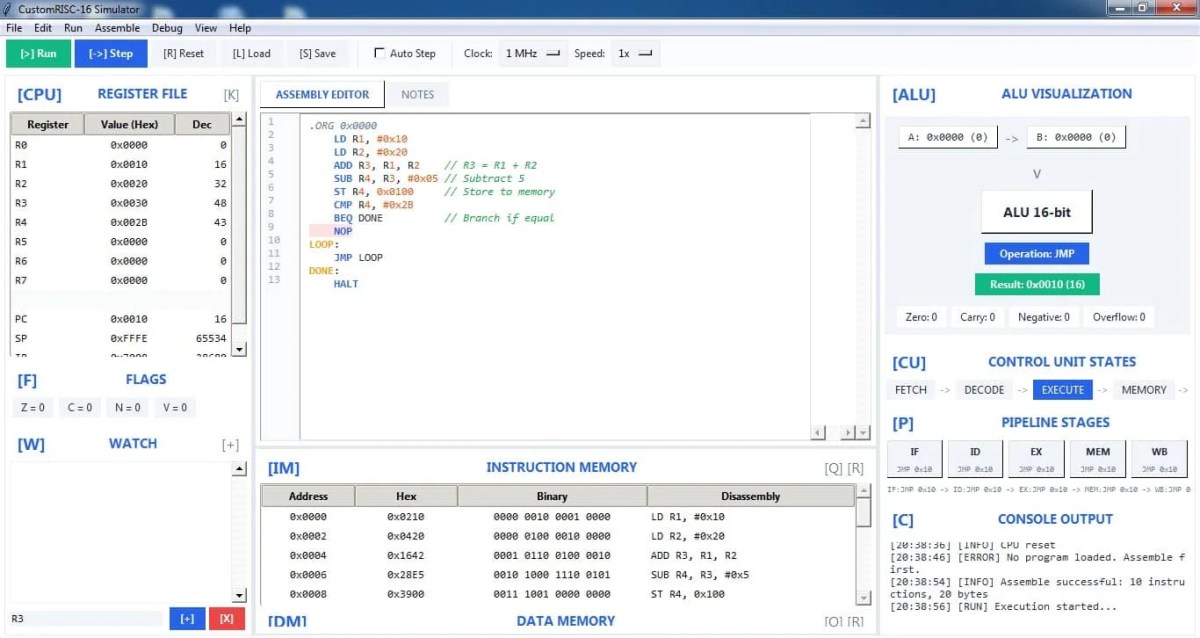
- Interactive Execution: Step through instructions one cycle at a time or run complete programs to observe CPU behavior.
- Memory & Flags Visualization: Track memory changes, register updates, and flag states in real-time.
- Educational Focus: Designed for teaching RISC principles, debugging assembly programs, and demonstrating CPU internals in classrooms or labs.
Why This Simulator Matters
The RISC architecture revolutionized computing by simplifying instruction sets, enabling faster execution and more efficient processor designs. Understanding RISC principles is essential for students of computer science, electrical engineering, and embedded systems. This simulator bridges the gap between theory and practice, allowing learners to experiment with assembly code and CPU internals without needing physical hardware.
Unlike traditional textbooks, this tool provides interactive learning. Users can load programs, step through instructions, and watch how registers and memory evolve. This active engagement ensures deeper comprehension and retention of concepts.
Benefits for Different Audiences
- Students: Gain practical experience with RISC assembly programming and CPU internals, preparing for exams and projects.
- Educators: Use the simulator as a teaching aid to demonstrate instruction cycles, addressing modes, and flag behavior.
- Developers: Debug and test assembly routines in a controlled environment without hardware dependencies.
- Researchers: Extend the simulator to model variations of RISC CPUs or integrate with other tools for experimentation.
Technical Highlights
- Implements a register-based instruction set with emphasis on simplicity and efficiency.
- Provides step-by-step execution and full program run modes.
- Modular Python codebase allows customization and integration with external projects.
- Optimized for Windows environments, ensuring smooth installation and execution.
- Lightweight design ensures compatibility with modern systems without requiring advanced hardware.
Practical Use Cases
- Classroom demonstrations of RISC instruction cycles and register-based operations.
- Self-paced learning for assembly programming and low-level debugging.
- Research projects in computer architecture and embedded systems.
- Development of teaching aids and interactive learning modules.
Windows-Specific Advantages
While the simulator is cross-platform, it is optimized for Windows users, ensuring easy installation and execution. The Python-based design integrates seamlessly with Windows environments, making it accessible for students and professionals who primarily use Windows systems. This ensures a smooth learning experience without compatibility issues.
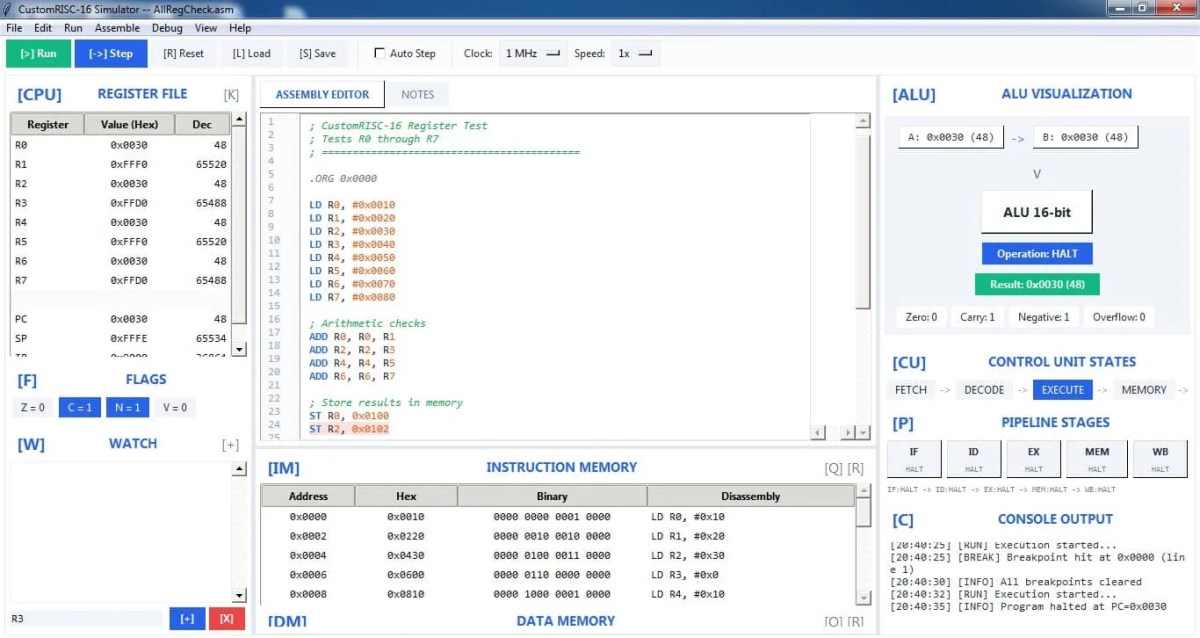
Example Walkthrough
- Input: ADD R1, R2, R3
- Cycle 1: Instruction Fetch → Program Counter updated, instruction loaded.
- Cycle 2: Decode → Registers R2 and R3 read.
- Cycle 3: Execute → ALU performs addition.
- Cycle 4: Write Back → Result stored in R1.
- Output: R1 contains the sum of R2 and R3.
This simple example demonstrates how the simulator makes abstract CPU operations tangible and easy to follow.
16-bit RISC Simulator, Register-Based CPU Emulator, Python RISC Simulator, Windows CPU Emulator, Assembly Language Learning, Computer Architecture Tool, Educational CPU Emulator, RISC Instruction Set Simulator, Debugging Assembly Programs, Microprocessor Simulator
Related products
-
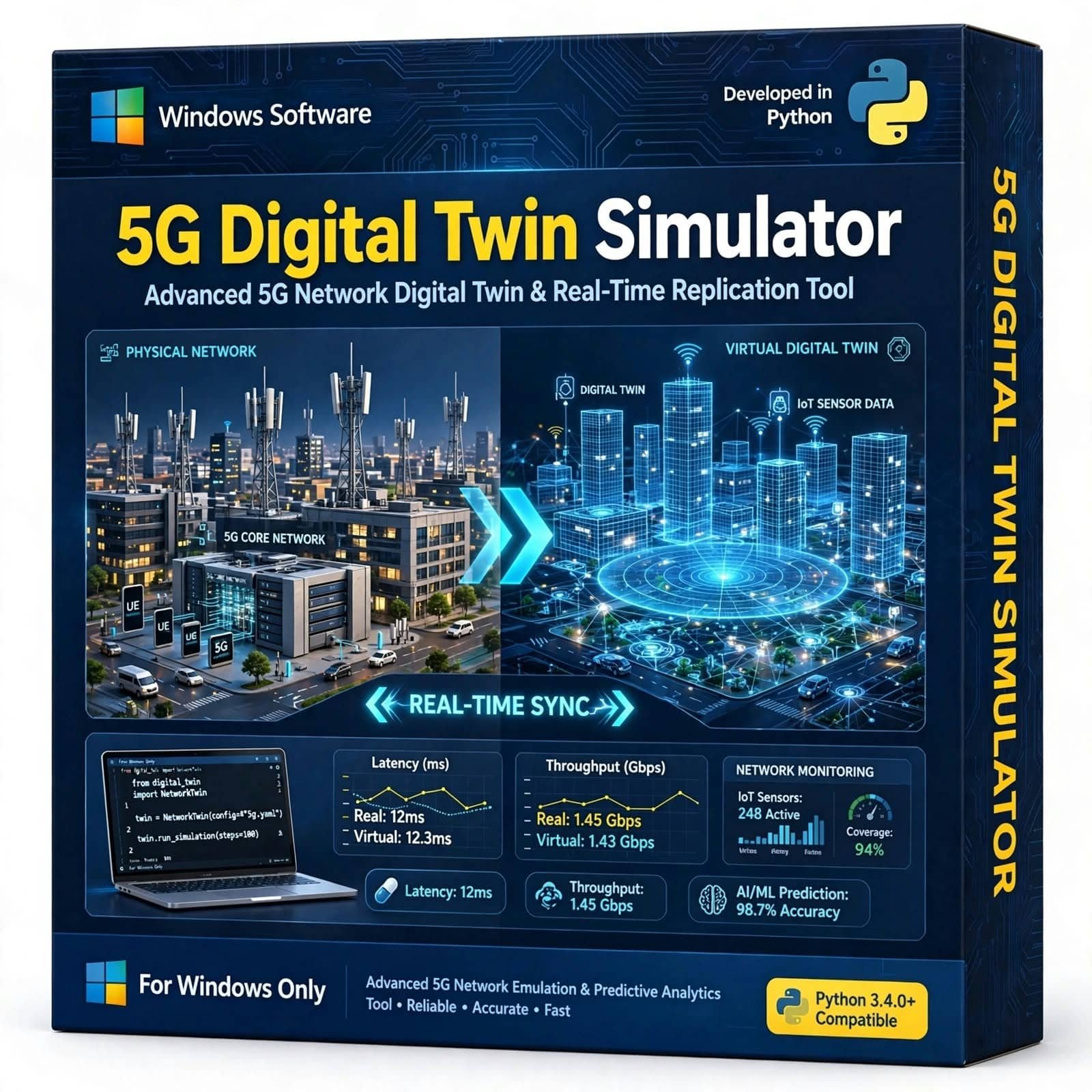
The 5G Digital Twin is a Python-based software solution designed for researchers, engineers, developers, students, and telecommunications professionals interested in modeling, simulating, and analyzing 5G communication networks and their real-world behavior in a virtual environment.
A digital twin provides a virtual representation of a physical or network system, enabling users to study system behavior, evaluate scenarios, analyze performance, and experiment with different configurations. Developed using Python, this 5G Digital Twin can support research, education, network analysis, experimentation, and proof-of-concept development.
Available for sale as a software product. Contact us for pricing, licensing, technical specifications, customization, and purchase information.
Original price was: ₹750.00.₹250.00Current price is: ₹250.00. -
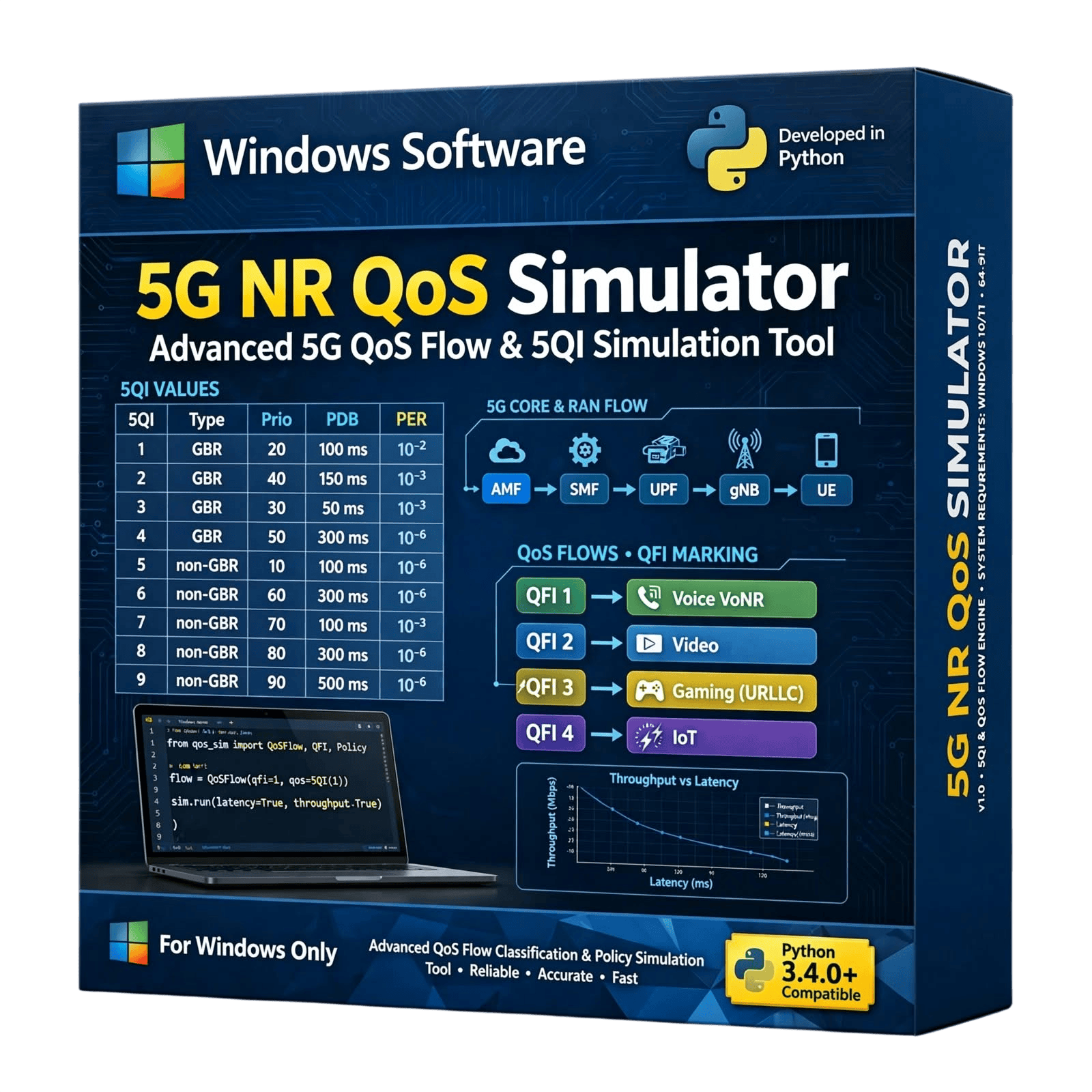
The 5G QoS Simulator is a Python-based software solution designed for researchers, engineers, students, developers, and telecommunications professionals working with 5G Quality of Service (QoS) concepts. The simulator provides a software-based environment for studying and analyzing QoS-related aspects of 5G communication networks, including service performance, traffic behavior, resource management, and network performance evaluation.
Developed using Python, the simulator is suitable for academic research, telecommunications projects, demonstrations, experimentation, algorithm development, and educational applications.
Available for sale as a software product. Contact us for pricing, licensing, features, customization, and purchase information.
Original price was: ₹750.00.₹250.00Current price is: ₹250.00. -
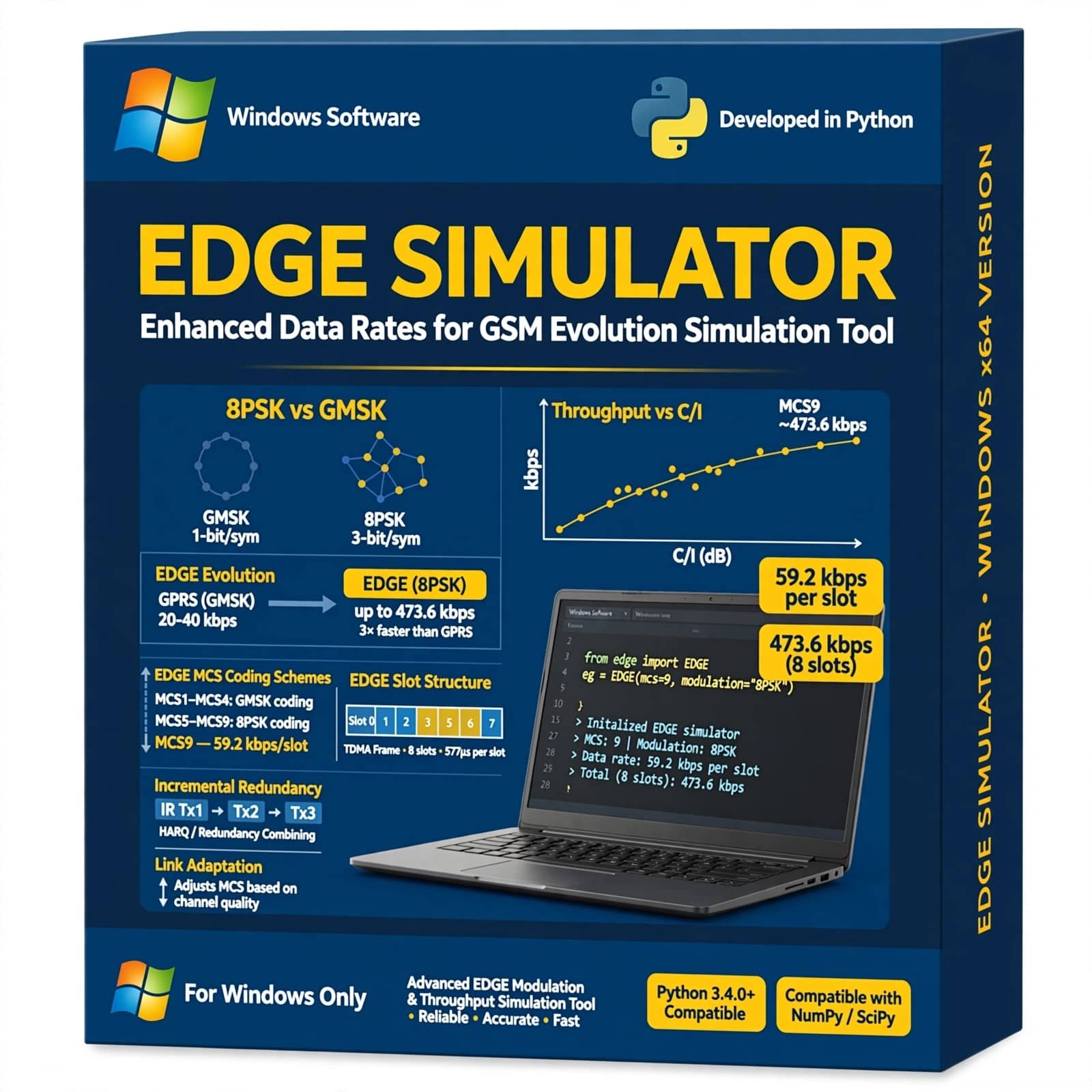
EDGE Simulator Using Python is a practical mobile communication simulation tool designed to demonstrate and analyze Enhanced Data rates for GSM Evolution (EDGE) technology. It helps students, researchers, and communication engineers study GSM/EDGE data transmission, modulation, channel conditions, bit error rate, data rates, and wireless communication performance using Python-based simulation.
Original price was: ₹750.00.₹250.00Current price is: ₹250.00. -
A Python-based 5G Core Network Simulator designed for studying, analyzing, and demonstrating 5G Core network architecture and procedures. Explore key 5G Network Functions such as AMF, SMF, UPF, AUSF, UDM, PCF, NRF, and NSSF, along with UE registration, authentication, session management, mobility, and signaling procedures.
Ideal for 5G research, telecom engineering, academic projects, university laboratories, protocol development, and network simulation. Provides a flexible software environment for experimenting with 5G Core concepts without requiring a complete commercial 5G network infrastructure.
Original price was: ₹750.00.₹250.00Current price is: ₹250.00. -
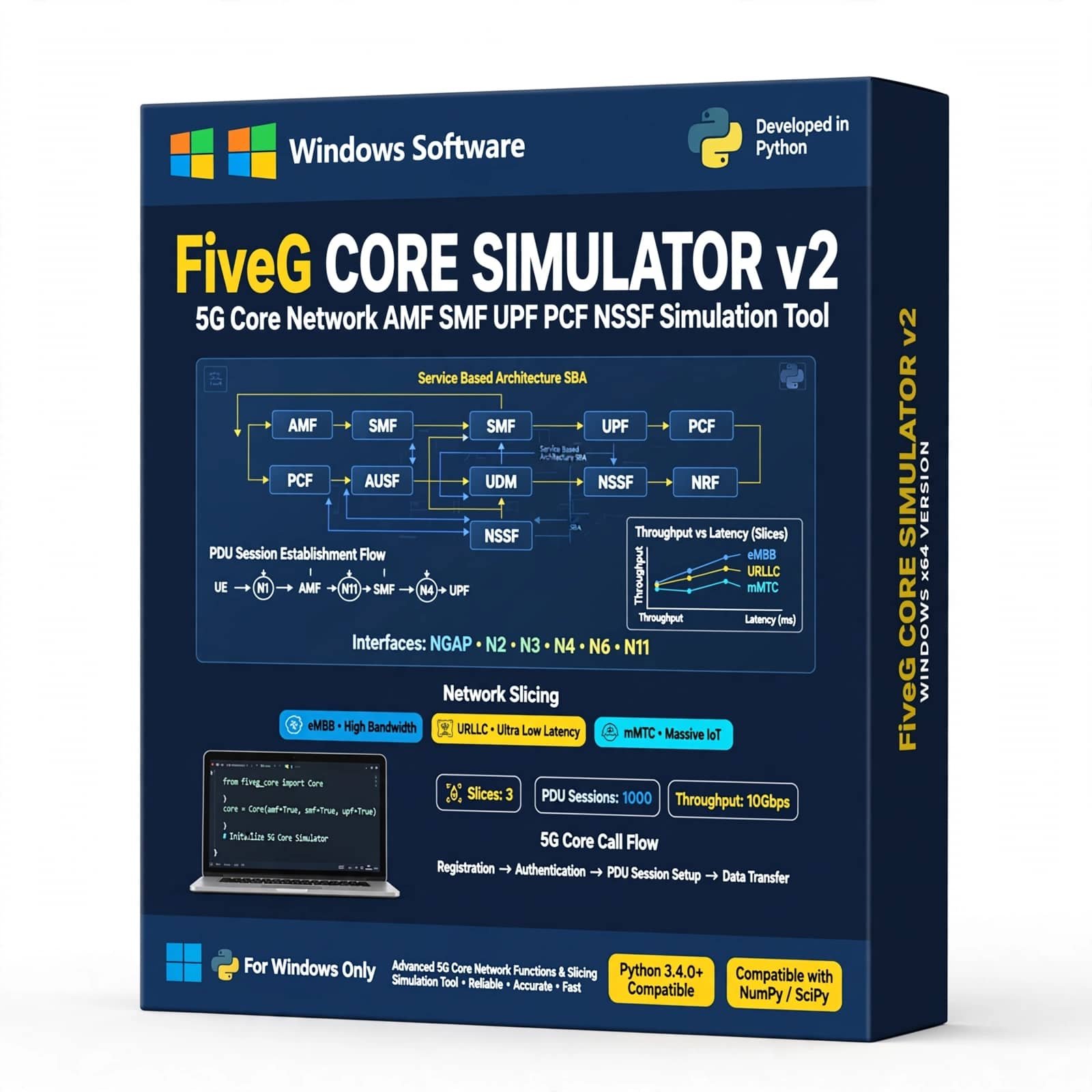
FiveG Core Simulator v2 is an educational 5G Core Network simulation tool designed to help students, educators, researchers, and telecom professionals understand 5G core architecture, network functions, signaling procedures, latency, and protocol interactions through an interactive topology and signaling animation environment.
Original price was: ₹750.00.₹250.00Current price is: ₹250.00. -
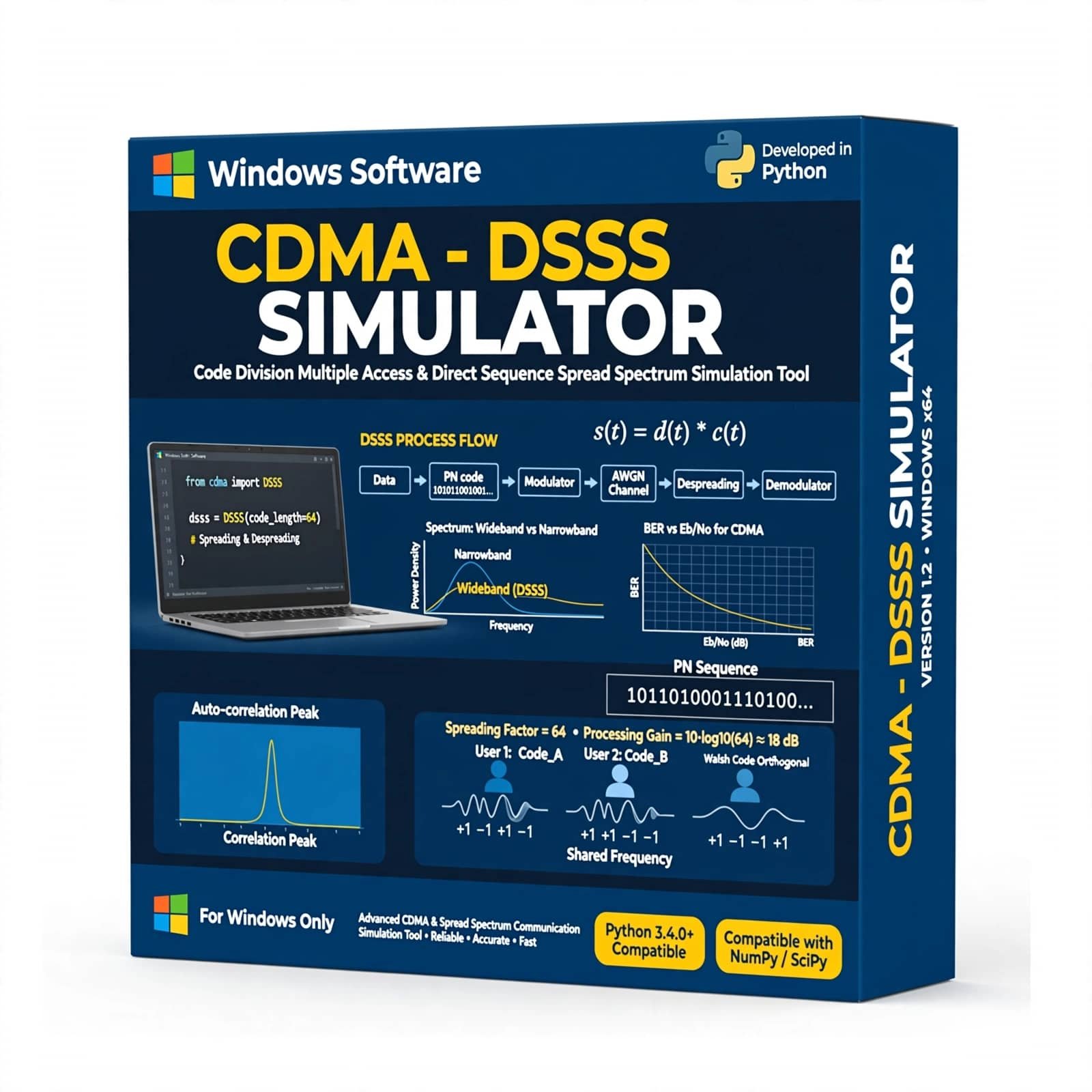
The CDMA – DSSS Simulator with Python is a software-based communication simulation tool designed to demonstrate and analyze Code Division Multiple Access (CDMA) and Direct Sequence Spread Spectrum (DSSS) techniques. Developed using Python, the simulator provides a practical environment for studying spreading codes, signal spreading and despreading, data transmission, multiple-access communication, interference, and signal recovery. It is ideal for digital communication and wireless communication laboratories, engineering education, student projects, technical training, and communication-system research.
Original price was: ₹750.00.₹250.00Current price is: ₹250.00.

Reviews
There are no reviews yet.