
New
67% Off

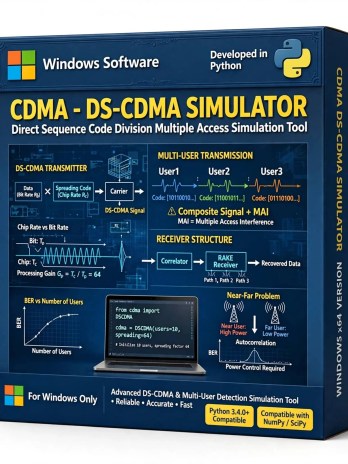
CDMA Power Control Simulator
Original price was: ₹750.00.₹250.00Current price is: ₹250.00.
In StockCDMA Power Control Simulator is an advanced communication engineering simulation tool designed to help students, researchers, and professionals understand and analyze power control techniques in Code Division Multiple Access (CDMA) wireless communication systems. It enables practical study of uplink and downlink power control, signal interference, power levels, and system performance.
Description
CDMA Power Control Simulator
The CDMA Power Control Simulator is a powerful educational and research-oriented simulation tool designed to provide a practical understanding of power control in CDMA wireless communication systems. It helps students, researchers, communication engineers, and academic institutions study how transmit power is managed in a CDMA network to improve signal quality, reduce interference, and enhance overall system performance.
In a Code Division Multiple Access (CDMA) system, multiple users can share the same frequency band at the same time by using different spreading codes. However, because users operate within the same frequency spectrum, controlling transmission power is essential to maintain reliable communication. The CDMA Power Control Simulator provides a convenient environment for studying these concepts without requiring a physical wireless communication network.
Understand CDMA Power Control
Power control is one of the most important techniques used in CDMA communication systems. If a mobile user transmits with excessive power, it can create unwanted interference for other users. On the other hand, insufficient transmit power can result in poor signal reception and unreliable communication. The CDMA power control simulation helps users understand this relationship and observe how appropriate power levels can improve network performance.
The simulator can be used to demonstrate fundamental concepts such as transmit power control, received signal strength, interference management, signal-to-interference ratio (SIR), and power adjustment. By changing relevant parameters and observing the resulting system behavior, users can gain a clearer understanding of how power control algorithms operate in practical wireless networks.
Key Learning and Simulation Features
The CDMA Power Control Simulator can be used as a practical platform for exploring various aspects of wireless communication and power management. Depending on the configured simulation model, users can study:
- CDMA wireless communication principles
- Uplink and downlink power control
- Transmitter and receiver power levels
- Signal-to-interference ratio (SIR)
- Co-channel interference
- Near-far problem in CDMA systems
- Power adjustment mechanisms
- User-to-user interference
- System capacity and performance
- Effects of changing transmission parameters
- Power control algorithms and their behavior
The simulator provides an interactive approach to learning, making complex wireless communication concepts easier to visualize and analyze.
Application in Education and Research
The CDMA Power Control Simulator is particularly useful for engineering colleges, universities, communication laboratories, research institutions, and organizations involved in wireless communication training. It can support practical sessions and laboratory experiments related to CDMA technology, digital communication, mobile communication, wireless networks, and communication system simulation.
Students can use the simulator to complement theoretical lessons with practical experimentation. Instead of relying only on mathematical equations and textbook diagrams, learners can modify simulation parameters and evaluate how different power levels influence communication performance.

For researchers and postgraduate students, the simulator can also serve as a useful platform for investigating power control strategies and evaluating the effects of interference and changing network conditions.
Explore the Near-Far Problem
One of the important concepts associated with CDMA power control is the near-far problem. A nearby transmitter may be received at a much higher power level than a distant transmitter using the same frequency band. Without effective power control, the stronger signal can interfere with weaker signals and negatively affect communication quality.
The CDMA Power Control Simulator helps users explore this important phenomenon and understand why dynamic power management is necessary in CDMA-based communication systems. This makes it a valuable tool for demonstrating real-world wireless communication challenges in an academic laboratory environment.
Benefits of CDMA Power Control Simulation
Using a simulation-based approach offers several advantages. Users can perform experiments repeatedly, change system parameters, compare different operating conditions, and observe results without the cost and complexity of deploying a physical CDMA network.
The simulator can help users:
- Develop a practical understanding of CDMA power control.
- Analyze the relationship between transmit power and interference.
- Study SIR and signal quality.
- Understand the near-far effect.
- Experiment with different power control conditions.
- Support communication engineering laboratory experiments.
- Improve understanding of wireless network performance.
- Conduct demonstrations for classroom and technical training.
- Support academic projects and communication-system research.
Ideal for Communication Engineering Labs
The CDMA Power Control Simulator is an excellent addition to a wireless communication laboratory or digital communication laboratory. It can be used for demonstrations, student experiments, project work, technical presentations, and research activities.
By combining theoretical concepts with simulation-based experimentation, the tool provides an effective way to study how power control contributes to efficient and reliable CDMA communication.
Whether you are teaching CDMA technology, studying mobile communication, conducting a wireless communication laboratory experiment, or researching power control algorithms, the CDMA Power Control Simulator provides a practical environment for analyzing the key principles behind power management in CDMA networks.
Conclusion
The CDMA Power Control Simulator provides a practical and engaging way to understand one of the fundamental challenges in CDMA wireless communication: maintaining suitable transmission power while controlling interference. Its simulation-based approach makes it useful for students, educators, researchers, and communication professionals who want to explore CDMA power control, SIR, interference management, near-far effects, and wireless network performance.
It is a valuable solution for institutions looking to enhance their communication engineering laboratories with practical CDMA simulation and wireless communication experiments.
Related products
-
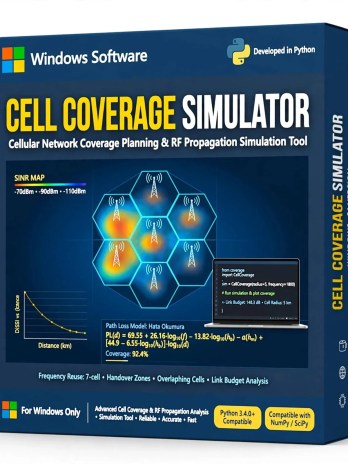
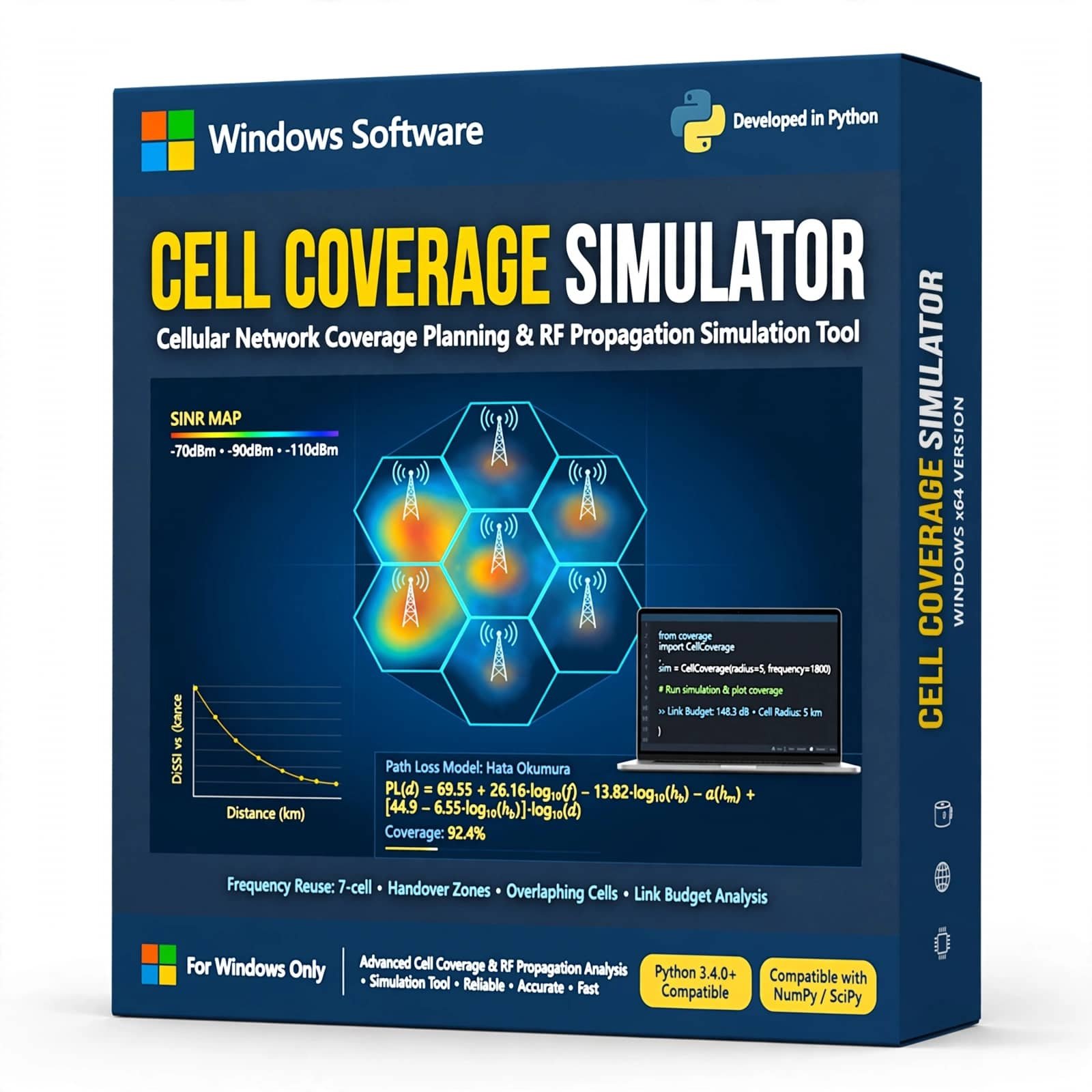
Cell Coverage Simulator is a wireless communication simulation tool designed to model and analyze cellular network coverage using Python. It helps students, researchers, and telecom professionals visualize cell coverage, signal propagation, coverage areas, and network planning concepts through practical simulation and analysis.
Original price was: ₹750.00.₹250.00Current price is: ₹250.00. -
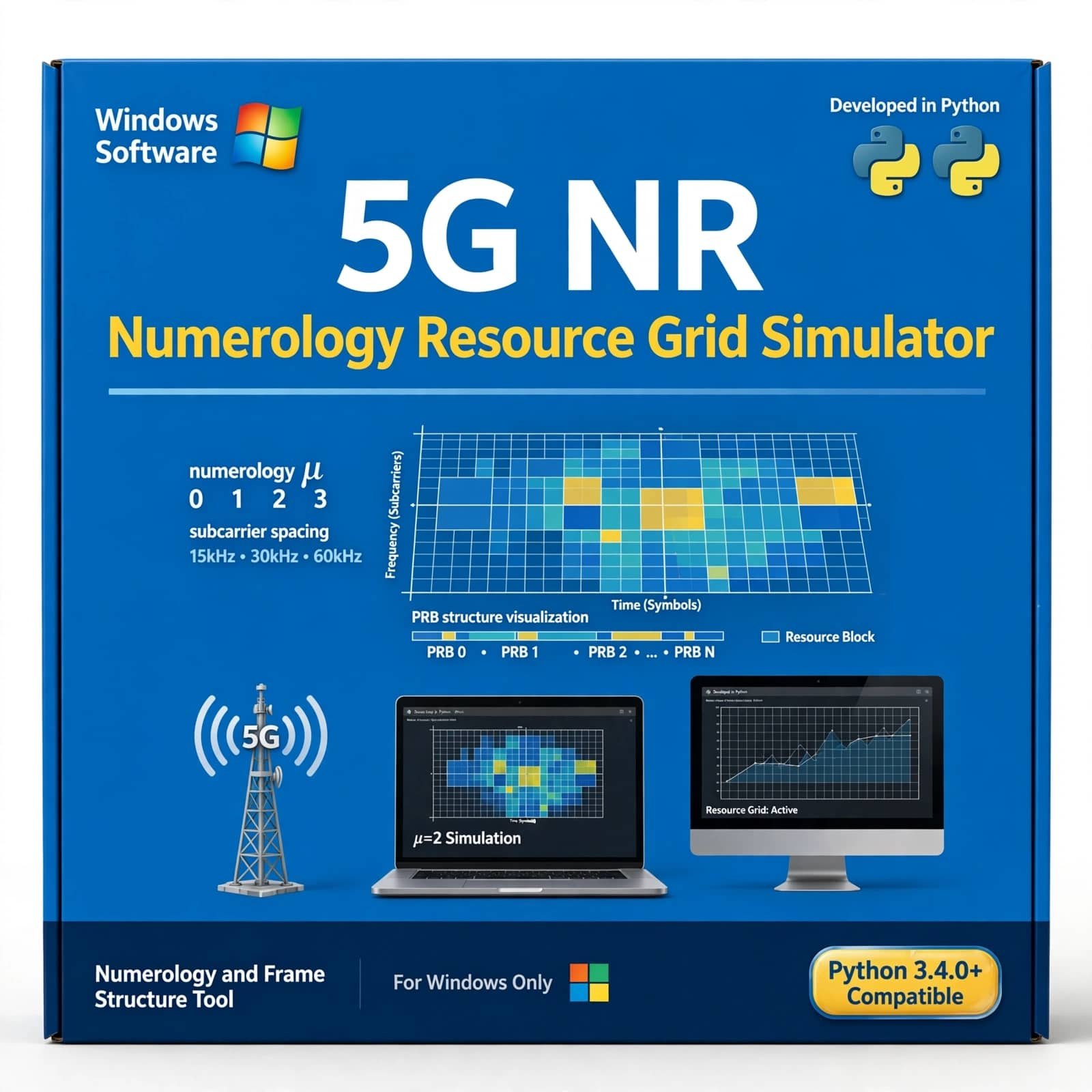
5G NR Numerology Resource Grid Simulator is an advanced simulation solution for modeling and analyzing 5G New Radio numerology and time-frequency resource grid structures. It enables users to study subcarrier spacing, OFDM symbols, slot structure, cyclic prefix, Physical Resource Blocks (PRBs), Resource Elements (REs), bandwidth configurations, and resource mapping. The simulator is ideal for 5G NR physical-layer research, numerology analysis, resource allocation studies, academic projects, waveform development, and 5G/6G wireless communication research.
Original price was: ₹750.00.₹250.00Current price is: ₹250.00. -
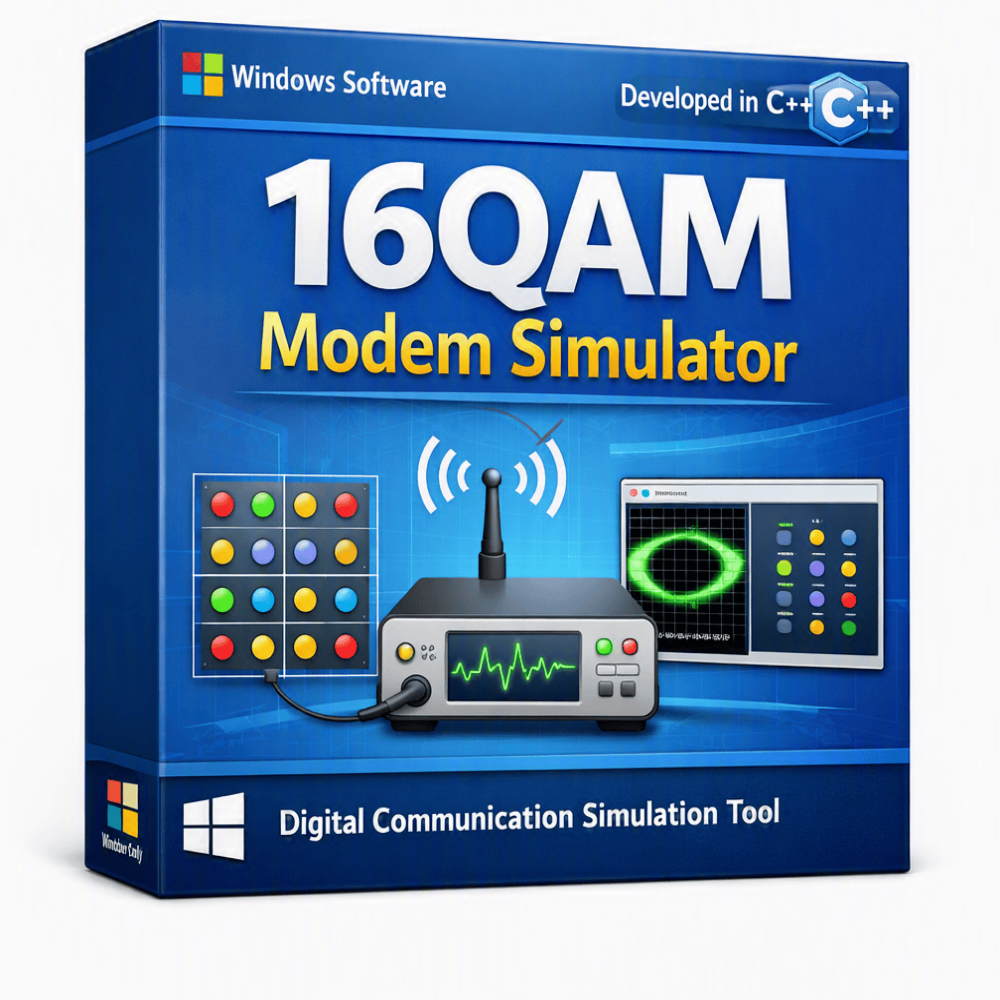
The 16QAM Modem Simulator is a C++-based software application designed to simulate and analyze a 16-QAM digital communication system. It demonstrates the complete modulation and demodulation process, including symbol mapping, signal generation, transmission, and data recovery. The simulator helps users understand key concepts of digital communication and evaluate system performance under different channel conditions.
Original price was: ₹750.00.₹250.00Current price is: ₹250.00. -
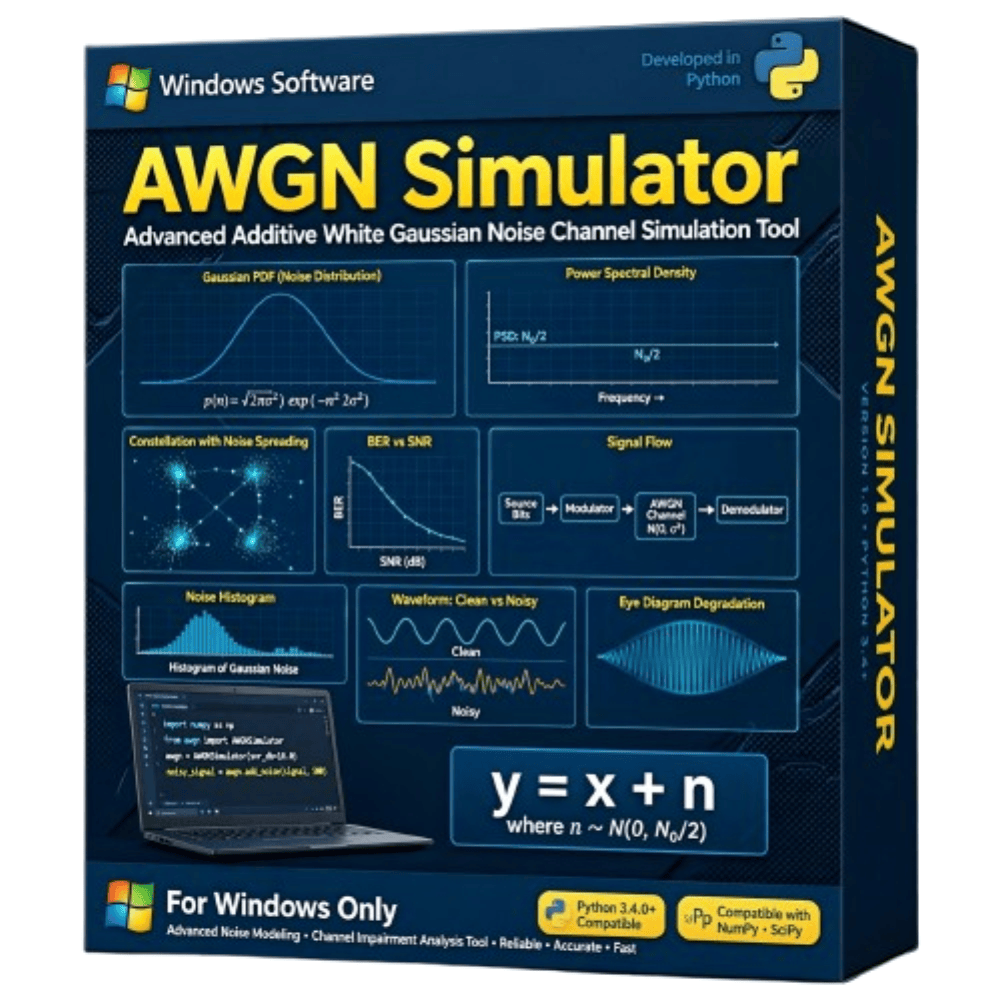
An AWGN Simulator i.e. Additive White Gaussian Noise Simulator developed using Python is a software-based tool designed to demonstrate and analyze the effect of Gaussian noise on digital communication signals. The simulator generates a clean input signal, adds controlled amounts of AWGN, and displays both the original and noisy signals for comparison. Users can vary parameters such as noise power, signal-to-noise ratio (SNR), and signal characteristics to observe how communication quality changes under different noise conditions. Python libraries such as NumPy, SciPy, and Matplotlib can be used for signal generation, noise modeling, numerical processing, and graphical visualization but this is purely from tkinter only. The simulator is useful for understanding fundamental concepts of wireless and digital communication systems.
Original price was: ₹750.00.₹250.00Current price is: ₹250.00. -
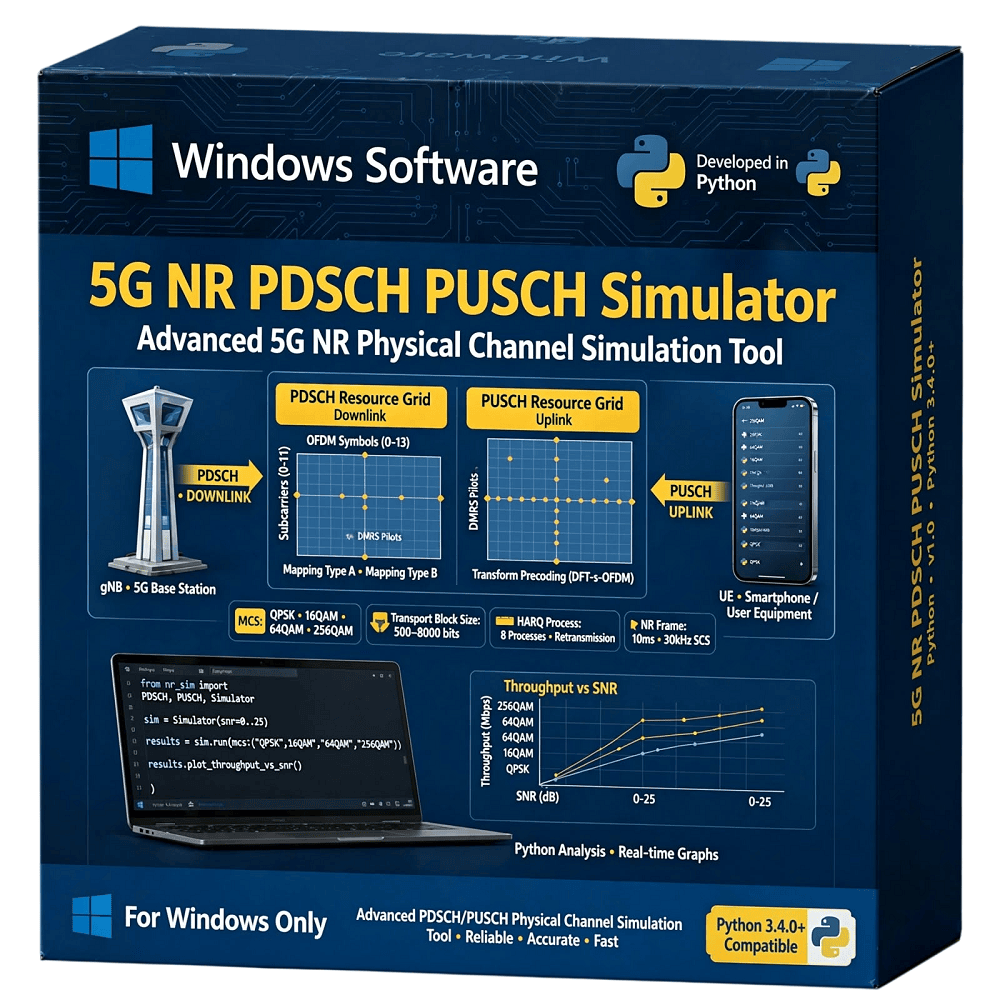
The 5G NR PDSCH PUSCH Simulator is a Python-based simulation software solution designed for researchers, engineers, students, and telecommunications professionals working with 5G New Radio (NR) physical-layer technologies. The simulator provides a practical environment for studying and experimenting with PDSCH (Physical Downlink Shared Channel) and PUSCH (Physical Uplink Shared Channel) transmission concepts.
Developed using Python, the simulator is suitable for academic research, algorithm development, demonstrations, testing, and educational applications related to 5G NR communication systems.
Available for sale as a software product. Contact us for product details, licensing, and purchase information.
Original price was: ₹750.00.₹250.00Current price is: ₹250.00. -
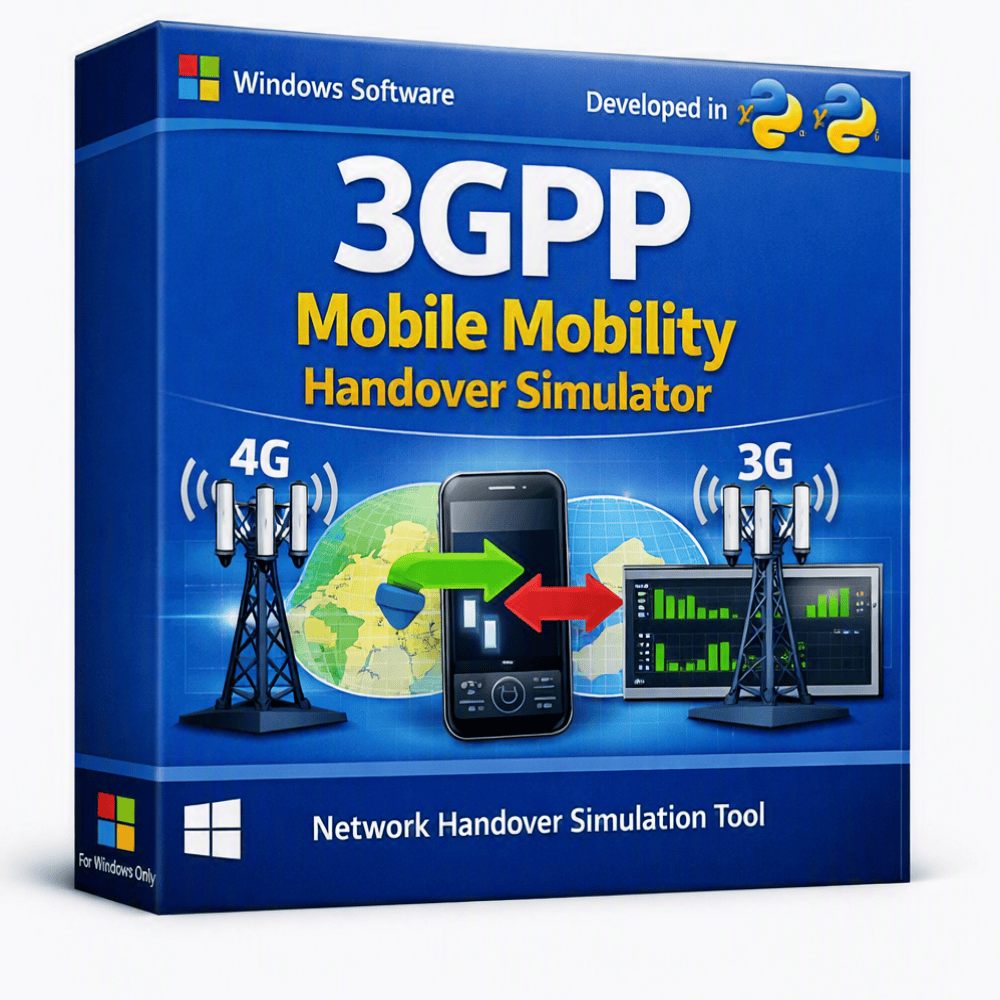
A powerful simulation tool for analyzing and validating 3GPP mobile mobility and handover procedures. The simulator enables users to model mobile network scenarios, study handover behavior, and evaluate mobility performance under different network conditions.
Key Features:
- 3GPP-compliant mobility and handover simulation
- Configurable network and mobility scenarios
- Analysis of handover performance and behavior
- Supports research, testing, and network optimization
- Useful for telecom engineers, researchers, and academic projects
Ideal for 5G/4G/3G mobility research, protocol testing, network planning, and academic simulation studies.
Original price was: ₹750.00.₹250.00Current price is: ₹250.00.

Reviews
There are no reviews yet.